
A single burst pipe averages about $500 for the plumbing fix, but the total incident cost often lands between $1,500 and $20,000+ once extraction, drying, structural repair, and mold are in play. If water is still spreading, the pipe itself is no longer the main problem, the clock is.
That's the part most homeowners miss when they search burst pipe repair cost. They're usually trying to price a plumber, but the full bill is shaped by how far the water traveled, how fast it was stopped, and what had to be opened up to dry out the structure.
What a Burst Pipe Costs Beyond the Plumber
A homeowner gets the bad news the same way every time, a wet floor, a stain spreading across drywall, or a utility room that suddenly sounds like running water behind the wall. In that moment, the question feels simple. You want to know what a plumber will charge to stop the leak.
Start there and you miss the full cost. The plumbing repair alone often sits near $500 as a baseline, with common pricing clustering between $400 and $2,000 depending on access, pipe type, and whether the break is hidden behind finished surfaces or under a slab, according to Angi's burst pipe repair cost guide. The plumber's invoice only covers the cut, the fix, and the reset. It does not cover the soaked drywall, the flooring that swelled, or the crew that has to dry the structure before mold takes hold.
That gap is why a burst pipe quote can look harmless while the incident cost climbs fast. The repair is one line item. Extraction, drying, demolition, material replacement, and repainting are the rest of the bill. A pipe that leaks behind a wall for a short period may stay near the low end of the range, but once water reaches insulation, baseboards, or cabinets, the job stops being a simple plumbing call and turns into a water-loss project.
Practical rule: if you are opening walls, drying framing, or replacing flooring, you are not pricing plumbing anymore. You are pricing water damage.
A common Phoenix-area scenario makes the split obvious. A pinhole leak in a copper line behind a laundry wall can look minor at first, then turn ugly if nobody spots it for hours. The plumber may still charge a modest repair, but hidden moisture can force extraction, structural drying, drywall replacement, and repainting, which is why the total climbs far past the plumbing call.
That same split between the obvious bill and the one that matters shows up in other home systems too. The pattern is familiar if you have ever compared a basic service fix with the larger expense created by waste or inefficiency, much like the ways AC increases utility costs article separates the headline number from the less visible cost.
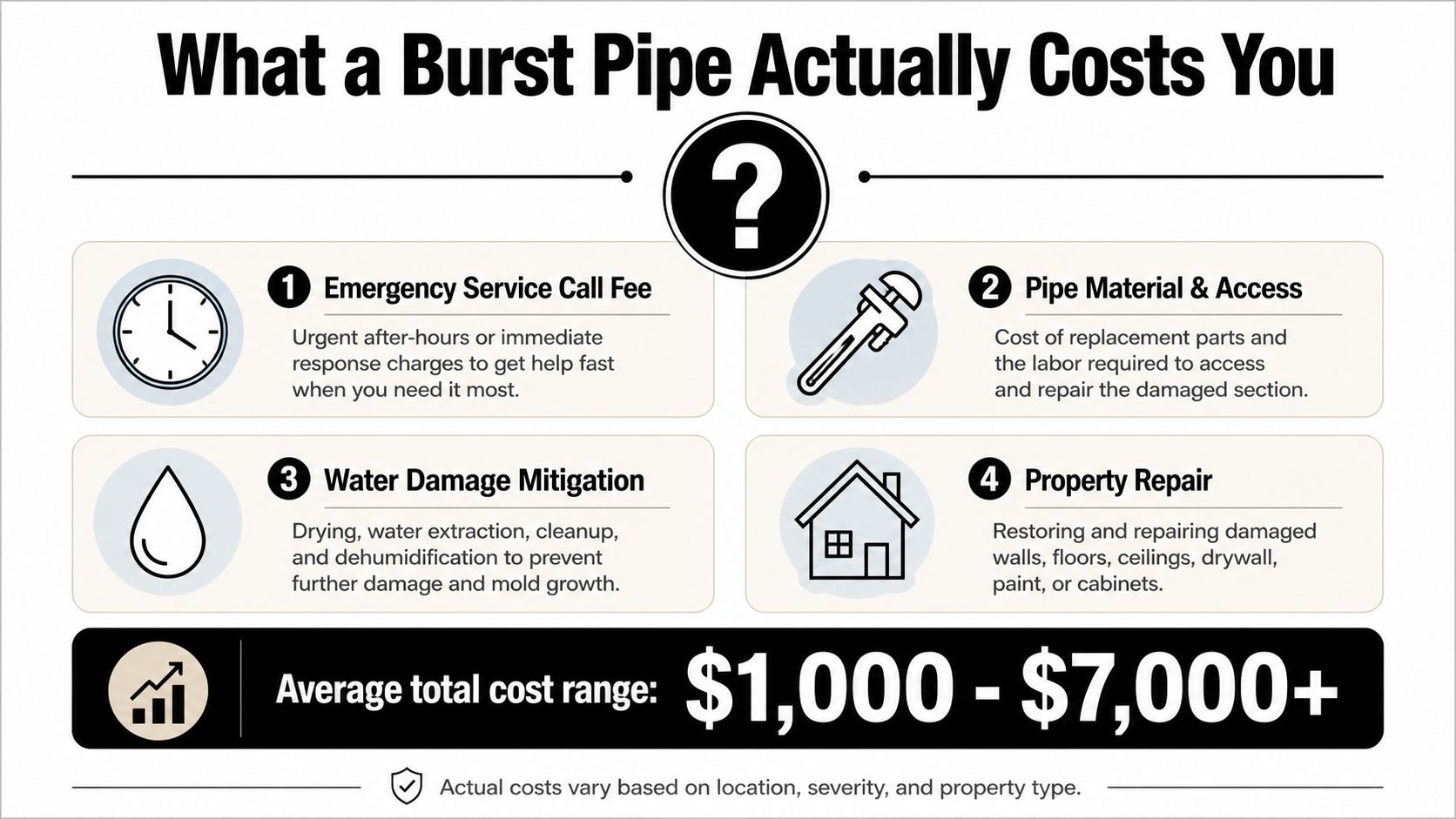
If you want the number in plain terms, read the whole incident, not just the plumbing ticket. The pipe is the trigger, but the bill comes from labor, access, and the square footage that got wet. For a wider breakdown of water-loss expenses, the water damage repair cost guide is the right companion reading.
The Five Cost Drivers That Change the Final Bill
The final bill follows five drivers, and they stack fast. If you understand them, you can usually predict whether you're facing a routine repair or a full-blown restoration job before the first contractor arrives.
Pipe Material and Accessibility
The material matters, but access matters more. A visible, exposed line is quicker to cut out and replace than a section buried behind tile, inside a vanity wall, or below a slab. That's why a simple repair can stay near the lower end of the typical range while hidden work pushes the job upward.
Copper, PEX, and older galvanized pipe all change the labor pattern. A plumber works differently on each one, and every extra minute spent reaching the failure point shows up in the bill. If the pipe is easy to touch, the repair is usually easier to control.
Water Volume and Time of Discovery
A small burst discovered right away is a plumbing problem. A pipe that runs for hours turns into a drying project, then a demolition project. Time is the multiplier that homeowners underestimate most.
Once water spreads into insulation, underlayment, or wall cavities, drying equipment has to work longer and the repair scope expands. That's where the bill shifts from a few hundred dollars to something much heavier.
Location Under Slab, In Wall, or Above Ceiling
Where the break sits changes everything. In-wall and slab failures are the expensive ones because they force access work before the actual repair can even start. Cutting drywall or opening a floor adds labor, noise, debris, and restoration time.
Hidden pipes don't just cost more to fix, they cost more to reach. That's the part people pay for twice, once in labor, then again in rebuild.
After-Hours Response
Emergency response is not a rounding error. Palm Bld's burst pipe pricing guide notes that after-hours service can add $100 to $250 or more on top of the base rate, while accessible repairs may run $200 to $700 and in-wall, slab, or underground repairs can rise to $1,200 to $3,500 or more. That spread reflects a simple reality, a midnight call with active water loss costs more than a daytime appointment with a dry room.
Secondary Damage
This is the line item that turns heads. Once extraction, structural drying, drywall, flooring, insulation, cabinet work, and mold come into the picture, the job is no longer a plumber's ticket. Independent restoration cost guides put emergency extraction and drying at $1,000 to $4,000, structural repairs at $1,500 to $20,000+, and mold remediation at $500 to $6,000, with severe cases going above $15,000 and sometimes $50,000+ when multiple floors or large assemblies are affected.
For a homeowner, that means the final cost is not driven by the pipe itself. It's driven by how much of the house got wet and how quickly someone stopped it.
Realistic Price Ranges by Scenario
A single average hides too much. Scenario-based pricing is more useful because it matches how burst pipes happen in homes, by location, by delay, and by how much damage the water caused before anyone got there.
| Scenario | Typical Range | Main Cost Drivers |
|---|---|---|
| Accessible pinhole in a basement utility room | Lower end of the common plumbing range, often near the baseline repair cost | Easy access, small section replacement, limited cleanup |
| Leak inside a wall behind tile | Mid-range to higher-range repair | Wall opening, tile removal, harder access, drying behind the surface |
| Slab leak requiring penetration | Higher-range repair and possible restoration costs | Slab access, labor intensity, detection, structural disruption |
| Multi-room flood that runs overnight | Can move into severe restoration territory | Extraction, drying, demolition, rebuild, mold risk, contents loss |
A basement utility room leak is the least punishing version because the plumber can usually get to the failure point quickly. The bill still depends on pipe type and labor, but the structure itself usually stays out of the fight.
A wall leak behind tile is a different animal. Tile removal, drywall access, and drying hidden cavities all add labor before the pipe is even fixed. That's why the repair can feel wildly more expensive than the physical pipe segment suggests.
Slab leaks are where homeowners get blindsided. The pipe may be small, but the access work is not. Once the slab has to be opened or bypassed, the repair starts competing with restoration work for the biggest expense.
A multi-room flood that ran overnight is the worst-case pattern because it combines plumbing, extraction, drying, demolition, and rebuild. That's the situation where the total incident cost can move from a plumbing quote into the severe-loss range described earlier.
For a more detailed comparison of damage scope and pricing, the water damage repair cost guide is worth reading before you accept the first number you hear. If you only remember one thing from this table, remember this, the scenario sets the price more than the pipe does.
DIY Repairs Versus Calling a Professional
DIY only makes sense when the pipe is exposed, the leak is small, and the repair stays outside finished spaces. If you are looking at a visible supply line, a basic shutoff valve, or a short section you can reach cleanly, a homeowner can sometimes stop the problem without turning it into a larger restoration bill.
A small fitting and careful work can beat a service call. The second the line disappears into a wall, ceiling, or slab, the risk changes fast. One bad connection can send water into the same rooms you were trying to protect, and that is how a plumbing job becomes a drying job.
If you cannot see both sides of the repair, do not gamble with it.
A professional visit costs more upfront, and a plain plumbing repair is usually nowhere near the price of a real water-loss event. The difference is access and control. A failed DIY patch can end up costing far more than the service call if it soaks drywall, flooring, or cabinets, because then you are paying for plumbing, extraction, drying, and probably some demolition.
Use the job size as your filter. If water is still moving, or the pipe sits behind finished surfaces, call someone who does this every day. If you want a smart pre-call reference, the plumbing inspection checklist helps you identify what can be inspected safely before you start guessing.
How Insurance Typically Handles Burst Pipes
Insurance is where a lot of homeowners get confused, because the policy often treats the pipe and the damage around the pipe differently. In plain English, the dwelling portion of a standard homeowner's policy may address the structure affected by a sudden burst, while personal-property coverage may apply to soaked belongings, subject to the deductible and the policy's limits.
The key phrase is sudden and accidental. That's the trigger many claims rely on. A pipe that bursts unexpectedly is usually a very different insurance conversation from a slow leak that was ignored for months.
What Usually Helps a Claim Move Smoothly
Start with photos and video. Capture the pipe, the standing water, the wet walls, and the damaged contents before too much cleanup happens. Then keep receipts, contractor notes, and any moisture readings if a mitigation company takes them.
What Commonly Creates Problems
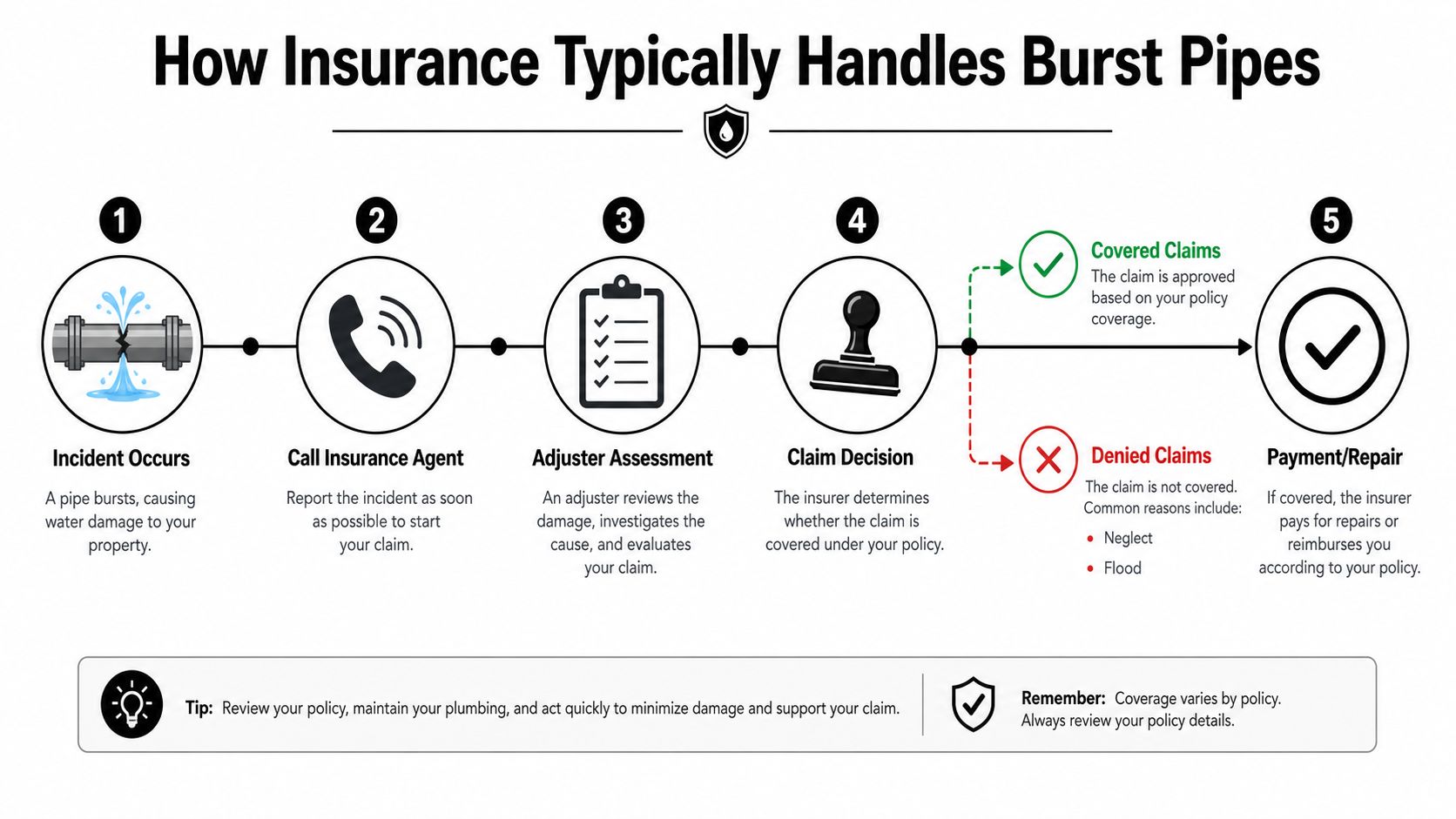
Gradual leaks and maintenance issues are the usual trouble spots. Frozen pipes in an unheated home can also become a coverage dispute depending on the policy language and the circumstances. Flooding from outside the home is a separate issue, and it's often not treated the same way as a burst supply line inside the structure.
Don't assume the insurer will sort out the documentation for you. The cleaner your records, the easier the claim file is to read.
A good starting point for policy language and claim basics is whether homeowners insurance covers busted pipes. The process itself usually follows a simple path, incident, call, assessment, decision, then payment or repair, as shown in the infographic below.
The hard truth is that insurance can help, but it rarely makes the hassle disappear. It's still your job to stop the water, document the loss, and keep the scope of work clear.
Practical Ways to Keep the Bill Down
The fastest way to reduce cost is to reduce time. Every minute water stays active raises the odds that you'll move from plumbing repair into drying, demolition, and mold prevention.
First hour decisions matter most.
- Shut off water at the main valve. Don't wait to confirm every source, stop the flow first.
- Turn off electricity to the affected area. Water and live circuits are a bad combination.
- Call early. Waiting to “shop around” during active flooding usually costs more than picking up the phone now.
The first day is about controlling spread and creating a claim record. A home efficiency guide from Sparkle Tech Window Washing LLC is useful if you're already thinking about how hidden air leaks and moisture management affect long-term building performance, because the same habit applies here, stop loss early and document what happened.
- Photograph and video everything. Get wide shots and close-ups.
- Begin water removal if it's safe. Buckets, towels, and a wet-dry vacuum all help.
- Move porous items out of the wet zone. Rugs, cushions, paper, and similar items dry badly once they've soaked up water.
By the first week, the focus shifts to drying and paperwork.
- Get multiple plumber quotes. Compare what's included.
- Review the insurance policy. Know the deductible, limits, and exclusions before you approve work.
- Keep every receipt and note. That paper trail is part of the loss record.
If you're comparing mitigation vendors, water mitigation cost is the right place to sanity-check the scope. Speed isn't everything, but in water loss, speed is money.
Phoenix-Area Considerations and Choosing a Restoration Partner
Phoenix homes have their own cost traps. Hard-water scale can wear plumbing over time, slab-on-grade construction can hide leaks until flooring starts to warp, and summer storms can complicate drying when humidity and heat are working against the structure.
That means the cheapest contractor is not always the lowest-risk choice. You want a team that can move from extraction to structural drying to rebuild without sending the job through a pile of handoffs. Fewer handoffs usually means tighter control over time, scope, and confusion.
When you compare restoration partners, look for IICRC certification, 24/7 response, insurance coordination, and in-house mitigation and rebuild capability. In a burst pipe job, those traits matter because they reduce delays between stopping the water and getting the house dry.
Restore Heroes fits that model in Phoenix as a licensed, bonded, insured, and IICRC-certified restoration company with 24/7 availability, an Immediate Response Guarantee, free onsite inspections, no upfront payment, and all-insurance accepted. For homes with roof-related water entry, commercial roof leak repair is a reminder that water damage often involves more than one trade, which is exactly why coordination matters.
The right partner doesn't just quote the repair. They help control the full incident so the final bill doesn't spiral because nobody moved fast enough.
If you're dealing with a burst pipe in Phoenix, call Restore Heroes and get a real mitigation team involved before the damage spreads further. Visit Restore Heroes to arrange help from a licensed, bonded, insured restoration company that handles water extraction, drying, and rebuild coordination for burst pipe losses.