
Yes, water damage is dangerous when water is contaminated, near electricity, or left in materials past 24–48 hours, and a small hidden leak can be worse than a large spill dried the same day. The familiar advice to mop up the puddle and wait misses what matters most: where the water came from and what's still wet.
In Phoenix, dry outdoor air doesn't prove that insulation behind a cabinet or padding beneath carpet has dried. Before choosing a cleanup method, check the water source, possible contamination, hidden spaces, airflow, and how long materials have been wet.
Is Water Damage Dangerous Depends on the Water
A supply-line leak and a sewage backup create different hazards, even if the puddles are the same size. A broad spill on open tile may be easier to address than a slow leak hidden inside a wall, where moisture can linger unseen.
The source offers a first clue, not a safety guarantee. Clear water can still pick up contaminants, and water that starts clean can become contaminated as it moves through dirty materials.
Identify the source before entering
Clean supply water comes from plumbing that carries drinking water, such as a broken supply line or an appliance inlet. Gray water, such as washing-machine discharge, may contain detergents, organic matter, and bacteria. Sewage and outdoor floodwater call for more caution because hazards may not be visible.
How dangerous water damage is by source
| Water type | Typical source | Main danger | First move |
|---|---|---|---|
| Clean supply water | Supply line, water heater, supply-side appliance leak | Hidden moisture, swollen materials, later mold | Stop the water and begin prompt extraction and drying |
| Gray water | Washing machine, dishwasher, aquarium, toilet overflow without feces | Bacteria, detergents, skin and eye irritation | Limit contact, ventilate safely, and dry fast |
| Sewage or toilet with waste | Drain backup, toilet with feces | Infection from germs in porous materials | Keep people out and call for professional cleanup |
| Storm or monsoon floodwater | Outdoor runoff, rising water, roof failure with debris | Chemicals, waste, debris, electrical shock | Don't enter standing water; isolate power only from a safe location |
| Water near electricity | Any leak by outlets, panels, or appliances | Shock or electrocution | Stay out until power is confirmed off |
These categories describe likely hazards, not safety levels you can determine by sight alone. If contamination is uncertain, treat the water cautiously. A toilet overflow without visible waste, for example, is not automatically harmless.
Phoenix monsoon runoff can carry pollutants that affect skin, eyes, and ears, and flood-exposed food or drinking water shouldn't be consumed, according to the City of Phoenix's monsoon resources. Sewage and heavily contaminated water may require specialized cleanup. Learn more about Category 3 water damage.
Building conditions change the outcome
A building's features can affect how much moisture remains after flooding. Airtightness, bathroom-exhaust airflow, and roof age may influence indoor mold risk, so the same amount of water can leave different conditions in different homes.
For example, a supply connection dripping behind a vanity may leave the visible floor dry while moisture collects in the cabinet base or wall cavity, where airflow is limited. A larger spill on an open floor may be less persistent if it is stopped and thoroughly dried promptly.
Practical rule: Match the response to the water source before entering standing water, plugging in equipment, or restoring power.
How Water Turns Dangerous Over Time
The doorway view hides several different problems. Structural damage, electrical danger, microbial exposure, and concealed moisture can exist together, but each needs a different response.
Drywall paper, insulation, carpet pad, and wood absorb or retain water. Tile and metal absorb much less, although water can collect beneath tile or around metal components. That's why removing a puddle doesn't establish that the building is dry.
What water does inside the building
Wet drywall can soften, doors can swell, and subfloors can lose firmness. Prolonged wetting can also affect connections and fasteners. A sagging ceiling beneath a wet attic is a possible collapse hazard, not a stain to inspect from directly underneath.
Electrical danger can be immediate. Water around cords, receptacles, appliances, or a panel means you should stop at the boundary of the affected area. Don't walk through water to reach a breaker, and don't assume an appliance is safe because its exterior has dried.
The diagram shows why different materials need different drying approaches.
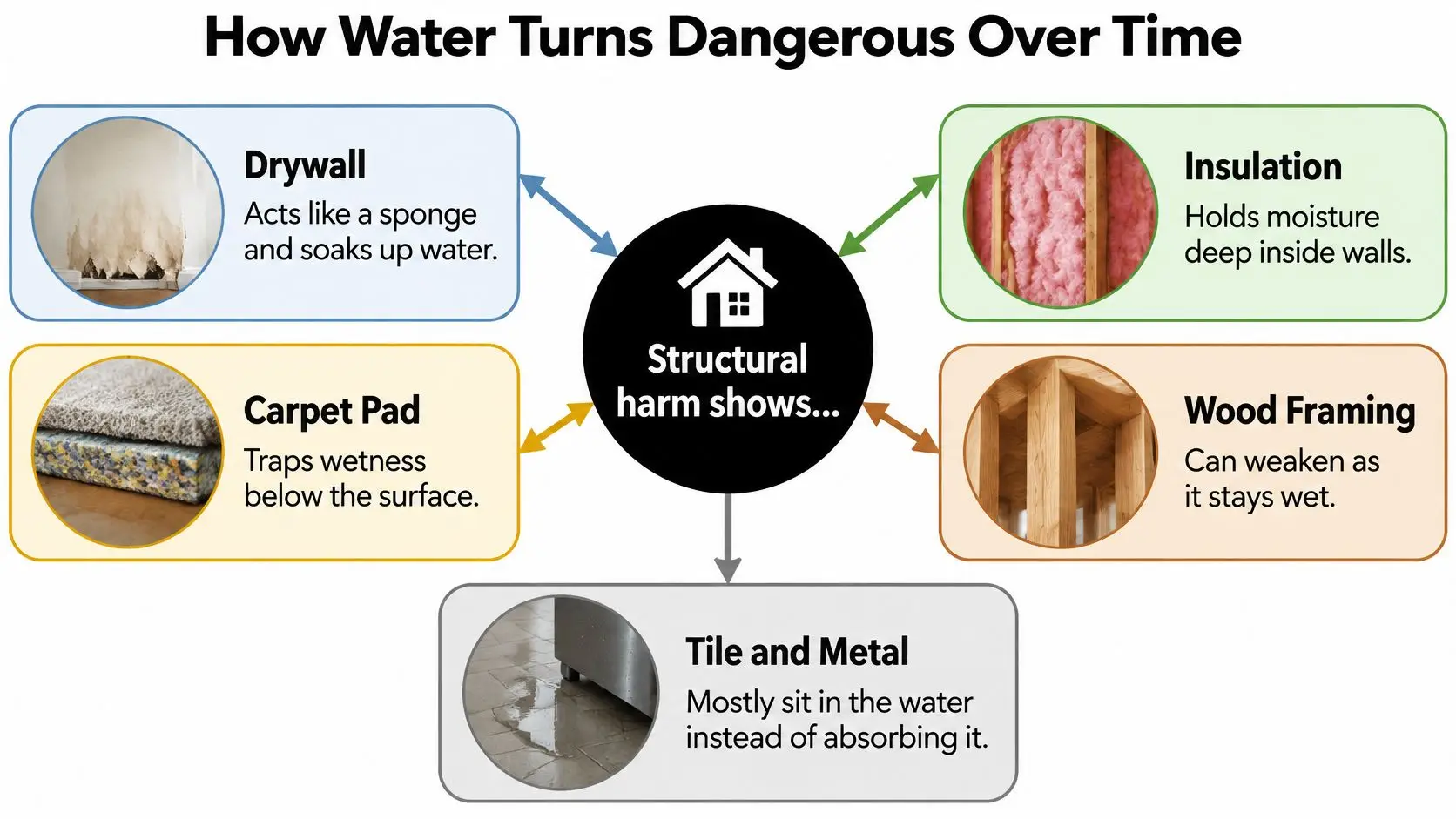
Health risks begin with whatever the water carried. Damp materials can then support microorganisms while toe-kicks, wall cavities, and spaces beneath flooring remain wet out of sight. Running a towel across the exposed floor won't tell you what's happening in those layers.
Treat the drying window as a target, not permission to wait
The U.S. Environmental Protection Agency's mold guide recommends drying water-damaged areas and belongings within 24–48 hours to help prevent mold growth. This is a prevention target, not a guarantee that mold starts at a particular hour or that contaminated water is safe until then.
Water damage timeline if materials stay wet
| Time wet | What you may see | What is happening | Why it matters |
|---|---|---|---|
| 0–24 hours | Puddles, damp carpet, soft drywall edges | Water wicks into porous layers | Shock and slip hazards may already exist; prompt drying helps prevent mold |
| 24–48 hours | Possible musty smell, darker drywall, swollen trim | Materials can still hold substantial moisture | The practical drying window is closing |
| After 48 hours | Possible spotting, stronger odor, cupped wood | Continued dampness increasingly favors mold growth | Health and salvage decisions become harder |
| Days to weeks | Blistered paint, rust, sagging ceilings | Closed cavities may remain damp | Material deterioration and air-quality problems can continue |
These are possible conditions, not a stopwatch diagnosis. Odor or spotting may appear sooner, later, or not where you can see it. A freshly discovered leak may also have been running long before you noticed it.
Verify drying beyond the surface
A moisture meter helps compare affected building materials with an appropriate dry reference. A thermal camera can help locate temperature patterns worth investigating, but a cold patch alone doesn't prove moisture. Readings, access, and knowledge of the wall or floor assembly work together.
For unexplained staining or recurring dampness, Axis Meter Solutions' steps to address hidden wall leaks offer useful context for investigating the source before closing the wall. Don't cut into a cavity where wiring, plumbing, or contamination may be present without assessing those hazards.
Safe drying may involve extraction, controlled airflow, dehumidification, and repeated measurements. Avoid blowing air across suspected contamination or through affected HVAC equipment. Practical guidance on preventing mold after a flood can help organize the moisture-control work, but sewage, extensive saturation, and inaccessible cavities warrant professional assessment.
Mold and Illness After the Water Is Gone
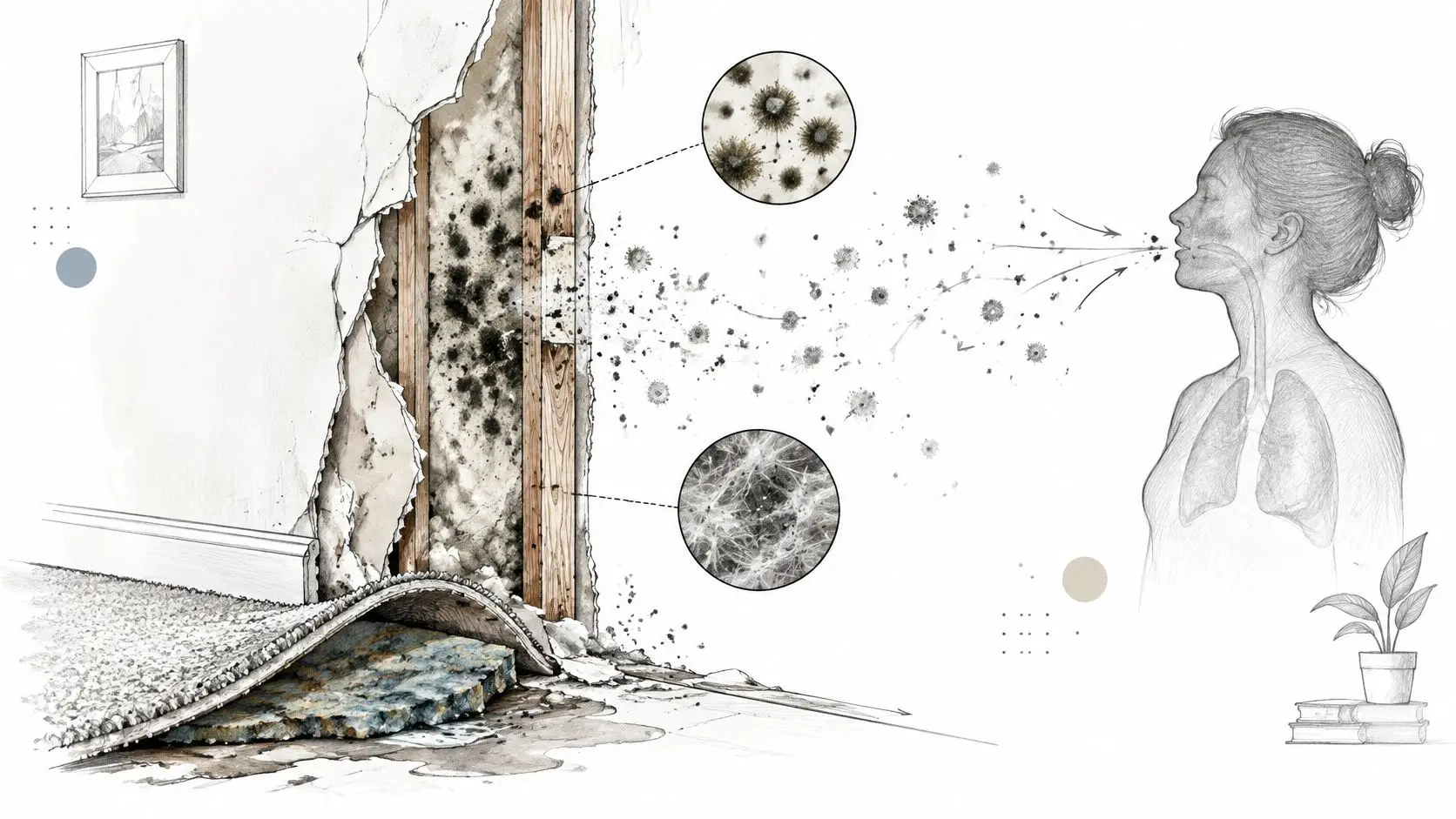
An empty room can look restored while damp material remains beneath flooring or behind cabinets. No visible mold colony doesn't establish that an assembly is dry or that its air-quality problem is resolved. Dust and paper-faced building materials can provide surfaces for growth when moisture persists.
This illustration shows how concealed growth can create an exposure pathway into occupied rooms.
Separate symptoms from the moisture problem
Mold produces allergens and irritants, and some molds produce mycotoxins. Breathing or touching mold can cause sneezing, a runny nose, red eyes, or a rash; it can also irritate the throat and lungs and trigger asthma symptoms in people allergic to mold. These effects don't mean every damp building causes the same illness or that symptoms can identify a mold species.
A musty smell deserves investigation, but smell isn't a measurement of exposure. Likewise, a person feeling fine doesn't establish that wet materials are ready to enclose. The useful building question is whether the source has been repaired and the affected layers have been cleaned, dried, or removed.
Painting a wet wall changes its appearance. It doesn't remove the moisture inside it.
The EPA's guidance on biological contaminants and indoor air quality recommends indoor relative humidity below 60%, ideally 30–50%, and a specific dehumidification strategy if humidity consistently exceeds that upper level. A hygrometer can track room humidity, but it doesn't replace measurements inside affected materials.
Don't paint, caulk, or seal wet or mold-spotted surfaces as a shortcut. That can enclose the problem much like putting a lid over a wet sponge. The same concern applies to enclosed lower-level spaces discussed in this guide to the dangers of mold in a basement.
The following video provides additional visual context for mold concerns after water damage.
Know when symptoms need medical attention
After floodwater or sewage contact, fever, persistent diarrhea, trouble breathing, or a wound that looks infected warrant medical attention. Tell the clinician about the water exposure, including contact with cuts or contaminated mud, as advised in the EPA's flooding guidance.
Don't assume every symptom is mold-related. Flood exposure can involve ingestion, skin contact, contaminated wounds, and airborne cleanup residues, so the circumstances matter to medical assessment.
Who Should Leave and Who Can Stay
A healthy adult dealing briefly with a small supply-water spill faces a different situation from someone with asthma sleeping beside moldy drywall. Occupancy decisions depend on both the environment and the person exposed, not just odor, stain size, or mold color.
The CDC's mold-cleanup guidance says people with asthma, COPD, or compromised immunity shouldn't stay in a moldy home while it's being cleaned. It also warns that heavy mold contamination after flooding can cause invasive fungal infections in people with weakened defenses.
Make the stay-or-leave decision conservatively
Keep cleanup work zones unoccupied except for people performing the work with appropriate protection. Infants, people recovering from surgery, and those with severe allergies, hypersensitivity pneumonitis, or immune suppression need particular consideration. A clinician can help with individual medical restrictions, but obvious electrical or contamination hazards don't require waiting for symptoms.
Who should leave during water damage cleanup
| Situation | Healthy adult | Child, older adult, pregnant, or immunocompromised | During active cleaning |
|---|---|---|---|
| Small clean-water leak, dried fast | May stay if the area is ventilated and otherwise safe | Limit time in the wet room | Keep the work zone clear |
| Sewage, toilet waste, or floodwater | Leave affected spaces until assessed | Leave affected spaces; don't help with cleanup | Nobody occupies contaminated rooms |
| Mold odor or prolonged wetness | Avoid sleeping in affected rooms pending assessment | Arrange another space, especially during mold cleanup | People with asthma, COPD, or suppressed immunity shouldn't stay during mold cleaning |
| Water on electrical equipment | Everyone stays out | Everyone stays out | Stay out until electrical safety is confirmed |
This table is a conservative triage aid, not medical clearance. Children, older adults, and pregnant people don't all have identical susceptibility, but avoiding unnecessary exposure is sensible when the contamination or cleanup conditions are uncertain.
Apply the decision to the whole household
For a small clean-water spill, a healthy adult may be able to stop the source and perform brief cleanup with gloves, provided electrical hazards and hidden saturation aren't involved. Other occupants should use a separate dry area rather than walking through the work zone.
With sewage or stormwater, moving someone to the other side of an open-plan room isn't meaningful separation. If safe access, bathrooms, sleeping areas, or airflow can't be separated from contamination, temporary relocation may be necessary.
For landlords and property managers: No reported symptoms isn't proof that a unit is safe to occupy.
Document the source, affected rooms, access restrictions, and assessment findings. Before moving bedding, upholstered furniture, or other soft goods back in, confirm that the leak is fixed and the space is ready for use. Reoccupying too early can expose clean belongings to an unresolved problem.
What Floodwater Ruins and What You Can Clean
A wet rug and a wet metal shelving unit need different decisions. Porous materials can hold contaminated water beyond the reach of surface wiping, while accessible hard surfaces are often more practical to clean. Appearance alone won't tell you whether an item can be safely kept.
The CDC's disaster-cleanup guidance advises discarding items that can't be cleaned or dried quickly. Examples include mattresses, carpet and padding, rugs, upholstered furniture, pillows, books, paper products, and foam-rubber items.
Compare absorption with cleanability
| Material or item | Practical decision after floodwater exposure |
|---|---|
| Drywall and insulation contaminated with sewage or floodwater | Remove and discard affected material |
| Mattresses, carpet pad, upholstery, pillows, and foam | Discard when thorough cleaning and prompt drying aren't achievable |
| Books and paper products | Discard contaminated items that can't be safely cleaned and dried |
| Accessible concrete, metal, countertops, and plumbing fixtures | Clean with hot water and detergent when appropriate and safe |
| Appliances | Assess electrical and internal contamination before reuse |
A clean-water spill may leave room for saving a washable rug or drying hardwood if the backing, underlay, and subfloor can be addressed. Floodwater changes that calculation: the same rug may retain contaminants that ordinary washing won't reliably remove. The decision is about the entire item, not only its exposed face.
For building materials, understanding what happens when drywall gets wet helps distinguish a surface mark from damage requiring removal. Don't open a contaminated wall to see whether the back looks better.
Keep ordinary textile care separate from flood recovery
Curtains that weren't touched by contaminated water may need routine fabric-specific care rather than disposal. For those items, CleanOnline's guide to cleaning heavy drapes, from CleanOnline, North York's Premium Dry Cleaners, offers useful care context. Routine drapery cleaning isn't a substitute for assessing flood-soaked fabric.
Hands-on cleanup also requires more than cleaning products:
- Protect contact points. Use waterproof gloves and boots, eye protection, and respiratory protection suited to the task.
- Avoid dispersing residue. Pressure washing and aggressive dry sweeping can send contaminated material into the air.
- Keep ingestion separate. Never drink floodwater or use it to prepare food.
- Stop at sewage or uncertain contamination. Don't begin demolition without appropriate protection and an assessment.
The CDC's floodwater safety guidance explains that floodwater may contain waste, chemicals, germs, sharp debris, and electrical hazards. Wash exposed skin with soap and clean water.
Looking dry isn't the same as being clean and dry all the way through.
When to Call a Restoration Team
Call for professional assessment the same day when the event involves contamination, electrical equipment, inaccessible moisture, or someone who can't safely avoid exposure. Waiting for a stain to darken or an odor to strengthen won't clarify the immediate safety question.
Stop the DIY plan when any warning applies
- The source is unsafe or unknown. Sewage, outdoor flooding, and unexplained dirty water need assessment before cleanup.
- Water touched electrical components. Keep away from affected outlets, cords, appliances, and panels.
- A vulnerable occupant can't avoid exposure. Arrange a safer location and explain the occupancy concern when requesting help.
- Materials remain wet beyond the recommended drying window. Hidden saturation needs evaluation rather than another surface wipe.
- The building shows warning signs. Sagging ceilings, soft floors, water inside walls, and affected HVAC equipment call for specialist attention.
A small clean-water spill on hard flooring may remain a homeowner job when the source is stopped, water is extracted, and the area can be dried safely. That judgment changes if water has traveled beneath flooring, behind cabinets, or into adjoining rooms.
Focus on assessment and moisture removal
For Phoenix-area homes and businesses, we handle water damage caused by flooding, burst pipes, appliance leaks, and severe storms. Our IICRC-certified professionals assess the extent of damage, develop a customized restoration plan, and verify moisture removal rather than relying on the disappearance of stains.
Restore Heroes is IICRC certified, licensed, bonded, and insured. Our assessment and mitigation process focuses on stabilizing the property and limiting additional damage, with decisions based on contamination, material condition, and drying needs.
You can review our emergency flood cleanup information before requesting an assessment. Describe the water source, affected rooms, electrical concerns, and whether anyone needs a safer place to stay.
If water matches a high-danger situation, leave the power and porous materials alone. A professional assessment should determine what needs cleaning, drying, removal, or further specialist evaluation, without assuming that every item can be saved.
Restore Heroes offers water damage assessment, mitigation, and restoration for Phoenix-area homes and businesses facing leaks, flooding, and storm damage. If you're unsure whether your water damage is dangerous, visit Restore Heroes to request help and describe the source, hidden-moisture concerns, and safety issues at your property.