
You notice the air before you notice a stain. Maybe the house feels stuffy even with the AC running, your child wakes up congested, or the living room smells a little musty after the monsoon. In Phoenix, that can happen after a dust storm, a smoky week, or a long stretch of heavy HVAC use, and it leaves homeowners wondering whether the problem is just comfort or something inside the air itself.
Indoor air quality testing gives you a way to answer that question with evidence instead of guesswork. Think of your home's HVAC system like lungs, it pulls air in, moves it around, and sends it back out. If the “lungs” are under strain, contaminated, or poorly balanced, the symptoms show up in the rooms where your family lives, sleeps, and cooks.
What Is Indoor Air Quality Testing?
Indoor air quality testing is the process of checking what's in the air inside a home, office, or other building. It can look for gases, particles, moisture-related problems, and biological contaminants that are not always easy to see or smell. The goal is not to chase every possible pollutant at once, it is to identify the conditions that may be affecting comfort, breathing, or how the building performs.
Your home's HVAC system works like a respiratory system. It pulls air in, moves it through the house, and sends it back out again. If that system is strained, contaminated, or out of balance, the results show up in the rooms where your family sleeps, cooks, and spends time.
A good starting point is carbon dioxide, because it gives a practical read on ventilation. The EPA's guidance explains that CO2 above 1000 ppm in the breathing zone generally points to a ventilation problem, while lower readings usually suggest ventilation is adequate for routine occupancy, and it recommends taking more than one measurement because conditions change over time and from place to place (EPA guidance on IAQ and CO2). That is why a single number rarely tells the full story.
Practical rule: if a room feels stale, stuffy, or unusually humid, testing should start with ventilation, not just the smell in the air.
Phoenix homes face a few extra pressures. Many stay closed up for long stretches to keep the heat out, and that can trap odors, particle buildup, and moisture pockets just as easily as it traps cooled air. Dust storms, wildfire smoke, and monsoon humidity can all change indoor conditions fast, so a home that felt fine one week can feel different the next.
If you are trying to understand cleaner air for your family, this overview from Platinum Heating & Cooling is a useful companion resource.
Testing also helps separate an air problem from a building problem. A dirty filter, a weak return vent, or a bathroom fan that does not exhaust well can all change how air feels without creating the same health risk. The value of testing is that it replaces hunches with measurements you can act on. For homes where materials or past damage may be part of the concern, Restore Heroes' asbestos removal and testing overview is another helpful reference point.
Common Contaminants Lurking in Your Home
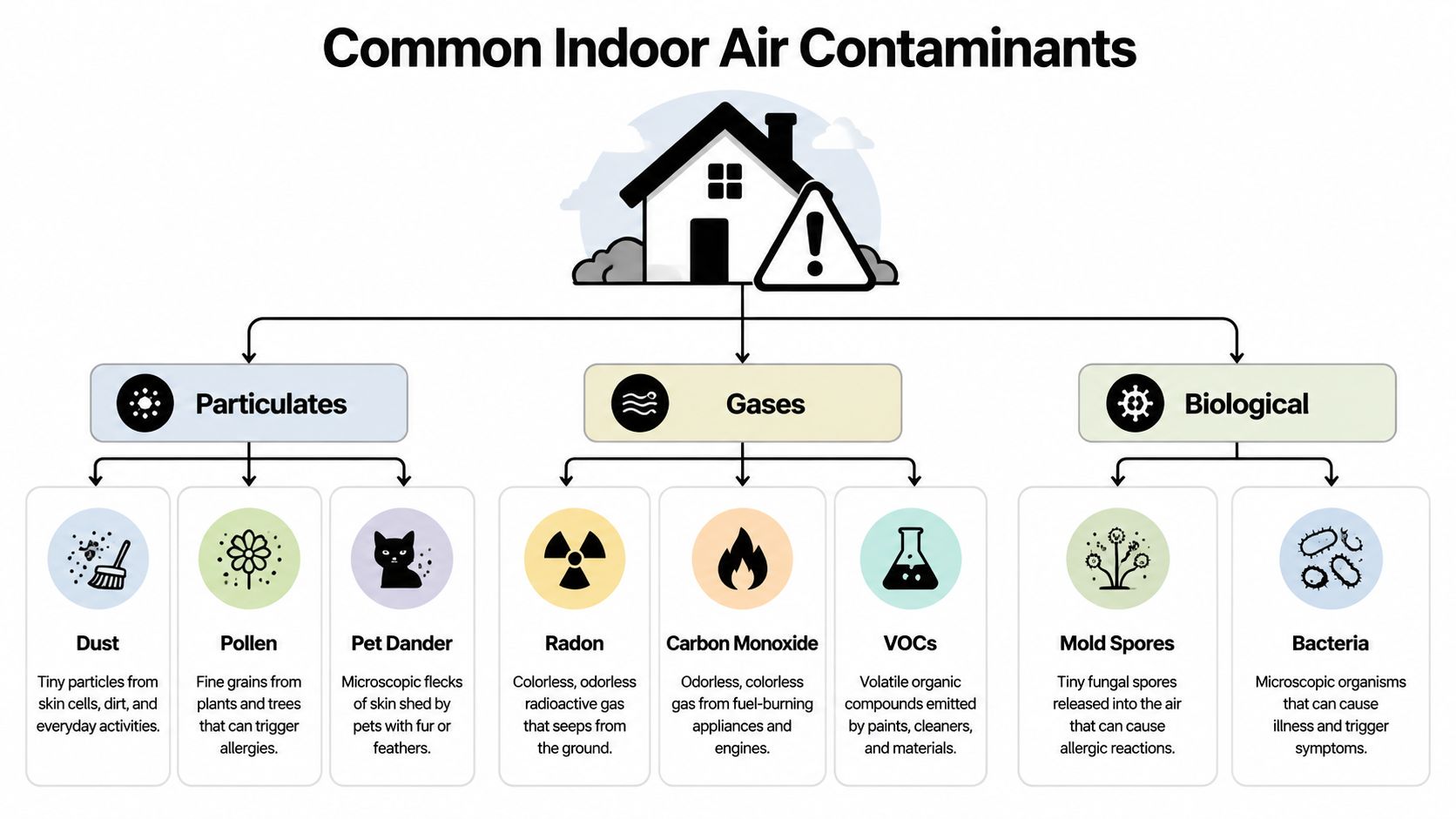
Indoor air usually contains a mix of particulates, gases, and biological contaminants. The tricky part is that each category behaves differently. Dust can settle fast, gases can linger without warning, and moisture-related growth can hide in walls, ducts, or under materials after a leak.
Particulates that ride the air
Dust, pollen, pet dander, and smoke particles are the first contaminants noticed. In Phoenix, dust can enter through doors, gaps, and worn weatherstripping, then settle onto surfaces or keep circulating if filtration is weak. Smoke from nearby wildfire events can also creep indoors and leave the home feeling irritating long after the outdoor haze clears.
These particles matter because they can aggravate allergies and make a space feel dirty even when it's clean. They also help reveal how well your home is filtering and moving air. If you're seeing more dust than usual on vents or furniture, that's often a clue that the system is moving particles around instead of capturing them.
Gases you can't always smell clearly
This group includes carbon monoxide, VOCS, and radon. Carbon monoxide is especially serious because it comes from combustion equipment, flues, or other fuel-burning sources, while VOCs can come from paint, furniture, cleaners, and building materials. Radon testing is specifically recommended for homes, and the EPA notes that homeowners can use inexpensive DIY kits if they choose state-certified products or kits that meet a national proficiency requirement (EPA radon guidance).
If you want a deeper look at how specific products can affect indoor air, this guide on incense ingredients and air quality is a helpful example of how everyday items can change what's in a room.
Biological contaminants tied to moisture
Mold, bacteria, and related bioaerosols usually show up where moisture lingers. That can happen after a roof leak, a plumbing issue, or even a long period of condensation around cold surfaces. If you're concerned about materials hidden behind walls or under flooring, an internal resource on asbestos removal and testing can help frame the difference between old building materials and active moisture problems.
Types of Indoor Air Quality Tests Explained
Different tests answer different questions. Some are simple and useful for a narrow concern, while others build a bigger picture of how the whole house is breathing. The best choice depends on whether you're checking a single suspected source or trying to understand the air in multiple rooms.
A basic spot check looks at conditions in the moment. A time-series monitor tracks changes over time, which matters because the EPA says more than one measurement is important when evaluating CO2 and ventilation (EPA guidance on IAQ and CO2). In a Phoenix home, that can help show the difference between a quiet morning, a busy evening, and a hot afternoon when the system is working hardest.
Some air problems only show up when the house is occupied, doors are closed, or the AC has been running for hours.
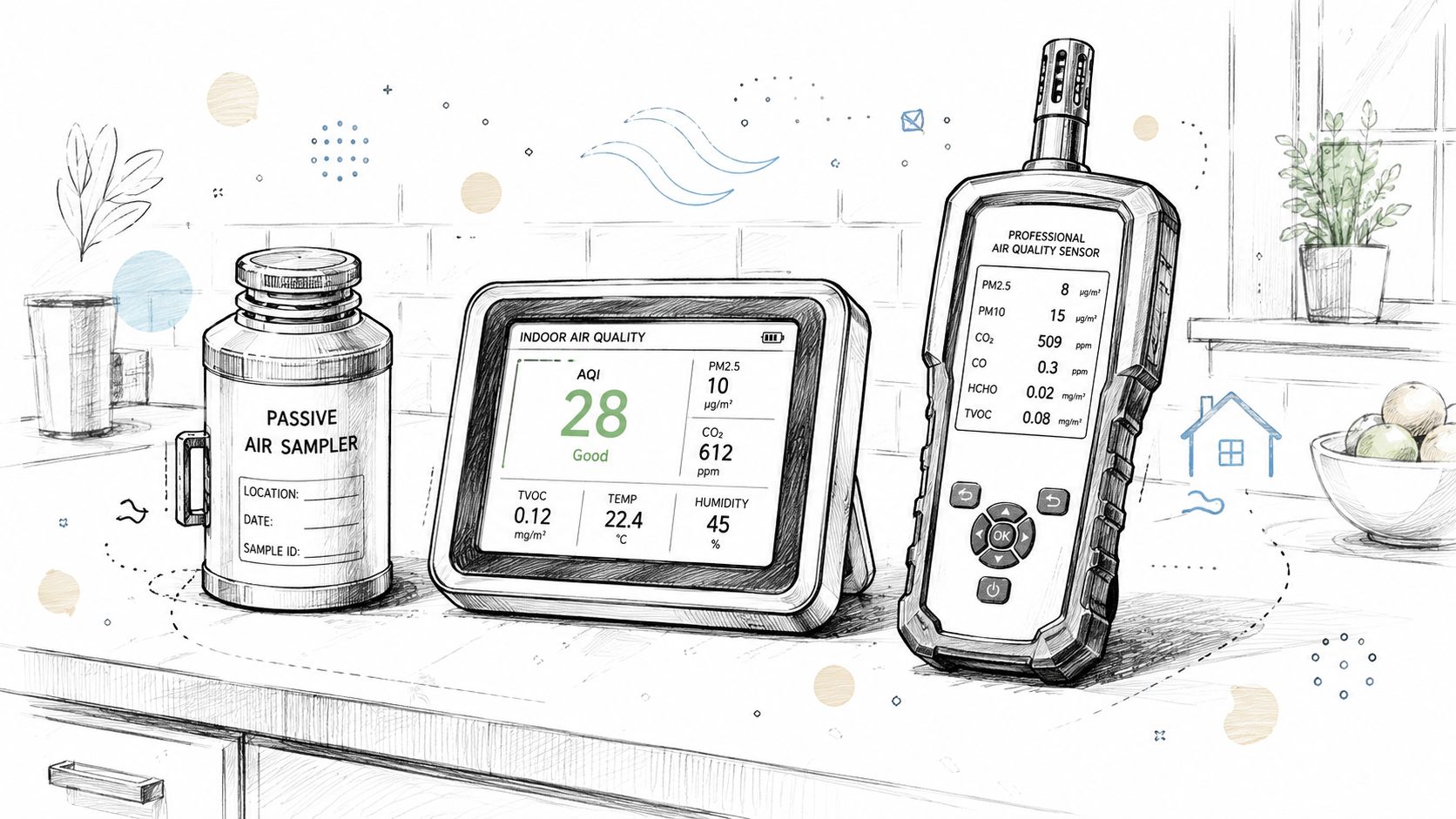
Simple tools and what they catch
DIY kits are often used for radon or certain single-contaminant checks. They're straightforward and can be a smart first step when you already know what you want to measure. They're less useful when you need to compare rooms, trace a source, or understand whether a reading reflects the house or the weather outside.
Professional equipment goes further. Technicians may use pumps, calibrated sensors, and laboratory analysis to measure gases, particles, humidity, temperature, and moisture-related conditions. The key difference is context, because a technician can relate the numbers to airflow, room use, and source locations instead of handing you a single result with no explanation.
For homeowners trying to understand where a leak, odor, or filtration issue starts, a thermal scan can help reveal temperature differences and hidden moisture patterns. A related resource on thermal imaging inspection can show why that kind of tool often fits into a broader investigation.
What a professional test usually adds
A proper inspection also includes a walk-through, because the equipment only tells part of the story. Technicians look at returns, exhausts, maintenance areas, and signs of moisture before they decide where to sample. That's where testing becomes more than a gadget, it becomes a building diagnosis.
DIY Kits vs Professional IAQ Testing
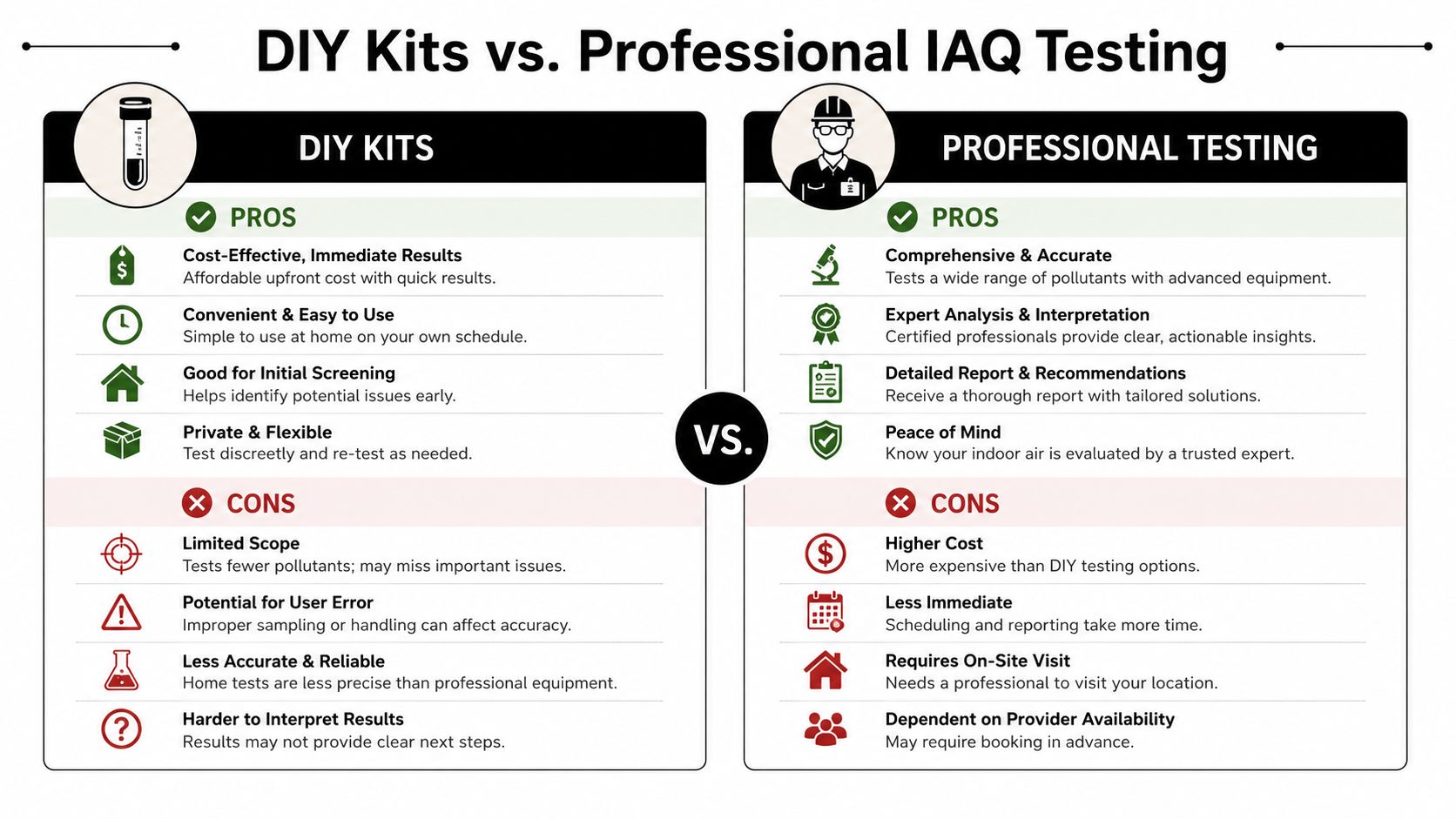
DIY kits and professional testing each solve a different kind of problem. A kit works well when you already have one clear concern, like radon in a basement or a single room you want to check. Professional testing fits better when the home has several symptoms, more than one floor, or a problem that seems to shift from room to room.
Your home's HVAC system functions like a respiratory system. It pulls air in, moves it through the house, and sends it back out, so a weak filter, a hidden leak, or poor airflow can affect the whole building. In Phoenix, that matters even more because dust storms, wildfire smoke, and monsoon moisture can all change what ends up inside.
Where DIY kits make sense
DIY testing is simple and easy to access. It works best when you already know what you are checking for and only need a screening result. For many homeowners, that means a first look at radon or a basic check after a specific concern.
The limitation is scope. A kit does not inspect the HVAC system, compare one room with another, or explain whether a reading changed because the house was closed up, the weather shifted, or a fan was not running. If the issue is wider than one spot, a DIY kit can leave you with a number and no clear next step.
Where professional testing adds value
Professional testing helps when the reading needs context. A technician can sample multiple rooms, document outdoor conditions, and compare indoor values against return-air or exterior air, which helps show whether the problem comes from ventilation, an internal source, or one localized area. Good field work often means repeated sampling instead of one quick pass.
Bottom line: a test result matters most when someone can explain what changed in the building and why the reading looks the way it does.
That kind of interpretation matters even more after a leak or a stretch of monsoon humidity, when mold can start in places a homeowner may not see. An overview of mold testing services can help show how a targeted inspection fits into the larger process. For a broader contamination problem, the sample collection method matters as much as the instrument itself.
Understanding Your Air Quality Test Results
Air reports can look intimidating because they mix units and thresholds. ppm means parts per million, ppb means parts per billion, and µg/m³ means micrograms per cubic meter. Those units don't tell you whether the air is safe by themselves, they only make sense when compared with a benchmark.
For example, EPA-style specifications set formaldehyde below 20 micrograms per cubic meter, which is listed as 16.3 ppb, total VOCs below 200 micrograms per cubic meter, and carbon monoxide not above 9 ppm (EPA testing specification). The same specification also says airborne mold species in indoor air cannot vary by more than 10% from exterior samples. That gives you a reference point, not a guess.
Reading the numbers without overreacting
A single high result doesn't always mean the whole home is unsafe. It can mean one room was sampled during a high-use period, a window was closed, or the HVAC system wasn't in its normal cycle. That's why the timing and location of the sample matter as much as the lab sheet.
Massachusetts' sampling guide recommends starting monitoring at least one hour, and preferably two hours, before indoor monitoring, and continuing until at least 30 minutes before it ends. It also advises comparing same-day, same-method data when checking different parts of a building (Massachusetts indoor air sampling guide). In plain English, don't compare a bedroom sample collected after the AC shut off with a hallway sample taken under different conditions and assume they mean the same thing.
A good report should help you answer three questions. What was measured, where was it measured, and what should change next. If the report doesn't address those, you may need a second opinion or a more complete inspection.
Phoenix-Specific Air Quality Challenges
Phoenix homes deal with air problems that don't look like the problems in cooler, wetter places. A house can be sealed against heat, run its AC for long hours, and still pull in contaminants from the outside when conditions shift fast. That's why local context matters as much as the test itself.
Smoke, dust, and monsoon moisture
Wildfire smoke can drift into the region and settle into a home through small leaks, open doors, or weak filtration. Dust storms can do the same thing, except the issue is often heavier particulate loading that clogs filters and leaves surfaces coated. Monsoon moisture brings a different problem, because humidity can create the kind of damp corners where growth starts behind materials, around bathrooms, or near overworked AC components.
The HVAC system in a Phoenix house has a hard job. It's not just cooling the place, it's constantly filtering, drying, and recirculating air in a climate that swings from dry grit to humid bursts. If one part of that system is underperforming, the effects spread through the whole house quickly.
Why local homes need local eyes
A generic test can miss what matters most here. A room may read fine at midday and still feel contaminated at night after the system cycles differently. A technician who understands local smoke seasons, dust infiltration, and monsoon-related moisture can sample in a way that reflects how Phoenix homes really live.
For homeowners in Northern Arizona or the Valley looking at system cleanup, duct cleaning in Northern AZ is one example of how air pathways get addressed alongside the broader home environment. The main point is simple, local conditions shape the test, and the test should reflect the building you live in.
From Testing to Treatment What to Do Next
A good air test should lead to a clear next step. If the issue is ventilation, the fix might be as simple as improving airflow, checking exhaust fans, or correcting HVAC timing. If the issue is moisture, the priority is stopping the source first, then drying and cleaning the affected materials so the problem doesn't keep returning.
When contamination involves mold, smoke residue, or other building damage, remediation has to be handled carefully. That's where experience matters, because a rushed cleanup can spread debris, leave hidden residue behind, or miss the source entirely. A proper plan starts with inspection, then containment, removal, cleaning, and verification.
Why certification matters
An IICRC-certified company follows recognized restoration practices, which helps keep remediation structured and accountable. For a homeowner, that matters because the work isn't just about making a room look better, it's about dealing with the source and the impacted materials in a way that supports a safer indoor environment. If the home needs structural cleanup after water intrusion or smoke, a certified team is easier to trust with the sequencing and the details.
A useful internal resource on mold inspection checklist can help you think through what gets looked at before remediation starts. If the test points to active contamination, a dedicated mold remediation in Phoenix, AZ page shows how that kind of work is typically approached in a local setting.
The right next step depends on the source, not just the symptom.
If you want to move from uncertainty to action, Restore Heroes can help with inspection, mitigation, and remediation across water, fire, and mold-related conditions in Phoenix-area homes and businesses. Visit Restore Heroes to request help from a local team that understands how indoor air problems connect to building damage and recovery.