
A musty smell appears near the hallway after a plumbing leak. Then you notice a dark patch along the baseboard, and the questions start: Is it only on the surface? Has it spread behind the wall? Will insurance pay? Should you clean it yourself or call a contractor?
Start with a mold remediation free estimate, but don't treat it as a casual price check. A useful visit should investigate moisture, document affected materials, and explain the likely work before anyone asks you to authorize demolition or remediation. The cost matters, but it should come after the scope.
Why a Mold Remediation Free Estimate Is the Right First Call
A homeowner with a musty room often has two bad options in mind. One is to tear out drywall based on a guess. The other is to accept a fast flat quote from a company that hasn't found the leak, checked surrounding materials, or considered whether air movement has carried contamination elsewhere.
A no-cost onsite estimate gives you a better starting point. The technician can identify the suspected moisture source, inspect visible and accessible areas, record affected materials, and explain whether the next step is remediation, additional investigation, or moisture control. You get information before committing to the work.
The concern isn't trivial. A 2007 assessment estimated that approximately 47% of U.S. homes had dampness or mold problems, and estimated that 21% of current U.S. asthma cases could be attributable to dampness and mold in homes. A companion meta-analysis of 33 studies associated dampness and mold exposure with a 30–50% increase in the occurrence of several respiratory problems. These figures come from the assessment and meta-analysis published through the National Library of Medicine. They don't mean every visible patch needs identical treatment, but they do explain why a professional assessment should look beyond discoloration.
What the visit separates
Consider a leak beneath a Phoenix kitchen sink. The visible staining may be limited to the cabinet floor, while the moisture has also reached the toe-kick, adjacent drywall, and flooring edge. A proper visit separates what can be cleaned from what may need removal, then identifies whether the plumbing problem is still active.
Practical rule: Don't compare remediation prices until you know whether each company is pricing the same affected area, materials, containment, and follow-up work.
The written record can also help you compare contractors or communicate with an insurer. It may include dated photographs, moisture observations, measurements, suspected source information, and assumptions about concealed areas. That record doesn't force you to hire the estimator, and it can't establish a medical diagnosis or guarantee a claim decision.
For homeowners looking for region-specific prevention ideas, Greater Hartford mold remediation tips can provide useful context about attic and moisture-related concerns outside the Phoenix market. The core principle remains the same: find and correct moisture before treating the visible result.
What a Qualified Inspector Actually Does on Site
A qualified technician shouldn't walk in, glance at a dark mark, and write a number. The inspection should follow a practical sequence because each finding affects the next decision.
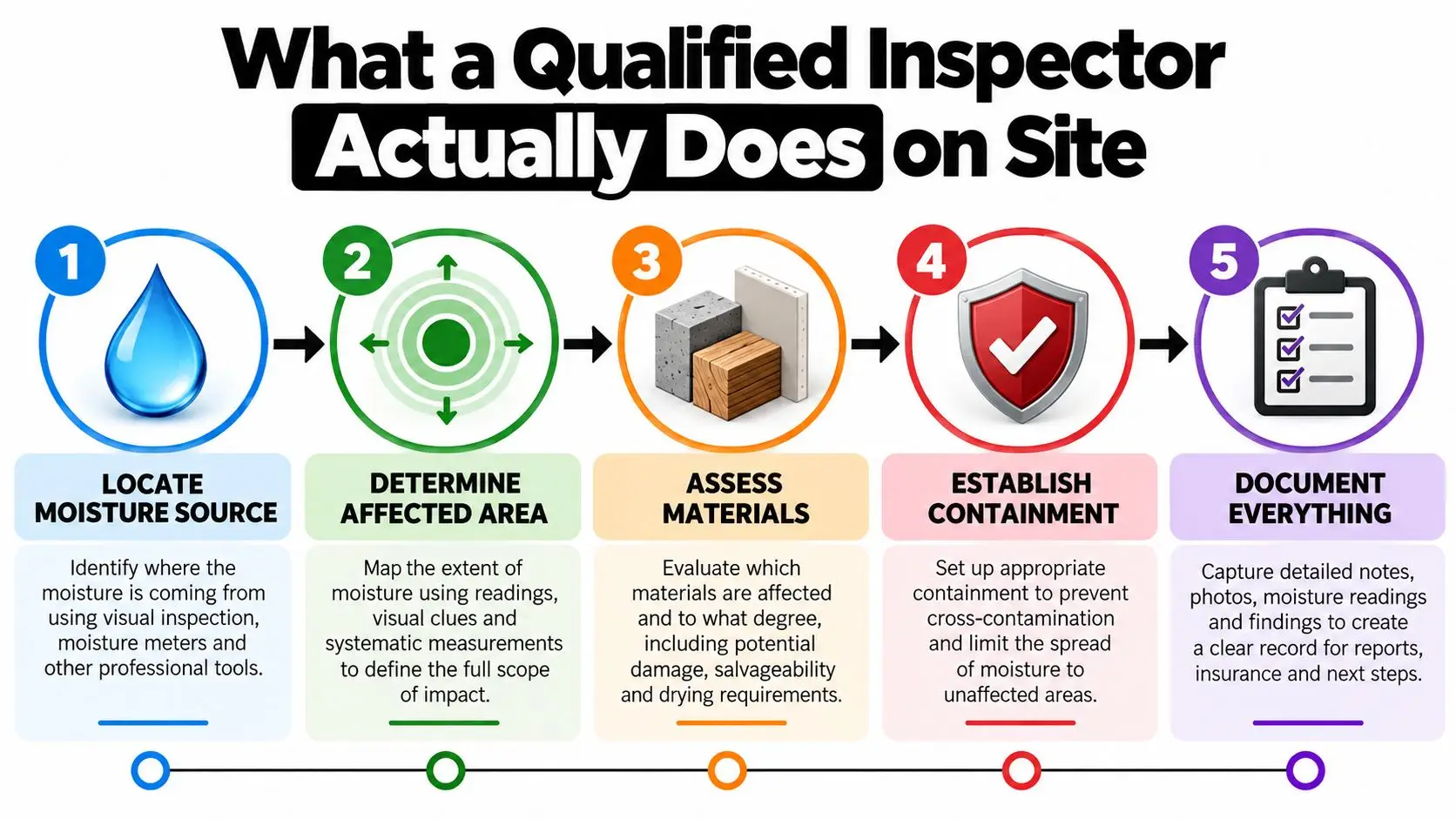
1. Locate the moisture source
The technician starts with the event or condition that introduced water. That might be a plumbing failure, an air-conditioning condensate problem, an evaporative-cooler leak, roof intrusion, or high indoor humidity. A moisture meter helps identify wet building assemblies, while a thermal camera can reveal temperature patterns that suggest water migration or hidden dampness.
These tools don't magically identify mold, and a thermal image isn't proof of contamination. They help the technician decide where to look more closely and whether the source appears corrected.
2. Determine the affected area
The inspector maps visible staining, odor, discoloration, damaged finishes, and areas with readings that warrant further evaluation. The assessment should consider drywall, insulation, flooring, carpet pad, cabinetry, framing, contents, and nearby rooms.
If an unexplained odor exists without visible growth, the technician should explain whether additional inspection is appropriate rather than inventing a confident scope.
3. Assess materials
Porous materials often require a different decision from hard, cleanable surfaces. The written estimate should distinguish materials proposed for removal from those proposed for cleaning, and should identify contents that can be salvaged or require separate handling.
HVAC involvement deserves specific attention. If contaminated material is near an air handler, return, duct, or supply path, the technician should explain how that possibility affects containment and inspection.
4. Establish containment
Containment isn't decoration. The estimate should identify the work zone, sealing approach, air movement controls, and whether negative pressure is appropriate. A technician may use barriers and filtered air equipment to limit migration while workers remove or clean affected materials.
For more detail about the diagnostic role of thermal equipment, review this thermal imaging inspection resource.
5. Document everything
Photographs should cover the source, affected rooms, materials, readings, access points, and conditions that could change the scope. The technician should also record assumptions and exclusions, such as areas that couldn't be opened during a visual visit.
The EPA guidance for assessing affected areas and selecting remediation methods emphasizes documenting damaged materials, determining the moisture source, and choosing containment and remediation methods accordingly. That's why documentation, not just the visual impression, forms the basis of a credible written estimate.
The process should be systematic. If the technician skips the source investigation and jumps straight to square footage, the resulting number may look precise while describing the wrong job.
Why a Free Estimate Is Not Just a Price Quote
A free estimate isn't valuable because someone writes a low number on a clipboard. It's valuable because it explains why the work is needed, what the work includes, and what conditions could change the scope.
Professional remediation follows procedures rather than one universal pricing formula. The ANSI/IICRC S520 standard was first published in December 2003, followed by editions in 2008, December 2015, and 2024. It applies to residential, commercial, and institutional buildings, including building systems and personal property contents. You can review the standard's publication history through the ANSI/IICRC S520 reference.
Square footage matters, but only after the technician considers the contamination category, moisture source, material type, HVAC involvement, access, containment, contents, disposal, and post-remediation verification. Two rooms with similar visible areas can require very different work if one has cleanable concrete and the other has wet drywall, insulation, and concealed growth.
Compare scope, not just totals
A lower bid may omit source correction, limit containment, exclude contents handling, or leave post-remediation verification outside the stated price. A higher bid may include those items. Without a line-by-line scope, the totals aren't comparable.
A useful estimate should separate:
- Moisture control: What stops the leak or reduces the condition that caused the growth?
- Preparation: What barriers, air filtration, protective measures, and access work are required?
- Removal and cleaning: Which materials are demolished, disposed of, HEPA-cleaned, or treated?
- Drying and reconstruction: Is structural drying included, and is rebuilding handled separately?
- Verification: Is a visual inspection included, or is independent testing separately itemized?
The Connecticut 2024 mold-abatement guidance identifies the foundational sequence as correcting the moisture source, removing moldy materials, and following a site-specific plan. It also advises discarding porous materials that have remained wet for more than 48 hours, as described in the verified remediation guidance. A Phoenix estimate should apply the same logic to local conditions, not substitute a generic allowance for an investigation.
The price is a byproduct of the documented conditions. If the document doesn't explain those conditions, the free estimate hasn't done its main job.
Free Visual Assessment Versus Lab Testing and Clearance
Homeowners often hear several different services described as an “inspection.” They aren't interchangeable. A free visit may identify visible conditions and support a preliminary scope, while testing and clearance answer separate questions at different points in the project.
| Service | Provider | Purpose | Output | Cost Status |
|---|---|---|---|---|
| Visual assessment | Remediation technician or inspector | Identify visible conditions, moisture indicators, materials, and likely scope | Site notes, photographs, observations, and preliminary estimate | Often offered at no cost |
| Remediation protocol | Qualified assessor or remediation professional | Define work methods, containment, removal, cleaning, and verification requirements | Written, site-specific protocol or scope of work | May be included or billed separately |
| Air testing | Independent environmental professional and laboratory | Measure airborne spore conditions at the time of sampling | Sampling report and laboratory results | Typically a billed service |
| Clearance | Independent assessor or qualified testing professional | Evaluate whether completed work meets the agreed post-remediation criteria | Clearance report, visual findings, moisture observations, and possibly test results | Typically a billed service |
A free visual assessment usually covers the first stage. Some companies also provide a written remediation scope, but you should ask whether that document is a detailed protocol or just a treatment allowance.
Air sampling answers a narrower question. The EPA explains that sampling captures conditions only at the moment of collection, and that indoor spore levels can change with barometric pressure, indoor and outdoor temperatures, and building activity. The agency also states that visual and sensory inspections are generally more useful for judging remediation effectiveness, and that a negative sample shouldn't replace a visual survey. Those limits are detailed in the EPA mold course guidance on sampling and remediation effectiveness.
Choose the service based on the decision
A visible, localized condition with a known source may call for a documented visual assessment and scope. An unexplained odor, recurring moisture, hidden wall cavity, HVAC concern, sewage exposure, or multiple affected rooms may justify additional investigation.
If you need testing before or after work, ask whether the company uses an independent provider and whether the laboratory fee is separate. The mold testing services information can help you distinguish testing from remediation. Don't pay for a lab report just because the word “mold” appears in a sales conversation, and don't assume a free visual estimate includes a clearance letter.
Questions to Ask During the Free Estimate Visit
Treat the appointment as a scope-and-method interview, not a price negotiation. The technician should be able to explain the reasoning behind the proposed work in plain language.
Ask these questions and write down the answers:
- What is the suspected moisture source? Ask how the source will be corrected and who is responsible for that work.
- Which materials will be removed, and which will be cleaned? The answer should identify porous materials, salvageable contents, and disposal assumptions.
- Does the scope include HVAC inspection or cleaning? This matters when air movement could connect the affected room to other parts of the home.
- What containment will be installed? Ask where barriers go, how access is controlled, and whether negative pressure is part of the plan.
- Which IICRC S520 or ANSI/IICRC principles apply? The technician should connect the method to site conditions rather than use a standard name as a sales slogan.
- What happens if demolition reveals more growth? Ask how change orders are documented, priced, and approved before extra work begins.
- Does the estimate include drying, demolition, disposal, cleaning, reconstruction, and verification? Separate each scope so you know what isn't included.
- What photographs and readings will I receive? Request moisture readings, source photographs, affected-material measurements, and a room-by-room record.
- What will you guarantee in writing, and what won't you guarantee? No contractor should guarantee insurance approval, a fixed final scope where concealed areas haven't been inspected, or a particular laboratory result.
A company should also provide its legal business name, licensing or certification information where applicable, proof of insurance, references, and a written contract before work begins. If you're unsure how to evaluate a contractor beyond the sales pitch, this guide on how to verify if a company is legit offers a useful checklist.
You can also compare the proposed qualifications and process with information about mold remediation specialists. The right technician won't be offended by detailed questions. Clear answers are part of the service.
Insurance, Coverage, and What the Visit Can and Cannot Prove
A free estimate cannot guarantee insurance reimbursement. The insurer looks first at what caused the moisture, then applies the policy's exclusions, deductibles, limits, endorsements, and claim findings.
A sudden and accidental event, such as a burst pipe or accidental appliance failure, may receive different treatment from a gradual leak, chronic humidity, poor ventilation, deferred maintenance, floodwater, or a sewer backup. Standard homeowners policies commonly exclude mold in some circumstances, while coverage may apply when mold results from a covered water event. The presence of mold alone doesn't decide the claim.
Build a useful claim record
The estimate visit can strengthen the documentation without determining the outcome. Ask the technician to provide:
- Dated photographs of the moisture source and affected areas.
- Moisture-meter readings and notes about building assemblies.
- Measurements of affected materials and rooms.
- A description of containment, demolition, cleaning, drying, and disposal.
- Separate pricing for remediation, reconstruction, testing, and other services.
- Notes connecting the proposed work to recognized remediation procedures.
- Any records showing when the leak was discovered and when mitigation began.
The homeowners insurance and mold coverage guide explains why the underlying peril and policy language matter more than the contractor's estimate. An estimator can document the loss and communicate with an adjuster, but can't promise approval, reimbursement, or payment of every expense.
Claim reality: The estimate builds the record. The policy and the carrier's determination control coverage.
Before authorizing demolition, ask your insurer whether the suspected cause is covered, whether mold limits or sublimits apply, whether your deductible is relevant, and whether the carrier requires specific documentation or testing. Don't ask the contractor to interpret a policy as though the contractor were the claims decision-maker.
For broader context about contractor risk and insurance relationships, the Duncan & Associates contractor insurance guide is a useful reference. Keep the roles separate: the contractor assesses and performs work, while the insurer evaluates coverage.
You can also review this explanation of whether homeowners insurance covers mold, then confirm the answer directly with your carrier.
Booking the Visit and Preparing Your Phoenix Home
The booking process should be simple, but preparation affects what the technician can see and document.
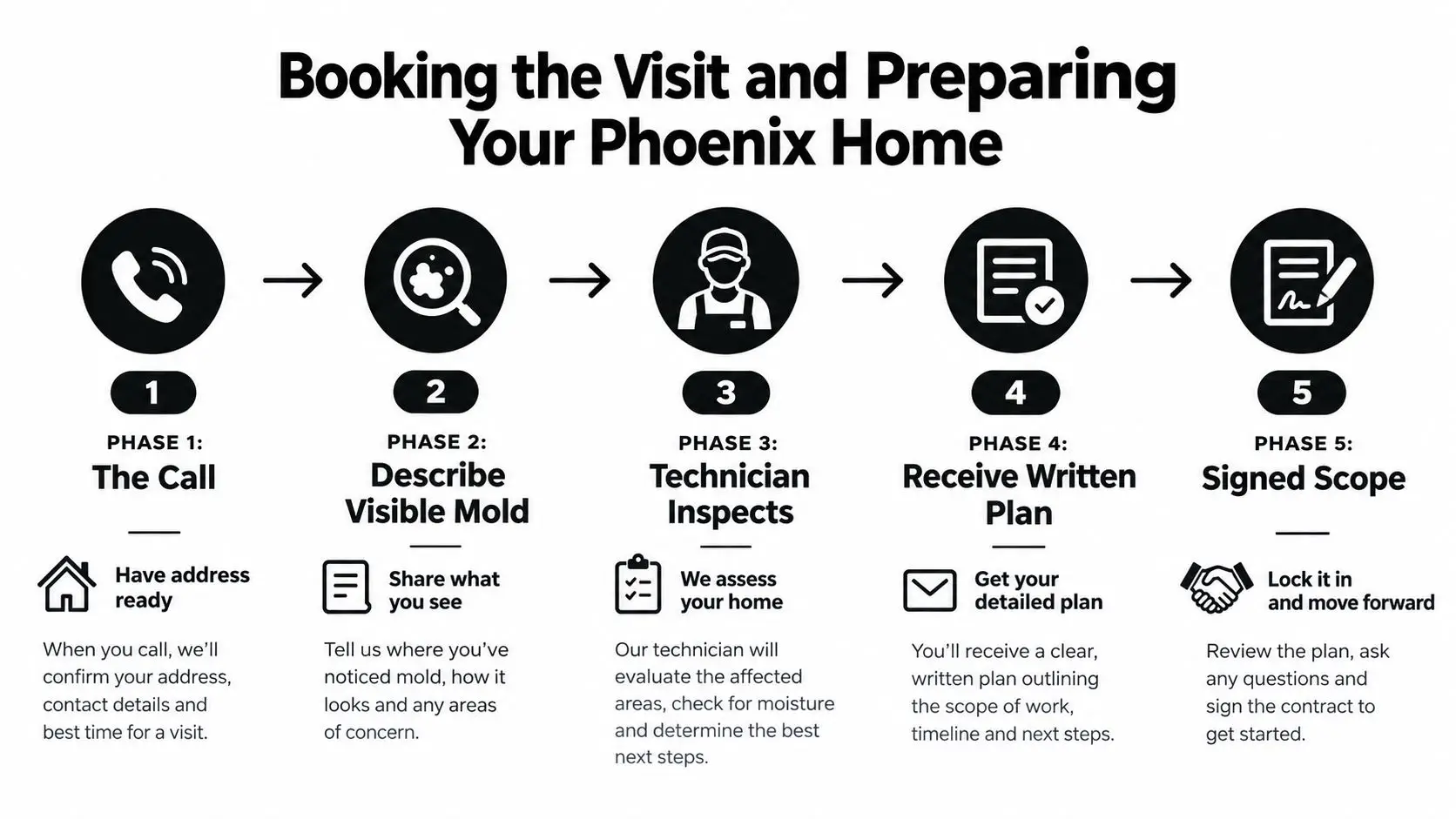
Phase 1 and Phase 2
When you call, have the property address, your contact details, the suspected moisture source, the rooms involved, and photographs already taken. Explain whether the issue followed a plumbing failure, roof intrusion, air-conditioning problem, evaporative-cooler leak, monsoon event, or another condition.
During scheduling, confirm the arrival window, whether the first visit is in person or virtual, who will attend, what areas need access, and when you should expect the written estimate. A dispatcher should also know whether the property is occupied, whether tenants or vulnerable occupants are present, and whether an active leak requires emergency mitigation.
Phase 3 and Phase 4
Clear a path to affected walls, cabinets, flooring, attic access points, utility rooms, and HVAC equipment. Move small furniture or stored items only if you can do so safely, secure pets, and tell the technician whether the HVAC system has been running since the odor or visible growth appeared.
Don't scrub or paint over the area before the visit. Those actions can remove useful evidence, spread debris, or hide the boundary the technician needs to document. If water is still entering the property, report it immediately rather than waiting for a routine appointment.
On site, the technician should identify themselves, walk through the property, take photographs, inspect accessible areas, and record moisture conditions. You should receive a written scope after the visit, with the delivery timing confirmed during scheduling.
Phase 5
Review the document before authorizing anything. A no-cost visit doesn't obligate you to approve remediation. Work should begin only after you understand the scope, exclusions, payment terms, insurance assumptions, and process for concealed conditions or added work.
Using the Estimate to Make a Confident Next Step
A useful written estimate should contain more than a total. Look for the identified moisture source, affected materials and measurements, containment plan, removal method, drying expectations, post-remediation verification, and an itemized cost tied to those conditions.
Use this decision test:
- Does the proposed method reflect the site-specific principles described by IICRC S520?
- Is someone correcting the moisture source before reconstruction or final cleaning?
- Are testing and clearance included, excluded, or separately itemized?
- Does the document explain what happens if hidden contamination appears?
- Can you compare this scope with another contractor's scope line by line?
The estimate should make uncertainty visible. The EPA advises that hidden mold may exist behind drywall, wallpaper, paneling, ceiling tiles, or beneath carpet and carpet pads, and that the plan should be revised if demolition reveals additional affected areas. Its mold assessment checklist supports documenting observed conditions, assumptions, and possible concealed contamination rather than promising a complete fixed scope without access.
For a broader explanation of why surface area alone can mislead, see this guide to mold remediation cost. The price is the result of the documented work, not the primary purpose of the visit.
Moisture-source correction remains the deciding factor. Cleaning without fixing the cause invites recurring growth, regardless of how polished the finished surface looks. A strong free estimate turns a stressful guess into a structured plan you can question, compare, and authorize on your own timeline.
Restore Heroes offers free onsite mold inspections and written estimates for Phoenix-area homes and commercial properties, with technicians who assess moisture, affected materials, containment, and remediation needs. Visit Restore Heroes to request an evaluation and take the next step with documented scope instead of a blind price quote.