
You wake up to the sound of water where it should not be. The carpet is cold under your feet, a hallway light catches a shine on the floor, and you're trying to decide whether to grab towels, kill the power, or call for help first. That first minute feels chaotic because it is, and the wrong move can turn a manageable spill into a bigger loss.
If you're standing in that moment right now, think in this order, safety first, source second, documentation third, mitigation fast. A real 24/7 flood response isn't about a phone line that rings after midnight, it's about getting the right people moving while you keep the situation from spreading.
What a Midnight Flood Call Actually Feels Like
At 2 a.m., no one is thinking about restoration jargon. A homeowner sees water creeping out from under a bathroom door, a facility manager finds wet ceiling tiles in a corridor, and a tenant hears dripping inside a wall and can't tell whether it's a supply line, a roof leak, or something worse. The first reaction is usually the same, stare at the damage, then look for the nearest phone.
That moment is where response time slips away. They open doors they shouldn't, step into water without checking the risk, or start moving everything before they know what source is feeding the mess.
Practical rule: if you can't tell where the water is coming from, treat it as unstable until someone confirms it.
A midnight call should feel calm on the other end, even if the property isn't calm at all. A proper crew listens for the source, the spread, and whether electricity or contamination is involved, then decides what can be stabilized immediately and what has to wait for a more controlled entry. If you want a visual sense of what that first crisis can look like inside a house, this flooded-house walkthrough is a useful companion.
The stress is real, but the next move is usually simple. Keep yourself safe, keep the damage from widening, and get the right people on the way.
What 24/7 Flood Response Actually Means
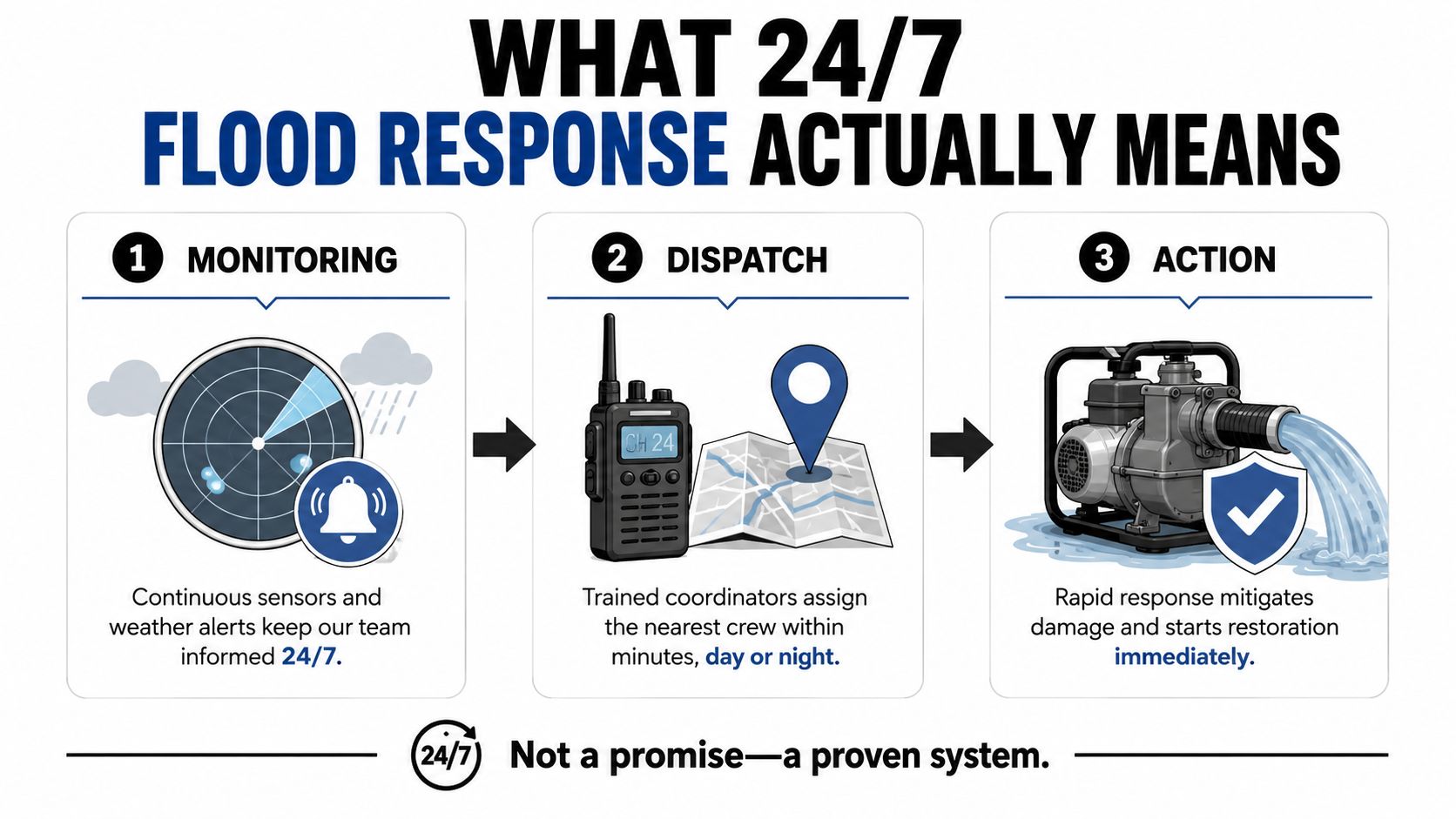
A true 24/7 flood response is an operating system, not a slogan. It means someone is monitoring the call, someone can dispatch a crew, and the crew has the equipment and authority to start mitigation without waiting for business hours. That matters because restoration is a race against moisture migration, hidden saturation, and secondary damage.
The time pressure is not abstract. The National Weather Service reported 230 flood-related deaths in 2025 in the United States, and FEMA-linked guidance commonly notes that 1 inch of water inside a typical home can cause up to $25,000 in damage, while mold can begin growing within 24 to 48 hours on wet materials under the right conditions. Those facts explain why the clock starts the moment water appears, not when the office opens. National Weather Service flood summary
A real response system usually has three jobs going at once.
Monitor, dispatch, act
The first job is tracking the call and the scene. That can mean phone triage, storm alerts, or sensor-driven alarms in a commercial building. The second job is dispatch, which is the difference between “we got your message” and “a truck is rolling now.” The third job is immediate action, extraction, containment, drying, and documentation before damage spreads into wall cavities and assemblies.
A phone line alone doesn't dry a building.
That's why round-the-clock coverage is operational, not cosmetic. If the crew can't isolate the source, start water removal, and commit to structural drying, the “24/7” label doesn't help the property much. For a basic overview of what a restoration company is supposed to do once that call is answered, this service breakdown is a solid reference.
How Emergency Restoration Teams Work the Job
The first on-site decision is source control. Crews identify where the water is coming from, shut or isolate it if possible, and then move straight to extraction, because the longer standing water sits, the farther it travels into materials. That sequencing matches institutional remediation guidance, which says to identify and secure the source first, then remove the water immediately with a flood vacuum and notify facility management. University of Colorado remediation guidance
After extraction, the crew turns to drying the structure itself. Air movers and dehumidifiers are placed to pull moisture out of framing, drywall, flooring, and sublayers, and moisture meters are used to track progress instead of guessing. That's how a mitigation job stays controlled, with daily readings, equipment adjustments, and decisions based on actual conditions rather than appearance.
What happens on the first visit
The first visit is usually about stabilization, not finishing work. Expect assessment, extraction, equipment placement, and a clear explanation of what's wet, what's salvageable, and what needs monitoring. Content handling can happen too, but not everything gets removed right away, because some materials should stay in place until they're inspected and documented.
Antimicrobial treatment may follow when the source and contamination level call for it, but it isn't a substitute for drying. Drying comes first. If the structure stays wet, you can clean surfaces all day and still lose the building materials underneath.
If you need a plainspoken explanation of the technician side of the job, this certification page helps show what trained remediation work is supposed to involve.
Certifications, Equipment, and Insurance Coordination
The quickest way to separate a real mitigation company from a general handyman is to look at three things, training, equipment, and paperwork discipline. IICRC certification tells you the team is trained around water-damage and drying standards. Bonded and insured status matters too, because those are different protections, one relates to financial assurance, the other to liability coverage. If you've ever compared service providers for household work, the same logic applies to hiring window cleaners with confidence, where the distinction between bonded and insured helps you judge risk before anyone starts work.
Equipment that actually matters
Truck-mounted extraction units pull water faster than makeshift cleanup. Commercial dehumidifiers and air movers do the heavy lifting once the standing water is gone. Thermal imaging and calibrated moisture meters help crews find hidden wet areas, especially behind walls, under flooring, and in ceiling assemblies where the eye can't verify the damage.
Insurance coordination is part of the job, not a side conversation. A professional team documents the loss, provides estimates in the format carriers expect, and talks to the adjuster directly instead of making the homeowner repeat the story over and over. That saves time and cuts down on conflicting versions of the same event.
If a company can't explain its drying plan and its documentation process in plain language, keep looking.
One practical reason this matters is that flood work isn't just labor, it's evidence. Clear photos, moisture logs, and itemized scope notes are what help a claim move without unnecessary friction. A crew that treats paperwork as an afterthought usually causes more stress than it removes.
What to Do Before the Restoration Crew Arrives
The first 10 to 30 minutes are yours, and they matter. Your job is not to fix the property, it's to make it safer and easier for the crew to work when they get there. The best triage is calm, quick, and boring.
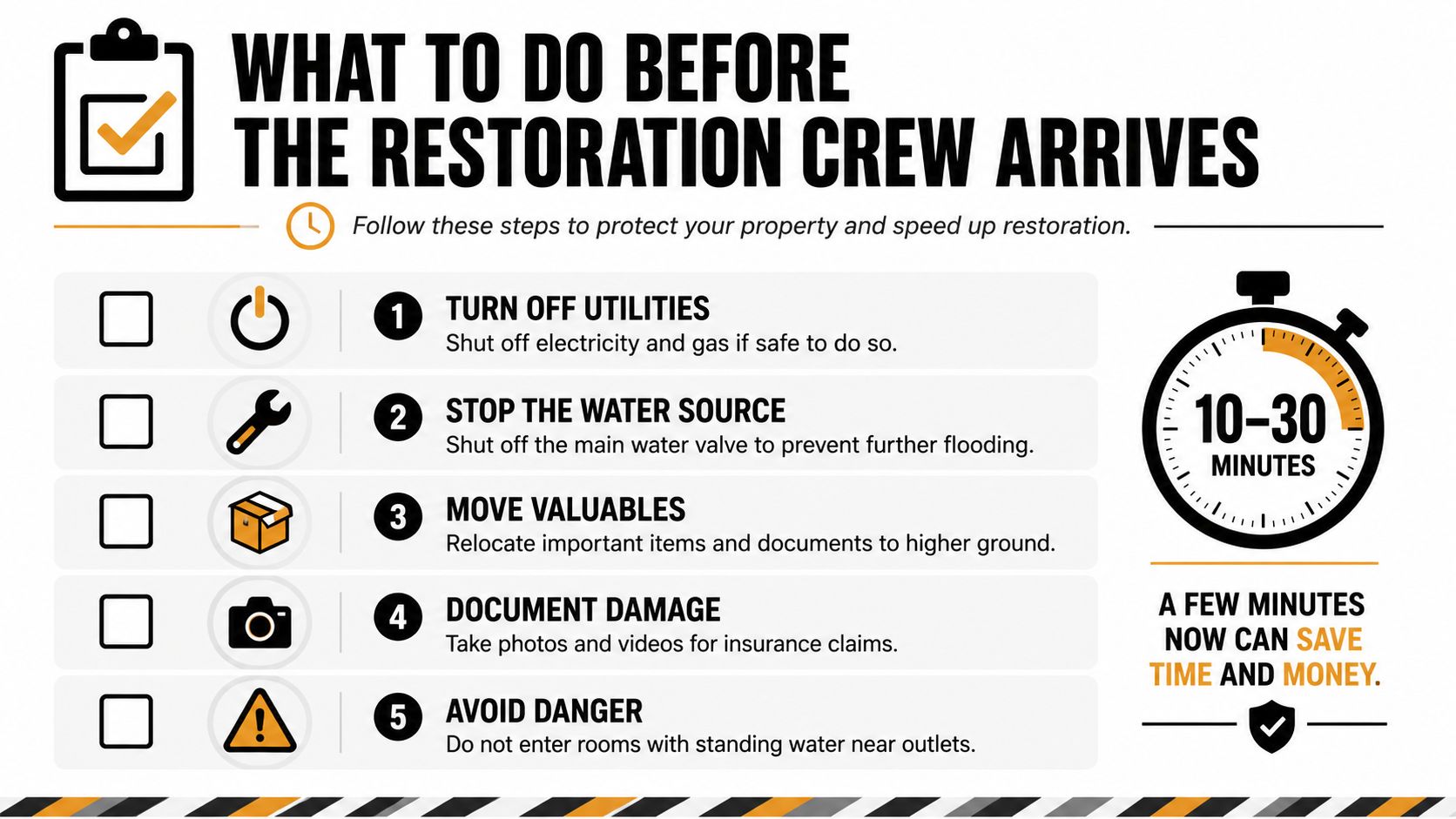
First, shut off electricity if it's safe to reach the panel without walking through standing water. Avoid any area where outlets, cords, or appliances are sitting in water, because electricity and floodwater are a bad mix. If you can safely stop the water source, do that next, then move valuables, documents, and electronics to higher ground.
The right triage steps
- Turn off utilities if safe: Kill power and gas only if you can do it without entering a dangerous area.
- Stop the source: Close the main valve or isolate the failing appliance if you know exactly where the leak is.
- Document everything: Take photos and short videos before moving items, because insurance needs a record of what happened.
- Move high-value items: Get paper records, medication, and electronics out of the wet zone.
- Keep out of danger rooms: Don't walk into standing water near outlets, damaged ceilings, or sagging floors.
What not to do matters just as much. Don't throw away wet materials before they're inspected, and don't run household fans across soaked carpet and call it drying. In humid monsoon conditions, that can spread moisture and slow real mitigation. For a deeper homeowner-oriented checklist, this mitigation guide is worth keeping handy.
The short version is simple. Protect yourself, protect the claim, and don't make the wet area bigger by trying to solve it with the wrong tools.
Matching the Response to the Type of Flood
Not every water problem needs the same midnight response. A supply-line break is urgent because clean water can turn into structural damage fast, but it usually doesn't carry the same contamination burden as a sewage backup. A hidden slab leak may look minor at the surface and still require fast work because the moisture is trapped where you can't see it.
Response Intensity by Flood Type
| Scenario | Contamination Risk | Typical Response Window | Special Precautions |
|---|---|---|---|
| Supply line break | Lower at first, then rising as water sits | Immediate | Shut off water, protect flooring and walls |
| Appliance leak | Usually moderate | Same day, sometimes next day if contained | Check cabinets, subflooring, and adjacent rooms |
| Sewage backup | High | Immediate | Avoid contact, treat as a biohazard, keep occupants out |
| Storm runoff | Variable | Immediate if active intrusion continues | Watch for electrical hazards and hidden wall saturation |
| Slab leak | Often hidden, can grow quietly | Same day | Look for warm floors, damp baseboards, and moisture spread |
That's why the decision isn't just “is there water.” It's “what kind of water, where is it coming from, and is it still moving.” A sewage issue deserves a different level of urgency than a contained appliance drip, and a midnight dispatch makes sense when contamination, active ingress, or safety risk is still in play. For a more detailed look at high-risk contamination cases, this category 3 water damage page gives the right frame.
Service Area Specifics for Phoenix Homeowners
Phoenix-area properties face a different mix of problems than places built around river flooding. Monsoon intrusion, slab leaks, HVAC condensation, and appliance failures are the calls that show up most often in metro homes, condos, and commercial spaces. That's why a local team has to be ready for fast triage across neighborhoods like Phoenix, Mesa, Gilbert, Scottsdale, and Chandler.
A good local response is about logistics as much as cleanup. If a property manager is juggling tenant safety, unit access, and documentation for an insurer, the crew has to communicate clearly and keep the job organized from the start. That's where local service coverage matters, and if you're checking which nearby areas a vendor says it serves, this cities-we-serve page is a useful model for how service territory should be presented.
Restore Heroes handles those local calls with free onsite inspections, 24/7 availability, and no upfront payment, while coordinating mitigation before the paperwork drags the job out. That's especially useful when a homeowner is staring at active damage and can't afford to wait for the rest of the process to catch up. The point is simple, local response should reduce delay, not add another layer of it.
Questions Property Owners Ask Most and What to Do Next
How fast should a real crew arrive? Fast enough that the damage doesn't keep spreading while you wait, but the exact window depends on call volume, location, and road conditions. What matters more is whether they can start mitigation as soon as they're on site.
Do you have to pay up front? Some companies structure billing differently, but you should never let a payment question delay safety steps or source control. If the water is active, stop the source and get help moving.
Will mold happen? Not automatically, but once wet materials stay wet long enough, the risk rises quickly, which is why the drying clock matters. That's also why you shouldn't wait for a prettier day to start.
If you're comparing responses the way you'd compare a service like clean solar panels for efficiency, the same rule applies, speed and consistency matter more than the sales pitch. Call with your address, what happened, whether the water is still coming in, and whether electricity is affected.
If you've got water in the house or a storm moving toward you, contact Restore Heroes now and give them the source, the room, and whether power is still on. They handle emergency water mitigation, drying, sanitation, and insurance coordination across the Phoenix metro area, and the sooner you call, the more damage you can usually keep out of the rest of the structure.