
Dehumidifier rental cost in 2026 usually runs $15-$40 per day, $50-$150 per week, and $100-$350 per month for residential units, with commercial and industrial units costing more. That daily rate is only a slice of the total bill, because delivery, accessories, deposits, electricity, and late fees can push the total much higher than the sticker price.
If you're standing in a wet room with your phone in one hand and a soaked carpet under your feet, that's the number you need first. The problem is that most rental quotes stop at the machine rate and leave you to discover the rest after the truck shows up.
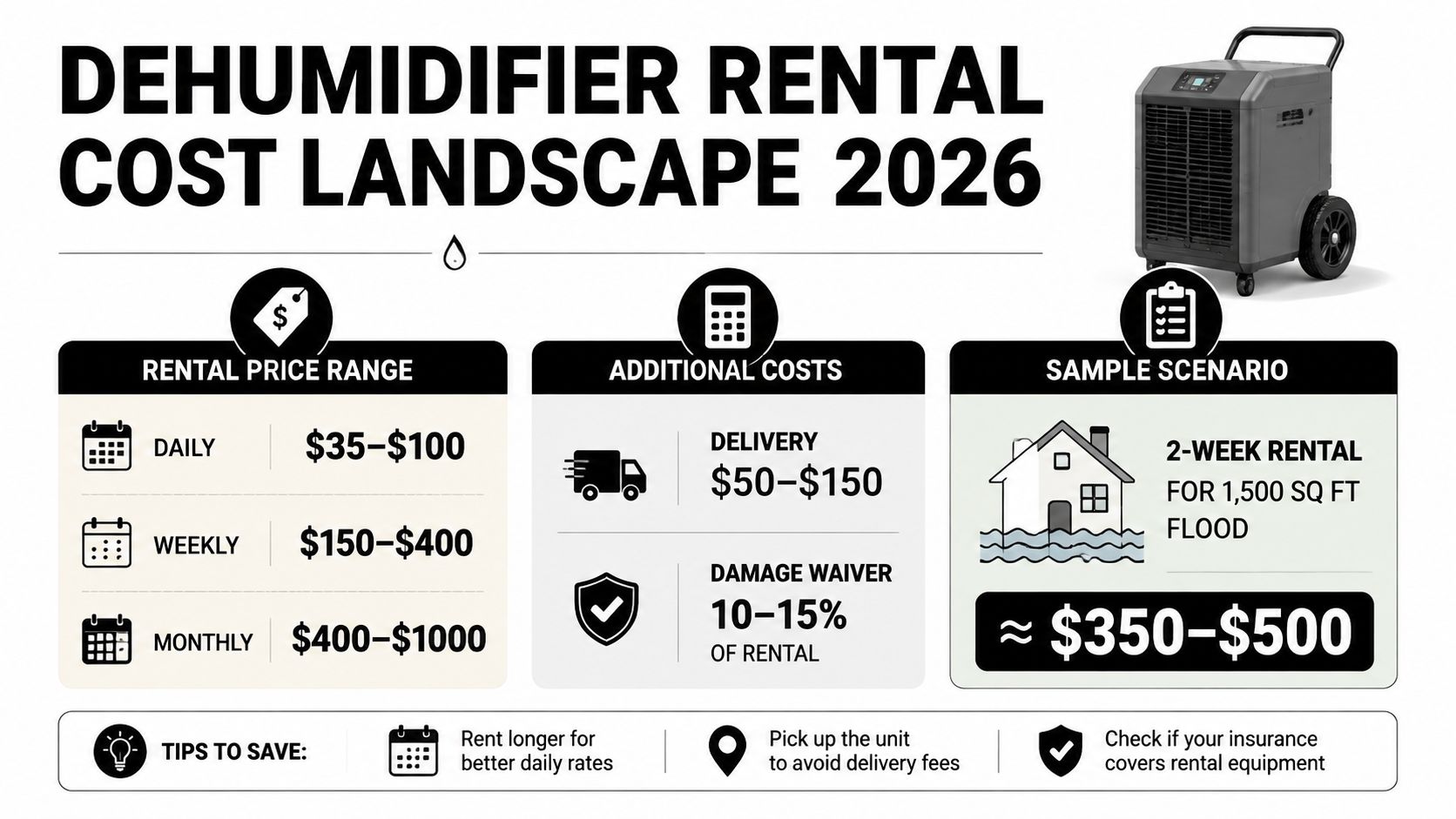
What You Will Pay to Rent a Dehumidifier
The first mistake people make is shopping dehumidifiers like they're buying a box fan. They are not. Rental pricing tracks drying capacity, delivery logistics, and whether you are trying to control humidity in one room or dry a structure after water damage. That is why rental quotes often look cheap at the machine level and expensive once the job gets real.
A small residential unit for a damp basement is one price. A high-output unit for active water mitigation is a different quote altogether. The gap comes from more than the equipment itself. You are paying for a machine that can move more moisture, run longer without failure, and fit the pace of a restoration job.
The numbers in a quote also depend on how the company delivers and supports the rental. Bigger units are harder to move, harder to stage, and usually tied to more demanding jobs, so the rate moves with the service burden. For a grounded local benchmark, compare any quote against a real water mitigation cost page like this Phoenix-area breakdown. It makes clear why the machine rate alone never tells the whole story.
Practical rule: If you are comparing quotes, ask what size unit they are supplying, how long they expect it to run, and what else shows up on the invoice.
That last part matters. A quote can look fair until delivery, hoses, power accessories, or a longer-than-expected rental period show up on the bill. The cleaner the quote, the fewer surprises when the equipment lands at your door.
Daily, Weekly, and Monthly Rate Structures
The billing cycle changes the bill more than most homeowners expect. A renter who chooses the wrong structure can pay more for a short job than they would for a cleaner weekly rate, plus the usual extras like delivery, hoses, power accessories, deposits, and late fees. That is why the question is not the posted rate. It is which billing trigger matches the drying timeline.
Daily pricing only works when the machine is back fast. If the unit stays out longer than planned, the daily total climbs quickly and the quote stops looking cheap. The better move for any job that might stretch past a day or two is to ask for the weekly price first, then compare the full rental period, not the sticker rate.
Weekly billing is usually the smartest middle ground for homeowners. It gives you room for a leak repair, a room dry-out, or a small mitigation job without turning every extra day into a penalty. A lot of rental companies also structure their paperwork around weekly terms because it is simpler to stage, deliver, and collect the equipment on a predictable schedule.
Monthly pricing only makes sense when the job is dragging on or the equipment is tied to a larger restoration plan. At that point, the machine cost matters less than the whole job cost, because the longer run time often means more electricity, more monitoring, and more chances for extensions or late returns. If you are renting for a month, you are usually not dealing with a simple damp room anymore.
A good quote should tell you which billing lane you are in without making you guess. If the company cannot explain why your job is daily, weekly, or monthly, they are pricing the machine, not the drying job.
For jobs that need air movement as well as moisture removal, ask whether the quote also covers the right equipment for the space. A proper rental package may include items that keep the dehumidifier effective, especially if the room needs water damage fans to push wet air toward the unit.
How Unit Size and Capacity Change the Price
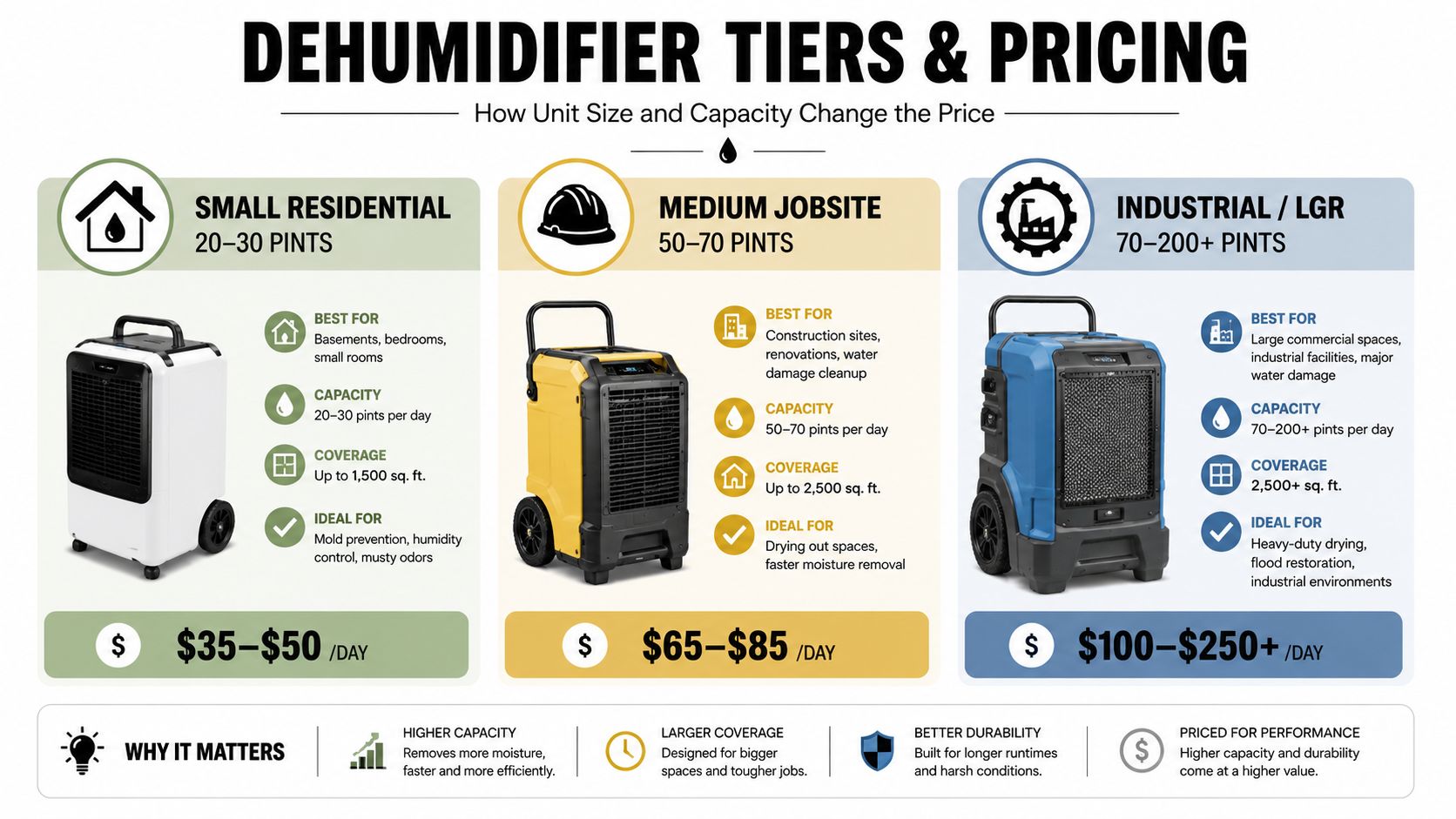
Capacity drives the bill more than the brand name on the casing. Small residential units, medium jobsite units, and industrial or LGR units sit in different price bands because they are built for different moisture loads and different drying timelines. The broad tiering is shown clearly in this dehumidifier rental chart, and the practical takeaway is simple, bigger capacity costs more up front, but the wrong size usually costs more by the end.
Small residential units handle lighter jobs
Small residential units in the 20-30 pint range are usually the cheapest option. They are built for basic humidity control in one room, not for soaked baseboards, wet insulation, or a restoration job that needs real drying pressure.
If you put a small unit on a bigger water loss, you do not save money. You just stretch the rental, extend the electricity bill, and keep the space damp longer than it should stay damp.
Medium jobsite units are the common middle ground
Medium jobsite units in the 50-70 pint range are where a lot of homeowners and property managers end up. That tier fits a contained water loss, a room dry-out, or a repair job where the space still needs solid moisture removal, not just casual dehumidifying.
A useful clue is airflow. The more air the machine moves, the faster the whole drying setup works, which is why crews often pair dehumidifiers with water damage fans instead of expecting one machine to do all the work.
Industrial and LGR units cost more because they work harder
Industrial or flood units in the 70-200+ pint range sit at the top of the rental ladder. A commercial guide from Rock Rental shows that larger industrial and LGR rentals carry a much higher daily and monthly cost than standard residential equipment, and that pricing tracks with what the machines are built to do.
The reason is capacity, not marketing. One industrial model on that commercial listing advertises 55 L/day maximum extraction, while a large commercial unit priced at $100/day advertises 211.6 pints/day maximum removal and 365 CFM airflow Rock Rental. Bigger units cost more because they pull more water, move more air, and hold up better in continuous restoration work.
If the job really needs that class of equipment, the rental bill is only part of the story. The 2026 water extraction insights piece makes the same point from the restoration side, the machine has to match the loss or the drying job drags on and the total cost climbs.
Bottom line: Rent the smallest unit that actually hits the drying target. Too small means a longer job, more power use, and a bigger final bill.
Hidden Costs Most Renters Forget About
The quoted rate is never the final bill. Homeowners and property managers get caught by the add-ons, and that is where the budget blows up. Delivery, pickup, accessories, deposits, late-return penalties, and electricity all change the actual total, and a restoration comparison shows a two-room drying job can reach $925-$1,850 in equipment alone before power use or longer drying time RedMadRobot.
The usual add-ons
| Add-On Fee | Typical Range | Why It Matters |
|---|---|---|
| Delivery and pickup | $20-$50 | The truck does not come free, and the unit still has to be set up correctly |
| Damage deposit | 50% to 100% of rental cost | This can tie up cash before the equipment even starts running |
| Accessories | Varies by quote | Air movers and hygrometers can be billed separately and change the actual total |
| Electricity | Separate from hire cost | Running cost is not the same as rental cost |
| Late-return penalty | Varies by company | A missed return date can turn a short rental into a much more expensive one |
Emergency drying pricing gets even clearer when you look at 2026 water extraction insights. Read it as a cost check, not as a shopping list.
Electricity is real, but it still usually is not the biggest line item
Power use does add to the bill, but it usually sits below the rental charge itself. One 2026 guide estimates a small portable dehumidifier costs $0.40-$1.20 per day to run, while a larger 50-70 pint unit typically costs $1.50-$3.50 per day in electricity alone HVAC Review Hub. In the U.K., Checkatrade says the machine running cost is £0.48-£1.56 per week, separate from the hire cost Checkatrade.
That split matters. You are paying for delivery, setup, and return logistics, not just the machine sitting in your house for a few days.
Ask these questions before you sign
- Does delivery cost extra? Do not assume it is bundled.
- What accessories are included? Air movers and hygrometers often are not.
- What deposit do you hold? Know the cash hit upfront.
- What happens if the drying takes longer? Late fees change the math fast.
- Is electricity my responsibility? It often is.
If you want a broader view of how restoration bills build up, check water damage repair cost details before you approve a rental you have not fully priced.
Sizing the Equipment and Rental Duration You Need
The cheapest rental is the one that ends fastest without leaving moisture behind. That means you need to think in pints per day and cubic feet per minute, not just in brand names or calendar days. In restoration work, the correct unit is usually the smallest one that meets the job's moisture-removal target.
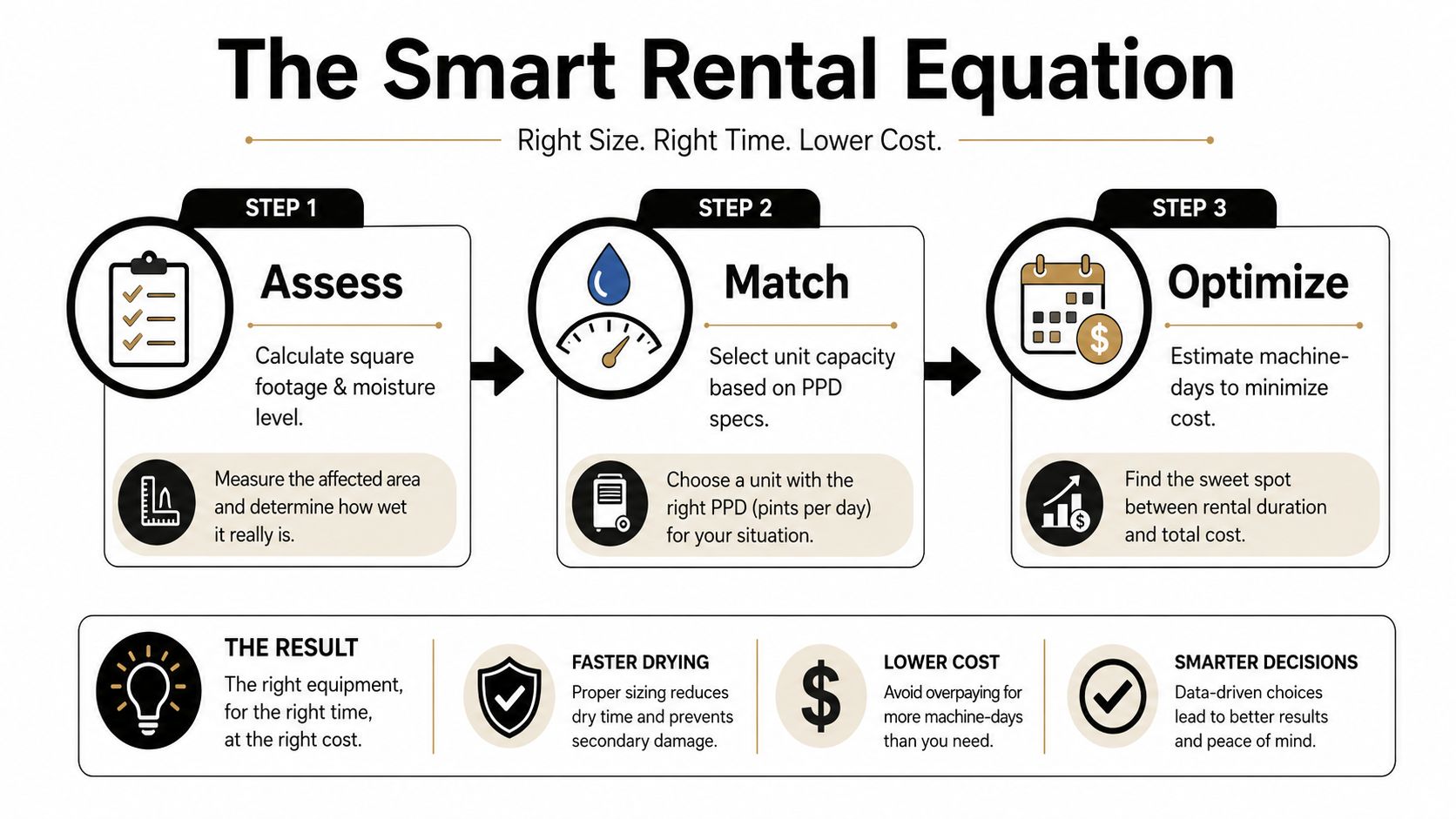
Match capacity to the water loss
A dehumidifier that's too small drags the job out. A unit that's too large can cost more up front, but it may still be cheaper if it cuts the rental duration sharply. That's why crews price the work by machine-days, not by the sticker on the machine.
A practical way to think about it is simple. Assess the room size and moisture level, match the unit to the job's PPD spec, then estimate the number of machine-days before you rent anything.
Drying time drives the bill
A contained residential loss might dry in a few days. A larger structural loss can take longer, especially if walls, flooring, or insulation are involved. The longer the drying window, the more likely a weekly rate is the smarter buy than a daily one.
If you want a broader read on how long restoration work tends to take, review how long water damage restoration takes before you lock in a return date.
Don't ignore humidity and secondary damage
Humidity isn't just uncomfortable, it creates the conditions for more trouble if you leave it hanging around. A practical overview of humidity and pest problems shows why moisture control matters beyond the carpet itself.
Practical rule: If you're still guessing after one walkthrough, the equipment is probably undersized or the loss is bigger than it looks.
The smartest rental is usually the one that finishes drying the structure before the bill starts climbing from extra days, extra pickup charges, and extra stress.
Three Real-World Cost Scenarios
A dehumidifier quote looks small until you put the whole job on paper. Then the difference between a one-room leak and a bigger flood gets obvious fast. The same machine can be cheap in one case and a lousy deal in the next.
Small bedroom after a localized leak
A single bedroom with a known leak usually fits a small residential unit or a modest jobsite unit. If the job runs a few days, the rental often lands in the lower part of the daily or weekly band, but delivery and a deposit can still change the total more than people expect.
My practical budget for this kind of job starts with the rental, then adds pickup and delivery, then adds a cushion for a longer dry-out than you hoped for. If the room needs a hygrometer or an extra air mover, that bill goes up again. A homeowner trying to dry out a tight space like this should also look at West Tennessee crawl space solutions if moisture is showing up below the floor instead of just in the room.
Multi-room flood after a burst pipe
A multi-room flood is where people underestimate the cost the most. This is not a single machine, single-day problem. A larger residential or commercial unit is more realistic, and the total often moves into the weekly rate structure because the drying timeline stretches.
The reason the bill jumps is simple. More space means more moisture load, more airflow needs, and more room for mistakes. If the crew has to keep equipment on site longer, you pay for the extra machine-days whether you planned for them or not.
Small office or retail water loss
Commercial losses often justify industrial or LGR equipment right away. That's because downtime matters and the building may need faster extraction to get back to work safely. A commercial package can also include more than one piece of gear, so the total aligns more closely with a restoration package than with a consumer rental.
A useful benchmark from a water-damage equipment guide is that a full drying setup can cost $200-$600 per day, with individual equipment ranging from $30 per day for an air mover to $250 per day for a commercial dehumidifier Amazing Flash. The same guide says a large residential 70-90 pint dehumidifier rents for $40-$80 per day, while a commercial LGR unit that removes 15-30 gallons per day rents for $100-$250 per day. A separate restoration overview on what a restoration company does shows why small jobs can turn into multi-piece setups once drying, monitoring, and cleanup all get pulled into the same bill.
For a broader look at how a restoration bill gets built, this West Tennessee crawl space resource is useful because it shows how water problems often stop being a single-equipment issue fast.
When Renting Makes Sense and When to Call a Pro
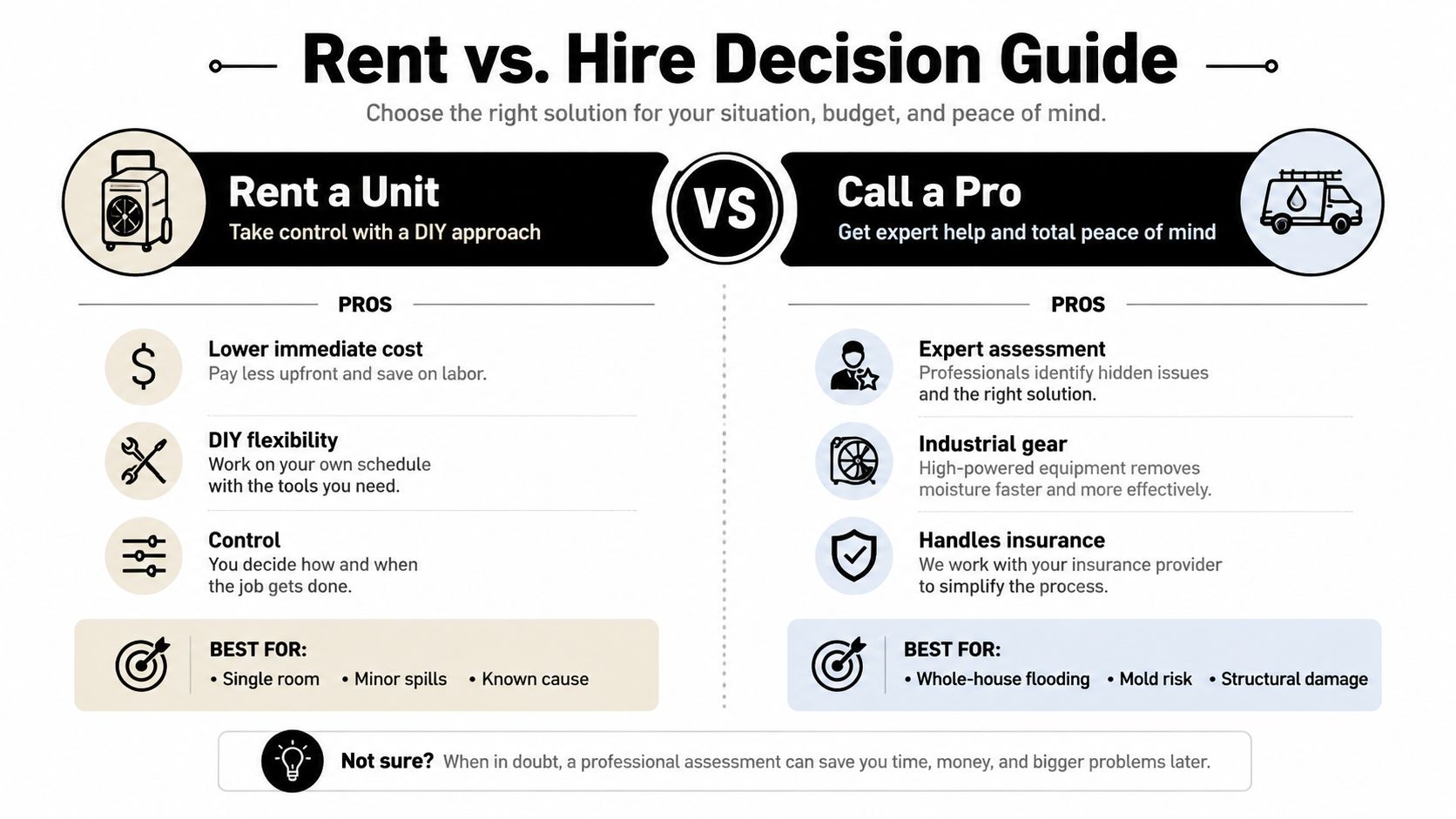
A rental makes sense when the damage is small, contained, and you know exactly what you are drying. One room, a minor spill, or a leak caught early usually stays in the homeowner category. In that setup, renting keeps the immediate bill lower, and you control the timing instead of waiting on a crew.
Rent a unit when the job stays simple
Choose a rental if the water source is obvious, the affected area is limited, and you can keep an eye on the drying without guessing. That is the cleanest case for a homeowner who wants to avoid paying for a full service call.
The catch is simple. If the job runs long, the savings disappear fast. Daily rental math looks good only until the machine stays out longer than expected, and that happens often enough that I never tell people to assume a quick dry unless the moisture readings back it up.
Call a pro when the loss is bigger than a room
Professional restoration is usually the better spend when the job needs multiple air movers, more than one dehumidifier, or fast structural drying. It also makes more sense when the loss involves contaminated water, insurance work, or hidden moisture inside walls and flooring.
If you are unsure whether the structure is drying correctly, you are already in the danger zone for a simple rental.
A contractor's view of what a restoration company does helps make the call clearer before you try to handle a job that needs a crew.
Decide on risk, not pride
A dry room is manageable. A wet wall cavity, soaked flooring system, or a building that has to reopen quickly is a different bill altogether. At that point, a professional assessment beats a guess, because the wrong rental choice usually costs more than the right service call.
For a local example of how moisture problems can get worse in hidden spaces, West Tennessee crawl space solutions shows how water management often turns into a bigger job than one appliance can handle. For larger losses, bringing in a pro is the smarter spend.
Cost-Saving Tips and Your Next Step
Get three quotes, not one. Ask for the weekly rate first, then ask what delivery, pickup, accessories, and deposits do to the total. A cheap daily number is useless if the invoice doubles after the truck leaves.
Keep the bill under control
- Ask for the weekly price: It's the cleanest benchmark for a multi-day job.
- Confirm delivery terms: Some companies bundle it, some don't.
- Return on time: Late fees can wreck a short rental.
- Use a hygrometer: Monitor moisture instead of over-drying the space.
- Match the unit to the job: Don't rent a smaller machine and hope it keeps up.
A good rental quote should tell you the unit size, the expected drying window, and the added fees in plain language. If it doesn't, keep looking.
Know when to stop comparing and call
If the affected area is large, the water source is uncertain, or the job already needs multiple machines, stop chasing consumer rental pricing and get a restoration assessment. That's how you avoid paying twice, once for the wrong equipment, and again for the crew that has to fix what the first plan missed.
If you're dealing with water damage in the Phoenix area, Restore Heroes handles the drying, mitigation, and cleanup side of the job so you don't have to guess at equipment size or rental timing. Visit Restore Heroes to get a professional assessment and move fast before the drying window closes.