
When water gets into your home, you're officially on the clock. The most important tools for winning the race against mold and structural rot are specialized water damage fans. Professionals call them air movers, and they're a whole different beast compared to what you have at home. These are high-powered machines built to blast a focused, high-speed jet of air to speed up evaporation and save your property.
Why Water Damage Fans Are Essential for Drying Your Home
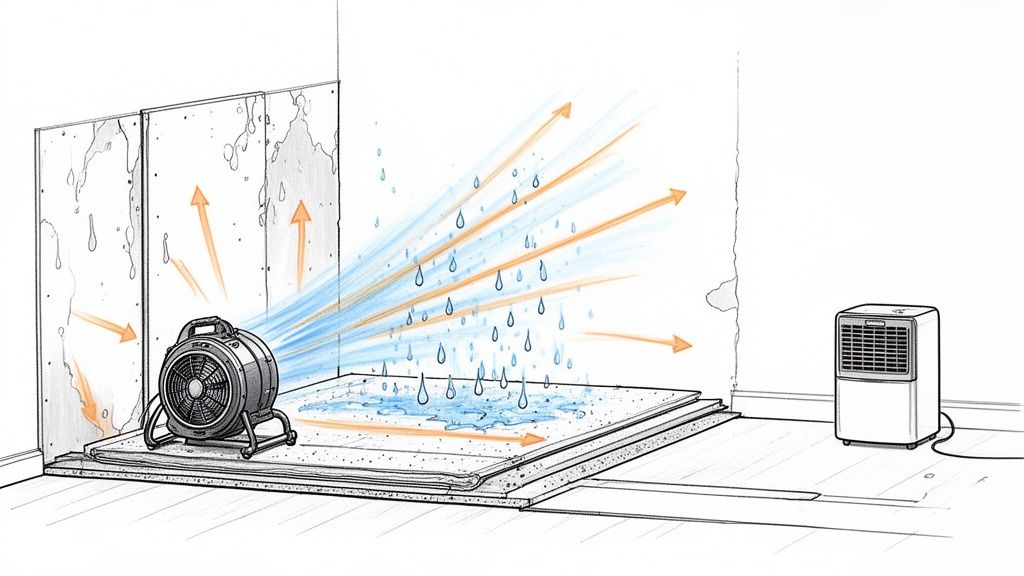
Think of a water-damaged room as completely saturated, not just wet. Moisture doesn't just pool on the floor; it soaks deep into anything porous—drywall, wood subfloors, and carpet padding. A simple box fan might feel like it's helping, but it just doesn't have the muscle to pull that trapped water out.
This is where a real water damage fan shows its worth. Its job isn't just to circulate air; it's to force evaporation, and fast. By hammering wet surfaces with a powerful, targeted stream of air, it literally lifts stubborn moisture out of materials and sends it airborne. This is the cornerstone of professional structural drying.
The Science of Evaporation
There’s a real science to drying a structure properly; it’s not guesswork. The whole point is to create an environment where water can turn from a liquid into a vapor as quickly as possible. To do that, you need a constant cycle of swapping the damp, humid air right at the surface of a wet material with drier air.
On a professional restoration job, air movers and dehumidifiers are a tag team. The fans do the heavy lifting of pushing moisture into the air. Then, the dehumidifiers grab that moisture out of the air, creating a powerful and continuous drying loop.
Here in Phoenix, this is critical. Our dry desert air can fool you. Surfaces might feel dry to the touch, but moisture can still be trapped deep inside your walls or underneath the flooring. That hidden dampness is a perfect invitation for mold and can cause wood to rot from the inside out. It's important to know about the hidden dangers of water damage, which go way beyond what you can see.
More Than Just a Wet Floor
The fallout from not drying things correctly goes far beyond a stained rug. On a much larger scale, a 2025 report showed just how devastating water-related disasters can be. In a single year, these events led to almost 5,000 deaths, displaced around 8 million people worldwide, and caused economic damage topping US$360 billion.
While a burst pipe in your home is thankfully on a much smaller scale, the core truth is the same: water that isn't controlled causes serious, expensive damage. Using the right equipment, especially professional-grade water damage fans, isn't just a good idea—it's essential for getting the job done right. If you're dealing with a specific problem area, our guide on how to dry out a flooded basement has more detailed steps.
How Air Movers Win the Battle Against Hidden Moisture
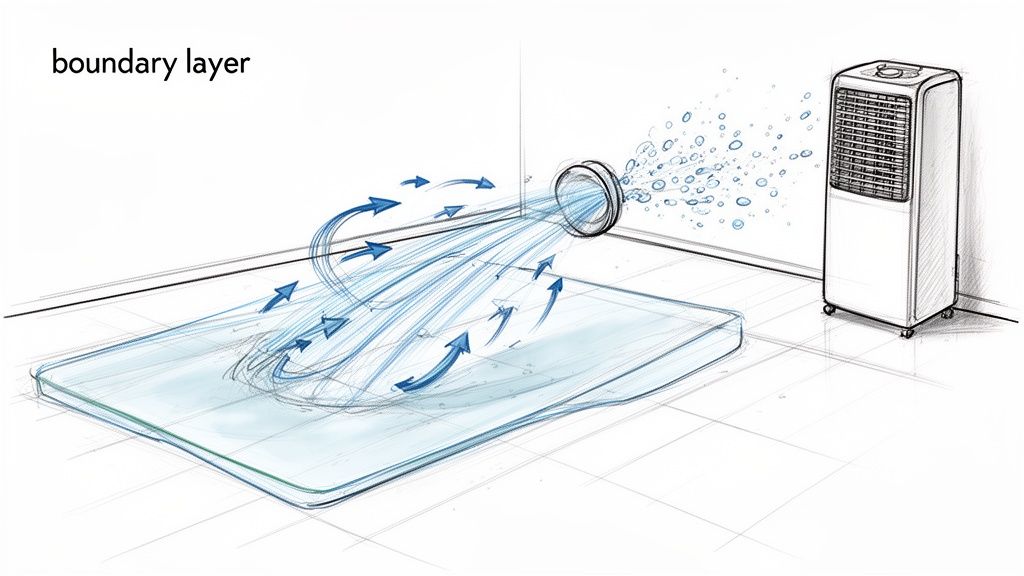
To really get why professional water damage fans are so good at their job, you have to look past the puddles. The real fight is happening on a microscopic level, against an invisible enemy called the boundary layer.
Think of it like a thin, stubborn blanket of cold, moist air that clings to a wet floor or damp drywall. This little layer of air is totally saturated, so it can't absorb a single drop more water from the surface it's covering. It basically puts a lid on evaporation.
Your average box fan might stir the air in a room, but its gentle, unfocused breeze just doesn't have the muscle to break through this barrier. That's where professional air movers come in—they're built specifically for this kind of fight.
Shattering the Boundary Layer
An air mover doesn't just circulate air; it blasts it. It shoots a concentrated, high-velocity stream of air directly at the wet surface. It's the difference between trying to clean a dirty patio with a garden hose versus a pressure washer.
This powerful airflow shatters that saturated boundary layer, instantly replacing the wet air with drier air from the room. That forces the damp material to release its trapped moisture into the new, dry air. The air mover then blows that newly humid air away, and the cycle starts all over again.
This constant, forceful exchange is the secret to proper structural drying. It’s not about heat. It’s about aggressively replacing wet air with dry air right at the surface, which pulls moisture out from deep inside the materials.
Getting this right is more important than ever. We're seeing more intense and frequent extreme rainfall events across the globe. In fact, maximum daily precipitation has been climbing by 2.3% per decade, meaning homes are at a greater risk of flooding and water intrusion. You can read more about these developing weather patterns and what they mean for homeowners.
The Drying Tag Team: Air Movers and Dehumidifiers
Of course, just blowing all that moisture into the air is only half the job. If you only run water damage fans, you'll just end up turning your house into a swampy, humid mess. That's where the second hero of professional drying comes in: the commercial dehumidifier.
Together, they create a powerful and continuous drying cycle:
- Release: Air movers hit wet surfaces hard, forcing trapped moisture to evaporate into the air.
- Capture: A big dehumidifier sucks in that humid air, pulls the water out, and collects it as liquid.
- Recycle: The dehumidifier then pushes warm, incredibly dry air back into the room.
- Repeat: The air movers grab this super-dry air and blast it against the wet surfaces again, ready to absorb even more moisture.
This is the one-two punch that allows restoration pros to pull moisture out of the very bones of your house—the drywall, wood studs, and subfloors. It's a methodical, scientific process that a few simple fans could never match. Without this tag-team approach, hidden moisture gets left behind, creating the perfect setup for mold and rot.
Comparing Different Types of Water Damage Fans
When a restoration crew shows up, you'll see they don't just roll in with one type of fan. The equipment they bring is chosen for a specific purpose, a lot like a surgeon picking the right tool for a delicate operation. Not all air movers are created equal, and understanding the "why" behind their choices demystifies the whole structural drying process.
The two main workhorses you'll see on almost any water damage job are Centrifugal fans and Axial fans. They both move air, but how they move it and where they're most effective are worlds apart. Picking the right tool for the job is the difference between a quick, thorough drying and a job that drags on.
The Focused Power of Centrifugal Fans
Centrifugal fans are probably what you picture when you think of professional drying equipment. They're the ones with that distinct, snail-like shell, which is why we often call them "snail fans." That shape isn't just for show—it's the secret to their power.
A centrifugal air mover sucks air in from the side, spins it through an impeller wheel, and then shoots it out of a small, concentrated snout at high velocity.
Think of it like putting your thumb over the end of a garden hose. The amount of water stays the same, but the pressure skyrockets. A centrifugal fan does that with air, creating a powerful, targeted jet stream.
This high-pressure, laser-focused airflow is perfect for blasting moisture out from specific, tricky spots. We use them all the time to:
- Shoot air under kitchen and bathroom cabinets where water loves to hide.
- Target the "wet wall" effect by aiming the snout right along the baseboards.
- Force air into wall cavities or other tight structural nooks and crannies.
Because of this design, they are masters at pushing air through dense, saturated materials like carpet and padding. They cut right through that stubborn surface layer of moisture with real force.
The High-Volume Airflow of Axial Fans
Axial fans, on the other hand, look more like your typical fan. They have big blades that spin around a central hub, a bit like an airplane propeller. Their whole purpose isn't to create intense pressure; it's to move a massive amount of air across a big, open room.
An axial fan pulls air straight from behind and pushes it directly forward, creating a wide, high-volume column of air. This makes them the clear winner for drying large, open areas like living rooms, basements, or commercial spaces. They excel at promoting overall air circulation and dramatically speeding up evaporation across broad surfaces.
Understanding the Technical Specs
To really know what a fan can do, pros look at a few key technical specs that define its power and efficiency on the job.
CFM (Cubic Feet per Minute): This is all about air volume—how much air the fan can move in one minute. Axial fans are the champs here, often boasting a much higher CFM. A good axial fan can push 2,000 to 4,000 CFM or even more, making it perfect for ventilating large spaces.
Amperage (Amps): This tells you how much electricity the fan needs. It's a critical number because on a water damage job, we might have dozens of machines running at once, all on your home's circuits. A low-amp fan means we can safely plug more units into a single circuit without constantly tripping the breaker. Most modern, efficient air movers are designed to draw between 1.5 and 2.5 amps.
To make it even clearer, let's break down the key differences between these two essential tools.
Centrifugal vs. Axial Air Movers at a Glance
This table sums up the core differences and helps show why a professional crew brings both types of fans to a job site.
| Feature | Centrifugal Air Movers (Snail Fans) | Axial Air Movers |
|---|---|---|
| Airflow Pattern | High-pressure, focused jet stream | High-volume, wide column of air |
| Best Use Case | Targeted drying (under cabinets, along walls, in cavities) | Drying large, open spaces (living rooms, basements) |
| Primary Strength | Precision; forces air into and through dense materials | Moves a massive amount of air for general circulation |
| Typical CFM | Lower CFM, focused on pressure | Higher CFM, focused on volume |
| Common Application | Drying carpet, padding, subfloors, and structural cavities | Ventilating large rooms and speeding surface evaporation |
By strategically using both types of fans, restoration pros create a powerful drying vortex customized to your home's specific situation. We might place centrifugal fans around the room's perimeter to hit the walls and floors, then stick a high-volume axial fan in the center to keep all that moist air moving. It’s a one-two punch that helps to get every last bit of moisture taken care of.
The Professional Strategy for Equipment Placement
Placing water damage fans isn't just about pointing them at a wet spot and hoping for the best. That’s the DIY approach. When a professional restoration technician walks into a water-damaged room, they’re thinking like a scientist, not a handyman. They're engineering a controlled drying environment, and every piece of equipment has a specific job to do.
It all starts with a thorough assessment. We don't just look at the puddle on the floor; we use specialized tools like moisture meters to map out exactly where the water went. We need to know how far it spread behind the walls and how deep it soaked into the subfloor. We measure the room's total size (the cubic footage) and identify every single material that got wet—drywall, carpet, insulation, you name it.
That data gives us the numbers we need to calculate the precise amount of drying equipment for the job. Industry standards, set by organizations like the IICRC, give us a formula. It tells us exactly how many air movers and dehumidifiers are required for the size of the room and how saturated it is. This way, we bring in enough power to get the job done right, without overdoing it.
Creating the Drying Vortex
With the right number of fans on site, the real art and science begins: placement. The goal is to create a powerful, circular airflow that we call a drying vortex. This isn't just random air movement; it's a carefully choreographed whirlwind designed to encourage a constant flow of warm, dry air hits every single wet surface.
Think of it like a whirlpool of air, continuously sweeping across the floors and up the walls. We create this effect by setting up our centrifugal fans (the "snail" fans) along the perimeter of the room. Each one is angled at about 15 to 45 degrees to the wall, with its snout aimed right at the baseboard. This creates a high-pressure jet of air that peels moisture right off the surface and pushes it into the air.
The next fan in the line is positioned to catch that stream of air and send it along to the next, building a powerful, room-circling current. In a larger space, we might place a big axial fan in the middle, pointing up at the ceiling, to keep all that humid air circulating and moving toward the dehumidifier, which is working hard to pull it all out.
This simple comparison shows the two key players in this process and what they're built to do.
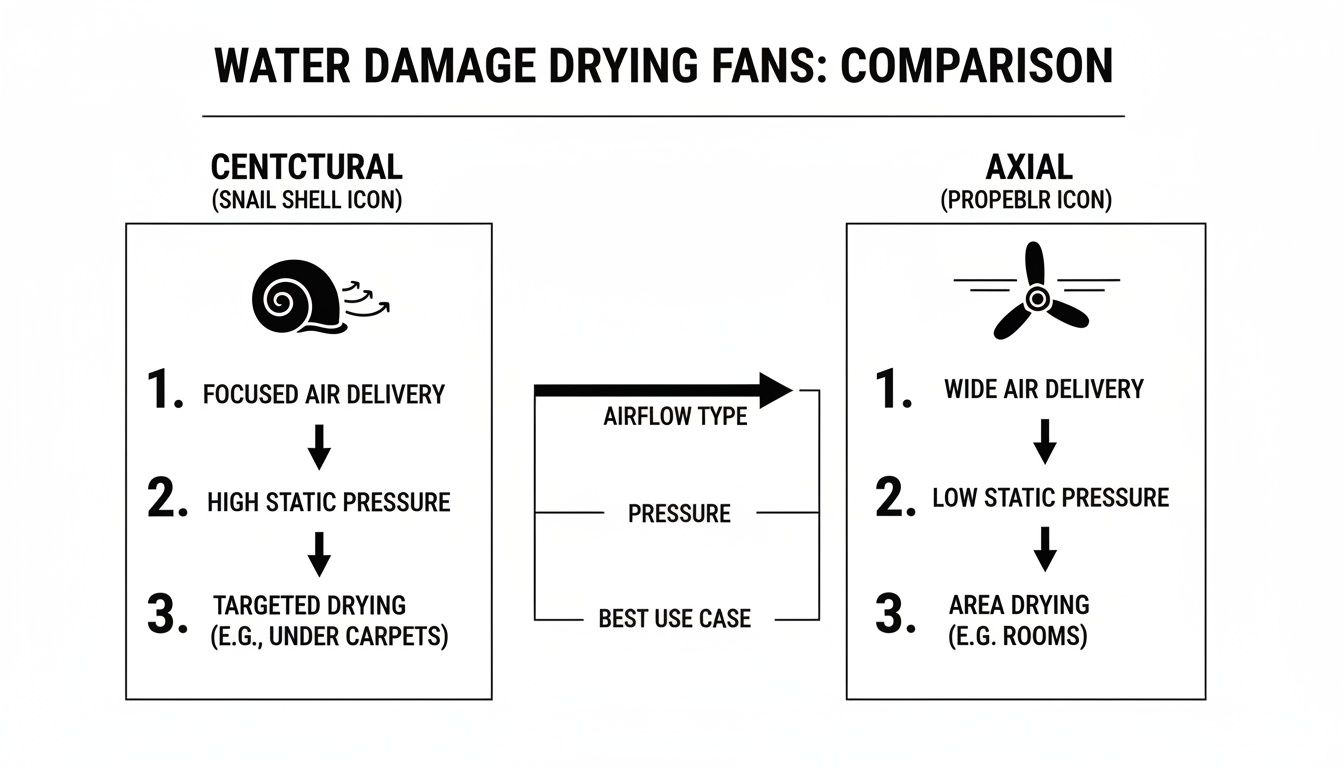
As you can see, the centrifugal fans give us that focused, wall-blasting power, while the axial fans are the workhorses for moving massive volumes of air around the room.
Monitoring and Adjusting for a Perfect Dry
Setting up the equipment is only day one. The job isn’t done until the building materials are back to their normal, pre-loss moisture levels—what we call the "dry standard." To get there, we come back every single day to check our progress.
A professional drying process is dynamic, not static. We don't just "set it and forget it." Technicians take new moisture readings daily, moving fans and adjusting the setup as certain areas dry out faster than others.
This daily monitoring is absolutely critical. A heavily soaked corner might need an extra fan focused on it for another 24 hours, even after other parts of the room are perfectly dry. By constantly tweaking the system based on real data from our meters, we avoid two huge problems:
- Under-drying: This is the most dangerous mistake. Leaving hidden pockets of moisture behind is an open invitation for mold growth and wood rot.
- Over-drying: Blasting materials like hardwood with too much heat and airflow can cause irreversible damage, like cracking, warping, and shrinking.
This scientific, data-driven approach is what separates a professional from a well-intentioned amateur. It promotes a complete and safe recovery, which is a world away from the guesswork of a DIY setup. If you’re facing a situation that feels out of your control, you can learn more about our comprehensive emergency flood cleanup services and see how our team manages the entire process from start to finish.
Common Drying Mistakes and How to Avoid Them
When you're dealing with water damage, firing up a few high-powered water damage fans seems like the obvious first step. But in my experience, a few simple mistakes can turn a small problem into a costly disaster. Using these tools the wrong way doesn't just slow things down; it can spread contaminants all over your house and even create new hazards.
Let's not forget the bigger picture. Flooding is a massive issue globally, causing a staggering US$388 billion in average yearly losses and making up 35–40% of all weather-related disasters. Even a localized leak in your home is a big deal, and knowing how to respond correctly is crucial. You can discover more about the global impact of flooding to see just how serious it is.
Here are the most common mistakes I see people make, and how we pros do it differently.
Mistake 1: Running Fans Too Soon
When you see a puddle, the gut reaction is to aim a fan at it. Resist that urge. Turning on high-velocity fans while there’s still standing water is one of the worst things you can do.
- Here’s Why: Those powerful air movers will literally spray contaminated water into the air. Think about it—any bacteria, chemicals, or nasty stuff in that puddle gets aerosolized, coating walls, furniture, and everything else. It’s like turning a sprinkler on, but with dirty water.
- The Professional Approach: We always extract first. Before a single fan gets plugged in, we use commercial-grade pumps and vacuums to get every last drop of standing water out. Only then do we bring in the water damage fans to start pulling the deep, absorbed moisture out of the structure itself.
Mistake 2: Forgetting the Dehumidifier
Just running fans without a dehumidifier is like trying to dry a wet towel in a sauna. It's a pointless exercise. You're just moving water around, not getting rid of it.
- Here’s Why: The fans do their job by speeding up evaporation, which dumps a ton of moisture into the air. If you don't have a powerful dehumidifier running to capture that moisture, you just create a hot, humid, tropical environment inside your home. In a place like Phoenix, that’s an open invitation for mold, which can start growing in just 24-48 hours.
- The Professional Approach: We always use fans and dehumidifiers together. It's a one-two punch: the fans push moisture into the air, and the dehumidifiers immediately pull it out. This creates a powerful drying cycle that gets your home dry fast.
A common DIY mistake is creating a "human terrarium." By running fans alone, you just move moisture from the floor to the air, making the problem worse and creating ideal conditions for secondary damage like mold.
Mistake 3: Overloading Electrical Circuits
Professional air movers are beasts. They draw a lot of power, and we often need to run a dozen or more on a single job. Just plugging them into the nearest outlets is asking for trouble.
- Here’s Why: Overloading a circuit will just keep tripping the breaker, which means your equipment shuts off and the drying stops. At worst, you could overheat the wiring and start a fire—the last thing you need on top of a water emergency.
- The Professional Approach: We’re trained to read a home's electrical system. We'll map out the circuits and do the math to see how many fans we can safely put on each one. By carefully distributing the load, we ensure the equipment runs nonstop. This careful management is a huge part of learning how to prevent mold after a flood because it keeps the drying process moving without interruption.
Knowing When to Call a Water Damage Professional
While renting a few water damage fans seems like an easy fix, it's critical to know when you're in over your head. The line between a small, manageable spill and a full-blown property disaster can be thinner than you think. Getting it wrong can have serious consequences for your home and your health.
Sure, if you spill a glass of clean water on a tile floor, you can probably handle that. But the second that water hits porous materials, the game changes. Once water soaks into drywall, gets behind baseboards, or saturates your carpet and padding, you've got a problem that fans alone can't solve. These materials are like sponges, locking in moisture where it can do the most damage.
Red Flags That Demand a Professional Response
Some situations are just not meant for a DIY approach. Trying to tackle these on your own almost always leads to bigger problems down the road—think structural rot, widespread mold, and thousands in secondary damages.
If you see any of these signs, it's time to pick up the phone:
- Contaminated Water: Did the water come from a toilet backup, dishwasher overflow, or outdoor flood? That’s "gray" or "black" water (Category 2 or 3), and it’s a biohazard. It’s teeming with bacteria and other nasty stuff that requires professional safety gear and sanitation to handle safely.
- Large Affected Area: Is the water in more than one room? Has it seeped into the subfloor or wicked up the walls? This is no longer a small spot-drying job. A professional team has the sheer volume of equipment and manpower to tackle a large-scale drying project correctly.
- A Musty Odor Appears: That first whiff of a damp, earthy smell is the universal sign of mold. In the right conditions, mold can start growing in just 24-48 hours. Once it takes hold, you need a professional to get rid of it for good.
Water damage is incredibly deceptive. A small wet patch on the ceiling could be masking a huge, saturated area in the attic. A damp spot on the wall might mean the entire wall cavity is soaked. Pros don't guess—they use tools like moisture meters and thermal cameras to find every last drop of hidden moisture.
When you're facing these issues, a certified restoration team is your best bet. They don’t just show up with a truck full of powerful water damage fans and dehumidifiers; they bring a scientific approach to the entire problem. They'll assess the damage, extract the standing water, create a strategic drying plan, and give you all the documentation you may need for your insurance claim.
To get a better sense of the entire process, see what a certified water damage restoration contractor does to bring a home back to how it was before the disaster.
Frequently Asked Questions About Water Damage Fans
When you're dealing with water damage, the sight of big, noisy fans can bring up a lot of questions. It's totally normal to wonder what they're doing and how long they'll be there. Let's clear up a few of the most common things people ask us.
How Long Do Water Damage Fans Need To Run?
There's no single magic number, but most drying projects have fans running continuously for about three to five days. Think of this as a general ballpark figure.
The real answer depends on what we're up against. How much water is there? What got wet—is it porous concrete or dense hardwood? What's the humidity like in the room? We don't guess. Our technicians use professional moisture meters to track the drying progress every single day. The fans stay on until every affected material is back to its normal, dry state. For a more detailed breakdown, check out our guide on how long water damage restoration takes.
Can I Just Use Regular Box Fans Instead?
It's a logical question, and while a regular fan is better than nothing, it's really not in the same league as a professional air mover. Your typical box fan is designed to move air around a room for comfort. It's a gentle breeze.
Professional air movers are a different beast entirely. They're built to blast a concentrated, high-speed jet of air directly across wet surfaces like floors and walls. This powerful airflow is what actually forces trapped moisture to evaporate quickly. A box fan just doesn't have the muscle to do that effectively.
Is It Safe To Leave The Fans Running Unattended?
Absolutely. Professional water damage fans are built for the job. They're heavy-duty machines designed to run 24/7 for days on end without any issues.
The key, though, is professional setup. A certified technician knows exactly where to place them for maximum effect and safety—on a stable, dry surface far from any standing water. More importantly, we manage the power draw by plugging them into different electrical circuits. This prevents overloading your system, so you don't have to worry about tripped breakers in the middle of the night.
When you're facing water damage, having the right team and the right equipment is everything. For a professional assessment and fast response here in the Phoenix area, you can count on the experts at Restore Heroes. Give us a call 24/7, and we'll work to get your property dry so you can get back to normal. https://www.restoreheroesaz.com