
When you first discover a flood in your home, it's a frantic, heart-pounding moment. The natural instinct is to start saving things, but the most critical actions you take in these first few minutes have nothing to do with cleanup. It's all about safety.
This initial phase—what we call emergency flood cleanup—is about securing the area before any water removal even begins. Getting this part right prevents serious injury and sets the stage for a smoother recovery.
Your First Moves When Facing a Flood
Walking in to find water rapidly filling your space is overwhelming. In that chaos, it's tough to think straight. But your immediate priority isn't the water itself; it's the hidden dangers it brings with it.
The two biggest threats in any flood are electrocution and contamination. Never, ever step into standing water unless you are certain the power is off. Water is a fantastic conductor of electricity, and a live current in that water can be deadly.
Prioritizing Safety Above All Else
First things first: head for your home's main circuit breaker. If you can get to it without wading through water, shut off the power to the entire house.
What if the breaker box is in the flooded area, like the basement? Don't go near it. Get out of the house immediately and call your utility company or the fire department. They can shut the power off safely from the outside.
With the electrical risk handled, your next move is to stop the water at its source, if you can. For a burst pipe or a failed water heater, you'll need to find your home's main water shutoff valve. It’s usually where the main water line comes into your house—check the basement, a crawl space, or an outside utility box. A clockwise turn should stop the flow.
This simple flowchart nails the immediate safety protocol.
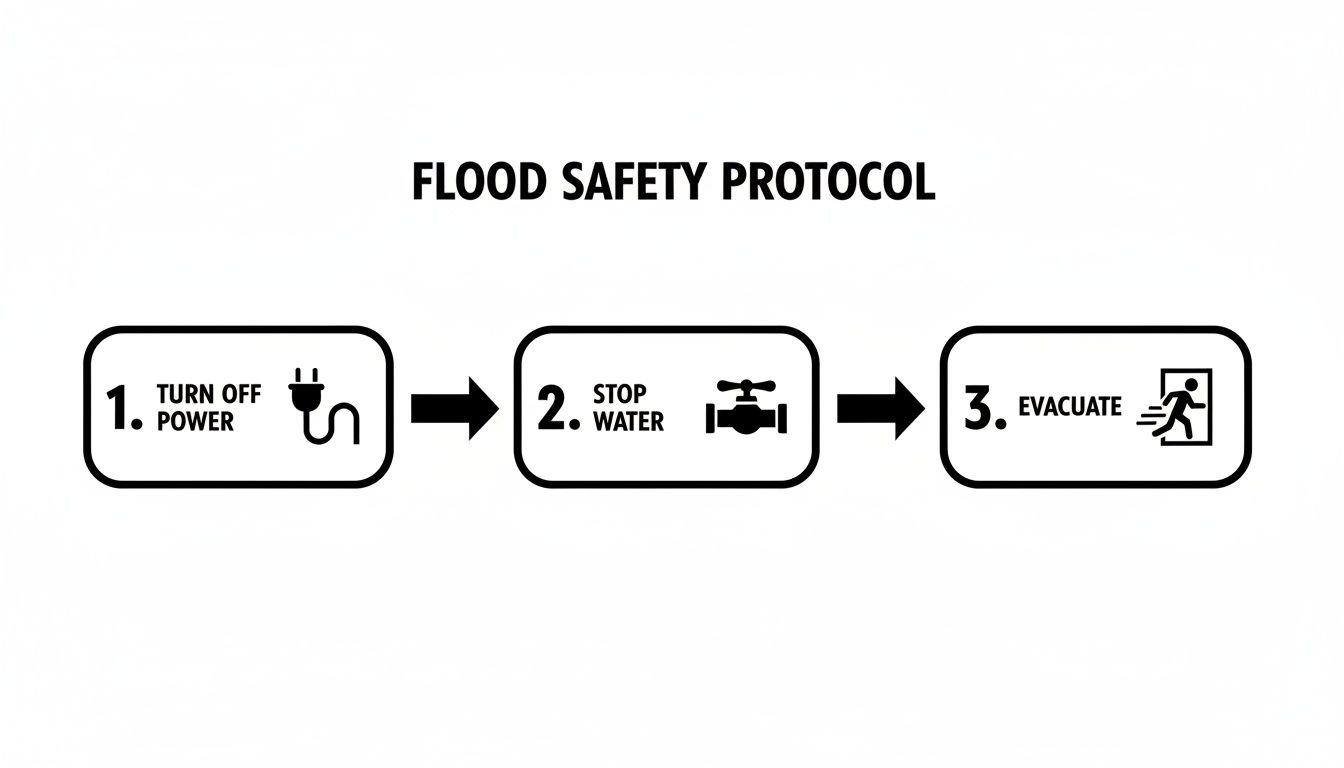
Think of it as your mantra in a crisis: Power off, Water off, Everyone out.
The Importance of Evacuation
Once you've dealt with the utilities, get everyone out. That includes family, roommates, and pets. Floodwater is a toxic soup. It can be contaminated with everything from raw sewage and household chemicals to sharp debris you can't see just below the surface.
It only takes about six inches of moving water to sweep an adult off their feet. Don't underestimate it.
The rule is simple: if the water is rising or you have any doubt about the safety of your home, get out. You can replace your stuff; you can't replace yourself.
A flooded basement presents its own set of challenges, and it's crucial to handle it correctly once the immediate danger has passed. You can learn more about the specific steps in our guide on how to dry out a flooded basement.
Also, remember that water is incredibly heavy. The weight and pressure can weaken your home's foundation, floors, and walls, creating a very real risk of collapse.
Don't even think about going back inside until a professional has inspected the property and given the go-ahead. This first stage of flood cleanup is purely about managing risk. The real restoration work comes much, much later, but only after you’ve made the scene safe.
How To Document Damage For An Insurance Claim
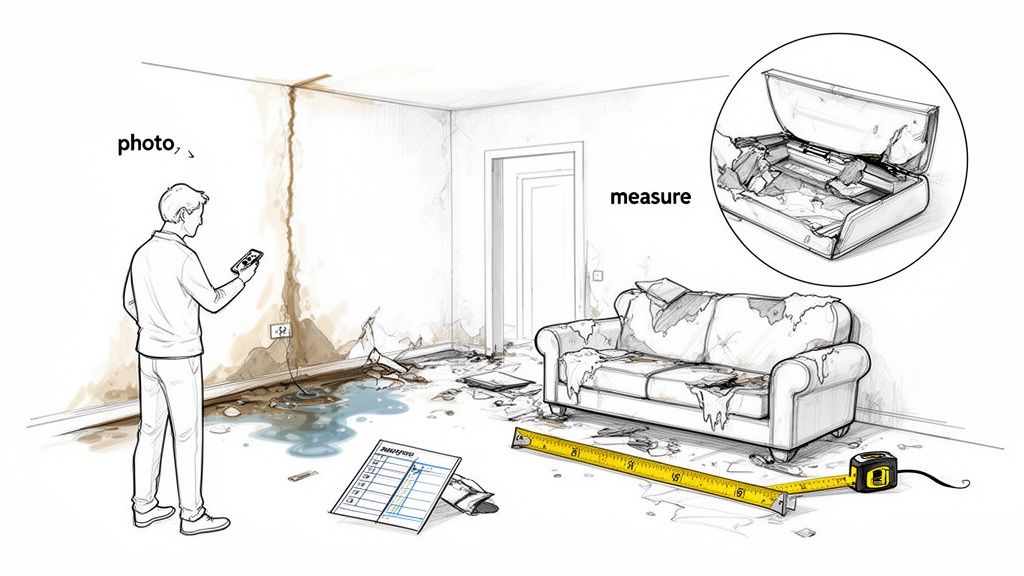
Once everyone is safe, your next priority is to document absolutely everything. This isn't just a suggestion; it's the bedrock of your insurance claim. Think of yourself as a crime scene investigator building a case. The more evidence you gather, the stronger your claim may be, and the smoother your financial recovery.
Don't make the mistake of waiting for the water to disappear before you start. If you can safely do so, start recording right away. Capturing the flooding at its peak provides undeniable proof of how high the water got and the initial scale of the damage.
Your Camera Is Your Best Friend
Your smartphone is the most important tool you have right now. Start by taking a slow, steady video walkthrough of every affected area. As you walk, talk to the camera—narrate what you're seeing, mention the specific room you're in, and state the date and time. This video gives your insurance adjuster a powerful, real-time overview.
After the video, switch to taking still photos. You can’t take too many.
- Wide Shots: Get a full picture of each room from every corner to establish the overall scene.
- Medium Shots: Zoom in on specific damaged areas, like a warped cabinet or a water-soaked piece of furniture.
- Close-Ups: Capture the fine details. Get clear shots of damaged electronics, furniture, and personal items. If you can see a model or serial number, snap a picture of it.
Make sure to get clear photos of the high-water marks left on walls, furniture, and doorways. These lines are critical evidence that proves the depth of the flooding, a key detail in any emergency flood cleanup assessment.
Create An Itemized List of Losses
Photos and videos are crucial, but a detailed written list gives your claim the structure it needs. Go through your home room by room and create an inventory of every single thing that was damaged. The more specific, the better.
For example, don't just write "sofa." Instead, list it as a "Gray, three-seat sectional sofa from Living Spaces, purchased in 2021." For a TV, note the make, model, and screen size. This level of detail helps the adjuster assign an accurate replacement value instead of a generic one.
I see this mistake all the time: homeowners throw out ruined belongings before the adjuster sees them. Unless an item is a clear health hazard, do not throw it away. Move it to a garage or a tarp in the yard if you must, but your adjuster needs to see the physical proof firsthand.
To keep everything organized, a simple spreadsheet is perfect. Below is a checklist to guide you through what’s most important to document.
Essential Damage Documentation Checklist
This checklist will help you create a thorough record of the damage, which is exactly what your insurance company needs to see.
| Action Item | Why It's Critical | Pro Tip |
|---|---|---|
| Photograph the Source | Shows the origin of the flood (e.g., burst pipe, storm entry point). | If possible, take photos before you or anyone else makes temporary repairs. |
| Document High-Water Marks | Proves the depth and extent of the water intrusion. | Place a ruler or tape measure next to the waterline in your photo to provide a clear scale. |
| List Every Damaged Item | Creates a comprehensive record for valuing your total loss. | Dig up receipts, credit card statements, or even old photos to prove the original cost and condition of high-value items. |
| Keep Damaged Belongings | Provides physical evidence for the insurance adjuster's inspection. | If you can't save a whole item like a soaked carpet, cut out a small square as a sample. |
Taking these steps will put you in a much stronger position when filing your claim.
Know What Your Policy Covers
Great documentation is only half the battle; you also need to know what your insurance policy actually covers. Standard homeowners insurance policies often don't cover damage from groundwater flooding. It’s crucial to understand if private flood insurance or an NFIP policy is needed for your home before a disaster strikes.
Navigating the claims process can feel overwhelming, but being prepared makes a difference. For more guidance, take a look at our water damage insurance claim tips page. The hard work you put in now may pay off in a faster, fairer settlement.
Understanding What’s Really in That Floodwater
Here's a significant mistake homeowners can make during an emergency flood cleanup: they underestimate the water itself. It’s natural to see it as just a massive, messy inconvenience. But floodwater is almost never just water.
Think about it. When a storm hits or a sewer backs up, that water doesn't come from a clean tap. It carries everything it has picked up along the way—pesticides from a neighbor's lawn, industrial chemicals, animal waste, and even raw sewage. Suddenly, that "water problem" has become a potential biohazard in your living room.
Not All Water Is Created Equal: The Three Categories
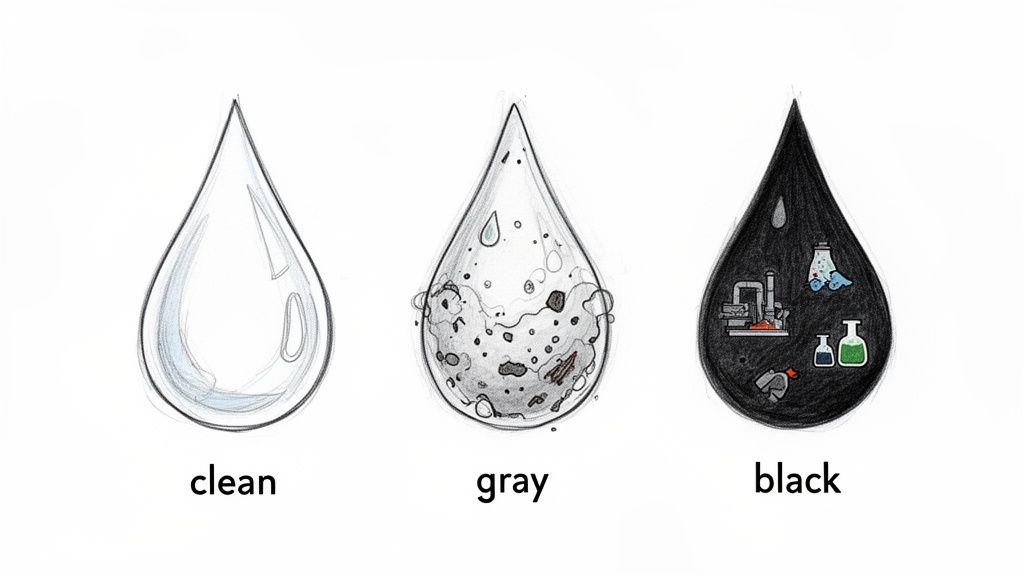
In the restoration business, we don't treat all water the same. We classify it into three categories based on how contaminated it is. Knowing the difference is absolutely critical because it dictates everything—from the safety gear we wear to the specific methods we use to make your home safe again.
Category 1 (Clean Water): This is the stuff you’d get from a burst supply line or an overflowing sink. It starts out clean, but don't get complacent. Left to sit, it will quickly get contaminated and become far more dangerous.
Category 2 (Gray Water): Now we're getting into risky territory. This water is already contaminated and can make you sick. Think of water from an overflowing washing machine or a dishwasher. It's full of soaps, grime, and other contaminants.
Category 3 (Black Water): This is the worst-case scenario. Black water is grossly contaminated with pathogens, toxins, and all sorts of nasty stuff. The most common sources are sewage backups and any ground-level flooding from rivers or storms.
Here's a critical rule of thumb we live by: any water that sits for more than 24-48 hours can become Category 3, no matter where it came from. Bacteria and mold don't wait around. They multiply fast, turning a simple leak into a serious health hazard.
The Hidden Dangers You Can't See
The real risks in floodwater are often invisible. Direct contact can cause everything from skin infections to serious gastrointestinal illnesses. Even the air you're breathing becomes a problem, thick with mold spores and airborne bacteria that thrive in the damp environment.
A perfect real-world example is a backed-up sewer line. That water is immediately a Category 3 disaster, teeming with E. coli, parasites, and viruses. Trying to tackle that kind of emergency flood cleanup without professional-grade personal protective equipment (PPE) and sanitizers isn't just a bad idea—it's incredibly dangerous. You can learn more about the specifics in our guide to Category 3 water damage.
Why Professional Sanitation Is Important
When you're dealing with contaminated water (gray or black), getting things dry is only half the battle. The real work is in what you can't see. Contaminants soak into drywall, get trapped under flooring, and hide inside wall cavities, posing a health threat long after things look normal.
This is why a professional team follows a strict protocol.
- Containment: We immediately seal off the affected zone. This is crucial to stop contaminants from spreading through your HVAC system to the rest of the house.
- Deep Cleaning: We use EPA-registered antimicrobial agents designed to kill bacteria, viruses, and fungi on contact.
- Strategic Removal: Porous materials like carpet, padding, drywall, and insulation are often impossible to fully decontaminate. They have to be safely removed and disposed of.
This isn't about making things look pretty. It's a meticulous process designed to protect the health of your family by returning your home to a truly safe, sanitary condition.
Knowing When To Call For Professional Help
After a flood, the first instinct is often to roll up your sleeves and start cleaning. And for a minor spill from a clean pipe, a DIY approach might be just fine. But when you’re staring at a real emergency flood cleanup, what looks like a simple water problem is almost always more complex—and dangerous—than it seems.
Honestly, knowing your limits is the most critical decision you'll make in this whole process. Trying to tackle a job that needs professional gear and expertise not only puts your health on the line but can lead to incomplete drying. That leads to hidden mold and long-term structural issues that will cost you far more down the road. The line between a small mess and a major restoration job can feel blurry, but there are some clear signals telling you it's time to pick up the phone.
Obvious Signs You Need a Restoration Pro
Sometimes, the situation is so out of hand that the need for help is crystal clear. If you're facing any of these scenarios, your first call should be to a certified restoration company.
Large Volume of Water: If the water covers more than a small patch in one room, you're probably out of your league. A few wet towels aren't going to make a dent when an entire basement or multiple rooms are saturated. Pros bring in truck-mounted extractors that can pull out thousands of gallons of water in a hurry.
Water Has Been Standing for Over 24 Hours: The clock starts ticking the second the water stops rising. After just 24 to 48 hours, clean water can degrade into what we call Category 3 black water as bacteria and mold start growing exponentially. At that point, the health risks are serious, and you need specialized sanitation procedures.
You Suspect Contaminated Water: Did the flood come from a sewage backup, an overflowing toilet, or storm runoff from the outside? If so, you're dealing with Category 3 black water from the start. This stuff is a biohazard. Never, ever try to handle it yourself without proper training and full personal protective equipment (PPE).
When Water Gets Inside Your Home’s Structure
Here’s the thing about flood damage that trips most people up: it's the water you can't see that causes the biggest problems. A surface might look and feel dry, but moisture can be trapped deep inside building materials, creating a perfect breeding ground for mold and causing things to rot from the inside out.
Water is sneaky. It can wick its way a few feet up drywall, get trapped under vinyl flooring, and completely saturate the wooden subfloor underneath. A shop vac and a few fans just can't reach this hidden moisture. Professionals use tools like thermal imaging cameras and non-invasive moisture meters to hunt down every last pocket of dampness. Without dealing with this trapped water, you're basically setting the stage for a future mold infestation that can ruin your home's air quality and structural integrity.
A key takeaway I’ve learned from years in restoration is this: If water has soaked into porous materials like drywall, insulation, or carpet padding, it's virtually impossible for a homeowner to dry them out completely. These materials act like sponges and almost always need to be removed and replaced by a professional team to stop bigger problems from developing.
Understanding Professional Certifications
When you call for help, you want to know you're getting a team that actually knows what they're doing. That’s where certifications come in.
The gold standard in this industry is the Institute of Inspection, Cleaning and Restoration Certification (IICRC). Look for a company that advertises its technicians are IICRC-certified.
An IICRC certification isn't just a piece of paper. It means the technicians have been formally trained on the industry's highest standards for water mitigation, structural drying, and getting rid of mold. They understand the science behind properly drying a home and follow proven, documented processes to do it safely and effectively. Hiring a certified company gives you peace of mind that the crew handling your emergency flood cleanup has the real expertise needed to protect your property and your family’s health.
What To Expect From The Cleanup Process
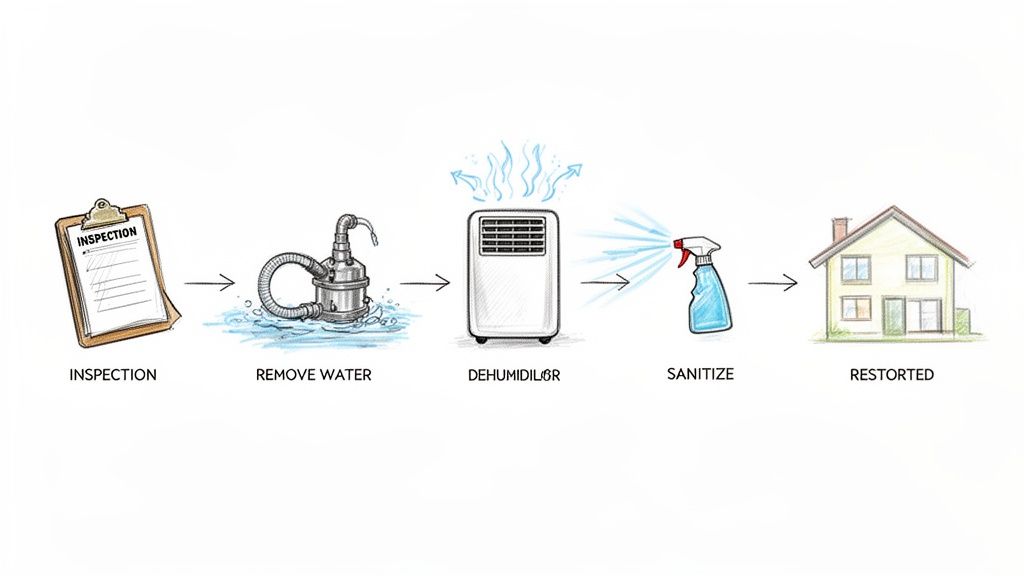
After you’ve made that critical call for help, it’s easy to feel like you're just stuck waiting. But once a certified restoration crew shows up, things start moving fast. Knowing what they’re going to do can really help demystify the process and give you back a sense of control during a pretty chaotic time.
It all starts with a thorough inspection. A good technician won’t just look for puddles; they’ll pull out specialized tools like moisture meters and thermal imaging cameras to see what the naked eye can’t. They're mapping out exactly how far moisture has seeped into your walls, crept under the flooring, and hidden in structural cavities. This detailed assessment becomes the blueprint for the entire emergency flood cleanup plan.
Kicking Off The Water Extraction
With a clear picture of the damage, the first priority is getting the bulk of the water out—and fast. The team will roll out powerful, truck-mounted pumps and vacuums designed to remove hundreds, sometimes thousands, of gallons of water in a very short time.
This is a world away from your average shop vac. We’re talking industrial-grade equipment built for one purpose: maximum extraction. Every minute counts. The longer water sits, the deeper it soaks into your home’s materials, dramatically increasing the risk of permanent damage and mold.
The global impact of flooding is staggering. Flash floods cause over 5,000 deaths and $50 billion in economic losses worldwide each year. Any delay in water removal can lead to secondary issues like mold and structural decay, potentially increasing repair costs by 50% or more if not handled within the first 48 hours. Professional intervention is shown to reduce long-term recovery time by a significant margin.
The Critical Drying and Dehumidification Phase
Once the standing water is gone, the real science begins. This is arguably the most important part of the entire job. Crews will strategically place high-velocity air movers across wet surfaces, like your walls and floors, to speed up evaporation.
At the same time, they'll set up an army of large, commercial dehumidifiers. These machines are the workhorses of the operation, pulling gallons of moisture right out of the air every single day. This one-two punch of air movers and dehumidifiers creates an environment where your home can finally dry from the inside out, tackling that hidden moisture that causes so many long-term problems. You can learn more about what to expect from the timeline in our guide: https://restoreheroesaz.com/how-long-does-water-damage-restoration-take/.
Cleaning and Sanitizing Your Home
With the property now completely dry, the focus shifts to making it clean and safe again. Every surface that the floodwater touched gets cleaned with professional-grade agents. If you were dealing with contaminated gray or black water, technicians will use EPA-registered antimicrobial treatments to fully disinfect the area and kill off any dangerous bacteria or pathogens.
This phase is about more than just wiping things down. It often involves:
- Odor Removal: Using techniques like thermal fogging to neutralize those stubborn, musty odors.
- Contents Cleaning: Salvageable personal items are often carefully packed and moved off-site for specialized cleaning.
- Ductwork Inspection: It’s crucial to check your air ducts for any mold growth, as the HVAC system can spread spores throughout the house. A comprehensive guide to air duct cleaning mold removal can be a great resource here.
The final step is restoration. This is when the crew starts to put your home back together. They'll repair or replace materials that were too damaged to save, like drywall, flooring, and insulation. The goal is simple: to bring your home back to its pre-flood condition, making it safe, clean, and structurally sound for you and your family again.
Answering Your Flood Cleanup Questions
When you're standing in a flooded home, your mind races with questions. It's a stressful, uncertain time, and you need straight answers. Here are some of the most common concerns we hear from Phoenix homeowners dealing with an emergency flood cleanup.
How Long Does Flood Cleanup Take?
This is almost always the first question, and the honest answer is: it depends. A small leak from a supply line that's caught quickly might only take a couple of days to dry out completely. But if you’re dealing with a major flood that soaked multiple rooms, you could be looking at a timeline of several weeks.
A few key things really dictate how long the process will be:
- How much water are we talking about? The more water there is, the longer it takes just to get it all out.
- How long did it sit? Water that’s been standing for more than 48 hours creates a much bigger problem. It starts to break down materials and invites mold, which means a more intensive cleanup.
- What got wet? Drywall, insulation, and carpet are like sponges. They soak up a ton of moisture and can take a long time to dry properly, if they can be saved at all.
- Is the water contaminated? If you're dealing with "black water" (like from a sewer backup), the safety protocols are much stricter. Containment and thorough sanitation add a lot of time to the job.
Once a professional restoration crew gets on-site and sees the situation firsthand, they can give you a much more accurate timeline.
Can I Save My Carpet and Furniture?
Whether your belongings are salvageable really comes down to two things: the type of water and how fast you act.
If the flood was from a clean source (Category 1 water), like a burst water heater line, and cleanup starts right away, you have a pretty good chance of saving carpets and some furniture. We have specialized equipment designed to clean and dry these items effectively.
On the other hand, if the water was contaminated (Category 2 or 3) or if anything sat in water for more than a day, it's often a lost cause. Things like carpet padding, mattresses, and upholstered furniture are so porous they can become breeding grounds for bacteria, making them impossible to truly decontaminate.
It's a tough call to make, but your family's health has to be the top priority. A certified technician can help you make the right decision, identifying what can be safely restored versus what needs to be thrown out to avoid future health risks.
What Does Flood Cleanup Typically Cost?
The cost of an emergency flood cleanup has a huge range. A minor, clean-water issue might be a few thousand dollars, while a severe black-water flood that requires significant demolition and rebuilding can easily run into the tens of thousands. The final bill depends on the size of the area, the water category, how long the drying takes, and what repairs are needed.
It's worth noting the bigger picture, too. Between 1970 and 2019, water-related hazards made up 50% of all disasters. Today, annual global damages from natural disasters can exceed $224 billion, and a lot of that isn't covered by insurance. Getting a professional team in quickly with the right gear can actually lower restoration costs by 30-50% simply by preventing secondary damage like mold. You can see more data on the global scale of flooding over at the UNDRR website.
This is exactly why a reputable company can't give you a real quote over the phone. A detailed, in-person inspection is the only way to build an accurate estimate. A big part of that professional process is stopping future problems before they start, which is why we also focus on what comes next. For more on that, take a look at our guide on how to prevent mold after a flood.
When disaster strikes, you need a team you can trust. Restore Heroes offers emergency services across the Phoenix area to help you recover quickly and safely. For a free, no-obligation inspection, contact us today. https://www.restoreheroesaz.com