
When water invades your business, you need a professional team to handle the cleanup, drying, and repairs. This process, known as commercial water damage restoration, is all about getting your property back to its pre-loss condition as fast as possible. It’s a specialized field that uses powerful equipment and proven techniques to stop the damage in its tracks, head off secondary problems like mold, and minimize the time your doors are closed.
What Happens When Water Damages Your Business
Walking into your property to find a burst pipe or the aftermath of a Phoenix monsoon storm is a gut-wrenching experience. That initial shock quickly turns to practical worries: How long will we be shut down? What about our inventory? Is the building itself safe?
Unchecked water is a silent saboteur, quietly wreaking havoc on your building and your balance sheet. A fast, professional response isn’t just about cleaning up a mess—it’s a critical business decision. The longer water sits, the more damage it does. It soaks into drywall, weakens structural supports, and creates a breeding ground for mold, which can start growing in as little as 24-48 hours.
When you discover water damage, every minute counts. The choices you make in that first hour can drastically reduce the total cost and downtime for your business.
Here’s a quick-reference table to guide you through those crucial first steps.
Your First Moves After Discovering Water Damage
| Action Step | Why It's Critical for Your Business |
|---|---|
| Stop the Water Source | This is your top priority. Shut off the main water valve if it’s a plumbing issue. You can't start recovery until the flow stops. |
| Turn Off Electricity | Water and electricity are a dangerous mix. Shut off power to affected areas to prevent electrocution and short circuits. |
| Alert a Restoration Pro | The sooner experts are on-site, the faster they can mitigate damage, potentially saving you money and downtime. |
| Relocate Key Assets | Move valuable inventory, sensitive electronics, and critical documents to a dry, safe location if you can do so safely. |
| Notify Your Insurance | Start the claims process immediately. Document everything with photos and videos before anything is moved. |
Following these steps immediately helps protect your people, your property, and your bottom line while you wait for professional help to arrive.
The Unique Risks Businesses Face
Water damage hits a commercial property differently than a home. The financial stakes are much higher. Every hour your business is closed means lost revenue, lost productivity, and potentially lost customers.
Here's what makes it so much more complicated for a business:
- Operational Disruption: A closed sign is a business killer. It stops cash flow, frustrates customers, and can even disrupt your entire supply chain.
- Inventory and Asset Loss: Water doesn’t just damage drywall. It can destroy your retail stock, fry expensive electronic equipment, and ruin essential paper records beyond recovery.
- Structural and Health Hazards: Moisture doesn't just evaporate; it seeps deep into building materials, weakening them from the inside out. It also creates the perfect environment for mold, which poses a serious health risk to your employees and customers. You can learn more about mitigating different types of water damage to better protect your investment.
Why a Professional Response is Not Optional
There's a reason the commercial restoration industry is growing so quickly. Facility managers are dealing with increasing risks. FEMA, for instance, reported a 25% jump in flood claims from 2020-2024. For those of us in Arizona, this hits close to home during monsoon season. The need for expert help has never been greater. Discover more insights about the growing restoration market on 360iresearch.com.
A professional commercial water damage restoration team does more than just remove water. They bring a systematic approach, using industrial-grade equipment to help ensure every hidden pocket of moisture is found and eliminated, safeguarding your investment and accelerating your return to normal business operations.
The Professional Restoration Process From Start to Finish
Once you make that emergency call, a well-orchestrated process kicks into gear. This isn't just about showing up with a few fans and a wet-vac. Professional restoration is a highly structured operation guided by industry-wide standards, specifically those set by the Institute of Inspection, Cleaning and Restoration Certification (IICRC). A true pro team executes a deliberate, multi-phase plan to stop the damage cold, head off secondary problems like mold, and get you back to business.
The initial chaos of a water event—from a burst pipe to the immediate business downtime and financial bleeding—is a rapid domino effect.
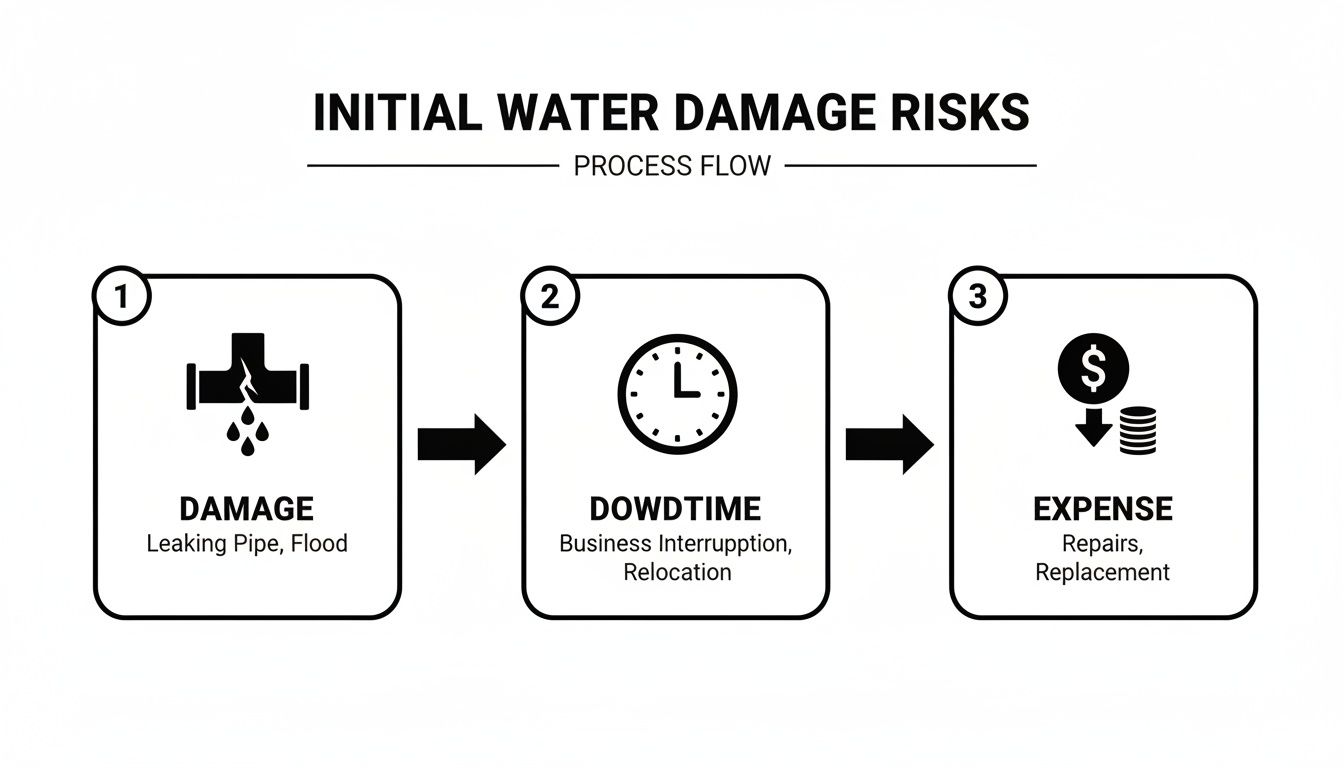
As you can see, one single point of failure quickly spirals into serious operational and financial problems. This is exactly why a swift, methodical response is non-negotiable.
Phase 1: Initial Inspection and Damage Assessment
The very first thing that happens is a thorough assessment. Think of the technicians as building detectives arriving at a crime scene. Their first job is to find the water source, figure out how far the damage has spread, and classify the type of water contamination they're dealing with.
They aren't just eyeballing it. They come armed with specialized tools like moisture meters and thermal imaging cameras that let them "see" behind walls and under floors. This helps them map out precisely where the water has traveled, turning guesswork into a science.
This deep dive is critical. It allows the team to build a precise action plan and give you an accurate scope of work, informing every single step that comes next.
Phase 2: Water Removal and Extraction
With a clear plan in place, the crew immediately gets to work on water removal. For a commercial property, this isn't a small-scale job. We're talking about powerful, truck-mounted extraction units and submersible pumps capable of removing thousands of gallons of water in a surprisingly short amount of time.
The name of the game here is speed. Getting the bulk of the standing water out is the single most important thing to stop the damage from spreading and drastically cut down the drying time.
This phase goes beyond just the visible puddles. Technicians use high-powered vacuums and special extraction wands to pull trapped moisture from carpets, padding, and upholstery, setting the stage for the heavy-duty drying process.
This aggressive first step is what makes the next, more technical, part of the job possible.
Phase 3: Structural Drying and Dehumidification
Once the standing water is gone, the real work begins: tackling the moisture you can't see. This is the water that has soaked into porous materials like drywall, wood framing, and even concrete. This is where the science of psychrometry—the study of air and moisture—really comes into play.
Crews strategically set up an arsenal of industrial-grade equipment to create the perfect drying environment. This usually includes:
- High-Velocity Air Movers: These aren't your average box fans. They're powerful turbines designed to blast air across wet surfaces, which dramatically speeds up the rate at which moisture evaporates into the air.
- Commercial Dehumidifiers: As the air movers push moisture into the air, these massive dehumidifiers pull it right back out. They work around the clock to lower the building's humidity, preventing all that airborne moisture from just soaking back into other materials.
Throughout this drying phase, technicians are constantly taking readings of the temperature, humidity levels, and the moisture content within the affected materials. They'll adjust the equipment daily to help ensure everything is drying out evenly and completely, chasing down any hidden moisture pockets that could become a future mold problem. For a closer look at this workflow, you can explore our detailed restoration process.
Phase 4: Cleaning, Decontamination, and Odor Removal
Water damage rarely just involves clean water. Floods and sewage backups can introduce a host of nasty bacteria, contaminants, and, of course, terrible odors. This next phase is all about making the space safe and clean for your employees and customers again.
This can involve everything from applying antimicrobial agents to stop mold growth in its tracks to using specialized fogging equipment that neutralizes odors at a molecular level. If sensitive items like documents or electronics were damaged, they may be taken off-site for specialized restoration.
This step is absolutely crucial. It’s about restoring not just how your property looks, but its overall health and safety.
Phase 5: Repairs and Final Reconstruction
The last leg of the journey is putting everything back together. The goal is to return your property to its pre-loss condition, or sometimes even better.
This could mean minor repairs like replacing a few feet of drywall and painting. Or, it could involve major reconstruction, like rebuilding entire office suites or replacing compromised flooring systems from the subfloor up.
A top-tier restoration company can manage this entire process for you, bringing in licensed contractors to help ensure all repairs are done correctly and up to code. This final phase is what turns a disaster site back into a fully functional, safe, and welcoming space, ready for you to open your doors for business again.
The Technology That Gets the Job Done Right
Properly restoring a commercial property after water damage isn't about guesswork or just pointing a few fans at the wet spots. It's a science, and it requires some serious, specialized equipment. When professionals show up, they’re not just bringing mops and buckets; they have an arsenal of tools designed to find hidden moisture, pull out massive volumes of water, and get the building's environment under control.
This technology is what separates a quick, superficial cleanup from a truly restored, safe, and dry property.
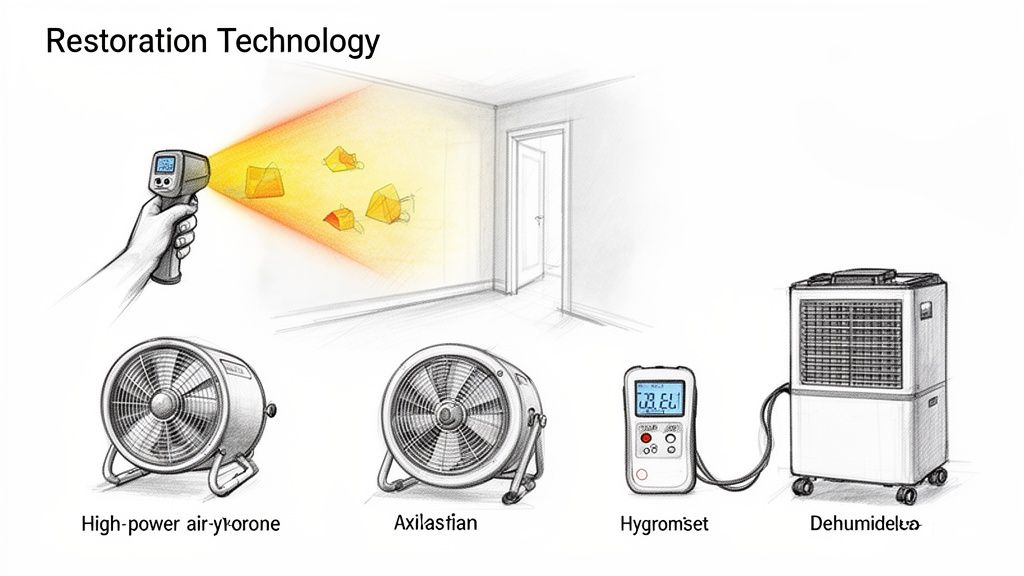
Think of it like a medical emergency. The first thing a doctor does is run diagnostics to understand the full extent of the problem, and that's exactly what restoration pros do. They need to see far beyond what the naked eye can tell them.
Seeing Beyond the Surface with Advanced Detection
Before a single fan is turned on, experts need to map out exactly where the water went. Missing even one hidden pocket of moisture can lead to major headaches like mold growth or structural rot down the road.
They rely on a couple of key diagnostic tools for this:
- Infrared (IR) Cameras: These cameras don't see water, but they do see temperature differences. Wet spots are almost always cooler than dry ones. This allows technicians to create a thermal "map" of your walls, floors, and ceilings to pinpoint where water has spread without having to tear anything open.
- Moisture Meters: While an IR camera gives a great overview, a moisture meter gives the hard data. Using both penetrating and non-penetrating sensors, these tools provide precise readings of the moisture content in materials like drywall, wood, and concrete, confirming what the camera suggested.
This initial diagnostic work is crucial. It helps ensure the entire drying effort is targeted and nothing gets missed.
The Powerhouse Tools of Drying and Dehumidification
Once the damage is fully mapped, the heavy-duty equipment comes out. The goal is to create a carefully controlled drying environment that pulls moisture out of the building materials and the air as quickly and safely as possible.
The science behind this is called psychrometry—it's all about managing the relationship between temperature, humidity, and airflow. By getting these three elements just right, technicians create a powerful "drying vortex" that forces moisture out of materials and captures it for good.
This is where the big guns come in:
- Air Movers: These aren't your average box fans. High-velocity air movers are strategically placed to blast a layer of dry air across wet surfaces, which massively accelerates the evaporation process.
- Dehumidifiers: As the air movers turn liquid water into water vapor, industrial-grade dehumidifiers work to yank that moisture right out of the air. These beasts can remove dozens of gallons of water from the atmosphere every single day, stopping it from being reabsorbed by other materials.
Water emergencies are incredibly common. Globally, about 14,000 people deal with one every day. For a business, the stakes are even higher, with water damage accounting for nearly 30% of all commercial insurance claims. Getting your property dried professionally is absolutely essential. You can learn more about how to properly dry out a flooded space in our guide.
The IICRC: The Gold Standard of Restoration
So, how can you be sure a company has actually mastered this technology and the science behind it? Look for one thing: IICRC certification.
The Institute of Inspection, Cleaning and Restoration Certification is the global organization that sets the standards for our industry.
When a firm and its technicians are IICRC-certified, it means they've gone through tough training, passed hands-on exams, and are committed to staying up-to-date. That certification isn't just a fancy logo on a van—it's your assurance that the team handling your property knows what they're doing and will use the right science and technology to do the job right.
Navigating the Insurance Claims Process
Once you get over the initial shock of finding water damage in your building, your mind probably jumps straight to the cost. Let's be honest, dealing with a commercial insurance claim can feel just as overwhelming as the water damage itself. It’s a world of specific steps, endless paperwork, and constant communication, all while you're trying to keep your business from grinding to a halt.
But you can get through it. With a solid game plan, you can tackle the claims process head-on. It all begins with taking clear, immediate action the second you spot the problem. Your job is to build a rock-solid record of what happened and what it affected—that record is the bedrock of your entire claim.
Your First Steps After a Water Damage Event
Before you even think about repairs, your first priority is to document everything. This isn't the time to start mopping up; it's time to become a detective. Think of it as building a case for your insurance company, where every photo and note makes your claim stronger.
Start by taking pictures and videos of absolutely everything. Get shots of where the water came from, how far it spread, and any inventory, equipment, or building materials that got wet. Don’t just take wide-angle photos of the room. Get up close and capture the details—the water lines on the drywall, the warped flooring, the ruined stock.
Once you’ve gathered this initial proof, take these three crucial steps:
- Call Your Insurance Agent Immediately: The faster you report the loss, the better. Your agent is your first point of contact and can walk you through your policy, give you a claim number, and tell you what to do next.
- Review Your Commercial Policy: It’s time to find that policy document. Look specifically for coverage related to water damage, flooding (which is often a separate policy), and business interruption. Knowing what’s covered and what your deductible is right from the start is critical.
- Mitigate Further Damage: Your policy almost certainly requires you to take reasonable steps to keep the damage from spreading. This is exactly why you call a professional commercial water damage restoration company. Bringing in the experts shows your insurer you're acting responsibly to get the situation under control.
The Role of a Professional Restoration Partner
Trying to manage an insurance claim by yourself is a recipe for frustration. A certified restoration company is much more than just a cleanup crew. They can become your advocate, providing the detailed, technical proof your insurer needs to process your claim without a hitch.
A good restoration team is trained to document damage using the same industry-standard software and terminology that insurance adjusters use. This shared language can make a massive difference in how smoothly things go.
A professional restoration partner provides the detailed, itemized reports, moisture readings, and photographic evidence that insurance companies often require. This level of documentation moves the claim from a subjective "it looks bad" to an objective, data-driven assessment of the loss.
This professional documentation is what turns a confusing, stressful process into something manageable. You can get more helpful advice by reading these water damage insurance claim tips to guide your next steps.
Common Pitfalls and How to Avoid Them
Even with an expert team on your side, a few common mistakes can slow down or complicate a commercial water damage claim. Knowing what they are can help you steer clear of trouble.
- Waiting Too Long to File: Don't put it off. Insurance policies have strict deadlines for reporting a claim. Waiting even a day or two could put your coverage at risk.
- Discarding Damaged Items Prematurely: Whatever you do, don't throw anything away until the insurance adjuster has seen it or given you the green light. Tossing out damaged inventory is like throwing away the evidence you need to get paid.
- Signing Off on a Settlement Too Quickly: It can be tempting to take the first offer just to get it over with, but don't feel rushed. If you think the adjuster’s assessment is too low or missed something, you have every right to ask for a review or even hire a public adjuster for a second opinion.
At the end of the day, a successful insurance claim comes down to three things: thorough documentation, prompt action, and clear communication. When you partner with a professional restoration team, you arm yourself with the expertise and evidence needed to navigate the process, allowing you to focus on what truly matters—getting your business back on its feet.
Finding The Right Restoration Partner In Phoenix
When your commercial property is underwater, the pressure is on. The first instinct is to call the first company you find online, but that split-second decision can lead to major headaches down the road. The contractor you choose directly impacts how quickly you get back to business, the quality of the repairs, and your final bill.
Think of it like this: you wouldn't pick a surgeon out of a phone book for an emergency operation. You'd want someone with proven expertise, the right tools, and a steady hand. Choosing your restoration contractor is just as critical.
Core Qualities Of A Top-Tier Restoration Company
Before you even start dialing, you need a mental checklist. A truly professional commercial restoration partner will have a few non-negotiables that set them apart from the crowd.
Look for these signs of a serious, capable team:
- Always on Call (24/7/365): A burst pipe or a failed sump pump doesn't care if it's 2 a.m. on a Sunday. Your restoration company needs to be ready to roll day or night, holidays included.
- Lightning-Fast Response Time: Every minute that water sits, the damage spreads. The best companies can get a team to your property fast to start assessing the situation and stopping further damage in its tracks.
- Verified IICRC Certification: This is the seal of approval in our industry. When a firm and its technicians are IICRC-certified, it means they’ve passed rigorous training and are committed to the highest standards. It’s your assurance that the job will be done right.
When you're looking for an expert, the same rules apply whether you're fixing a flood or growing your business. It's all about knowing how to hire an effective business partner who will actually deliver results. The core principles—vetting their track record, checking references, and ensuring they have the right tools—are universal.
Vetting Your Restoration Contractor Checklist
Finding a qualified pro can feel overwhelming. This quick checklist will help you compare companies and make a confident choice.
| Qualification | What to Look For | Why It Matters |
|---|---|---|
| Licensing & Insurance | Request proof of license, bonding, and general liability/worker's comp insurance. | Protects you from liability if someone gets hurt on your property and indicates they're a legitimate business. |
| IICRC Certification | Ask for their company and technician certification numbers. | This indicates they follow industry-approved standards for safe and effective restoration. |
| Local Commercial References | Ask for names and numbers of other Phoenix-area property managers they've worked for. | Speaking to past clients is the single best way to know what you're getting into. |
| Insurance Claim Experience | Inquire about their process for working with commercial insurance carriers. | A team that speaks "insurance" can provide the right documentation to help streamline your claim. |
| Equipment & Manpower | Ask if they own their own industrial-grade equipment and have an in-house team. | You want a company that can handle a large-scale commercial loss without relying on rental gear or subcontractors. |
Use this as your guide during those initial phone calls. A professional company will have no problem answering these questions and providing the proof you need.
Critical Questions To Ask Every Potential Contractor
Once you have a shortlist, it's time for a quick interview. Don't be shy—these questions will tell you everything you need to know about their professionalism and experience.
- "Are you IICRC certified, licensed, bonded, and fully insured?" This should be an easy "yes." Ask them to email you proof of their credentials for your records.
- "Can you give me references from a few other commercial property managers here in the Valley?" A confident contractor will have a list of happy clients ready to go.
- "What is your typical response time to my property's location?" Look for a specific, confident answer. "As soon as we can" isn't good enough.
- "How much experience do you have working directly with commercial insurance adjusters?" Their answer will tell you if they can provide the detailed documentation your claim will require.
- "What kind of equipment will you bring for a commercial job of this size?" They should immediately mention things like industrial-grade LGR dehumidifiers, air movers, and moisture meters. It shows they're properly equipped for the scale of your problem.
Taking a few extra minutes to ask the right questions upfront is the single most important thing you can do after discovering water damage. It helps ensure the team you bring in is qualified, experienced, and ready to get your doors back open—safely and correctly.
Simple Maintenance to Prevent Future Water Damage
Honestly, the best way to deal with a commercial water damage restoration job is to make sure you never need one in the first place. Being proactive is always cheaper and less of a headache than cleaning up a disaster.
For those of us managing properties in Phoenix, that means having a simple, repeatable checklist that accounts for our climate—blistering heat one minute, monsoon downpour the next.
Think of your building like a ship. You wouldn't wait for a storm to check for holes in the hull, right? A little bit of consistent attention can prevent a major catastrophe.
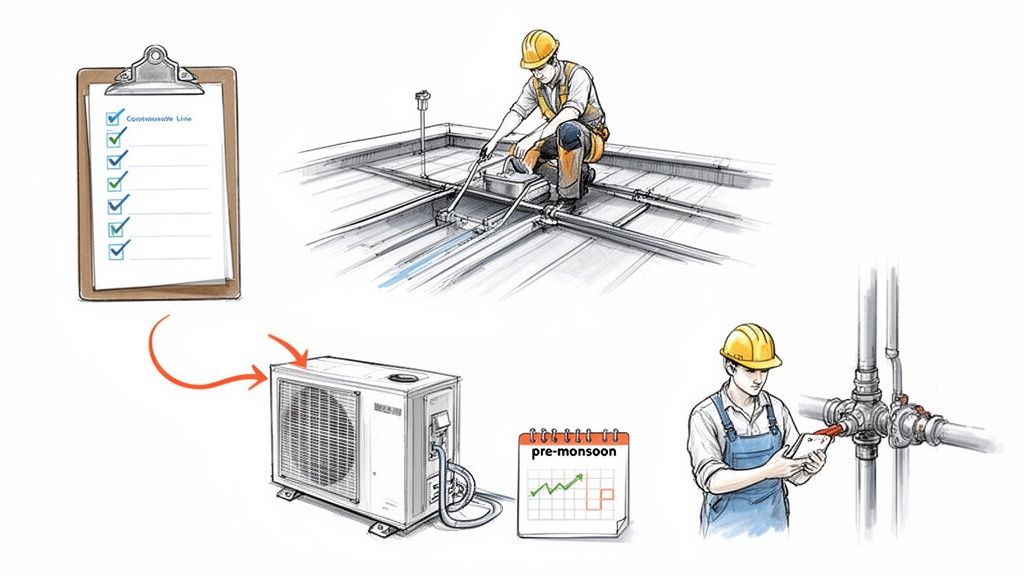
Your Proactive Maintenance Checklist
Building a few key checks into your regular facility routine can dramatically cut your risk of water damage. These aren't complicated tasks; they just target the most common failure points I see in commercial buildings.
Here are the non-negotiables:
- Inspect Your Roof Before Monsoon Season: Our desert sun is brutal on roofing materials. Small cracks that seem like nothing can turn into firehoses during a heavy downpour. Get a professional up there every spring to catch and fix those weak spots before the storms roll in.
- Check HVAC Systems Routinely: In Phoenix, your AC is the hardest-working piece of equipment you own. A clogged condensate line is one of the most frequent (and preventable) causes of water damage, leading to slow leaks that soak drywall and breed mold. For a deeper dive on this, see our guide on how to avoid mold: https://restoreheroesaz.com/how-to-avoid-mold-in-basement/
- Examine Plumbing and Appliances: Make it a habit to walk through and look for small drips or signs of corrosion around water heaters, under sinks in breakrooms, and in public restrooms. A tiny leak today often becomes a burst pipe tomorrow.
Focus on Exterior Water Management
How your property sheds rainwater is just as crucial as what happens inside. A neglected drainage system basically rolls out the welcome mat for water to seep into your foundation.
It helps to know what you're looking at. For example, understanding the parts of a rain gutter system and making sure they're clear of debris is a simple but critical task.
A single blocked downspout can send thousands of gallons of monsoon runoff pooling directly against your foundation. The pressure from that much water is immense and is a classic recipe for a flooded lower level.
This kind of routine attention is your single best defense. By scheduling these simple checks, you’re doing more than just maintaining a building—you’re protecting your entire business operation from the chaos and cost of a water-related shutdown.
Got Questions About Commercial Water Damage? We've Got Answers.
When your commercial property is hit with water damage, your head is probably swimming with questions. It’s a stressful situation, and getting straight answers is the first step toward getting things under control.
Here are some of the most common questions we hear from Phoenix business owners, along with practical, no-nonsense answers.
Can We Keep the Business Running During the Restoration?
This is usually the first thing on every owner's mind, and for good reason—downtime costs money. The short answer is: it depends.
If you're dealing with a small leak in a contained area, like a storage room or a single office, then yes, it's often possible to section off the affected space and continue business as usual.
However, if the damage is widespread or involves contaminated water (think sewage backups or floodwater), you'll likely need to close temporarily. It's a matter of safety for your employees and customers. A good restoration team will assess the situation and work with you to create a phased plan that gets you back to full operation as quickly and safely as possible.
How Long is This Going to Take?
There’s no one-size-fits-all timeline for a commercial water damage restoration job. A minor leak from a supply line might be dried, cleaned, and repaired in a few days. But a major event, like a fire sprinkler system going off or a storm flood, could easily take several weeks, especially if structural repairs are needed.
The total timeline really hinges on a few key factors:
- How large of an area is affected?
- What kind of water are we dealing with? (Clean, gray, or black?)
- How long did the water sit before cleanup began?
- Are we just drying things out, or do we need to rebuild walls and replace floors?
After their initial inspection, any credible restoration company should give you a detailed project timeline and keep you updated as they hit key milestones.
Do I Need to Worry About Mold?
In a word, yes. Mold is a major concern after any water incident, especially here in the Phoenix heat. It doesn't take long, either—mold colonies can start forming in just 24 to 48 hours wherever there’s lingering moisture.
The good news is that a professional restoration process is designed specifically to stop mold in its tracks. The entire goal of rapid water extraction and structural drying is to eliminate the moisture mold needs to grow. We use powerful air movers and commercial-grade dehumidifiers to pull every last bit of dampness out of the structure.
As an extra precaution, technicians often apply antimicrobial treatments to affected surfaces. And if mold has already started to appear, a certified team will know how to contain and remove it safely without cross-contaminating the rest of your property.
When water damage strikes your business, you need a team that’s fast, knowledgeable, and reliable. For an immediate response and expert commercial water damage restoration in the Phoenix area, contact Restore Heroes. Visit us online at https://www.restoreheroesaz.com to learn more.