
A fire at your business is more than just burned materials. It's a complex crisis that leaves behind a wake of structural instability, toxic smoke, and corrosive soot that can cripple your operations long after the fire department leaves. What you're facing requires an immediate, professional response to secure the property, identify hidden dangers, and kick off a careful, methodical restoration.
Your First 48 Hours After a Commercial Fire
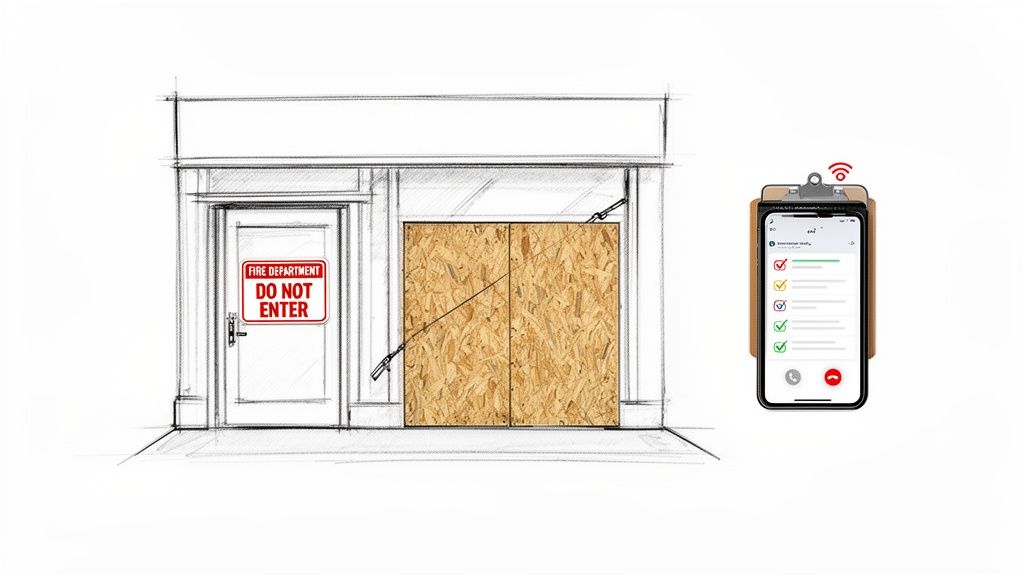
The moments after a fire strikes your Phoenix business are often a blur of confusion and stress. But the steps you take in the first 48 hours are absolutely critical. They lay the groundwork for your entire recovery, turning a chaotic scene into a manageable process.
Your number one priority, without question, is safety. Never, ever re-enter the building until the fire department has given you the official all-clear. The fire might be out, but the danger isn't gone. You're dealing with potentially weakened structures, invisible toxic fumes, and other hazards that could cause serious harm.
Securing Your Property and Starting the Process
Once you have the green light from the authorities, the immediate goal is to prevent any further damage. Your building is vulnerable. Broken windows, busted doors, and a compromised roof are an open invitation for theft, vandalism, or more damage from the elements. Arranging for emergency board-up and tarping services isn't just a good idea; it's a must-do first step.
At the same time, get on the phone with your insurance provider to start your claim. The sooner you report the incident, the faster the wheels can start turning. They'll walk you through the process and will likely need to send an adjuster to assess the fire damage firsthand.
Heads-up on documentation: Before a single thing is moved, cleaned, or thrown away, you need to document everything. Take photos and videos of the scene from every possible angle. Get close-ups of charred equipment, smoke-stained walls, damaged inventory—everything.
This visual proof is your best friend when it comes to substantiating your insurance claim. Back it up with a detailed list of every single item that was damaged or destroyed. I know it's overwhelming, but this methodical work now can pay off big time later. For more help navigating these initial steps, our comprehensive checklist on what to do after a fire is a great resource.
The following checklist breaks down these crucial first steps into a clear, actionable plan.
Immediate Response Checklist After a Fire
This table summarizes the most important actions to take right after a fire to ensure safety and begin the recovery process on the right foot.
| Priority | Action Item | Why It Matters |
|---|---|---|
| 1. Safety | Wait for official clearance from the fire dept. | Prevents injury from structural collapse, electrical hazards, or inhaling toxic fumes. Your safety is paramount. |
| 2. Security | Arrange for emergency board-up and tarping. | Protects the property from theft, vandalism, and further weather damage, securing your remaining assets. |
| 3. Insurance | Contact your insurance agent to file a claim. | Officially starts the recovery process and gets you the financial support and guidance needed for restoration. |
| 4. Document | Take extensive photos and videos of all damage. | Provides valuable proof for your insurance claim, which can help in getting compensated for your losses. |
| 5. Mitigate | Call a certified restoration company. | Halts ongoing damage from soot and water, preventing issues like mold growth and permanent staining. |
Following this checklist helps bring order to a chaotic situation, ensuring you've covered the most critical bases from the very beginning.
Making Key Calls for Recovery
After you've secured the site and notified your insurer, it's time to shift your focus to professional mitigation. That soot and smoke residue isn't just messy; it's acidic. It will corrode metals, stain surfaces, and cause permanent damage if left to sit. On top of that, the water used to fight the fire can lead to serious mold growth within just 24-48 hours, especially in the Phoenix heat.
This is why getting a certified restoration company on-site quickly is so important. A professional team will perform an immediate, expert damage assessment, spotting risks you might miss. They can launch into critical mitigation tasks—water extraction, structural drying, and initial soot removal—that stop secondary damage in its tracks. Acting fast with the right help is the key to minimizing your downtime and getting your business back on its feet.
Beyond the Burn: Understanding the Full Scope of Fire Damage
When you first walk into a business after a fire, the obvious destruction is what hits you first—charred walls, melted equipment, and piles of ash. That’s what we call primary damage, the direct result of the flames themselves. But what you see is just the tip of the iceberg. The real trouble with fire damage often lies in what you can't see.
Think of it this way: a visible wound is easy to spot, but a good doctor knows the real danger could be internal. It's the same with a fire. The flames are just the start; they leave behind a whole host of secondary problems that sneak into every corner of your property. If you ignore them, you're setting yourself up for much bigger headaches down the road.
The most common culprits are smoke and soot, and they’re far from harmless. They are aggressive, corrosive, and incredibly invasive.
The Hidden Damage from Smoke and Soot
Smoke isn't just a simple cloud of gray stuff. It's a toxic mix of tiny particles and gases that can travel anywhere and everywhere—through your HVAC system, inside walls, and deep into porous materials like drywall, carpet, and upholstery.
Soot, the greasy black residue left behind, is even more destructive. It's often highly acidic and starts causing permanent damage almost immediately.
- Corrosion: Soot can quickly tarnish metal fixtures, etch glass, and ruin sensitive electronics and machinery.
- Staining: If not handled by a professional, soot can permanently stain plastics, fiberglass, and fabrics within days.
- Health Risks: These microscopic soot particles are easily inhaled, creating serious health risks for anyone entering the building without the right safety gear.
This is why rooms that never even saw a flame can be some of the most damaged parts of the building. The contamination is silent but widespread.
When Water Adds to the Problem
Ironically, the very thing that saves your building—water—creates an entirely new crisis. Firefighting efforts dump thousands of gallons of water into a property, soaking everything from the insulation in the attic to the foundation below. This creates a secondary disaster that has to be dealt with immediately.
Without a rapid professional response, all that moisture becomes the perfect breeding ground for mold. Here in the Phoenix heat, mold can start growing in as little as 24 to 48 hours, leading to structural rot and dangerous indoor air quality.
This is exactly why you need a team that understands how to handle both fire and water damage at the same time. The two problems are completely intertwined. You can dive deeper into the specifics by reading our guide on commercial water damage restoration. Tackling both issues from day one is the only way to stop your property from deteriorating further.
The Broader Economic Impact
The financial fallout from a commercial fire goes way beyond the repair bill. The recent global wildfire season drove this point home, with total economic losses estimated to be between $250 billion and $275 billion. That number is staggering, but what's more revealing is how much it dwarfs the insured losses. It shows just how many businesses are caught underinsured and unprepared.
When you factor in the lost revenue from being shut down, the true financial toll is devastating. You can find more details on the invisible costs of wildfire disasters on undrr.org.
Ultimately, you can't just eyeball the damage. The only way to know what you're truly up against is to get a thorough assessment from a certified professional. They have the expertise and the equipment to find the hidden structural issues, the trapped moisture, and the full extent of the soot contamination. Getting that complete picture is the first and most critical step to a successful restoration.
Breaking Down The Professional Fire Restoration Process
When you're staring at the aftermath of a commercial fire, the path forward can feel overwhelming, like you're trying to piece together a complex puzzle without the box top. You know you need to get your business back on its feet, but the steps from a disaster scene to a fully operational property are anything but clear.
Professional fire restoration isn't a single action; it's a meticulously planned, multi-stage process. Think of it less like a simple cleanup and more like a surgical procedure. A surgeon doesn't just address the obvious wound. They diagnose the underlying damage, stabilize the patient, perform the necessary repairs, and then oversee a comprehensive rehabilitation plan.
In the same way, IICRC-certified technicians follow a proven, systematic approach to bring your commercial property back to its pre-fire condition—safely, efficiently, and completely. The journey begins the second they step on-site.
Stage 1: Initial Inspection and Damage Assessment
Before a single tool is lifted, the first job is a thorough assessment. This is far more than a quick walkthrough; it's a forensic investigation into the full extent of the fire's impact. Technicians will pinpoint the fire's origin, trace the path of smoke and soot throughout the building, and identify both the obvious and the hidden damage.
This initial evaluation forms the bedrock of the entire restoration strategy. It dictates the specific techniques, equipment, and manpower required to handle your unique situation.
Stage 2: Securing The Property and Mitigating Further Damage
With a clear picture of the damage, the immediate priority is to stop the bleeding. A fire often leaves a building vulnerable, with shattered windows, gaping holes in the roof, or compromised doors creating new risks.
To protect the property from the elements and prevent unauthorized entry, the team jumps into emergency mitigation services. This usually involves:
- Board-Up Services: Securing any broken windows, doors, or other openings.
- Roof Tarping: Covering damaged roof sections with heavy-duty tarps to keep rain and debris out.
These crucial first steps stabilize the site and protect your remaining assets, paving the way for the intensive restoration work ahead. If you're looking for a deeper dive, a comprehensive homeowner's guide to the fire damage restoration process can offer additional perspective.
Stage 3: Water Removal and Structural Drying
What many business owners don't expect is that the water used to extinguish the fire often causes as much—or more—damage as the flames themselves. Thousands of gallons of water can saturate everything from drywall and insulation to structural supports, creating a prime breeding ground for mold, especially in our warm Phoenix climate.
Here's a hard truth every property owner needs to know: Mold can start to grow in just 24-48 hours after water exposure. Taking immediate, aggressive action to dry everything out is absolutely non-negotiable to prevent a secondary disaster.
Professionals attack this problem with heavy-duty equipment. They use powerful pumps and truck-mounted vacuums to remove standing water, then bring in an arsenal of high-velocity air movers and commercial-grade dehumidifiers to pull every last bit of trapped moisture out of the building's structure.
Stage 4: Soot and Smoke Removal
Once the property is secure and bone-dry, the painstaking work of removing soot and smoke residue begins. This is where true professional expertise makes all the difference. Soot isn't just dust; it's an acidic, greasy, and incredibly invasive substance that requires very specific cleaning protocols depending on the surface it's clinging to.
Technicians use specialized tools like dry-ice blasters or chemical sponges designed to lift soot particles away without smearing them deeper into materials. This meticulous process covers everything from the ceilings and walls to every piece of equipment and inventory inside your building.
This diagram shows just how interconnected fire, smoke, and water damage really are.
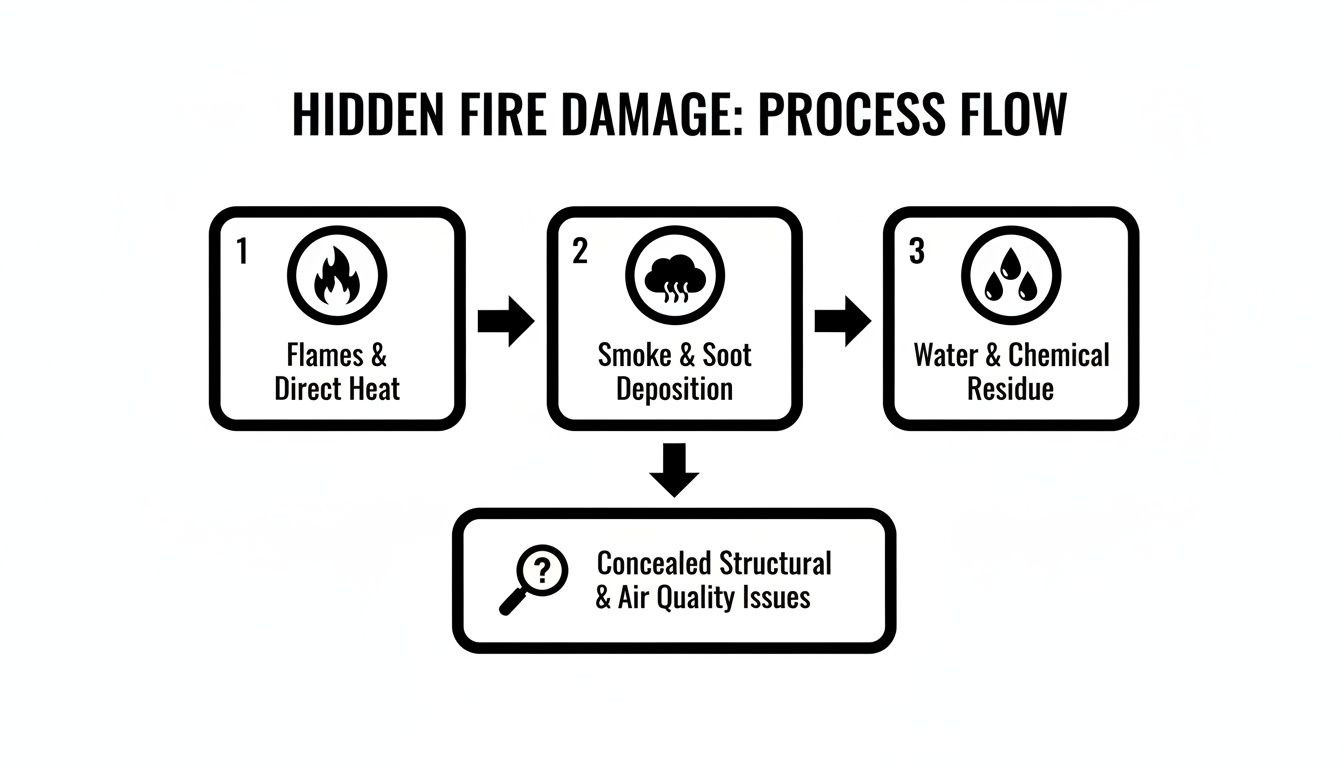
As you can see, simply dealing with the burn damage is only scratching the surface. The paths of smoke and water create their own distinct problems that demand specialized attention.
Stage 5: Cleaning, Sanitizing, and Deodorizing
With the soot gone, the next step is a top-to-bottom deep clean and sanitization. All salvageable surfaces and items are thoroughly cleaned to remove any lingering contaminants. Crews then use EPA-registered disinfectants to help ensure the property is hygienically safe for you and your employees to return to.
But what about the smell? The persistent odor is often the most stubborn reminder of a fire, as smoke particles can penetrate deep into porous materials and haunt a building for years if not handled correctly.
Professionals don’t just cover up the smell with air fresheners; they obliterate it at the molecular level. Using advanced technologies like thermal fogging or hydroxyl generators, they neutralize the odor-causing particles for good. You can learn more about these powerful techniques in our guide to the fire damage restoration process.
Stage 6: Restoration and Rebuilding
The final leg of the journey is putting it all back together. This phase can involve anything from minor repairs like new drywall and a fresh coat of paint to major reconstruction of entire sections of your building. A quality restoration contractor can manage this entire process, ensuring every repair is done correctly, up to code, and to a high standard.
This methodical, step-by-step approach is designed to turn a chaotic and destructive event into a structured and manageable recovery.
Navigating Your Commercial Insurance Claim
For most Phoenix business owners, the shock of a fire is quickly followed by a whole new kind of stress: dealing with the insurance claim. Once the smoke clears, you’re left with a process that can feel just as destructive as the fire itself. It’s complicated and unfamiliar, but having a game plan makes all the difference.
Think of it this way: you have to prove your losses to your insurance carrier. The more organized and thorough you are, the better your chances are for a fair and timely settlement. Your best tool in this fight? Meticulous documentation.
Your Role in the Claims Process
Before a single thing is moved, cleaned, or thrown away, your first job is to document everything. Seriously, everything. Pull out your phone and become a photographer. Take hundreds of pictures and videos from every angle you can think of—wide shots of each room, then close-ups of damaged equipment, ruined inventory, and charred structural components.
This visual proof is a huge part of your claim, but you also need to start building a detailed inventory of everything that was lost or damaged. It's a grind, but you need to list each item, its approximate age, and its replacement cost. This comprehensive list is the backbone of your claim's value.
Important Takeaway: Your insurance policy is a contract. Dust it off and actually read it. You need to know your coverage limits, your deductible, and exactly what’s covered (and what isn’t). Knowing these basics puts you on a much better footing when you talk to your provider.
Getting this groundwork done right away sets the stage for everything that follows and lets you deal with your insurance adjuster from a position of strength.
The Adjuster and Your Restoration Partner
Shortly after you report the fire, your insurance company will send out an adjuster. Their role is to inspect the property, evaluate the extent of the commercial fire damage, and essentially put a price tag on your loss for the insurer. They play a pivotal role, so handing them your detailed photos and inventory can help speed things up.
But remember, the adjuster works for the insurance company, not for you. That’s why it’s so valuable to have a certified restoration company in your corner. They act as your advocate. A professional team will perform their own exhaustive inspection and generate a detailed, line-item estimate using the same software the insurance companies use and trust.
This professional estimate becomes the roadmap for getting your property back to its pre-fire state. It outlines every necessary step, from initial water removal and soot cleanup all the way through major structural repairs and getting rid of the smoke odor for good.
How Professional Documentation Helps Your Claim
When your restoration contractor submits their report, it's more than just a list of costs. It's the precise evidence your insurance carrier needs to understand the full scope of the disaster and process your claim without endless back-and-forth.
Preparing a claim is all about building a solid case. A professional restoration contractor is your expert witness, providing the evidence needed to justify every repair and replacement. To help you and your contractor build the strongest case possible, you'll need to gather some key documents.
Here's a checklist of what you'll typically need to have on hand.
Key Documentation for Your Insurance Claim
| Document Type | Description | Why It's Important |
|---|---|---|
| Your Insurance Policy | The full policy document, including all declarations and endorsements. | This is your contract. It defines your coverage, limits, and deductible. |
| Photos and Videos | Comprehensive visual evidence of all damage, taken immediately after the event. | Provides undeniable proof of the condition of your property before cleanup began. |
| Damaged Item Inventory | A detailed list of all destroyed or damaged items, with descriptions and values. | Forms the basis for your personal and business property claim value. |
| Proof of Ownership | Receipts, invoices, manuals, or financial statements showing you owned the items. | Substantiates your inventory list and proves the value of your claimed items. |
| Business Financial Records | Profit & loss statements, tax returns, and payroll records from before the fire. | Crucial for a Business Interruption claim to prove lost income. |
| Restoration Estimate | The detailed, line-item scope of work from your IICRC-certified contractor. | Serves as the professional, third-party assessment of the necessary repairs. |
| Communication Log | A record of every call, email, and meeting with your insurance company. | Creates a timeline and helps you keep track of conversations and commitments. |
Having these documents organized and ready will streamline the entire process, reducing delays and misunderstandings.
By bringing in an IICRC-certified restoration expert, you help to ensure that the true extent of the commercial fire damage is professionally assessed. This closes the gap between what you see and what the insurer needs to see, giving them the clear, detailed proof that may be required to approve your claim and get you back in business.
The Invisible Threat of Soot and Smoke
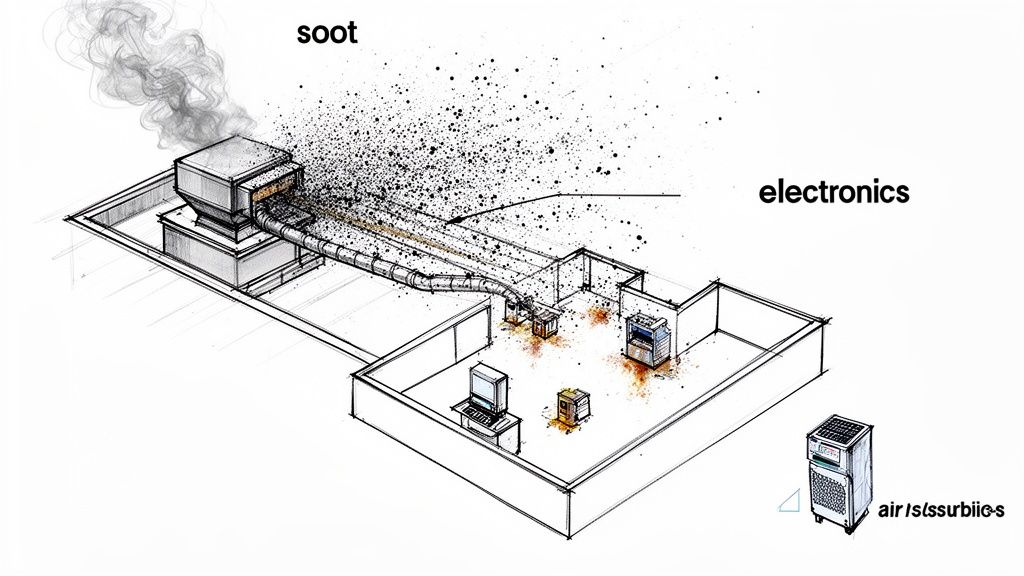
When the fire trucks leave, it’s easy to think the worst is over. But for your business, the most deceptive and damaging part of a fire is just getting started. It’s not the flames you have to worry about anymore; it’s the microscopic soot and smoke particles that have invaded every corner of your building.
Think of your HVAC system like the building's lungs. During a fire, it inhales a toxic mix of smoke and soot, then tirelessly circulates it everywhere. These particles settle on every surface, get into every crack, and contaminate the very air your employees and customers breathe.
This isn’t just a bit of dust. It's an ongoing, invisible threat that requires a professional game plan.
The Corrosive Nature of Fire Residue
Soot isn't just inert ash. It's an acidic, oily residue that actively corrodes and degrades everything it touches. It's a silent destroyer, causing irreversible damage to your assets long after the fire department has rolled up its hoses.
You might see its destructive power most clearly on your most sensitive equipment:
- Electronics and Machinery: Tiny, conductive soot particles work their way inside computers, servers, and production machinery. They can short-circuit delicate electronics, leading to catastrophic failure.
- Metal Fixtures: Soot can quickly tarnish and eat away at metals like steel, brass, and aluminum. This leaves behind permanent pitting and discoloration on everything from light fixtures to structural beams.
- Porous Surfaces: Materials like drywall, wood, and upholstery act like sponges, soaking up soot and smoke. A simple wipe-down won’t cut it; the contamination and the smell are trapped deep inside.
Beyond the obvious damage, this residue can leave a stubborn film on windows and glass partitions. If you’ve ever tried it, you know that cleaning cloudy glass windows caused by this kind of grime requires a very specific approach.
Air Quality and The Lingering Smell
That stubborn, smoky smell that hangs in the air? It’s more than just a bad memory—it’s a clear sign of widespread contamination. Simply opening the windows won’t get rid of it because the odor-causing particles are physically embedded in your walls, carpets, and ventilation system.
To kill the smell, you have to eliminate the source. We've actually put together a detailed resource on this very topic; you can check out our guide on how to remove smoke smell from a house.
It's easy to underestimate the sheer volume of airborne particles. During a recent fire season, carbon emissions from fires reached 2.2 petagrams—the sixth-highest total since 2003. In some places, particulate matter levels shot up to 13–60 times higher than daily air quality standards.
This isn't just about making the place smell better. Professional air scrubbing and deodorization are critical health and safety steps. We use specialized equipment to capture airborne particles and neutralize odors at the molecular level. It's the only way to ensure your property is truly clean, safe, and ready for your team to return.
How to Choose a Phoenix Fire Restoration Partner
When you're dealing with the aftermath of a commercial fire, the restoration company you hire will be the single most important factor in your recovery. This isn't a decision to rush; you need a team with proven expertise, the ability to act fast, and a real understanding of what it takes to get a Phoenix business back on its feet.
Your search should start with one non-negotiable credential: IICRC certification. Think of it as the gold standard for restoration. It’s an indication that the technicians walking onto your property are trained in current, effective methods for dealing with fire, soot, and water damage. Hiring a company without it is a roll of the dice you can't afford to take.
Verifying Credentials and Local Experience
Beyond the certifications, you need someone who can be there now. Soot and water damage don't wait, and every hour that passes causes more problems and drives up the cost. A company offering 24/7 emergency response isn't a luxury—it's essential for protecting what's left of your property.
Local experience is another huge piece of the puzzle. A Phoenix-based contractor knows our climate inside and out, like how quickly mold can take hold after the firefighters' hoses have done their job. They also have working relationships with local insurance adjusters and suppliers, which can make the whole process move a lot more smoothly.
Wildfires aren't just a "season" anymore. Recent trends show major fires happening year-round, which means Phoenix businesses are always at risk. This new reality makes it critical to have a restoration partner who is ready to respond instantly, any day of the year. You can read more about the expanding wildfire season on ajg.com.
Essential Questions for Potential Contractors
Before you sign on the dotted line, it's time to ask some tough questions. A professional, reputable company will have no problem giving you straight answers.
Come to the conversation prepared with this checklist:
- Licensing and Insurance: Can you show me your current Arizona contractor's license, general liability insurance, and worker's comp?
- Certifications: Are you an IICRC-certified firm, and will the actual technicians on-site be certified as well?
- Experience: Have you handled commercial fire damage projects like mine here in the Phoenix area? Can you provide examples?
- Process and Timeline: What are the steps you'll take to restore my property? Can you give me a rough timeline for a job this size?
- Insurance Coordination: Do you have experience working with my insurance company? How will you document everything for my claim?
Getting clear, confident answers to these questions is how you find a team you can truly trust with your business's future. For a transparent look at how a professional project should unfold, feel free to review our restoration process.
Frequently Asked Fired-Related Questions
When you're dealing with the aftermath of a fire at your Phoenix business, you're bound to have a lot of questions. Let's walk through some of the most common ones to give you the clarity you need to take the next step.
How Long Does Commercial Fire Restoration Take?
Honestly, there’s no single answer—the timeline for getting a business back on its feet can vary wildly. A minor fire that was put out quickly might only take a few days to clean up. But if there’s serious structural damage, you could be looking at a project spanning several months.
The final timeline really depends on a few key things: the size of your property, what kinds of materials were burned or smoke-damaged, and how much water damage was caused by the firefighters. The only way to get a solid estimate is to have a professional come out and assess the situation firsthand.
Is It Safe to Go Back Inside My Building After a Fire?
Absolutely not. You should never re-enter your property until the fire department has given you the official all-clear. Just because the flames are gone doesn't mean the danger is.
A post-fire building is full of hidden risks, including:
- Weakened Structures: The fire can compromise beams and supports, making a collapse a real possibility.
- Electrical Hazards: Damaged wiring can still be live, creating a serious risk of shock or electrocution.
- Toxic Air: Soot and smoke particles are often carcinogenic and can do major damage to your lungs.
A certified restoration team typically starts with a comprehensive safety inspection to identify and neutralize these threats before any cleanup work begins.
Can I Just Clean Up the Damage Myself?
I strongly advise against trying to clean up commercial fire damage on your own. It's not just a matter of wiping things down. Soot is incredibly acidic and oily; using regular household cleaners will likely just smear it around, pushing it deeper into surfaces and causing permanent stains.
More importantly, this isn't just dirt. Soot is packed with harmful carcinogens. Handling it without professional-grade personal protective equipment (PPE) is a major health risk. Certified technicians have the right gear, specialized cleaning agents, and proven methods to remove these contaminants safely and completely.
How Do You Actually Get Rid of the Smoke Smell?
That lingering smoke smell is so tough to beat because it comes from tiny particles that have worked their way deep into porous materials—think drywall, wood, carpet, even insulation. Air fresheners and surface cleaning just mask the odor because the source is still trapped inside the building's materials.
To truly eliminate it, we have to attack the smell at a molecular level. Professionals use advanced equipment like thermal foggers or hydroxyl generators that create a vapor that neutralizes the odor-causing particles right where they are. This is the only way to permanently get rid of the smell, not just cover it up for a little while.
When a fire hits your Phoenix business, you need a team that can move fast and handle the entire recovery process with real expertise. Restore Heroes provides 24/7 emergency services to secure your property and get the restoration started immediately. For a free onsite inspection and a clear plan to get you back in business, visit us at https://www.restoreheroesaz.com.