
When you're hit with the smell of smoke, your first few moves are everything. Acting fast can be the difference between a quick cleanup and a lingering problem that sticks around for months. The game plan is simple: get fresh air in, stop the contaminated air from spreading, and get the source of the smell out of your house.
Your First Moves to Stop Smoke Odor from Spreading
Whether it's a burnt dinner or something more serious, smoke particles are tiny and invasive. They’ll work their way into drywall, carpet fibers, and upholstery faster than you’d think. Your job is to stop them in their tracks before they get a permanent hold.
Don't underestimate how stubborn that smell can be. I've seen it firsthand—studies show that in 80% of untreated homes, smoke odors can stick around for over six months as they chemically bond to surfaces. If you wait more than 48 hours to act, you could be looking at a remediation job that takes 50% longer. Time is not on your side.
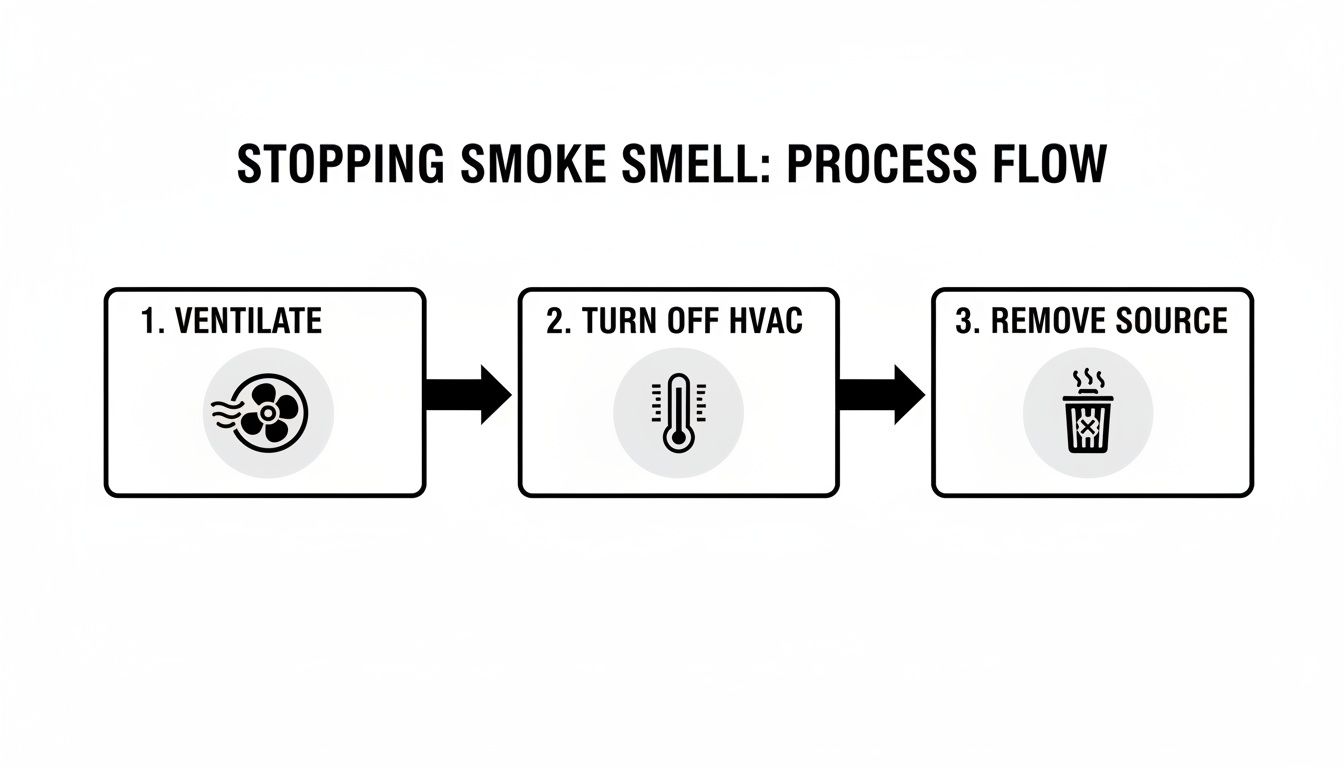
Create Immediate Ventilation
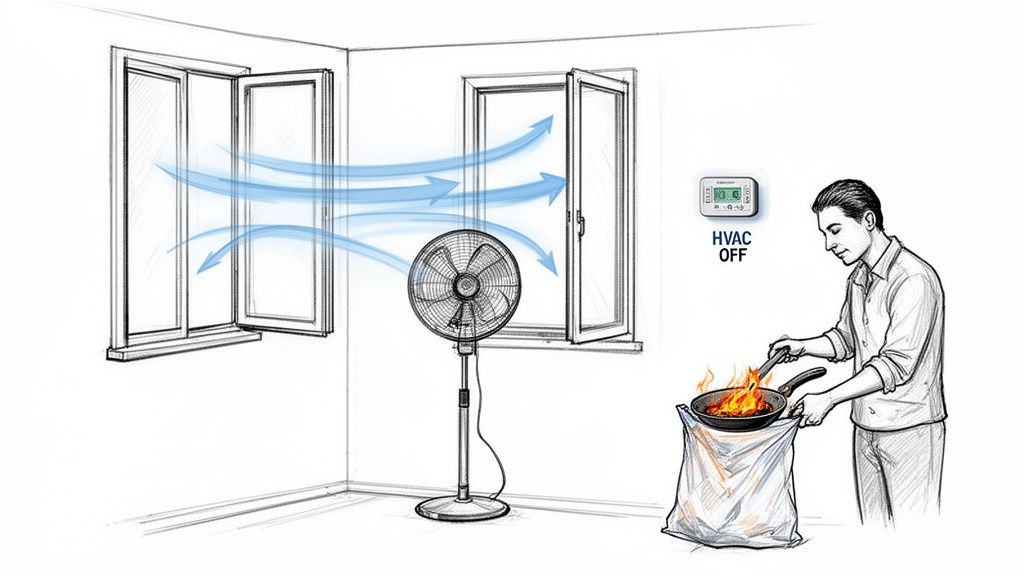
First thing's first: get the air moving. You need to push the bad air out and pull fresh air in.
- Open everything. Throw open every window and door you can to start diluting the smoke inside.
- Get strategic with fans. Don't just flip on a ceiling fan. A much better trick is to place box fans in windows, facing out. This actively forces the smoky air outside and creates a powerful cross-draft to speed things up.
Shut Down Your HVAC System
This is a big one, and it's easy to forget in the moment. Your HVAC system is designed to move air throughout your entire home. When that air is full of smoke, your furnace or AC becomes the enemy, pumping the odor into every single room and contaminating all your ductwork.
Key Takeaway: Turning off your HVAC system immediately is non-negotiable. It stops the smoke from spreading through the ducts and turning a one-room problem into a whole-house nightmare.
Leaving it on is a recipe for a much bigger, more expensive cleanup. Make sure the thermostat is completely off—not just set to "fan." If you're dealing with the aftermath of an actual fire, our what to do after a house fire checklist provides more essential steps for securing your home.
Remove the Odor Source
Airing out the house is a great start, but the smell will just come right back if the source is still there. You have to find what's causing the odor and get rid of it.
This means tossing out that burnt pan of food, emptying ashtrays, or removing any fire-damaged debris. Bag it up, seal it tight, and get it out of the house completely. You can't start the real cleaning process until the source of the smell is long gone.
A Practical Guide to Cleaning Smoke-Damaged Surfaces
Once you've aired things out and stopped the immediate spread, the real work of cleaning begins. Smoke particles are incredibly fine and invasive, settling on every single surface—from walls and countertops to deep inside your carpets and furniture. This isn't a quick wipe-down; it's a methodical, top-to-bottom process.
First, you need to know what you're dealing with. The soot from a kitchen grease fire is oily and sticky, a real pain to remove. On the other hand, soot from burned wood or paper is usually drier and more powdery. Figuring this out upfront helps you pick the right cleaning strategy and avoid making a bigger mess.
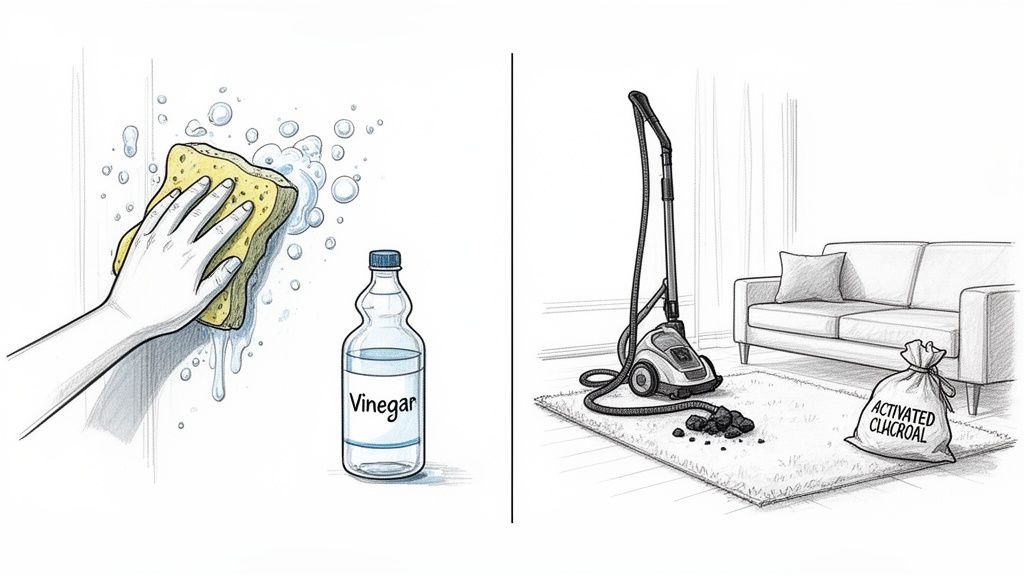
Tackling Hard Surfaces: Walls, Ceilings, and Floors
Hard surfaces are your starting line. Because soot and ash fall downward, you have to work from the top down. Always start with the ceiling, then move to the walls, and finally, the floors. If you do it in any other order, you’ll just knock debris onto the areas you've already cleaned.
Before you even think about using a liquid cleaner, get rid of all the loose soot. If you try to wipe wet soot, it will smear and get ground into porous surfaces like drywall or unsealed wood. Your best tool for this is a dry chemical sponge (often called a soot sponge) or a vacuum with a soft brush attachment. The goal is to lift the residue, not rub it in.
Once the loose stuff is gone, it's time to wash. You've got a few solid options:
- Trisodium Phosphate (TSP): This is a heavy-hitter that pros often turn to for tough, greasy soot. Mix it according to the label's directions and be sure to wear gloves and eye protection—it's powerful stuff.
- White Vinegar Solution: For less severe smoke residue, a simple 50/50 mix of white vinegar and water works surprisingly well as a natural degreaser.
- Specialized Soot Removers: Your local hardware store will have products specifically designed to break down smoke and soot without damaging surfaces.
The goal is to achieve truly Odor Free results from every surface in your home. After washing any surface, give it a final rinse with a clean, damp cloth to remove any cleaning residue and then let it air dry completely.
Pro Tip: Don't be surprised if stains remain on your walls even after a thorough cleaning. Before you even think about painting, you must use an odor-blocking primer like Kilz or Zinsser. Regular paint won't cut it; the smell will eventually seep right back through.
Dealing With Soft Surfaces: Upholstery and Drapes
Fabrics are like magnets for smoke odors. The materials in your furniture, curtains, and carpets soak up those tiny smoke particles, trapping the smell deep within their fibers. This makes them the toughest part of the job.
As with hard surfaces, start by vacuuming everything you can. Use the upholstery attachment on your couches, chairs, and drapes. For carpets, go over them slowly and repeatedly from multiple directions to pull up as much soot as possible.
Anything that can go in the washing machine (some curtains, cushion covers) should be washed with your regular detergent plus one cup of white vinegar. It might take a couple of cycles. For a deeper dive into techniques, you can explore professional resources on https://restoreheroesaz.com/tag/smoke-damage-cleanup/.
If an item can't be washed, steam cleaning is your next best bet. The hot, pressurized steam is fantastic at breaking down and releasing the smoke particles trapped in the fabric. You can rent a steam cleaner or call in a professional service.
For DIY cleaning, it's helpful to know which common household ingredients work best.
DIY Smoke Odor Cleaning Solutions Comparison
| Cleaning Agent | Effectiveness on Odor | Best For | Safety Precautions |
|---|---|---|---|
| White Vinegar | High | Walls, hard surfaces, laundry | Dilute with water; good ventilation is recommended. |
| Baking Soda | Moderate | Carpets, upholstery (as a dry absorbent) | Test on an inconspicuous area first; vacuum thoroughly. |
| TSP | Very High | Greasy soot on painted walls and ceilings | Wear gloves and eye protection. Keep away from children/pets. |
| Activated Charcoal | High (Absorbent) | Air purifying in enclosed spaces | Non-toxic, but keep contained in bags to avoid a mess. |
Choosing the right agent for the job makes a huge difference in how effectively you can remove the smoke residue and the lingering odors.
Using Odor Absorbers for Lingering Smells
After all that cleaning, you might still catch a faint whiff of smoke. That's where odor absorbers come into play. Forget air fresheners—they just mask smells. You need something that will actually trap and neutralize the odor molecules for good.
Here are a few tried-and-true methods:
- Activated Charcoal: Place bags of it around the affected rooms. It's incredibly porous and works silently to pull odors from the air.
- Baking Soda: Don't underestimate this kitchen staple. Sprinkle a thick layer over your carpets and furniture, let it sit for 24 hours, and then vacuum it up completely. It works wonders.
- Bowls of Vinegar: Another simple trick is to set out a few bowls of white vinegar. Over a couple of days, it will help neutralize any remaining airborne odors.
This layered approach—dry removal, wet cleaning, and then odor absorption—is your best bet for getting rid of that smoke smell for good. It takes patience, but doing it right the first time saves you from having that nasty smell return weeks or months later.
Uncovering Hidden Odor Sources in Your Home
You've scrubbed every surface and aired out every room, but that stubborn smoke smell just won't quit. It’s frustrating. When this happens, the source is almost always hiding where you can't see it. These hidden odor reservoirs can completely undo all your hard work if you don't hunt them down.
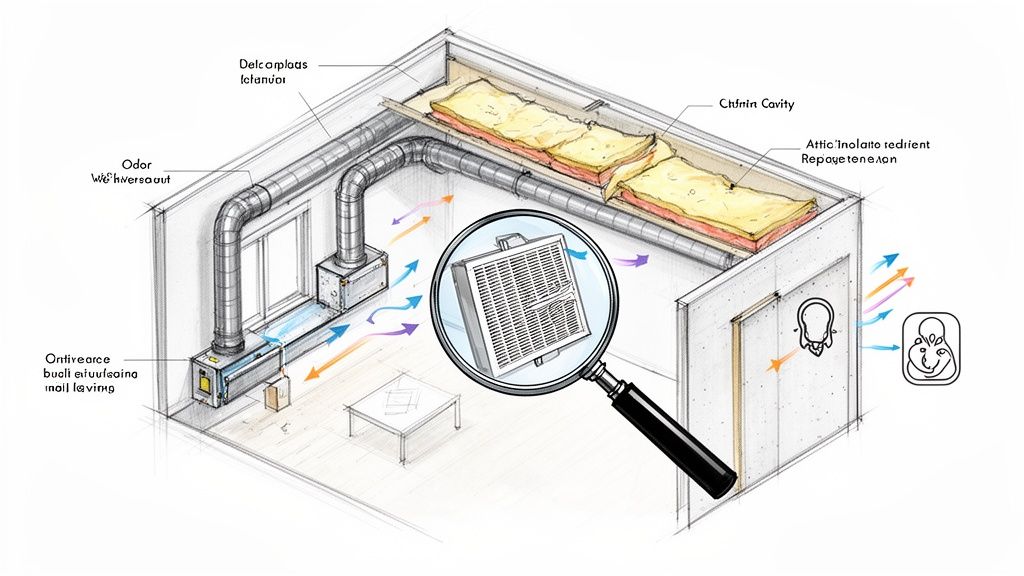
The most common culprit is your home’s circulatory system—the HVAC unit. Smoke particles are microscopic and get pulled right into your return vents, then pushed throughout the entire house via the ductwork. If you ran your furnace or AC at any point while smoke was present, it's a near certainty the smell is now baked into your vents and filter.
Your HVAC System: The Odor Superhighway
Think of your HVAC system as a network of tunnels. Once smoke particles get in, they coat the inside of the ducts and clog up the air filter. Every single time the system kicks on, it blasts those trapped odor particles right back into your living space. It's a vicious cycle.
Your first move? Check and replace your air filter. A filter that was running during a smoke event is basically a concentrated brick of that awful smell. Don't just look at it—replace it immediately with a new, high-quality one. A HEPA filter is a great investment for trapping any leftover airborne particles.
Next, take a close look at the vents in each room. You might find a fine layer of soot or black dust around the registers. That’s a dead giveaway that the ducts themselves are contaminated. You can learn more about the importance of deep cleaning from our resources on soot removal.
Real-World Scenario: A client once dealt with a small kitchen fire. They cleaned the kitchen top to bottom, but the smoke smell kept returning every evening. It turned out the air conditioner had kicked on during the incident, sucking smoke into the system. The smell was actually strongest in the upstairs bedrooms—the farthest point from the fire—because the HVAC system was so efficiently delivering the odor particles there.
When to Consider Professional Duct Cleaning
While you can clean the vent covers and the areas right inside, the full length of your ductwork is out of reach without specialized tools. If you’re noticing any of these signs, it’s probably time to call a professional:
- A persistent smell that gets noticeably stronger when the heat or AC is running.
- You can see visible soot or dark debris blowing out of your vents.
- The smoke smell is present in rooms that were nowhere near the original source.
Professionals use high-powered vacuums, rotating brushes, and antimicrobial foggers to scrub the inside of your ducts clean. For a widespread smoke problem, it’s a non-negotiable step.
Other Unseen Odor Hiding Spots
Beyond the ductwork, smoke has an uncanny ability to worm its way into the most remote parts of your home. These areas act like sponges, soaking up odor molecules and releasing them slowly over weeks or even months.
You’ll have to play detective. Get a flashlight and investigate these common hiding places:
- Wall Cavities: The empty space behind your drywall is a perfect trap for smoky air. If a smell seems to be coming from a specific wall, this could be why.
- Attics and Crawlspaces: These spots usually have poor ventilation, allowing smoke to settle into insulation, rafters, and floor joists. Blown-in insulation is especially bad for trapping odors.
- Light Fixtures and Electrical Outlets: Carefully remove the cover plates. You might be surprised to find soot stains and discoloration, showing exactly where smoke has seeped into the walls.
Checking these hidden spots is absolutely essential. Overlooking them is the number one reason DIY efforts fail and that nagging smell makes a comeback. Tackling these sources is the final frontier in your battle to get your home smelling fresh again.
When to Call for Professional Smoke Odor Removal
You’ve scrubbed, you’ve aired out the house, you’ve tried every trick you found online, but that stubborn, smoky smell just won't leave. It’s frustrating. While DIY methods can work for minor smoke issues, some situations are just too big, too deep, or too hazardous for home remedies to handle.
Knowing when to call in a professional isn’t giving up—it’s the smartest move you can make to protect your home’s value and your family’s health. Sometimes, the source of the smoke is the real problem. Smoke from burnt plastics, synthetic fabrics, or even a forgotten pot roast (a protein fire) creates a nasty, oily residue that typical household cleaners just can't touch. This stuff requires specialized chemicals to truly break it down and neutralize it.
Recognizing the Signs You Need an Expert
It's not always easy to tell when you've crossed the line from a weekend project to a job for the pros. But there are a few dead giveaways that it's time to pick up the phone. If you spot any of these, you’ll save yourself a ton of time, frustration, and probably money by calling for help sooner rather than later.
Keep an eye out for these tell-tale signs:
- Thick, Obvious Soot: Are you seeing thick, dark layers of soot on walls, ceilings, or furniture? That’s a sign of widespread contamination. If the soot is greasy and just smears when you try to wipe it, that's an even bigger red flag.
- The Smell That Won't Die: You clean everything, and for a day or two, things seem better. Then, that stale smoke odor creeps back in. This almost always means the smoke particles have worked their way deep into porous materials like your drywall, wood framing, or insulation.
- The Whole House Smells: If the odor isn't just in one room but seems to be everywhere, your HVAC system has likely become a smoke-particle super-spreader. Cleaning the ducts and the system itself requires specialized equipment.
- A Major Fire Occurred: After a significant house fire, the smell is almost certainly embedded in the actual structure of your home. No amount of surface cleaning will get rid of an odor that's soaked into studs, subfloors, and attic spaces.
Key Insight: It's hard to grasp just how invasive smoke is. The particles can be as tiny as 0.001% of the width of a human hair, which allows them to sneak into nearly every nook, cranny, and material in your home. That’s why a professional approach is often the only way to get rid of the smell for good.
Advanced Tools and Techniques Pros Use
So, what’s the secret sauce the professionals have? They come armed with commercial-grade equipment and scientific methods designed to destroy odor at a molecular level. We’re not talking about masking the smell with air fresheners—this is about permanently eliminating the compounds causing the odor.
Ozone Generators: This is a heavy hitter. An ozone generator creates O3, a highly reactive molecule that chemically breaks down smoke particles it comes into contact with. This process oxidizes the odor-causing compounds, neutralizing them. Because high concentrations of ozone are unsafe to breathe, the home must be completely empty of people, pets, and even plants during treatment.
Thermal Fogging: This is another common and highly effective technique. A technician uses a special fogger to heat a deodorizing solution into a fine mist. This "fog" behaves just like smoke, traveling into the same tiny spaces the smoke particles did. It gets into drywall, wood pores, and fabric fibers to neutralize the smell at its source.
To get a better sense of what a full-scale job looks like, you can see the step-by-step fire damage restoration process.
Why Professional Methods Outshine DIY
When deciding between tackling the smell yourself and hiring a professional, it helps to see a direct comparison. Each approach has its place, but for severe or persistent odors, professional techniques are in a different league.
Here’s a look at how they stack up:
| Method | Effectiveness | Typical Cost | Best For |
|---|---|---|---|
| Professional Ozone Treatment | Very High | $200 – $600+ | Severe, widespread odors embedded in a structure. Must be done by trained pros. |
| Professional Thermal Fogging | Very High | $200 – $500+ | Deeply penetrated smoke odors in porous materials like wood and upholstery. |
| DIY Vinegar/Charcoal Bowls | Low | < $20 | Minor, localized odors in a small, contained area. More of an odor absorber than a remover. |
| DIY Cleaning Solutions | Low to Moderate | $20 – $100 | Light surface soot and mild, fresh smoke smells. Won't affect embedded odors. |
Ultimately, while DIY methods are great for your wallet on minor issues, they often just mask the problem or fail to address the root cause. Professionals bring the right tools and expertise to eliminate the odor permanently.
The Value of IICRC Certification
When you start looking for a restoration company, make sure they have an IICRC certification. The Institute of Inspection, Cleaning and Restoration Certification is the gold standard in this industry. An IICRC-certified technician has undergone rigorous training on the safest and most effective methods for smoke and fire remediation. They understand the science and follow proven protocols to get the job done right the first time.
This expertise is more important than ever. The market for smoke odor removal is now at USD 2.34 billion globally, a reflection of the increasing number of fire-related incidents. Lingering smoke odor can slash a home's value by 10-15%, and over 70% of homeowners who rely solely on DIY methods report that the smell eventually comes back. Hiring a certified pro is your best bet for protecting your investment and ensuring your home is truly clean and safe.
Juggling Insurance Claims and Health Concerns
After a fire, the cleanup is only half the battle. You're suddenly thrown into two critical situations at once: navigating a complicated insurance claim and protecting your family from the invisible health risks left behind by smoke and soot.
Getting the insurance part right from the get-go can make all the difference. Before you touch, move, or clean a single thing, stop and document everything. Walk through your home taking photos and videos of every affected room and item. Then, start a detailed list of all your damaged belongings, including how old they are and what you think they're worth.
This documentation is your proof. It's the evidence your insurance adjuster will rely on to understand the true extent of the damage, and a thorough record gives your claim a solid foundation. It also pays to know the common insurance claim denial reasons so you can steer clear of simple mistakes that could jeopardize your coverage.
Working with Professionals on Your Claim
A good restoration company becomes your best advocate when you're dealing with the insurance company. They speak the same language as adjusters and can provide the professional-grade documentation needed to show exactly what's wrong and what it will take to fix it.
Here’s how they can help:
- Detailed Damage Reports: They’ll create a comprehensive report that details every step required to truly remove the smoke smell from your house, from cleaning the structure itself to final deodorization.
- Direct Communication: Many pros will talk directly to your insurance adjuster. They can explain the technical side of the restoration and justify why specific, often expensive, procedures are non-negotiable for a safe and complete recovery.
Having an expert in your corner helps ensure your claim covers all the necessary work, not just a surface-level fix. If you want to dive deeper, we have more insights on handling a fire insurance claim you might find helpful.
Don’t Underestimate the Health Risks
That lingering smoke smell isn't just a nuisance—it's a red flag for serious health hazards. The residue left by smoke is packed with toxic chemicals and tiny particles that can wreak havoc on your respiratory system. This is especially dangerous for children, older adults, and anyone with conditions like asthma.
The real danger comes from volatile organic compounds (VOCs) that hang in the air and embed themselves in materials long after the fire is out. The good news? Air purifiers with both HEPA and activated carbon filters are incredibly effective, capable of removing 99.97% of these dangerous airborne particles.
In fact, industry data shows that professional, in-depth remediation—which goes beyond surface cleaning to address soot trapped inside walls and framing—can cut down post-cleanup health complaints by a staggering 75%.
Safety First: If you attempt any cleanup on your own, please don't do it without the right Personal Protective Equipment (PPE). At a minimum, you need an N95 respirator mask, safety goggles, and heavy-duty gloves. This stuff is toxic, and you don't want to breathe it in or get it on your skin.
With risks like these, calling in certified professionals is almost always the smartest and safest path forward. They have the right equipment and follow strict safety protocols to make sure every last bit of toxic residue is gone, making your home not just smell better, but truly safe for your family again.
Common Questions About Smoke Smell Removal
Even with a good game plan, you're bound to have questions when tackling a smoke smell problem. Let's walk through some of the most common things homeowners ask, so you know exactly what you’re up against.
How Long Does It Take to Get Rid of Smoke Smell in a House?
This is the million-dollar question, and the honest answer is: it depends. The timeline for getting rid of smoke odor can vary dramatically.
If you just burned a bag of popcorn, you're probably looking at a few hours with the windows open. A small kitchen fire that was put out quickly might take a solid weekend of deep cleaning.
But when you're dealing with a serious situation—like after a house fire or cleaning a home lived in by a heavy smoker for years—the smell has worked its way into everything. In those cases, even professional remediation can take 3 to 7 days, sometimes longer, depending on the size of your house and the level of contamination. Trying to DIY a problem that severe could take weeks, and you might not even get the results you want.
Will an Air Purifier Remove Smoke Odor by Itself?
An air purifier is a great supporting actor, but it can't be the star of the show. It's a fantastic tool, but it won't solve the core problem on its own.
A good air purifier, especially one with both a HEPA and an activated carbon filter, is brilliant at grabbing airborne smoke particles out of the air. It will definitely improve the air you're breathing. The problem is, the smell isn't just floating around—it's stuck to things. That stubborn odor comes from a sticky residue coating your walls, furniture, carpets, and even the inside of your air ducts.
An air purifier can't scrub your walls or shampoo your carpets. It's best used during and after the actual cleaning process to catch any particles that get stirred up. You have to physically remove the source of the smell from all the surfaces first.
An air purifier cleans the air, but it can’t clean the house. For the smell to truly be gone, you have to get rid of the odor-causing residue on surfaces.
Is It Safe to Stay in a House That Smels Like Smoke?
It’s really not a good idea, especially after a fire. That smell is more than just annoying; it’s a warning sign that you’re breathing in harmful particulates and chemical compounds.
These tiny, invisible particles can seriously irritate your lungs and cause other health problems. This is especially true for children, older adults, and anyone with respiratory issues like asthma.
For something minor like a little cooking smoke, just airing the place out might be fine. But if the smell is strong and won't go away, it's safest to find somewhere else to stay until the home is properly cleaned and deodorized. Your health always comes first.
Does Homeowners Insurance Typically Cover Smoke Odor Removal?
For the most part, yes. A standard homeowners insurance policy will often cover damage from fire and smoke. This can include the cost of professional smoke odor removal services.
That means things like deep cleaning, duct cleaning, and specialized treatments like thermal fogging or ozone generation may be covered under your policy.
The trick is to move fast. Call your insurance agent right away to get the claim started. They'll want you to document everything, so take plenty of pictures and make a list of anything that's been damaged. Hiring a certified restoration company can make this process a lot easier, as they know how to provide the detailed estimates and reports your insurance adjuster will need.
When you're facing smoke damage that feels too big to handle, you need a partner you can trust to bring your home—and your peace of mind—back to normal. Restore Heroes is IICRC-certified and has the experience to manage every step of smoke and fire remediation, from the first look to the final deodorization. We can work with insurance carriers to help make things as simple for you as possible. For 24/7 help in the Phoenix area, contact us today.