
Finding mold in your home is a gut-wrenching moment. Whether it's a suspicious black patch spreading behind a leaky pipe or just a stubborn musty smell you can't seem to shake, your first thought might be to reach for a bottle of bleach. But I’ve seen firsthand that a little scrubbing rarely solves the real problem.
True mold damage restoration is much more than surface cleaning. It’s a professional process that digs deep to find the source of the moisture, get rid of the mold, and rebuild any damaged areas. It has to be done right, especially since mold can start growing in just 24-48 hours after a water incident.
What Is Mold Damage Restoration and Why It Matters
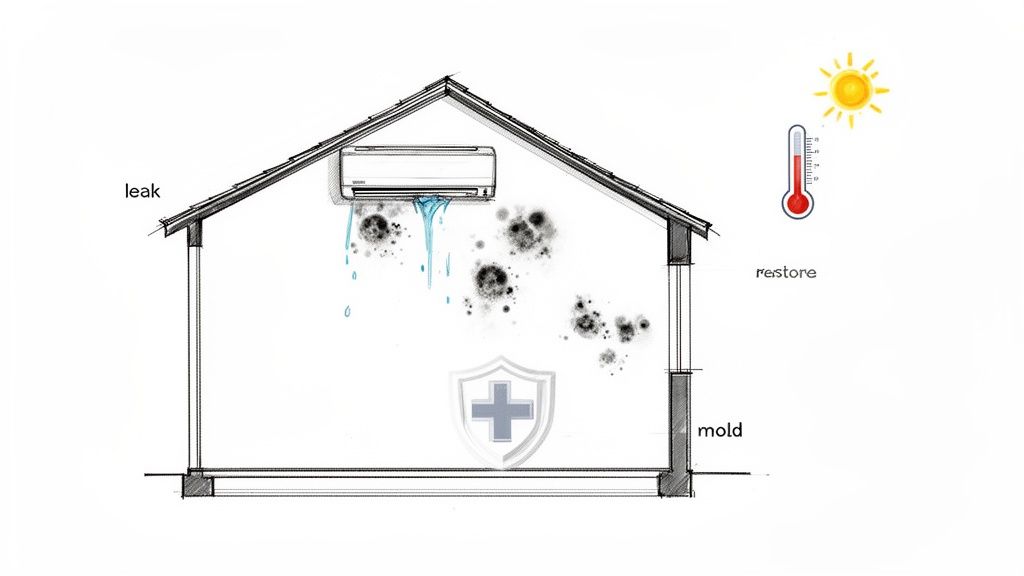
Think of mold like a stubborn weed. You can't just snip the top off and call it a day—the roots are still there, ready to sprout again. Professional restoration is about getting to the root of the problem, not just wiping away what you can see.
This means finding out why the mold grew in the first place. Was it a slow-leaking pipe inside a wall? Poor ventilation in the bathroom? Condensation from an overworked AC unit? Without fixing that underlying moisture issue, the mold is likely to come back.
At its heart, mold damage restoration is a comprehensive service focused on containing the mold, safely removing it, and helping to prevent it from returning. It’s about protecting the structure of your home and, more importantly, the health of your family.
The Importance of a Professional Approach
Here’s something many people don’t realize: trying to remove mold yourself can actually make things worse. When you disturb a mold colony without the right precautions, you can send millions of tiny spores flying into the air, spreading the contamination to other rooms and creating a potential health hazard.
That's where the experts come in. A professional team has the training and equipment to handle mold safely. They follow a very specific, industry-tested process:
- Inspection and Assessment: It starts with a thorough investigation. Professionals may use tools like moisture meters and thermal cameras to find mold and moisture, even what might be hiding behind walls or under floors.
- Containment: The next crucial step is to seal off the affected area. This may involve setting up plastic sheeting and using special negative air pressure machines to create a quarantine zone, preventing spores from escaping during the work.
- Removal and Cleanup: Anything that can't be saved, like porous drywall or carpet, is carefully bagged and removed according to regulations. Harder surfaces are cleaned and disinfected with EPA-registered antimicrobial solutions.
- Drying and Dehumidification: Once the mold is gone, powerful air movers and dehumidifiers are brought in. Getting the area dry is non-negotiable—it eliminates the moisture mold needs to survive.
- Repair and Restoration: The final phase involves rebuilding. This may mean replacing drywall, laying new carpet, and repainting so your home can look like the damage never even happened.
Why It’s Different in Phoenix
Living in Phoenix presents some unique challenges. While it's famously dry outside, our constant need for air conditioning creates perfect opportunities for mold inside. A little condensation or a small leak from an AC unit in a hot attic can quickly become a hidden, humid paradise for mold.
Because our climate can create these hidden moisture pockets, a fast and knowledgeable response is key. Knowing what a restoration company does from start to finish can give you confidence during a stressful time. Hiring an IICRC-certified team helps ensure the job is handled correctly, protecting both your property value and your family's health from the silent threat of mold.
How to Spot the Early Signs of a Mold Problem
Mold is sneaky. Long before you see those ugly black or green patches, it often leaves subtle clues. The key is knowing what to look for—and what to smell for—to catch a problem before it turns into a major restoration project.
Your nose is often your best first line of defense. The most common giveaway is a persistent musty smell. People often describe it as smelling like a damp basement or wet dirt. That odor is caused by gases—called Microbial Volatile Organic Compounds (MVOCs)—that active mold releases. If that smell is stronger in a bathroom, under a sink, or in a closet, that's a huge red flag pointing to hidden growth.
Beyond the Obvious Signs
Sometimes, the signs are right in front of you, but they don't scream "mold." Instead, they look like minor cosmetic issues. You have to know how to connect these dots to moisture, which is the root of any mold problem.
Keep an eye out for these subtle indicators that something is wrong:
- Bubbling or Peeling Surfaces: Is your paint or wallpaper starting to bubble, crack, or peel? That's a classic sign of moisture trapped underneath, creating the perfect environment for mold to thrive.
- Warped Materials: If your wood floors or baseboards are starting to warp or feel soft, they're soaking up moisture. This is especially common after a slow leak you might not even know you have. It's why spotting mold behind baseboards is such a critical skill for homeowners.
- Discoloration and Stains: Mysterious yellow or brown stains on walls or ceilings are ghosts of water damage past. Even if the area feels dry now, that moisture was enough to kickstart a mold colony inside the wall. We cover this in more detail in our guide on the signs of mold in walls.
Unexplained allergy-like symptoms that get worse when you're home—sneezing, a runny nose, itchy eyes, or skin rashes—can also be an early sign. If your "allergies" seem to clear up when you leave the house, it might be the air quality inside, not pollen outside.
Phoenix-Specific Mold Triggers
Living in the Phoenix area, we face unique challenges. It’s bone-dry outside, but inside, our homes are sealed tight with the AC blasting for months. This creates specific moisture issues that can easily lead to mold.
I've seen it countless times: a homeowner is shocked to find black mold after a heavy monsoon storm. This isn't just a local problem; it's a growing trend.
Here are some of the most common causes of mold we see in Phoenix homes.
Common Causes of Mold in Phoenix Properties
| Moisture Source | Common Location | What to Look For |
|---|---|---|
| AC Condensation | HVAC drain pan, air handler closet, ducts | Water stains on the ceiling below the unit, musty smells when the AC kicks on. |
| Monsoon Leaks | Roof, window sills, around exterior doors | Water stains after a storm, peeling paint, damp drywall. |
| Slab Leaks | Under flooring, baseboards | Warped flooring, a sudden spike in your water bill, unusually warm spots on the floor. |
| Appliance Leaks | Behind refrigerators, dishwashers, washing machines | Buckling floors, discolored baseboards, damp or moldy smell in the kitchen or laundry room. |
| Poor Ventilation | Bathrooms, laundry rooms | Persistent moisture on walls after showering, slow-drying towels, visible spots on the ceiling. |
Being aware of these Phoenix-specific risks helps you stay one step ahead of a potential mold disaster.
Globally, the mold remediation market was valued at USD 1,340.3 million in 2025 and is projected to hit USD 1,751.9 million by 2032. This spike is driven by increasing water damage from extreme weather, like our monsoons. With North America making up over a third of that market, it shows just how often property owners are dealing with leaks that can explode into mold problems in as little as 24 hours. You can discover more insights about the rising demand for remediation services on Barchart.com.
So, you’ve found mold. The idea of calling in a professional team can feel daunting, but it's not as chaotic as you might think. A professional remediation isn't just about tearing things out; it’s a systematic, step-by-step process designed to remove the mold and make your home safe again.
Let's walk through exactly what you can expect when the experts arrive.
Step 1: The Inspection and Assessment
The entire process kicks off with a thorough inspection. This isn’t just a quick glance around. A trained technician acts like a detective, using tools like moisture meters and infrared cameras to find not only the visible mold but also the hidden moisture that’s feeding it. This is a very important step, because if you don't find and fix the water source, the mold may come right back.
Think of this assessment as the blueprint for the entire project. It tells the team where the problem started—a slow leak behind a cabinet, condensation in the attic, or a crack in the foundation—so they can address the cause, not just the symptom.
Often, the first clues are things you can see, smell, or feel.
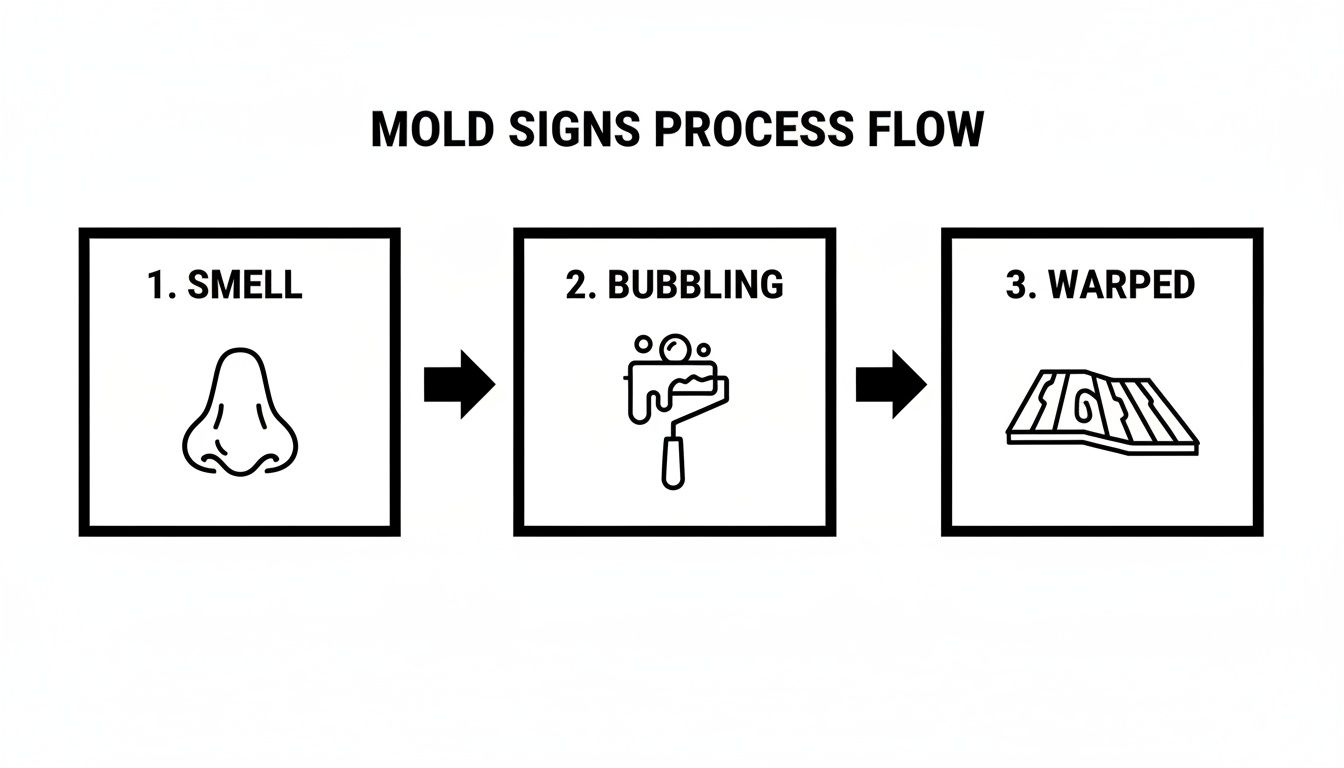
That musty smell or the sight of bubbling paint are your home's way of telling you something is wrong behind the scenes.
Step 2: Containment and Air Filtration
Once the technicians know the extent of the problem, their next move is to stop it from spreading. Mold spores are tiny and get everywhere if you’re not careful. To prevent this, they often set up a containment zone.
This is done by sealing off the affected area with thick plastic sheeting and creating negative air pressure. Essentially, they use special fans to pull clean air into the work zone and then vent the contaminated air outside through a filter. This helps ensure that any spores kicked up during the cleanup are captured instead of spreading to the rest of your house.
Inside the containment zone, you'll see air scrubbers running. These are powerful machines with HEPA (High-Efficiency Particulate Air) filters that can capture up to 99.97% of airborne particles, literally scrubbing the air clean of mold spores.
Step 3: Mold Removal and Cleanup
With the area safely contained, the actual removal can begin. How this is done depends entirely on what’s moldy.
- Porous Materials: Things like drywall, insulation, and carpet are like sponges for mold. Once mold gets in deep, you can't just clean it off. These materials are carefully cut out, sealed in thick bags, and disposed of properly. Dealing with moldy drywall is a common challenge, and our guide on how to remove mold from behind walls goes into more detail on that.
- Non-Porous and Semi-Porous Materials: Hard surfaces like glass, metal, tile, and some sealed wood can usually be saved. Technicians use special antimicrobial cleaners and proven techniques to scrub these materials clean, removing traces of mold.
The key here is physical removal. Simply spraying a chemical on the mold isn't enough; it often has to be completely removed from the surface.
Step 4: Drying and Final Sanitation
After all the moldy materials are gone, the focus goes right back to moisture. The team will bring in industrial-grade dehumidifiers and high-speed air movers to dry everything out completely. They'll use moisture meters to confirm that the wood, concrete, and air are back to normal, safe levels. This drying step is critical for preventing a repeat problem.
Once everything is dry, the area gets a final cleaning. All the surfaces that were part of the project—studs, subfloors, and anything else left in the containment zone—are wiped down with an antimicrobial solution. This final sanitation helps ensure the space is truly clean and ready for repairs. Only after air tests confirm the spore counts are within an acceptable range will the containment barriers come down.
What Factors Influence the Cost and Timeline of Remediation
When you find mold, two questions always come first: how long is this going to take, and what’s it going to cost me? It's impossible to give a flat rate without seeing the problem firsthand, but I can walk you through the main variables that shape the price and timeline for any mold damage restoration job.
Think of it this way: you can't call a mechanic and ask, "How much to fix my car?" without them looking under the hood. They don't know if you just need a quick fix or a complete engine overhaul. It’s the exact same for us in the restoration world; we have to see what we're up against.
The Scale and Spread of the Mold
First and foremost, the cost often comes down to the size of the affected area. A small, contained spot of mold on a bathroom wall is a completely different ballgame than a colony that has crept through an entire attic or basement.
The more square footage that has to be dealt with, the more labor, specialized equipment, and containment materials it’s going to take. A widespread problem may also force a team to set up more extensive barriers to prevent spores from contaminating the rest of your home, which adds time to the project.
A small, isolated mold problem (under 10 square feet) might take a day or two to handle properly. But if that mold has gotten into structural beams or your HVAC system, it could be a week or even longer for a full remediation and rebuild.
This is exactly why catching it early is so important. A little leak you fix right away stays a small, manageable project. A leak that goes unnoticed for weeks can spawn a massive mold problem that can dramatically drive up the cost and complexity.
Types of Materials and Accessibility
Next, you have to look at what the mold is actually growing on. Different materials require totally different approaches.
- Non-Porous Surfaces: Things like glass, metal, and sealed countertops are the easier ones. Technicians can usually clean and sanitize these surfaces with professional-grade antimicrobial treatments.
- Porous and Semi-Porous Surfaces: This is where it gets tricky. Materials like drywall, insulation, carpet, and untreated wood act like sponges. Once mold sets its roots deep inside, it's often impossible to fully remove. In these cases, the only safe option is to carefully cut out and replace the affected materials.
Where the mold is located also plays a huge role. If it’s on an open, easy-to-reach wall, the job is pretty straightforward. But if the mold is hiding behind a kitchen cabinet, under your flooring, or deep inside the air ducts, the job instantly becomes more involved. Technicians have to spend extra time carefully accessing these hidden spots to get the job done right.
The Source of the Moisture
A professional remediation job isn't just about removing the mold you can see; it’s about fixing the water problem that caused it in the first place. The difficulty of that initial repair has a direct impact on the overall scope. Fixing a simple leaky pipe under a sink is usually a quick job.
On the other hand, if the water is coming from a cracked foundation, a hidden slab leak, or a persistent roofing issue, that repair is much more involved. Our guide on understanding water damage repair costs gives you more insight into how these initial repairs factor into the total project.
There's a reason the restoration industry is growing. Mold is an equal-opportunity invader that costs property owners billions. In fact, waiting to address a problem can cause costs to spiral—untreated mold can lead to structural repairs costing anywhere from $1,000 to $5,000 per square foot. You can read the full research about these restoration industry statistics to see the real financial impact of delays.
Any reputable restoration company will provide you with a detailed inspection followed by a transparent, line-by-line estimate. This allows you to know what work is being proposed and why, so there are no surprises down the road.
Navigating the Insurance Claims Process for Mold Damage
Once you find mold, your mind probably jumps to two things: how to get rid of it and how to pay for it. That’s where insurance comes in, but dealing with a claim can feel like its own full-time job. The key to making it manageable is understanding one simple rule: it’s all about where the water came from.
Insurance companies draw a hard line between mold from a "sudden and accidental" water event and mold from a long-term problem. A classic example is a burst pipe that floods a wall—that’s often covered. On the other hand, mold from a slow, drippy faucet or poor bathroom ventilation that’s been ignored for months? That's usually considered a maintenance issue, which insurance policies may not cover.
Understanding Your Policy and Coverage
Your very first call should be to your insurance agent to get a clear picture of your policy. Never assume you’re covered. Many standard homeowner's policies put specific limits, or "caps," on how much they'll pay for mold remediation, even if the cause was a covered event.
These caps can be as low as a few thousand dollars, so it's critical to know that number before any work begins. Knowing your policy’s limits helps you and your restoration company create a realistic plan from the start.
The most important thing to remember is that insurance focuses on the initial cause of loss. Your claim should be built around the water damage incident that caused the mold, because the water damage is often the covered event.
Document Everything Meticulously
From the second you spot the problem, start keeping records. Meticulous documentation is your single most powerful tool when filing an insurance claim. A professional restoration company can be invaluable here—they are experts at creating the detailed evidence adjusters require.
Use this checklist to build a stronger claim file:
- Take Detailed Photos and Videos: Before a single thing is moved, capture everything. Get wide shots of the entire area, then zoom in on the mold, the source of the water, and any personal belongings that were damaged.
- Keep a Communication Log: Every phone call, every email. Write down the date, time, the name of the person you spoke with, and a summary of the conversation. It creates a clear timeline.
- Save All Receipts: Keep every receipt for any money you spend out-of-pocket, like the emergency plumber you called to stop the leak or tarps you bought to protect your floor.
- Do Not Discard Damaged Items: This is a big one. Don't throw anything away until your insurance adjuster has physically inspected it or given you the green light to toss it.
This level of detail creates an undeniable record of what happened and the true extent of the damage. An IICRC-certified team can back this up with professional moisture readings, detailed reports, and a precise scope of work that adjusters understand and respect. To dive deeper, take a look at our guide on whether homeowners insurance covers mold and the common exceptions.
How to Choose the Right Mold Restoration Company in Phoenix
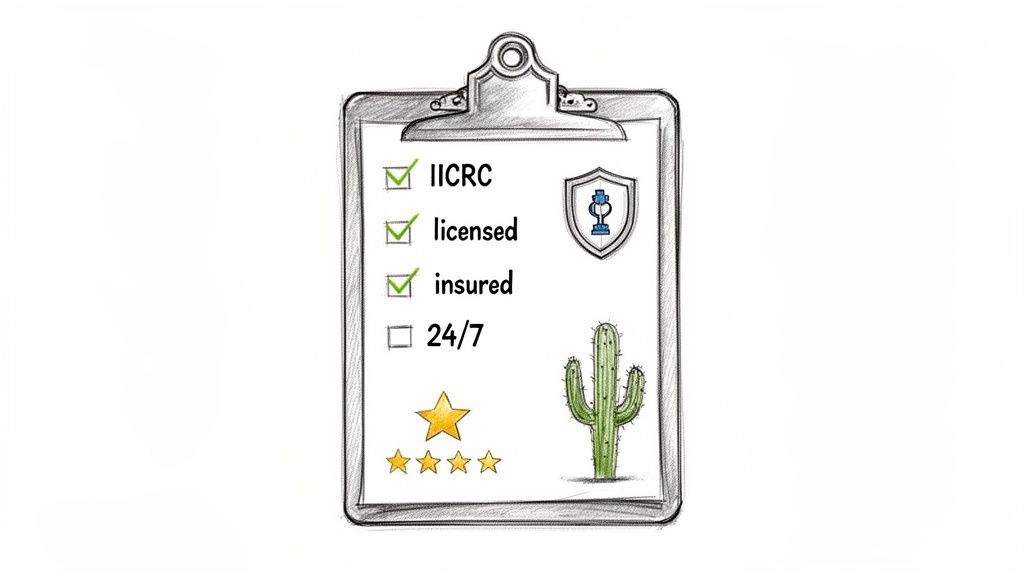
When you find mold, the first impulse is to just get it gone—fast. But the single most important decision you'll make is who you hire for the mold damage restoration. This is about more than just a cleanup; it's about protecting your property and your family from bigger problems down the road.
The truth is, not all mold companies are the same. A properly trained team follows strict, science-backed protocols. An unqualified crew, on the other hand, can accidentally spread mold spores all over your house, making a small issue a massive one. Knowing what to look for will help you tell the real pros from the pretenders.
Look for IICRC Certification
The first thing you should always ask about is IICRC (Institute of Inspection, Cleaning and Restoration Certification). This isn't just a decal on a van; it's the gold standard for our industry. It means the technicians have gone through intense training and passed exams on the correct, safe, and effective methods for handling mold.
An IICRC-certified pro understands the science of how mold grows, how to contain it, and how to remove it. They know how to prevent cross-contamination and get the job done right. Think of it this way: you wouldn't let a doctor operate without a medical license. The same logic applies to your home's health.
Choosing a non-certified company is a huge gamble. They might quote a lower price, but without the right training in containment, they risk turning a problem in one room into a full-blown contamination affecting your entire home.
Verify Licensing and Insurance
Next, you absolutely must confirm the company is licensed, bonded, and insured to operate in Arizona. This is a non-negotiable step that protects you from major liability. If a worker gets hurt on your property and they aren’t insured, you could be on the hook financially.
Proper insurance also protects your home. A legitimate company will carry general liability insurance, but they should also have specific pollution liability coverage. This is the policy that covers problems arising from contaminants like mold, giving you a critical safety net.
Essential Questions for Any Potential Contractor
Before you sign anything, have a list of questions ready. A company that knows its stuff will have no problem giving you clear, direct answers.
- Are You IICRC-Certified? This should always be your first question. Don't be afraid to ask for their certification number.
- Can You Provide Proof of Insurance? Don't just take their word for it. Ask for a copy of their insurance certificate to review.
- Do You Offer 24/7 Emergency Service? Mold doesn't stick to a 9-to-5 schedule. You need a company that can respond quickly when you need them most.
- Do You Provide Free Inspections and Estimates? A professional team should be willing to come out, assess the situation, and give you a detailed estimate with no strings attached.
By focusing on these key qualifications—certification, proper insurance, and a history of good local reviews—you can confidently hire a trustworthy partner like Restore Heroes. It's the best way to ensure your home is in good hands and the job gets done safely and correctly.
Common Questions About Mold Damage Restoration
It's completely normal to have questions swirling around after discovering a potential mold problem. We get it. Let's clear up a few of the most common ones we hear from homeowners right here in the Phoenix area.
Can't I Just Clean It Myself With Bleach?
This is probably the first thing that comes to mind for most people, but it's a common mistake. While we think of bleach as the ultimate germ-killer, the Environmental Protection Agency (EPA) actually warns against using it on mold, especially on porous materials like drywall or wood.
Think of it like this: the chlorine in bleach kills the surface mold, but the water component can soak into the material. This water can then feed the mold's hidden roots, and before you know it, the problem may come roaring back, often worse than before. Professional teams use specialized, EPA-registered antimicrobials designed for the job.
Is Mold Always Easy to See?
Not at all. In fact, mold is incredibly good at hiding where you’d least expect it—behind walls, tucked away in attics, under floorboards, or deep inside your HVAC system.
Many times, the first clue isn't what you see, but what you smell. That persistent musty, earthy odor that you can't seem to place? That’s a huge red flag for a hidden mold colony. A professional inspection is designed to track down these hidden sources without tearing your home apart unnecessarily.
The key to preventing mold from returning is consistent moisture control. A successful restoration project addresses the immediate problem, but long-term prevention is a partnership between the homeowner and the restoration expert.
How Can I Stop Mold from Coming Back?
Once the professionals have finished, keeping mold away is all about controlling moisture. The restoration process is designed to leave the area dry, but you play a big role in keeping it that way.
Here’s what you can do to keep your home protected:
- Solve the Source: Double-check that the original leak—whether it was a pipe, roof, or window seal—is completely and permanently fixed.
- Keep It Dry: Aim to keep your indoor humidity below 50%. Always run the exhaust fans in your bathroom and kitchen to vent steam and moisture outside.
- Do Regular Spot Checks: Every so often, take a peek under sinks, around window sills, and in your laundry area. Catching a small drip early can prevent a major headache later.
A great restoration job gives you a fresh start. These simple habits are what make it last.
If you’re worried about mold or need help right away, don’t let the problem fester. The IICRC-certified professionals at Restore Heroes are on call 24/7 to provide a free inspection and give you real, expert advice. Visit us online at https://restoreheroesaz.com to get your home—and your peace of mind—back.