
You open a bedroom closet and notice a musty smell, then find dark spotting behind a storage box. Maybe you're the tenant wondering whether the apartment is safe, or the landlord trying to work out whether the air conditioner, a pipe, or everyday condensation caused it.
Landlord responsibility for mold comes down to a chain of cause, notice, and repair time. Who controlled the moisture source? Who knew about it? What happened after the problem was reported? For Arizona rentals, those questions are more useful than arguing about who first spotted the mold.
Who Pays for Mold Repairs in a Rental
The landlord usually must correct mold caused by building defects, while tenants may bear responsibility for moisture they create or damage they worsen through delayed reporting. That doesn't mean every cleanup bill automatically belongs to either party.
The Washington Department of Health's mold guidance describes the basic boundary: owners address building-related moisture problems, while residents help control everyday moisture and report defects. It's a useful practical distinction, although Arizona law governs an Arizona dispute.
Who is usually responsible for mold by moisture cause
| Cause of moisture | Usually landlord | Usually tenant | Deciding factor |
|---|---|---|---|
| Roof, window or building envelope leak | Yes | No, unless the tenant caused the damage | Source is structural |
| Plumbing or pipe leak | Yes | No, unless the tenant caused the damage | Notice and repair timing |
| Inadequate ventilation or heating and cooling defect | Yes | No | Whether the system was maintained |
| Condensation from cooking, showers or drying laundry | Shared | Yes, if ventilation was not used or problems were not reported | Use of fans and reporting |
| Tenant spill or unreported small leak | For defective plumbing or resulting building repairs | Yes, for tenant-caused water or avoidable additional damage | Notice given and size of damage |
| Mold that grows after a delayed repair | Yes | No, where the tenant reported it and cooperated | Time between notice and correction |
How the cause changes the answer
Say a Phoenix apartment's air conditioner leaks behind a bedroom wall, and mold appears in the closet three weeks later. The failed cooling equipment is a building defect, so the landlord generally owns the equipment repair and appropriate treatment of affected building materials.
The tenant's conduct becomes relevant if they caused the water or noticed warning signs and delayed reporting them. A hidden leak that the tenant couldn't reasonably detect is different from a puddle they repeatedly wiped up without telling management.
Practical rule: Identify who controlled the moisture source before deciding who should pay.
Insurance is a separate question from legal responsibility. This explanation of whether homeowners insurance covers mold can help distinguish a coverage issue from a repair obligation, but a particular rental-property policy needs its own review.
Find the moisture cause that best matches your situation in the table. Then check the deciding factor, not just the column naming the usual responsible party.
Arizona Laws That Set Landlord Duties
Arizona doesn't have a standalone mold statute identified in the Environmental Law Institute's state-law summaries. Rental disputes generally fall under the Arizona Residential Landlord and Tenant Act, including its habitability and maintenance duties.
In plain language, landlords must keep covered rental housing fit for habitation and maintain supplied plumbing, ventilation, and other building systems. Tenants must use facilities reasonably and promptly report needed repairs. A roof leak and a tenant's overflowing container therefore raise different questions, even if both leave similar-looking mold.
No mold number settles the legal question
There's no single federal mold exposure limit or nationwide building-tolerance standard that automatically establishes whether a rental is habitable, as the mold liability and prevention legal explainer explains. Housing requirements often address mold indirectly through weather-tight construction, working ventilation, and leak-free plumbing.
A landlord can therefore owe a repair even without a statute naming an allowable mold concentration. Conversely, a laboratory result alone doesn't resolve every question about liability or damages.
The facts that usually need examination include:
- Moisture source: Was the problem a defective building component or something the occupant did?
- Written notice: What information reached the landlord, and when?
- Repair history: Was the same leak patched repeatedly without being corrected?
- Lease and conduct: What duties did each party accept, and did they cooperate with repairs?
A lease might require tenants to clean bathroom surfaces and use an exhaust fan. That doesn't turn a leaking roof into a housekeeping duty, or establish that a nonworking fan was the tenant's fault.
Local housing codes in Phoenix, Mesa, and Scottsdale may add requirements, so check the applicable city code as well as state law. The strongest position connects visible growth to a specific repair issue, then documents what each party did about it.
What Tenants Can Do When a Landlord Does Not Act
Before choosing a remedy, answer these questions: Did you give written notice? Is the underlying defect a landlord repair duty? Has the applicable repair period passed? Confirm the details under the Arizona Residential Landlord and Tenant Act and your local code rather than assuming that any delay authorizes withholding rent or ending the lease.
Send a clear written repair demand identifying the location, visible conditions, suspected water source, and earlier reports. Ask for an inspection and repair schedule, and offer reasonable access. Keep copies outside a management portal in case access to the account later ends.
Escalate without weakening your position
If the landlord doesn't respond, build an orderly record rather than sending increasingly vague complaints.
- Document each delay: Record missed appointments, unanswered messages, and whether water is still entering.
- Contact local enforcement: Ask the housing or code enforcement office whether it can inspect the reported building defect.
- Get legal advice: Significant property losses, displacement, health allegations, or a proposed lease termination deserve individual legal review.
For a negotiated approach, Mediation & Negotiation Services (M&N) provides context on mediation for uninhabitable rental units. Mediation may help parties discuss repairs, access, or disputed charges, but it doesn't replace advice about statutory remedies.
If work makes the unit temporarily unusable, review tenant relocation assistance considerations and confirm what applies to your lease and circumstances. Don't assume every mold report creates an automatic right to paid accommodation.
Check disclosure duties separately
The available Arizona summaries don't establish a specific Arizona mold-disclosure rule. By contrast, the Washington Department of Health's renter and landlord guidance states that Washington landlords must provide information about indoor-mold health hazards and controlling growth.
Check whether an Arizona state rule, local code, or your lease requires notice, and put disclosures in writing. A tenant who caused water damage or ignored a known leak may weaken a claim; the final responsibility question belongs to the parties and, when necessary, a lawyer or local housing office.
How to Respond After a Tenant Reports Mold
A message about a musty smell or a dark patch calls for a documented response, not an argument about whether the spot is really mold. Record when the report arrived and what the tenant observed. Treat the following schedule as a management practice, not a substitute for Arizona's legal notice and repair requirements.
Follow a moisture-first response
Acknowledge the report in writing the same day. Confirm the date, room, description, and any active leak. Written notice can be important to statutory remedies, so don't leave the tenant unsure whether management received it.
Arrange an inspection within a few days, sooner for active water intrusion. Photograph the affected surface, nearby staining, and the suspected source. Ask when the tenant first noticed dampness and whether the condition changes when the air conditioner runs or after a shower.
Stop the water before cleaning. Repair the pipe, drain, roof opening, failed fan, or other source. Waiting for laboratory results while water continues entering is a preventable mistake; coordinate access and trades using a clear apartment water damage response plan.
Dry promptly and remove materials that can't be recovered. The EPA's mold and moisture guide recommends drying wet materials within 24–48 hours and keeping indoor humidity ideally around 30–50 percent. Use extraction equipment and dehumidifiers, with fans where appropriate for uncontaminated drying, rather than blowing air across visible mold.
Clean or remove affected materials with suitable protection and containment. Don't paint over growth or apply a biocide and call the job finished. Porous materials that can't be thoroughly cleaned and dried may need removal; larger or uncertain conditions warrant professional help.
Reinspect the work. Check for visible growth, moldy odors, continuing water damage, and damp material. Compare moisture readings with unaffected materials, and investigate adjacent cavities or HVAC components when the visible patch doesn't explain the smell or repeated wetting.
Send a written completion summary. Identify the source, repairs, drying work, removed materials, and reinspection findings. State when the affected room can be used again based on the completed work and any professional recommendations, rather than guessing a date before inspection.
Prevent the next report
A clean-looking wall isn't a completed repair if the pipe behind it still leaks.
Build prevention into ordinary maintenance rather than waiting for another complaint:
- Exhaust fans: Verify that bathroom and kitchen fans operate and remove moist air.
- Humidity checks: Use a hygrometer to identify persistent moisture and investigate readings that remain high.
- Exterior checks: Inspect roof and window conditions after storms.
- Scheduled walkthroughs: Inspect at move-in, turnover, and on a recurring yearly schedule.
Arizona's repair deadlines after qualifying written notice are short. Check the current applicable period in the Residential Landlord and Tenant Act, and don't confuse a preferred maintenance schedule with the time the law allows.
When Mold Needs a Professional Assessment
About 10 square feet is a rough cleanup-planning guideline, not a legal mold limit. Area alone doesn't decide whether owner cleanup is appropriate: hidden damage, contaminated water, HVAC involvement, and occupant health concerns can make even a small visible patch more complicated.
Testing isn't always the first step. A laboratory result can identify sampled material, but it can't by itself establish who caused the moisture or prove that a particular building caused someone's symptoms.
When a cleanup is enough and when a professional is advised
| Situation | Owner cleanup may be enough | Professional assessment advised | Testing |
|---|---|---|---|
| Under 10 square feet, moisture source already fixed | Yes, for a straightforward, safely accessible area | Not routinely, absent other risk factors | Usually not needed |
| 10 square feet or more | Not the default approach | Yes | May help if scope is disputed |
| Growth connected to ductwork or an air handler | No | Yes | Professional decides whether sampling adds useful information |
| Hidden growth behind walls or under flooring | No | Yes | Moisture investigation and selective inspection help define scope |
| Occupant with asthma or an immune condition | Only after considering individual risks | Yes | Discuss health concerns with a health provider |
| Growth returns after a repair | No | Yes | Targeted investigation helps locate the unresolved cause |
Ask what the assessment will answer
The EPA's remediation completion guidance focuses on correcting the water problem, removing visible mold and damaged materials, and checking for moldy odors and recurrence. It doesn't define success as achieving a universally required zero-mold reading.
For a Phoenix rental with recurring closet growth, useful questions include whether an air-handler drain leaks, insulation is missing, or damp material remains inside the wall. An air sample without that investigation may leave the actual repair question unanswered.
Review mold testing service considerations with a clear purpose in mind: defining uncertain conditions or verifying a disputed scope, not purchasing a number as a substitute for repairs. Discuss asthma, immune conditions, or new symptoms with a doctor.
If professional findings change the likely cause or responsibility, preserve the report alongside the notice, maintenance history, and repair records.
Records That Protect Both Landlord and Tenant
Repairs address the condition; records show who knew what and when. A complete file should let someone unfamiliar with the property follow the report, inspection, access arrangements, repair, and verification without relying on anyone's memory.
Use a shared checklist, while keeping your own copies of the documents.
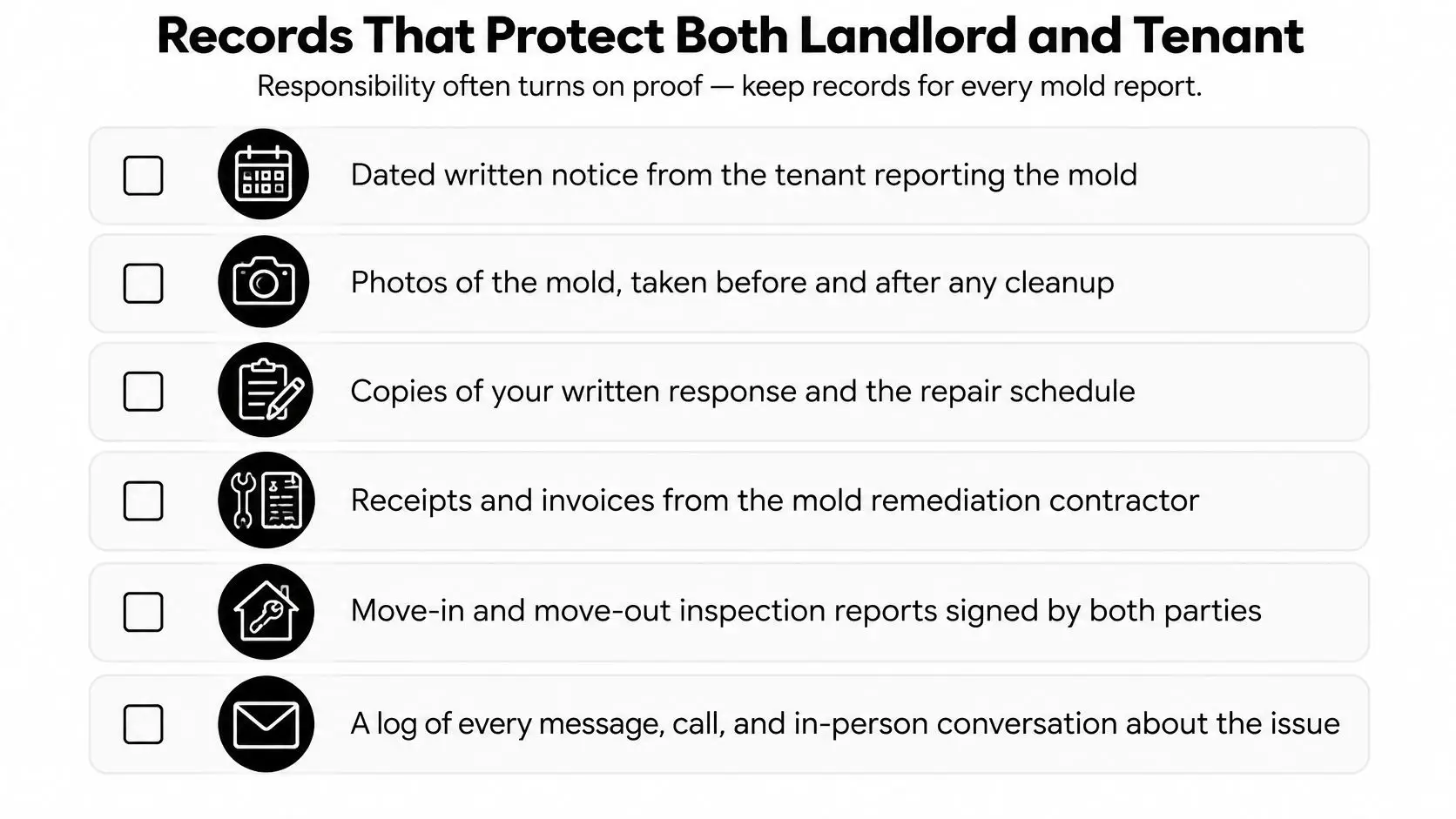
Build a usable incident file
- Dated notice: Save the tenant's original message, including the room and reported conditions.
- Photographs: Keep images from the first report, drying work, and final reinspection.
- Measurements: Preserve humidity readings, leak observations, and moisture-meter locations where available.
- Maintenance tickets: Include arrival times, technician names, findings, invoices, and the work performed.
- Access history: Record inspection appointments offered to the tenant, whether they were accepted, and any rescheduling.
- Earlier complaints: Include previous reports involving the same room, pipe, roof area, or cooling equipment.
- Drying log: Track material readings over time, not merely whether equipment was running.
- Completion note: Identify who reinspected the area and what they checked before closing the ticket.
For a hypothetical example, a landlord's file might show a leak reported on March 3, a plumber's visit on March 4, and drying readings returning to an acceptable baseline on March 7. Those entries make the response easier to evaluate than a statement that someone handled it promptly.
Tenants should retain their own messages, damage photographs, receipts, and dated symptom notes. Symptom notes can support a medical discussion, but they don't independently establish medical causation.
Keep the originals: Save full messages and original photographs, not just cropped screenshots without dates.
HUD's applicable lead-hazard program guidance requires retaining certain records for at least three years, a useful administrative benchmark rather than a universal mold-record deadline, according to HUD's housing maintenance guidance. Check your program, insurer, and local requirements before discarding a file.
Organizing the same materials for insurance claim documentation can reduce missing information, although the insurer's coverage decision remains separate from landlord-tenant responsibility.
Confirm Your Next Step Before Mold Spreads
Act on the moisture problem now, while preserving the evidence needed to sort out responsibility. You don't need to settle every disputed charge before reporting a leak, arranging access, or preventing additional water intrusion.
Choose the path that matches your role:
- Landlord: Confirm the source, put your response and repair arrangements in writing, reinspect after drying, and retain the incident file.
- Tenant: Send a written report, keep photos and dates, and allow reasonable access for inspection and repairs.
Waiting for a dispute to become formal can leave both parties with more damaged material and less reliable evidence. A professional can document conditions and completed work, but deciding legal responsibility remains a matter for the parties and, where needed, a lawyer or local housing office.
At Restore Heroes, our licensed, insured, IICRC-certified team serves the Phoenix metro area; our professionals assess the extent of damage, develop a customized restoration plan, and check that moisture is properly removed. We offer a free inspection through our contact form or by calling 480-690-5277.
We offer mold inspection and remediation to help identify affected materials and address moisture-related damage in rental properties. Visit Restore Heroes to request a free inspection, and have your photographs, maintenance notices, and access details ready so we can assess the reported conditions.