
Does a mold stain show how much of the wall is wet? Often, it shows only where the problem became visible. Paper-faced drywall works like a sponge: moisture can travel sideways through its paper facing and into insulation or the wall cavity. The damp area may therefore extend beyond the stain, even when the paint feels dry.
Water leaks and mold are common enough to treat as routine home concerns, not rare defects. A wall's appearance alone cannot show how far moisture has spread or whether the material underneath is still damp.
Start with two questions: how wet is the board, and how long has it been wet? Those answers help determine whether drying may be sufficient or whether more extensive work is needed. A dry-looking surface is only one clue; the condition of the wall behind it matters too.
Repair or Remove Moldy Drywall Depending on Its Condition
Two very different jobs hide behind a search for Mold and Drywall Repair Near Me. One is cleaning and drying board that is still structurally sound. The other is demolition, cavity drying and rebuild. The quote, the schedule and the amount of dust in your house all depend on which one you need, and the wall's surface won't tell you which it is.
| Drywall condition | Usual action | Why |
|---|---|---|
| Small stain, board firm, wet for under 48 hours | Clean and dry in place, then monitor | Porous board can be dried if it stays intact and dries fast |
| Soft, swollen, crumbling or peeling board | Remove and replace | Structure and paper facing are compromised |
| Any porous drywall wet for more than 48 hours | Remove and replace | Mold can grow into board and is hard to clean fully |
| Mold on both faces or inside the cavity | Remove under containment, then replace | Disturbance can release spores and hidden growth remains |
| Small dry patch, moisture source fixed | Homeowner cleaning may be suitable | Roughly 10 square feet or less with safe cleaning and drying |
| Visible mold with unknown or active moisture source | Professional inspection first | Surface work hides a problem that is still growing |
Why the paper facing decides the outcome
Gypsum is mineral, and mineral doesn't feed anything. The paper on each face does. The EPA's basic mold cleanup steps explain that mold can work into porous materials and fill the empty spaces and crevices inside them, which makes complete removal difficult or even impossible, so porous items with growth may need to be thrown out. The same guidance gives workers a practical rule: porous material such as drywall that has been wet for more than 48 hours is generally best removed and replaced. If you want to understand how far water travels through board, read what happens when drywall gets wet.
The size line, and the fix that fools people
Many homeowners can handle a patch on their own, but only when the moisture source is already fixed and the area can be cleaned and dried safely. Federal mold guidance puts that practical limit around 10 square feet (FEMA mold remediation guidance). The same guidance is blunt about the shortcut people reach for first: painting or caulking over mold does not stop it growing. The colony keeps digesting the paper behind the new paint, and the stain bleeds back through within a season.
Concealed leaks are the Phoenix version of this problem. Roof flashing lifted by a monsoon storm, a slow supply line behind a vanity, or an air handler dripping condensate in a closet all soak drywall that still looks clean from the hallway.
Three checks you can do today
- Press the board with two fingers. Firm board with a tight seam is a different job from spongy board that dents under light pressure.
- Write down when the water started and when it stopped. That single line of text shapes the scope more than any photo.
- Photograph each stain with a ruler in the frame. Scale in the picture helps a provider judge area before anyone drives out.
Hidden Moisture and the Drying Clock Set the Repair Scope
Water enters at one point and spreads in every direction it can. It climbs the paper facing by capillary action, soaks the insulation, and runs down the inside of the framing cavity. The dark ring on your ceiling or wall is where the water finally stopped being visible, not where the leak began.
The size of the problem across the housing stock is why this gets treated as a system issue rather than a stain issue. A 2024 state-of-the-science review in Environmental Health Perspectives puts estimates of mold growth in dwellings at 10% to 50% (Environmental Health Perspectives).
Say a ceiling stain appears under an upstairs bathroom. A week later the spot looks dry, and the homeowner paints it. The board behind it stays soft and cool for weeks, because the trap seal under the tub drains slowly and only wets the cavity when someone showers. Three principles follow from that picture.
- The visible patch is a fraction of the wet area. Mold often appears where conditions were right, not where the water first landed.
- A leak can look resolved while the board stays wet. Stopping the drip is not the same as drying the assembly.
- Patching over an unfixed source guarantees a repeat. The growth returns as soon as the next cycle of moisture arrives.
Read the clock, not the surface
The EPA's guide to mold, moisture and your home advises drying water-damaged areas and contents within 24 to 48 hours to help prevent mold growth, and its commercial-building guidance says wet, non-moldy materials should be dried within 48 hours. It also requires the moisture problem to be corrected before remediation is considered complete.
| Time since wetting | What the guidance says | Typical repair scope |
|---|---|---|
| 0 to 24 hours | Drying is most likely to prevent mold | Extraction and drying in place if board is firm |
| 24 to 48 hours | Drying must be fast and thorough | Drying with measured readings, removal if board softens |
| More than 48 hours on porous drywall | Removal and replacement generally best | Controlled removal, cavity cleaning and new board |
| Ongoing dampness with no source found | Correct the moisture source before any repair | Leak search and inspection before repair work |
Dampness also reaches the people in the building. A CDC-hosted review of damp-building evidence cites an estimate that about 21% of current asthma in the United States may be attributable to dampness and mold exposure, which matters in rentals, schools and shared walls.
Phoenix adds a twist. Hot, dry outdoor air pulls moisture off a wall surface fast, so the paint feels dry an hour after a leak. The cavity behind it can stay damp for days, and monsoon-season humidity slows evaporation enough to stretch that out. Trust the meter, not your palm. Our guide to moisture meter readings explains what the numbers mean on drywall, studs and subfloor.
The line that shapes the scope: when the water was found and when it was stopped. A dishwasher leak discovered Monday morning after a weekend away is already past the 48 hour mark before anyone touches a towel.
How a Professional Drywall Mold Repair Works
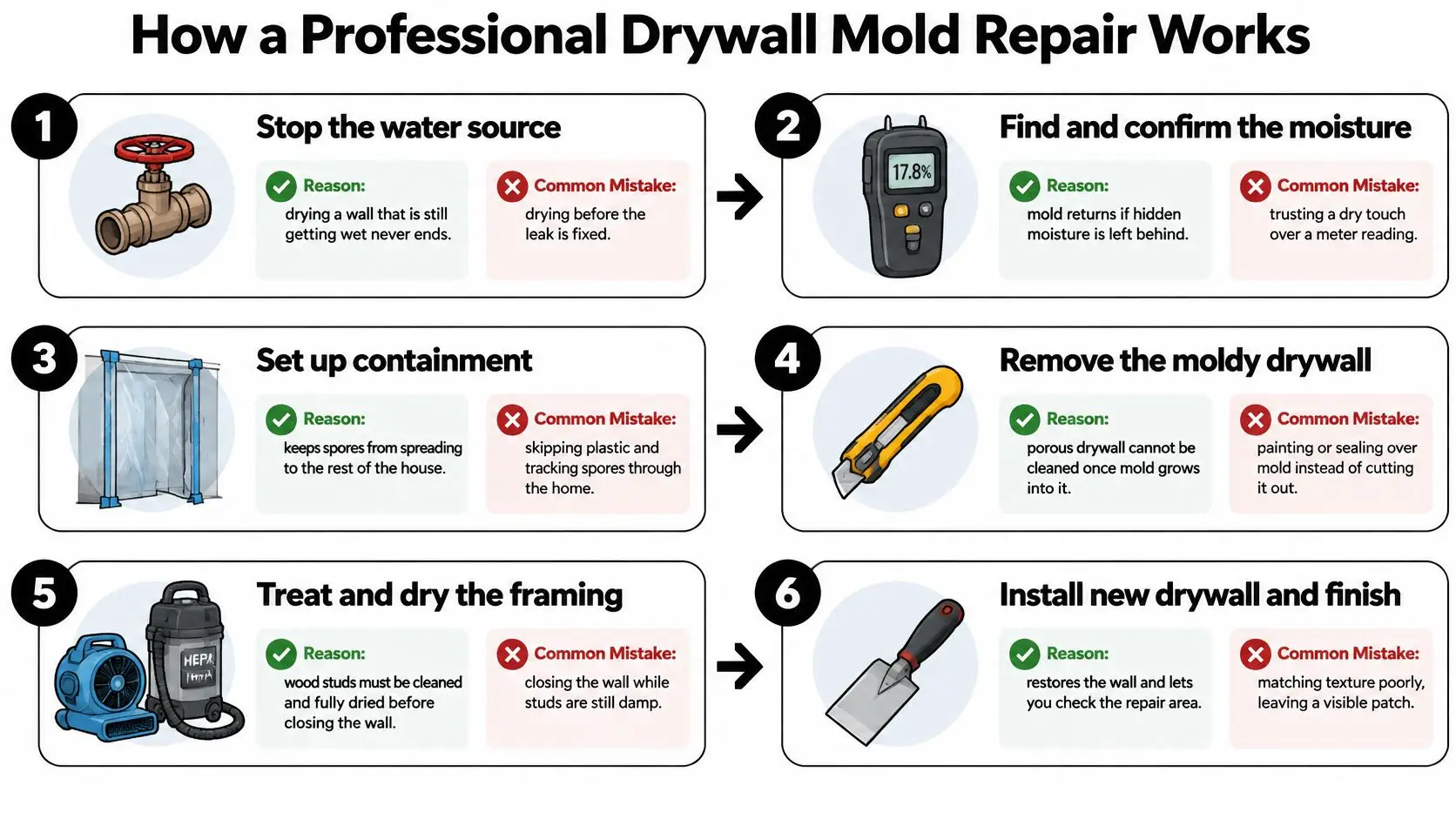
What should happen before a mold-damaged wall is closed up? The repair follows a sequence because each step prevents a different problem, from continued leaks to moisture trapped behind new paint. The visible stain is only the wall's surface; like a sponge, drywall can hold moisture beyond the mark. Its condition, hidden readings, and how long it stayed wet help determine the repair.
The steps, and the mistake each one prevents
Stop the water source first. A wall that continues to get wet will not dry, even with air movers running. Find and address the leak before drying begins, or the moisture can return.
Map moisture with a meter. Check the drywall, baseboards, insulation, and cavity, then record the readings. Touch alone cannot show whether moisture remains behind the surface.
Set up containment and HEPA filtration before cutting. Plastic sheeting and negative air help limit the spread of mold particles into other rooms. Opening the wall before setting up containment can carry debris beyond the work area.
Remove wet, soft, or moldy board and cut beyond the affected area. A stain may show only part of the wet section, so the meter helps guide the repair boundary. EPA building moisture guidance says board may be dried in place when there is no obvious swelling and the seams are intact.
Clean the framing and dry the cavity. Air movers and dehumidifiers help remove moisture from the wall space. Drying is complete when readings remain stable, not just when the surface looks dry. EPA notes that wall cavities can be difficult to dry and should be ventilated when the board remains in place.
Confirm dryness against the log. ASHRAE's moisture chapter describes a water-activity level near 0.8 as a point below which growth is rarely a problem when conditions remain controlled. Persistent meter readings above the dry baseline for the framing and board mean drying is not finished.
Install new board, using moisture- and mold-resistant gypsum where the exposure calls for it. A closet wall beside a shower may need a different board choice from a hallway ceiling.
Tape, finish, prime, and paint last. Finishing a damp wall can trap moisture behind a clean-looking surface, where the problem may persist beneath the paint.
A short walkthrough shows the same sequence, from shutting off the water to finishing the wall:
At the end, ask for a written moisture log and confirmation that readings in the repaired area are stable and dry. A lingering odor can also signal that something needs attention. Restore Heroes' IICRC-certified professionals assess the extent of the damage, develop a customized restoration plan, and make sure moisture is properly removed before the wall is closed. Learn more about mold damage restoration.
What Drywall Repair Typically Costs and What Changes It
Forbes Home put residential drywall repairs at an average of $80 to $225 in 2024 (Forbes Home). Treat that as a broad reference for ordinary patch and finish work, not a quote for mold-related removal, containment or cavity drying.
What moves the number is rarely the texture. It's the hidden work. Square footage and sheet count set material volume. Removal versus a small patch decides labor. Containment and HEPA cleanup add setup and disposal. Cavity drying adds equipment and monitoring days, because a technician has to return until the readings hold. Access matters too: a ceiling above a stairwell or a wall behind cabinetry takes longer than an open hallway. Texture and paint matching finishes the list.
Three ways to compare estimates fairly
- Ask for an itemized estimate. Line items for removal, treatment, drying days, materials and finish let you compare two bids on the same work.
- Ask whether moisture readings and removal scope are included. A scope without readings is a guess about area.
- Ask which items are optional. Cosmetic upgrades belong in a separate column from the work that protects the structure.
Insurance sits in the background of most of these jobs. Many policies set conditions around sudden versus long-term water damage, so ask your insurer how it classifies your loss and ask the contractor how documentation will be handled. No provider can promise a price, a coverage outcome or a repair result before an onsite inspection. For a fuller breakdown of the variables, see what mold remediation costs involve.
What to Check Before Hiring a Local Repair Provider
How can you tell whether a repair provider will address hidden moisture, not just the stain on the wall? Compare written qualifications and proposed work rather than relying on a confident phone call. Drywall can act like a sponge: the visible mark may show only part of the wet area, so clear documentation matters.
- Confirm licensing, bonding and insurance. Restore Heroes is IICRC certified, licensed, bonded, and insured. Ask any provider to show certificates rather than accepting a verbal yes.
- Ask which certifications the technicians hold. A provider should be able to identify the qualifications relevant to the work. Learn why an IICRC-certified restoration company matters.
- Request a written assessment. It should explain moisture readings, the proposed removal scope and any containment. Readings help establish whether water may extend beyond the visible stain.
- Get an itemized estimate. Ask what is included and which items are optional. Separate removal and moisture-related work from cosmetic finishing, so you can compare like with like.
- Ask whether the inspection is charged and how insurer communication is handled. Knowing these details before an inspection helps you understand the process.
- Confirm the company covers your city. Local coverage affects scheduling and equipment arrival. Restore Heroes serves homeowners throughout the greater Phoenix area and Rim Country, and has no minimums.
Use this checklist to keep the questions handy.

Red flags worth walking away from
A firm price given before anyone inspects the wall is not a reliable assessment. Treat promises that mold will never return with caution, too. Painting, sealing or patching alone can improve the appearance while leaving damp material unresolved. Ask for moisture documentation; without it, the proposed scope may miss wet areas hidden behind the surface.
Compare written scopes, especially the removal and drying details. If a proposal omits containment or cavity drying, ask why those steps are not included. The right scope should reflect what the inspection finds, rather than just what the wall looks like.
Book an Inspection Before the Damage Spreads
A drywall stain can look small while moisture has spread behind it, much like a sponge that is wet beyond the spot you can see. Before deciding whether to dry or remove the board, check whether it feels firm, how far the dampness extends, and how long the leak has been active.
Start by stopping the water, if you can do so safely, and move furniture and other porous items away from the wall. Note when you found the water and its likely source, and take photos to show the affected area. A firm, limited stain may be suitable for drying and monitoring; soft drywall, extensive wetting, prolonged dampness, or mold on both sides calls for a professional inspection.
Ask a qualified provider to assess the wall before agreeing to a repair scope. Restore Heroes offers a free onsite estimate and inspection, available 24/7 through its contact form or by calling 480-690-5277. To request service through the form, select Mold Removal. Choose a scope that addresses the wall's condition and hidden moisture, not just the visible stain.
Minor finishing work after the area is dry, such as patching or trim, may suit local handyman services for homeowners. Moisture assessment and mold remediation require a team equipped to address the underlying damage.
A moisture reading helps determine whether drywall can be dried or needs removal. Restore Heroes' IICRC-certified professionals assess the damage, develop a customized restoration plan, and make sure all moisture is properly removed. Homeowners across the greater Phoenix area and Rim Country can request a free inspection or onsite estimate by calling 480-690-5277. Visit Restore Heroes to request an inspection.