
At 2 a.m., the first thing you hear is water where it shouldn't be. A supply line has let go, the floor is slick, and the water is creeping toward the kitchen island while you're standing there with your phone, trying to figure out who to trust before the damage spreads. In that moment, an IICRC certified restoration company isn't a marketing phrase, it's the difference between a crew that has a published method and a crew that's improvising in your house.
The problem is that many hear “certified” and stop there. That's not enough. You need to know whether the firm is certified, whether the technicians on the truck are certified for the actual loss, and whether the job is being run under the right standards for water, mold, fire, or biohazard work. That's the filter that matters when you're tired, stressed, and one bad decision away from turning a wet floor into a longer, uglier mess.
What Happens in the First Hour After a Disaster
A midnight pipe burst in Phoenix doesn't wait for business hours. Water starts moving fast, tile gets slick, baseboards soak up moisture, and if you've got travertine or engineered flooring, the clock starts ticking immediately. The first call you make usually decides whether the response is organized or chaotic.
Practical rule: speed matters, but speed without standards just gets you a fast mess.
A real IICRC certified restoration company is built to handle the emergency as a sequence, not a panic. The crew has to stabilize the loss, figure out what kind of water they're dealing with, document the affected materials, and decide what can be dried and what needs to come out. That's why certification matters in the middle of the night, not after the fact.
The company should also know how to talk to insurers without turning your kitchen into a debate stage. Good mitigation work creates a paper trail, and that paper trail starts early. If you want a practical look at how water mitigation should be handled in a real emergency, see water damage mitigation.
The first hour is where the three forces collide, speed, technical scope, and insurance coordination. A truck showing up quickly is nice. A truck showing up quickly with the right drying plan, the right documentation, and the right certification is what protects the property.
The Standards That Drive Certified Restoration Work
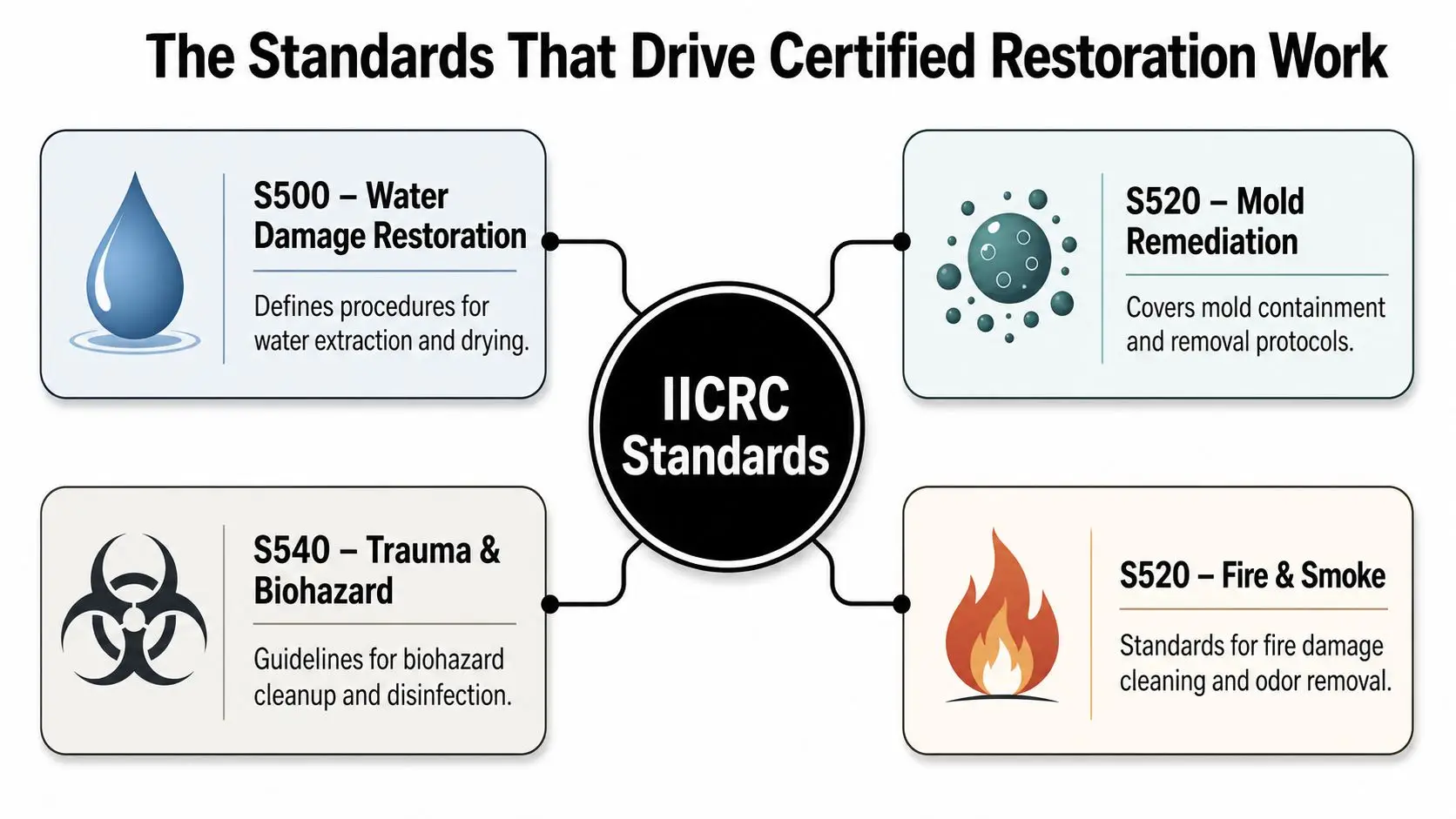
The biggest reason certification matters is simple, certified restoration work follows published standards instead of guesswork. For disaster restoration, the core documents are S500 for water damage, S520 for mold remediation, S540 for trauma and crime scene cleanup, and S700 for fire and smoke damage restoration, all tied to ANSI-accredited technical standards published by the IICRC IICRC standards. That's the playbook a trained contractor is supposed to follow.
What each standard actually controls
S500 is the one most homeowners run into first. It governs water damage restoration, including inspection, drying decisions, material classification, and documentation. It uses a Category 1 to 3 contamination model and a Class 1 to 4 drying model, so the contractor isn't just guessing whether a wall can be dried or needs removal S500.
S520 covers mold remediation. That means containment, removal methodology, and cleaning rules that stop a mold problem from getting pushed into clean parts of the building. S540 is for trauma and crime scene cleanup, where decontamination and safety protocols matter more than cosmetic cleanup. S700 governs fire and smoke restoration, where soot, residue, and odor all need their own treatment path.
Here's the point. A certified firm isn't supposed to invent its own process in your house. It's supposed to inspect, classify, dry, clean, document, and verify according to a published method. That matters because adjusters and property owners both need a scope that can be explained, defended, and checked later.
A job that follows standards is easier to question, easier to document, and easier to defend than a job built on intuition.
Why Certification Is a Real Filter, Not Just a Logo
The market looks crowded until you start checking who's certified. In RestoreRadar's directory dataset, only 32.2% of listed records matched an IICRC Certified Firm record overall, and in the water-damage category, 164 of 485 provider records, about 33.8%, matched RestoreRadar market data. That means certification isn't a universal badge, it's a real filter.
The broader IICRC network is large, with more than 53,000 active IICRC Certified technicians and more than 6,000 IICRC Certified firms worldwide IICRC industry organization spotlight. That scale matters because it shows the credential is established, but it doesn't mean every company claiming it is a verified firm.
Trust signals that look strong but aren't enough by themselves
| Signal | Listed Providers Claiming It | What It Actually Tells You |
|---|---|---|
| 24/7 response | 87.8% | The company answers emergencies, which is expected in this market |
| Direct insurance billing | 63.7% | The company is familiar with claims coordination, not automatically better |
| IICRC Certified Firm match | 32.2% overall, 33.8% in water damage | The company is in a smaller verified subset with documented firm status |
The table says what experience already tells you, emergency response and insurance billing are table stakes in this business. They're useful, but they don't separate one contractor from the next. Certification does, because it tells you the business is tied to a verifiable framework instead of just a branded truck and a fast phone answer.
If you're hiring under pressure, don't let the logo do the thinking for you. A real certified firm should be able to prove firm status, and the technicians should be able to prove the credentials tied to the job you have.
How to Verify an IICRC Certified Restoration Company
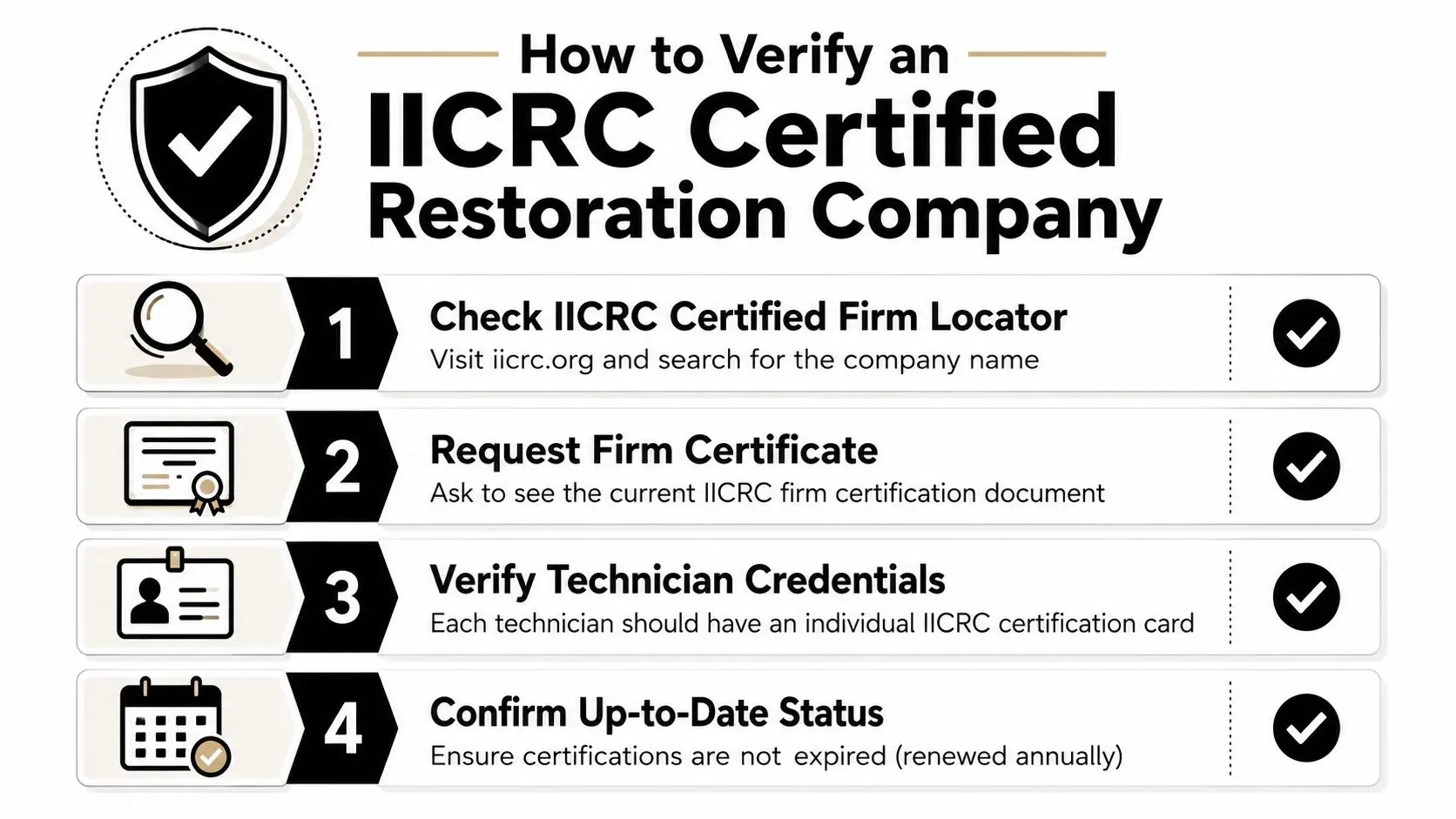
Don't take anyone's word for it. Verify the firm, verify the people, and verify the insurance before you let work start. The IICRC defines a Certified Firm as a business with one or more IICRC Certified Technicians, and the firm application requires at least one active IICRC Certified Technician, current general liability insurance, and a $25.00 application fee Certified Firms Application Certified Firm Verification. That makes this a real status, not a casual label.
The verification sequence that actually works
Start with the IICRC Certified Firm locator. Search the business name and confirm the status is active. If the company won't give you the exact legal name it uses on its certification paperwork, that's a warning sign.
Next, ask for the firm certificate number and the technician certificate numbers for the people who will be on-site. Individual certification is earned by completing an approved training course and passing a written examination, so the credential belongs to a person, not a truck wrap Zack Academy IICRC FAQ. If the crew can't tell you who is certified for water, fire, mold, or odor work, you're guessing with your house.
Then confirm the company's insurance. The IICRC's firm application requires current general liability insurance, so a real certified firm should be prepared to show proof without drama. If they dodge the request, move on.
Warning sign: if a contractor keeps saying “we're certified” but can't identify which technicians hold which credentials, treat that as a sales claim, not proof.
If you're comparing local options, a contractor page like water damage restoration contractor should still be backed by the same checks. The marketing can say a lot. The verification page tells you what's real.
Questions to Ask Before You Sign a Restoration Contract
The right contractor won't get defensive when you ask sharp questions. The wrong one will. If you want a quick screening script, keep it simple and direct, because you're not interviewing a poet, you're hiring a company to work inside your walls.
Start with credentials. Ask, “Which technicians on this job hold active IICRC credentials for this type of loss?” Then ask, “Can you show me the firm verification and proof of current insurance?” Those two questions separate the verified companies from the ones coasting on vague language.
Ask these before anyone starts work
- Scope and methods: “What standard are you following for this loss, and what gets dried versus removed?”
- Documentation ownership: “Who keeps the moisture logs, photos, and daily readings?”
- Crew assignment: “Will the same certified technicians stay on the job, or do you subcontract parts of it?”
- Communication: “Who updates me if the scope changes after demolition starts?”
- Complaint path: “If there's a problem, who inside your company handles it?”
These questions matter because they expose process. A contractor who can answer cleanly usually has a system. A contractor who drifts into vague promises probably doesn't.
If you also want to know whether the business is properly set up as a contractor, not just technically trained, review bonded and insured contractor guidance before you sign. That's especially useful when multiple vendors are pushing for a quick commitment.
The cleanest contract conversations are the ones about paper, not emotion. Ask for the written scope, the materials that will be removed, the drying plan, and who signs off on changes. If the answers are slippery before the job begins, they'll be worse once the walls are open.
Insurance Claims and Standards-Based Documentation
Claims people care about proof, not speeches. That means moisture maps, equipment logs, psychrometric readings, photographs, and material notes all matter because they show what was affected, what was dried, and why the contractor chose a specific mitigation step. Standards-based documentation helps turn a messy loss into a defensible file.
The reason this works is simple. When a crew follows a standard, the scope is easier to explain to an adjuster, and there's less room for disagreement over whether a wall was left in place, removed, or isolated for a reason. It doesn't guarantee coverage or a specific claim result, but it gives the file structure.
If you want your records organized on the homeowner side, good document storage matters too, especially when multiple vendors, estimates, and photos start piling up. A practical reference like company document storage for 2026 is useful as a reminder that loss paperwork shouldn't live in random text threads and camera rolls forever.
What to ask about claims coordination
Ask whether the firm bills the insurer directly, whether it works with assignment of benefits, and whether it reports to you first or to the carrier first. Those aren't trap questions. They tell you how the company handles authority and communication.
Keep your own copy of every estimate, photo set, and drying log. If the contractor disappears for a day, your file shouldn't disappear with them.
If you want to see what documentation expectations should look like before a job starts, review documentation requirements and use it as your checklist. The best restoration files are boring in the right way. They're dated, labeled, readable, and complete.
What Certified Restoration Looks Like in the Phoenix Metro
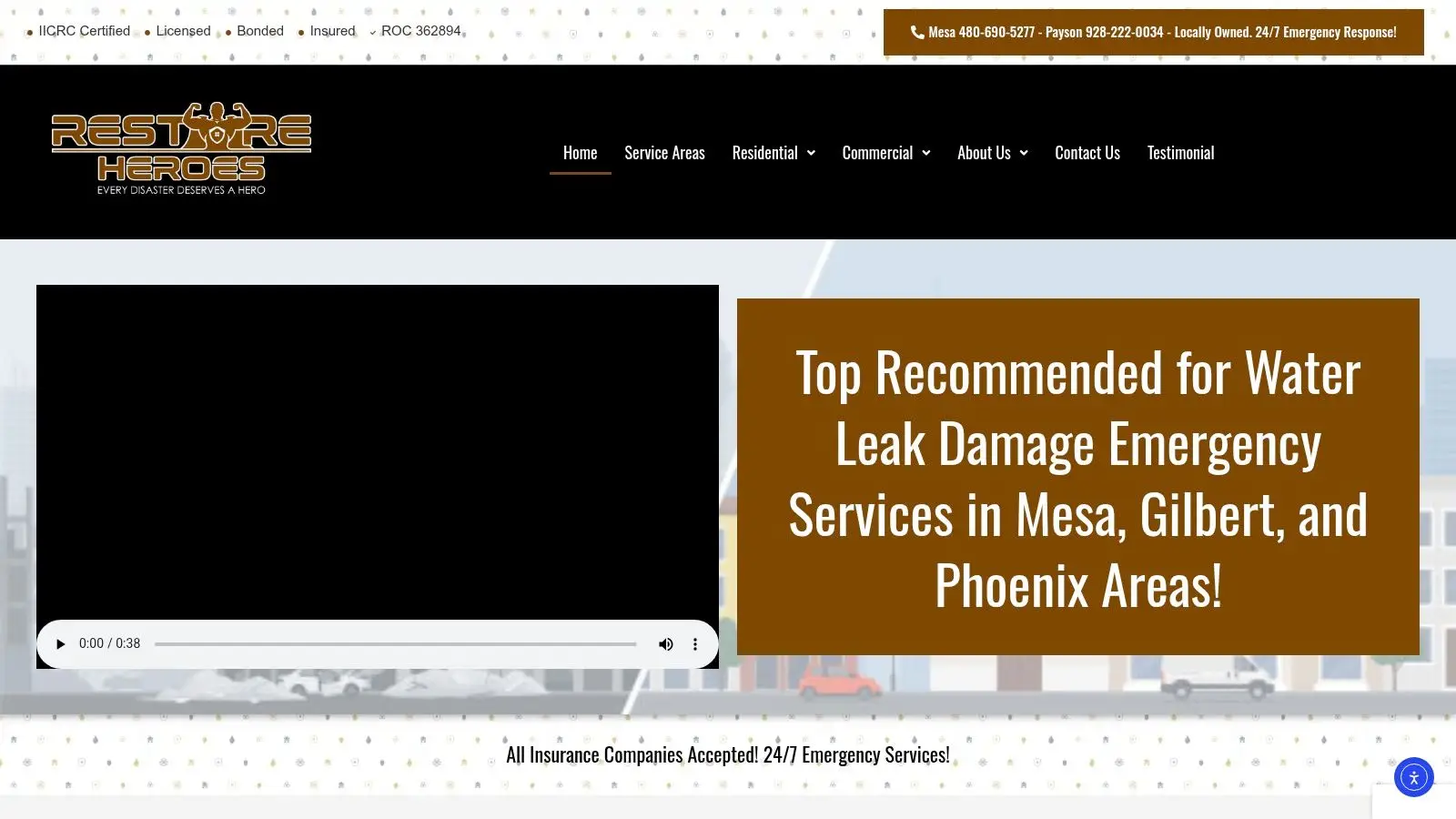
A Phoenix-area water loss tests everything at once. Heat, drywall, flooring, cabinetry, and timing all work against you, so the response has to be disciplined. A company like Restore Heroes positions itself around 24/7 dispatch, water extraction, structural drying, fire and smoke restoration, mold removal, and trauma and biohazard cleanup, which lines up with the standards-based categories discussed earlier.
How the local model maps to the standards
Water jobs belong under S500, fire and smoke under S700, mold under S520, and biohazard work under S540. A company that covers those areas with trained crews, extraction equipment, drying gear, and insurer coordination is speaking the same operational language the standards require. That's what you want to see in a regional provider, whether the loss is in Phoenix, Mesa, Gilbert, Scottsdale, or Chandler.
If you're also comparing specialty home vendors while you're dealing with reconstruction, a resource like premier custom rug store near me may help once the mitigation phase is done and you're thinking about replacement materials. That's not part of the emergency response, but it's a reminder that restoration doesn't end when the water leaves.
For a broader look at how local companies stack up, best water damage restoration companies is worth reading after you've handled the immediate call. The point here isn't to sell you on a brand. It's to show you what a verifiable, standards-driven response looks like in the Phoenix metro, with the same credential, insurance, and documentation checks you'd use anywhere else.
A Practical Pre-Hire Checklist for Any Property Owner
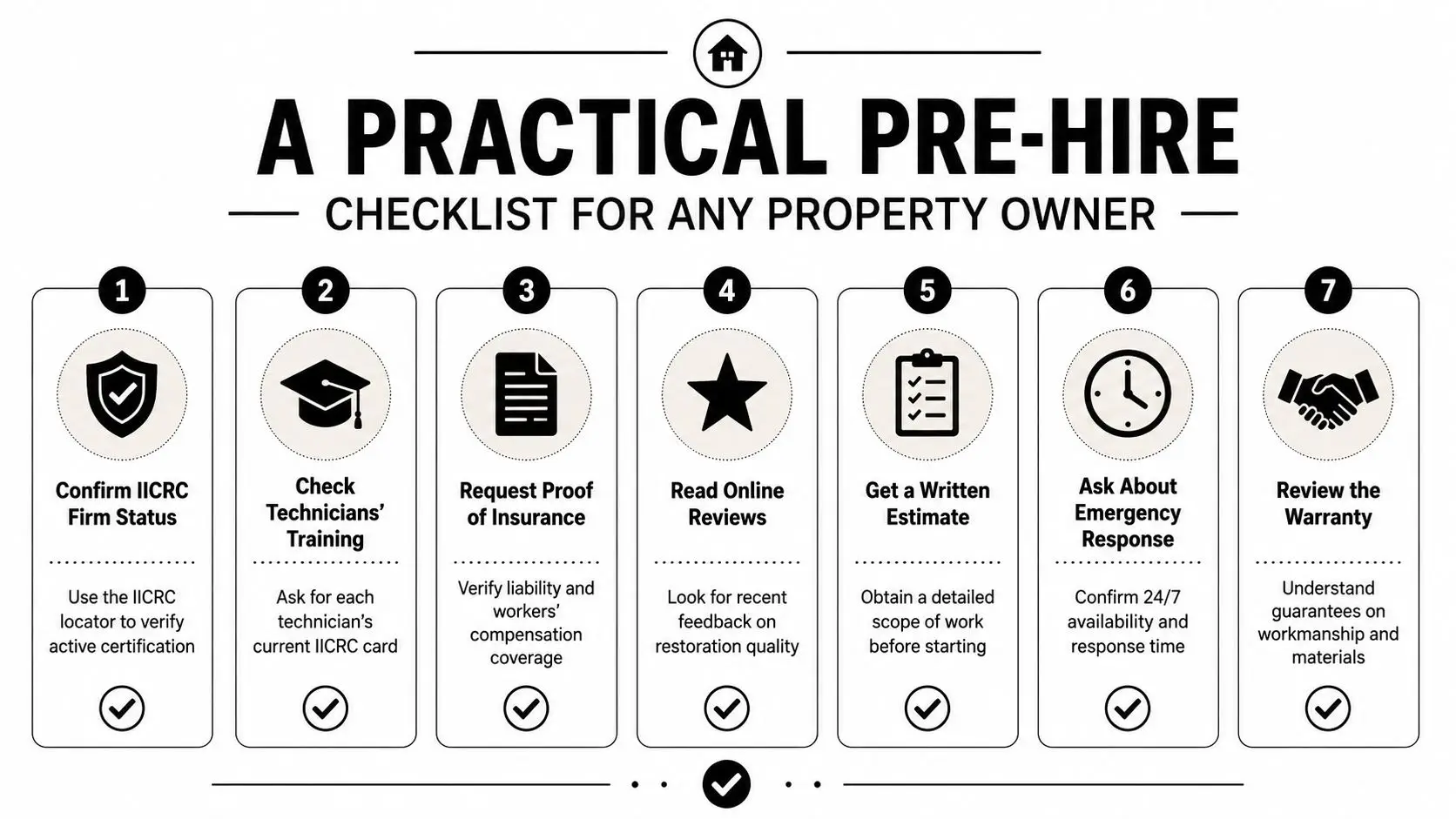
You don't need a long research project. You need a short checklist and the discipline to use it before you sign.
Use this before the crew starts
- Confirm firm status: verify the company in the IICRC locator.
- Check technician training: ask who on the crew has the right certification for your loss.
- Request proof of insurance: don't accept a verbal promise.
- Get the written scope: make sure the plan says what gets dried, removed, cleaned, or isolated.
- Ask about documentation: confirm you'll get photos, logs, and readings.
- Clarify insurance coordination: know whether they bill the carrier directly or work through you.
- Keep every record: save the estimate, the certificate info, and the daily job notes.
That's the whole game. Certified doesn't mean perfect, and it doesn't mean you stop asking questions. It means the company should be able to prove its status, show its people's credentials, and work from a documented standard instead of improvising in your home.
If you're dealing with water, fire, mold, or biohazard damage right now, use this checklist before anyone opens a wall or asks you to sign. Then call Restore Heroes to confirm what their certified team can document, how they handle mitigation, and how they coordinate the job from first visit through cleanup.