
The first sign is usually small. You step into the hallway and your shoe meets soft carpet, or you hear a pipe still hissing behind a wall, and suddenly the whole house feels out of control. In that moment, structural drying services are not about making the room look better, they're about stopping hidden moisture from settling into wood, drywall, insulation, and concrete before the damage spreads.
A professional drying crew treats the home like a system, not a puddle. They measure what's wet, isolate the affected area, move moisture out of materials, and keep checking until the structure reaches target dryness, because dry by sight and dry enough to keep building safely are not the same thing. That's why this work is closer to drying a piece of wood in a controlled kiln than to leaving a few fans running in a hallway.
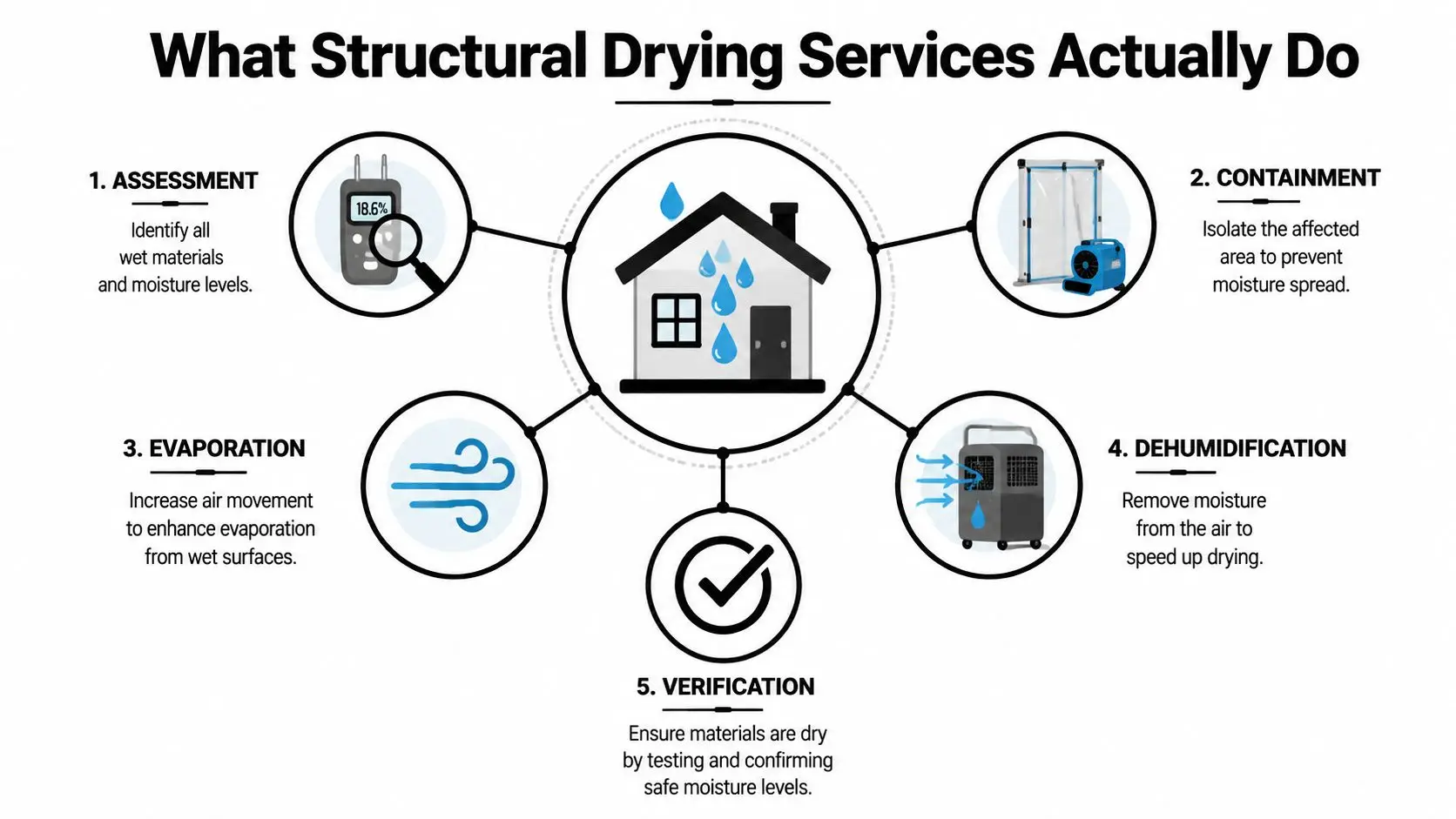
What Structural Drying Services Actually Do
A homeowner often sees the obvious part first. A supply line bursts under the sink, water runs into the hallway, and the instinct is to grab towels, open windows, and aim a box fan at the mess. That can help with surface water, but it doesn't reach the moisture that wicks into baseplates, subfloor, wall cavities, and trim.
That's where structural drying services come in. The job is to remove water from the structure itself, then verify that the hidden parts of the home have returned to safe moisture levels. The point is not to make the room look less wet. The point is to get the building back to a measurable target so the damage doesn't keep unfolding after the visible water is gone.
Drying is measured, not guessed
The simplest way to think about it is this, drying a structure is like drying lumber under controlled conditions, not like hanging a wet towel over a chair. A certified crew doesn't stop when the room feels less damp. They keep going until moisture targets are met, because hidden water can keep feeding mold or weakening materials even when the surface looks fine.
That's also why a certified crew changes the outcome compared with renting a couple of fans. Fans move air, but air movement alone doesn't remove water vapor from the room. If the moisture stays trapped in the space, it keeps cycling between the structure and the air, which is why the work depends on both evaporation and dehumidification.
Practical rule: if the moisture meter says the material is still wet, the job is still in progress, even if the carpet feels dry to your hand.
If you want a homeowner-friendly visual of airflow tools, this guide to water damage fans helps show why the right equipment is about placement and balance, not just volume.
The Step-by-Step Drying Workflow
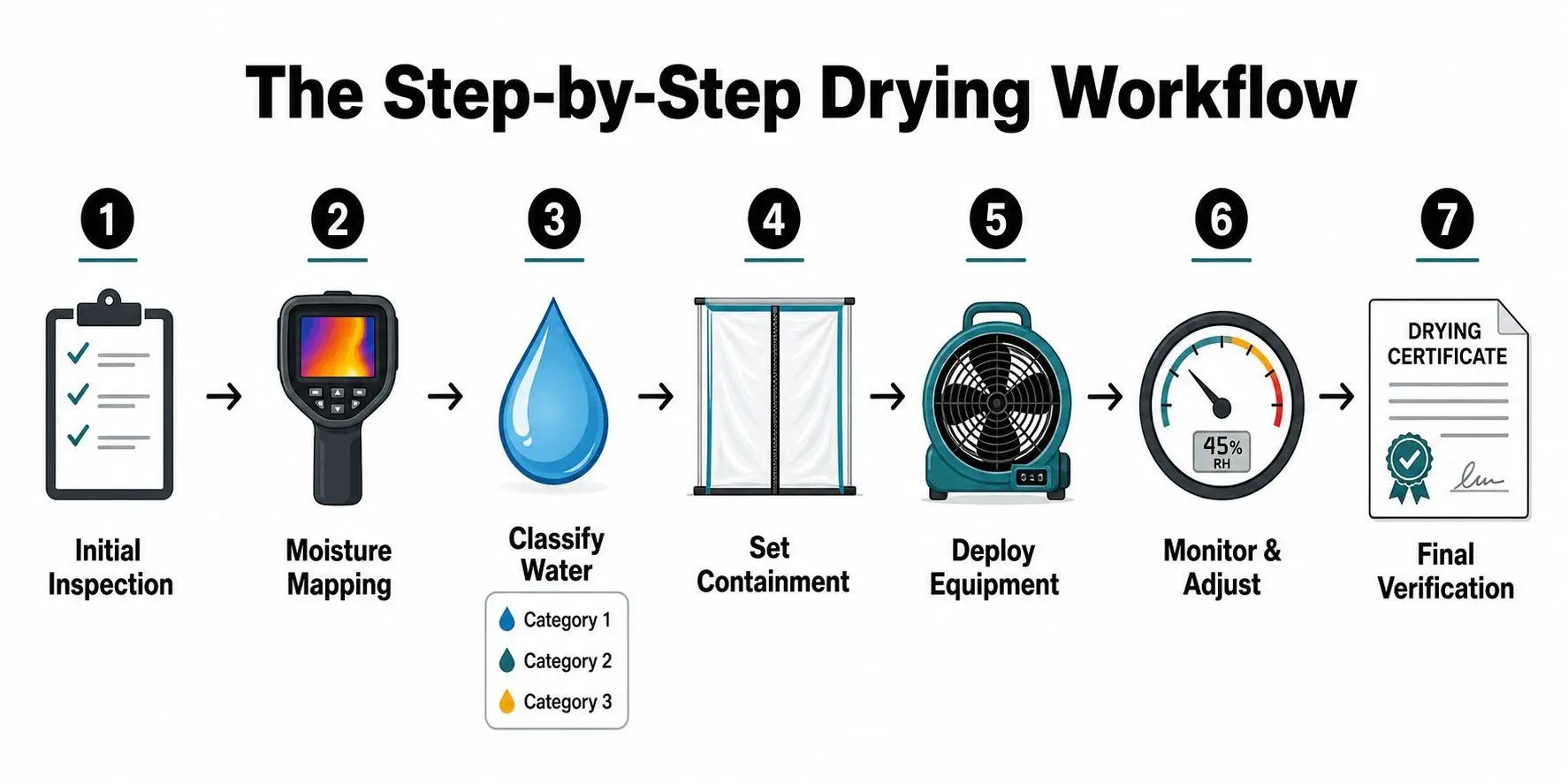
The drying workflow follows a set sequence because each step answers a distinct question. Where did the water travel, how contaminated was it, what material absorbed it, and what moisture target is realistic for the structure? In a stressed home, that order matters because crews are trying to stop hidden dampness from spreading while the building is still within the 24 to 48 hour mold prevention window.
First comes inspection and mapping
The first visit is the scene-setting step. Crews look for visible damage, then use meters and cameras to find moisture behind walls, under flooring, and in other places a homeowner cannot judge by touch alone. That moisture map tells them where water traveled and where assumptions would waste time.
Next comes classification and containment
After the inspection, the team classifies the water and the extent of the affected materials. IICRC-based drying uses Category 1 through Category 4 for cleanliness and contamination, plus Class 1 through Class 3, with a separate Class 4 for specialty low-porosity materials such as hardwood, plaster, or concrete slabs, and Category 3 events require removal of porous materials like drywall, carpet, and insulation before drying begins (structural drying and dehumidification guidance). Once that decision is made, crews contain the affected zone so wet air does not keep spreading into the rest of the house.
Then water comes out, and drying begins
Extraction removes standing water first, because evaporation works faster when less liquid is left behind. After that, crews place air movers and dehumidifiers, then check readings daily and adjust the setup as materials change. The goal is not just to make the room feel better, it is to reach a measurable dryness condition that lets repairs begin with confidence.
A simple example helps here. Enclosing a wall before dehumidification traps moisture inside, turning a simple cleanup into a costly repair issue. The same idea applies to carpet, trim, and framing, if wet material gets sealed in too soon, the water has nowhere to go and hidden damage can keep developing.
Equipment Crews Bring and Why It Matters
The truck usually looks like a mix of science lab and job site. That's because drying depends on different tools for different tasks, and each one solves a different problem. A homeowner who understands the equipment can tell the difference between real mitigation and a room full of noise.
The diagnostic tools come first. Moisture meters give direct readings in wood, drywall, and other materials, while thermal cameras help crews spot temperature patterns that often point to hidden wet areas. Those tools don't dry anything on their own, but they tell the crew where to focus.
Air movement comes next. Axial fans and air movers push air across wet surfaces so moisture can evaporate faster, and the right placement matters more than adding more machines. One room may need several air movers because the goal is to keep air moving across every wet surface, not just blow hard in one direction.
Moisture removal is the other half of the equation. LGR dehumidifiers are a standard choice because they stay effective at lower grain conditions, and a typical residential unit can remove 70 to 100 liters of moisture per day (professional structural drying process guide). In cooler conditions, crews may switch to desiccant dehumidifiers because refrigerant systems lose efficiency when the environment changes.
A bigger fan isn't a substitute for the right dehumidifier. Air can move water out of a surface, but only a dehumidifier removes that water from the room so the cycle can keep going.
If you want to compare extraction and setup tools in more detail, this overview of water extraction equipment shows how crews match machines to the material in front of them.
How Long Drying Takes and What Drives the Cost
A ceiling leak that spreads into a hallway, a bedroom, and the adjoining closet usually leaves one question at the front of a homeowner's mind. How long will the house stay disrupted? The answer depends on what got wet, how far the moisture traveled, and how quickly the crew began extraction and drying.
In standard water-damage jobs, complete structural drying often takes 3 to 5 days, while harder materials such as concrete or hardwood may need 7 to 10 days or longer (structural drying benchmarks). More severe flooding can stretch professional drying to 3 to 7 days in residential properties, and some severe events take 1 to 2 weeks or longer depending on materials, water volume, and response time (drying science overview).
The building materials set the pace. Carpet usually gives up moisture sooner because air can move through it more easily, while hardwood retains moisture longer, and concrete and plaster release water more slowly, each requiring adjusted drying timelines. A room with soaked baseboards also behaves differently from a room with wet carpet alone, because each surface sends moisture back into the air at a different rate. That is why a drying plan has to match the structure itself, not just the amount of standing water.
| Typical Cost and Timeline Drivers in Structural Drying | Effect on Timeline | Effect on Cost |
|---|---|---|
| Number of rooms affected | More rooms usually mean more setup and more monitoring time | More equipment and labor visits |
| Material type | Hardwood, concrete, and plaster can extend drying | Specialty drying equipment and longer run time |
| Volume of water | More saturation slows evaporation and extraction | More extraction work and possible demolition |
| Equipment days | Longer runtime usually means more days of service | Dehumidifier and fan usage rises |
| Unsalvageable materials | Removal can shorten drying later | Demolition and disposal add scope |
| Monitoring visits | Daily checks keep the job on track | More labor tied to documentation and adjustments |
No contractor should promise a fixed price before inspecting the job. A real estimate depends on what is wet, what can be saved, and what must come out before drying can finish. Moisture readings, material type, room access, and the amount of setup all shape the final scope. For a broader homeowner timeline, see how long water damage restoration takes.
Working With Your Insurance Company
Insurance claims move better when the drying work is documented well. Adjusters don't just want to hear that a room was wet, they want to see moisture maps, daily readings, photos, equipment logs, and a clear record of what was removed and why. That paperwork shapes how the claim is evaluated.
The smartest move is to call the carrier early and ask how mitigation is handled versus the repair scope. Emergency services often cover the immediate response, while full restoration is a separate part of the job, and those lines matter when an estimate is reviewed. If the documentation is thin, the claim can look incomplete even when the work on site was necessary.
A solid file usually includes the same records a certified crew uses to run the job:
- Moisture maps and meter readings, so the adjuster can see where the water went.
- Photos and short progress images, taken before demolition, during drying, and at completion.
- Equipment logs, showing what was placed in the home and when it was removed.
- Daily notes, especially if materials changed or hidden damage was found.
- Communication records, so there's a clear timeline for the carrier.
If you want a plain-language overview of claim handling, the restoration claim settlement tips article from For The Public Adjusters, Inc. is a helpful companion read. For a more local angle on the claim process, this page on water damage insurance claim tips matches the same kind of documentation discipline homeowners need.
Key point: careful records don't guarantee approval, but they do make it much easier for an adjuster to understand what happened and why the work was done.
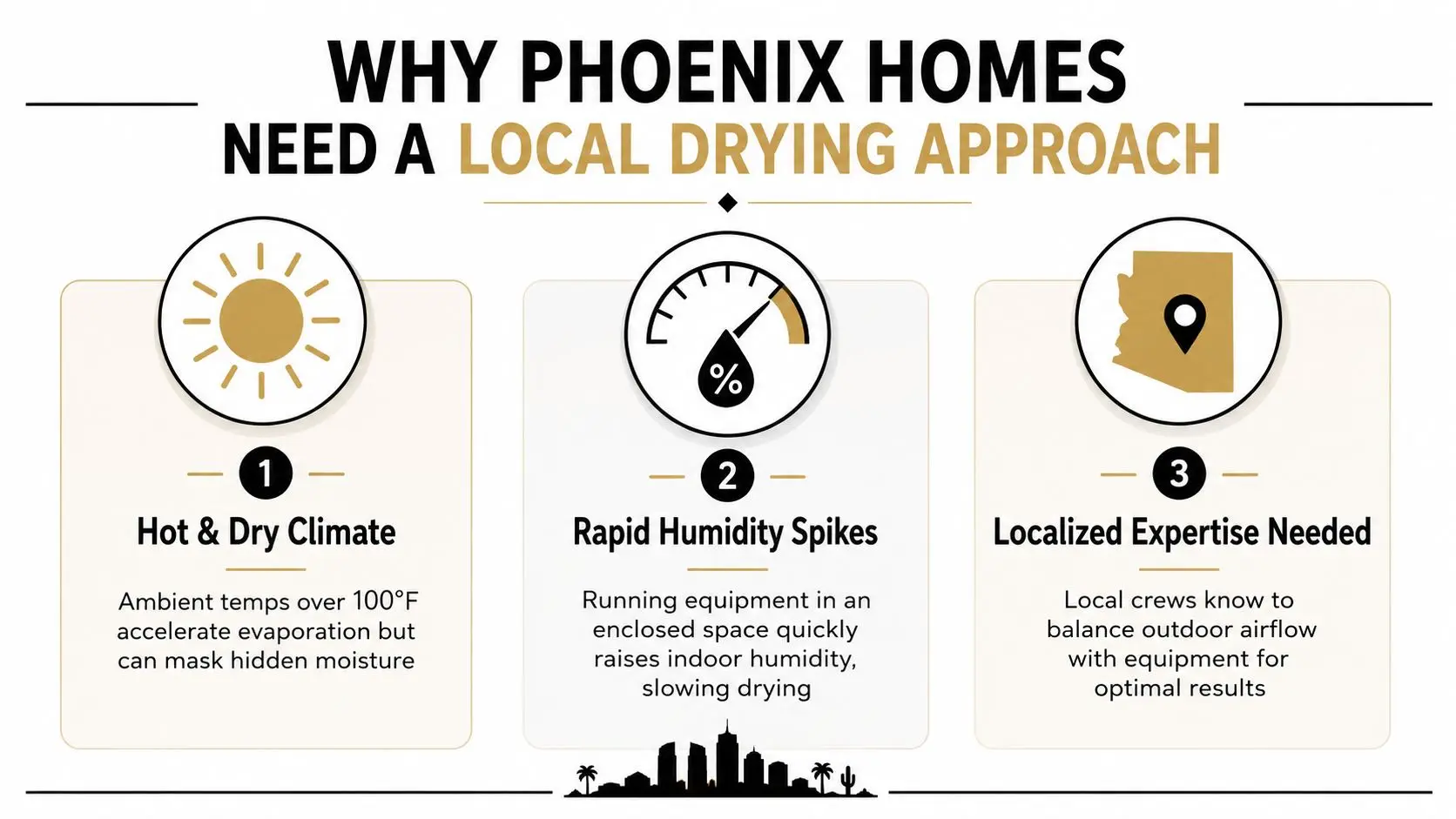
Why Phoenix Homes Need a Local Drying Approach
Phoenix changes the drying plan in ways homeowners don't always expect. The heat can drive fast evaporation at the surface, but once equipment is running inside a closed structure, indoor humidity can rise quickly and slow the job if the setup isn't balanced. Summer storms also bring contaminated water, and slab-on-grade construction means moisture can travel through concrete and base materials differently than in raised-floor homes.
That's why a local crew reads the job differently than someone used to a humid climate. In a desert home, the balance between outdoor air, closed indoor spaces, and equipment placement matters more than a simple “open it up and let it breathe” approach. If the crew uses the wrong mix of fans and dehumidifiers, the house can feel drier while hidden materials stay wet.
Climate and construction shape the equipment plan
The material underneath your feet matters as much as the weather outside. Concrete slabs hold moisture differently from framed crawlspaces, and that changes how quickly the crew can expect the structure to respond. A local IICRC-certified team knows when to lean on containment, when to increase dehumidification, and when the outside conditions can help rather than hurt.
If you're looking at contractor pages and trying to understand what a site is saying, Paletz Roofing and Inspections' social metadata resource is a useful reminder that local service pages should make it easy to identify who's providing the work and how they present it. That's useful when you're comparing companies in a hurry.
Your First 24 Hours After a Water Event
The first day is about reducing loss, not fixing everything. If it's safe, stop the source of water, shut off power to affected zones, and keep kids and pets out of the wet area. Take photos and video before moving anything, because those records help the drying crew and the insurance carrier understand the original condition.
After that, call a certified restoration company for an inspection and notify your insurance carrier. Don't throw away damaged materials before the adjuster has a chance to see them, and don't rely on household fans to solve the problem without dehumidification. Fans can spread moisture around a closed space if the vapor has nowhere to go.
If you're trying to decide what qualifies as mitigation versus repair, this local resource on water damage mitigation can help you talk through the first response without panic. The goal in those first hours is simple. Keep the damage from getting worse, then let a crew measure what needs drying.
Common Questions Homeowners Ask After the Crew Arrives
How do you know drying is working? The crew should show you falling moisture readings, not just running machines. When the numbers change in the right direction and the structure reaches target dryness, the job is moving correctly.
Can you stay in the home? Sometimes, yes, but it depends on the affected area, the water category, and how much containment is needed. If the crew finds contaminated water or starts removing porous materials, they may advise separating the work zone from the living space.
When should the HVAC go back on? Usually only after the crew has checked the system and the affected areas are safe to recirculate. If mold is discovered mid-job, the plan can change quickly, because the team has to stop, document, and handle the issue before drying continues.
You can also ask for the company's IICRC certification and review the estimate carefully against the documented scope. The estimate and final invoice should match the conditions found on site, but no one should promise that number before the inspection.
If you're dealing with a wet room right now, Restore Heroes can inspect the loss, document the moisture, and set up structural drying services that match the materials in your home. Visit Restore Heroes to request help and get the drying process started with a local IICRC-certified team.