
You've cleaned the walls, washed the curtains, and thrown open every window, yet the house still smells like smoke. Maybe the odor appears only when the air conditioner starts, or returns on a humid day. That lingering smell is frustrating because the visible mess may be gone while odor compounds remain inside porous materials, wall cavities, insulation, furniture, or ductwork.
Thermal fogging odor removal can help in that situation, but it isn't a magic spray and it shouldn't be the first step in every cleanup. A careful restoration job removes contamination first, applies deodorization where needed, then checks whether the odor has been addressed. The sections below explain what thermal fogging does, where it fits, and why a technician may recommend another treatment instead.
What Thermal Fogging Actually Is
After a small kitchen fire, a homeowner may see clean cabinets and freshly painted walls but still notice a burnt smell when opening a drawer. After mold remediation, a room may look orderly while a musty odor remains in a closet, under flooring, or near an air return. Surface cleaning can remove visible residue without reaching every place where odor compounds settled.
Thermal fogging is designed for that hidden residue. A machine heats a petroleum-based or water-based deodorant solution and converts it into an extremely fine cloud. Unlike an ordinary spray, the fog is intended to move through cracks, pores, fibers, cavities, and other pathways that a cloth or conventional sprayer may not reach. Thermal fogging guidance for fire odor describes droplets commonly ranging from about 0.5 to 15 microns, with some technical descriptions narrowing the range to roughly 0.5 to 2 microns.
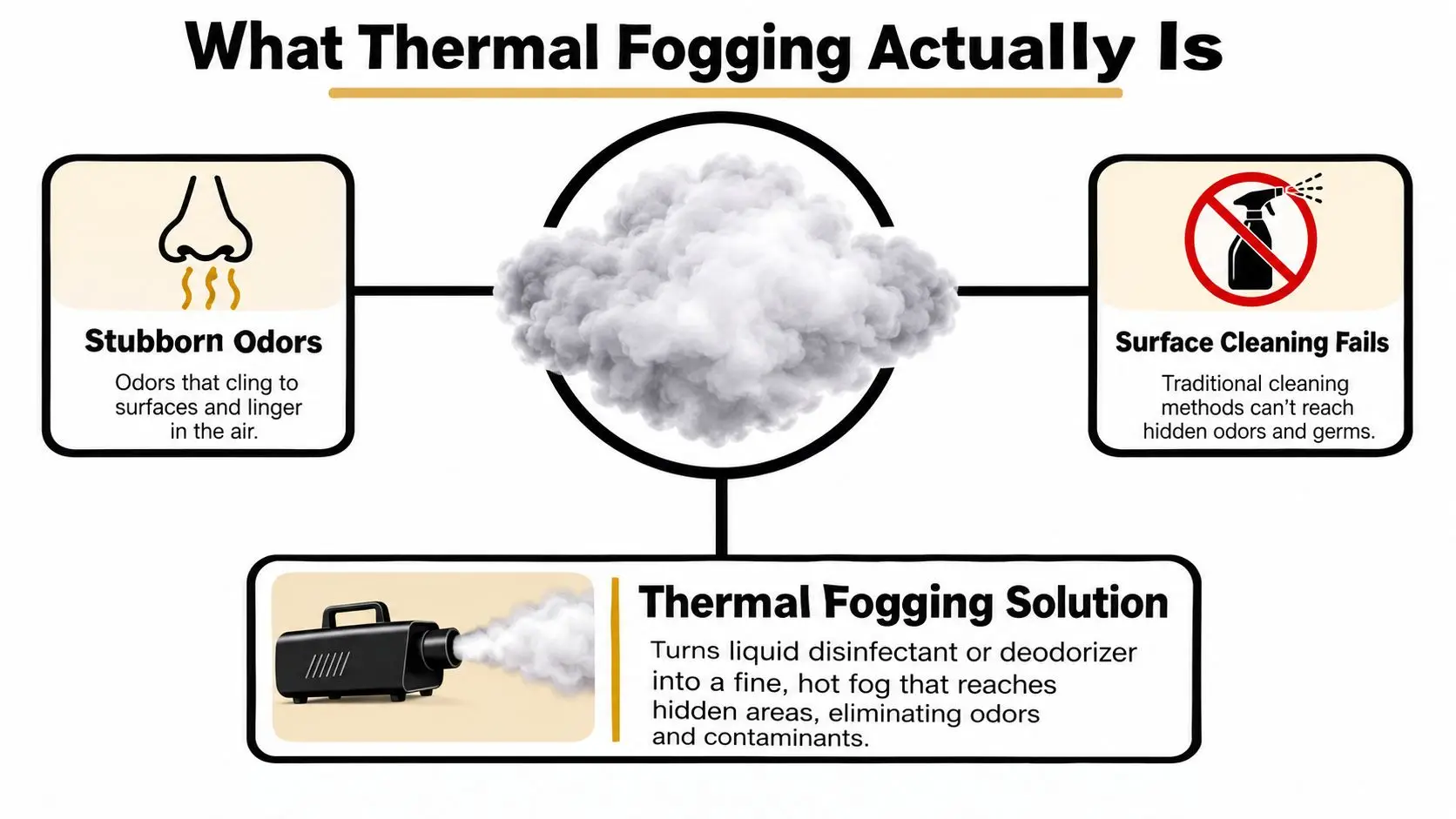
It's a deodorization step, not a cleaning shortcut
A technician may use thermal fogging after cleaning soot from framing, drywall, upholstery, insulation, or other affected materials. The process helps treat odor that remains after physical contamination has been removed. It doesn't scrape away char, wash soot from a wall, extract contaminated water, or remove a damaged building material.
That distinction matters on a fire-loss job. If you're still dealing with visible soot, a professional smoke damage cleanup plan should address the residue before anyone fogs the space. Otherwise, the deodorant may interact with an odor source that remains embedded, and the smell can return later.
Practical rule: If a proposal recommends fogging but doesn't explain what will be cleaned first, ask for the full sequence before approving the work.
Thermal fogging appears on a quote because smoke and other odors often travel farther than visible damage. The same reasoning can apply to porous contents and concealed spaces after a microbial event, although the source must still be identified and corrected. The most accurate way to describe the method is simple: fogging carries a deodorizing solution into hard-to-reach areas after the primary contamination has been addressed.
How the Fog Reaches Where Soot Went
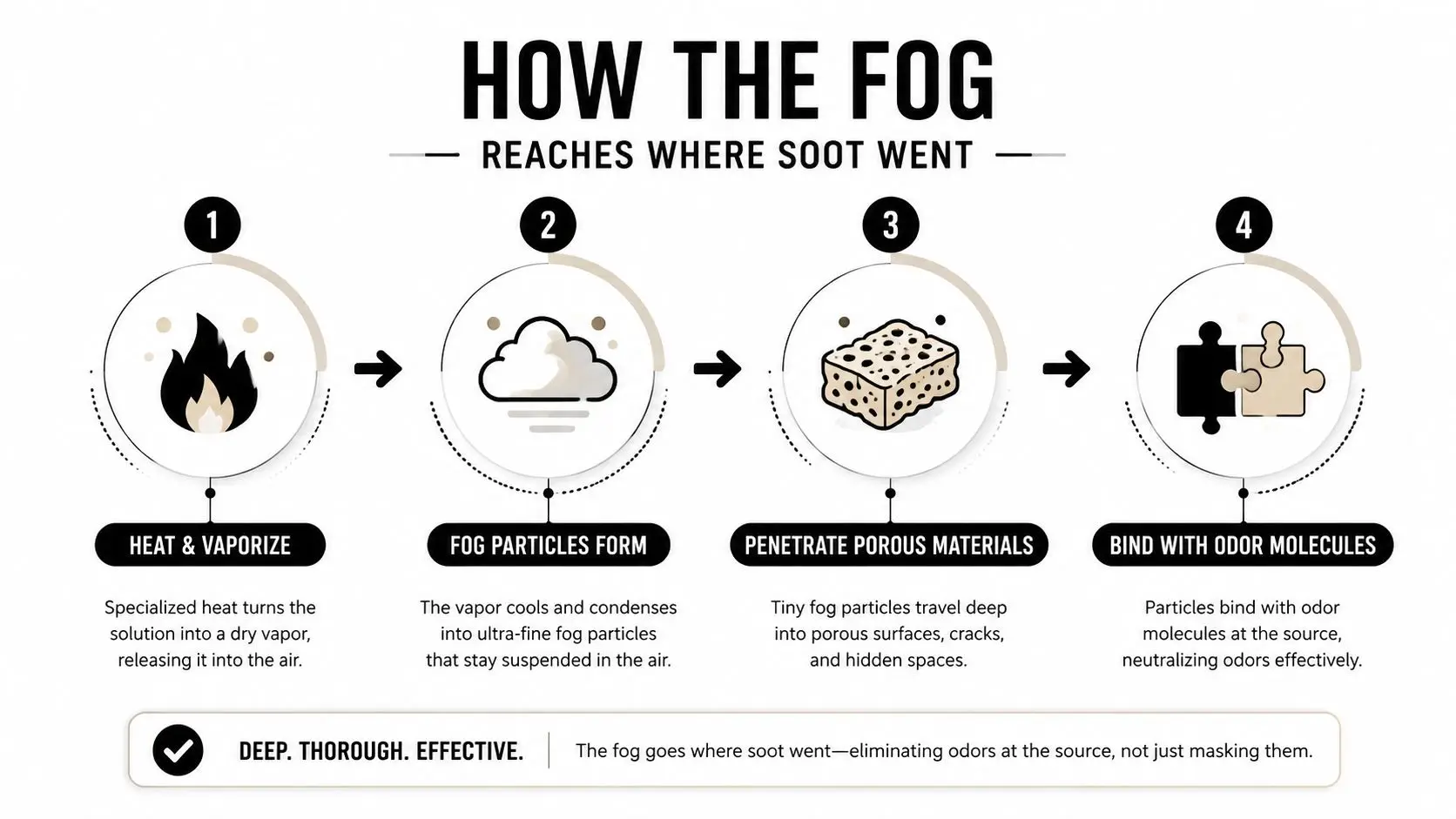
Thermal fogging differs from ordinary spraying in particle size and penetration depth. A spray bottle releases larger droplets that settle mainly on exposed surfaces. A thermal fogger heats the deodorizing solution and produces a finer cloud that can move with air currents through a structure.
That reach does not replace cleaning soot from walls and other surfaces. It helps place deodorant near residual odor after loose soot, char, and damaged materials have been addressed. The process generally follows four linked stages:
- Heat and vaporize. The machine heats the deodorizing solvent until it can leave the nozzle as a fine fog.
- Form small particles. The solution becomes micron-scale droplets rather than a heavy, wet spray.
- Move through hidden spaces. The cloud can enter cracks, crevices, porous materials, and HVAC-related voids.
- Interact with odor compounds. The counteractant contacts residual odor where surface cleaning may not reach.
Why particle size matters
Smoke shows how airborne material migrates. It can move through door gaps, wall assemblies, ceiling voids, and air-handling pathways. Restoration technicians follow that same path when planning deodorization. The goal is to place the agent where smoke traveled, not just to make the room smell better.
One technical manual describes thermal fogging particles at about 0.5 to 2 microns. It also compares heated fog particles at about 13.5 microns with cold-spray particles at 115 microns. These figures come from different descriptions and equipment contexts, so they are not a universal specification for every machine. They do show the practical distinction: heated fog generally forms a finer cloud than conventional cold spraying, which can support movement into fibers and cavities. The ProRestore Unsmoke ElectroGen manual explains this particle behavior.
Fogging delivers deodorizing solution into porous materials and cavities. It does not extract soot or char from those surfaces. Upholstery stuffing, wood framing, drywall, insulation, and similar materials may hold odor after visible cleaning, but the source still needs physical cleaning, removal, or correction. If contamination remains, the smell may improve temporarily and then return.
For a homeowner, this explains why fogging is not the same as painting over odor. Sealing paint can block some exposed residue, while fogging can reach areas a coating cannot. Neither method replaces source removal. The treatment works best as one controlled step after cleaning, not as a shortcut around it.
Comparing Fogging to Other Odor Treatments
Thermal fogging is one option among several. The right choice depends on the odor source, the affected materials, whether the building can be vacated, and how much cleaning has already occurred. A cold fogger, ozone generator, masking agent, or sealing coating each behaves differently.
| Method | Typical Particle Size | Best Use Case | Re-Entry Consideration |
|---|---|---|---|
| Thermal fogging | About 0.5 to 15 microns, depending on the source and equipment | Residual odor in porous materials, cracks, cavities, and smoke pathways after cleaning | People and pets should be cleared from the area. The space requires controlled dwell time and ventilation. |
| ULV cold fogging | Larger than the heated fog described in technical comparisons | Surface-oriented application where a wet or cool mist is appropriate | Follow the product label, control exposure, and ventilate as directed. |
| Ozone treatment | Gas rather than a sprayed droplet | Carefully assessed odor situations where a trained professional determines it's suitable | Ozone is hazardous to people, pets, and plants. The area must remain unoccupied until a professional determines re-entry is safe. |
| Masking agents | Not primarily a penetration technology | Short-term odor covering or fragrance adjustment | The original contamination remains. Ventilation and product directions still apply. |
| Sealing paint | Not applicable | Encapsulating suitable, cleaned surfaces when the material and coating system are appropriate | Re-entry depends on the coating's curing and ventilation requirements. |
How to choose without chasing the strongest smell
ULV cold fogging may be useful when the goal is surface application, but it doesn't provide the same heated particle behavior associated with thermal fogging. Masking agents can make a room smell different while leaving the source untouched, so a returning odor is not surprising. Sealing paints have a role on properly prepared surfaces, but they aren't a substitute for cleaning hidden cavities or contaminated HVAC components.
Ozone deserves extra caution. It's a reactive gas, not a harmless air freshener, and it can affect people, pets, plants, rubber, electronics, gaskets, and some plastics. A homeowner shouldn't select it because the odor is severe. Ask what type of odor is being treated, how the space will be isolated, and what controls will determine re-entry.
Commercial facilities may use specialized fogging in broader disinfection or emergency-response programs, but the application still needs a defined product, target, containment plan, and re-entry procedure. Arelli Cleaning's commercial fogging sanitizing resource offers useful context for how commercial operators frame emergency fogging rather than treating it as a casual room spray.
If the smell is coming from a home after a fire, use this guide to removing smoke smell from a house as a starting point, then ask a restoration professional to identify the source before choosing a treatment.
Operating Parameters That Affect Results
A thermal fogging job has more to it than switching on a machine. Temperature, dosage, containment, dwell time, and ventilation all influence whether the deodorant reaches the intended surfaces and whether occupants can safely return.
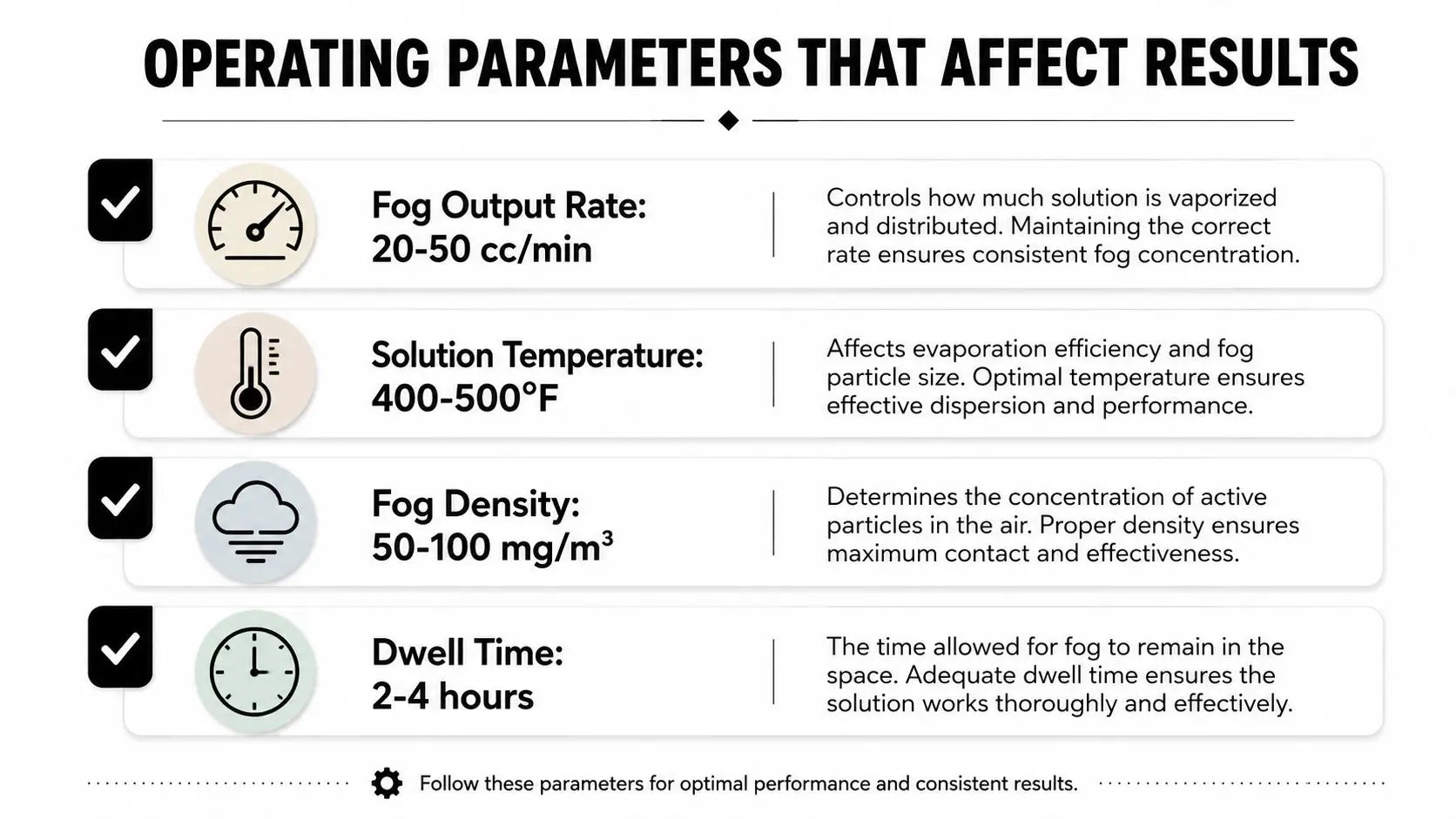
Manufacturer guidance for one thermal fogging counteractant recommends treating areas above 55°F, or 12.8°C, and applying 0.5 to 1.5 fluid ounces per 1,000 cubic feet of airspace. The same guidance calls for keeping doors and windows closed for about 30 minutes, followed by ventilation for at least 60 minutes before re-entry. These figures appear in the Thermo-55 odor counteractant user guide and a manufacturer user guide published by Jon-Don.
What those numbers mean in practice
Temperature affects fog behavior. A cold room can change how the solution disperses and deposits. That's why a technician should evaluate the space rather than assume the same procedure works in every season or building.
Airspace determines the dose. A small enclosed room and a large open floor plan don't require the same amount of product. A careful technician calculates the volume being treated and keeps the application within the product's stated range.
Dwell time gives the fog access. Closing the area for approximately 30 minutes allows the cloud to contact surfaces before ventilation begins. Opening windows immediately may clear the fog before it has reached the intended odor reservoirs.
Ventilation protects occupants. At least 60 minutes of ventilation is the cited minimum in the manufacturer guidance above, but actual re-entry decisions should also account for the product label, room conditions, odor intensity, and professional assessment.
The visual asset in this section lists output, solution temperature, fog density, and dwell time as operating considerations. Those values shouldn't be treated as universal specifications for every machine or chemical. Ask the contractor which product and equipment they're using, what its label requires, and how they'll document the room volume, dwell period, and ventilation.
Prep Work and the Cleanup Sequence
Restoration standards treat odor control as part of a broader cleaning process. The IICRC S700 standard covers fire odor management and restoration cleaning of buildings and contents, reinforcing the professional sequence of cleaning first, deodorizing second, and verifying the result. The IICRC S700 standard overview provides the formal reference point for that approach.
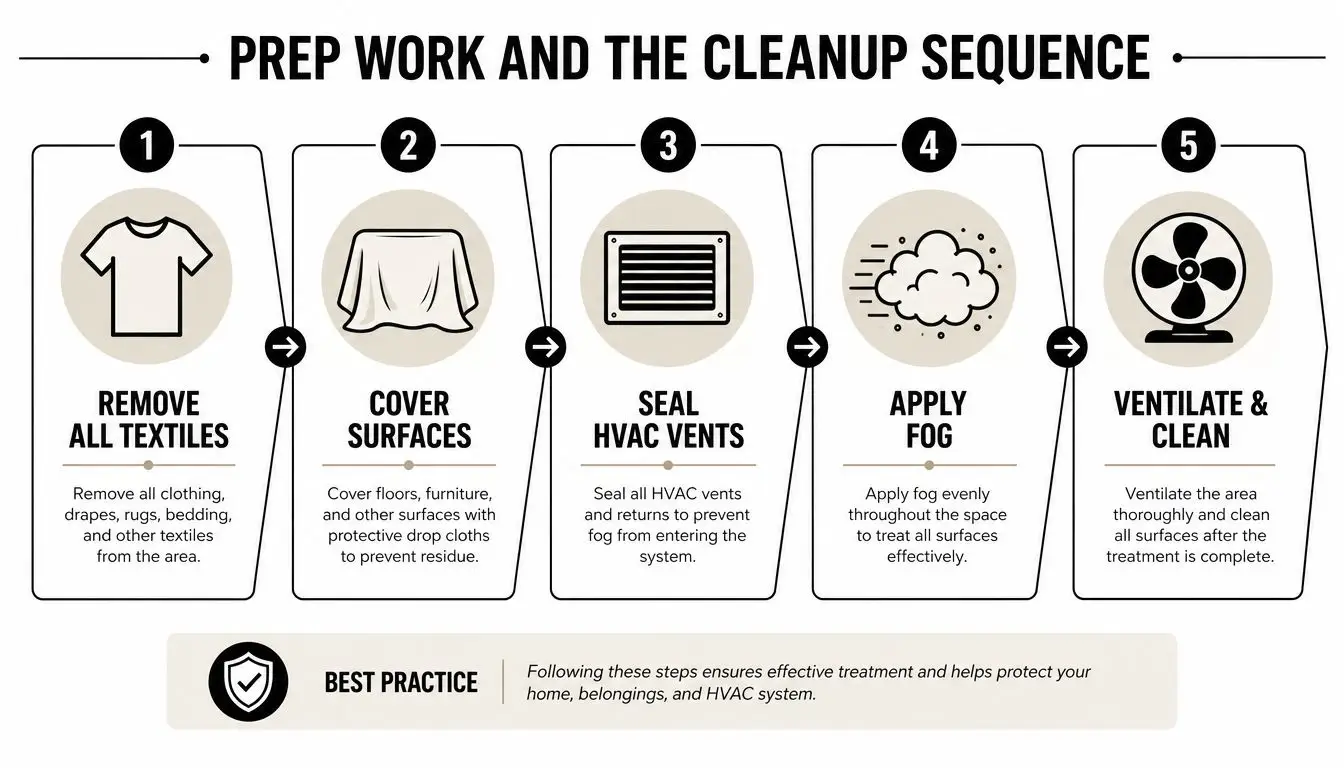
A sound job usually follows this order:
- Identify the source. The technician determines whether the odor comes from smoke residue, char, damp materials, microbial growth, HVAC contamination, or another condition.
- Remove or clean affected materials. Loose soot, residue, damaged contents, and materials that can't be adequately cleaned need appropriate handling before deodorization.
- Prepare the space. The crew clears people and pets, controls ignition sources, protects surfaces, and manages air movement and HVAC pathways as the product and work plan require.
- Apply the fog. The technician calculates the treatment area, distributes the product, and maintains the required containment and dwell conditions.
- Ventilate and verify. After the prescribed ventilation period, the crew checks the air and affected materials for remaining odor instead of assuming the treatment worked because the fragrance changed.
Why the order protects the result
Fogging before soot removal can leave the underlying residue in place. A technician may reach a cavity, but the odor source can continue releasing compounds into the room. That's why a proposal that starts and ends with fogging deserves careful questions.
The same principle applies when a fire affects contents. Clothing, drapes, upholstered furniture, carpeting, and insulation may hold odor differently. Some items need specialized cleaning, some need removal, and some may need sealing or replacement after assessment. Fogging shouldn't be used to avoid making those decisions.
Homeowners should also keep records. Photograph visible damage, save the work authorization, request the product name and safety data, and ask for notes describing what was cleaned, what was treated, and how the technician verified the outcome. On an insurance claim, that documentation can help the adjuster understand why deodorization was necessary and how it fit into the larger fire damage cleaning process.
Ask before approval: What contamination will be removed before fogging, which areas will be contained, how long must the space remain closed, and what test will show that the odor is gone?
Where Fogging Falls Short
Thermal fogging can reach difficult spaces, but it doesn't remove every odor source. If soot, char, smoke residue, biological material, or contaminated HVAC components remain embedded, the smell may return after the treatment appears successful. Heat, humidity, and air movement can make that recurrence more noticeable by encouraging trapped residues to release again.
A recurring odor isn't automatically proof that the technician used the wrong machine. It may indicate that the source was missed, a porous material needs additional cleaning, an air-handling pathway remains contaminated, or a damaged material should have been removed. A professional should investigate the pattern rather than apply another layer of fragrance.
Safety is part of the treatment
The work area should be cleared of occupants and pets, ignition sources should be eliminated, and doors and windows should be managed according to the product instructions. HVAC operation may need to be controlled so the treatment doesn't move unpredictably through occupied areas or distribute residue beyond the intended zone.
Ventilation also affects livability. Independent restoration guidance warns that fogging can leave noticeable VOC-like off-gassing from treated materials, with lingering smells that may last for days even when the original odor source has been addressed. The Cleanfax discussion of effective thermal fogging highlights why technicians should explain both the treatment benefit and the possibility of residual product odor.
A changed smell isn't the same as a clean building.
That difference matters for children, older adults, people with respiratory sensitivities, and anyone who must occupy the property soon. Ask what product will be used, whether it's petroleum-based or water-based, what surfaces may retain it, and what ventilation plan applies. Don't re-enter just because the fog has disappeared from view. Re-entry should follow the label and the technician's documented safety procedure.
Thermal fogging is the wrong tool when the source hasn't been located, when visible contamination still needs removal, when a leak or moisture condition continues, or when the proposed treatment ignores affected ducts and cavities. It can support a complete restoration plan, but it can't replace one.
When to Call a Certified Restoration Company
Call a restoration company when the odor returns after cleaning, appears to come from wall cavities or ductwork, or accompanies visible soot, char, water damage, or microbial growth. A recent fire deserves professional assessment even when the visible damage seems limited, because smoke can migrate beyond the room where the event occurred. Insurance documentation is another reason to bring in a qualified team early.
Look for an IICRC-certified, licensed, and insured company that explains the work in writing. Ask who will identify the source, what will be cleaned before deodorization, how the area will be contained, what product will be applied, how ventilation will be managed, and how the result will be verified. A company that offers emergency availability can also help limit the time residues remain on affected materials, especially during a stressful loss.
For Phoenix-area homeowners, local conditions can make odor changes noticeable as temperatures and indoor moisture fluctuate. That doesn't mean every lingering smell requires thermal fogging. It does mean a recurring odor deserves source-based evaluation rather than repeated masking.
Use this guide to choosing an IICRC-certified restoration company before signing a work order. Restore Heroes is one Phoenix metro option that provides fire and smoke damage restoration, mold removal, odor treatment, and related cleanup, with technicians handling assessment, mitigation, cleaning, and coordination with insurers.
Restore Heroes can assess the source of persistent smoke or other damage-related odors, complete the necessary cleanup, and determine whether thermal fogging belongs in the treatment plan. Visit Restore Heroes to request help for your Phoenix-area property and discuss the next safe step.