
Water damage in a Phoenix home usually starts with noise, confusion, and a fast decision that has real consequences. A supply line lets go under a sink. A washing machine pan overflows. Monsoon water pushes in where it shouldn’t. In the first hour, most homeowners aren’t comparing equipment lists or reading industry standards. They’re trying to find someone who will answer the phone, show up, explain the next step, and keep the problem from getting worse.
That’s why this guide gets to the point. The wrong restoration company can leave you dealing with avoidable moisture, unclear billing, poor communication, and a claim that becomes harder to manage than it should be. The right one usually brings order quickly. They document the loss, start extraction and drying, set expectations, and coordinate with the insurer without adding more stress.
That urgency matters in a big market. The U.S. has 62,582 damage restoration businesses in 2025, following 4.3% average annual growth from 2020 to 2025. More choice sounds helpful, but in an emergency it can make the decision harder, not easier.
This list focuses on the best water damage restoration companies for Phoenix area homeowners who need a practical framework, not a generic roundup. I’m weighing four things that matter most when water is actively affecting the property: IICRC certification, response speed, insurance handling, and customer-first policies such as free inspections or no upfront payment. If you’re also trying to protect furniture, boxes, or renovation materials during cleanup, temporary storage during home renovations and remodelling projects can help keep unaffected items out of the work zone.
1. Restore Heroes
If you want the shortest path from emergency call to organized action, Restore Heroes stands out. The company is built around the things stressed homeowners usually need first: 24/7 live response, an Immediate Response Guarantee, IICRC-certified technicians, and help dealing with insurance from the beginning instead of after the drying work is already underway.
That combination matters because water damage is the largest service type in disaster restoration, with a projected 38.56% revenue share in 2025. In plain terms, this is the kind of loss restoration teams handle constantly, and the companies that do it well tend to have a repeatable process for extraction, structural drying, documentation, and communication.
Why it works well in a real emergency
Restore Heroes is one of the more homeowner-friendly options on this list. The company promotes free onsite inspections, no upfront payment, no minimum charge, and acceptance of all insurance. Those policies don’t replace the need to confirm claim details with your carrier, but they do lower the friction at the exact moment people are trying to stop panic from taking over.
The service scope is also broad enough that you’re less likely to get bounced to another contractor midway through the job. Water extraction, drying, decontamination, odor removal, sanitation, and insurer coordination are handled under one roof. If the loss turns out to involve mold, sewage, smoke, or biohazard issues, the same team can keep the project moving.
For homeowners comparing local options, the dedicated Phoenix water damage restoration contractor page gives a clearer picture of what they do on water losses.
Practical rule: In the first call, ask who documents moisture, who talks to the insurer, and whether the same company handles mitigation through cleanup. If the answer is vague, keep calling.
Best fit and trade-offs
Restore Heroes is strongest for Phoenix homeowners who want one local company to manage the full sequence without requiring money upfront before the inspection. It’s also a strong fit for property managers and commercial owners who need fast communication and documented work.
A few trade-offs are worth noting. The company doesn’t publish rates online, so you won’t get line-item pricing before an inspection. That isn’t unusual in restoration, but it means budgeting conversations happen after the crew understands the scope and, if insurance is involved, after claim details are clearer.
Its service area is also local by design. That’s a benefit if you’re in Phoenix, Mesa, Gilbert, Scottsdale, Chandler, or nearby communities because local dispatch usually matters more than national branding. But if your property is outside the Phoenix metro, you’ll need another provider.
Pros and cons
Strong emergency intake: 24/7 live phone response and an Immediate Response Guarantee help homeowners get moving fast.
Certified and insured operation: IICRC-certified, licensed, bonded, and insured is the baseline homeowners should insist on.
Easier claim handling: Free onsite inspections, insurance acceptance, and no upfront payment reduce pressure during the first day.
End-to-end scope: Water, fire, mold, and biohazard capability helps when a “simple water loss” turns into something more complex.
No published pricing: You’ll need an inspection for a real estimate.
Phoenix-focused coverage: Excellent for local response, less useful outside the Valley.
For a homeowner trying to choose among the best water damage restoration companies in Phoenix, Restore Heroes is the most balanced option here. It pairs strong field credentials with policies that remove common points of friction.
Visit Restore Heroes.
2. SERVPRO of Phoenix
Some homeowners feel more comfortable with a large national brand, especially when the loss looks big on day one. SERVPRO of Phoenix fits that preference. The local franchise offers 24/7 emergency response, water mitigation, mold remediation, contents restoration, HVAC cleaning, board-up and tarping, and reconstruction.
That breadth can be useful when the water didn’t just affect flooring and drywall. If cabinets, documents, stored contents, or multiple rooms are involved, a larger system with pack-out capability can simplify the handoff between mitigation and recovery.
Where SERVPRO makes sense
SERVPRO’s biggest advantage is scale. Nationally, SERVPRO operates more than 2,000 U.S. franchises, which is why many property owners think of it first when they need a crew, equipment, and an established workflow quickly.
The Phoenix location also appeals to owners who want a familiar estimating and insurance process. Large franchise systems tend to have established documentation habits, and that usually helps when a claim adjuster wants clear photos, moisture records, and itemized scope notes. If you need background on the actual process, this explanation of what water damage restoration involves is useful context before you authorize work.
Large networks are helpful when the job is chaotic. They’re less helpful if the local branch is hard to reach after the first day. Ask who your direct point of contact will be.
The trade-offs to watch
The franchise model is both the strength and the caution flag. You get national systems, but actual service quality still comes down to the local office, crew leadership, and current workload. That’s why local reviews matter more than brand recognition alone.
SERVPRO also doesn’t publish line-item pricing online. That’s common in restoration, but it means you should ask direct questions about documentation, equipment monitoring, and what happens if reconstruction is needed after drying is complete.
Pros and cons
Large operational footprint: Good choice for bigger losses and properties with contents restoration needs.
Wide service menu: Helpful if water damage overlaps with mold, cleanup, or reconstruction.
Recognizable systems: Many homeowners and facilities managers are already familiar with the workflow.
Quality can vary by franchise: Local reputation matters more than the national logo.
No online pricing: Scope and billing are handled after inspection and insurer review.
Visit SERVPRO of Phoenix.
3. ATI Restoration Phoenix
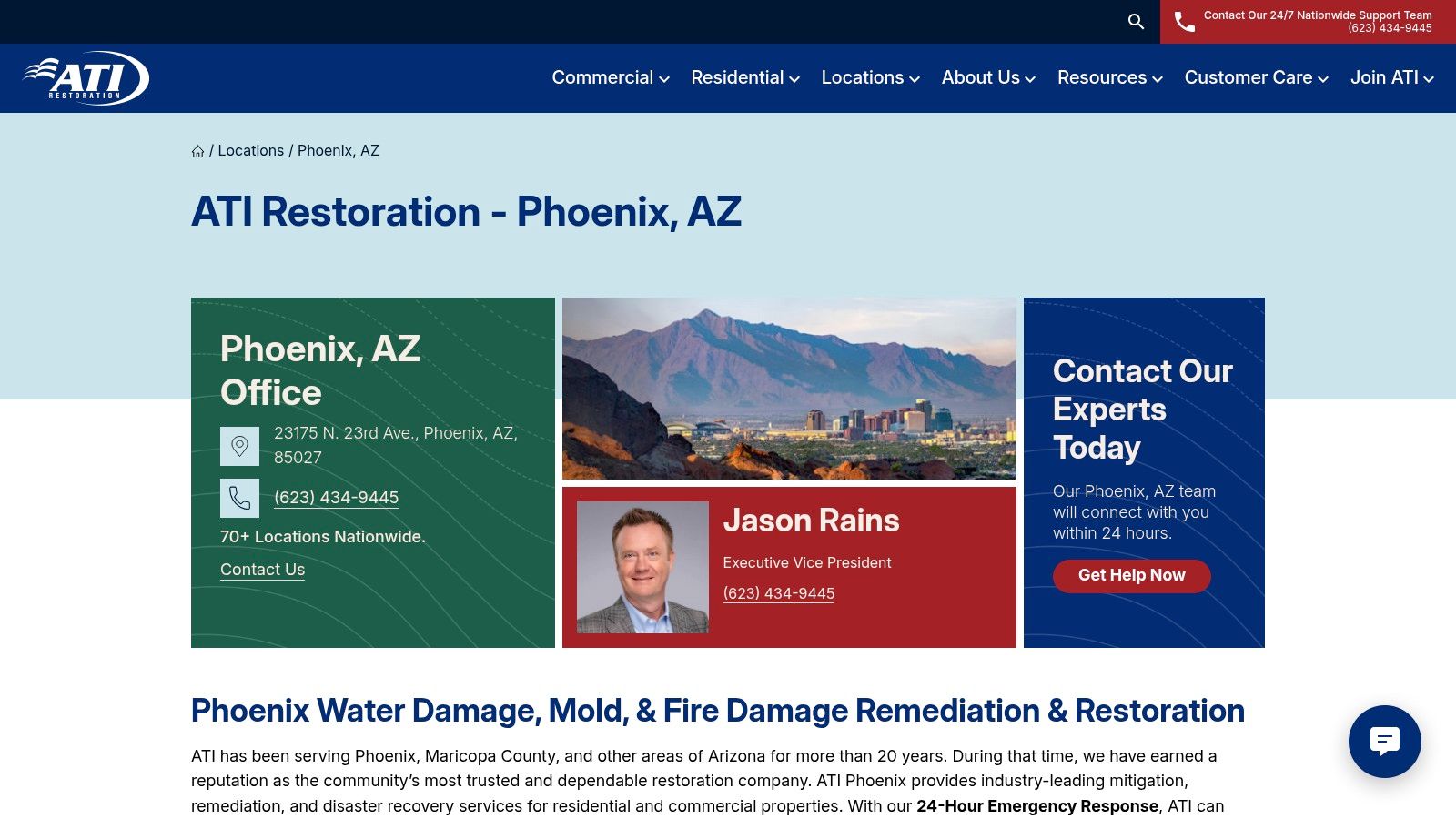
ATI Restoration is the company I’d look at first for more complex jobs. If the property has sewage involvement, multiple affected areas, environmental concerns, or a commercial component, ATI’s structure and in-house reconstruction model can be a practical advantage.
Its Phoenix office serves Maricopa County with 24/7 emergency response and end-to-end restoration. That includes extraction, drying, remediation, contents work, odor treatment, and rebuild coordination.
Best for complicated losses
ATI is especially relevant when homeowners need more than basic dry-out. The company notes HAZWOPER-trained technicians for Category 3 water and sewage scenarios, which matters when the job isn’t just wet but potentially contaminated. A provider that can handle hazardous conditions and reconstruction under one management system can reduce delays and finger-pointing.
This is also the kind of company that tends to work well with commercial owners, HOAs, and facilities that need process discipline. The more stakeholders involved, the more important documentation becomes. If you’re trying to understand the financial side before approving work, this page on how much water damage repair can cost helps frame the conversation.
Trade-offs before you call
The main caution with ATI isn’t capability. It’s triage. Large national restoration firms often prioritize by severity during widespread storms or citywide demand spikes, so smaller residential jobs may wait longer than homeowners expect.
That doesn’t mean they won’t respond. It means you should ask whether your job will be handled by the local office directly, whether reconstruction is managed in-house, and who approves changes in scope once walls or flooring are opened.
If your loss involves sewage, don’t shop on speed alone. Ask who is certified to handle contaminated water and what containment steps they use before demolition starts.
Pros and cons
Strong fit for complex losses: Especially useful for contaminated water and rebuild-heavy jobs.
In-house reconstruction capability: Less risk of getting handed off to another contractor later.
Commercial depth: Good option for larger residential and mixed-use properties.
Possible scheduling triage during surge events: Large firms may prioritize the most severe losses first.
No public pricing: Final numbers depend on inspection, scope, and insurance decisions.
Visit ATI Restoration Phoenix.
4. Titan Restoration of Arizona
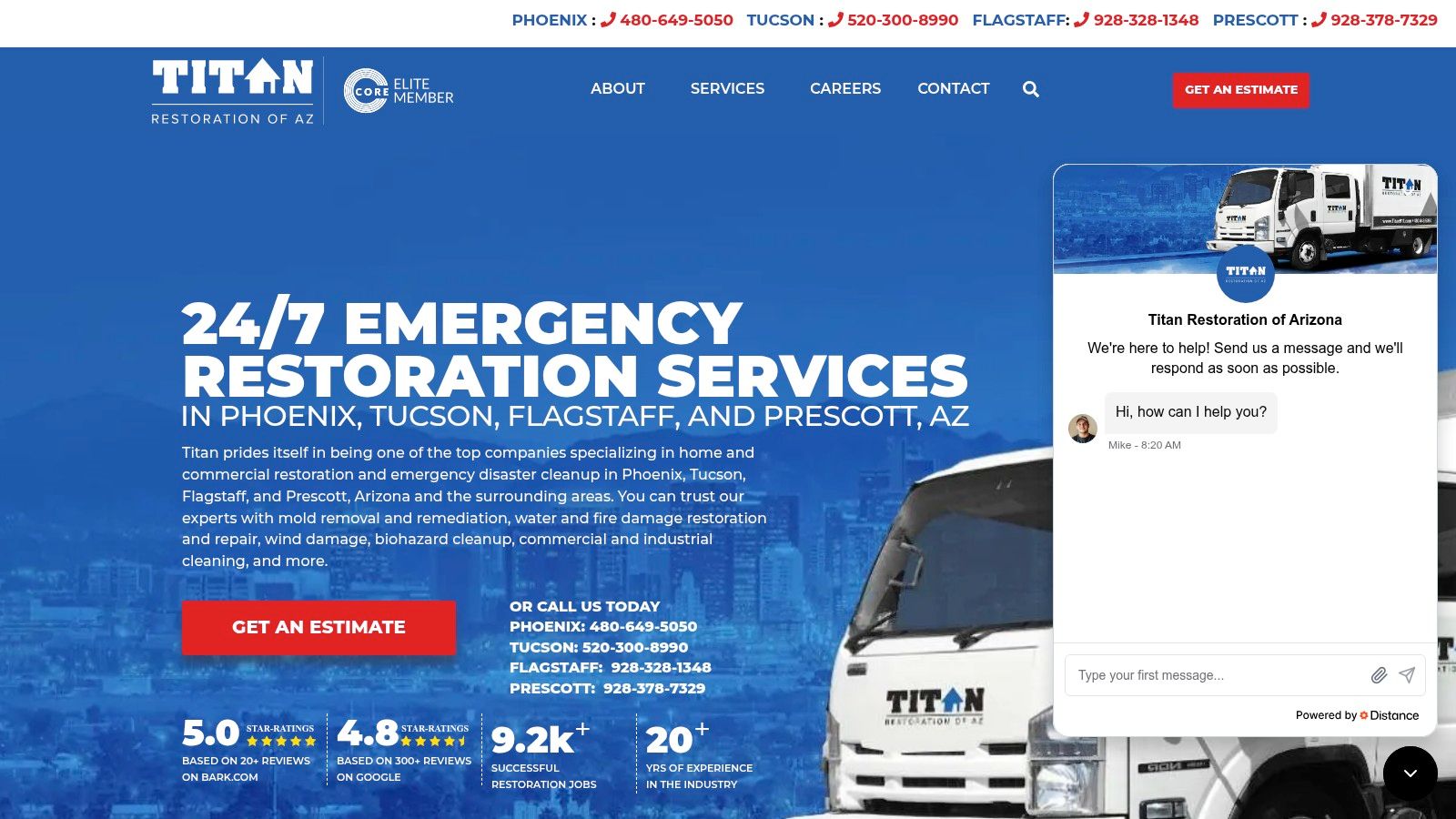
Titan Restoration of Arizona lands in a useful middle ground. It isn’t just a tiny local operator, and it isn’t a giant national network either. For many Phoenix homeowners, that balance is attractive because they want fast dispatch and local familiarity without feeling like they’ve entered a giant call-center system.
The company promotes 24/7 live response, a roughly one-hour on-site goal, residential and commercial service, and in-house reconstruction. It also emphasizes documentation tools, including 3D virtual imaging, which can make the scope easier for owners and adjusters to understand.
Why documentation matters
Water jobs go smoother when the restoration company documents the loss clearly from the start. Good records help everyone. The homeowner understands what’s affected, the insurer sees a cleaner narrative, and the contractor has a clearer baseline for drying and rebuild decisions.
Titan’s communication and imaging emphasis is a real point in its favor. In practice, poor documentation is one of the fastest ways for a manageable job to become a frustrating one. If emergency extraction is still your first need, this guide to emergency water damage response is a useful companion read.
What to like and what to verify
Titan is a good fit for homeowners who want an Arizona-focused company with broad service capacity. If your concern is not just “Can they show up?” but also “Will they explain what they’re doing?” this kind of operator often feels easier to work with than a very large brand.
The trade-off is the same one that applies to most restoration firms. Pricing isn’t published online because the scope changes from loss to loss. Response windows can also stretch during monsoon spikes, even when a company normally moves quickly.
Pros and cons
Arizona-focused service: Local market familiarity matters in Phoenix-area water events.
Strong communication angle: Imaging and documentation can help reduce confusion in the claim process.
Residential and commercial capability: Useful for owners with multiple property types.
No published pricing: You’ll need a site visit for meaningful numbers.
Response timing can shift during surge periods: Ask for the current dispatch ETA, not the usual one.
Visit Titan Restoration of Arizona.
5. Arizona Fire & Water Restoration Inc.
Arizona Fire & Water Restoration is one of the more established local-style choices for homeowners who want a Phoenix-area contractor with a long service identity and a straightforward emergency restoration offering. The company handles water cleanup, structural drying, mold remediation, repairs, and reconstruction, and it promotes direct insurance billing and claim assistance.
That setup is attractive for homeowners who don’t want to coordinate three separate vendors. In a water loss, the easiest jobs are often the ones where one company manages the mitigation and keeps the paperwork moving.
Where this company stands out
A practical strength here is local focus plus broad service range. That’s often the sweet spot for residential water losses. You want a crew that knows the area, but you also want enough internal capability that the project doesn’t stall once demolition, drying, or repair decisions start.
The company also has an A+ BBB rating noted in its profile. I treat BBB information as one signal, not the whole decision, but it’s still useful when you’re trying to gauge how a company handles complaints and follow-through. If insurance is a major concern for you, these water damage insurance claim tips can help you ask better questions before authorizing work.
The best restoration companies don’t just dry the structure. They explain what is being removed, what can be saved, and what the insurer is likely to ask for next.
Best fit and limitations
Arizona Fire & Water Restoration makes sense for homeowners who prefer a local Arizona company and want direct insurance billing built into the process. It’s also a reasonable option when the job may continue into repairs or reconstruction.
The main limitations are familiar. Pricing isn’t posted publicly, so decisions depend on the inspection and claim details. Also, while an A+ BBB rating is positive, BBB accreditation is optional, so don’t confuse the rating with every aspect of field performance. You still need to ask about response time, drying documentation, and who supervises the job.
Pros and cons
Local Arizona operation: Often easier for homeowners who prefer a regional contractor.
Broad project handling: Mitigation through reconstruction under one umbrella.
Direct insurance billing: Can reduce admin stress during the claim.
No public pricing: Expect estimates after inspection.
BBB information is helpful but limited: It shouldn’t replace review checks and direct questions.
Visit Arizona Fire & Water Restoration.
6. Rocky Mountain Restoration Phoenix Metro
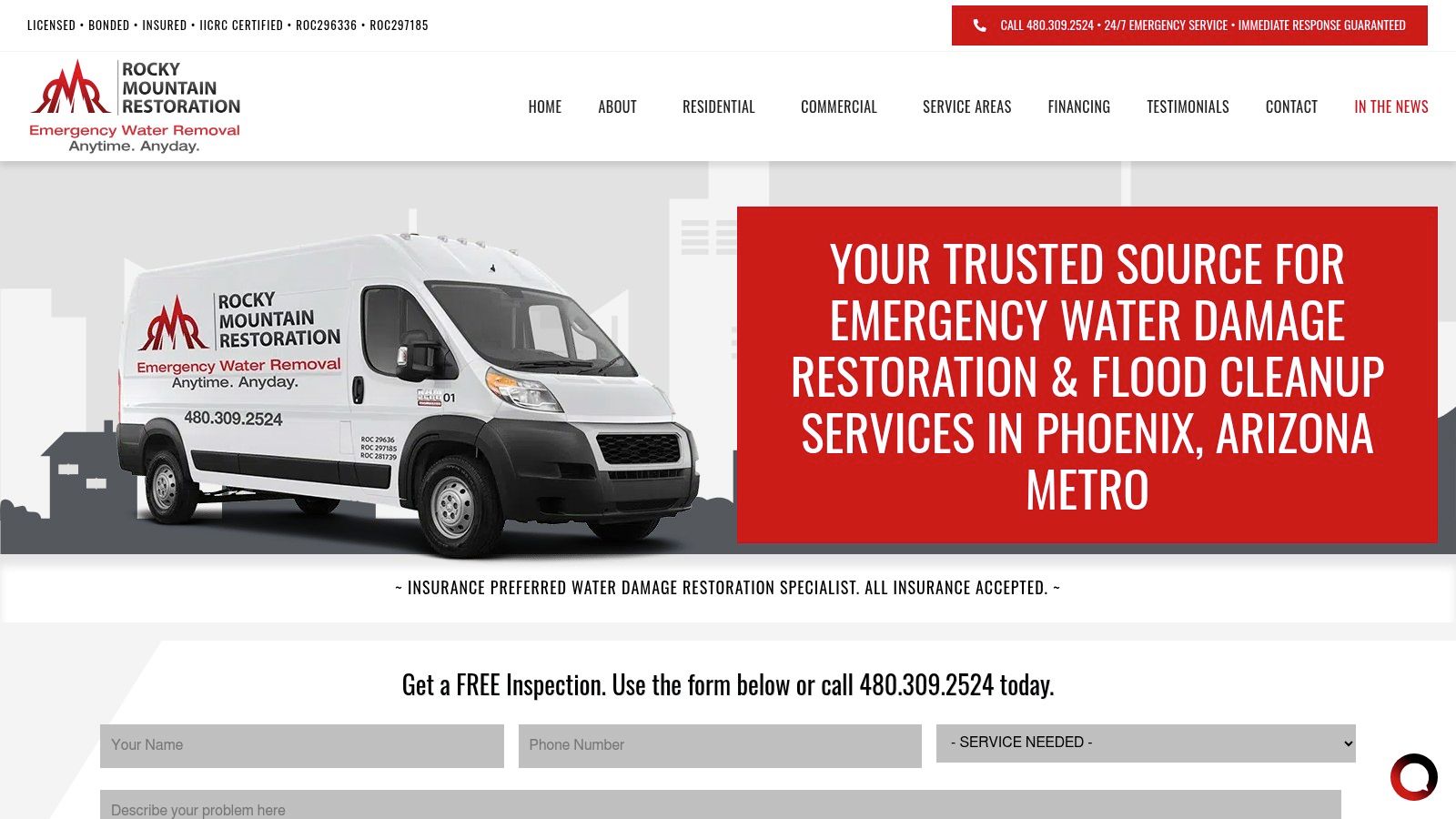
Rocky Mountain Restoration is one of the more customer-friendly entries in this comparison. The company highlights 24/7 emergency service, an Immediate Response Guaranteed claim, free onsite inspections and consultations, direct insurance billing, financing options, and a stated satisfaction guarantee. It also notes licensed, bonded, insured status and IICRC-certified technicians.
For homeowners under stress, those policies matter. The first decision often isn’t about equipment. It’s about whether the company is making the situation easier or harder.
Why homeowners tend to notice this one
Rocky Mountain Restoration feels designed for people who want less friction. Free inspections and direct insurance billing lower the barrier to getting a qualified team involved quickly. Financing availability can also matter when a loss includes non-covered items or work outside the insurer’s scope.
In a crowded market, customer-first policies are one way local and regional companies compete with larger brands. That matters because the best water damage restoration companies aren’t always the biggest ones. They’re often the ones that communicate clearly and remove the most stress during the first day.
What to confirm before signing
The key thing to verify is operational detail. “Immediate response” is a promising phrase, but ask what it means today, for your ZIP code, under current workload. Also ask who monitors drying progress, how often the crew checks equipment, and what happens if additional demolition becomes necessary.
This company can be a strong fit for homeowners who want local coverage and practical payment flexibility. Just keep your expectations grounded. Response guarantees and financing options are useful, but actual scope, timing, and insurer approval still drive the job.
Pros and cons
Very homeowner-friendly policies: Free inspections, direct billing, and financing reduce friction.
Certified and insured positioning: Good baseline for trust and professionalism.
Multi-office Valley coverage: Helpful for broader Phoenix metro dispatch.
No detailed online pricing: Scope determines the estimate.
Surge-event availability may vary: Confirm live ETA when you call.
Visit Rocky Mountain Restoration.
7. ZONA Restoration Tempe Phoenix Metro
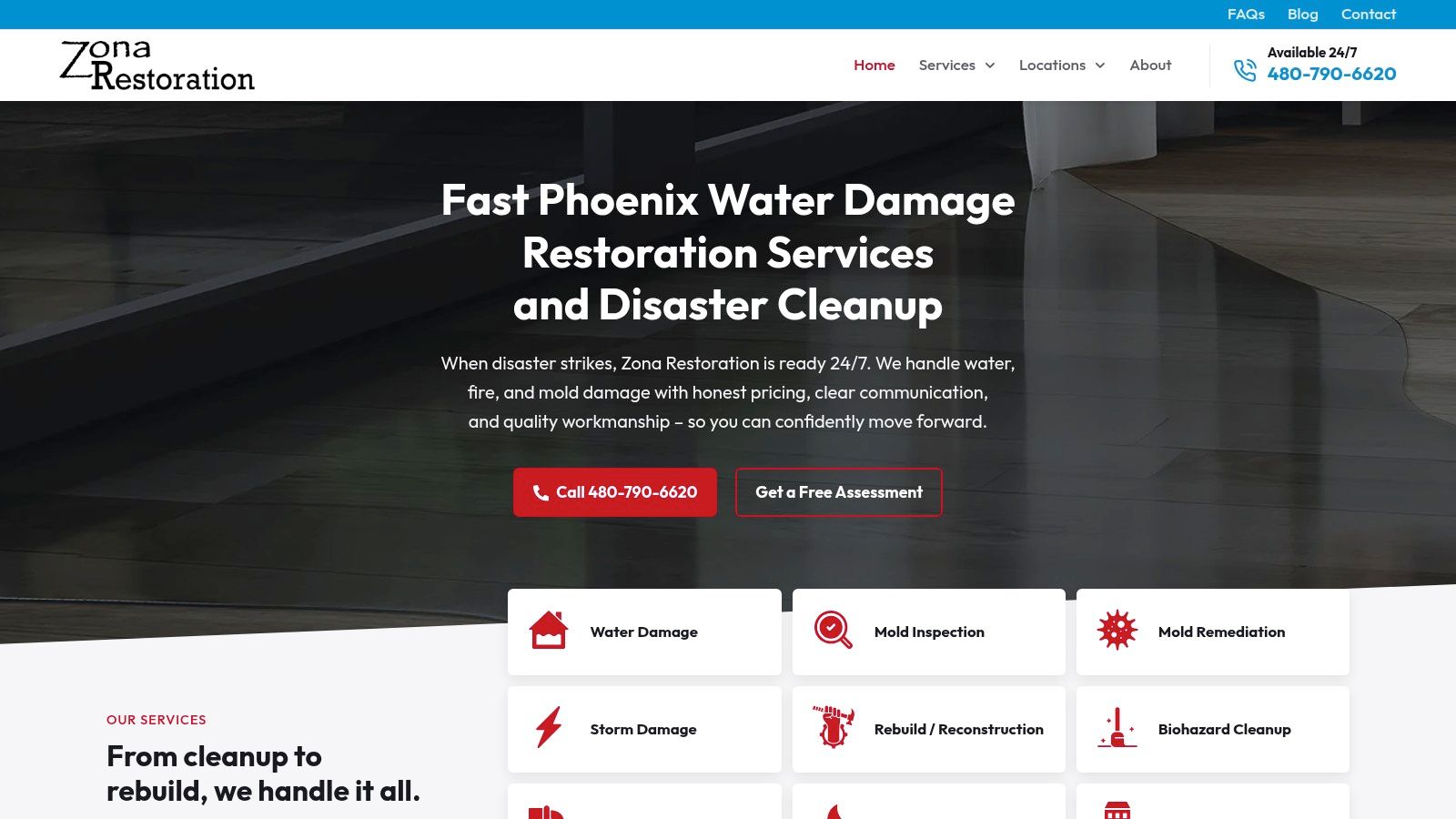
ZONA Restoration is a good example of a local company with a slightly wider technical profile than many homeowners expect. Along with water, fire, smoke, mold, sewage, biohazard, and reconstruction services, it also lists environmental services such as asbestos testing, abatement, and radon mitigation.
That broader scope won’t matter on every water loss. But when a job uncovers additional issues during demolition or rebuild, having one contractor with wider environmental capability can keep a project from stalling.
Why ZONA is worth a look
ZONA lists an IICRC Firm ID and Arizona contractor licenses, which is exactly the kind of detail I want to see from a local restoration company. It also presents clear insurance-coordination steps and start-to-finish handling, which gives homeowners a better sense of how the process works before they call.
This company is a practical option for homeowners who want local focus without a narrow service menu. It’s especially useful when the property is older, the loss is messy, or there’s a real chance the project will expand beyond basic extraction and fan placement.
The trade-offs
The downside is the same one you’ll see across most serious restoration providers. There’s no standardized public pricing because no two losses are identical. You’ll need an onsite inspection to know the likely scope.
Availability can also shift during citywide events. If you’re calling during a monsoon-related surge, don’t stop at “Yes, we service your area.” Ask for dispatch timing, who performs the inspection, and how soon the first moisture readings and documentation can start.
A local company earns trust when it gives straight answers on dispatch time, documentation, and insurance coordination. Brand size doesn’t replace that.
Pros and cons
Strong local technical positioning: IICRC and licensing details help build confidence.
Broad service menu: Useful if the project expands into environmental or rebuild work.
Clear claims-process emphasis: Good fit for homeowners who want transparency.
No public pricing: Inspection comes first.
ETA can vary during high-demand events: Confirm timing before committing.
Visit ZONA Restoration.
Top 7 Water Damage Restoration Companies Comparison
| Provider | Implementation Complexity 🔄 | Resource Requirements ⚡ | Expected Outcomes ⭐📊 | Ideal Use Cases 💡 | Key Advantages ⭐ |
|---|---|---|---|---|---|
| Restore Heroes | Low–Moderate 🔄: turnkey local workflows and documented IICRC practices | Moderate ⚡: certified technicians, advanced extraction/drying & decontamination equipment, claims coordination | High ⭐📊: end-to-end restoration to pre‑loss condition; reduced secondary damage | Immediate residential/commercial emergencies in Phoenix metro | 24/7 live response; Immediate Response Guarantee; no upfront payment; insurance coordination |
| SERVPRO of Phoenix | Moderate 🔄: franchise protocols with standardized processes | High ⚡: large crews, extensive equipment, contents restoration & reconstruction capacity | High ⭐📊: rapid mobilization and scalable recovery for large losses | Large commercial losses, extensive contents recovery, rapid surge response | National systems, large equipment inventory, established brand support |
| ATI Restoration – Phoenix | Moderate–High 🔄: structured procedures with hazardous‑event protocols | High ⚡: deep bench, HAZWOPER‑trained techs, Fast‑Track reconstruction resources | High ⭐📊: handles complex/Category‑3 and large‑loss jobs with clear documentation | Hazardous sewage, complex commercial large‑loss, major rebuilds | Hazard‑trained staff, commercial capacity, strong insurance coordination |
| Titan Restoration of Arizona | Low–Moderate 🔄: regional focus with rapid on‑site goals | Moderate ⚡: regional crews, 3D virtual imaging and claims tools | Good ⭐📊: fast mobilization and improved claims transparency | Local Arizona incidents needing quick response and clear documentation | ~1‑hour on‑site goal, 3D documentation, emphasis on communication |
| Arizona Fire & Water Restoration, Inc. | Moderate 🔄: long‑standing local processes and direct billing workflows | Moderate–High ⚡: end‑to‑end mitigation through reconstruction, insurance billing | Good–High ⭐📊: quick assessments and trusted local outcomes | Homeowners and businesses wanting experienced local contractor | A+ BBB rating, direct insurance billing, long Arizona tenure |
| Rocky Mountain Restoration (Phoenix Metro) | Low–Moderate 🔄: customer‑friendly, guaranteed response process | Moderate ⚡: multiple Valley locations, certified techs, financing options | Good–High ⭐📊: prompt response, financing availability, satisfaction guarantee | Homeowners seeking no‑upfront and financing across Phoenix metro | Immediate Response Guarantee, free inspections, financing, direct billing |
| ZONA Restoration (Tempe – Phoenix Metro) | Moderate 🔄: start‑to‑finish mitigation with environmental protocols | High ⚡: IICRC firm credentials, abatement and environmental services (asbestos/radon) | High ⭐📊: comprehensive mitigation plus environmental remediation and rebuild | Jobs requiring environmental testing/abatement plus reconstruction | IICRC Firm ID, licensed environmental work, transparent claims/process pages |
How to Choose the Right Restoration Partner A 4-Point Checklist
Choosing among the best water damage restoration companies gets easier when you strip the decision down to four questions. In an emergency, people often compare the wrong things first. They look at ad language, company size, or brand familiarity. Those can matter, but they don’t tell you how the job will proceed once a crew arrives.
The first question is certification. Ask whether the company and its technicians are IICRC-certified. That doesn’t guarantee a perfect experience, but it’s still the clearest baseline for professional water damage work. You want a team that understands extraction, drying, documentation, and contamination protocols in a standardized way, not a company improvising on your property.
The second question is response time. Not the marketing version. Ask when they can be onsite, who is dispatching, and whether that ETA is based on current demand. A company that answers clearly is usually easier to work with throughout the claim. A company that dodges timing on the first call often stays vague later.
The four questions worth asking on every call
- IICRC certification: Ask if both the firm and the technicians handling your job are certified for water damage restoration work.
- Response commitment: Ask for the actual current ETA to your address, not just a general “24/7” promise.
- Insurance coordination: Ask whether they work directly with insurers and what documentation they provide during the job.
- Payment policy: Ask if they require upfront payment, offer free inspections, or bill insurance directly when appropriate.
The third question is insurance handling. Good restoration companies know that homeowners are already stressed. They should be able to explain how they document the loss, how they communicate with the adjuster, and what you’ll still need to handle yourself. The right company won’t promise coverage they can’t control, but they will help you understand the process and reduce the paperwork burden where possible.
The fourth question is payment policy. This matters more than many people think. A company that requires money upfront before an inspection or can’t explain its billing process clearly may create more pressure than relief. By contrast, a company offering free inspections or direct insurance billing often makes the first day much easier to manage, especially when the scope is still developing.
What usually works and what usually doesn’t
What works is simple. Clear intake, documented moisture readings, realistic timelines, and one point of contact. Homeowners need a calm plan. They don’t need jargon, vague promises, or a disappearing project manager after the first equipment drop.
What doesn’t work is choosing based only on who answered fastest or who sounded cheapest over the phone. Water damage jobs often change after inspection. Materials may need removal. Hidden moisture may appear. Contamination may complicate the plan. The better question is whether the company is equipped to handle those turns without losing organization.
If you’re deciding today, keep it practical. Confirm certification. Confirm response time. Confirm insurance coordination. Confirm payment expectations. Then choose the team that gives direct answers and makes the path forward feel manageable. In most cases, that’s the company you’ll trust when the job gets harder before it gets better.
If you need a Phoenix-area team that combines IICRC-certified restoration, 24/7 live response, insurance coordination, free onsite inspections, and no upfront payment, Restore Heroes is a strong first call. They handle water damage, mold, fire and smoke, and biohazard cleanup across the Valley with a local, start-to-finish approach that’s built for emergencies.