
The moments after you discover damage to your home are a blur of stress and confusion. One minute everything is fine, the next you’re staring at a burst pipe flooding your kitchen, the aftermath of a garage fire, or a roof torn open by a Phoenix monsoon. It’s overwhelming.
But what you do in these first few hours can be critical. Your actions not only keep your family safe and prevent the damage from getting worse, but they also set the foundation for a smoother insurance claim process.
First things first: ensure safety. If there's any chance of a gas leak, you see sparks, or rising water is nearing electrical outlets, get everyone out immediately and call 911. Don't even think about going back inside until the professionals give the all-clear. Your life is more important than your property.
What to Do Immediately After Home Damage in Phoenix
Once you know the scene is safe for you to be in, your focus needs to shift to damage control. This is your responsibility as the homeowner, and it’s actually something your insurance company expects.
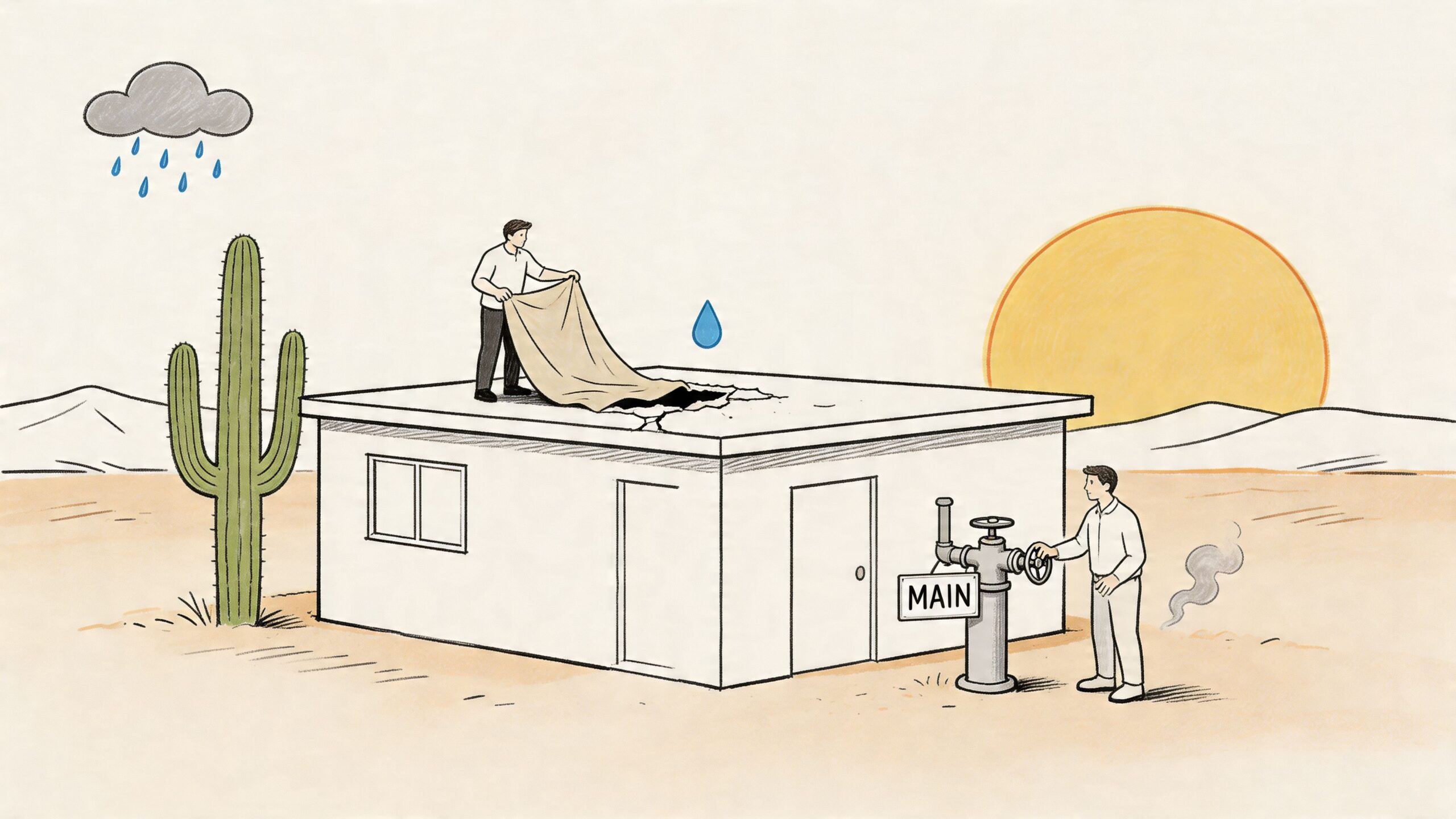
Secure the Scene and Prevent More Damage
Every homeowner should know where their main utility shut-offs are. Seriously, if you don't know, go find them after you read this. Turning off the main water valve can stop a leak in its tracks, preventing a small mess from becoming a full-blown catastrophe. The same goes for your electrical panel—shutting off the right breaker can prevent a fire.
Your insurance policy likely includes a clause that requires you to take reasonable steps to mitigate damages. This is just insurance-speak for "prevent the problem from getting worse." For a Phoenix homeowner, this could look like:
- Throwing a tarp over your roof after a monsoon to keep the rain out.
- Boarding up a window that was broken during a storm to keep your home secure.
- Moving furniture and other valuables out of a flooded area, as long as it's safe.
These quick fixes show your insurer you’re being responsible. It’s important to understand, though, that mitigation doesn't mean starting the actual repairs yourself.
Key Takeaway: Your insurance policy may require you to take reasonable steps to prevent further loss. This is often called your "duty to mitigate." Calling a professional restoration company is one of the best ways to fulfill this duty, as they have the expertise to stabilize the situation safely and correctly.
Why You Must Call Professionals Immediately
It's a common scenario: a homeowner, wanting to be helpful, starts ripping out soaked carpet or tossing fire-damaged belongings before the insurance adjuster ever sees them. Please, resist this urge! The adjuster needs to see the original, unfiltered scope of the damage to assess your claim properly. If you throw out the evidence, you could be jeopardizing part of your potential settlement.
This is where a professional restoration team can be a valuable partner. In the intense Phoenix heat, water damage can lead to mold growth in as little as 24-48 hours. We cover this in-depth in our guide on emergency water mitigation. A certified crew can get to work immediately, using professional-grade equipment to dry out the structure and prevent secondary damage like mold—which often isn't covered if it's the result of your inaction.
This infographic breaks down the crucial first steps to take.
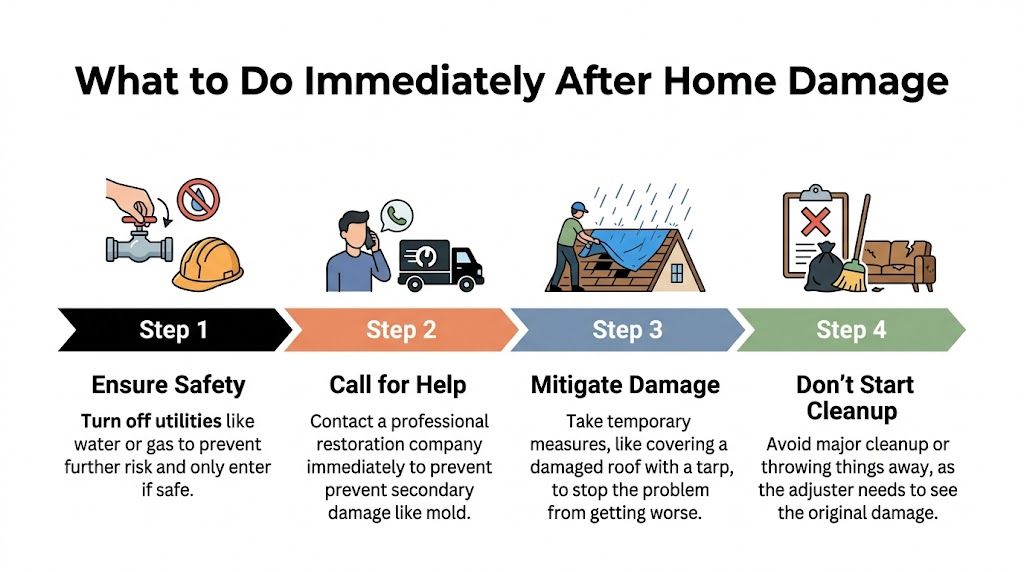
Think of it as a sequence. First, safety. Then, call for professional help to stop the bleeding. Only then should you handle small, temporary fixes while you wait, leaving the big picture untouched for the adjuster.
Documenting the Damage to Build a Strong Claim
Once you’ve taken steps to prevent more damage, it’s time to shift gears. What you do next—before a single thing is cleaned up or moved—can make a big difference in your insurance claim.
Think of yourself as a crime scene investigator. The evidence you gather in these first few hours can be a powerful tool. It can be the difference between a frustrating process and a fair settlement that helps get your home back to normal.
Capture Everything With Photos and Videos
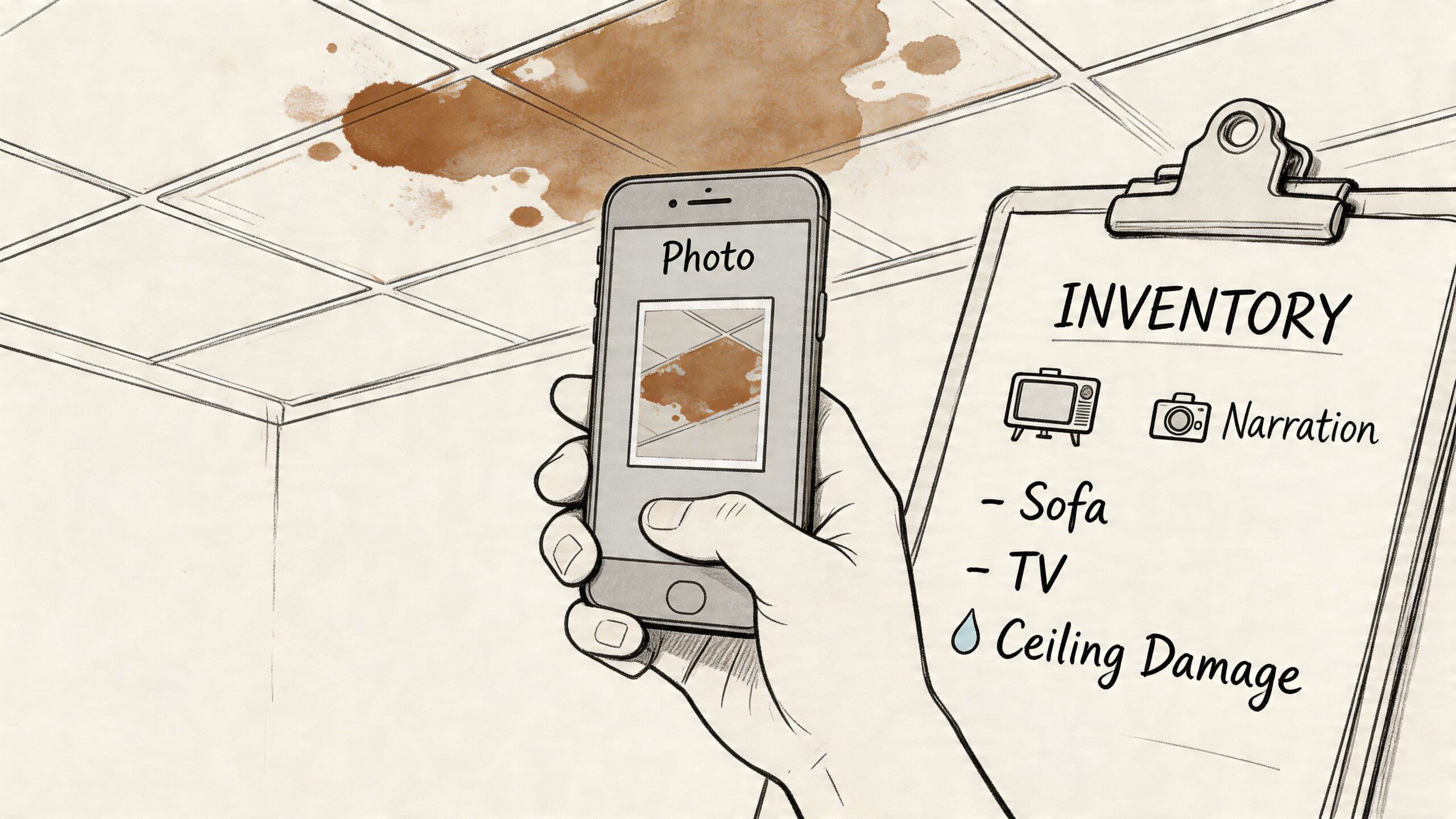
Your smartphone is about to become your best friend. Your goal is to create a visual record so thorough that anyone can understand the extent of the damage without ever stepping foot in your home.
Start by taking wide-angle shots of each affected room to show the overall scene. Then, get up close. Get detailed photos of the warped floorboards, the soot stains crawling up the walls, or the watermark left behind on the drywall.
Here’s how we coach homeowners to get it right:
- Take way more photos and videos than you think you need. You can always delete extras later, but you can’t go back in time to get a shot you missed.
- Shoot from different angles. Get down on the floor to show how water buckled the baseboards. Stand on a sturdy chair (be careful!) to capture the full scope of a ceiling stain.
- Use video to tell the story. Walk through the damaged areas and talk about what you’re seeing and smelling. A video allows you to document things a photo can't, like the overpowering smell of smoke or the squish of a waterlogged carpet. Simply saying, "I'm in the living room now, and the smoke smell is so strong it’s making my eyes water," adds a powerful, personal layer to your claim.
When you provide this level of detail, it’s much harder for an insurance adjuster to downplay the scope of your loss. Your meticulous records effectively become their guide.
Create a Detailed List of Damaged Belongings
Now, let's pair those visuals with a written record. You'll need to create a home inventory list—a detailed catalog of every personal item that was damaged or destroyed. Yes, it’s tedious, but it can be absolutely essential.
The following table provides a clear checklist to guide you through the process, ensuring you don't miss a single crucial detail.
Damage Documentation Checklist
| Action Item | Why It's Critical | Pro Tip |
|---|---|---|
| Photograph and video everything | Visuals provide undeniable proof of the "before" state, potentially preventing disputes about the extent of the damage. | Use your phone's timestamp feature. Narrate your videos, mentioning the date, room, and specific damage you see. |
| List every damaged item | You can't claim what you don't list. This list is the foundation for your personal property settlement. | Go room by room. Open every drawer and cabinet. Small items add up quickly. |
| Note item details | You'll likely need the brand, model, age, and original cost to prove the value of your lost items. | Can't find a receipt? Look for old credit card statements or online order confirmations. |
| Find original purchase records | Receipts, manuals, and credit card statements are concrete proof of ownership and value. | Keep a "Home" folder in your email or cloud storage for digital receipts of major purchases. |
For each item on your list, try to include:
- Item Description: (e.g., "Samsung 55-inch 4K Smart TV")
- Brand and Model Number: If you can find it.
- Age of the Item: Be as accurate as you can.
- Original Cost: What you paid for it.
- Estimated Replacement Cost: What a new one would cost today.
This detailed inventory helps account for every loss, which is key to pursuing the full settlement you may be entitled to.
Pro Tip: Don't throw anything away until the adjuster has seen it or you have written permission to do so. If you have to move a soaked rug to prevent further damage, take a photo of it in its original spot first, then another photo of it once it's been moved.
An accurate inventory is so important because it’s a primary source adjusters use to calculate your payout. This is especially true for the water damage claims we see so often here in the Phoenix area. You can find more advice in our guide to water damage insurance claim tips.
Putting in this work upfront can transform a chaotic mess into a well-managed claim. While only about 6 percent of insured homes filed a claim in recent years, wind and hail were among the most frequent causes, with average payouts around $11,695. Water damage and freezing claims were right there with an average of $11,650—a number that hits close to home for folks in Gilbert and Chandler dealing with burst pipes or monsoon damage. Your detailed documentation can help you get a fair assessment.
Reporting the Claim to Your Insurance Company
Making that first call to your insurance company is a big step. It officially starts the clock on your claim, and how you handle this first conversation can set the tone for the entire process. The key is to be calm, organized, and stick to the facts right from the get-go.
Before you dial, take a deep breath and get your key information together. Trying to find your policy number while you’re on the phone with an agent is a recipe for more stress, and you’ve got enough of that already.
What to Have Ready Before You Call
Having these details handy will make you sound professional and prepared, which is exactly the impression you want to make.
- Your Policy Number: This is your golden ticket. It’s usually on the declarations page of your policy or a digital/physical insurance card.
- Date and Time of Loss: Be as precise as you can. "Sometime Tuesday afternoon" is okay, but "Tuesday, around 2:30 PM when the storm hit" is even better.
- A Simple, Factual Description: Just state what you know for sure. Something like, "The supply line to the toilet in the upstairs bathroom broke and water came through the ceiling into the living room." That's it.
- Your Restoration Contractor's Info: Let them know you’ve already taken steps to stop the damage from getting worse. It shows you're being responsible.
If you’re scrambling to find your policy details, our guide on how to read a homeowners insurance policy can point you in the right direction.
What to Say and What to Avoid
When you get an agent on the line, remember one simple thing: facts over feelings. This isn't the time for guessing what caused the fire or getting emotional about the water damage. The person on the other end is logging every word you say into a permanent record. Keep it clean and simple.
Here’s a quick script that can work well:
"Hi, I'm calling to open a new claim. My policy number is [Your Policy Number]. We had a water heater fail on [Date] at my home. The damage is in the garage and the adjacent wall of the laundry room. I’ve already called Restore Heroes to start emergency water mitigation."
This is direct, informative, and doesn't offer any speculative opinions that could muddy the waters later. For example, after a big Phoenix monsoon, a damaged roof involves a whole other layer of complexity. Knowing the ins and outs of roof insurance claims can make that specific conversation go much smoother.
It’s also critical to report the damage right away. Any delay in filing gives the insurance company a reason to question things. Remember, you're not alone in this—97.3 percent of all homeowners insurance claims are for property damage, just like what you're dealing with now.
Keeping a Detailed Communication Log
This is a non-negotiable pro tip: from this moment on, you should document every single interaction with your insurance company. Create a "paper trail" of every phone call, email, and letter. It’s your best defense against confusion or "he said, she said" disputes down the road.
Grab a notebook or open a spreadsheet and start a log. For every entry, you'll want to track:
- Date and Time: Be specific.
- Name and Title: Who did you talk to? Get their full name and job title.
- Claim Number: The insurer will give you this on your first call. Write it down and keep it handy—it's your new favorite number.
- A Quick Summary: What was discussed? What did they agree to do? What are the next steps and deadlines?
This simple habit is one of the most powerful things you can do. It keeps everyone accountable and helps ensure nothing important gets forgotten.
Meeting with the Insurance Adjuster
Alright, let's talk about the adjuster's visit. This is the moment your claim goes from a phone call to a real, tangible thing. It's easy to get intimidated, but try to shift your mindset. This isn't just an inspection; it's the first and most important negotiation, and how you handle it can make a difference.
Your job is to make their job easy by showing them exactly what happened, leaving no room for doubt. It’s not about being aggressive—it’s about being prepared, organized, and confident.
Understanding the Adjuster's Role
First off, who is this person walking through your home? It helps to know. Insurers generally send one of two types of adjusters.
- Staff Adjusters: These folks are direct employees of your insurance company. They're on the payroll, and their job is to handle claims for the company day in and day out.
- Independent Adjusters: These are third-party professionals that insurance companies hire on contract. You'll see a lot of them after a big Phoenix monsoon storm when the primary staff is overwhelmed. Though "independent," remember they are paid by and work for the insurance company.
No matter who shows up, their mission is the same: to evaluate the damage against the specific language in your policy. They aren't your adversary, but they also aren't your advocate. They are there to do a job, and your role is to give them the clear, documented proof they need to do it right.
Why Your Restoration Contractor Should Be There
It is highly recommended that you have your restoration contractor present during the adjuster’s visit. This is probably one of the most important pieces of advice for navigating this process. Showing up to this meeting without your contractor can be like going to court without your lawyer.
A pro from a company like Restore Heroes speaks the same language as the adjuster. They know the lingo, the industry-standard pricing, and the specific building codes for cities like Phoenix, Mesa, or Scottsdale. They see things you don't.
Having your contractor on-site can change the entire dynamic. It becomes a collaboration between two professionals instead of a one-sided assessment. They can point out hidden water damage, explain why a certain repair method is necessary, and justify the costs on the spot. It's the difference between a guess and an expert consensus.
Getting on the same page from the beginning may prevent so much frustration down the road. It’s far simpler to agree on the scope of work when both experts are standing there, looking at the very same warped floorboard together.
Guiding the Tour and Answering Questions
When the adjuster arrives, you are the host. Be polite, be professional, and be in control of the tour. A good strategy is to start in the areas with the least damage and work your way to the most affected parts of your home.
Hand them a copy of your home inventory and share the link to your folder of photos and videos. This simple act immediately establishes you as organized and serious about your claim.
As you walk them through the property:
- Be specific. Don't just say "the room flooded." Say, "As you can see from this water line, the water was 18 inches high in this room, which is why the drywall and insulation need to be removed."
- Stick to the facts. Resist the urge to guess about what caused the fire or how long repairs might take. If you don't know something, the best answer is, "I'm not sure, but my contractor can probably answer that."
- Don't overshare. Answer their questions clearly and directly, but don’t ramble or offer up information they didn't ask for. Keep it simple and factual.
Remember, everything you say can be noted down and become part of your official claim file. Stay calm, let your documentation speak for itself, and defer all the technical questions to your contractor.
Analyzing the Adjuster's Initial Estimate
A few days after the visit, you'll receive the adjuster's report, often called a "scope of work" or an initial estimate. Please do not mistake this for the final word on your settlement. It's often a first draft.
Sit down with your restoration contractor and go through this document with a fine-tooth comb. You're looking for gaps and errors.
- What did they miss? They might have included the cost to repaint the wall but forgotten the baseboards and trim that also need to be replaced.
- Are their numbers right? Did they measure the square footage of the smoke-damaged ceiling correctly? Even small measurement errors can add up.
- Are the prices realistic? Adjusters rely on pricing software, but it doesn't always keep up with the real-time costs of labor and materials here in the Phoenix market, especially in 2026.
It's completely normal for an adjuster's initial estimate to be lower than your contractor's. This isn't the time to panic; it's the time to negotiate. This is where your detailed photos, your inventory, and your contractor's professional estimate become your most powerful tools. You can now respond with a clear, evidence-based argument for a fair and accurate settlement, which is the cornerstone of learning how to file a homeowners insurance claim successfully.
Understanding Your Settlement and Final Payments
That first check from the insurance company feels like a huge relief. After the stress of inspections and the chaos of the damage itself, it's easy to think you've crossed the finish line. But hold on—that initial payment is almost never the final amount.
Think of it as a down payment, not the full price. Before you agree to anything, you need to understand exactly what the settlement paperwork means for your bottom line.
Deciphering ACV, RCV, and Recoverable Depreciation
The insurance world loves its acronyms, but there are only two you really need to master right now: ACV and RCV. Many Phoenix homeowners have an RCV policy, but the payout process can be confusing.
Here's how it actually works in practice:
Actual Cash Value (ACV): This is the value of your damaged property with depreciation factored in. It's often the first check you’ll get. Imagine it as the "used" price for your five-year-old water heater or ten-year-old carpets. It’s what they were worth the moment before the damage happened.
Replacement Cost Value (RCV): This is what it costs to buy those same items brand new today. This is the number you’re aiming for.
Recoverable Depreciation: This is the gap between the ACV and RCV. The insurance company holds this money back until you prove you've actually repaired or replaced the damaged items.
You get the ACV check upfront to get the work started. Once you've paid the contractor and have the invoices, you submit them to the insurer. They then release the recoverable depreciation, which finally makes you whole.
Don't Forget Your Deductible
Your deductible is your share of the cost, and it's taken directly out of the settlement. If you have a $15,000 repair bill and a $2,000 deductible, the most your insurer will pay is $13,000.
This amount is non-negotiable, so make sure you know what your deductible is from the start and have it ready. Understanding these out-of-pocket expenses is a huge part of figuring out how much water damage repair costs.

Why You Shouldn't Rush to Accept the First Offer
It's common for the adjuster's first estimate to be lower than your contractor's. Don’t panic, and definitely don't accept it just to get it over with. A low initial offer is a negotiating tactic, not a final decision.
If you accept it too quickly, you could be on the hook for thousands of dollars to finish the job correctly. Go over the adjuster's estimate line by line with your restoration contractor. They often spot missing materials, incorrect measurements, or out-of-date labor costs in minutes.
Crucial Warning: Never, ever sign a "final release of claim" document until you are 100% certain all repairs are done and paid for. Once you sign, the claim is closed for good, even if you discover hidden mold or other problems weeks later.
The numbers show just how much is at stake. While the average property damage claim is $13,804, it varies wildly. For Phoenix homeowners, a water damage claim often averages $11,650, but a fire can easily climb to $77,340. These aren't just statistics; you can see how claim costs impact homeowners in real-world scenarios. Knowing these figures gives you the perspective to stand firm and fight for a fair settlement.
Common Questions About Phoenix Home Insurance Claims
Even with a plan, navigating an insurance claim can feel like a maze. Based on our years of helping Phoenix homeowners, we've pulled together answers to the questions that come up time and time again.
How Long Do I Really Have to File a Claim in Arizona?
This one trips up a lot of people. While Arizona state law gives you a window for taking legal action, your insurance policy is a different beast altogether. Most contracts say you need to report damage “promptly” or “as soon as reasonably possible.”
That’s not just a friendly suggestion; it’s part of your agreement. If you wait weeks to report a busted water heater or smoke damage, you’re giving the insurance company a reason to push back. They can argue the delay made the problem worse—like letting mold grow or smoke odor set in deeper—and use that to reduce your payout or even deny the claim.
The absolute best practice? Once you and your family are safe, call your insurance company.
Can I Start Repairs Before the Adjuster Gets Here?
You should definitely take steps to stop the damage from getting worse, but hold off on any permanent repairs. This is a huge point of confusion.
Here’s what you should do right away:
- Throw a tarp over a roof damaged by a monsoon storm.
- Find and shut off the main water valve if you have a serious leak.
- Board up a shattered window or door to keep your home secure.
These are considered emergency mitigation—you're just stopping the bleeding. But please, don't start tearing out soggy drywall or throwing away fire-damaged furniture. The adjuster needs to see the original scene to accurately assess the full scope of the loss. If you get rid of the evidence, you're essentially asking them to guess, and that almost never works out in your favor.
What if My Insurance Claim Gets Denied?
Seeing a denial letter in your inbox is a gut punch, but it’s rarely the end of the road. Take a deep breath. It’s time to get organized, not to panic.
Start by reading the denial letter from top to bottom. The insurer is required to give you a specific reason, usually pointing to a clause or exclusion in your policy. Once you know why they said no, you can start building your case. Gather all your photos, contractor quotes, and any new reports that support your claim, and draft a formal appeal letter.
A denial is often just the opening of a negotiation, not the final word. You have every right to appeal and bring new information to the table. If you hit a wall, you can always bring in a public adjuster or an attorney who knows the ins and outs of insurance disputes.
For a deeper dive into the entire process, this complete guide on how to file a home insurance claim is a fantastic resource for understanding all of your options.
Do I Have to Use My Insurer's "Preferred" Contractor?
No. Unequivocally, no. You have the legal right to choose your own contractor. Your insurance company might push their list of "preferred vendors," sometimes hinting it will speed things up.
But think about it: A contractor on their preferred list has a relationship with the insurance company. Who are they really working for? When you hire an independent, certified restoration company like Restore Heroes, you know our loyalty is to you and your home. Our job is to do the repair correctly and be your advocate, not to help the insurance company cut corners.
This is especially critical with complex issues like mold, where coverage can be a gray area. It’s always good to know if homeowners insurance covers mold and how your policy handles it before you even need to file a claim.
When disaster strikes your Phoenix-area home, you don't have to face the cleanup and claims process alone. The IICRC-certified professionals at Restore Heroes are available 24/7 to provide immediate mitigation and expert restoration for water, fire, and mold damage. We work with all insurance companies to make your recovery as smooth as possible. For a free, no-obligation inspection, contact us today at https://www.restoreheroesaz.com.