
The ceiling stain appeared after a Phoenix monsoon, but the worry started when the restoration technician mentioned antimicrobial treatment. Your bedroom smells damp, the closet carpet feels cool underfoot, and a line on the estimate suggests more than water extraction. You may be wondering whether the crew is just spraying something over the problem, whether your family can stay inside, and why the treatment matters if the visible water is already gone.
Those questions are reasonable. Antimicrobial treatment isn't a substitute for removing damaged materials or drying the structure. It's one part of a restoration plan that helps address microorganisms on affected surfaces after water, mold, biohazard, or fire-related contamination. Phoenix heat, monsoon moisture, and blowing dust can make a small event harder to manage, so the work should be explained in practical terms, not hidden behind chemistry jargon.
What Happens When Antimicrobial Treatment Shows Up at Your Door
A homeowner in Ahwatukee calls after an AC condensate line overflows into a bedroom closet. By the time the crew arrives, the carpet is wet, the baseboard has darkened, and the air carries that heavy, earthy smell that makes the room feel smaller. The technician places moisture meters against the drywall, checks the pad, and says extraction and drying may be followed by antimicrobial treatment.
That phrase can sound more dramatic than the actual process. In a well-managed visit, the crew first identifies the water source, documents affected materials, and decides what can be cleaned and what must be removed. You may see air movers, a dehumidifier, plastic containment, HEPA filtration equipment, and a sprayer or hand applicator. Fogging isn't automatically the right method, and visible mist doesn't prove that a surface has been properly treated.
What you'll notice first
Your senses can change during the work:
- Smell: A damp odor may remain until wet materials and contaminated debris are removed. A treatment product may add its own temporary scent.
- Sight: Technicians may apply solution to exposed framing, concrete, subflooring, or other salvageable surfaces after cleaning.
- Sound: Air movers and dehumidifiers can run continuously, sometimes making the affected area uncomfortable to occupy.
- Paperwork: The estimate may separate extraction, demolition, drying, cleaning, antimicrobial application, and odor control.
Phoenix homes face different exposure patterns depending on the event. A monsoon can drive humid air into a roof opening, while intense heat can accelerate evaporation at the surface without proving that the drywall cavity or framing is dry. Dust can also settle on treated areas if openings remain exposed.
Practical rule: Ask what problem the application addresses, which materials will receive it, and how the crew will verify drying afterward.
A contractor may also direct you to the broader decontamination process so you can see how treatment fits alongside removal, cleaning, and verification. The important distinction is simple: antimicrobial treatment is a controlled surface step, not a shortcut around source correction or structural drying.
Understanding Antimicrobial Treatment Beyond Simple Cleaning
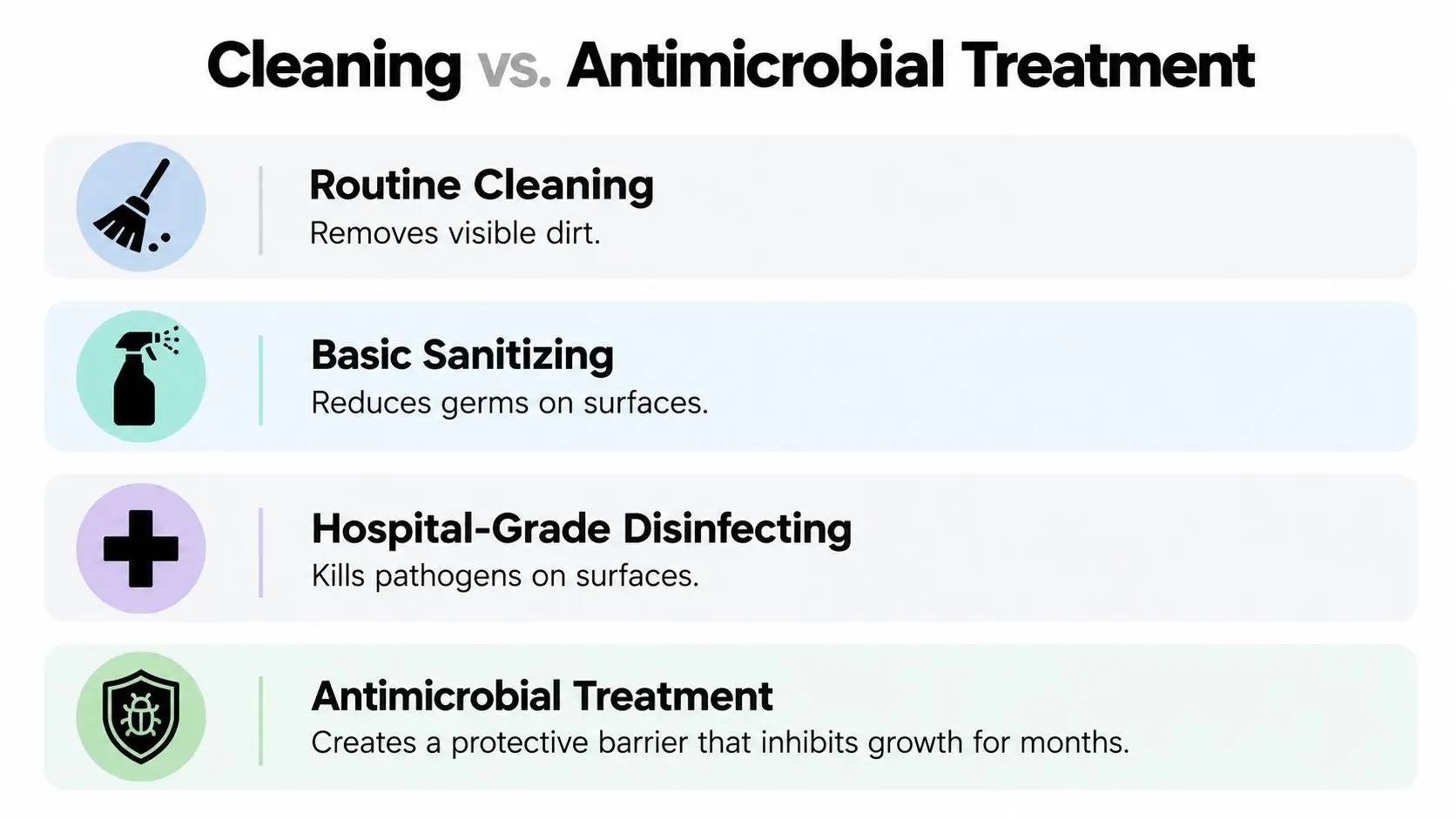
Routine cleaning removes dirt you can see. Antimicrobial treatment addresses microorganisms on or within treated surfaces by using a product and application method intended to inhibit or kill them, depending on the product label. Think of cleaning as taking mud off a boot, while antimicrobial work is an additional step designed for a surface that has been exposed to contamination and needs controlled microbial management.
The terms aren't interchangeable:
- Cleaning removes soil, dust, residue, and visible debris.
- Sanitizing reduces microorganisms on a surface to the level permitted by the product's directions.
- Disinfecting is a stronger label-defined claim for killing specified microorganisms on hard, nonporous surfaces.
- Antimicrobial treatment describes a product category and application purpose that may inhibit growth or address microorganisms on treated materials.
The label controls what a product can claim. A solution intended for hard, nonporous surfaces can't automatically be assumed suitable for carpet, insulation, unfinished wood, or drywall. The technician should match the product to the material, contamination type, safety directions, and required contact time.
Why restoration work needs more than wiping
After water extraction, a surface can look clean while moisture remains in a wall cavity, carpet pad, or framing joint. Technicians may remove porous materials that can't be reliably restored, clean salvageable areas, and apply an appropriate product before the drying process is complete. The treatment doesn't make wet materials safe by itself. Drying remains the control that prevents ongoing moisture from supporting further growth.
Residual products also need careful explanation. Some are designed for a continuing inhibitory effect on a treated surface, while others provide only the label-defined action during application. Don't assume that a “protective” claim means a permanent barrier, and don't assume a pleasant scent means the source has been removed.
If a room still smells musty, homeowners can review a practical resource on how to find the source of mold odor. For homes involving bodily fluids, sewage, or other biological contamination, the work may fall under a specialized biological clean-up plan rather than ordinary household cleaning.
Where Antimicrobial Treatment Actually Gets Used
The right application depends on what happened, what was contaminated, and which materials remain. A sewage backup doesn't call for the same approach as soot on painted walls, and visible mold isn't managed like a clean-water leak.
| Scenario | Affected Surfaces | Antimicrobial Type | Why It Matters |
|---|---|---|---|
| Category 3 water from sewage or heavily contaminated overflow | Subfloor, framing, concrete, and salvageable hard surfaces | EPA-registered antimicrobial or disinfectant selected for the label and material | Helps address contamination after removal and cleaning |
| Visible mold after a slow leak | Exposed framing, concrete, subfloor, and selected contents | Mold-control or fungistatic product used as directed | Supports cleaning and source correction on materials that remain |
| Biohazard from a death, hoarding condition, or animal incident | Flooring, walls, contents, and contact surfaces | Product approved for the contamination and surface involved | Adds controlled decontamination after bodily material and debris are removed |
| Soot and odor after a small kitchen fire | Cabinet interiors, hard surfaces, and odor-affected areas | Antimicrobial and odor-control products used alongside smoke cleaning | Addresses residue, odor sources, and affected surfaces without hiding fire damage |
Four homeowner situations
With contaminated water, the crew should stop the source, remove unsalvageable porous materials, extract standing water, clean remaining surfaces, and dry the structure. Spraying before removal can trap the wrong problem behind a surface.
Mold work starts with moisture correction. A technician may clean or remove visible growth, use containment and HEPA filtration, and treat exposed structural materials that remain. Antimicrobial treatment doesn't replace finding the leak, failed flashing, plumbing defect, or HVAC condensation source. Homeowners dealing with a slow leak can review mold damage restoration as part of the larger remediation picture.
Biohazard cleanup requires controlled handling, PPE, containment, disposal, and cleaning. A homeowner shouldn't judge the quality of the work by whether a room smells like disinfectant. The relevant question is whether contaminated material was removed and the remaining surfaces were treated according to the product directions.
After a small fire, soot removal comes first. Odor-neutralizing agents may be used after cleaning, but covering the smell with fragrance isn't the same as removing smoke residue. For general household context, Fillaree's guide to safe antimicrobial cleaning tips can help distinguish routine product use from restoration work.
Products, Safety Standards, and What Certification Means
In a Phoenix home, the product choice should follow the problem, not the other way around. EPA-registered antimicrobial solutions are selected for a stated use and approved surface. Fungistatic sealants may be used on cleaned, dried structural materials when the label permits. Odor-neutralizing agents address smoke, decomposition, or other lingering odors after the source has been removed.
An EPA registration number applies to specific claims and directions. It is not a universal safety approval for every room, material, or application. The label identifies approved surfaces, dilution, required personal protective equipment, ventilation, and the time a surface must remain wet.
| Product Category | Typical Use | What to Verify on Label |
|---|---|---|
| EPA-registered antimicrobial solution | Water, mold, or biological contamination on approved materials | Registration number, approved surface, target claim, dilution, PPE, and contact time |
| Fungistatic sealant | A cleaned and dried structural surface where sealing is appropriate | Material compatibility, preparation requirements, ventilation, and recoat directions |
| Odor-neutralizing agent | Smoke, decomposition, or persistent odor after source removal | Intended odor source, application method, occupancy restrictions, and ventilation needs |
Contact time matters
A hard-surface product may need to remain visibly wet for the period stated on its label. Work plans commonly refer to 10 to 15 minutes on hard surfaces, while porous materials may require more time. The label controls the actual requirement. Mixing a product more strongly does not make up for wiping it dry too soon.
Ask the technician to show you the product name and safety data sheet, or SDS. You can also request that the job file record the treated surface, application time, and concentration. For general household context, the Aroma Warehouse holistic usage guide may explain essential-oil use, but it does not replace the restoration product label or the crew's application instructions.
Certification helps you understand how a company was trained, but it does not make every recommendation automatically correct. IICRC S520 guidance shapes professional mold remediation practices, including containment, removal, cleaning, and verification. Ask for the technician's current credential and the reason for the selected method. A company such as Restore Heroes describes antimicrobial surface treatment within its mold remediation services, including treatment of remaining wood framing or concrete after contaminated materials are removed. Their explanation of an IICRC-certified restoration company can also show the type of documentation and process a homeowner should expect.
What to Expect During the Treatment Process
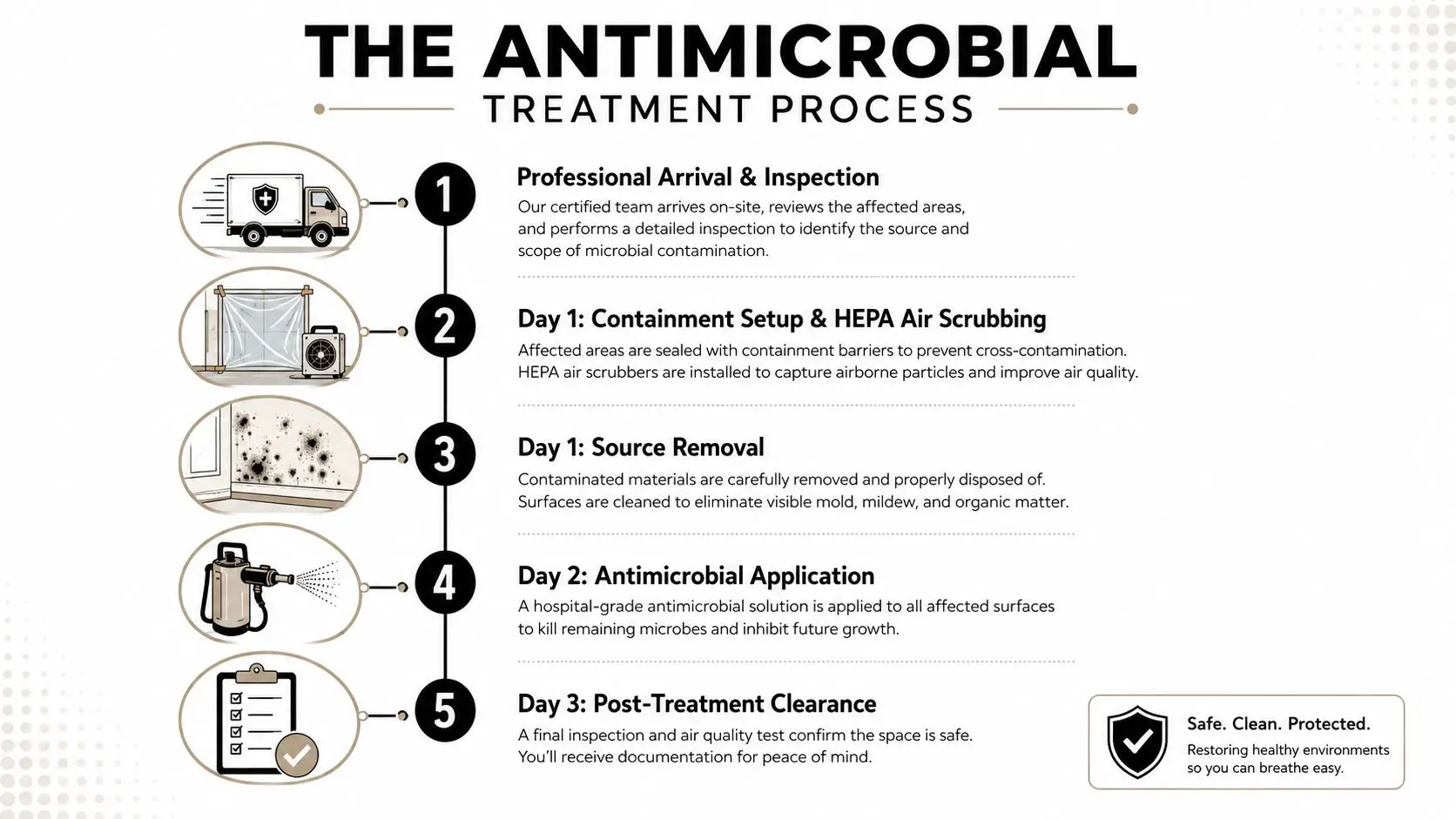
The first visit should feel like an investigation, not a race to spray. The technician reviews the loss, traces the moisture source, checks affected materials, takes readings, and photographs conditions. If contamination is present, the crew may establish containment and position HEPA air-scrubbing equipment before removing damaged contents or materials.
The visit sequence
Day one usually begins with control. The crew isolates the affected zone, removes the source of contamination, and cleans surfaces before applying a product. HEPA air scrubbing helps manage airborne particles during disturbance, but it doesn't replace removal or cleaning.
Application may occur on day one or day two. Technicians may spray, fog, or wipe, depending on the material, access, product label, and contamination. Direct wiping often makes more sense on a small hard surface, while another method may suit exposed framing or a larger area. The crew should explain the method rather than presenting fogging as a universal solution.
During application and dwell, occupants generally need to leave for two to four hours, following the product label and the contractor's instructions. Children, pets, and aquariums should be removed from the treatment area, and the technician should explain reentry and ventilation requirements.
The closed room isn't wasted time. It gives the product the contact period stated on its label.
Drying comes after the visible work
Drying can continue from day two through day five, depending on the materials, weather, building assembly, and readings. Air movers push air across surfaces while dehumidifiers pull moisture from the room. Phoenix heat may make a room feel dry while hidden moisture remains, so the crew should rely on measurements rather than comfort alone.
At the final visit, the technician reviews visual conditions and moisture readings. Depending on the project, the contractor may offer swab or ATP clearance testing, along with a written certificate of treatment. Testing can add useful documentation, but it should be interpreted alongside source removal, cleaning, and drying records.
Insurance, Costs, and Phoenix-Specific Considerations
Insurance handling depends on the policy, cause of loss, exclusions, deductible, and adjuster's approval. In many restoration claims, antimicrobial treatment is documented within the broader mitigation work rather than treated as an isolated service. Don't assume coverage, payment timing, or reimbursement until the insurer and contractor have reviewed the loss.
Phoenix conditions can change the work even when the damaged room looks straightforward. Monsoon humidity may slow drying, hot attic spaces can affect application conditions and ventilation, and dust intrusion can recontaminate exposed surfaces if openings aren't controlled. These factors don't create a guaranteed outcome or a fixed schedule. They create reasons for careful documentation and follow-up.
What changes the estimate
The cost depends on the affected square footage, material type, contamination level, access, containment, cleaning, removal, drying, and documentation. A small hard-surface application won't be priced like treatment connected to wall demolition, HEPA filtration, odor work, and extended drying.
The estimate should separate the work clearly:
- Mitigation: Source control, extraction, removal, and cleaning.
- Drying: Equipment, monitoring, and labor.
- Antimicrobial application: Product, preparation, application, and required dwell.
- Verification: Readings, photographs, testing, and reporting.
- Reconstruction: Replacement of drywall, insulation, flooring, cabinetry, or finishes.
Keep a file for the adjuster and your own records. Include the certificate of treatment, product SDS sheets, moisture readings, photographs of treated areas, and notes about the source of the damage. If the estimate includes a treatment charge, ask what condition it addresses and how the contractor will document completion.
Documentation matters: A line item is easier to evaluate when it connects to a photographed area, a product label, a moisture record, and a stated purpose.
Common Questions Homeowners Ask About Antimicrobial Treatment
Safety questions
Can children and pets stay home during application? They should stay out of the treatment area, and the contractor may require everyone to leave the home during application and dwell. Pets, birds, reptiles, and aquariums need special attention because ventilation and airborne exposure can affect them differently.
Is the product safe because it has an EPA registration number? Registration means the product has approved label claims and directions for specified uses. It doesn't mean you can apply it to every material, change the dilution, shorten contact time, or ignore PPE requirements.
Why does the room smell afterward? The odor may come from the product, remaining smoke residue, damp materials, or contamination that hasn't been fully removed. A fragrance can mask an odor without correcting its source, so ask what was removed, cleaned, and dried.
Occupancy and timing
How long should we stay out? Follow the product label and the contractor's reentry instructions. A common planning window is two to four hours, but conditions, ventilation, surface type, and the specific product can change that requirement.
Will the smell disappear faster in Phoenix heat? Heat may change how quickly a room feels dry or how strongly a product odor is noticed, but it doesn't override the label or prove that the structure is ready. Ventilation should happen only when the technician says it's appropriate.
Can we sleep in the room after the crew leaves? Not until the contractor confirms reentry, the product's requirements have been met, and the area is free of unsafe conditions. Wet materials, containment, equipment, or lingering contamination may still make the room unsuitable.
Follow-up questions
What if mold returns after monsoon humidity? Stop and report it rather than requesting another spray automatically. Recurrence can point to a roof, plumbing, HVAC, drainage, or hidden-moisture problem, and treatment won't compensate for a continuing source.
Does antimicrobial treatment replace structural drying? No. Products may support surface management, but trapped moisture can undermine the entire restoration plan.
How do I verify the work followed IICRC practices? Request the technician's certification information, product label or SDS, affected-area photographs, moisture readings, application record, and final documentation. Ask how the contractor decided the materials were cleaned, dried, or removed.
A Simple Checklist Before and After Treatment
Use this list before the crew arrives, then keep it with your claim documents. It won't replace professional judgment, but it will help you notice missing explanations and preserve a clear record.
Before the application
- Photograph the damage: Capture ceilings, walls, flooring, contents, visible growth, soot, and standing water before work begins.
- List health sensitivities: Tell the contractor about asthma, chemical sensitivities, pregnancy, children, pets, birds, and aquarium animals.
- Clear access: Move valuables and furniture only as directed, and don't disturb contaminated debris yourself.
- Confirm credentials: Ask who will apply the product, what training or IICRC certification they hold, and which EPA-registered product they plan to use.
- Ask about the scope: Confirm whether the estimate includes source correction, removal, cleaning, drying, application, monitoring, and documentation.
During the application
- Watch containment: Plastic barriers, negative-air equipment, or HEPA filtration may be appropriate when the crew is disturbing contaminated materials.
- Ask about dwell time: The technician should explain how long each treated surface must remain wet and when reentry is allowed.
- Protect belongings: Keep food, medications, toys, electronics, and personal items outside the treatment zone unless the crew has assessed them.
- Notice PPE: Gloves, eye protection, respirators, protective clothing, and safe handling practices should match the task and product directions.
- Don't shorten the visit: Leaving early, opening containment, or turning off equipment can disrupt the planned process.
After the treatment
- Confirm reentry: Follow the written instruction instead of relying on smell or touch.
- Review readings: Ask whether moisture levels have dropped in the affected materials and whether equipment will remain.
- Save safety sheets: Keep the product SDS, treatment certificate, photographs, and invoice with your insurance file.
- Schedule follow-up: Arrange a final inspection if the project involves mold, hidden moisture, odor, or major material removal.
- Monitor Phoenix conditions: Watch for new roof or plumbing leaks, post-monsoon humidity, condensation, and dust entering through unfinished openings.
- Record changes: Note returning odor, staining, visible growth, or dampness, then contact the contractor before applying household chemicals.
For the final handoff, use a final walkthrough checklist to confirm that the work area, documentation, equipment removal, and next steps are clear.
Restore Heroes provides water, fire and smoke, mold, and trauma and biohazard restoration in the Phoenix metro area, including assessment, drying, decontamination, odor removal, and insurance coordination. If your property needs antimicrobial treatment after a leak, mold discovery, fire, or biohazard event, visit Restore Heroes to request an onsite inspection and discuss the documented scope of work.