
A Phoenix business owner often finds out how complicated commercial property insurance claims are in the worst possible moment. You open the door after a monsoon storm, hear the AC still running, and then see water staining the drywall, soaked inventory, and ceiling tile on the floor. Tenants are calling. Staff wants to know whether they should come in. Your insurer wants details before you've even had time to understand what failed.
That first day matters more than most owners realize. The claim doesn't just depend on what was damaged. It depends on what you did next, what you documented, what you threw away, what you approved for emergency work, and how clearly you can connect each cost to the loss.
In Phoenix, that pressure gets sharper. Monsoon wind can drive water into places that don't look obvious at first. Extreme heat can turn a minor moisture issue into warped finishes, odors, and secondary damage if drying lags. The local construction market can also stretch rebuild timelines well beyond what an owner expected when the policy was purchased.
Your First Steps After Property Damage Occurs
A common Phoenix scenario starts with a heavy monsoon cell overnight. By morning, a retail owner opens the suite and finds water along the rear wall, wet base cabinets, and a saturated back office where the roof flashing failed. The first instinct is often to start cleaning, move everything around, and call the insurance carrier once the mess looks more manageable.
That usually creates problems.
The first hours after a loss are about safety, stabilization, and preservation of evidence. They are not about making the building look normal again. In high-stress losses, owners who slow down just enough to follow the right sequence usually put themselves in a stronger position later.
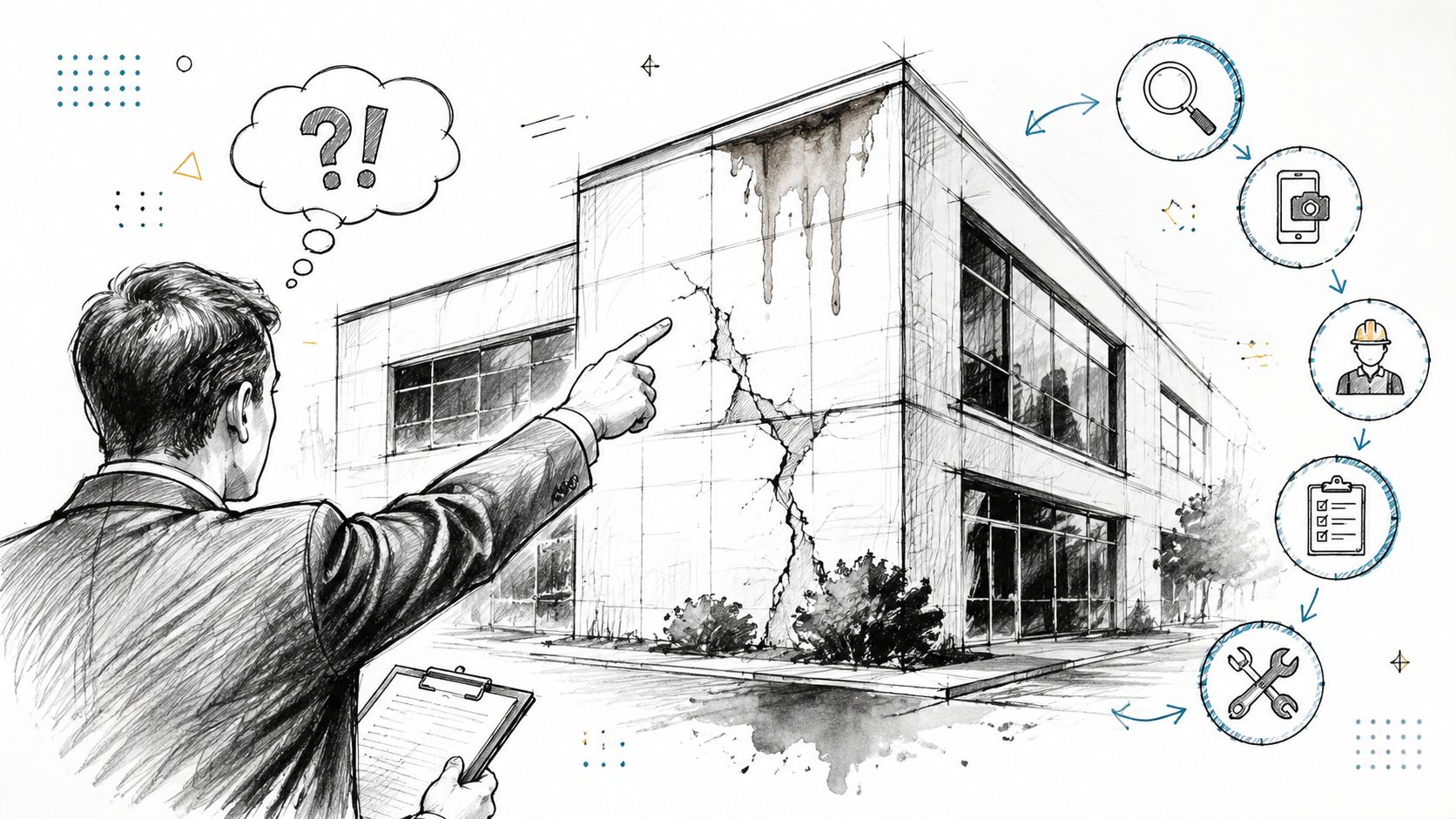
Secure people first
If there's active water, exposed wiring, structural movement, soot, or a possible gas issue, get occupants out of the affected area and control access. Shut off utilities if the condition calls for it and if you can do it safely. For a tenant-occupied building, notify the tenant contact immediately and document that notice.
Then stop further damage. Tarping, board-up, extraction, temporary power shutdown, and emergency drying are mitigation steps, not optional extras. If water is involved, rapid response matters. A practical resource on emergency water mitigation explains the kind of immediate containment work that protects both the structure and the claim record.
Preserve the scene before cleanup
Take wide photos first. Then tighter photos. Then video while walking the loss in sequence from exterior to interior. Don't limit this to the obvious damage. Capture roof areas, drains, parapets, equipment rooms, electrical panels, affected stock, flooring transitions, and undamaged adjacent areas that help show where the loss starts and stops.
Practical rule: Don't throw away damaged materials until they've been documented and, when appropriate, made available for inspection.
That includes carpet squares, broken pipe sections, charred components, failed roofing materials, and damaged contents. If emergency disposal is necessary for health or access reasons, photograph each item before removal and keep a removal log.
Notify the right parties in the right order
Call the insurer or broker once the site is stable enough for a clear first report. Be factual. Date of loss if known, suspected cause if known, affected areas, whether operations are interrupted, and what mitigation has started. Avoid guessing about total cost or making broad statements about cause before qualified people inspect.
Given the substantial financial impact, in 2023, global commercial property catastrophe losses reached $85 billion, driven by climate-related events, which is one reason early claim handling has become so important for owners and carriers alike, according to Gitnux commercial insurance industry statistics.
Decoding Your Commercial Property Policy
Most owners don't read their policy until there's water on the floor or a fire report on the desk. That's normal. But once a loss happens, you need to read it less like legal paperwork and more like a financial first-aid kit. Each part is there for a different kind of wound.
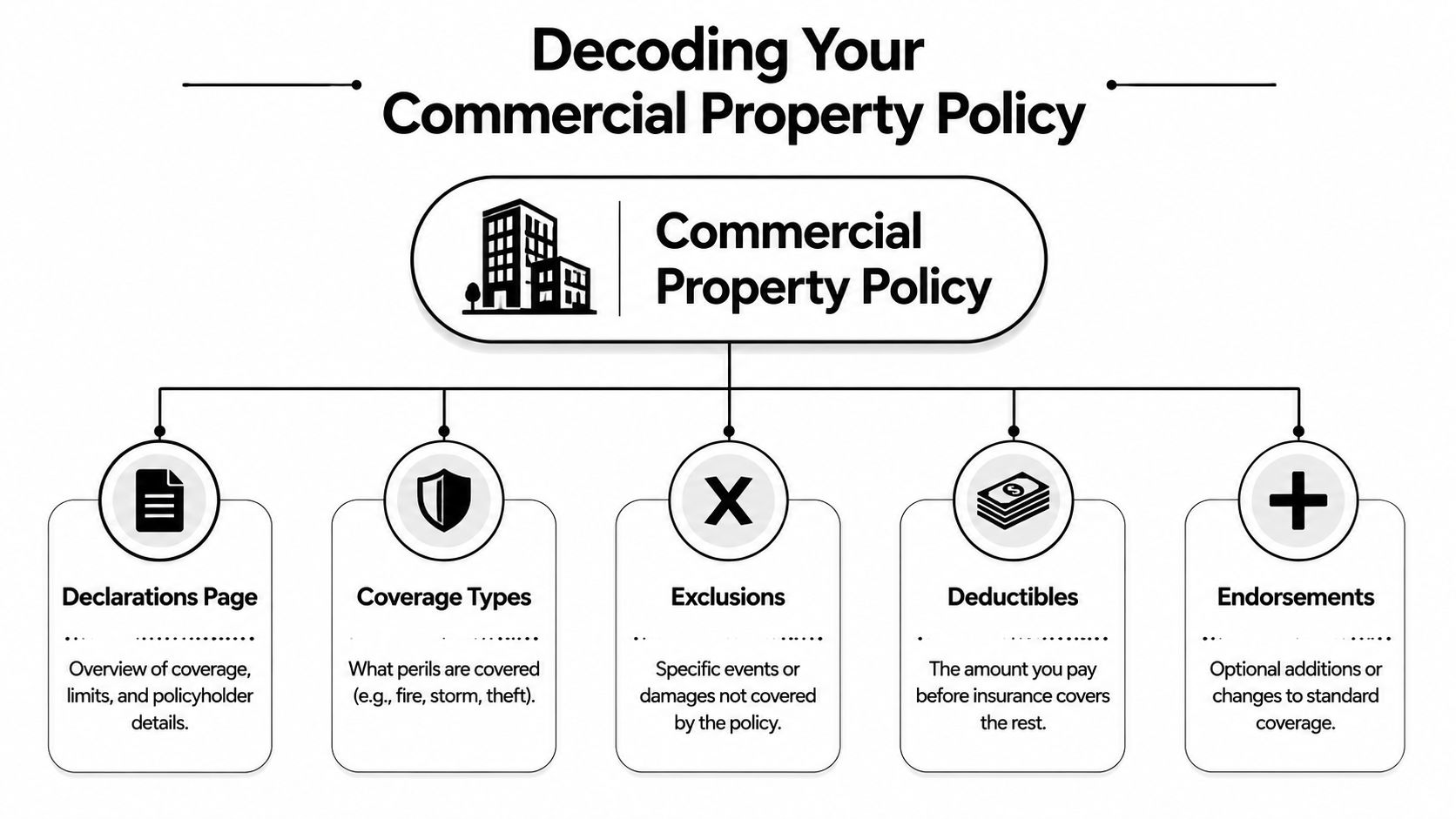
Start with the declarations page
The declarations page is the summary sheet. It tells you who's insured, what location is covered, the policy period, and the major limits and deductibles. When a claim gets tense, this is usually where the first misunderstandings show up.
Check these items carefully:
- Named insureds: Make sure the entity suffering the loss is the entity listed.
- Covered locations: Multi-site owners sometimes assume all buildings are on one schedule. They aren't always.
- Limits: Building, business personal property, and income-related coverage may each have different caps.
- Deductibles: A deductible that looked manageable at renewal can feel very different during a major loss.
Think in three buckets
A commercial property policy usually makes more sense when you separate it into three practical buckets.
| Coverage part | What it usually protects | Real-world example |
|---|---|---|
| Building coverage | The structure and attached building components | Roof membrane, drywall, permanent HVAC, built-in finishes |
| Business personal property | Contents used in the business | Desks, computers, inventory, movable equipment |
| Business interruption or income-related coverage | Lost income and certain ongoing expenses after a covered loss | Revenue drop while part of the building is unusable |
A clear explainer on business interruption coverage is worth reviewing if operations are slowing down or stopping because of the loss.
Your policy isn't one promise. It's a stack of separate promises, each with its own trigger, limit, and restriction.
Replacement Cost and Actual Cash Value are not the same thing
This distinction drives a lot of frustration in commercial property insurance claims.
Replacement Cost Value (RCV) aims at what it costs to repair or replace covered property with materials of like kind and quality, subject to policy terms. Actual Cash Value (ACV) applies depreciation. That means age, wear, and condition can reduce what the carrier initially values.
If your roof-mounted unit was older, ACV can produce a very different number from what the unit costs to replace in the current Phoenix market. The same problem shows up with flooring, millwork, and specialized tenant finishes.
For owners reviewing dense language, a tool like AI document review software can help organize endorsements, exclusions, and valuation language before a meeting with the carrier or counsel. It won't replace legal advice, but it can make the policy easier to sort.
Watch endorsements and exclusions closely
The standard form is only part of the story. Endorsements can expand or narrow what looks covered at first glance. Exclusions can become central in water intrusion, flood-related issues, repeated seepage, equipment breakdown, vacancy, or ordinance and law questions.
A practical reading method works best:
- Read the declarations page.
- Read the insuring agreement and covered causes of loss.
- Read exclusions next.
- Read endorsements last, because they often change what you just read.
If a sentence in the policy changes who pays for tenant improvements, code upgrades, or temporary relocation costs, that one sentence can shape the entire recovery.
The Commercial Claims Process Step by Step
The claims process feels messy because several tracks are moving at once. Mitigation is happening on site. The insurer is setting up a file. The adjuster is trying to scope damage. Your accountant may be pulling financials. Tenants may be asking when they can reopen.
A chronological view helps.
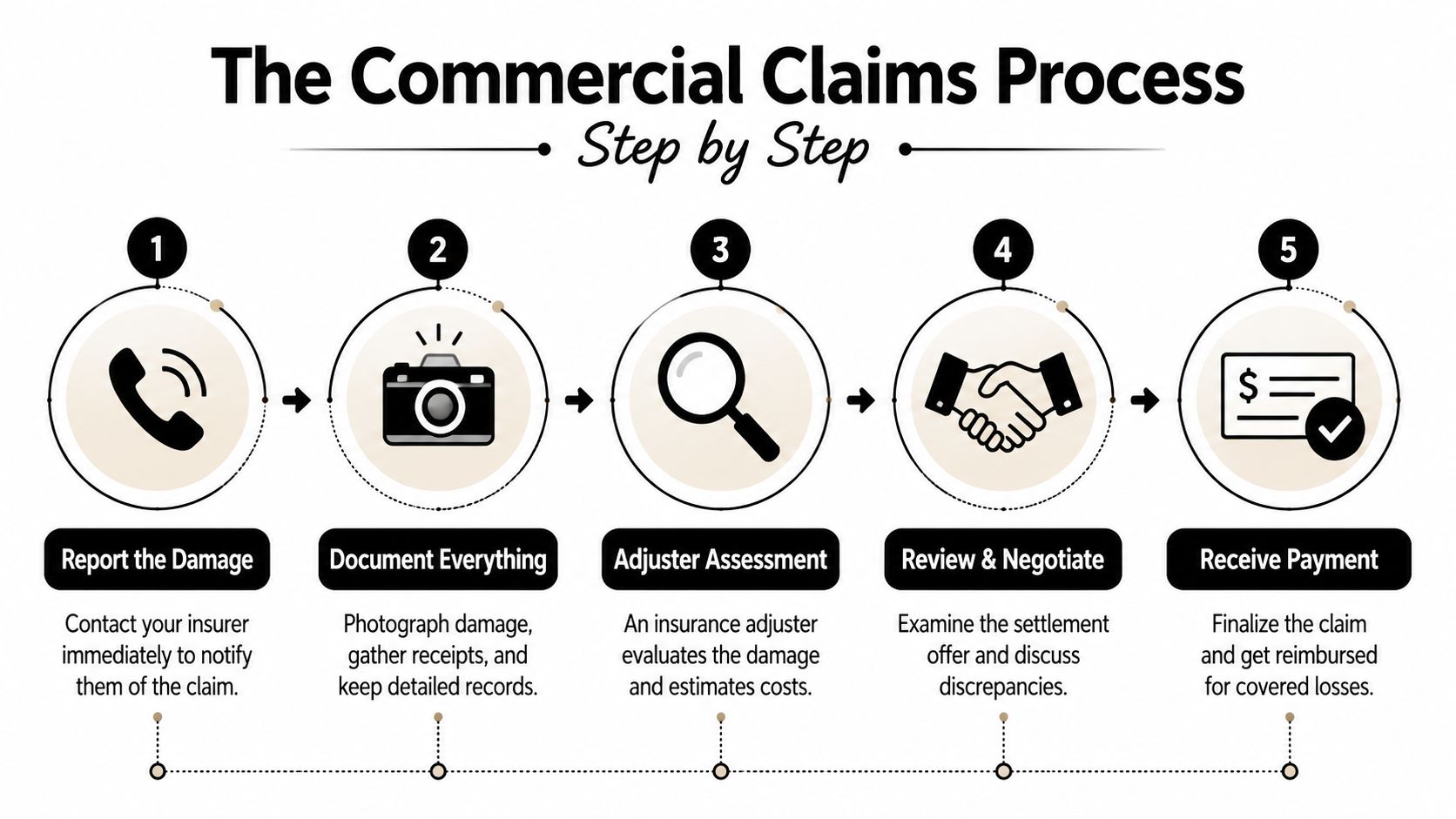
Report the loss quickly and clearly
Open the claim as soon as the property is stable enough for an accurate first notice. Give the carrier the date of loss, location, suspected cause if known, areas affected, and whether operations are interrupted. Ask for the claim number immediately and start using it on every email and invoice.
A strong first notice does three things:
- It fixes the timeline: Everyone is now working from the same reported loss event.
- It shows mitigation began: That matters if questions come up later about preventable secondary damage.
- It starts your communication record: Every later disagreement usually traces back to an early assumption.
Expect close scrutiny
Commercial claims are reviewed carefully. In 2023, the U.S. commercial casualty insurance industry had a loss ratio of 68%, meaning insurers paid out 68 cents in claims for every dollar of premium collected, according to Custom Market Insights on the commercial property insurance market. That kind of pressure helps explain why adjusters ask for detailed support, challenge scope, and revisit valuation.
That doesn't mean every carrier is looking for a reason to deny your claim. It does mean vague documentation won't carry much weight.
This overview gives a useful visual of how the process unfolds in practice.
Inspection is not the finish line
When the adjuster walks the property, many owners assume the hard part is over. It isn't. The inspection is only one data point. Carriers still need records, estimates, cause analysis, and sometimes specialist input.
Bring order to the site before the inspection:
- Label affected areas: Suite numbers, rooms, and floors should be obvious.
- Separate damaged contents: If possible, stage by category or tenant.
- Have mitigation records ready: Drying logs, extraction tickets, and emergency invoices matter.
- Walk the chronology: Show where the damage began and how it spread.
If there's disagreement about scope, don't turn the meeting into an argument. Take notes, ask what additional support the adjuster needs, and follow up in writing.
Proof of loss, scope, and pricing
Once emergency conditions are under control, the claim shifts from observation to proof. That means assembling the formal package: estimates, inventories, photographs, invoices, leases if relevant, and financial records for income loss.
At this stage, owners often need help with insurance claim assistance so the loss presentation matches what the carrier is evaluating.
A typical sequence looks like this:
- Carrier acknowledges the claim and assigns an adjuster.
- Site inspection occurs and mitigation begins or continues.
- Cause and extent are evaluated through photos, reports, and expert review if needed.
- Proof of loss material is submitted with backup documentation.
- Scope negotiations begin if quantities, pricing, or coverage are disputed.
- Partial or initial payments may issue while remaining items are reviewed.
- Final reconciliation happens after repairs, replacement, or further documentation.
The cleanest claims are rarely the fastest at the start. They're the ones where each cost is tied to a cause, a location, and a document.
Review every payment line by line
A claim payment isn't just a check. It's an estimate, a coverage position, depreciation logic, and sometimes a set of silent omissions. Read the adjuster's estimate line by line. Look for missing demolition, omitted detach-reset work, incomplete finish matching, code-related issues, or contents categories that were grouped too broadly.
What works is specific rebuttal. What doesn't work is telling the carrier the number “feels low.” If drywall was wet to four feet but base trim, insulation, paint, and cabinet toe-kicks are missing from the estimate, point that out in writing and support it with photos and contractor scope.
Your Essential Documentation and Evidence Checklist
A strong claim file beats a strong opinion. If you can't show when the damage happened, what was affected, what emergency work was necessary, and what it costs to return the property to pre-loss condition, you're negotiating from memory.
Treat documentation as your claim success kit. Build it once, keep it organized, and update it every few days.
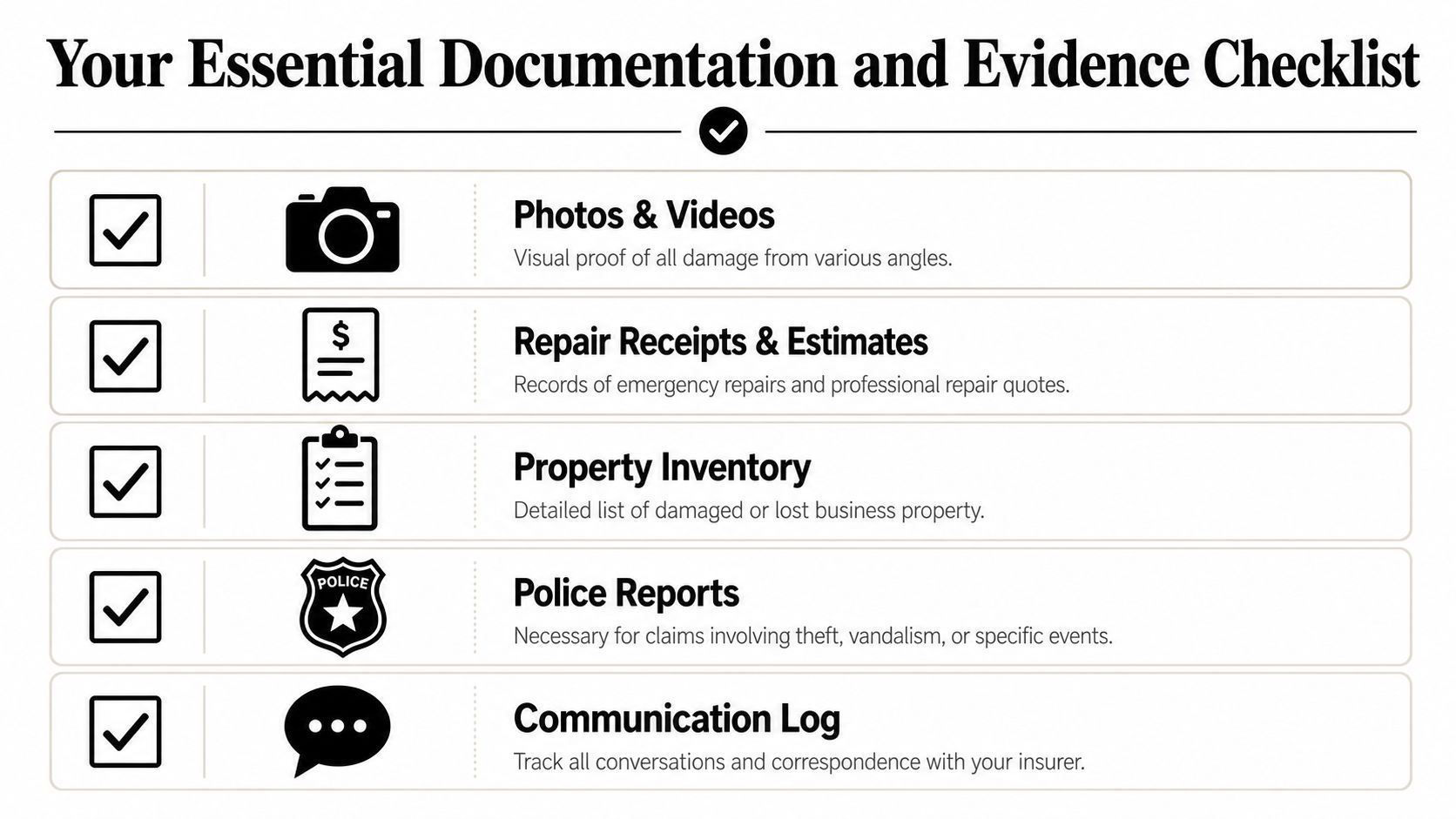
The non-negotiable records
Start with the basics and make them easy to retrieve. A cloud folder with dated subfolders is usually better than a long email chain and random phone photos.
Keep these categories:
- Photos and video: Exterior first, then interior, then close-ups of specific damage.
- Emergency mitigation records: Extraction logs, drying equipment placement, daily moisture notes, board-up or tarping invoices.
- Repair estimates: Separate temporary work from permanent reconstruction where possible.
- Contents inventory: Item description, owner, location, condition, and whether repaired, cleaned, or replaced.
- Lease and responsibility documents: Especially important if the loss affects tenant improvements or landlord obligations.
- Financial records: Needed if the loss disrupts operations and you're claiming lost income or extra expense.
- Communication log: Date, person, company, topic, and next step for every call or email.
Fire and structural claims need more technical support
For some losses, general photos and a contractor estimate won't be enough. Insurers often require a sworn Statement of Fire Claim and a detailed estimate from a civil engineer or architect that properly accounts for age and depreciation, according to the UNESCAP commercial property insurance claim process document.
That matters because the insurer is not paying for contemplated upgrades or betterment because reconstruction is underway. The estimate has to tie back to pre-loss condition.
A practical guide on documentation requirements can help owners organize that material before the file gets bloated and confusing.
Build a usable file, not a pile
A carrier adjuster, public adjuster, attorney, accountant, and contractor may all need to review the same records. If your file is hard to follow, your claim gets slower.
Use a simple structure:
| Folder name | What goes inside |
|---|---|
| 01 Incident | Initial photos, videos, date discovered, weather notes if relevant |
| 02 Mitigation | Work authorizations, drying logs, emergency invoices |
| 03 Building damage | Estimates, material lists, engineer or architect reports |
| 04 Contents | Inventory spreadsheets, photos, purchase records |
| 05 Business records | Financial statements, payroll, rent roll, lease documents |
| 06 Carrier communications | Emails, letters, claim number, adjuster notes |
Keep originals. Send copies. Label everything with the claim number and date.
Small habits that prevent big disputes
A few details save a lot of time later:
- Use room names consistently: Don't call it “back office” in one estimate and “storage room 2” in another.
- Photograph serial numbers when available: Especially for electronics, equipment, and appliances.
- Save damaged samples when practical: Roofing, flooring, pipe sections, and finish materials can become important.
- Confirm verbal conversations by email: A two-sentence recap after a phone call can clear up later disagreement.
Good documentation doesn't guarantee a smooth result, but weak documentation almost guarantees a harder one.
Common Pitfalls and Reasons for Claim Denial
One of the costliest assumptions in commercial property insurance claims is that the first settlement offer is probably close enough. Sometimes it is. Often it isn't. Early offers can reflect limited inspection access, missing documents, narrow scope assumptions, or valuation methods that don't line up with the policy.
The fix isn't outrage. It's diagnosis.
Tenant improvements are where many owners get surprised
Landlords and tenants often assume the other party's policy will solve the problem. Then the loss happens and the lease says one thing, the policy says another, and the rebuild cost says something else.
Many commercial policies underinsure Tenant Improvements by 20-30% compared to current market rates and limit rent loss coverage to just 6 months, while construction delays in markets like Phoenix can often extend to 12-18 months, according to Agency Height on commercial property insurance tenant disputes.
That issue shows up often in offices, medical suites, restaurants, and retail spaces with customized buildouts. The drywall may be part of the building, but what about upgraded lighting, reception millwork, glass partitions, specialty plumbing, or branded finishes installed for a tenant? If the lease makes the landlord responsible to restore certain improvements, but the building limit was set too low, the gap lands on the owner.
Phoenix weather creates coverage confusion
Monsoon losses are a good example. Owners may say “storm damage” when the carrier is trying to separate wind-driven rain, roof failure, drainage issues, exterior maintenance conditions, and flood-related exclusions. Heat adds another wrinkle. Materials can delaminate, adhesives can fail, and secondary damage can spread quickly after the original event.
What helps:
- Match each damaged area to a cause: Roof opening, pipe break, backed-up drain, fire suppression discharge, or another specific source.
- Separate old conditions from new ones: Prior staining or deferred maintenance can cloud a valid claim.
- Document emergency conditions immediately: Standing water, active leaks, wet insulation, and buckled flooring can look very different two days later.
These mistakes trigger delays and underpayment
Some pitfalls are preventable but common:
- Throwing damaged items away too early: That removes physical evidence the carrier may want to inspect.
- Blending upgrades into repair scope: If your estimate includes redesign or better finishes without clear designation, expect pushback.
- Ignoring lease language: In tenant-occupied buildings, liability for restoration is often split more narrowly than people think.
- Missing income-loss support: “Business was slow” isn't evidence. Financial records are.
- Assuming verbal approvals are enough: If the carrier approved emergency work on a call, confirm it in writing.
A denial often starts as a documentation problem, a scope problem, or a policy-reading problem long before it becomes a formal denial letter.
How to pressure-test an offer before accepting it
Set the emotions aside and compare the offer against the actual loss.
Ask these questions:
- Does the estimate include all affected areas?
- Does it account for detach and reset work?
- Are code-related items missing?
- Did the carrier price current reconstruction conditions realistically?
- If tenants are involved, does the offer align with lease obligations?
If the answer to any of those is no, don't assume you're stuck. Ask for the basis of valuation, request the missing line items be reviewed, and support every correction with documents.
Assembling Your Recovery Team for Success
In a commercial loss, the insurer has its experts. You need yours. That doesn't mean every claim requires a fight. It means a serious claim usually benefits from people who know how to read scope, challenge valuation, and protect the recovery timeline.
Know who works for whom
The carrier adjuster works for the insurance company. That doesn't make the adjuster dishonest. It does mean the adjuster is not your advocate.
Your side may include a restoration contractor, a reconstruction estimator, a public adjuster, an engineer, an accountant for business interruption issues, and legal counsel if coverage turns into a dispute. For building stabilization and repair planning, a qualified water damage restoration contractor can help translate field conditions into a scope the carrier can evaluate.
When outside representation makes sense
At this stage, many owners hesitate. They don't want to escalate too soon, and that's fair. But delay can also cost money if the file is already drifting toward an incomplete scope or weak valuation.
Nearly 40% of commercial claims are initially underpaid due to adjusters using Actual Cash Value instead of Replacement Cost. Hiring a public adjuster can help recover 20-40% more in lost value by effectively challenging these valuations, according to The Property CEO commercial property insurance guide.
If you're looking into outside representation, resources that explain assistance for business owners with property damage can help you understand what a public adjuster does and when it may be worth the cost.
Use the appraisal clause when the dispute is about value
A lot of owners jump straight to “lawyer” when the underlying issue is amount of loss, not coverage. If the policy includes an appraisal clause, that can be a useful path when both sides agree the loss is covered but disagree on scope or valuation.
What works in negotiation:
- Specific rebuttals: Missing line items, wrong quantities, wrong valuation method.
- Independent estimates: Especially when prepared by experienced commercial estimators.
- A disciplined record: Photos, logs, lease terms, invoices, and correspondence in one place.
What doesn't work:
- Angry calls without backup.
- Vague complaints that the offer is unfair.
- Waiting too long to challenge a flawed estimate.
Their estimate is not the claim. It's one version of the claim.
Frequently Asked Questions About Claims
How long do commercial property insurance claims take in Arizona
It depends on cause, scope, access, and documentation quality. A straightforward water loss can move far faster than a fire claim with structural questions, tenant disputes, and income-loss components. In Phoenix, labor availability and permitting can also affect how quickly repair numbers become final.
What if a tenant caused the damage
Start with the lease. The lease often defines repair responsibility, insurance obligations, and indemnity language. Then compare that to the policy. Don't assume tenant negligence automatically means the building carrier won't respond, or that the tenant's policy will automatically make you whole.
Will a prior claim affect future premiums
It can, but the effect varies by loss history, property condition, location, and underwriting decisions. Focus first on presenting the current claim accurately and documenting mitigation well. A messy file can create more problems than the fact of the loss itself.
Should I accept the first offer if I need money quickly
Not without understanding what the payment covers. Review whether it is partial, actual cash value only, or intended as a full settlement. If any part of the estimate looks incomplete, ask questions before signing anything that may limit further recovery.
If your commercial property in Phoenix has water, fire, smoke, or storm damage, Restore Heroes can help stabilize the site, document conditions, and support a more organized recovery process. Fast mitigation, clear records, and consistent communication won't solve every coverage issue, but they do put you in a stronger position when the claim starts moving.