
You notice it in a quiet moment. The house seems normal, but something feels off. Maybe the water bill jumped for no clear reason. Maybe there's a faint musty smell near a closet, or a warm spot on the tile that wasn't there before.
That kind of uncertainty can make any Phoenix homeowner uneasy. A hidden leak doesn't usually announce itself with a burst pipe and standing water. More often, it starts small, stays out of sight, and keeps feeding damage while you try to figure out whether you're dealing with a plumbing issue, a moisture problem, or both.
The Unseen Threat Hiding in Your Walls
A lot of homeowners call for help only after they've stared at the same stain for days, hoping it won't spread. They hear a soft hiss when everything is turned off, or they catch a damp smell in one room that never quite goes away. In Phoenix, slab foundations, hot weather, and constant plumbing use can make those clues easy to dismiss at first.
The problem is that hidden leaks rarely stay small. Water moves. It follows framing, seeps under flooring, wets insulation, and creates the kind of concealed moisture that leads to staining, swelling, and microbial growth. If moisture sits behind drywall long enough, the next concern may not just be plumbing. It may also involve cleanup, drying, and removing mold from behind walls.
Why small leaks matter
The scale of ordinary household leaks is often underestimated. The average U.S. home's leaks can waste more than 10,000 gallons of water annually, about 10% of homes have leaks that waste 90 gallons or more per day, and household leaks contribute to more than 1 trillion gallons of water wasted each year according to this OSTI summary of U.S. leak data.
That national number matters because it explains what homeowners see every day. A pinhole leak in a line behind a shower wall may not look dramatic, but it can steadily add moisture to the same area day after day.
Practical rule: If you can see a stain, smell mustiness, or hear unexplained water, the leak may have started well before the symptom became visible.
What worry usually gets wrong
A common fear is overreacting. In my experience, the more common mistake is waiting too long because the symptom seems too minor to justify a call.
A leak check isn't panic. It's triage. You're trying to answer one basic question early, while the problem is still manageable: is water escaping somewhere it shouldn't?
What Exactly Are Leak Detection Services
Leak detection services are diagnostic plumbing services. Their job is to locate the source of unwanted water or drainage problems with as little disruption as possible. Consider it a medical scan for your house. You don't start with demolition if you can first identify where the problem is.
That distinction matters. Homeowners sometimes expect the first company out to both find and fix everything on the spot. Sometimes that happens if the issue is simple and accessible. But often, the first priority is precision. If a technician can tell you the leak is under a specific section of slab, behind a certain wall, or inside a drain line instead of a supply line, the repair becomes far more focused.
Why this is a specialized service
This isn't guesswork with a flashlight. Leak detection is part of a global market valued at USD 4.7 billion in 2022 according to GM Insights' leak detection market analysis. That matters to a homeowner because it reflects how much the field now depends on specialized tools and training.
Professionals may use listening devices, infrared cameras, pressure testing, tracer methods, and line inspection equipment to narrow down the source without opening up large areas blindly. The value is accuracy. The less guesswork involved, the less unnecessary cutting, drilling, and patching later.
What leak detection can look for
A good leak detection visit may involve several types of plumbing problems, such as:
- Supply line leaks: Pressurized water lines in walls, ceilings, floors, or under the slab.
- Drain line issues: Waste lines that may leak slowly and create odors or moisture without obvious standing water.
- Fixture-related problems: Tubs, showers, sinks, toilets, appliance connections, and valves.
- Underground or exterior lines: Service lines or irrigation-related concerns when the symptoms point outside.
If you're still trying to sort out whether what you're seeing fits the pattern, this guide to home water leak signs gives a useful plain-language overview of the early clues people often miss.
The main service isn't “tear everything open until we find it.” It's “pinpoint the problem so the next step is targeted.”
Telltale Signs You Have a Hidden Leak
Some leak symptoms are obvious. Many aren't. What throws homeowners off is that the first sign may show up far away from the actual leak location. Water travels along framing, under floors, and inside wall cavities before it becomes visible.
This is what to watch for.

Clues you can observe at home
- Unexpected bill changes: If your water use habits haven't changed but your bill has, continuous hidden flow is one possible reason.
- Running water sounds: A hiss, trickle, or faint rushing noise when fixtures are off often points to water moving somewhere it shouldn't.
- Musty odors: Moisture behind walls, under flooring, or inside cabinets can feed mildew and mold even before stains appear.
- Pressure changes: Lower pressure at one or more fixtures can mean water is escaping before it reaches the tap.
- Visible material changes: Bubbling paint, warped baseboards, soft drywall, loose tile, and ceiling marks all suggest moisture intrusion.
How to read the signs correctly
A warm spot on the floor doesn't automatically mean a slab leak, but it deserves attention. A ceiling stain doesn't always mean the pipe is directly above it. Water often follows the path of least resistance, so the symptom is only a clue, not a map.
That's why homeowners often benefit from learning the difference between simple cosmetic issues and real moisture migration. If you want a practical primer on detecting moisture damage in your walls, that resource can help you tell whether discoloration is superficial or part of a larger hidden-water problem.
Signs that need faster action
Some symptoms call for a quicker response because they suggest active moisture rather than old damage:
- Fresh ceiling spotting: Small discolorations can expand fast, especially around bathrooms, kitchens, or upper-floor plumbing. If that's what you're seeing, these examples of small brown spots on a ceiling can help you recognize when a plumbing leak may be involved.
- Strong odor in a closed room: Persistent smell often means moisture is trapped in a low-airflow area.
- Flooring movement: Cupping, lifting, or soft areas mean the material has likely been exposed for more than a brief spill.
- Recurring dampness: If you dry the area and it returns, the source is probably still active.
If the same symptom keeps coming back after you clean, dry, or repaint it, treat that as evidence of an unresolved source, not bad luck.
How Professionals Find Hidden Leaks
The tools can sound technical, but the basic idea is simple. A leak detection specialist looks for evidence that water, pressure, sound, heat, or gas is escaping from a system in a place where it shouldn't. Different tools answer different questions.
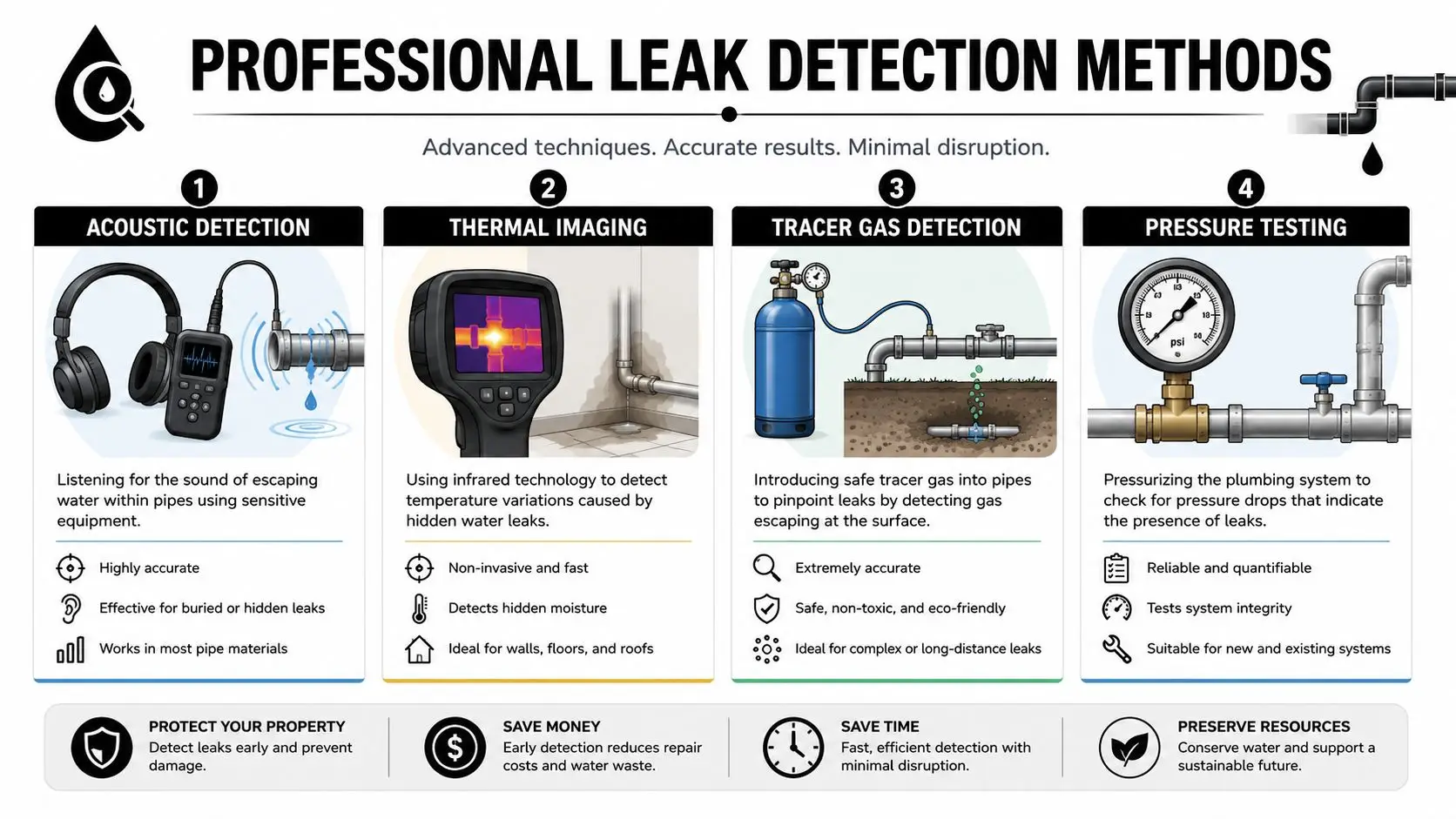
Acoustic detection
This is the plumbing version of using a stethoscope. Pressurized water escaping from a pipe creates sound and vibration. Sensitive listening equipment helps the technician compare areas and isolate where that sound is strongest.
Acoustic tools are often useful when the leak is active and the line is pressurized. They can be especially helpful for supply lines in walls, under floors, or beneath slabs.
Thermal imaging
Thermal imaging works like heat-vision for moisture clues. It doesn't directly see water through walls, but it can show temperature differences caused by wet materials, evaporative cooling, or hot water moving where it shouldn't.
This is helpful when a leak changes the temperature pattern of a surface. A warm pipe leak under tile, for example, may create a noticeable thermal signature. So can wet drywall that cools differently than dry drywall.
Tracer gas
Tracer gas is used when a system needs another way to reveal where it's escaping. A harmless gas is introduced into the line, and specialized equipment detects where that gas emerges.
Homeowners often find this method mysterious, but the concept is straightforward. If the gas leaves the pipe at a hidden break, the detector helps identify the escape point above the surface.
Camera inspection and pressure testing
For drain and sewer concerns, technicians may run a small camera through the line to inspect the pipe interior. That can reveal cracks, separations, blockages, or other defects that a surface inspection won't show.
Pressure testing answers a different question. It checks whether a line is holding pressure properly. If it isn't, that confirms a loss somewhere in the system and helps guide the next detection method.
Common Leak Detection Technologies
| Technology | How It Works | Best For |
|---|---|---|
| Acoustic detection | Uses sensitive listening equipment to hear water escaping from pressurized pipes | Supply line leaks, slab areas, wall leaks |
| Thermal imaging | Shows temperature differences on surfaces affected by moisture or hot water movement | Hot water leaks, wet wall areas, floor anomalies |
| Tracer gas | Introduces harmless gas into a line and detects where it escapes | Hard-to-locate concealed leaks |
| Pressure testing | Checks whether a plumbing line maintains proper pressure | Confirming a leak exists in a line |
| In-pipe camera inspection | Sends a camera through the pipe interior for visual review | Drain lines, sewer lines, line defects |
Why one house may need more than one method
A technician doesn't always rely on one tool. They may start with visual inspection, verify a pressure loss, use acoustic equipment to narrow the area, and then confirm moisture spread with thermal imaging.
That layered approach is why leak detection services can reduce unnecessary tear-out. Instead of opening a large area and hoping for the best, the technician builds evidence until the probable source is clear. If the leak has already affected surrounding materials, that's when homeowners may also need to understand what water remediation is and how drying fits into the process after the plumbing issue is exposed.
The Leak Detection Process From Start to Finish
When homeowners haven't dealt with this before, the biggest stress point is not knowing what the appointment will look like. The process is usually more orderly than people expect.

Step one starts before anyone arrives
The first conversation usually covers symptoms, timing, and location. You may be asked when you first noticed the issue, whether the water meter appears to be moving when fixtures are off, what rooms are affected, and whether any prior plumbing repairs were done recently.
That information helps narrow the possibilities before testing begins. A ceiling stain below a bathroom suggests a different path than a warm slab spot in the middle of a room.
What happens during the visit
Once on site, the technician typically does a visual walkthrough first. They'll look at fixtures, exposed plumbing, water-using appliances, flooring changes, staining, and areas with odor or moisture concerns.
After that, they choose the tools that fit the situation. In one home, that may be a listening device and pressure test. In another, it may be thermal imaging and a drain camera.
The part many homeowners misunderstand
The result of leak detection is usually a precise location or narrowed target area, not always a completed repair. That handoff is a normal part of the process. As the California Department of Water Resources notes in its discussion of leak surveys, detection is the first step in a larger corrective process, not the full solution.
That's good news for the homeowner. The plumber or restoration contractor who follows doesn't have to spend time and money searching blindly. They can work from a much clearer map.
A good detection report tells the repair team where to focus, what type of line is involved, and how much access may be needed.
What you should expect to leave with
By the end of the visit, you should usually understand:
- Where the likely source is: Exact spot or a clearly defined area.
- What type of leak is suspected: Supply line, drain line, fixture connection, slab issue, or another source.
- What the next trade may be: Plumber, restoration contractor, or both.
- Whether surrounding materials need drying: Especially if moisture has spread beyond the pipe location.
That clarity is often the biggest relief. Even when the leak isn't repaired that same moment, the uncertainty starts to lift because you know what problem you're dealing with.
Understanding Costs and Insurance Coverage
Most homeowners ask two questions right away. What will this cost, and will insurance help? The honest answer is that both depend on the details.
Leak detection pricing can vary based on access, the type of plumbing involved, how obvious or concealed the leak is, and which tools the technician needs to use. A simple exposed-line issue is different from a hidden slab or drain problem that requires multiple diagnostic methods.
Why detection can save money even before repairs begin
Paying for diagnostics can feel frustrating when you know a repair is still coming. But targeted detection often helps avoid a much more expensive version of the same job. If the source is narrowed down first, contractors are less likely to open unnecessary areas just to search.
That matters even more when flooring, cabinetry, drywall, or finished surfaces are involved. The better the location data, the cleaner the repair plan usually becomes.
How insurance often gets handled
Insurance treatment can be confusing because there may be several separate pieces involved:
- The leak source itself: Policies often treat the failed plumbing component differently from the damage caused by escaping water.
- Access or tear-out: Some policies may address opening walls or floors to reach the damaged plumbing, depending on the policy language and cause of loss.
- Water damage restoration: Drying, cleanup, material removal, and related mitigation may be handled under a different part of the claim review.
Because the details vary by carrier and policy, it helps to ask very specific questions. This guide on whether homeowners insurance covers busted pipes is a good starting point for understanding how those parts can differ.
Questions worth asking early
When you speak with your insurer or adjuster, keep the questions plain:
- Is leak detection itself eligible for review under my policy?
- If access is needed, how is tear-out evaluated?
- What documentation do you want from the detecting company?
- If materials are wet, should mitigation begin right away?
If you use a company that regularly documents moisture conditions, equipment findings, and affected materials, the claim conversation often becomes easier because the file is more organized. That doesn't guarantee coverage, but it does reduce confusion.
Choosing a Certified Leak Detection Expert in Phoenix
Choosing the right provider matters almost as much as finding the leak itself. A rushed or vague diagnosis can send the next contractor to the wrong place, which means more disruption in your home.

What to check before you book
Start with the basics and make the company prove them clearly.
- Licensing and insurance: Ask whether they're properly licensed for the work they perform and insured for work inside occupied homes.
- Relevant certifications: If water damage may be part of the issue, IICRC-related restoration knowledge is useful because the leak and the moisture problem often overlap.
- Local experience: Phoenix homes can present different plumbing layouts, slab conditions, and heat-related material issues than homes in other regions.
- Clear scope: Ask whether the visit is for locating the leak, repairing it, documenting it, or some combination.
- Emergency response capability: If the leak is active, speed matters.
Questions that tell you a lot
You don't need a technical interview. A few direct questions usually reveal whether the company works methodically:
- What tools do you typically use for concealed leaks?
- Will I receive a clear explanation of where the leak is located?
- If water damage is present, can you coordinate the next step?
- Have you worked with both plumbers and insurance adjusters before?
One local option homeowners may come across is Restore Heroes' water damage restoration contractor service, which is relevant when leak detection turns into drying, cleanup, and restoration work after the source is identified. The important point isn't the brand name. It's whether the company can document the issue clearly and help move the job from discovery to stabilization without confusion.
When you hire for leak detection, you're really hiring for confidence in the next step.
In a stressful situation, that confidence matters. You want a provider who can explain what they found in plain language, tell you where the handoff begins, and help you understand whether you need a plumber, a drying team, or both.
If you're in the Phoenix area and you're staring at a stain, smelling mustiness, or trying to make sense of a sudden water issue, Restore Heroes is one local company homeowners can contact for help with the detection-to-restoration side of the process. A clear diagnosis, fast documentation, and a calm explanation of what happens next can make a hard day feel manageable again.