
That musty, damp odor coming from your carpet isn't just unpleasant. It’s a dead giveaway that you need to act fast. To kill that wet carpet smell for good, you have to completely dry the area and then hit it with a targeted cleaner—like an enzymatic solution—to neutralize the bacteria causing the stink. Getting this right from the start is the key to preventing long-term damage and health problems.
Why That Wet Carpet Smell Is an Urgent Warning Sign
Think of that lingering, earthy smell as your home’s first cry for help. It’s a sure sign that moisture has seeped past the carpet fibers and is soaking into the padding and even the subfloor beneath. I’ve seen it a hundred times—this is the perfect environment for bacteria and mold, which can start growing in as little as 24 to 48 hours.
This problem is incredibly common. Imagine coming home after a heavy Phoenix monsoon only to find your family room carpet soaked and already starting to reek. It happens all the time, which helps explain why the global market for carpet cleaning products is booming. It's projected to grow from USD 1,805.8 million in 2023 to over USD 2.4 billion by 2030. That’s a lot of wet carpets.
The Science Behind the Stink
So, what exactly is that awful "wet dog" or musty smell? It's caused by gasses released by mold and bacteria as they feed on the organic materials in your carpet. They’re literally having a feast, and that smell is the result.
The longer your carpet stays damp, the faster the problem spirals out of control.
- Bacteria Explode: In wet conditions, bacteria can multiply up to 150 times faster than they would in a dry environment.
- Health Risks Mount: Those microorganisms release airborne spores that can trigger allergies, asthma, and other respiratory problems. The air in your home can quickly become unhealthy.
- Your Home's Structure Is at Risk: If left unchecked, moisture will eventually rot the subfloor, warp your baseboards, and cause serious structural damage.
That tell-tale musty odor isn't just unpleasant; it's often an urgent indicator of mold growth. For a comprehensive look at the risks and a practical essential guide to moldy carpet removal, it's helpful to understand the connection between the smell and potential contamination.
More Than Just a Bad Smell
Ignoring that smell is one of the most expensive mistakes a homeowner can make. Water damage isn't just a nuisance; it’s a leading cause of property claims, making up 23% of all homeowners insurance claims in the U.S. and costing over $13 billion every year. Your carpet is almost always the first casualty.
Because the smell points to a much deeper issue, you have to treat it as a serious warning. A small, untreated spill can quickly escalate into a massive restoration project. What starts as a damp spot can end with you needing not just new carpet, but also professional remediation for the dangerous molds in your home.
Taking that smell seriously from day one is the best way to protect your property and your family’s health.
That musty, damp smell coming from your carpet isn’t just an annoyance—it’s a warning sign. Before you even think about cleaning, you have to play detective and figure out where the water is coming from and how bad the situation really is.
A spilled drink is one thing, but that lingering odor often points to a hidden problem, like a slow leak you can’t see. Getting this first step right is everything. After all, there’s no point in cleaning a carpet that’s just going to get soaked again tomorrow.
How To Pinpoint The Source Of The Smell
Your nose is your best guide. The smell will always be strongest right at the source of the moisture. Get on your hands and knees and start investigating the area.
- Check the Hidden Spots: Water loves to travel and hide. Be sure to look behind furniture, along all the baseboards, and deep in the corners. You're looking for any subtle signs, like dark spots on the carpet or faint water stains on the drywall.
- Do the “Paper Towel Test”: Your eyes can lie, but a dry paper towel won't. Press down hard on the carpet. If the towel picks up any moisture, the problem is active.
- Feel the Padding: Here’s a pro tip: always check the padding underneath. Gently pull back a corner of the carpet if you can. The padding is a thick sponge, and I’ve seen countless cases where the carpet on top feels almost dry, but the pad is completely saturated.
- Follow the Trail: Try to trace the water back to its origin. Does it seem to be coming from a leaky dishwasher? Is it concentrated under a window where rain might be getting in? Or maybe it’s near an AC unit with a clogged drain line.
If the wet area is bigger than a small puddle or you can’t find the source, the problem might be more than a simple DIY fix. Understanding the full scope of the issue is key, and this guide on water damaged floor repair has some great insights for bigger jobs.
This flowchart can also give you a quick visual guide to help you decide on the right course of action.
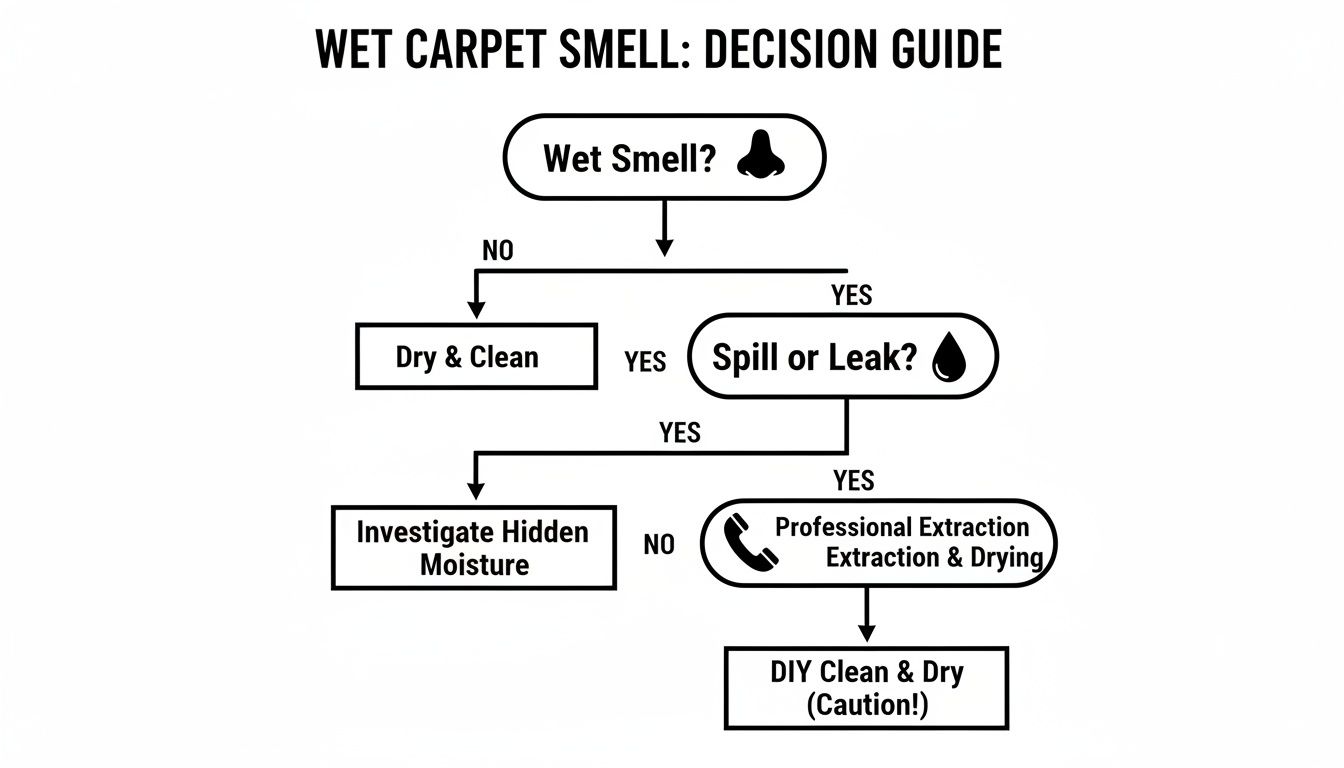
It breaks down the process, helping you move from finding the smell to deciding if it's time to call in a professional.
Understanding Water Source Categories and Next Steps
Knowing where the water came from is just as important as finding the leak itself. The source tells you what kind of contaminants you might be dealing with, which is a huge factor for your health and safety. In the restoration industry, we classify water into three distinct categories defined by the IICRC (Institute of Inspection, Cleaning and Restoration Certification).
This isn't just industry jargon—it’s a critical safety standard. Figuring out which category your water falls into will tell you if you can handle the cleanup on your own or if you need to call for backup immediately.
| Water Category | Description & Common Sources | Potential Health Risk | Recommended Action |
|---|---|---|---|
| Category 1 | Clean Water. This is water from a sanitary source, like an overflowing tub, a broken water supply line, or rainwater that hasn't touched contaminants. | Low | Generally safe for DIY cleanup if the area is small and addressed within 24 hours. |
| Category 2 | Gray Water. This water is contaminated with chemical or biological agents. Think of water from a washing machine, dishwasher, or a leaky aquarium. | Medium | Use caution. This water can cause illness. Professional help is strongly recommended, especially for larger affected areas. |
| Category 3 | Black Water. This is grossly unsanitary water containing harmful bacteria, viruses, and fungi. Sources include sewage backups and floodwaters. | High | Stop immediately and call a professional. Never attempt to clean Category 3 water yourself due to severe health risks. |
If you’ve caught a small Category 1 spill quickly, you can probably handle it. But if you’re dealing with Category 2 or 3 water, or if any water has been sitting for more than 24-48 hours, it’s time to call a certified restoration company. After that time frame, even clean water can degrade and start breeding bacteria, turning a simple problem into a serious health hazard.
Alright, you've found a small puddle on your carpet from a clean water source—maybe a toppled plant or a leaky water bottle. Your first instinct is crucial, and acting fast is the name of the game. That musty, mildewy smell can start to creep in within just 24 hours, so what you do right now makes all the difference.
Most people immediately reach for a stack of old towels and start stamping on the wet spot. While that's better than nothing, it's just not going to cut it. Towels only soak up the surface water, leaving the padding and subfloor beneath saturated. To really solve the problem before it starts, you need to get aggressive with extraction.
Getting the Water Out and the Air Moving
This is where a wet/dry vacuum (you might know it as a shop vac) becomes your most valuable tool. Forget your regular household vacuum—it can’t handle water and you'll ruin it. A wet/dry vac, on the other hand, is built for this.
Work the nozzle over the wet area slowly, making several passes. You’ll probably be shocked at how much water it pulls out, even when the carpet starts to feel dry to the touch. This step is about removing the bulk of the moisture trapped deep down.
Once you’ve extracted all you can, your next mission is to dry everything out with relentless airflow. This is the part people often skip, and it's why they end up with that lingering damp smell.
- Create a Wind Tunnel: Grab every fan you have—box fans, oscillating fans, whatever. Aim them directly at the wet spot from different angles to get air moving across the surface.
- Use a Dehumidifier: If you own a dehumidifier, now is its time to shine. Place it in the room, close the doors and windows, and let it work its magic. It will pull moisture straight from the air, which helps wick it out of the carpet and padding.
This one-two punch of extraction and drying is what stops mold and bacteria in their tracks. If you want an even deeper dive into the drying process, we have more tips in our guide on how to dry wet carpet fast.
A Common Mistake I See All the Time
In a moment of panic, it’s tempting to grab something from the pantry to "fix" the problem. The biggest mistake I see homeowners make is dumping baking soda on a soaking wet carpet.
While baking soda is great for deodorizing a dry carpet, on a wet one it just turns into a goopy, cement-like paste. It gets caked into the carpet fibers and becomes a nightmare to clean up later. It doesn't help with the moisture and just makes a bigger mess.
Expert Tip: Focus entirely on getting the area bone dry first. Deodorizing comes later. Things like baking soda or vinegar solutions should only be touched after the carpet, padding, and subfloor are completely dry. Using them too soon just adds more liquid to an already wet situation.
Your Game Plan for Small Spills
So, for a minor, clean-water incident, here’s an approach that often works. The goal is simple: get it dry.
First, use that wet/dry vac until it stops pulling water. Be patient here; it's the most important part.
Next, get that airflow going. Set up your fans for maximum circulation right over the spot. If you have a dehumidifier, get it running in the closed room.
If the spill is near a wall and you feel comfortable, carefully use pliers to pull the carpet up from the tack strip. Propping that corner up lets air get directly to the padding and subfloor, which speeds up drying immensely.
Finally, just wait. Don't put furniture back, don't walk on it, and don't try to clean it. You need to be 100% certain everything is dry, which can take anywhere from 24 to 72 hours. Moisture is the enemy, and a little patience now will save you from a much bigger headache down the road.
Advanced Techniques for Stubborn Odor Removal
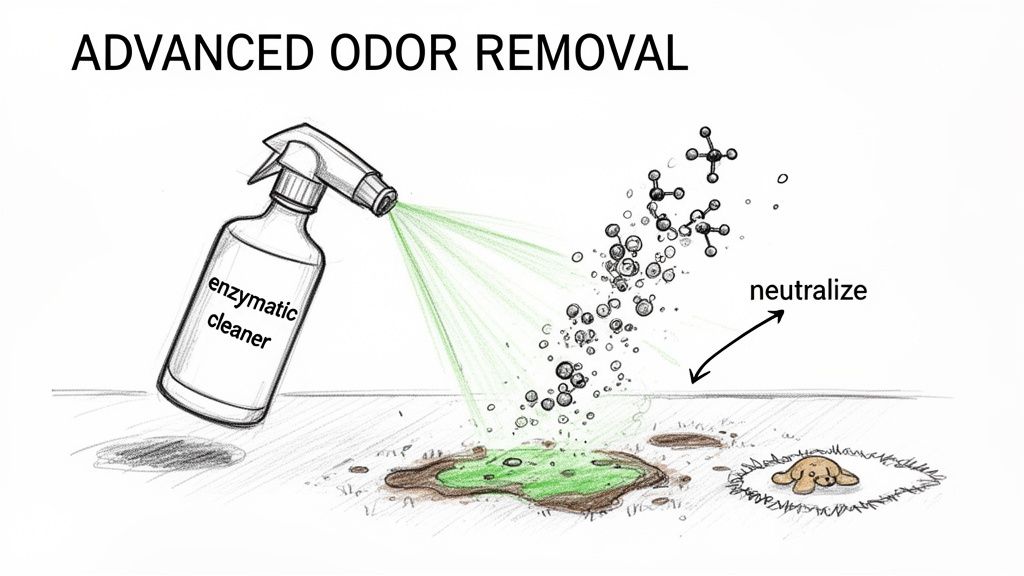
So you’ve done all the hard work. You’ve extracted the water, you've had fans running for days, and the carpet is finally dry to the touch. But that damp, musty smell just won’t go away.
This is a scenario we see all the time. If water sits for more than a day, or if the spill involved something like a pet accident or even just a sugary drink, basic drying simply isn't enough. That lingering odor is a tell-tale sign that bacteria have already made a home deep within the carpet fibers and, more importantly, the padding underneath. It's time to go on the offensive.
The Power of Enzymatic Cleaners
To knock out that wet carpet smell for good, you need something that does more than just mask the problem. Scented sprays and air fresheners are a temporary fix at best—they don't touch the root cause. You have to destroy what's causing the odor.
This is where enzymatic cleaners become your best friend. Think of them as a targeted cleanup crew on a microscopic level. These formulas use beneficial bacteria and enzymes that are specifically designed to break down and literally "eat" the organic material creating the smell—whether it's from pet urine, spilled milk, or old food.
- How They Work: When you apply an enzymatic cleaner, the enzymes get to work breaking down the complex odor-causing molecules into simple, bite-sized pieces. The friendly bacteria in the solution then consume these pieces, leaving behind only harmless water and carbon dioxide.
- Why They're Effective: Unlike standard chemical cleaners, enzymes are designed to permanently eliminate the smell because they remove the source. No source, no smell.
For any odor with a biological or organic origin, an enzymatic cleaner is the most powerful tool in a DIY arsenal. Just be sure to follow the directions closely. Most require you to saturate the spot and let it air dry completely, giving the enzymes enough time to do their job.
Weighing Household vs. Professional Solutions
In the battle against odors, many people reach for household staples like white vinegar. A 50/50 mix of white vinegar and water can definitely help neutralize some smells, as its acidity is great for killing certain types of bacteria. It's a decent first try for minor odors from a clean water spill.
But vinegar has its limitations. It often isn't strong enough for powerful organic smells, and it won't do much to sanitize a carpet contaminated by something more serious. Plus, you might just end up trading a musty smell for the smell of vinegar for a few days.
A wet carpet smell is more than just an annoyance; it's a warning sign of rapid bacterial growth. Research has shown that bacteria like E. coli can multiply a thousandfold within just 72 hours of saturation. This biohazard risk is a major driver behind the growing demand for effective cleaning solutions, as highlighted in recent carpet cleaner market analysis.
This is why professionals often turn to antimicrobial treatments. These are powerful, specifically formulated agents designed to kill a wide spectrum of bacteria, mold, and mildew. While you can find some for sale, the pros may use them to achieve total sanitization after significant water damage. This process often involves powerful drying equipment, and you can see what the pros use in our guide to high-powered fans for water damage restoration.
At the end of the day, your home’s air quality is directly linked to the condition of your floors. The global carpet cleaner market is projected to hit USD 1,082 million by 2033, which shows just how seriously people are taking indoor hygiene. Here in Phoenix, where 40% of homes have wall-to-wall carpeting and monsoon season is a yearly threat, knowing how to eliminate wet carpet smell is a critical skill. Proper sanitization isn't just about getting rid of a bad smell—it's about making sure your home is a safe and healthy place to live.
Knowing When to Call a Water Restoration Professional
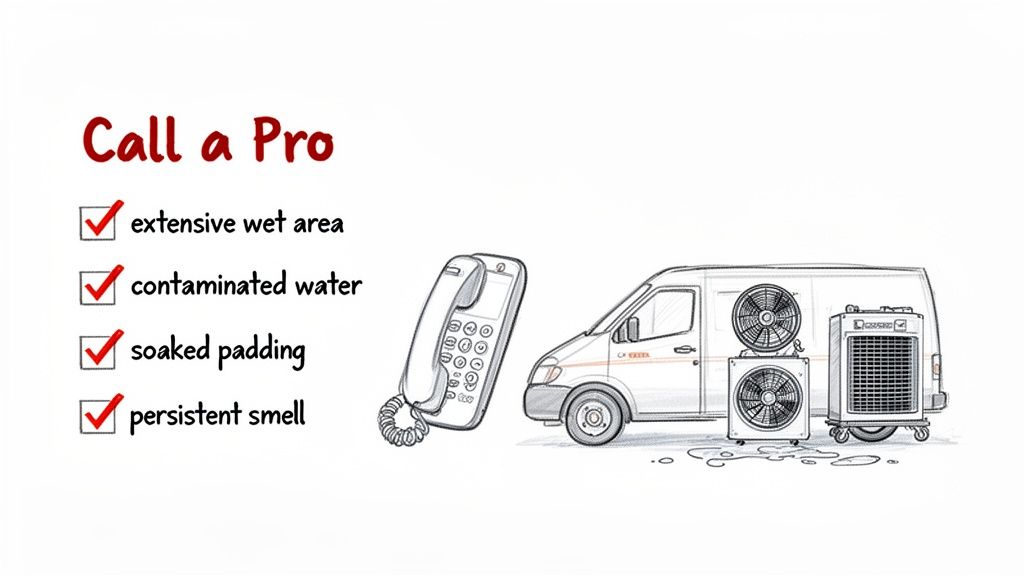
It’s one thing to tackle a small, contained spill. But there’s a definite point where a wet carpet problem escalates beyond what home equipment can handle. Knowing when to put down the shop vac and pick up the phone is probably the most critical decision you'll make.
Honestly, misjudging the severity is a recipe for bigger, more expensive problems. Some water damage situations are just too large or hazardous for household tools and cleaners. Trying to go it alone doesn't just put your property at risk—it can put your health on the line, too.
Red Flags That Signal It's Time for Help
So, how do you know when you're in over your head? If you see any of these signs, it's a clear signal to bring in a certified restoration company immediately. This isn't a "wait and see" situation.
Here are the undeniable indicators that you need professional help:
- The water has spread. A small puddle is manageable. But if the water has saturated an area larger than 10 square feet, you're fighting a losing battle with a home dehumidifier and a few fans. Pros use commercial-grade equipment built for this kind of scale.
- The water isn't clean. If you’re dealing with Gray Water (from a washing machine or dishwasher) or, even worse, Black Water (from a sewage backup or outside flood), don't even think about touching it. This water is teeming with contaminants that pose serious health risks.
- That musty smell just won't quit. You’ve done everything right and the carpet feels dry to the touch, but that stubborn, damp odor lingers. That’s the classic sign that moisture is trapped deep in the padding or subfloor, and mold has likely already started growing.
- The padding is completely soaked. Pull back a corner of the carpet. If the padding underneath is squishy and saturated, you'll never get it fully dry on your own. This deep-seated moisture is a perfect breeding ground for mildew.
Homeowners invest a lot in their flooring—the global carpet market is on track to hit USD 84.7 billion by 2034. Here in Phoenix, where 60% of water damage claims are from plumbing or AC leaks, protecting that investment is crucial. A wet carpet can release volatile organic compounds that spike 200-500% in just one week, creating a major odor problem you can't ignore.
The Hidden Dangers of Incomplete Drying
The single biggest risk of trying to fix major water damage yourself is failing to get everything 100% dry. Water loves to hide, seeping into the subfloor where it can silently cause destruction for weeks or even months.
I’ve been on countless jobs where homeowners thought they'd solved a leak, only for us to discover rotten floorboards and a huge mold colony months later. This trapped moisture doesn't just compromise the structure of your home by warping wood and crumbling drywall; it creates a hidden mold factory that pumps spores into your air, triggering allergies and respiratory problems.
The Professional Advantage
When you call in a certified team, you're getting more than just powerful equipment. You're getting years of expertise and a systematic approach that can achieve a complete fix. IICRC-certified technicians use a process that goes far beyond what any homeowner can accomplish.
For starters, their extractors may operate at 200-300 psi, pulling up to 90% of the water and contaminants out of the deepest layers of your carpet and pad. They may follow this with advanced techniques like antimicrobial fogging, where ULV foggers disperse a fine mist that can kill 99.99% of bacteria. This can be worlds more effective than store-bought chemical shampoos, which can leave behind residue in up to 40% of cases.
Professionals have the moisture meters to find hidden water, the powerful air movers to dry your home's structure completely, and the know-how to eliminate microbial threats for good. If you think the problem is more than you can handle, our guide on choosing a water damage restoration contractor can help. At the end of the day, making that call helps ensure the job is done right, protecting your property and giving you back your peace of mind.
Answering Your Questions About Wet Carpet Odors
After you’ve dealt with a water issue, a lot of questions can pop into your head. It’s natural to feel a little unsure if you've done enough. We get these kinds of questions all the time, so let’s walk through some of the most common ones to give you some clarity and peace of mind.
How Quickly Does a Wet Carpet Start to Smell?
You’d be surprised how fast it happens. In a warm environment, like a typical Phoenix home, a wet carpet can start to give off that distinct musty smell in as little as 24 to 48 hours.
That odor is a direct signal that mold and mildew are already starting to grow. The warmer and more humid it is, the faster they multiply. This is exactly why getting that carpet dry as fast as possible is the single most important thing you can do.
Can I Save a Carpet Soaked by Floodwater?
This is a tough one, and it really comes down to two things: where the water came from and how long the carpet was wet. If it was clean water—say, from a supply line—and you started the drying process within 24 hours, there's a very good chance you can save it.
However, if the water was from a flood, a sewer backup, or even a toilet overflow, the story changes. That's considered "Category 2" or "Category 3" water, and industry standards often recommend a full replacement. The carpet and pad can hold onto dangerous bacteria and contaminants that you may not be able to clean out completely, creating a serious health risk.
That musty smell from a wet carpet is more than just annoying—it's a warning sign. The odor is caused by mold and bacteria releasing spores into your air. The CDC has long warned that living in a damp, moldy environment can trigger everything from allergy symptoms and asthma attacks to other respiratory problems, especially for kids, the elderly, or anyone with a sensitive immune system.
Will Homeowners Insurance Help with the Cost?
In many cases, yes. Many standard homeowner's policies will cover water damage if it’s from a "sudden and accidental" event. Think of a pipe that bursts out of nowhere or a washing machine hose that lets go. In those situations, your insurance may help pay for water extraction, professional drying, and even replacing the carpet.
But, they usually draw the line at damage from gradual leaks, poor maintenance, or widespread regional flooding. It’s always best to pull out your policy and read the fine print. To get a better handle on the details, you can read our guide on whether homeowners insurance typically covers mold.
Is the Smell from a Wet Carpet Actually Dangerous?
Yes, that smell is a genuine red flag. The odor itself won't make you sick, but what causes the odor certainly can. That musty, earthy scent is produced by active mold and bacteria colonies growing in your carpet fibers.
When you breathe that air, you're inhaling microscopic particles that can cause a whole range of health problems, such as:
- A stuffy nose and irritated throat
- Coughing and wheezing
- Itchy eyes or skin rashes
- Much more severe reactions for people with mold allergies or weakened immune systems
Getting rid of the smell isn’t just about making your house pleasant again; it's a critical step in keeping your home's air quality safe and healthy.
When the water damage is more than you can handle, don't wait for the problem to get worse. Restore Heroes offers 24/7 emergency water restoration services throughout the Phoenix metro area to get your home back to normal quickly and safely. Call us for a free onsite inspection at https://www.restoreheroesaz.com.