
Water on the floor changes the mood in a house fast. One minute you're dealing with a normal day. The next, you're moving rugs, listening for dripping behind a wall, and wondering if the ceiling stain means something bigger is happening above you.
For homeowners seeking water clean up services near me in Phoenix, the first question usually isn't who can dry the room. It's what you should do right now, before anyone gets there. That's where many homeowners lose time, make avoidable mistakes, or put themselves in danger.
A water loss is urgent, but it doesn't need panic. It needs order. If you handle safety first, stop the source if you can, and document the scene before too much gets moved, you'll put yourself in a much better position for both cleanup and insurance.
Responding to a Water Damage Emergency in Your Home
The first few minutes after finding water damage are usually messy in every sense. You may not know whether you're dealing with a small plumbing leak, a roof problem, an appliance failure, or contaminated water that makes the area unsafe to enter.
That uncertainty is normal. Water losses are common enough that they affect about 14,000 people in the U.S. every day, and 23.7 million U.S. properties are at risk of flooding, according to industry statistics on water damage and flooding risk. Those same figures also point to billions in annual losses. The practical takeaway is simple. You're not dealing with a rare event, and quick action matters.
What matters first
In a home emergency, people often focus on the visible water. Professionals focus on three things first:
- Safety: Electrical hazards, slip risks, and contaminated water can turn a property problem into an injury.
- Source control: If the water is still entering the home, cleanup can't meaningfully start.
- Documentation: Early photos and notes help preserve the cause and condition of the loss.
Practical rule: Don't start with cleanup. Start with safety and control.
Why speed matters
Water doesn't stay where it first lands. It moves into baseboards, drywall, insulation, cabinets, underlayment, and subfloors. A room can look only mildly affected while moisture is already spreading into concealed spaces.
That's why local response matters so much. In real-world restoration work, "near me" isn't about convenience. It's about getting trained eyes and drying equipment to the property before a smaller loss turns into a larger tear-out.
Your First 30 Minutes What to Do Before Help Arrives
If you're standing in a wet kitchen, hallway, laundry room, or garage, keep your next moves simple. You do not need to solve the whole problem. You need to make the scene safer, limit ongoing damage, and preserve evidence of what happened.
Independent safety guidance reflected through flood and water damage safety recommendations says you shouldn't enter a flooded area until it's safe, and you should avoid contact with floodwater because it may contain contaminants. That's the right starting point for any homeowner.
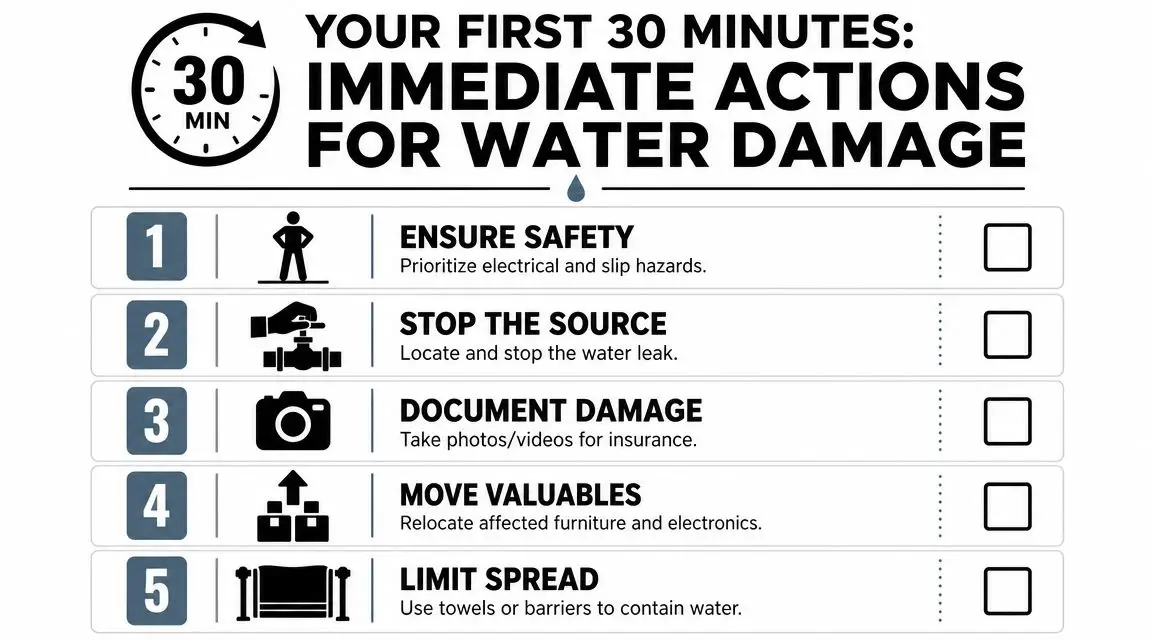
Start with safety, not salvage
Use this order.
Stay out if the area may be energized
If water is near outlets, power cords, appliances, or your electrical panel, don't step into it. If you can shut off electricity without standing in water, do that. If you can't, leave it alone and wait for qualified help.Avoid contact with questionable water
If the source may be sewage, storm runoff, toilet overflow beyond a simple bowl spill, or water that has sat long enough to become dirty, don't treat it like a clean leak.Watch your footing
Wet tile, vinyl, and hardwood become slick immediately. Stairs are a common problem area because people try to carry items while rushing.
If you have to choose between saving belongings and staying safe, choose safety every time.
Stop the source if you can do it safely
Once the area is safe enough to approach, stop the incoming water if possible.
- Shut off a local valve: This works for sinks, toilets, dishwashers, washing machines, and some refrigerators.
- Turn off the main water supply: Use this if you can't isolate the problem quickly.
- Stop appliance operation: Turn off the washing machine, dishwasher, or HVAC equipment if that appears to be involved.
If the source is roof-related or storm-related, you may not be able to fully stop it right away. In that case, focus on containment and documentation.
Document before you move too much
A common pitfall for homeowners is hurting their own claim. They clean first and record later. Do the opposite.
- Take wide photos first: Get the full room, adjoining areas, and the visible source.
- Then take close-ups: Capture damaged drywall, flooring edges, swollen cabinets, stained ceilings, and wet contents.
- Shoot video: A slow walk-through with narration can help show active dripping, pooling, and the path of water.
- Keep a basic timeline: Note when you discovered the problem, what you shut off, and what was affected.
If you want a visual sense of how water can move through a house, this inside a flooded house guide is useful context before a crew arrives.
Protect what you can without spreading damage
Move portable valuables to a dry area, but don't drag soaked items across unaffected rooms if you can avoid it.
A short list helps:
- Lift electronics and chargers: Get them off floors and away from damp surfaces.
- Move paper items: Documents, photos, passports, and school records should be separated and air-exposed if damp.
- Create a buffer: Use towels or temporary barriers to slow spread into nearby rooms.
- Leave built-ins alone: Don't start tearing out cabinets, baseboards, or drywall unless a professional has advised it and the area is safe.
Understanding Professional Water Cleanup Services
Homeowners often hear a lot of terms during a water loss. Extraction, drying, dehumidification, sanitizing, restoration. They aren't interchangeable, and each one solves a different problem.
A professional crew isn't there just to remove visible water. The job is to identify what got wet, determine what kind of water is involved, dry the structure properly, and reduce the chance of hidden damage being left behind.
The three parts homeowners should know
Here's the simplest way to think about the work:
| Service | What it means | Why it matters |
|---|---|---|
| Water extraction | Removing standing water with pumps, vacuums, or extraction tools | Less water in the structure means less spread |
| Structural drying | Using air movers, dehumidifiers, moisture meters, and sometimes thermal imaging | Wet materials can stay saturated long after surfaces look dry |
| Restoration | Repairing or replacing damaged materials after mitigation | Drying alone doesn't rebuild drywall, flooring, trim, or cabinets |
A good explainer from Restore Heroes on what a water restoration company does can help you compare what different vendors include.
Why water type changes the job
Not all water losses are treated the same way. In practice, crews talk about clean water, gray water, and black water. Homeowners don't need to memorize the terminology, but they should understand the difference in risk.
Clean water usually starts from a supply line, sink line, or similar source that hasn't picked up serious contamination.
Gray water may come from appliances or drains and carries a higher contamination concern.
Black water, often called Category 3, is different. For sewage and contaminated water cleanup, 1-800 WATER DAMAGE explains that the work is a health and safety operation, not just water removal. It requires protective gear, removal of affected porous materials, thorough sanitization, deodorization, and only then proper drying.
A sewage backup is not a mop-and-fan job. Treat it as a contamination event.
What doesn't work well
A few common homeowner moves usually create more trouble than progress:
- Running household fans without a plan: This can move humidity around without drying the structure.
- Assuming dry surface equals dry material: Flooring and drywall can feel dry while moisture remains underneath or behind them.
- Spraying deodorizer on contaminated areas: Smell control doesn't replace cleaning or sanitization.
The Water Damage Remediation Process Step by Step
Modern water cleanup is a sequence, not a single service call. Established restoration workflows now center on inspection, extraction, moisture evaluation, drying, cleaning, and restoration as part of a time-sensitive mitigation process, as outlined by a professional overview of water damage response.
That matters because water damage isn't solved when puddles are gone. It's solved when the building materials are brought back to a dry, stable condition and the affected areas are cleaned or repaired appropriately.
A visual walkthrough helps:
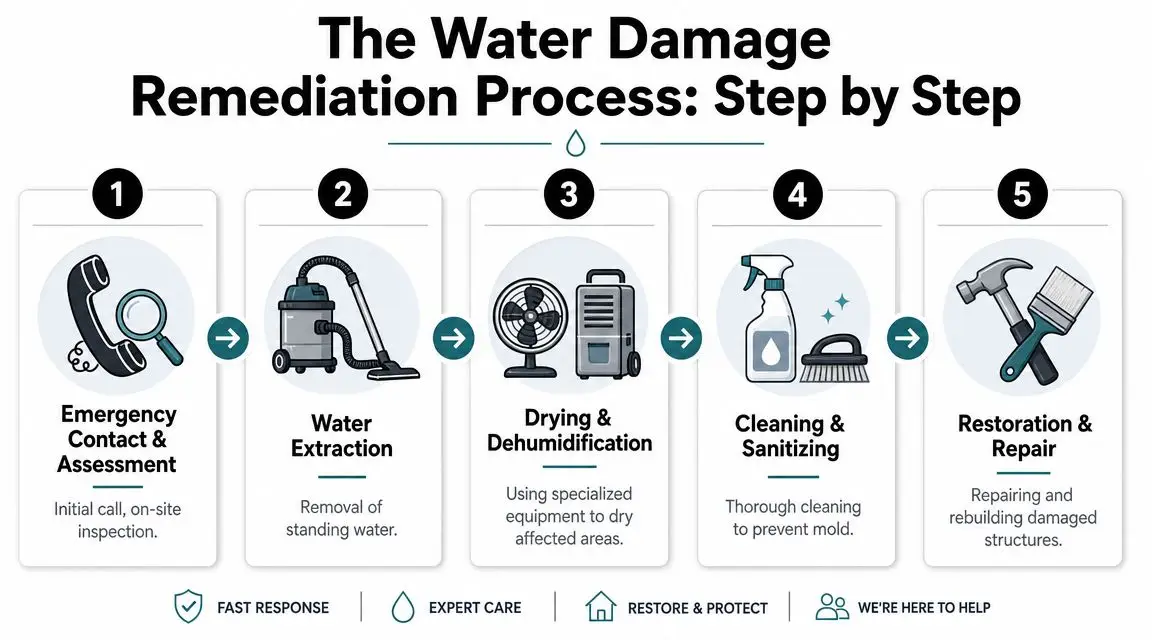
What the job usually looks like
A typical project moves through these phases.
Emergency contact and assessment
The first useful questions are about the source, when the loss was discovered, whether power is affected, and what rooms are involved. On site, the crew checks visible damage and starts identifying likely migration paths.
Extraction
Standing water is removed first. This is the fastest way to reduce immediate load on flooring, padding, drywall bases, and cabinets.
Drying and dehumidification
After extraction, the structure still holds moisture. Air movers push evaporation from wet surfaces. Dehumidifiers remove that water from the air so it doesn't settle back into materials.
Cleaning and sanitizing
Affected surfaces and salvageable contents are cleaned according to the type of water involved. Odor treatment may also be part of this phase.
Restoration and repair
Once the area is dry and stable, repair work can begin. That can range from reinstalling baseboards to replacing drywall, flooring, or built-in materials.
For a homeowner-friendly explanation of the full sequence, see this water damage restoration process overview.
Why moisture mapping matters
The biggest difference between casual cleanup and professional remediation is measurement. Crews don't rely on what looks dry. They check what the materials are doing.
That often includes:
- Moisture meters for drywall, wood, and other building materials
- Thermal imaging to help locate hidden temperature differences associated with wetting
- Daily monitoring to confirm drying is moving in the right direction
- Equipment adjustment if one area dries slower than another
This short video gives a helpful visual sense of the process in action.
Drying a house isn't about blasting air. It's about controlling where the moisture goes and proving it left.
What homeowners should expect during drying
The property may stay noisy for a while. Air movers and dehumidifiers are doing real work, and placement matters. Rooms can feel warmer than normal because the system is trying to pull moisture out of materials, not make the space comfortable.
That can be frustrating, but it's usually part of doing the job correctly.
How to Choose a Certified Water Cleanup Company
Individuals looking for water clean up services near me usually compare response time first. That's understandable, but speed by itself isn't enough. You need a company that knows how to inspect, document, dry, and communicate without guessing.
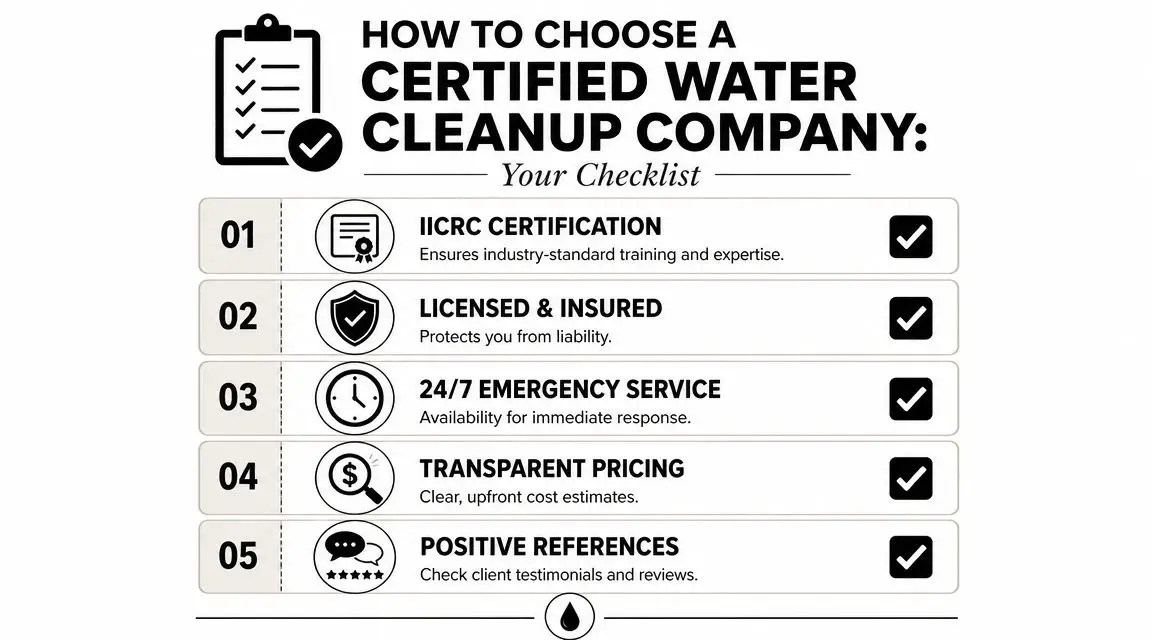
One of the clearest technical signals is IICRC certification. The IICRC standards and certification framework matter because restoration crews should measure moisture in materials, not rely on appearance alone. Hidden wetting in wall cavities, insulation, and subfloors is where many incomplete jobs go wrong.
Green flags and red flags
This is the simplest way to screen companies during a stressful call.
| Green flags | Red flags |
|---|---|
| Explains the drying plan clearly | Only talks about sucking up water |
| Uses moisture meters and documented readings | Says the area looks dry without testing |
| Discusses contamination level and safety | Treats sewage or dirty water like a basic cleanup |
| Provides written scope and records | Pushes immediate approval without explanation |
| Answers insurance documentation questions carefully | Promises coverage or makes guarantees |
A practical local reference point is this contractor checklist for water damage restoration, which shows the kinds of questions worth asking before authorizing work.
Questions worth asking on the first call
You don't need a long interview. A few direct questions tell you a lot.
How will you determine what materials are wet?
Listen for moisture meters, inspection, and monitoring. Be cautious if the answer is vague.How do you handle contaminated water?
A qualified company should talk about protective procedures, removal of affected porous materials when necessary, and sanitization.What documentation do you provide?
Good records help both the homeowner and the adjuster understand what was found and what was done.Are you licensed, bonded, insured, and IICRC-certified?
Those aren't buzzwords. They help separate trained contractors from opportunists.
Why this matters in Phoenix
Phoenix homes see water losses from burst supply lines, water heater failures, appliance leaks, roof entry during storms, and HVAC-related issues. The visible damage may be similar, but the drying strategy can change depending on flooring type, cabinet construction, insulation, and how long the materials stayed wet.
That is exactly why certification and method matter more than a fast sales pitch.
Navigating Insurance Claims and Cleanup Costs
Insurance questions start almost immediately after the leak is found. Most homeowners ask two things. Will the policy cover this, and what should I save for the claim?
The hardest part is that water claims are often decided by source, not just by severity. According to guidance summarized on water damage insurance distinctions, standard homeowners policies typically don't cover flood damage unless the owner has separate flood coverage, and claim handling often depends on whether the water came from a sudden internal failure, outside flooding, or long-term seepage.
What helps your claim the most
The claim usually gets stronger when the cause and your response are easier to verify.
A simple checklist helps:
- Report promptly: Waiting creates avoidable questions about when the damage occurred and whether it worsened unnecessarily.
- Photograph before disposal: If materials need to be removed, record them first.
- Document the source: Burst pipe, appliance line, roof leak, overflow, or storm entry should be noted as clearly as possible.
- Keep damaged samples when practical: Don't throw everything away immediately if an adjuster or contractor may need to inspect it.
- Save communication records: Emails, claim numbers, technician notes, and invoices all matter.
For homeowners who want a more detailed checklist, this water damage insurance claim tips page is a useful reference.
What not to do
Many claim problems start with avoidable mistakes.
Don't assume "water damage" is one category in your policy. Insurers often separate sudden discharge, long-term seepage, and flood-related losses.
Avoid these missteps:
- Giving a vague cause when you know more
- Throwing away key evidence too early
- Failing to show that you tried to limit further damage
- Accepting verbal assumptions as final coverage decisions
Where cleanup companies fit in
A restoration company doesn't decide coverage. The carrier does. But a good cleanup company can support the process by documenting conditions, recording moisture findings, listing affected materials, and showing what mitigation steps were taken.
That documentation often matters just as much as the drying equipment.
Your Phoenix Partner for Water Damage Restoration
In Phoenix, the best fit for water clean up services near me is usually a company that can do two things at once. Handle the technical side correctly and guide the homeowner through the first stressful decisions without making the situation harder.
That means showing up with a real mitigation process, not just extraction equipment. It means understanding contamination risk, knowing how to document moisture conditions, and being careful about what gets removed, what gets dried in place, and what needs to be discussed with the insurer before major disposal.
For local property owners in Phoenix, Mesa, Scottsdale, and Chandler, Restore Heroes is one example of an option that aligns with those practical standards. The company states that it is licensed, bonded, insured, and IICRC-certified, and it provides water damage restoration in the Phoenix metro area. Those are the kinds of baseline qualifications homeowners should look for in any contractor they call.
What good local service looks like
The strongest water damage partner usually does the following well:
- Responds with clear safety guidance
- Documents the loss carefully
- Uses measurement-based drying, not guesswork
- Communicates in plain language with homeowners and adjusters
- Stays focused on mitigation first, then repair decisions
There's also value in understanding the broader restoration business model if you're comparing how contractors communicate and generate emergency work. This guide for home service contractors gives useful context on how the industry operates behind the scenes.
Phoenix homeowners don't need hype during a water loss. They need calm direction, competent drying, and records that hold up after the equipment leaves.
If you need help after a leak, overflow, burst pipe, or storm-related water intrusion, Restore Heroes serves the Phoenix metro area with water damage restoration and related disaster cleanup services. Reach out when you're ready to get professional eyes on the damage, understand the next steps, and move the property from emergency response into a clear remediation plan.