
Mold remediation specialists isolate contaminated material, dry the structure, control moisture, and give you a written post-remediation report. That's the job, not a wipe-down with bleach, and the difference matters the moment you notice a musty smell after a Phoenix monsoon, a dark patch behind the refrigerator, or a landlord who suddenly has time to call you back.
You're usually deciding fast in that first hour. Do you open windows, run a fan, paint over the spot, or start making calls? The right move is to treat it like a moisture problem first and a surface problem second. In a growing market, that trade matters to homeowners and property managers because the work is about containment, drying, and verification, not just making the stain disappear. Grand View Research's mold remediation service market report places the global market at USD 1,234.6 million in 2023 and projects USD 1,516.8 million by 2030, with a 3.0% CAGR from 2024 to 2030.
The Morning You Notice Something Off
Phoenix mornings make people complacent. The air feels dry, the sky looks clean, and then you catch that stale, basement-like smell near a cabinet or see a shadow line under a sink that wasn't there yesterday. A lot of people try to outrun the problem with a can of paint or a box fan.
That's the wrong instinct. If moisture is still there, mold keeps growing inside the wall, under flooring, or around a fridge line. A real response starts with finding where water entered, then limiting spread before anyone starts ripping things out.
The first decisions matter more than the stain
A homeowner in the Valley usually has three bad options and one good one. Painting over it hides the evidence. Running a fan can spread spores if the area isn't contained. Waiting for it to “dry out on its own” is how a small problem turns into a bigger tear-out.
Practical rule: if you can smell it before you can prove it, treat it like a moisture issue until someone with the right tools verifies otherwise.
That first call should be to someone who can explain the plan in plain English. The person should talk about containment, drying, and written documentation, not just “killing mold.” If they sound like a handyman with a spray bottle, keep looking.
For a quick home check, this guide to signs of mold in walls is a useful place to start before you agree to any work. It won't replace an inspection, but it can help you decide whether the problem is cosmetic or structural.
The main point is simple. Mold remediation specialists don't just clean what you can see, they isolate the area, remove what's contaminated, dry what's left, and verify the space is ready for teardown and rebuild. That's the standard you should hold them to from the first phone call.
What Mold Remediation Specialists Actually Do
A mold remediation specialist is not the same thing as a cleaner, a general contractor, or an indoor air tester. The job starts with identifying the moisture source, because mold is usually the symptom, not the root cause. If the leak, condensation, or intrusion stays active, the work fails.
A real specialist works from a containment-first engineering control model. That means the crew isolates the work zone, puts the area under negative pressure with HEPA-filtered air filtration devices, seals HVAC registers, and keeps contaminated dust from moving into clean rooms. The removal side is just as disciplined, with HEPA vacuuming, damp wiping of non-porous and semi-porous surfaces, controlled demolition, and bagged waste removal to keep debris from traveling through the house. NAMRI's remediation SOP spells out that approach in practical terms.
What separates a specialist from a guy with bleach
Bleach is the favorite shortcut because it looks decisive. It's not a plan. It doesn't solve hidden contamination, and it doesn't tell you whether the space is dry enough for reconstruction.
A specialist gives you a tighter chain of work:
- Find the water source. No source control, no real fix.
- Isolate the job. Keep the rest of the home clean.
- Remove damaged materials. Especially porous items that can't be reliably cleaned.
- Dry the structure. Moisture control is the backbone of the job.
- Document the result. You need a written scope and a post-remediation report.
If you're a service business owner or property manager vetting vendors, a practical guide like Guide for service businesses helps you think about response time and lead handling, which matters when the first call decides whether the job gets contained or spread.
The one-sentence definition you can carry around is this. A mold remediation specialist finds the moisture, contains the contamination, removes affected materials, dries the structure, and proves the area is ready for the next phase.
How a Professional Mold Job Unfolds
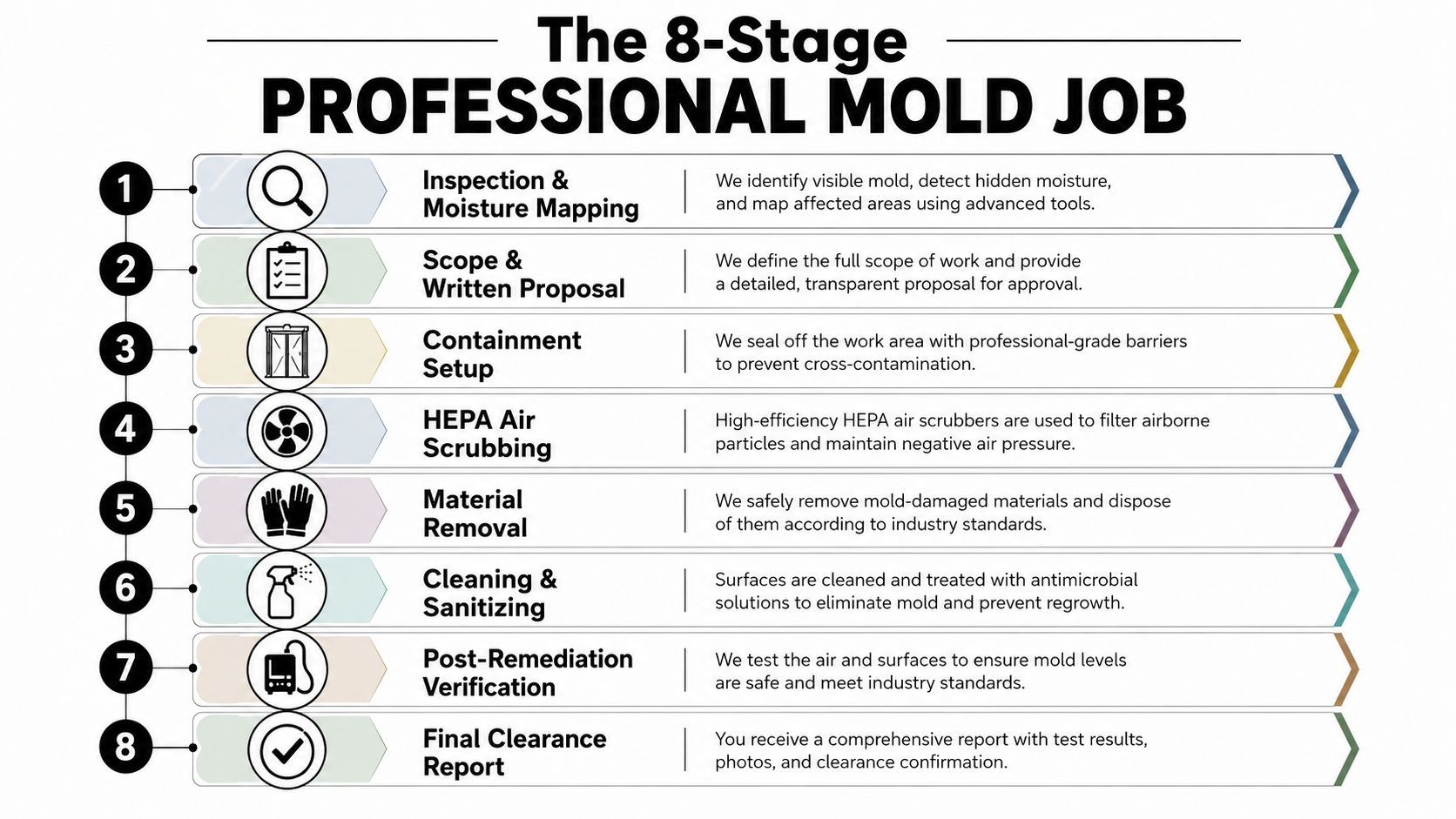
A good mold job starts with a wet map, not with a sledgehammer. The crew needs to trace where moisture traveled, because visible growth only shows part of the problem. If the contractor skips that step, they are guessing, and guessing is how jobs get reopened later.
The inspection phase should identify wet materials, affected surfaces, and the likely source of the leak or intrusion. Then the crew gives you a written scope, not a vague promise. That scope should say what gets removed, what gets cleaned, what gets dried, and what gets checked before rebuild starts. If you want a homeowner-friendly way to keep the job on track, use a mold inspection checklist before anyone starts opening walls.
The job should tighten up, not spread out
Containment comes first once the work zone is set. Crews isolate the area, seal HVAC registers, and put the space under negative pressure so particles move toward the work zone instead of drifting through the house. A serious crew treats that setup as the line between a contained repair and a spread contamination problem.
After that, the work should follow a clear order.
- Inspection and moisture mapping. The contractor identifies the wet spots and the likely source.
- Written scope. You should know exactly what's coming out and what stays.
- Containment setup. Plastic barriers, sealed vents, and negative pressure.
- HEPA air scrubbing. Air filtration runs while work is underway.
- Material removal. Porous and badly damaged semi-porous materials come out.
- Drying. Dehumidifiers and air movement bring the structure back to target.
- Cleaning and treatment. HEPA vacuuming and damp wiping clean the surfaces left behind.
- Verification. Someone checks the space before rebuild starts.
The drying step is where sloppy crews cut corners. Industry guidance says wet building materials should be dried within 24 to 48 hours to limit colonization, and some protocols say visible mold exposed to moisture content above 17% should be remediated. NORMI's recommended licensing regulations also say affected materials should be dried to accepted moisture levels before reconstruction.
Practical rule: if the contractor can show you clean-looking surfaces but cannot show moisture verification, the job is not done.
The homeowner should treat the job like quality control, not spectatorship. Ask for readings, ask where the moisture came from, and ask what was removed versus what was left in place. If you want another reference for how organized a proper inspection should be, compare it with the mold inspection checklist, then make sure the site work matches the paperwork.
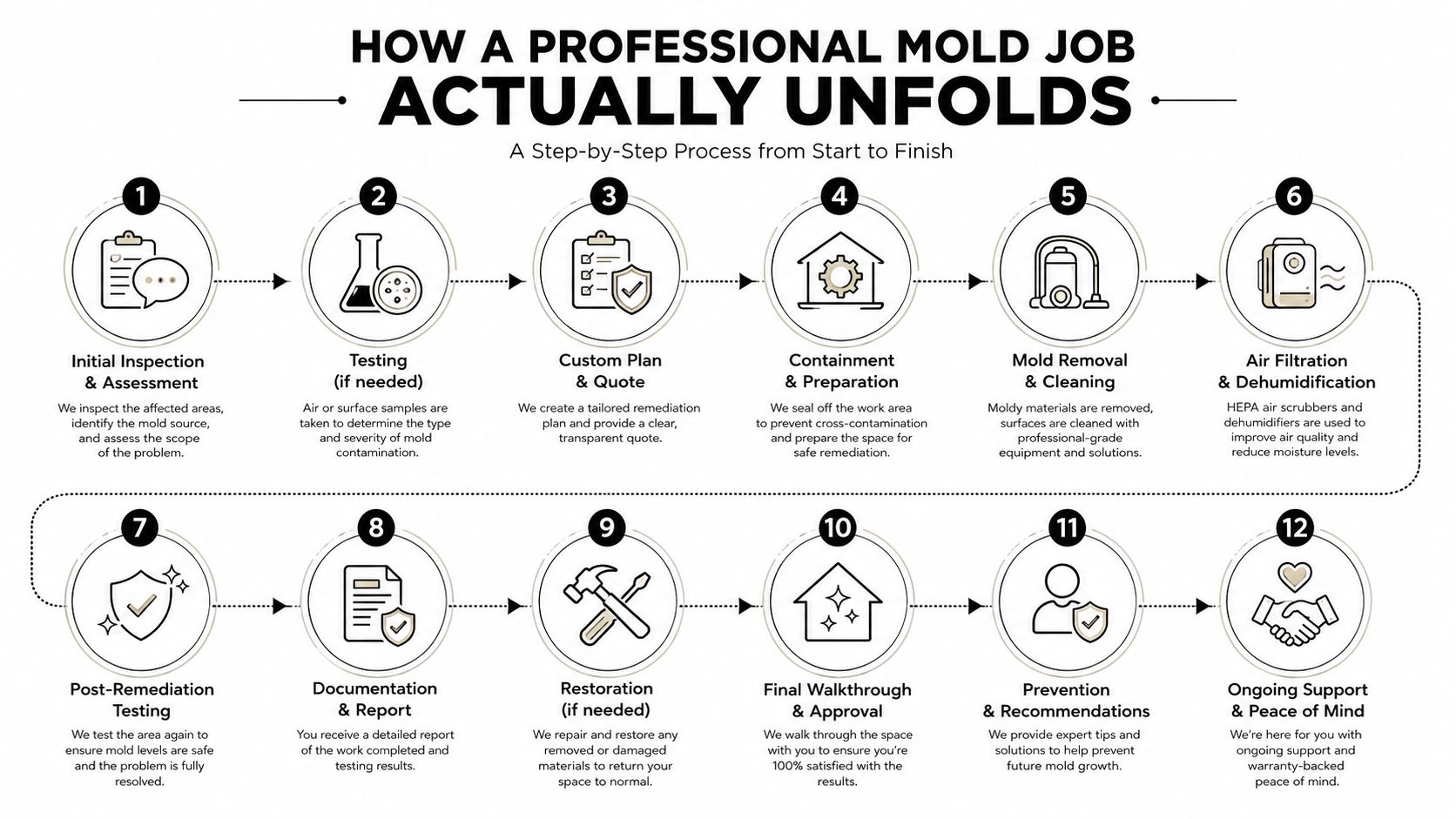
The daily rhythm should be easy to read. Day one is inspection and containment. The middle of the job is removal and drying. The last phase is verification, not a quick cleanup pass. If the crew is serious about safety systems on site, their process should line up with ISO 45001 requirements and costs, because disciplined work practices show up in how the job is run.
Credentials That Matter
Credentials do not clean mold by themselves, but they tell you whether the person across the table understands the trade. The IICRC's Mold Remediation Specialist credential requires 12 months of mold-remediation field experience, a current government-issued photo ID, and a $150 non-refundable, non-transferable application fee. Candidates are also told to log in at least 15 minutes before the exam time, which says the process is formal, not casual. IICRC's MRS page gives the mechanics.
State rules matter too. In Texas, the Department of Licensing and Regulation says it regulates and licenses people and companies that inspect, test for, clean up, and remove mold, and a licensed mold assessor must send collected samples to a licensed laboratory for analysis. In Florida, the state says it licenses individuals, not mold-assessment or mold-remediation businesses, and each licensee must complete 14 hours of continuing education within each biennial licensure period. Texas mold FAQ and Florida mold-related services FAQs are the sources to check.
Ask for paperwork, not reassurance
A thin resume is easy to spot if you know what to ask for. Ask for the license number, proof of insurance, the written scope, and the post-remediation report. If a company cannot produce those without stalling, that tells you more than a sales pitch ever will.
For safety and compliance structure, a resource like ISO 45001 requirements and costs helps you see how organized companies document risk and control their processes. That mindset matters in remediation, even if the exact standard differs from job to job.
| Credential | What it covers | What to verify |
|---|---|---|
| IICRC MRS | Field experience and remediation process knowledge | Experience proof, application status, exam readiness |
| Texas licensing | Mold assessment and remediation regulation | Active state license and lab handling chain |
| Florida licensing | Individual licensing and continuing education | Current individual license and education record |
| DC insurance threshold | Liability and mold-related pollution coverage | Policy limits and specific mold coverage language |
One more hard rule. Washington, D.C. says all mold professionals must maintain general liability insurance of at least one million dollars, unless covered under an employer policy, and the coverage must include mold-related and general pollution claims. That is the kind of detail that separates a real operator from someone hoping nobody asks questions. DC mold requirements and standards lays it out.
If you want the paperwork to line up with the work, start with a bonded and insured contractor and verify the coverage before anyone opens a wall. A licensed, bonded, and insured option like Restore Heroes fits the kind of paperwork-first approach I would want a homeowner to demand.
What Mold Remediation Costs and Why It Varies
Homeowners usually ask for a price before they want the scope. That is backwards. The actual number depends on what is wet, what is damaged, what can be dried, and what has to be removed.
The biggest cost driver is still the amount of material affected. A small patch of drywall behind a sink is one kind of job. A crawlspace, attic, or wall cavity with hidden spread is another. Porous materials usually push the work harder than non-porous surfaces because they are harder to clean with confidence.
The job also changes fast once the contractor opens the area. If the mold is tied to a slow leak, the scope often grows as more damage shows up. If the problem stops at the surface, the work stays narrower. If framing, insulation, or flooring is involved, expect more labor, more containment, and more drying time.
A straight bid tells you what the contractor thinks they will remove, clean, dry, and verify. A sloppy bid just gives you a number and leaves the rest to guesswork.
Compare the bid against the job, not against a neighbor's story
A contractor who gives you one flat number without explaining the work is asking you to trust the wrong thing. Ask how they priced removal, drying, containment, and verification. Ask whether independent clearance testing is included or separate.
Use this checklist when the estimate lands:
- Affected area: What rooms, cavities, or concealed spaces are included?
- Material type: Are drywall, insulation, framing, or flooring involved?
- Drying time: How long are dehumidifiers and air movers expected to run?
- Verification: Who confirms the job is ready for rebuild?
- Documentation: Do you get a written scope and post-remediation report?
Insurance changes the conversation, but only partly. Water-loss claims tied to a sudden event are often handled differently from long-term moisture issues, so the paperwork has to be clean. If the estimate is vague, the adjuster has less to work with and you have less power to verify what was truly done.
For a local pricing framework, this how much does mold remediation cost page is a practical reference point, but it should never replace an itemized scope from the contractor standing in your house.
The cleanest bids are the ones that break the job into pieces. If the company cannot explain the removal, drying, and verification steps, the number on the page does not mean much.
How to Verify the Job Was Done Right
This is the part most homeowner guides skip, and it's the part that keeps you from paying twice. Hiring mold remediation specialists is only half the job. The other half is making sure the moisture problem was fixed and the wall did not just get dressed up.
Start with the paperwork. The written scope should spell out what was removed, what was cleaned, what was dried, and what stayed in place. The post-remediation report should show the job from start to finish, not just the final cleanup. If you want a straight answer on what a solid remediation process should look like in your area, the mold remediation Phoenix AZ page is a useful local reference.
Independent clearance testing is the safer route. When the company that did the work signs off on its own job, that is a built-in conflict. This overview of mold professional questions points right at that problem. A third party gives you a cleaner answer, and it gives the adjuster something harder to argue with.
What to check before you sign off
Before you approve teardown or final payment, check the job like a quality-control manager, not like a relieved homeowner. The contractor should be able to show you proof, not just talk you through it.
- Moisture readings in target range. Wet material has to be dry enough to stop supporting growth.
- No visible growth on sealed surfaces. Clean surfaces should look clean, not blotchy or patched over.
- HEPA equipment logged for the job. Air scrubbers should be documented during containment and cleaning.
- Negative pressure documented. The work zone should have stayed isolated from the rest of the house.
- Independent clearance, if possible. A third party should confirm the space instead of the remediator grading their own work.
- Final report in writing. You need a paper trail for insurance and resale questions.
The best mold job is the one you can prove with documentation, not the one that smells better for a week.
Do not get distracted by fresh paint or new drywall. Those can hide sloppy moisture control fast. If the readings, photos, and report do not match up, the job is not done, no matter how clean it looks.
Watch how the handoff is handled, too. A good company will tell you when containment comes down, when verification happens, and what has to be true before rebuild starts. If they rush the sign-off, they are protecting the schedule, not your house.
If the work affected indoor air quality or a larger facility system, this improve facility air quality article is a smart companion read for property managers who need to think beyond one room and into the whole building.

If you need help now, use a company that can handle the full job instead of only the cleanup. For local support, review the Phoenix mold remediation page and ask for the documents before you approve the work. You want the written scope, the moisture readings, and the final report to line up with what happened in the house. Ask for the paperwork first, then decide.