
Most dehumidification advice starts with a simple command: turn the setting as low as it will go. That sounds sensible until the machine runs continuously, the room heats up, the utility meter climbs, and wood materials lose moisture faster than the structure can safely tolerate. In restoration work, the objective isn't zero humidity. It's controlled drying, measured against material moisture, indoor conditions, and the moisture load entering the air.
The dehumidification process removes water vapor, but it also consumes energy and changes temperature. A good drying plan keeps the affected materials moving toward equilibrium moisture content while limiting mold-friendly humidity, protecting finishes, and avoiding unnecessary runtime. The field question is therefore more useful than “How dry can I make this room?” It's “What level of drying solves the damage without creating a second problem?”
Why Lower Humidity Is Not Always the Right Goal
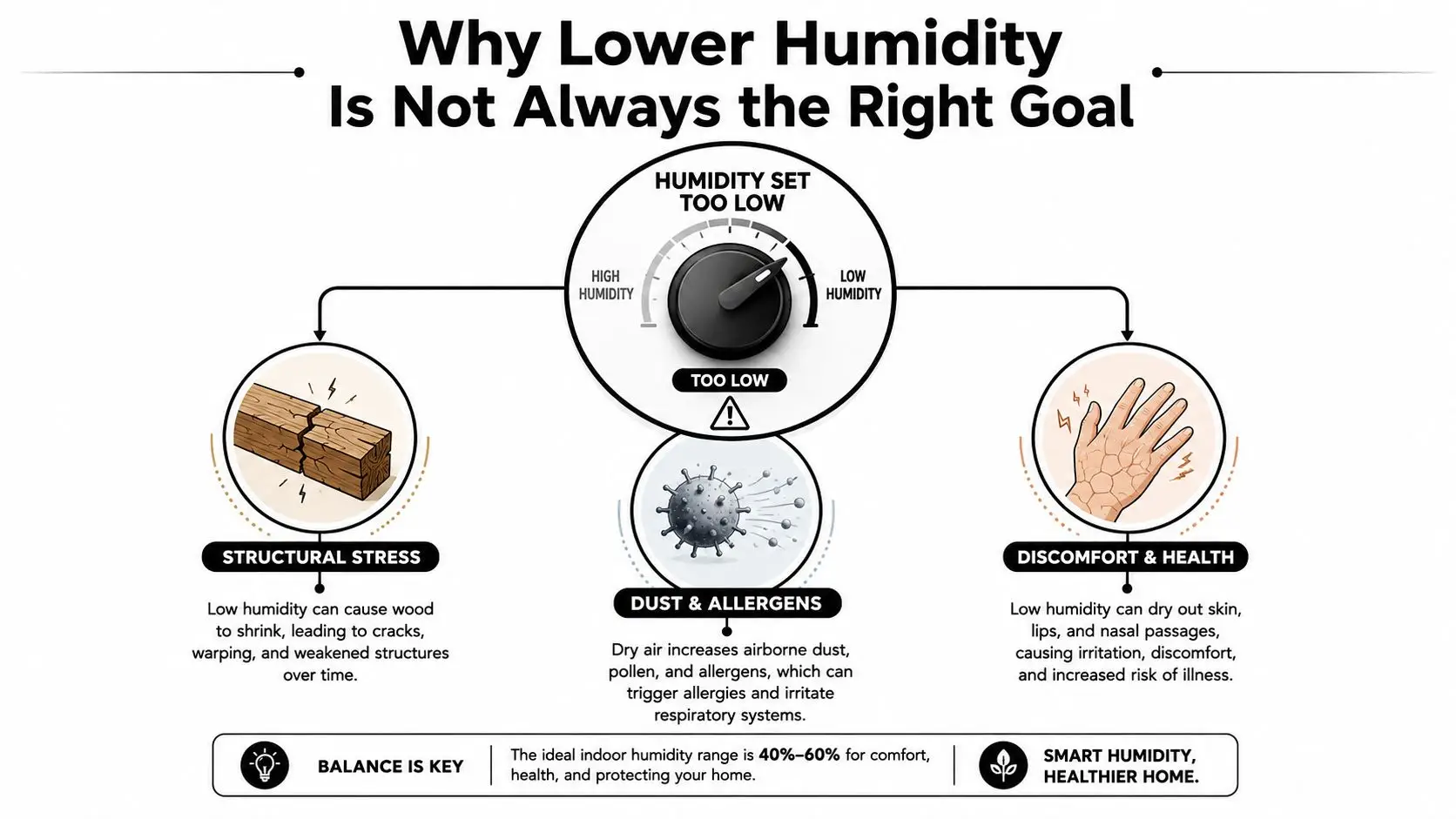
Lower humidity isn't automatically better. A dehumidifier set aggressively low can keep extracting moisture after the affected wood, flooring, or drywall has reached a reasonable drying condition. That extra runtime still costs electricity, adds heat to the space, and may pull moisture from materials that shouldn't be pushed further.
The practical target is a balance between mold prevention, occupant comfort, material safety, and operating cost. A widely used indoor control ceiling is 60% relative humidity, and ASHRAE-related guidance evaluates humidity control at 65% RH or less under design conditions in its ventilation standard addendum. That doesn't mean every job should be driven to a fixed low number. It means the technician must understand the moisture load and verify the materials.
Drying the structure, not chasing a dial
Wood responds to its surrounding air. If a technician strips moisture from a floor assembly too aggressively, the material can shrink, open joints, crack, or develop finish problems. Sensitive contents and electronics can also suffer when heat and low humidity rise together. That's why I look for stable readings and material trends, not a dehumidifier display that happens to show a lower RH.
The same judgment applies to seasonal maintenance. Homeowners dealing with wood flooring can use this guide to seasonal wood floor care alongside professional moisture measurements. The point is to keep the environment compatible with the material, not to make the air as dry as possible.
Field rule: Stop treating RH as the only finish line. Compare room conditions with moisture-meter readings from unaffected and affected materials.
A 40% RH target in a cool crawl space may require substantially more machine runtime than a higher, still-controlled target, especially when the space has limited moisture gains. In hot-humid buildings, supplemental dehumidification energy is highly sensitive to the set point. One building analysis found source-energy penalties of about 12.6% to 22.4% at a 50% RH target, compared with roughly 1.5% to 2.7% at a 60% RH target in its humidity-control assessment. Lower isn't free, and it isn't always necessary.
When indoor air quality is part of the concern, air quality testing can help separate a humidity problem from other indoor contaminants. Testing doesn't replace drying measurements, but it prevents the team from using extreme dehumidification as a cure for an issue the machine can't solve.
How the Dehumidification Process Works
Warm air carries more water vapor than cool air, but the air itself does not hold water like a container. Its moisture condition depends on temperature, vapor pressure, and the amount of vapor per mass of dry air. That relationship determines whether a dehumidifier can condense moisture efficiently and how much energy the drying cycle will consume.
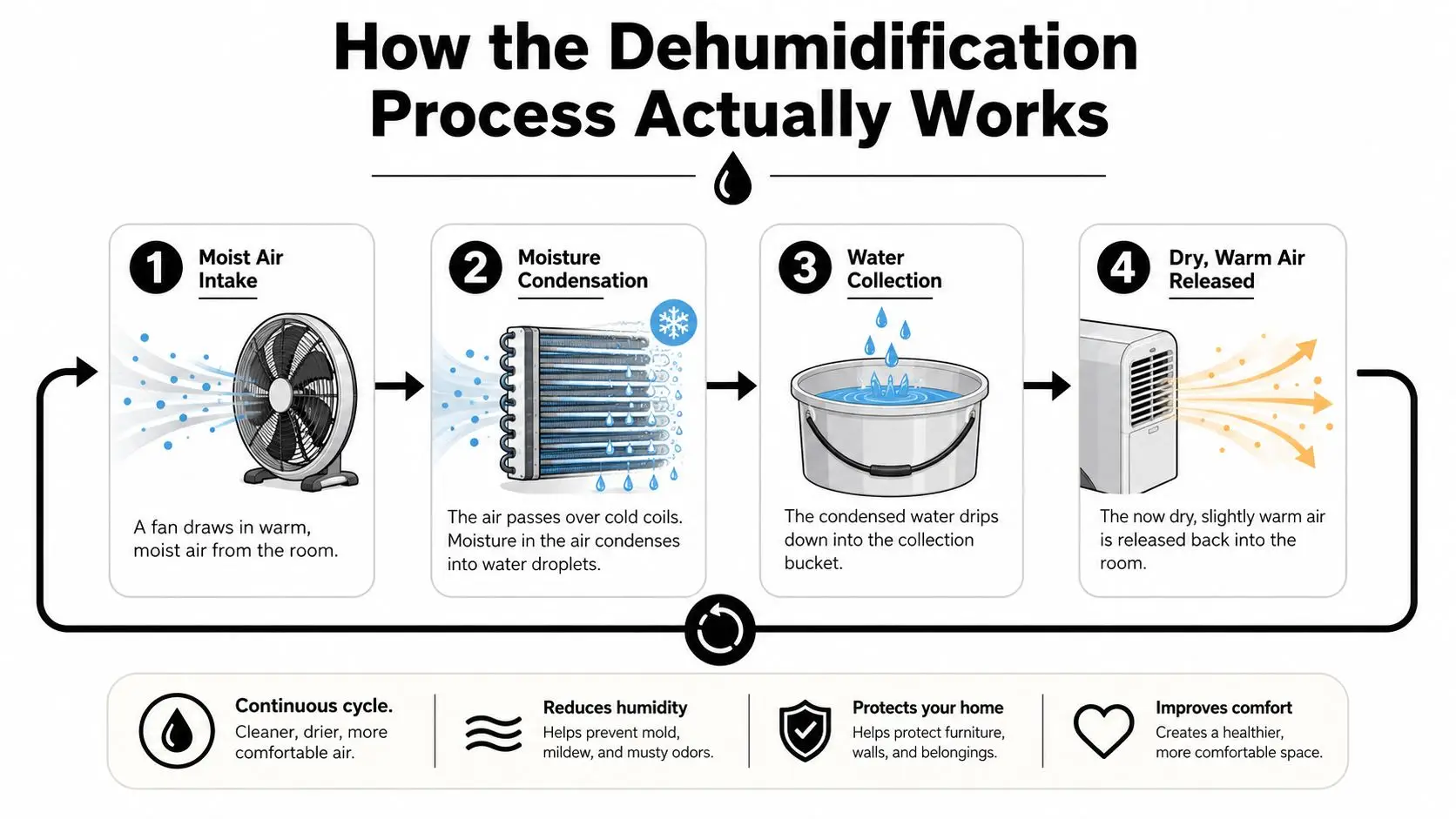
In a refrigerant dehumidifier, a fan draws humid air across a cold coil. The coil surface must be below the entering air's dew point. Air first cools sensibly until it reaches saturation. Further cooling condenses vapor on the coil, and the machine collects or drains the water before reheating the leaving air with heat produced inside the system. The process therefore removes latent heat and sensible heat, rather than drying the air without changing its temperature as described in these psychrometric notes.
The four parts of structural drying
A drying cycle works through four connected actions:
- Evaporation: Air movement and heat encourage water in wet materials to become vapor.
- Dehumidification: The machine removes that vapor from the air and lowers its humidity ratio.
- Air movement: Fans replace saturated air at the material surface with drier air.
- Temperature control: Warmer materials release moisture more readily, but excessive heat can damage finishes or distort contents.
The psychrometric chart shows these changes. Air moves horizontally at a constant humidity ratio while cooling toward its dew point. After saturation, continued cooling follows the saturation curve as vapor condenses, as explained in a technical explanation of how dehumidification appears on a psychrometric chart. Humidity ratio means the mass of water vapor per mass of dry air, often expressed as kilograms of water per kilogram of dry air.
Why temperature changes the job
A room at 65°F and 80% RH contains far less moisture than one at 85°F and 80% RH, even though the RH readings match. Cold rooms slow evaporation and reduce refrigerant capacity. Warmer rooms can release moisture faster, while also increasing the load placed on the dehumidifier.
Field decisions should account for the meter, not only the machine display. Technicians often track grain depression, the difference in grains per pound between supply and return air. A large depression indicates substantial moisture removal from passing air, but it does not prove that a wall or floor is dry. Record material readings, room temperature, RH, and the direction of change together.
For routine humidity control, guidance on managing humidity in your house addresses sources such as ventilation, cooking, and bathing. After a water loss, ordinary household operation may not provide enough air exchange or moisture removal. Commercial air movers, ducting, drainage, and monitoring become part of the system. Industrial drying fans can support the air-movement stage, but every added fan also uses electricity and may raise the room temperature.
A lower set point can extend runtime without improving material drying once the affected assembly has reached its target. Track moisture loss and utility use together, then adjust temperature, airflow, and dehumidifier operation to match the materials rather than chasing the lowest possible RH.
A short demonstration can make the airflow cycle easier to visualize:
Refrigerant vs Desiccant Dehumidifiers Compared
The most powerful dehumidifier is not automatically the right one. Refrigerant and desiccant machines remove moisture through different processes, so temperature, material type, and the target moisture level should determine the selection.
A refrigerant, or compressor-based, unit cools air below its dew point and condenses water on a coil. It generally performs well in warm, moisture-heavy rooms. As the air gets colder, capacity drops and coil icing becomes more likely. That lost capacity can extend runtime and increase electricity use without improving drying.
A desiccant unit passes air across a material that adsorbs vapor, then uses a regeneration airstream to release the moisture. It can continue working in cold or relatively dry conditions and can draw moisture from dense materials. The trade-off is regeneration heat, which raises energy demand and can increase the drying area's temperature. That heat may also require more cooling from the building's HVAC system.
| Performance Metric | Refrigerant (LGR) | Desiccant |
|---|---|---|
| Moisture removal conditions | Strong in warm, humid spaces | Strong in cold or low-humidity spaces |
| Energy profile | Usually more efficient for ordinary warm-air drying | Higher demand because regeneration requires heat |
| Heat added to the space | Produces noticeable reheat | Exhausts hot, dry air that needs management |
| Setup | Compact, drainable, and straightforward | Often needs ducting and careful air separation |
| Useful applications | General structural drying and high moisture loads | Cold losses, dense assemblies, and deep drying |
| Main limitation | Reduced capacity in cool conditions | Complexity, heat input, and maintenance demands |
Choosing by conditions instead of labels
A nameplate does not predict job-site results. Check room temperature, material type, air leakage, drainage, and expected moisture load before choosing equipment. These factors determine whether the machine produces useful grain depression and whether its runtime is justified by actual moisture removal.
Desiccants suit cold winter losses, hardwood, plaster, and assemblies where a refrigerant unit cannot maintain a sufficiently cold coil. They are not automatically the economical choice. A technical review of desiccant and liquid-desiccant dehumidifier systems describes potential advantages for deep dehumidification and regeneration, along with trade-offs involving heat, corrosion, maintenance, and system complexity.
Hybrid drying can fit changing conditions. A refrigerant unit may handle the heavy initial load in a warm area, while a desiccant supports the final stage or a colder enclosed assembly. Base that decision on readings and measured equipment performance, not on the assumption that more capacity always produces better results.
Homeowners should include equipment rental, delivery, drainage, and monitoring when estimating dehumidifier rental cost. A cheaper machine that runs longer may cost more to operate than a properly matched unit, especially when its heat causes the building's cooling system to work harder.
Real Operating Costs and Energy Trade-Offs
Electricity is the hidden cost of dehumidification, and aggressive drying can turn into a utility-bill problem after the materials have stopped responding. One federal field study measured portable dehumidifiers using 0.1 to 13.1 kWh per day, with an average of 5.9 kWh per day. It also recorded average power consumption of about 472.6 watts, while measured indoor moisture reduction during operation averaged -0.6485 g/m³ in its field data.
Those readings show why rated capacity cannot predict a household's bill. Runtime, entering humidity, room temperature, airflow, drainage, and moisture released by materials all affect the result. A unit may remove water efficiently in a wet basement, then consume power for little additional benefit in a cooler room that is already close to dry.
| Equipment Type | Daily kWh | Monthly Cost | Pints/Day | Heat Output | Best Use Case |
|---|---|---|---|---|---|
| Portable refrigerant | 0.1 to 13.1 measured range | Depends on local electric rate and runtime | Varies with conditions | Adds heat to the room | Household moisture control |
| LGR refrigerant | Job-site dependent | Depends on local electric rate and runtime | Varies with conditions | Adds heat and may increase cooling demand | Warm structural drying |
| Desiccant | Job-site dependent | Depends on local electric rate and regeneration runtime | Varies with conditions | Produces hot, dry exhaust | Cold or deep drying |
A monthly dollar estimate needs the local utility rate and the actual operating schedule. Field consumption can swing widely, so meter the equipment at the job site when operating cost matters instead of relying on the nameplate rating or marketing label alone.
When speed becomes waste
Fast drying earns its energy cost when it prevents secondary damage, keeps a business operating, or protects materials that are actively deteriorating. Continued operation becomes wasteful after affected-material readings stabilize and the machine keeps lowering room humidity without producing measurable progress.
Condensing 1 pound of water vapor requires about 1,000 Btu, while changing the temperature of 1 pound of material by 1°F requires roughly 1 Btu, according to historical energy analysis summarized in the technical literature energy analysis of dehumidification. Latent moisture therefore deserves attention during equipment selection, because removing vapor can require far more energy than changing material temperature.
A dehumidifier's heat output also changes the cost. In a hot climate, added room heat can make the air conditioner run longer. During cold loss, a desiccant's regeneration heater may be needed to maintain drying, but reduce or remove that load when readings show that the extra energy no longer produces meaningful progress.
Keep power data beside a moisture meter reading log. If RH falls while affected materials stop changing, reassess airflow, access, temperature, and the drying target before adding runtime.
Equipment Selection and Placement for Effective Drying
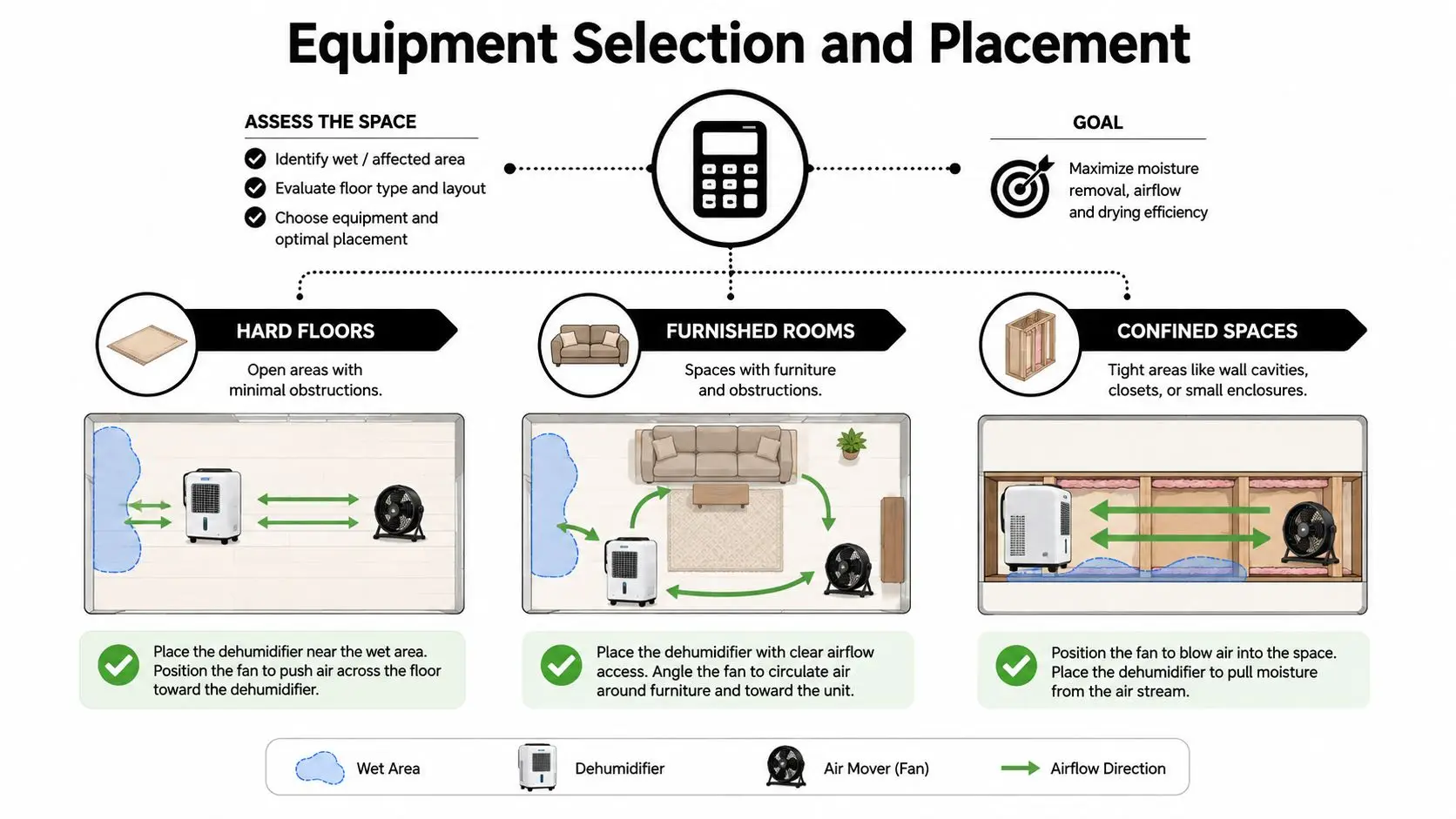
Equipment count matters, but placement often determines whether the machines can reach the moisture. A dehumidifier hidden in a corner may be technically running while receiving air that has already been dried, creating a short circulation loop. The wet wall, floor cavity, or contents remain under-served.
Start with the affected volume and material porosity, then compare the machine's tested capacity with the actual conditions. AHAM ratings can help compare household units, while restoration equipment should be evaluated using manufacturer data, airflow, operating temperature range, and field grain depression. Avoid treating a pint rating as a fixed promise. Capacity changes with entering air conditions.
Build a useful air path
Leave clearance around the intake and discharge. The commonly used 18-inch wall clearance rule helps prevent restricted airflow and recirculation, but the surrounding layout still matters more than the number alone. Keep the intake in the wetter part of the room, direct dry discharge across the space, and use air movers to sweep moisture away from material surfaces toward the dehumidifier.
For confined spaces, ducting can isolate the machine from the room and place dry air where it is needed. Desiccants require special attention because their process and regeneration airstreams must remain separated. A poorly routed hot exhaust can raise the room temperature without improving the affected assembly.
Monitor trends, not isolated readings
A practical monitoring routine includes:
- Room conditions: Record temperature and RH at consistent locations with a calibrated thermo-hygrometer.
- Air performance: Compare return and supply conditions to calculate grain depression and watch for falling output.
- Material response: Take readings at the surface and deeper in the assembly where accessible.
- Equipment position: Recheck airflow after moving furniture, containment, or ducting.
- Completion: Compare affected materials with unaffected reference materials in the same building.
Rotate equipment only when the readings show that another area has become the active moisture source. Moving a machine because a room “feels dry” can leave a hidden cavity untreated.
For a larger loss, structural drying services may include extraction, containment, air movement, dehumidification, and documented monitoring. The important feature isn't the number of machines. It's whether the setup creates a measurable path from wet material to dry air to moisture removal.
Common Dehumidification Mistakes to Avoid
A sealed room can still fail. On one type of job-site mistake, a contractor closes the room tightly but ignores the building's HVAC return path. The pressure imbalance pulls humid air from wall cavities and adjacent spaces, so the dehumidifier appears to work while new moisture keeps entering.
The correction is to inspect pressure, returns, door gaps, penetrations, and the source of replacement air before deciding that more equipment is needed. Containment should control the environment, not isolate the machine from the actual moisture source.
Four failures that repeat
- Cracked windows: Opening a window for “fresh air” can introduce humid outdoor air and defeat the controlled vapor-pressure difference. Ventilate only when the drying plan calls for it.
- Short-cycling: Placing an air mover directly against a dehumidifier intake can send dry discharge back into the machine. Separate the airflow paths so the unit processes moisture-laden air.
- Surface-only readings: A dry surface can conceal wet subfloor, insulation, or the center of a wood assembly. Probe deeper locations where the construction allows it and compare readings with unaffected materials.
- Premature removal: A room can feel comfortable while materials remain wet. Remove equipment only after the material trend, room conditions, and reference readings support completion.
Consumer equipment also has limits. A small household unit may be reasonable for a contained humidity problem, but Category 2 or Category 3 water losses require contamination controls, extraction methods, personal protective equipment, and professional judgment beyond ordinary humidity reduction.
A dry-looking surface isn't proof of a dry assembly. Moisture mapping prevents the most expensive assumption on a water-loss job.
Technicians should document daily conditions, machine placement, material readings, and changes in grain depression. If the data stop improving, the next step may be opening a cavity, correcting airflow, increasing temperature within safe limits, or changing technology. Running the same equipment longer isn't a diagnosis.
Your Action Plan for Water Damage Recovery
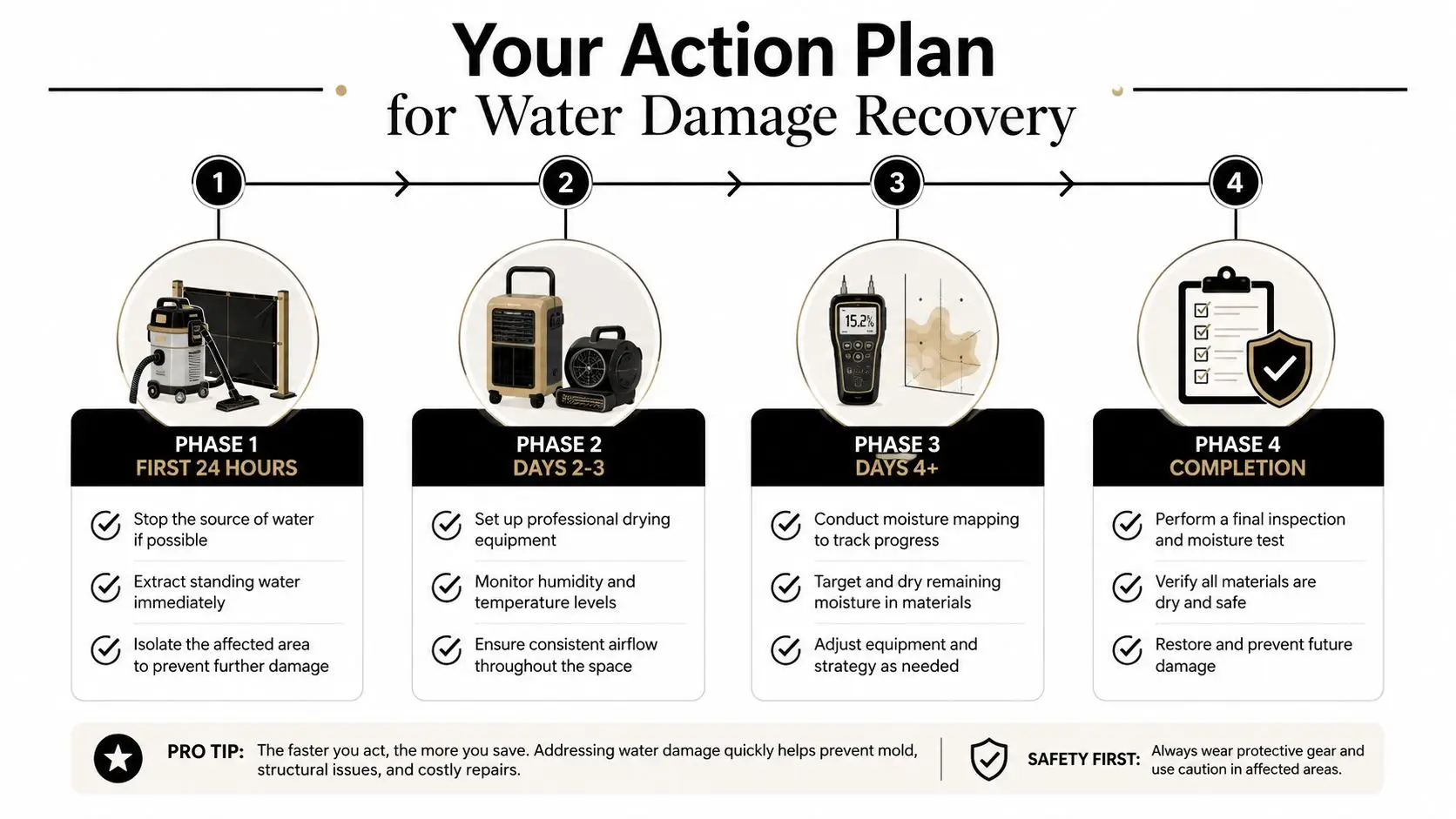
The first priority is source control and extraction. Stop the leak if it can be done safely, remove standing water, separate wet contents, and establish airflow across affected surfaces. Set dehumidifiers according to the affected volume and construction, then record the initial temperature, RH, material readings, and equipment locations.
Phase one begins immediately
During the first day, prioritize:
- Safety and source control: Address electrical hazards, contaminated water, structural instability, and the active leak.
- Extraction: Remove free water before expecting dehumidifiers to handle the load.
- Airflow: Position air movers to expose wet surfaces while avoiding short-cycling.
- Baseline documentation: Create a moisture map and record room psychrometrics before the setup changes.
The next phase is active measurement. Recheck conditions at consistent intervals, compare affected and unaffected materials, and inspect hidden areas. If a warm room produces strong refrigerant performance, keep that system properly positioned. If a cold or dense assembly shows weak progress, a desiccant may be more appropriate than adding another compressor unit.
Decide when to bring in a professional
A small, clean-water incident limited to accessible, nonporous materials may be manageable with careful extraction and monitoring. Call a certified restoration professional when water has entered wall cavities, insulation, flooring systems, HVAC pathways, or electrical areas, or when the category of water is uncertain. Professional help is also appropriate when readings stop improving, odor develops, contamination is present, or insurance documentation matters.
Daily logs should include equipment identification, room temperature, RH, material readings, affected locations, and changes made. Keep photographs and written notes with the moisture map. If contents must be moved out during drying, organized short term storage for one to three can reduce clutter and help technicians reach wet assemblies.
Finish by proving equilibrium
The final stage isn't the day the air feels normal. Compare the affected materials with unaffected reference materials in the same building and confirm that readings have stabilized. Remove equipment in stages when practical, then recheck the area for rebound moisture.
For prevention, keep indoor RH within a controlled range suited to the building and occupants, commonly around 40% to 50% when conditions allow. Inspect crawl spaces and basements, maintain HVAC equipment, correct drainage and plumbing problems, and watch for recurring condensation. In humid climates, the DOE found homes without supplemental dehumidification above 60% RH for 31.3% of monitored hours, while homes with dehumidification were above that threshold for 14.7% in its residential field study. The result supports targeted control, not blind over-drying.
Restore Heroes handles assessment, extraction, structural drying, moisture monitoring, odor removal, and sanitation for water-damage situations in the Phoenix metro area. Visit Restore Heroes to request an inspection and discuss a drying plan based on your building's materials, moisture readings, and operating conditions.