
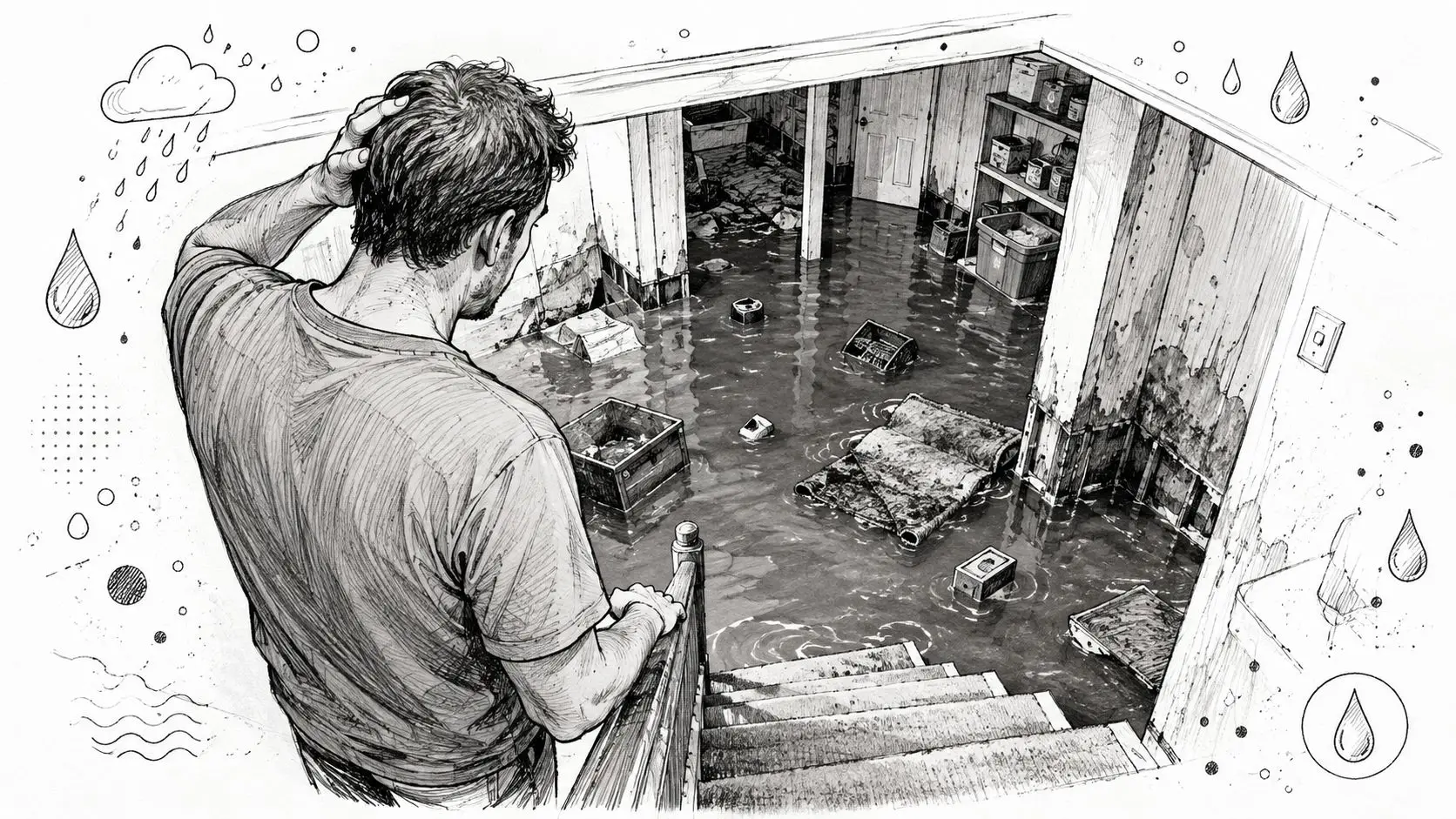
A Phoenix homeowner can go from a routine monsoon evening to a sewage emergency before the rain has even stopped. You walk downstairs and find contaminated water across the finished basement, soaked carpet underfoot, damaged drywall along the walls, and a sewage odor that makes the space unsafe to enter. Then comes the unsettling question: does your homeowners policy cover this?
For many homeowners, the answer is no unless they added a sewer backup or water backup endorsement. The premium may have looked minor at renewal, while the separate deductible, coverage limit, and distinction between sewer backup and flood damage remained easy to miss.
This guide gives you a practical way to decide whether sewer backup insurance is worth it. The decision comes down to four things: the condition of your plumbing, the amount of property at risk, the endorsement's limit, and the deductible you could pay without financial strain.
Why Homeowners Wonder if Sewer Backup Insurance Is Worth It
A finished basement makes the question more urgent. Carpet, baseboards, drywall, electrical components, furniture, stored belongings, and personal documents can all be affected when wastewater enters through a floor drain, toilet, tub, or sump system. Contaminated water also requires more than ordinary drying. Cleanup can involve extraction, disinfection, removal of porous materials, structural drying, and careful handling of items that may no longer be sanitary.
The homeowner usually discovers the coverage gap at the worst possible moment. A standard policy may cover certain sudden water losses, such as a burst supply pipe, while excluding sewage or water that backs up through a drain or sewer system. Independent insurance guidance notes that standard homeowners policies typically exclude sewer and drain backup, leaving the homeowner responsible without the optional endorsement (Real Cost Report explains the coverage gap and potential loss).
The decision starts with exposure
Ask what would be damaged if water rose across the lowest level of your home. An unfinished storage area with a concrete floor presents a different financial risk from a furnished living space with finished walls, flooring, electronics, and furniture. A slab-on-grade house also has a different exposure from a property with below-grade rooms.
Phoenix homeowners shouldn't treat monsoon-driven backups as a purely theoretical concern. Heavy rainfall can overwhelm local drainage conditions, while a blockage or restriction farther down the line can force wastewater toward individual homes. The risk depends on the address, the lateral line, the surrounding infrastructure, and the way water moves through the property.
The premium isn't the whole price
Many homeowners focus on the annual premium because it appears on the policy summary. The more important question is what happens after a loss. A separate deductible can consume much of a smaller claim, and a low coverage cap can leave you paying for the remainder of a large restoration.
Practical rule: Don't decide from the price of the endorsement alone. Read the limit, deductible, exclusions, and covered causes together.
The rest of the decision is straightforward. Compare the likely size of the loss with the cost of transferring that risk, then check whether you could handle the deductible and any amount above the endorsement limit.
What Sewer Backup Coverage Actually Is
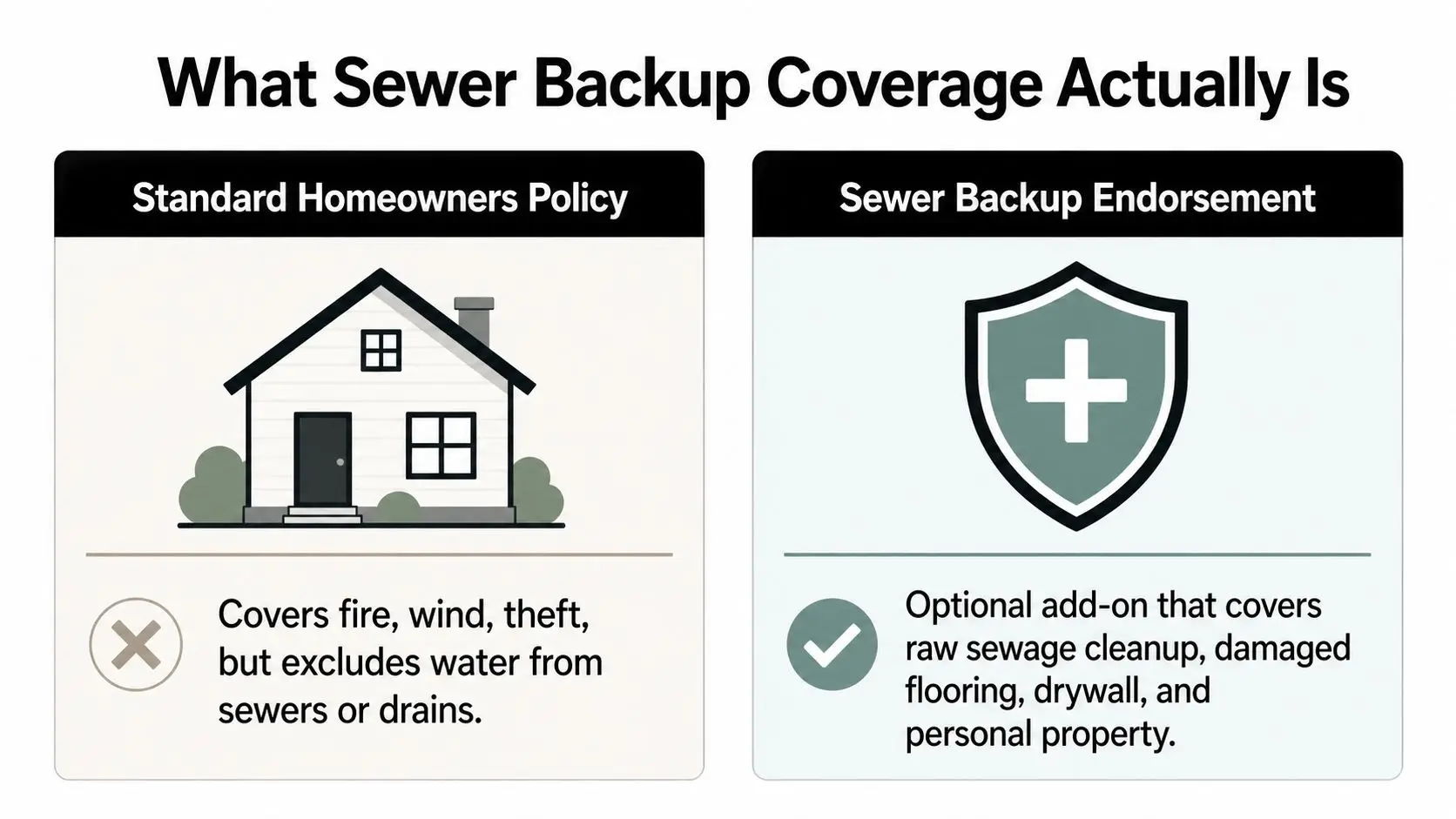
Sewer backup coverage is an optional endorsement, rider, or add-on attached to a homeowners, condo, or renters policy. It doesn't replace the base policy. Instead, it addresses a specific gap involving wastewater or water that enters through a backed-up sewer, drain, sump pump, or related system.
A useful analogy is an extended warranty for a washing machine. The original home insurance policy remains the main protection for covered events such as fire, wind, or theft. The added endorsement handles a narrower situation that the base policy generally leaves out. It isn't a general flood policy, and it doesn't automatically cover every form of water intrusion.
What the endorsement may pay for
The exact wording controls, but water backup coverage commonly addresses damage inside the home after a covered backup. Potentially covered work can include:
- Contaminated-water cleanup: Removal, extraction, disinfection, and sanitation of affected areas.
- Building repairs: Replacement or repair of damaged flooring, drywall, baseboards, and other covered components.
- Personal property: Replacement or restoration of belongings damaged by the backup, subject to policy terms and the selected limit.
- Additional living expenses: Some policies extend loss-of-use protection when a covered loss makes the home unsuitable for occupancy.
The endorsement normally carries its own coverage limit. That limit may be separate from the main dwelling limit, so a homeowner shouldn't assume the full replacement value of the house applies to a sewer backup. It also often has a separate deductible, which can differ substantially from the standard policy deductible.
What it doesn't automatically cover
A sewer backup endorsement generally isn't the same as flood insurance. Flooding from an overflowing river, lake, or other external source can fall under a different product or exclusion, while water entering through a drain or sewer may require the backup endorsement. The wording matters because the water's source and path into the home determine how the insurer classifies the loss.
The endorsement also may not pay to replace the underground service line itself. It can address resulting interior damage while leaving excavation and line replacement to a separate service-line coverage option or the homeowner.
For a plain-language explanation of how contaminated water moves through a plumbing system, review this sewer water journey breakdown. Phoenix homeowners can also compare the policy language with this guide to homeowners insurance and sewage backup.
The Real Numbers Behind Cost and Claim Severity
A sewer backup endorsement can cost little each year while protecting against a loss that reaches far beyond a routine plumbing repair. Water damage and freezing represented 22.6% of all homeowners claims in 2023, with average claim severity of $13,954 across 2018 through 2022 data, according to Insurance Information Institute figures summarized in an earlier water backup coverage analysis.
Those figures do not predict a Phoenix homeowner's specific loss. They show the scale a water claim can reach once contaminated water affects porous flooring, drywall, finished rooms, electrical areas, contents, and drying work.
Industry estimates commonly place water backup claims around $5,000 to $10,000, and some published estimates indicate that 35% of water backup claims exceed $10,000 (claim severity and premium ranges are discussed by Mitchell Joseph). Typical annual premiums are often cited at $50 to $250, based on the property, insurer, selected limit, and deductible. Some insurers price an initial $5,000 limit around $50 to $75, with higher limits available for an added annual cost.
Sewer Backup Cost vs Coverage Snapshot
| Item | Typical Value |
|---|---|
| Water damage and freezing share of homeowners claims in 2023 | 22.6% |
| Average claim severity across 2018 to 2022 | $13,954 |
| Common water backup claim range | $5,000 to $10,000 |
| Water backup claims exceeding $10,000 | 35% |
| Typical annual endorsement premium | $50 to $250 |
| First $5,000 of coverage in some pricing examples | $50 to $75 |
| Reported annual increase in sewer backup incidents | 3% |
| Average sewer line age cited by industry source | More than 30 years |
The deductible changes the answer
The annual premium is only half the calculation. Check the deductible, the coverage limit, and whether the endorsement addresses backup water rather than external flooding. Flood coverage is a separate issue, so a homeowner can pay for an endorsement and still have the wrong protection for water entering from an external source.
In Canada, some insurers have raised mandatory minimum deductibles for sewer backup and overland flood endorsements to as much as $2,500 in high-risk areas. Sewer backup and related external-water losses represented nearly a quarter of home insurance claims in 2025, as discussed by Canadian Underwriter.
For Phoenix homeowners, the practical test is direct. If you can pay the deductible without financial strain and the limit could cover the exposed finished space, adding the endorsement usually makes sense. Review realistic restoration costs in this sewage backup cleanup cost guide before choosing the limit, then check your insurance rates with My Policy and compare the actual terms, not just the headline premium.
Why Phoenix Homes Face Their Own Backup Risks
Phoenix homes face a different backup pattern from rain-heavy coastal cities. Long dry periods can be followed by intense monsoon rainfall in a short window, sending sudden flows toward drainage systems and sewer lines. That pressure can expose weaknesses in private laterals, neighborhood mains, drainage paths, and sump systems.
Older neighborhoods in central Phoenix and Glendale may still have clay or concrete sewer laterals. Desert soil shifts, mature mesquite and ash roots seek moisture, and aging joints can crack, separate, or collect debris. The warning may be subtle: several fixtures drain slowly, then wastewater rises through the lowest floor drain, toilet, or tub.
How a monsoon can change the pressure
A microburst can move water toward municipal drainage systems faster than those systems can carry it away. A restricted downstream line can push pressure back through a home's lateral and into the house. The contamination does not need to spread throughout the property to create a costly restoration. One finished room may contain porous flooring, drywall, furniture, and personal belongings that require removal, drying, and replacement.
Phoenix's relatively flat terrain creates another local concern. Gravity flow may be sluggish in some areas, allowing a downstream obstruction to affect several properties at once. Homes near the Salt River bed or in low-elevation pockets around South Mountain may have fewer natural paths for water to move away quickly.
The address matters more than a generic quote
A newer subdivision with PVC laterals has a different plumbing profile from an older home with clay or concrete lines. That difference does not remove the risk, but it can change the value of a camera inspection, backwater valve, and service-line review with the insurer.
Check the policy for sewer-backup coverage rather than assuming it includes flood water. An endorsement may address wastewater forced through drains, while water entering from outside can fall under separate flood coverage. Phoenix homeowners should match the protection to the property's drainage and elevation conditions.
After a backup, contaminated-water removal requires specialized handling, not ordinary household mopping. Property owners can review sewage backup cleanup services before an emergency to know whom to call and what information to gather.
Phoenix geography, aging infrastructure, mature landscaping, and monsoon intensity can combine in ways a quiet street does not reveal. Those local conditions are a practical reason to review the endorsement, deductible, limit, and flood exclusions instead of judging the coverage by its annual premium alone.
The Honest Pros and Cons of Buying the Endorsement
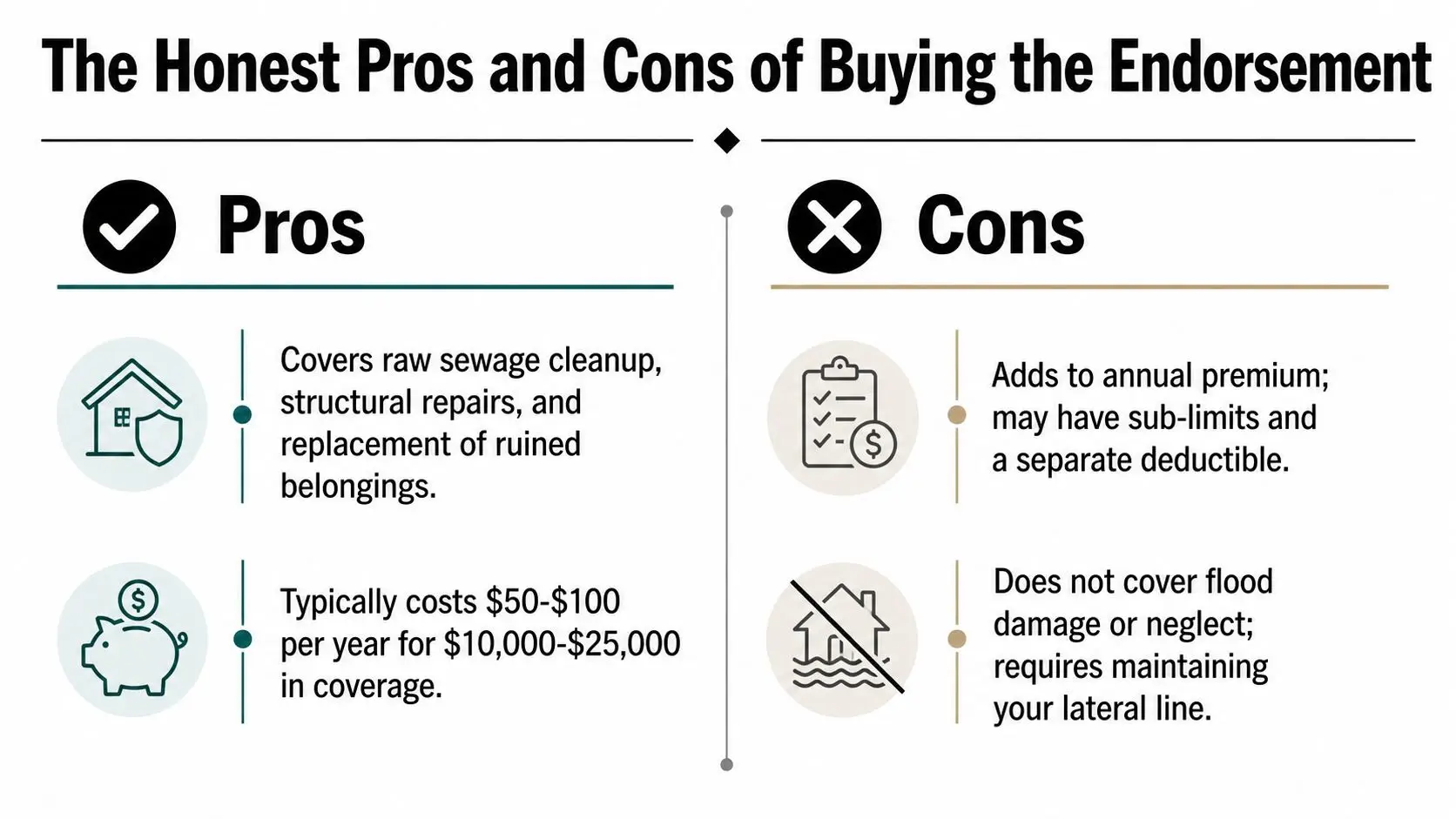
The endorsement is valuable because it transfers a specific, expensive risk. It isn't valuable because every water event falls under it. You need to compare the protection with the deductible, the cap, the exclusions, and your ability to self-fund a cleanup.
Where the endorsement helps
- It addresses contaminated cleanup: Raw sewage cleanup, sanitation, structural drying, and removal of damaged materials can be difficult to fund immediately.
- It protects exposed contents: Flooring, drywall, furniture, and personal property may be included up to the stated limit.
- It can support temporary relocation: If the policy extends loss-of-use coverage to a covered backup, additional living expenses may be available while the home is cleaned.
- It creates a defined claims path: Filing through an existing carrier is usually more practical than trying to arrange and fund a major response after the event.
Where it disappoints
The deductible can make a small loss financially unattractive. The coverage cap can also fall short when a finished below-grade area requires extensive removal, drying, rebuilding, and contents replacement. A homeowner who selects a low limit to save premium may discover that the policy pays only part of the actual restoration.
Flood confusion causes another problem. A survey reported that 38% of homeowners had not verified whether their policy included water backup coverage, and 41% had not confirmed service-line coverage (Insurance Business Canada reports on continuing flood and water coverage confusion). A sewer backup endorsement may cover water entering through a drain, while flood insurance addresses a different source of water. Neither option excuses maintenance neglect or automatically replaces a damaged underground line.
Filing a claim can also affect future premiums, depending on the insurer and claim history. The endorsement reduces financial exposure, but it doesn't prevent another backup. For broader context on how insurance incentives can shape behavior, see these real-world moral hazard examples.
Reducing Your Risk Before You Ever File a Claim
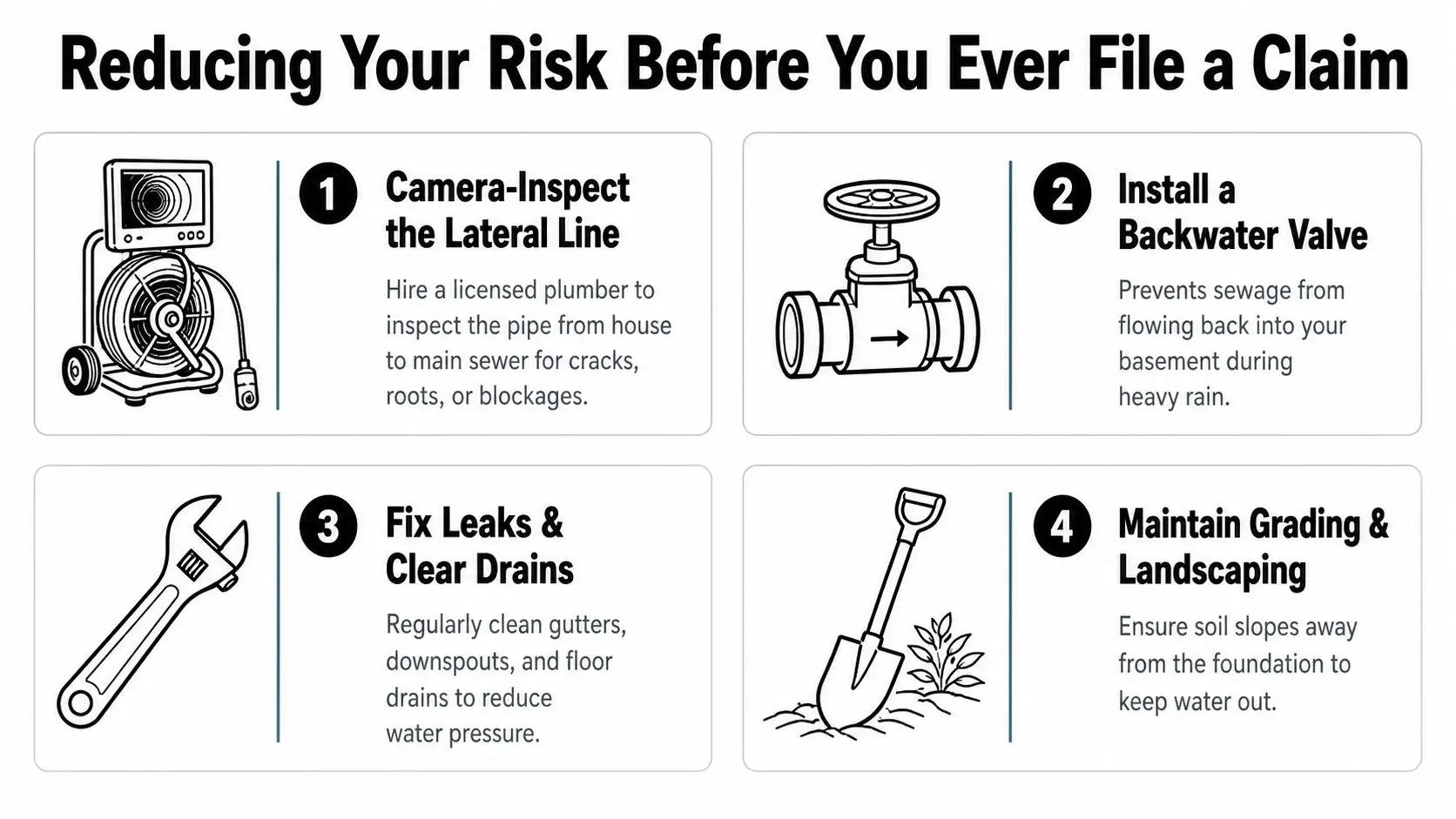
Insurance should support prevention, not replace it. Start with the sewer lateral, the pipe connecting your home to the municipal system. A licensed plumber can run a camera from the cleanout toward the street connection, checking for cracks, offset joints, root intrusion, and blockages before wastewater reaches the living space.
Older Phoenix homes deserve closer attention, especially where aging infrastructure and monsoon rainfall can expose weak points. Ask the plumber whether hydro-jetting or mechanical rodding fits the pipe's condition and whether recurring maintenance makes sense. Homes older than 25 years are commonly identified as candidates for regular attention, and an inspection can help determine the appropriate approach (NerdWallet outlines water backup prevention and maintenance considerations).
Install protection at the right points
A backwater valve is a one-way flap installed on the main lateral. If municipal flow reverses, the valve closes and helps keep sewage from moving toward the house. It needs an accessible location and regular inspection. A blocked or stuck valve cannot do its job.
A sump pump with a battery backup matters in homes with below-grade space. A storm-related power interruption can disable the primary pump when the property needs it most. Test the pump, inspect the discharge path, and keep the pit clear.
Watch the warnings
Several slow drains, a gurgling toilet, foul odors, or water rising in the tub when the washing machine drains can signal a main-line problem rather than an isolated fixture clog. Call a plumber before sewage enters the home.
Keep grease, cooking oil, wipes, and other clog-producing material out of drains. Use shower hair catchers, locate the main water shutoff and sewer cleanout, and direct gutters and downspouts away from the foundation. This plumbing inspection checklist provides a practical maintenance reference.
These steps reduce the chance of a claim, but they cannot remove every risk. A maintained line can still face municipal restrictions, extreme rainfall, or a failure outside the homeowner's control. That is why prevention and a sewer-backup endorsement serve different purposes.
Which Type of Homeowner Should Consider the Coverage
Use three filters: what can be damaged, how the plumbing is built, and how much cash you can access after a loss. That framework gives a better answer than relying on a neighbor's premium or a generic online recommendation.
Profile one has high exposure
A homeowner with a finished basement, older clay lateral, mature trees, and limited emergency savings is a strong candidate for the endorsement. The property contains more vulnerable materials, the plumbing has more potential failure points, and paying for contaminated cleanup personally could disrupt the household budget.
This owner should focus less on the cheapest option and more on a limit that reflects flooring, drywall, furniture, stored contents, and cleanup requirements. A deductible that looks acceptable on paper may still be difficult to fund during a major household emergency.
Profile two can reasonably self-insure
A slab-on-grade homeowner with newer PVC laterals, no sump pump, limited contents near floor level, and substantial accessible reserves may decide to self-insure. That choice is reasonable if the owner has deliberately set aside enough money for the deductible, cleanup, repairs, and temporary disruption.
Self-insurance isn't the same as having no risk. It means accepting the entire financial consequence in exchange for keeping the annual premium. The decision should be intentional, not the result of assuming the standard policy already includes backup protection.
Profile three needs a tailored middle ground
Many Phoenix homes land between those extremes. A homeowner may have an older line but no finished basement, or a finished lower level with a newer lateral. In that case, a higher limit, a backwater valve, a higher deductible, or stronger maintenance may change the calculation.
Renters and condo owners should also read their own policies. A landlord's or building association's insurance may not replace a tenant's belongings or cover every unit-level loss. Place yourself in the profile that best matches your home, then ask whether the deductible and limit fit your actual cash position.
My recommendation is direct. If a backup would force you to borrow money or abandon necessary repairs, buy the endorsement and choose the limit carefully. If you can absorb the loss and have low physical exposure, self-insuring can be defensible.
Smart Next Steps for Your Policy and Documentation
Don't wait for renewal paperwork to answer the important questions. Call the insurer or broker and ask for the endorsement wording, not just a verbal description of what it “usually” covers.
Use this checklist during the conversation:
- Availability: Is sewer or water backup coverage available for this property?
- Limits: What coverage limits can you select, and do they apply separately from the dwelling limit?
- Deductible: Is the sewer backup deductible separate from the standard policy deductible, and under what circumstances can it change?
- Exclusions: Does the policy exclude pre-existing line defects, neglected maintenance, or damage from an unrepaired condition?
- Flood distinction: How does the policy define flood, surface water, drain backup, and sewer backup?
- Loss of use: Does additional living expense coverage apply if a covered backup makes the home uninhabitable?
- Service lines: Does the policy cover interior damage only, or is underground service-line coverage available separately?
Build the file before the emergency
Photograph the sewer cleanout, sump pump, backwater valve, utility shutoffs, and vulnerable finished areas. Keep plumbing inspection reports, invoices, and maintenance records together. Create a current home inventory with photos, model information, and receipts where available, then store a copy off-site or in secure cloud storage.
This documentation helps establish the property's condition and contents before a loss. A clear insurance claim documentation guide can help you organize the records before they're needed.
If a backup happens, protect people first. Stay away from contaminated water near electrical equipment, stop using plumbing fixtures, and contact the insurer within the policy's reporting window. Photograph the damage before cleanup when it is safe, preserve damaged-item information, save emergency mitigation receipts, and avoid major repairs until the insurer has given direction, except for reasonable steps needed to prevent further damage.
For most Phoenix homeowners with finished lower-level space, older plumbing, or limited reserves, sewer backup insurance is worth adding. It isn't a guarantee of coverage for every water event, and the deductible and limit deserve as much attention as the premium. Read the endorsement, improve the plumbing risk where practical, and make the decision based on what your address and finances can withstand.
If a sewer backup has already affected your Phoenix-area property, Restore Heroes offers contaminated-water cleanup, structural drying, sanitation, and insurance coordination as part of its restoration services. Visit the team before the next emergency so you know where to turn for a professional assessment and mitigation response.