
You notice a warm patch on the floor, hear water moving when every faucet is off, or open a water bill that makes no sense. Because the pipe is hidden beneath the concrete slab, the first question is often urgent: does homeowners insurance cover a broken pipe under the slab?
The honest answer usually isn't a simple yes or no. Standard homeowners insurance often separates the water damage caused by the leak from the failed pipe that created it. Whether the claim applies can also depend on whether the leak was sudden and accidental, or whether it developed gradually through deterioration, poor maintenance, or another excluded cause.
The Unsettling Signs of a Hidden Water Leak
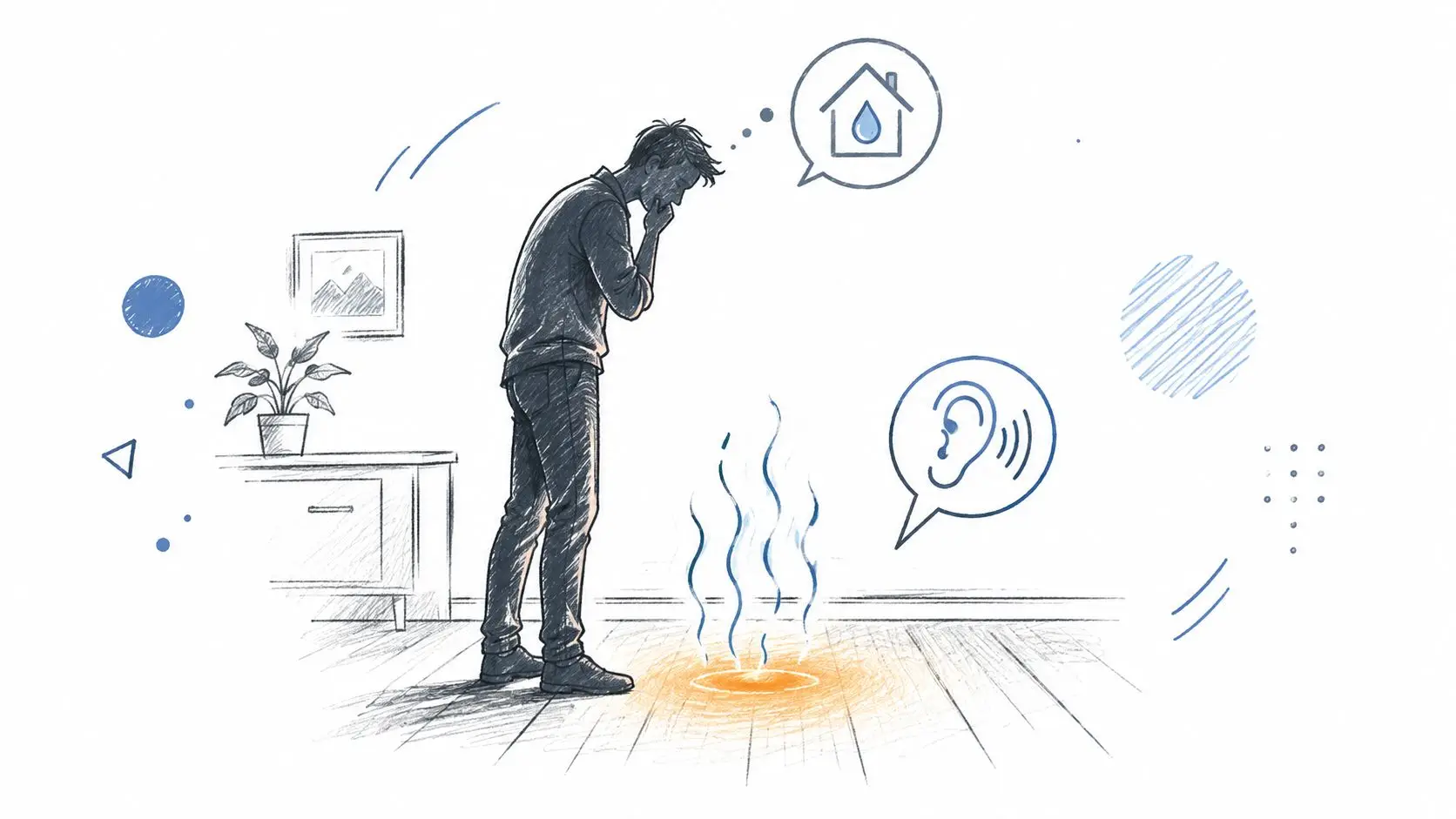
A slab leak often announces itself indirectly. You might walk barefoot across the floor and feel one area that's noticeably warm. You might hear a faint hiss or rushing sound from behind the walls even though the plumbing fixtures are turned off. Sometimes the first clue is damp flooring, a musty odor, unexplained cracks, or water collecting where no visible plumbing exists.
A sudden change in water use can also raise concern. If the meter continues moving while the household isn't using water, a hidden leak is one possible explanation. None of these signs proves that a pipe beneath the slab has failed, but each deserves prompt attention because water trapped below or around a foundation can affect flooring, drywall, belongings, and indoor air quality.
Why the answer feels confusing
Consider a homeowner who finds a wet baseboard near a room with a warm floor. A plumber confirms that a supply line beneath the slab is leaking. The homeowner may face several separate expenses:
- Finding the leak: Detection and diagnostic work.
- Reaching the pipe: Removing flooring or opening concrete.
- Repairing the pipe: Fixing or replacing the failed plumbing.
- Restoring the home: Drying materials and repairing affected finishes or belongings.
Insurance may treat each expense differently. The policy could respond to sudden, accidental water damage while excluding the pipe replacement itself. It could also question costs if evidence indicates that water seeped over an extended period.
A professional leak assessment can help identify the location and likely cause before assumptions shape the claim. Homeowners dealing with foundation concerns may also benefit from expert advice for slab foundation repair from Firm Foundations. For the plumbing side, a specialized slab leak detection service can help establish where the water is coming from and what needs to be opened.
The practical point is simple: don't wait for visible flooding before taking the warning signs seriously. Shut off water if you can do so safely, preserve what you observe, and ask your insurer how the policy handles both access work and resulting damage.
The Core Principle Damage vs The Pipe Itself
The most important distinction is damage versus source. A standard homeowners policy generally covers resulting sudden and accidental water damage from a broken pipe under a slab, but it usually doesn't cover the pipe repair itself. Policies may pay for removing and replacing the slab or other surfaces needed to reach the leak, along with repairs to floors, drywall, and belongings damaged by the water. The homeowner commonly pays to replace the failed pipe. Policy guidance explains this separation between resulting damage and the pipe itself.
A useful comparison is a washing machine hose. If the hose suddenly bursts, the policy may be concerned with the soaked flooring, damaged drywall, and cleanup required afterward. The hose itself is the defective component, so buying a replacement hose is generally treated differently from restoring the room.
Think of the claim as two columns
| Potential expense | How a standard policy may treat it |
|---|---|
| Water damage to floors, walls, or belongings | May be covered when the discharge was sudden and accidental |
| Drying and cleanup | May be covered as mitigation for covered resulting damage |
| Opening concrete or finishes to access the leak | May be covered when necessary to address covered damage |
| Replacing the failed pipe | Usually excluded under the base policy |
| Damage from long-term seepage | Often excluded or disputed |
This framework explains why an insurer might approve part of a claim and deny another part without treating the entire event identically. The policy isn't necessarily promising to make an old plumbing system new. It is generally designed to address an unexpected covered loss and the consequences that follow.
Practical rule: Ask for the claim decision to identify each category of work separately. “Covered” or “denied” may not describe every invoice in the same way.
The wording still controls. Your policy may contain exclusions, limitations, deductibles, and endorsements that change the outcome. A restoration contractor can document the physical damage, but only your insurer or qualified insurance professional can interpret the contract for your specific property and circumstances.
Understanding What Your Policy May Cover
Once the damage-versus-source distinction is clear, the next question is practical: which parts of the response may fall within the resulting-damage coverage? A standard ISO-style HO-3 water peril generally addresses accidental discharge or overflow of water from within a plumbing system. It typically excludes the plumbing system from which the water escaped, as well as constant or repeated seepage over weeks, months, or years. The policy form provides that water-peril framework and its exclusions.
Access is different from pipe replacement
A technician may need to remove tile, cut through flooring, or open the slab to reach a hidden line. Those access costs can be treated differently from the cost of repairing the defective pipe. If the event qualifies as a covered sudden and accidental loss, the policy may respond to necessary tear-out and restoration, subject to its terms and limits.
The same logic applies after the pipe is repaired. Water can affect several building materials at once, and each requires a documented response:
- Structural drying: Air movement and moisture control for wet building materials.
- Flooring restoration: Repair or replacement of affected tile, carpet, underlayment, or other finishes.
- Drywall work: Removal, drying, and replacement where water has damaged wall materials.
- Contents damage: Evaluation of belongings directly affected by the discharge.
- Mold remediation: Possible treatment when mold is a direct consequence of a covered water loss, though policy wording and the cause of the moisture matter.
The phrase sudden and accidental does important work here. A sudden break that releases water may receive different treatment from a small leak that continued unnoticed and saturated materials over time. The visible discovery date doesn't automatically establish the date the damage began.
Ask what evidence supports each cost
A drying company should record affected rooms, moisture conditions, equipment placement, removed materials, and completed work. Keep photographs, videos, plumber findings, estimates, invoices, and receipts together. If a cost is necessary to prevent additional damage or return the affected area to its prior condition, clear documentation gives the adjuster something concrete to evaluate.
For broader context on the relationship between water losses and insurance claims, see this guide to whether insurance covers water damage. Coverage isn't automatic, and no restoration provider can promise approval. The policy, the facts, and the evidence must align.
Common Exclusions and Reasons for Claim Denial
Claim disputes often begin with timing. A homeowner discovers water today, but the pipe may have been weakening or leaking for much longer. Insurers commonly distinguish an abrupt, accidental discharge from constant or repeated seepage, because standard policies are generally intended for unexpected events rather than routine maintenance or long-term deterioration.
A slowly corroding pipe may leave staining, dampness, odor, or material deterioration before anyone notices. If the available evidence points to gradual leakage, poor maintenance, or wear and tear, an insurer may treat the resulting damage as excluded. A sudden-looking discovery doesn't necessarily change that analysis.
Causes that can change the outcome
Insurance guidance states that a slab leak may be covered when it results from a sudden, accidental event such as a falling object or explosion. The same guidance identifies gradual leaks, poor maintenance, and earth movement as commonly excluded causes. Allstate's slab-leak guidance describes these covered-peril and exclusion distinctions.
Other questions may arise during an investigation:
- Was the water loss gradual? Repeated seepage can point to a maintenance-related condition.
- Did earth movement contribute? Soil movement or related foundation activity may fall outside standard coverage.
- Was the property maintained? An insurer may examine corrosion, deterioration, and delayed action.
- Is the loss flooding? Water entering from outside sources can be handled under different coverage than an accidental plumbing discharge.
- Did the homeowner take reasonable mitigation steps? Failing to stop an active leak or protect exposed materials can complicate the claim.
These categories don't determine your particular result by themselves. They show why the adjuster may request plumber reports, moisture readings, photographs, invoices, and information about when symptoms first appeared.
A claim file is stronger when it tells a consistent story: what you noticed, when you noticed it, what you did to limit damage, and what professionals found.
Don't guess about cause or exaggerate the timeline. Write down observations in plain language and preserve damaged materials when reasonably safe until the insurer or adjuster provides direction. A practical resource on water damage insurance claim tips can help you organize the conversation and records.
Optional Insurance Endorsements That Can Help
A base homeowners policy may address the damage caused by an accidental plumbing discharge while leaving the failed underground line outside the main coverage. That gap is where an endorsement can matter. An endorsement is an optional policy modification that adds, changes, or extends protection beyond the standard form.
Service line coverage is one example. It can provide protection for eligible underground utility lines, potentially including a water line serving the home, depending on the policy language, location, cause of failure, and exclusions. Optional service line endorsements can add roughly $10,000 to $25,000 of extra protection for underground utility lines, according to insurance coverage guidance. Review the explanation of service line endorsement limits and coverage gaps.
What an endorsement doesn't automatically solve
An endorsement isn't a universal repair promise. It may limit coverage by cause, location, type of utility, access requirements, exclusions, deductible, or maximum payable amount. Some policies may also distinguish between a service line outside the foundation and plumbing that serves fixtures within the home.
Ask your agent specific questions before relying on the add-on:
- Does the endorsement include water lines beneath a concrete slab?
- Does it cover locating the failure, excavation, access, and restoration?
- Does it cover the pipe itself, or only a defined underground service line?
- Which causes are excluded?
- What deductible and maximum limit apply?
- Does the endorsement coordinate with dwelling or water-damage coverage?
Read the actual endorsement, not only a summary on a quote. The name “service line” can sound broad, but the contract determines what the insurer considers an eligible line and covered failure.
The timing matters, too. An endorsement purchased after a leak is discovered generally won't retroactively cover a known loss. It works as a planning tool for future risks, alongside ordinary plumbing maintenance and prompt attention to warning signs.
Your Immediate Steps After Suspecting a Slab Leak
A suspected leak creates pressure to start breaking concrete immediately. Slow down long enough to protect people, limit additional damage, and create a clear record. Emergency action is appropriate, but it should be purposeful.
Follow this order
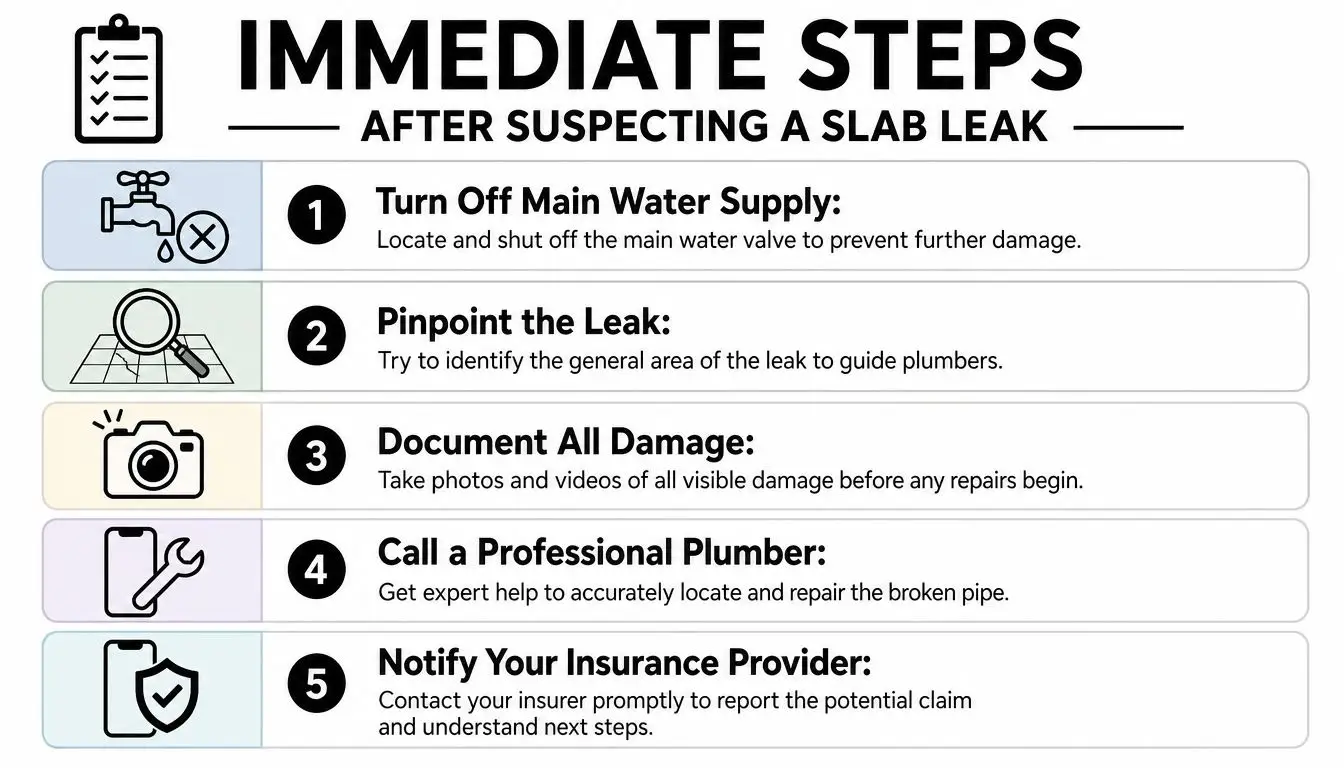
Turn off the main water supply. If you can locate the main valve and operate it safely, shutting it off may reduce continuing water release. If water is near electrical equipment, avoid unsafe contact and call for help.
Record conditions before disturbance. Photograph warm or wet flooring, staining, damaged walls, affected belongings, visible cracks, and any water around fixtures. Take video that shows the affected room and surrounding areas. Don't discard damaged materials before asking the insurer or adjuster how they want them handled.
Arrange professional leak detection. A plumber can help identify the general location and investigate the likely cause. Avoid authorizing unnecessary demolition before the source and required access route are understood.
Begin reasonable mitigation. A water damage restoration company can assess moisture, extract standing water, establish drying, and protect materials from additional deterioration. Restore Heroes is one Phoenix-area option that provides water damage restoration and coordinates documentation for insurance-related losses.
Report the loss to your insurer. Give the carrier the facts you know, including when you noticed symptoms and what steps you've taken. Ask what documentation, emergency work authorization, and adjuster inspection process it requires.
For help locating the home's shutoff, use this guide to finding an emergency water shut-off.
Emergency work shouldn't wait for a perfect claim decision if delay could worsen the property. At the same time, keep the work focused on stopping active damage and preserving evidence. Save every report, estimate, invoice, receipt, photograph, and communication.
The following video can reinforce the basic response sequence before a professional arrives.
Partnering with Restoration Experts and Your Insurer
A restoration professional doesn't decide whether the policy covers the pipe or the resulting damage. Their value is practical. They inspect the affected areas, measure moisture, record what materials were damaged, perform mitigation, and explain which work was necessary to stabilize the property.
That documentation can help the adjuster evaluate the loss. Insurers often reimburse mitigation and restoration work such as structural drying, flooring replacement, drywall repair, and mold remediation when those costs result from a covered leak. The failed pipe remains a homeowner expense unless an endorsement adds protection for it. The Texas Fair Plan endorsement language illustrates the importance of separating resulting damage from the system that failed.
What good documentation should show
A useful file connects the condition to the work:
- Initial condition: Photos and videos of affected rooms, finishes, and belongings.
- Moisture evidence: Readings and affected-material maps.
- Mitigation reasoning: Why extraction, removal, drying, or containment was necessary.
- Work records: Equipment logs, daily notes, estimates, invoices, and completion documentation.
- Plumbing information: The detected location, suspected cause, and pipe-repair scope.
This approach keeps the claim grounded in observable facts rather than a broad request to “cover the leak.” It also helps separate emergency stabilization from permanent reconstruction and pipe replacement.
Some homes require specialized access methods rather than extensive interior demolition. When the repair involves reaching a line beneath the foundation, homeowners may want to discuss under slab tunneling services with an appropriate foundation contractor. The right method depends on the property, pipe location, soil conditions, and professional assessment.
A qualified restoration company should communicate clearly with both the homeowner and the adjuster, while leaving coverage decisions to the insurer. For Phoenix-area homeowners, a water damage restoration contractor can help coordinate assessment, extraction, drying, and repair documentation. Choose providers carefully, ask what they will document, and confirm any work authorization before the scope expands.
The central question remains the same throughout the claim. What damage resulted from the event, what caused the pipe to fail, and what does the policy say about each part? Clear answers won't guarantee coverage, but they can make the process easier to understand and give every party a more reliable record.
If you suspect a slab leak in the Phoenix metro area, Restore Heroes can assess water damage, perform extraction and structural drying, and organize documentation for your insurance conversation. Contact the team promptly to discuss the visible damage, the mitigation needed, and the next practical step for your property.