
Yes, black mold that grows after water damage can be dangerous, because damp or moldy buildings are linked with respiratory symptoms, infections, and worsening asthma, and indoor dampness affects roughly 10% to 50% of indoor environments worldwide. The important question isn't whether the growth looks black, but whether moisture remains, how much material is affected, and who is breathing the indoor air.
You may be standing beside a wet ceiling, peeling baseboard, or dark patch that appeared after a burst pipe. The word “black” makes the problem feel urgent, but color alone can't tell you how hazardous the situation is. Water duration, hidden dampness, disturbance during cleanup, and household health conditions matter more.
The CDC says mold can irritate the eyes, nose, throat, skin, and lungs. It can also trigger allergic reactions and asthma attacks, while people with weakened immune systems can develop invasive mold infections after hurricanes or floods. The practical response is calm but quick: stop the water source, limit exposure, and make decisions based on moisture rather than appearance. The CDC's mold health guidance explains why untreated dampness deserves more than a cosmetic wipe-down.
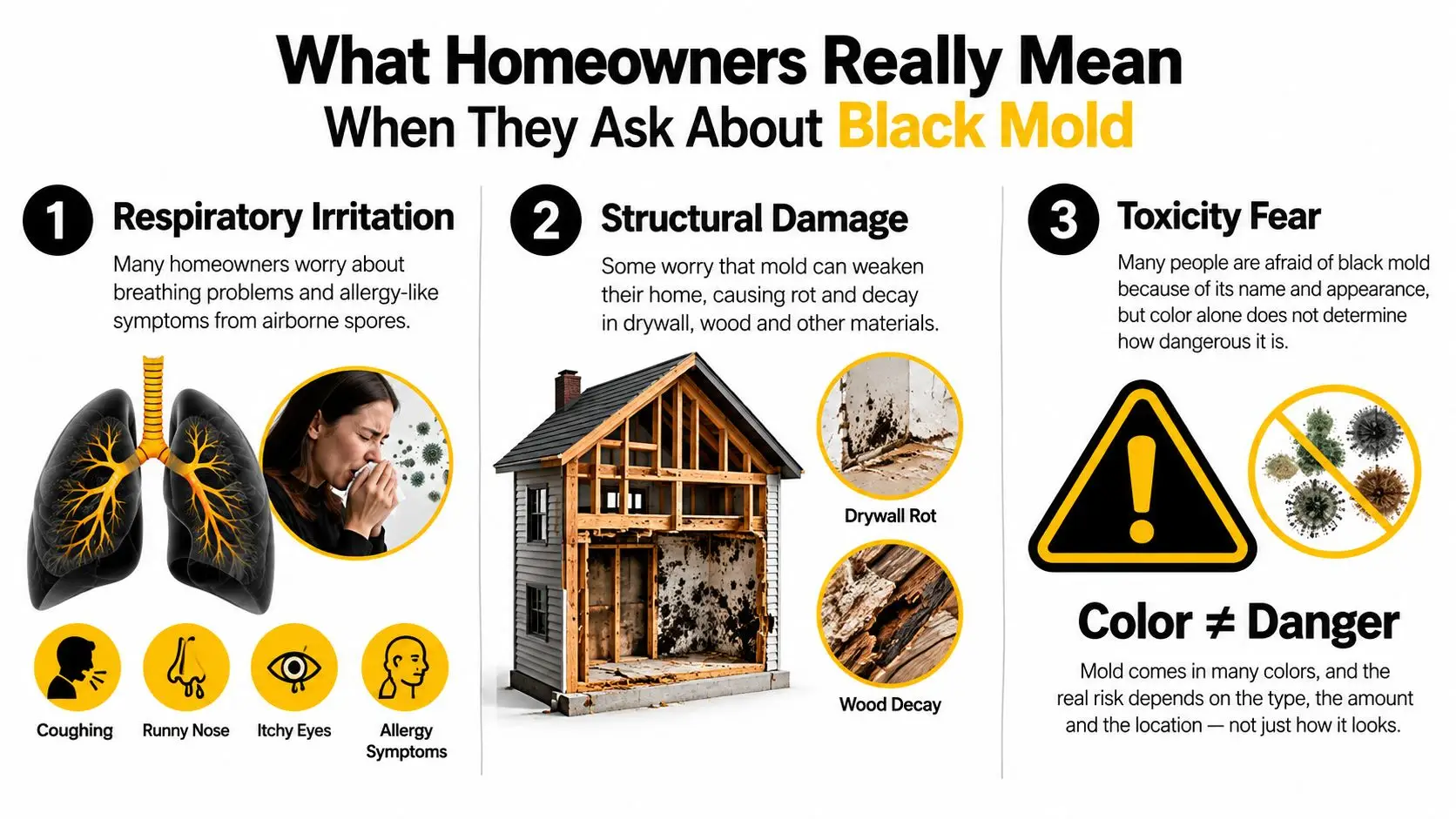
What Homeowners Really Mean When They Ask About Black Mold
After a leak, homeowners usually aren't asking for a species identification lesson. They want to know whether the air is safe, whether the building is being damaged, and whether waiting will make cleanup harder. Those are three different questions, and separating them prevents both panic and risky delay.
Respiratory irritation is the first concern. Mold-contaminated materials can release spores, cell fragments, and chemicals into indoor air. The World Health Organization reports increased risks of respiratory symptoms, respiratory infections, asthma exacerbation, allergic rhinitis, and asthma among occupants of damp or moldy buildings. WHO's indoor-air-quality review treats dampness as a public-health concern because moisture can affect many kinds of indoor environments.
Structural damage is the second concern. Drywall, insulation, carpet padding, ceiling materials, and some wood products can hold moisture where air can't reach them. Even if the visible patch is small, water may have traveled behind a wall, under flooring, or above a ceiling.
Delayed cleanup is the third concern. A stain that looks harmless can keep drawing moisture from a leaking pipe or roof assembly. The longer materials stay damp, the more likely a simple drying job becomes a contamination and removal project.
Color doesn't identify the hazard
Stachybotrys chartarum is commonly called true black mold, but other molds can also look dark. A homeowner can't reliably determine health risk from a photograph, a color label, or a home test alone. Public-health guidance emphasizes moisture control and exposure reduction rather than treating one color as automatically more dangerous than every other mold.
There also isn't a federal health-based indoor mold exposure limit that gives homeowners a simple safe-versus-unsafe number. That makes a moisture-based assessment more useful than trying to prove that a patch belongs to one feared category. For background on why dark growth can be misleading, see this explanation of what causes black mold in homes.
Practical rule: Treat the moisture source, affected materials, and occupant vulnerability as the risk assessment. Treat color as a visual clue, not a diagnosis.
How Water Damage Turns Into a Mold Problem
Mold growth after water damage follows a simple formula. Think of a wet wall like a sandwich. Moisture is the bread, building materials are the filling, and dormant spores are already in the surrounding air. Once the sandwich stays warm and damp, spores can begin germinating on drywall, wood, carpet padding, and ceiling tiles.
The critical early period is 24 to 48 hours, according to CDC flood and hurricane guidance on wet buildings and visible, extensive mold growth. CDC disaster guidance says buildings wet for less than 48 hours will generally support visible and extensive mold growth and should be remediated. The exact outcome depends on material, temperature, airflow, and the amount of water, but the decision shouldn't wait for a dark stain to appear.
The growth sequence
At first, growth may be hidden inside a wall cavity or beneath flooring. Later, you may see discoloration, fuzzy patches, or staining. If moisture continues, the building can develop persistent odors, weakened materials, damaged finishes, and contamination that reaches neighboring spaces.
An HVAC system can complicate the situation. If contaminated air or dust enters return pathways, the system may move particles beyond the original room. That's why a wet utility room, ceiling cavity, or air handler deserves attention even when the visible growth appears localized.
The water category also changes the cleanup approach, but it doesn't eliminate mold risk. Category 1 clean water, Category 2 gray water, and Category 3 black water can all create damp materials that support growth when drying is delayed. Gray and black water add contamination concerns, so porous materials may require removal rather than simple drying.
Roof leaks create the same moisture pattern as plumbing failures, even when the damage first appears as a ceiling stain. A useful companion resource on signs of roof water damage can help you investigate whether rain intrusion is keeping the assembly damp.
The first restoration priority is source control. Stop the leak or isolate the affected area, then arrange extraction and structural drying through a qualified water damage mitigation provider when materials are saturated, hidden, or contaminated.
Health Symptoms Linked to Mold After Water Damage
Mold exposure doesn't affect every person in the same way. The CDC lists stuffy nose, sore throat, coughing or wheezing, burning eyes, and skin rash among possible effects. People with asthma or mold allergies may experience severe reactions, while people with immune compromise or chronic lung disease can face lung infections.
A symptom-by-symptom view
The easiest way to interpret symptoms is to separate irritation from breathing trouble. Burning eyes after entering a damp room may reflect irritation. Wheezing, an asthma flare, or difficulty breathing deserves faster medical attention, especially if symptoms improve away from the building and return when you come back.
| Body System | Common Symptoms | Severity | When to See a Doctor |
|---|---|---|---|
| Eyes and skin | Burning eyes, itching, irritation, or rash | Usually irritating, but uncomfortable | Seek care if symptoms persist, spread, or become severe |
| Upper respiratory system | Stuffy nose, sneezing, sore throat, or congestion | Common allergic-type response | Arrange medical advice if symptoms continue or repeatedly return indoors |
| Lower respiratory system | Coughing, wheezing, chest tightness, or asthma symptoms | More concerning, especially for people with asthma | Seek prompt care for worsening breathing or an asthma flare |
| Lungs and sinuses | Persistent respiratory problems, hypersensitivity pneumonitis, or allergic fungal sinusitis | Rare but potentially serious | Contact a clinician, particularly if immunocompromised or symptoms interfere with breathing |
A damp building can also expose occupants to microbial fragments and chemicals, not just intact spores. The risk still depends on exposure conditions and individual sensitivity, not the color of the growth or a homeowner's guess about its species.
Use the indoor-air pattern as a clue
Notice timing without treating it as proof. Symptoms that worsen in a closed, musty room, interfere with sleep, or ease after leaving the property should prompt both a medical conversation and a moisture investigation. For a broader facilities perspective on indoor air, consider how ventilation, filtration, and building conditions interact.
Don't wait for a dramatic symptom if someone is struggling to breathe. Move the person away from the affected area and seek appropriate medical care. If the concern is concentrated in a lower level or basement, this guide to dangerous molds in basements provides additional context for hidden dampness.
Who Faces the Highest Risk From Water-Damage Mold
The same damp room can produce mild irritation in one occupant and a serious reaction in another. The CDC specifically identifies people with asthma, mold allergies, weakened immune systems, and chronic lung disease as groups that may experience more severe consequences. A household shouldn't wait for a vulnerable person to develop symptoms before controlling exposure.
People with asthma already have airways that can narrow and become inflamed. Mold exposure can trigger wheezing or an asthma attack. Those with chronic lung disease have less respiratory reserve, so a new irritant or infection can create a larger medical burden.
People with weakened immune systems face a different concern. The CDC warns that invasive mold infections can occur after hurricanes or floods in people whose immune defenses are impaired. This is not a reason to identify every dark patch as a medical emergency, but it is a strong reason to keep immunocompromised occupants away from contaminated materials and cleanup activity.
Infants, young children, and older adults may also need extra caution because breathing problems can affect them more quickly or be harder to recognize. Pregnant occupants and people with severe allergies should discuss significant exposure concerns with a clinician rather than relying on color-based internet advice. These groups don't all face the same mechanism or degree of risk, so individualized medical guidance matters.
| Population Group | Primary Health Concern | When to Escalate |
|---|---|---|
| People with asthma or mold allergies | Severe allergic reactions, wheezing, or asthma attacks | Escalate when breathing symptoms appear or worsen |
| Immunocompromised occupants | Increased concern for invasive mold infection | Keep them away from affected areas and contact a clinician promptly |
| People with chronic lung disease | Irritation, impaired breathing, or lung infection | Seek medical guidance for new or worsening respiratory symptoms |
| Infants and young children | Respiratory irritation that may be difficult to describe | Ask a pediatric clinician about persistent symptoms |
| Older adults | Greater concern when respiratory illness or chronic conditions are present | Escalate for breathing changes, weakness, or ongoing symptoms |
| Pregnant occupants and people with severe allergies | Individual sensitivity and uncertainty about exposure | Discuss significant or persistent exposure with a healthcare professional |
Risk rises with duration, concentration, and disturbance of contaminated materials. A healthy adult shouldn't assume repeated exposure is harmless, and a vulnerable occupant shouldn't be used as the test for whether a room is safe.
How to Tell If Mold After a Leak Is a Health Hazard
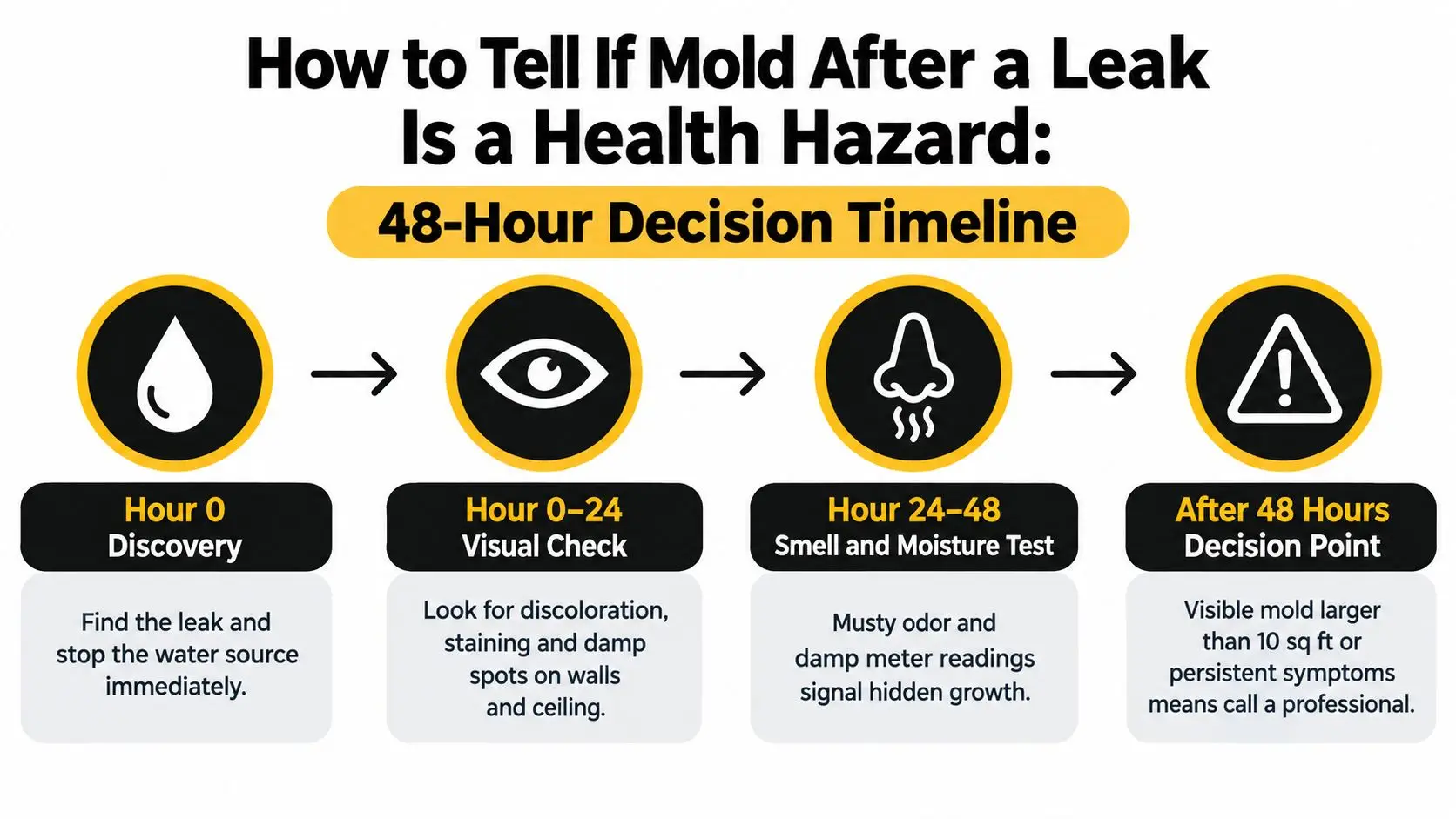
Start the clock when you discover the water, not when you see the first black mark. The CDC's flood guidance makes 48 hours a practical decision boundary because wet materials can support visible and extensive mold growth during that period. Your first task is to stop the source and prevent additional water from reaching walls, floors, ceilings, or contents.
The first day
During Hour 0, shut off the leaking supply when it can be done safely, address roof intrusion, and keep people away from electrical hazards or unstable areas. Between Hour 0 and Hour 24, document which rooms and materials are wet. Look for peeling paint, swelling, discoloration, dark speckling, and damp spots that spread beyond the original leak.
Moisture mapping is more reliable than smell alone. A moisture meter can identify wet drywall, subflooring, or framing that feels dry at the surface. Relative humidity readings can also show a persistently damp environment, but a single reading isn't enough to clear a wall cavity.
The second day and beyond
Between Hour 24 and Hour 48, check closed rooms, closets, behind baseboards, around supply and return vents, and inside accessible HVAC components. A musty or earthy odor that intensifies when a room is closed can point toward hidden moisture, but odor is a lagging indicator. Discoloration that returns after wiping suggests the source hasn't been corrected.
Don't use a household humidity reading or a visual inspection as a substitute for a full assessment. Visible growth covering more than 10 square feet or odor that continues after drying should trigger professional evaluation. This guide to what mold on drywall looks like can help with observation, but it can't establish whether growth extends behind the surface.
HVAC contamination deserves special care because cleaning ducts or air handlers can disturb settled material and redistribute it. If the system may be involved, consult a provider experienced in professional mold removal before turning affected equipment back on.
When and Why to Call Certified Remediation Professionals
Professional remediation is a health decision because cleanup itself can increase exposure. The CDC recommends avoiding areas where mold contamination is obvious and using protective equipment such as an N95 respirator, goggles, and gloves during cleanup. Its guidance also emphasizes environmental controls, clean hands and clothing, and protection from contaminated dust. CDC cleanup recommendations are especially relevant when demolition or removal will disturb moldy materials.
Situations that change the decision
Call for an assessment when the affected area is larger than 10 square feet, when HVAC equipment or duct pathways may be contaminated, or when sewage or floodwater entered the building. Hidden moisture inside walls, under flooring, or above ceiling tiles also warrants experienced investigation because surface cleaning can't reach those cavities.
A high-risk household member changes the calculation. If someone has asthma, severe mold allergies, chronic lung disease, or a weakened immune system, keeping that person away from the work zone is more important than trying a quick do-it-yourself scrub.
Certified professionals use a sequence rather than a single spray. They may use moisture meters and thermal imaging to trace the source, isolate the work zone with containment, create negative air pressure, and filter air with HEPA equipment. They remove materials that can't be reliably cleaned, address the moisture source, and document the work. Antimicrobial products may have a role, but they don't replace drying, removal, or containment.
Why casual cleanup can backfire
A homeowner wiping visible growth may leave saturated drywall, wet insulation, or a damp subfloor untouched. Dry brushing, sanding, demolition without containment, or using an unfiltered vacuum can disturb settled material and spread it through the property.
Ask prospective contractors specific questions:
- Credentials: Confirm current IICRC certification or relevant NORAC training.
- Containment: Request a written description of barriers, negative air pressure, and filtration.
- Moisture control: Ask how technicians will locate and document remaining damp materials.
- Verification: Confirm what post-remediation inspection or clearance process will be used before rebuilding.
- Records: Request photographs, moisture readings, disposal documentation, and a work summary.
No contractor should guarantee coverage, pricing, or a particular outcome before assessing the property and the moisture source. If you need a local option, Restore Heroes provides water extraction, structural drying, mold removal, odor removal, and sanitation for residential and commercial properties in the Phoenix metro area. How to choose an IICRC-certified restoration company can help you compare credentials and procedures.
A Moisture-First Way to Think About Mold Safety
The most useful answer to “is black mold from water damage dangerous” starts with a different question: Is anything still wet, where is it wet, and how long has it been wet? That framework works whether the visible material is black, green, gray, or not visible at all.
Use the 48-hour period as your action trigger. It isn't a promise that mold will appear at one exact moment, and it isn't permission to wait. It tells you that wet materials deserve immediate drying and assessment before hidden moisture becomes a larger contamination problem.
Four practical rules
Dry the structure quickly. Stop the source, extract standing water, increase appropriate airflow, and identify moisture inside cavities rather than relying on a dry surface.
Document the condition. Record affected rooms, materials, visible changes, odors, and moisture-meter readings. Documentation helps a professional distinguish a drying project from a remediation project.
Isolate affected materials. Keep occupants away from visible growth and don't disturb moldy drywall, insulation, carpet padding, or ceiling materials casually. Protecting people from contaminated dust matters as much as removing the visible patch.
Verify before rebuilding. Don't close a wall, reinstall flooring, or restart questionable HVAC equipment until the moisture source is corrected and the affected area has been evaluated.
Color-based rules create two opposite mistakes. Some homeowners panic at every dark stain, while others delay because the growth doesn't look black enough to matter. Moisture duration and occupant vulnerability provide a more dependable guide, and the WHO's evidence supports minimizing persistent dampness to reduce adverse health effects. Its review also associates damp or moldy buildings with respiratory symptoms, infections, worsening asthma, allergic rhinitis, and asthma.
Professional assessment adds value when stains recur, odors remain after drying, moisture is hidden, HVAC systems are involved, or a vulnerable person lives in the property. The goal isn't to give every patch a frightening name. The goal is to find the water, control exposure, remove what can't be restored, and confirm that the building is ready for normal use.
If water damage has left your Phoenix-area property damp, stained, or musty, Restore Heroes can assess the affected materials, provide water extraction and structural drying, and coordinate mold remediation when needed. Contact the team to discuss the situation and arrange an inspection based on the moisture source and the condition of your home.