
You've just finished a mold remediation project. The walls look clean, the equipment is gone, and the room is finally usable again. Then, weeks or months later, you notice a musty smell, a dark speck near the baseboard, or a stain in the same corner. The immediate question is understandable: can mold come back after remediation?
Yes, it can, but the visible return doesn't always mean the original cleanup was done badly. The new mark might represent true regrowth from an unresolved moisture source, a separate colony caused by a fresh leak, or simple discoloration left behind after inactive mold was removed. Telling those situations apart helps you choose the right next step instead of repainting over an active water problem.
Why Mold Can Return Even After a Clean Remediation Job
A homeowner may walk into a freshly cleaned basement and notice a dark patch two months later. The contractor finished the work, tested the area, and cleared the space. That result feels like a contradiction, but remediation and long-term moisture control solve different parts of the problem.
Remediation removes contamination that can be reached and treated. It may involve removing damaged materials, cleaning salvageable surfaces, containing the work zone, and confirming that the affected area is visibly clean. It doesn't sterilize the home. Mold spores exist throughout ordinary indoor and outdoor environments, so the practical objective is to remove active contamination and keep the building conditions from supporting new growth.
The deciding factor is water. The U.S. Environmental Protection Agency's guidance on mold, moisture, and homes states that if mold is cleaned up but the water problem isn't fixed, the mold problem will most likely come back. EPA guidance also makes clear that cleanup isn't durable while moisture remains poorly controlled.
What a clean job does and doesn't prove
A completed cleanup can prove that visible contamination was addressed at that point in time. It doesn't automatically prove that a slow roof leak, damp wall cavity, condensation pathway, or humidity problem has been eliminated.
That distinction matters when a roof has been involved. A patch may stop one drip while water continues entering around flashing or another roof section. Homeowners comparing choosing between roof repair and replacement can use that decision to look beyond the ceiling stain and ask whether the entire moisture pathway has been corrected.
Practical rule: A clean surface is an outcome of remediation. A dry, stable building is evidence of prevention.
If discoloration returns, don't assume the contractor or the material is automatically at fault. Start with the location, timing, odor, and moisture condition. A mark in the same damp cavity points toward unresolved source control. A dry, isolated shadow may be residual staining. A new patch under a recently damaged roof may be a separate event.
The Moisture Connection That Drives Every Recurrence
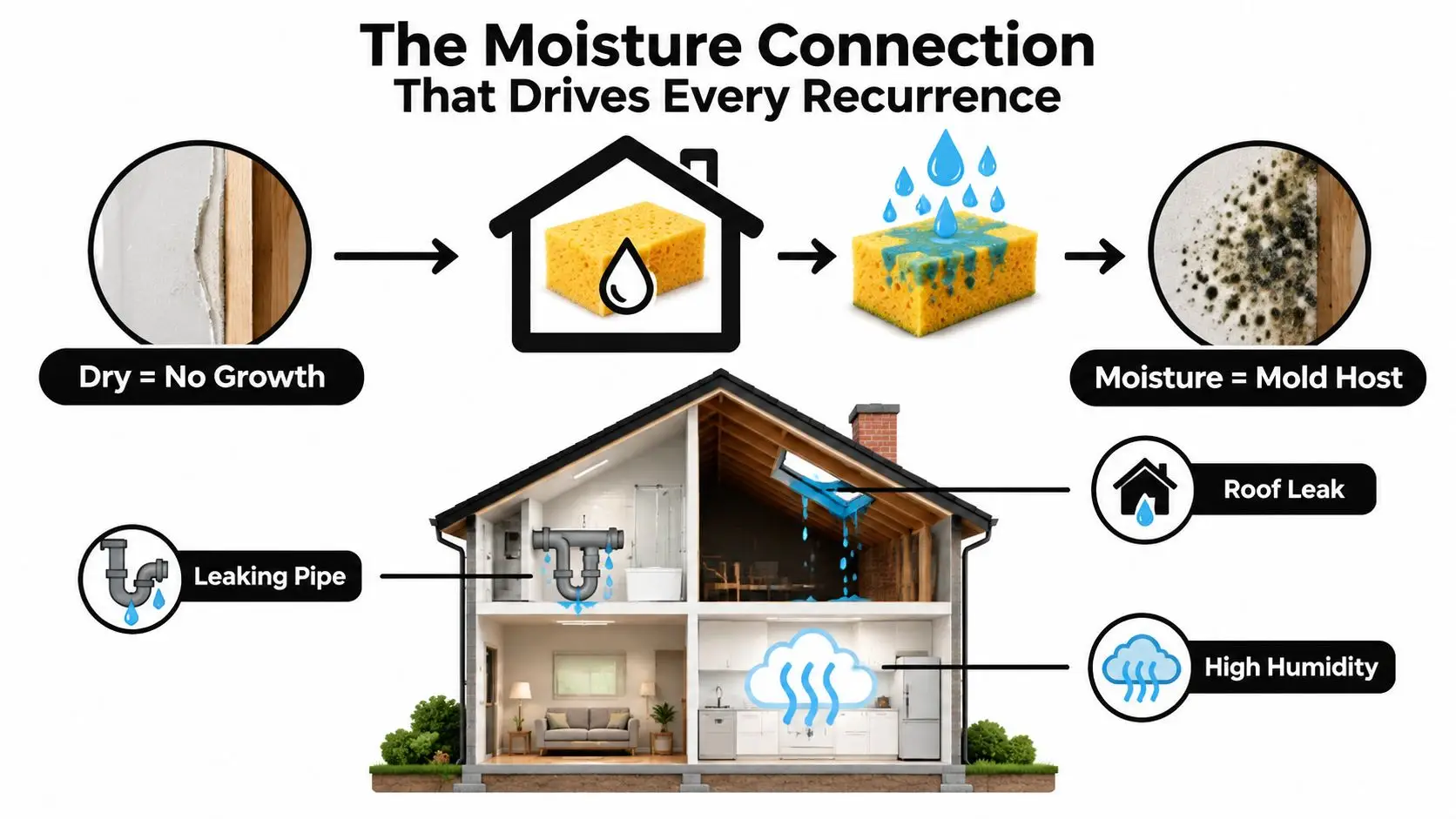
Think of a home as a sponge. A dry sponge can sit on a counter without supporting growth. Once it absorbs water and stays damp, it becomes a much more suitable environment for biological activity. Building materials behave similarly, although moisture can hide inside walls, floors, ceilings, insulation, and cabinetry.
Mold needs spores, a food source, and moisture. Spores and organic food sources such as drywall paper, wood, dust, and some flooring materials are difficult to eliminate from a lived-in building. Moisture is the factor homeowners and property managers can control.
That moisture may come from a pinhole plumbing leak, roof intrusion, flooding, foundation seepage, condensation, or indoor humidity. Water can move along framing, soak insulation, travel beneath flooring, or condense on a cool pipe and wall surface far from the original source. The visible patch is often only the place where the conditions finally became obvious.
Why humidity deserves its own investigation
Humidity can recreate the same problem without a dramatic leak. Bathrooms without adequate exhaust, laundry areas with poor air movement, and basements with cool surfaces can accumulate moisture repeatedly. In a hot climate, air-conditioning systems can also create condensation around coils, drain pans, ducts, and nearby insulation.
The CDC's mold guidance advises keeping indoor humidity no higher than 50% all day long and says that air conditioning or a dehumidifier can help maintain that level. The CDC also advises drying flooded areas fully and quickly within 24 to 48 hours to reduce regrowth risk.
A homeowner doesn't need to guess whether a wall is dry by touching its painted surface. A moisture meter can help identify moisture in materials, while a hygrometer tracks indoor humidity. A guide to moisture meter readings can help you understand why a single surface reading doesn't always describe the condition inside an assembly.
For broader indoor comfort, ventilation, filtration, and humidity management also support efforts to improve home air for allergies. These measures won't replace leak repair, but they can reduce the conditions that let moisture linger.
Common Reasons Mold Reappears in Treated Homes
Post-remediation growth usually has a physical explanation. The most useful investigation follows the moisture rather than focusing only on the new spot.
Four recurring triggers
Unfixed leaks are the clearest example. A wall may be cleaned on its room-facing side while a pinhole pipe continues dripping behind it. The cavity stays damp, organic materials remain available, and growth can restart near the same location. A soft section of drywall, bubbling paint, or a persistent odor should have prompted a closer plumbing inspection.
Hidden moisture in cavities creates a similar failure. A crew may stop demolition at the visible edge of damage, while wet insulation, a subfloor, or the back of a cabinet remains affected. The surface can look acceptable while moisture is trapped behind it. Warped flooring, swollen trim, or a moisture reading that remains high after drying are important clues.
Indoor humidity affects larger areas. A bathroom fan that vents poorly, a basement with limited air movement, or a laundry room that stays damp can repeatedly wet cool surfaces. Condensation on windows, ducts, or exterior-facing walls is an early warning sign, even when no pipe is leaking.
HVAC moisture can spread a problem beyond its starting point. A poorly maintained air handler, clogged condensate drain, or ductwork passing through a damp crawlspace can introduce moisture or distribute contaminated dust as the system cycles. Musty air from supply registers, water around the air handler, or recurring staining near vents deserves investigation.
| Cause | How It Triggers Regrowth | Early Warning Sign |
|---|---|---|
| Unfixed leak | Ongoing water keeps a wall, ceiling, or floor assembly damp | Soft drywall, bubbling paint, or a recurring odor |
| Hidden cavity moisture | Wet insulation, subfloor, or framing remains after surface cleanup | Warping, elevated meter readings, or damage beyond the cleaned area |
| Indoor humidity | Repeated condensation wets cool surfaces and porous materials | Condensation on windows, ducts, or cold walls |
| HVAC moisture | Condensation or damp duct pathways introduce moisture and distribute contaminants | Musty air from vents, drain-pan water, or staining near registers |
A useful inspection asks three questions: Where is the water entering, where is it traveling, and which materials are staying wet? Treating only the final visible spot leaves the rest of the chain intact.
True Recurrence Versus New Growth Versus Staining
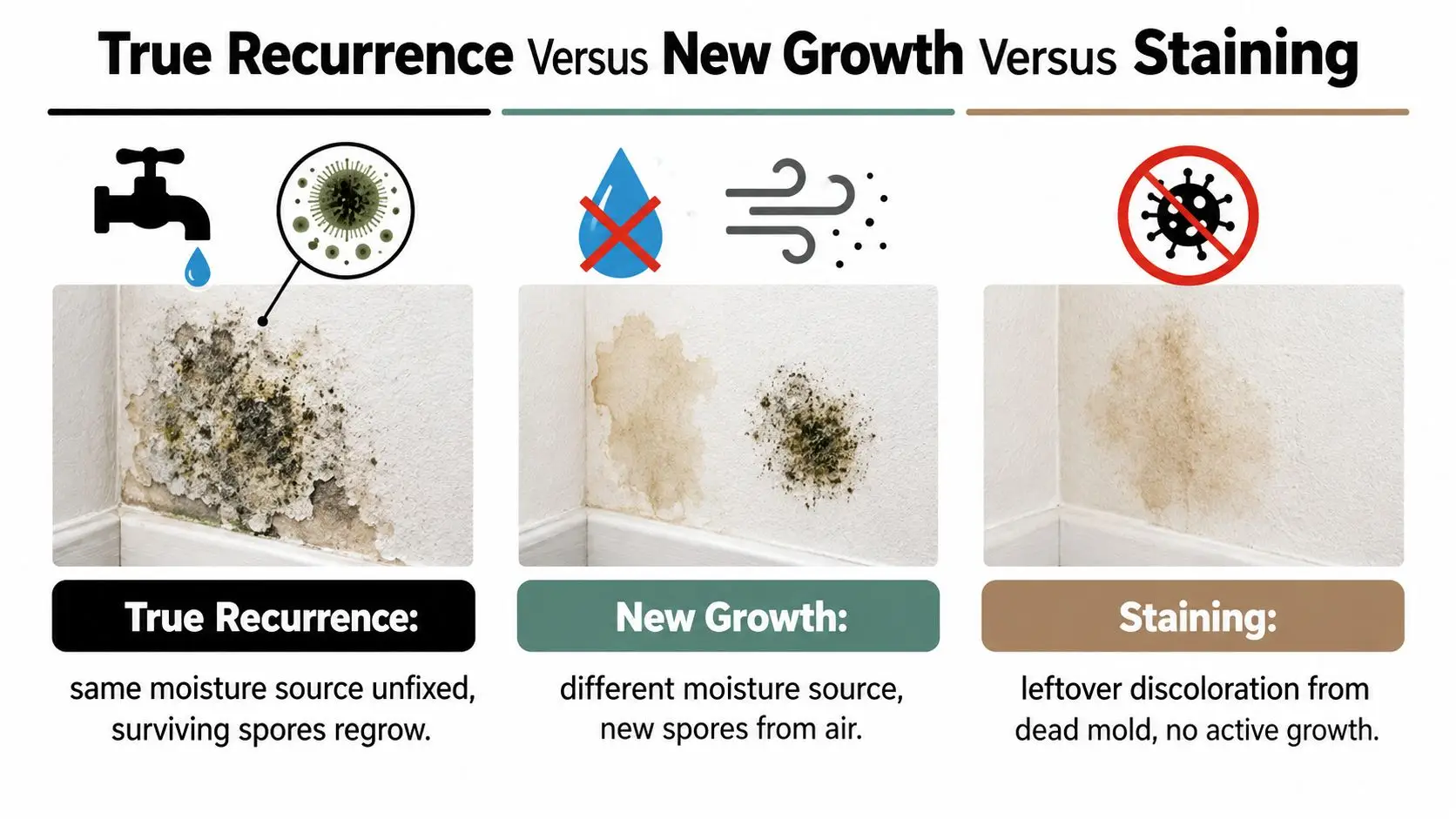
A dark mark after remediation falls into one of three practical categories. The appearance alone can't reliably identify which one you're seeing, so compare the timing, location, moisture condition, and texture.
True recurrence means the original moisture source wasn't corrected or contaminated material remained in the same zone. The same wall section, ceiling cavity, or floor edge becomes active again. A returning musty odor and dampness in that exact area make this category more likely.
New growth comes from a separate moisture event. A fresh roof leak, plumbing failure, overflow, or spill can create a new colony, often in a different location. The original remediation may have been successful, while the building later experienced another wetting event.
Residual staining is discoloration left by inactive or dead mold. It may look brown, gray, or shadow-like on drywall, grout, wood, or painted surfaces, but it doesn't have the texture or moisture associated with active growth. Repainting without confirming that the material is dry can hide a problem, so appearance should never be the only test.
A simple sorting method
- Same place and damp: Suspect true recurrence and investigate the original source, cavity, or nearby assembly.
- Different place after a new event: Treat it as possible new growth and document the fresh water intrusion.
- Dry, flat, unchanged shadow: Consider residual staining, while confirming that no hidden moisture remains.
You can also review guidance on how to tell if water damage is new or old before deciding whether the mark relates to the original incident.
A visual inspection should guide the next question, not end the investigation. Moisture readings, cavity inspection, odor tracing, and documentation from the original remediation can help identify the correct response.
What a Durable Remediation Protocol Should Include
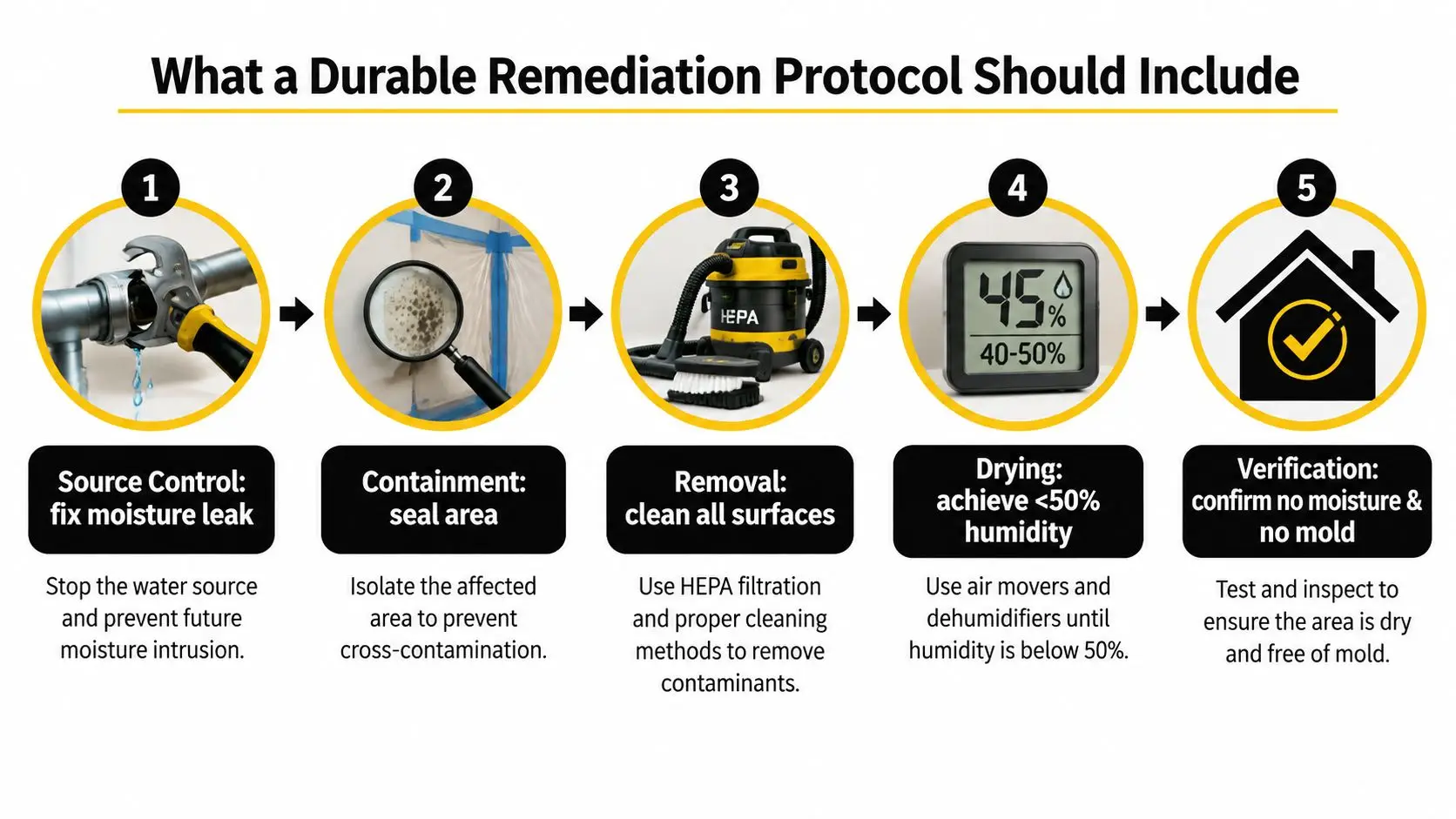
A durable project follows the moisture pathway from source to finished surface. Homeowners can ask for documentation at each stage instead of accepting a clean appearance as the only proof of completion.
Start with source control
The first task is identifying and correcting the entry point. That may involve plumbing, roofing, foundation drainage, exterior grading, ventilation, or HVAC condensate. If the source remains active, antimicrobial products and surface cleaning won't create a lasting result. The EPA's mold course says that no matter how good cleanup is, mold will return if the water problem isn't solved, and it identifies moisture control as the test of effective remediation. See the EPA mold course guidance for that principle.
Containment comes next. Workers should separate the affected area from clean rooms and manage dust and airborne debris during removal. The point isn't to make the work zone look orderly. It's to prevent disturbed contamination from spreading through occupied areas.
Dry, remove, clean, and verify
Drying should be documented with moisture meters, air movement, and dehumidification when needed. Materials that can't be returned to a dry, stable condition may need removal, especially when they are porous and visibly contaminated. Structural surfaces that can be salvaged are cleaned according to their material and condition.
The IICRC S520 standard says the moisture problem contributing to mold growth should be identified and corrected or controlled as soon as practical to prevent future contamination. Its professional remediation standard supports treating source control and drying as core parts of the work, not optional add-ons.
Before closing a wall: Ask for the repaired source, drying documentation, affected-material decisions, and final inspection results in writing.
Verification can include visual clearance, moisture readings, and, where appropriate, independent air or surface testing. Post-remediation verification gives homeowners a way to understand that final inspection step. The protocol is only as strong as its weakest part. A careful cleaning job can't compensate for an unrepaired leak or wet insulation left inside a wall.
Understanding Warranties and Guarantees After Mold Work
A mold warranty usually covers a defined service area and the workmanship performed there. It doesn't normally promise that mold can never appear anywhere in the building, because future moisture events remain outside the contractor's control.
The contract should distinguish between a workmanship warranty and a no-return guarantee. A workmanship warranty addresses whether the agreed work was performed properly. A no-return promise is broader and harder to evaluate because recurrence depends on moisture, building maintenance, new leaks, HVAC conditions, and areas outside the original scope.
| Warranty Scope | Usually Covered | Usually Excluded |
|---|---|---|
| Treated area | Workmanship in the documented remediation zone | Mold in untreated rooms or assemblies |
| Moisture-related conditions | Requirements tied to a resolved source | New roof, plumbing, flood, or HVAC events |
| Surface and material work | Agreed cleaning, removal, or treatment | Homeowner alterations that disturb the work |
| Follow-up obligations | Stated inspection or response terms | Conditions the contract excludes or cannot access |
Some contractors offer terms lasting one to five years, but that range should be verified in the written agreement rather than assumed. The warranty may also require the homeowner to maintain the property, report new water damage promptly, and avoid opening or modifying treated areas.
Before signing, confirm:
- Coverage area: Which rooms, materials, and cavities are included?
- Moisture condition: Who must repair the leak, and how is source correction documented?
- Exclusions: Are new leaks, HVAC issues, hidden cavities, or untreated areas excluded?
- Response process: Who pays for inspection if a mark returns?
- Proof requirements: Are moisture readings, photos, or post-remediation records required?
Be cautious with vague lifetime promises, guarantees that ignore water sources, and exclusions broad enough to eliminate meaningful coverage. For related questions about policy language, homeowners insurance and mold coverage should be reviewed with the insurer and the actual policy documents.
Warning Signs That Mold May Be Coming Back
Three months after remediation, a homeowner notices a faint musty odor near a basement closet. Nothing looks dramatically wrong, but the smell becomes stronger after the air conditioner runs. A closer inspection finds a slow drip behind the drywall. The odor appeared before the visible patch, which made it an early warning rather than a cosmetic surprise.
What to monitor after the crew leaves
- Returning musty or earthy odors: Smell near closets, baseboards, cabinets, and supply registers. Odor can point toward hidden moisture or HVAC involvement.
- New spotting: Check previously treated surfaces and nearby transitions, including corners, trim, ceiling edges, and flooring.
- Condensation: Watch windows, ducts, cold walls, and pipes for repeated moisture.
- Soft or changing materials: Peeling paint, bubbling finishes, soft drywall, and warped baseboards can signal water behind the surface.
- White dust or residue: This may indicate moisture movement or salts, not necessarily active mold, so don't identify it by appearance alone.
- Humidity changes: Use a hygrometer and record readings in basements, bathrooms, laundry areas, and rooms with limited airflow.
Homeowners should inspect plumbing fixtures, under-sink cabinets, condensate equipment, sump pumps, and exterior drainage after storms or seasonal changes. A flashlight can reveal staining along seams and behind stored items, but it won't confirm conditions inside a closed cavity.
If you notice a possible recurrence, document the location and don't scrub, paint, or dismantle the area before an assessment. An inspection focused on signs of mold in walls can help determine whether the issue is active growth, hidden moisture, or leftover staining.
Restore Heroes evaluates mold and water damage by looking for the moisture source, affected materials, and conditions that could support regrowth, then offers post-remediation verification as part of its mold cleanup process. Visit Restore Heroes to request an assessment for your Phoenix-area property and discuss the next practical step.