
A pipe bursts under the kitchen sink while you're away. By the time you notice, water has reached the cabinets, flooring, and perhaps the wall behind them. The visible puddle is only the beginning. You now need to know what can be saved, what must be removed, how to prevent mold, and how to document the work for an insurer.
That's the practical meaning of what is restoration work. It's a controlled response to damage that stabilizes a property, removes hazards, dries or cleans affected materials, and returns the structure as closely as possible to its pre-loss condition. It may include emergency mitigation, contents handling, odor treatment, and reconstruction, but it isn't just a cosmetic repair.
Defining Restoration Work and Its Core Purpose
Restoration work begins after an unexpected event changes the condition of a building. Water from a failed appliance, smoke from a kitchen fire, mold caused by persistent moisture, storm flooding, or a biohazard incident can affect more than the surface you can see. A restoration team assesses the loss, limits further damage, cleans or removes contaminated materials, and coordinates the repairs needed to make the property usable again.
Consider the burst pipe. A painter might replace stained drywall, but that alone wouldn't address moisture inside the wall cavity. A restoration technician may first extract standing water, inspect adjoining materials, establish drying goals, remove unsalvageable components, and record the condition of the property. Only after the affected areas are stable does reconstruction make sense.
Practical rule: Restoration focuses on recovery from a defined loss. Remodeling focuses on planned improvement.
The work can therefore include several connected phases:
- Assessment: Identifying the source, affected materials, contamination risks, and immediate hazards.
- Mitigation: Taking action to limit additional damage, such as extraction, containment, or temporary protection.
- Cleaning and treatment: Removing water, soot, odors, mold-contaminated materials, or hazardous residues.
- Reconstruction: Replacing damaged finishes and components after the property has been made safe and sufficiently dry.
The role of a restoration company often extends beyond physical labor. Technicians photograph conditions, track equipment, record moisture readings, communicate with property owners, and prepare information that helps an insurance claim move through review.
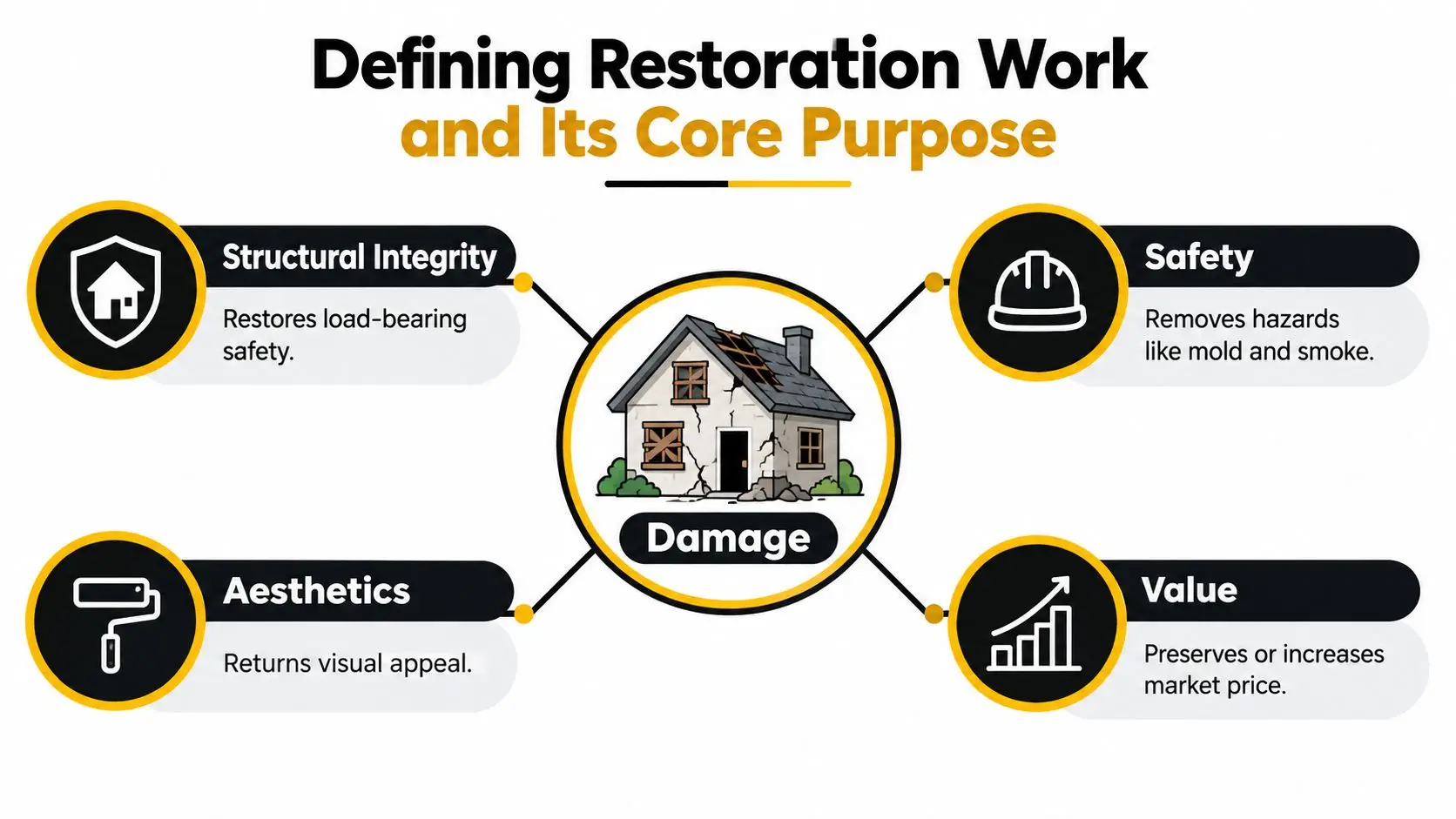
The purpose is broader than making a room look normal. Proper restoration protects structural integrity, removes risks to occupants, restores appearance, and helps preserve the property's function and value. A finished wall that still contains moisture or smoke residue isn't a complete recovery.
The Step-by-Step Restoration Workflow
A restoration project follows an order because each phase affects the next. Rushing to repaint or rebuild can conceal moisture, spread contamination, or leave odors embedded in materials. The sequence described in professional guidance commonly moves from emergency assessment through mitigation, verification, cleaning, and repair.
1. Inspection and loss assessment
The technician identifies what happened and whether the source is still active. They examine flooring, drywall, cabinetry, insulation, contents, and nearby rooms. For water losses, the assessment includes the type of water and the materials it touched. For fire losses, it includes soot patterns, odor, heat damage, and areas affected by firefighting water.
The owner may need a plumber, electrician, roofer, or other trade to correct the underlying cause. Restoration workers can document the condition and coordinate with those professionals, but fixing the source isn't automatically part of every restoration contract.
2. Immediate mitigation
Mitigation limits the spread of damage. Workers may extract standing water, cover openings, isolate a contaminated area, remove damaged materials, or set up air filtration. EPA guidance says plumbing leaks and other water problems should be fixed promptly, and affected items should be dried completely. If water may contain sewage or chemical or biological pollutants, PPE and containment are required, and fans shouldn't be used until the water is confirmed clean or sanitary. EPA's basic mold and moisture guidance explains these precautions.
3. Drying, cleaning, and verification
Technicians use extraction equipment, air movers, dehumidifiers, moisture meters, and sometimes infrared inspection to manage the environment. They don't rely on the surface feeling dry. They compare readings with an appropriate dry standard and check concealed areas where moisture can remain.
4. Repairs and closeout
After stabilization, the team cleans, sanitizes, deodorizes, and replaces damaged components as the scope requires. A clear workflow, including the elements of restoration, helps everyone understand which work is mitigation and which work is reconstruction.
Understanding Different Types of Restoration Services
The right response depends on the material involved and the hazard created. Water, fire, mold, and biohazard losses can overlap, but technicians shouldn't treat them as interchangeable cleanup jobs.
Water damage restoration begins with identifying and containing the water source, followed by moisture removal from affected materials. The IICRC S500 framework includes loss assessment, contamination categorization, psychrometry, and drying technology. A technician may map moisture in flooring and walls, extract trapped water, and use dehumidification to bring materials toward a reasonable pre-loss condition. The goal is evidence-based drying, not passive waiting for the floor to feel less damp.
Fire and smoke restoration requires more than washing black marks from a wall. Soot particles and odor residues can spread through air movement and settle on surfaces, contents, and ventilation components. EPA wildfire guidance emphasizes protecting indoor air during ash cleanup. Restoration practice therefore uses containment, HEPA filtration, appropriate PPE, controlled cleaning, and careful sequencing to reduce cross-contamination. Some materials can be cleaned, while others may need removal because heat, smoke, or chemical residue has caused permanent damage.
Mold remediation addresses both visible growth and the moisture condition that allowed it to develop. EPA guidance for schools and commercial buildings says wet, non-moldy materials should be dried within 48 hours to help prevent mold growth, and it recommends limited containment for mold-contaminated areas between 10 and 100 square feet using a single layer of 6-mil fire-retardant polyethylene sheeting. The EPA mold remediation guide provides the relevant procedures.
Biohazard cleanup involves biological contamination that may expose occupants or workers to infectious material. Technicians use containment, PPE, regulated waste handling, cleaning, and disinfection protocols. If you rent rather than own, a practical California renters insurance guide can help explain why documenting damaged personal property and living conditions matters, although coverage depends on the policy.
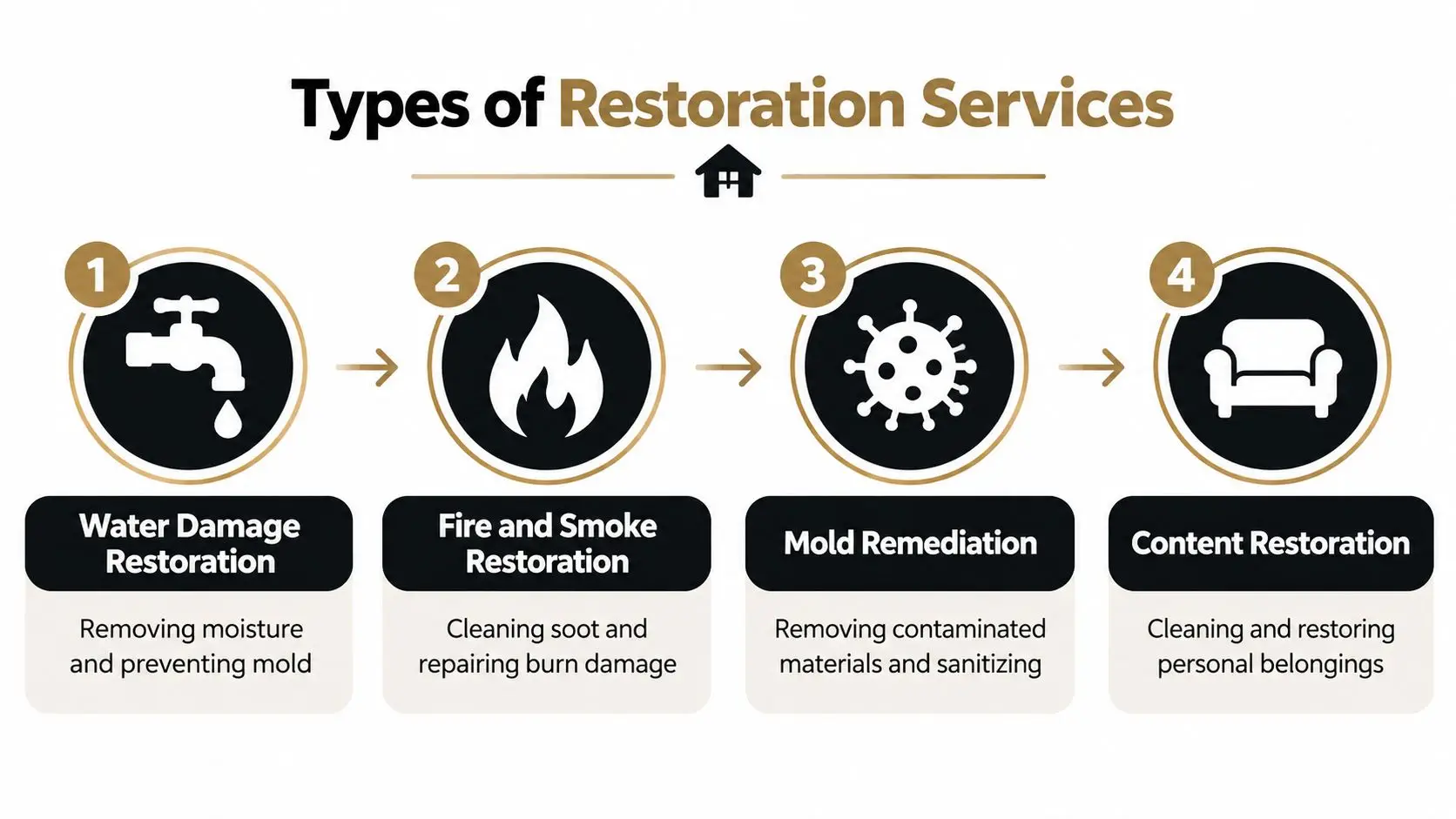
Contents restoration is often part of these services. Furniture, clothing, documents, and electronics may be cleaned, dried, deodorized, or evaluated for disposal. For incidents involving blood or other hazardous materials, property owners should use a trained biohazard remediation company rather than attempting ordinary household cleaning.
Restoration vs Construction and Understanding the Differences
Restoration and construction can overlap, but they start with different purposes. Restoration responds to a loss and aims to return a damaged property to its prior condition. Construction and remodeling create or improve something by design, such as an addition, a new floor plan, or an upgraded kitchen.
A restoration company may remove drywall, rebuild cabinets, replace flooring, or repair finishes. Those activities can look like construction, but the reason for the work is different. The team is addressing damage caused by a specific event, often while preserving evidence of the original condition for the property owner and insurer.
| Restoration work | Construction or remodeling |
|---|---|
| Responds to water, fire, mold, storm, or biohazard damage | Responds to a planned build, renovation, or upgrade |
| Prioritizes stabilization, mitigation, and safe recovery | Prioritizes design, expansion, or improvement |
| Uses documentation to define the loss and scope | Uses plans, specifications, and a planned project scope |
| May involve reconstruction after remediation | May begin with an undamaged property |
Licensing boundaries also matter. Neutral industry guidance explains that restoration commonly includes extraction, drying, soot removal, mold containment, odor treatment, and replacement of damaged materials. A general contractor's license may not be required for every restoration task, but structural, electrical, plumbing, or HVAC work can require the appropriate licensed professional.
Property owners should also think about managing project risks in construction, especially when a loss expands into structural repair. Before hiring, ask which parts of the work the company performs, which trades it coordinates, and who holds responsibility for regulated repairs. Checking whether a contractor is bonded and insured adds another useful layer of due diligence.
The Importance of Industry Certifications and Standards
Certification matters because restoration decisions often involve hidden conditions. A wall can look dry while its insulation or framing still contains moisture. A room can smell clean while soot remains on concealed surfaces. Standards give technicians a method for investigating these problems instead of relying on appearance.
The ANSI/IICRC S500 Standard for Professional Water Damage Restoration applies to residential, commercial, and institutional buildings. The fifth edition was published in 2021, and IICRC materials describe procedures and precautions for professional water damage restoration. The standard covers assessment, contamination categories, psychrometry, drying technology, and the documentation needed to support a controlled process. Current IICRC standards and field guides provide access to the standard's current listing.
Why measurable drying goals matter
A drying goal is a benchmark based on a reasonable approximation of pre-loss moisture or nearby unaffected materials. Technicians can compare readings over time, adjust equipment, and record when the affected assemblies meet the target. That creates a defensible process and lowers the chance that moisture remains trapped where microbial growth could develop.
The standard also makes an important responsibility clear. Determining and correcting the underlying cause of water intrusion belongs to the property owner unless the restorer has separately agreed to perform that work. A restoration company may identify a failed supply line or roof leak, but the repair arrangement should be explicit.
Certification doesn't replace judgment, communication, or proper licensing. It does help you ask better questions: Which standard does the company follow? What measurements will it record? How will it separate contaminated materials from clean areas? For a broader discussion of verification concepts, this cleaning validation guide from BacteriaFAQ.com offers useful context on documenting whether a cleaning process achieved its intended result.
A professional drying report should show what was measured, where it was measured, and why the job was considered complete.
When to Call Professional Restoration Experts
Small, isolated cleanup may be manageable when the material is known, the water is clean, and no hidden areas are involved. A professional assessment becomes much more important when water has entered walls or floors, mold covers a broad area, smoke has traveled through the building, or contamination may involve sewage, chemicals, blood, or other biological material.
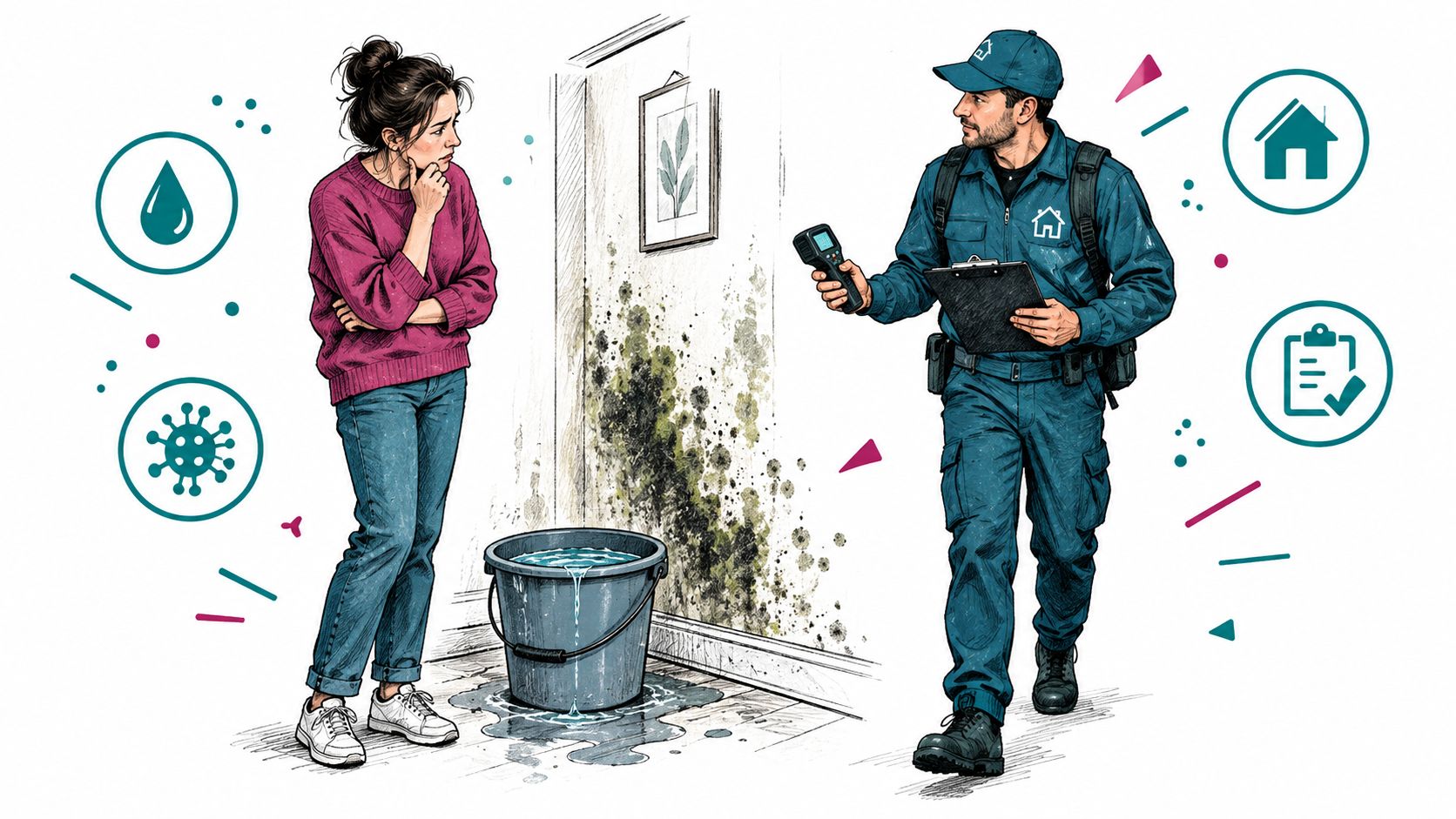
A useful warning sign is uncertainty. If you don't know how far moisture traveled, whether the water is sanitary, or whether a wall cavity is affected, surface cleaning may provide false confidence. Fans can also spread contamination if used before questionable water has been identified, and aggressive scrubbing can distribute mold or soot into nearby spaces.
Call a qualified restoration professional when:
- The source is active: A leak, storm opening, or plumbing failure continues to introduce water.
- Materials are hidden or porous: Moisture may be inside walls, under flooring, beneath cabinets, or in insulation.
- The loss involves contamination: Sewage, chemical pollutants, biological material, widespread mold, or heavy smoke requires controlled procedures.
- The building may be unsafe: Fire damage, structural movement, electrical concerns, or unstable ceilings need appropriate assessment.
- You need claim documentation: Photos, moisture readings, equipment records, contents inventories, and a written scope can clarify what happened and what work was performed.
Restore Heroes is one Phoenix metro option for water extraction, structural drying, fire and smoke cleanup, mold remediation, and trauma or biohazard cleanup. The company describes its technicians as licensed, bonded, insured, and IICRC-certified, with 24/7 emergency availability.
A prompt call doesn't guarantee coverage, pricing, or a particular claim result. It does give you a better opportunity to identify hazards early, preserve information, and choose the right response.
Conclusion and Ensuring a Safe and Complete Recovery
Restoration work is the organized recovery of a damaged property. It begins with identifying the loss and controlling immediate hazards, then moves through mitigation, drying or decontamination, verification, cleaning, and reconstruction. The visible repair is only the final part of that process.
The distinction between restoration and construction helps you choose the right professional. Restoration responds to an event and works toward the pre-loss condition, while construction and remodeling usually pursue a planned improvement. If the project involves structural, electrical, plumbing, or HVAC work, confirm that the appropriate licensed trades are involved.
Standards matter most where damage is hidden. IICRC S500 gives water restoration professionals a framework for assessment and measurable drying, while EPA guidance addresses moisture control, mold prevention, containment, and contaminated water precautions. Documentation matters alongside technical work because insurers, property managers, and owners need a clear record of conditions, decisions, and completed tasks.
The complete recovery test: The property should be safer, the cause should be addressed or clearly assigned, affected materials should be evaluated with evidence, and the work should be documented.
If a loss has just occurred, avoid guessing at the scope. Stop the source when it's safe, protect people from hazards, record the condition with photos, and contact qualified professionals for an assessment. Never make assumptions about insurance coverage or payment. Your policy, loss circumstances, and documented scope control those decisions.
Restore Heroes helps Phoenix-area homeowners, property managers, and businesses respond to water, fire, mold, storm, and biohazard damage with assessment, mitigation, drying, cleaning, and restoration coordination. Visit Restore Heroes to review the available services and request help assessing your property's recovery needs.