
You're standing in a wet hallway at midnight, listening to water keep moving somewhere inside the wall, and you already know this isn't a normal plumbing nuisance. If you found burst pipe repair near me because the ceiling is staining, the floor is soft, or a pipe is hissing behind drywall, the next few minutes matter more than the repair quote. The first job is to stop the flow, then protect what the water hasn't reached yet.
What a Burst Pipe Feels Like in the First Five Minutes
A burst pipe rarely announces itself politely. In a Phoenix home, it can sound like a faint rush behind drywall, then show up as a spreading stain, a puddle that seems to come from nowhere, or water tracking under laminate and baseboards. The frustrating part is how quickly it moves from “something is wrong” to “this room is getting damaged right now.”
Practical rule: if you can hear moving water and you can't explain it, treat it like an active leak until proven otherwise.
That urgency isn't dramatic, it's physical. A burst pipe can discharge 400+ gallons per hour. That's why a leak that starts in one spot can become a broader cleanup problem in only a few hours, with water working into framing, insulation, flooring, and hidden cavities before anyone gets the chance to open a wall (source).
The first five minutes also tell you what kind of problem you're dealing with. A slow drip leaves staining and a damp line. A burst line usually gives you active flow, pressure loss, or water appearing in places that shouldn't be wet at all. If the sound is behind a ceiling or wall, or the floor feels soft and warm in a way that doesn't make sense, you're already past “watch it” territory.
One useful local clue is timing. These failures often show up at night or on weekends, when heating and cooling patterns, temperature swings, and delayed discovery all work against you. The story homeowners tell me most often is the same, they heard something odd, ignored it for ten minutes, then found a bigger mess than they expected.
If you're trying to distinguish a burst pipe from an appliance leak, focus on spread and speed. Appliance leaks tend to pool near the machine. A broken supply line often travels farther, and it can show up as water in a room that never had a visible plumbing fixture in the first place. For a broader sign check, this burst-pipe guide is useful after you've stopped the flow.
The First Ten Minutes After You Spot the Leak
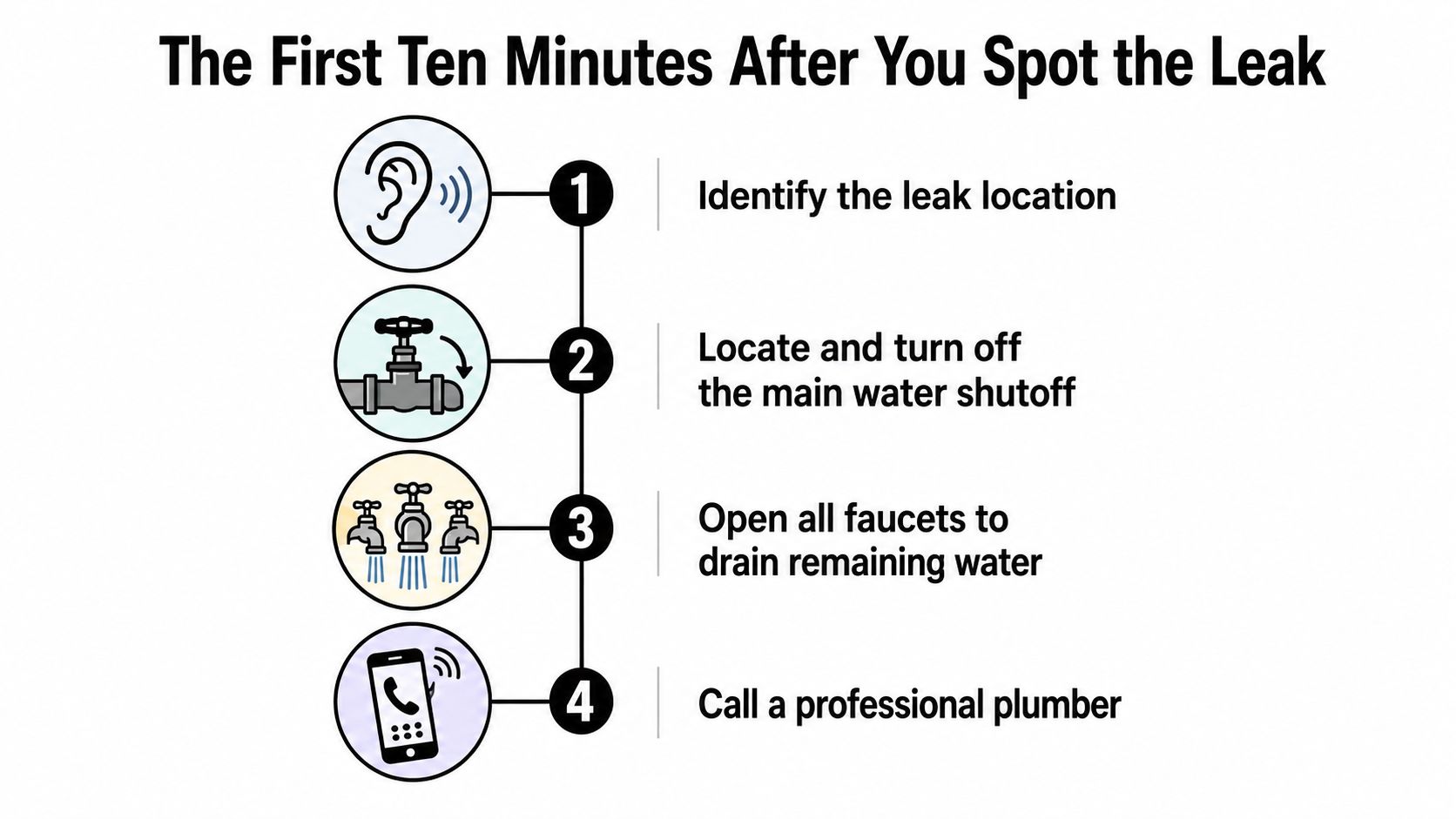
Shut off the water before you do anything else
Find the main shutoff and close it completely. That single move stops more water from entering the system and keeps the damage from growing while you decide who to call. Emergency plumbing guidance consistently puts this at the top of the list, then tells homeowners to open nearby faucets so pressure can drain out of the line (source).
After the main is off, open a few faucets. You're not trying to fix the pipe yourself, you're draining residual water and relieving pressure so the line isn't still pushing water through the break. This matters more than many realize because residual pressure keeps feeding the leak even after the shutoff is closed.
Cut power if water has reached electrical components
If water has reached outlets, appliances, or anything plugged in nearby, treat the area as an electrical hazard. One emergency guide specifically advises shutting off electricity to the affected area when the burst is near electrical components, and that's the right instinct here (source). Don't step into standing water if you suspect energized equipment is involved.
If you're not sure which breaker serves the area, stop and wait for qualified help rather than guessing. A few extra minutes of caution is better than turning a plumbing emergency into an electrical one.
Decide on the water heater before it keeps working against you
If the break affects hot water lines or the heater is part of the flow path, shut the water heater down too. That keeps the unit from heating an empty or partially drained system and reduces avoidable stress on the equipment. This is one of those decisions homeowners forget in the moment, then regret when the plumber has to deal with a hot tank still firing.
Document first, clean second
Before aggressive cleanup, take photos and short video clips of the leak, the shutoff, the surrounding room, and anything visibly damaged. Insurance-focused emergency guidance specifically recommends documentation for claims, and the same source pairs it with the advice to shut off electricity when needed (source). If you want a local emergency checklist, this burst-pipe page is a practical reference after the immediate shutoff steps.
The Critical Window Before Help Arrives
Handle the room like a drying job, not a normal cleanup
The awkward gap after the water stops is where a lot of secondary damage starts. In Phoenix, that means you've got to think about airflow, humidity, and what water is touching right now. If water is near vents or the HVAC system, turn the system off. If you don't know whether supply or return openings have been exposed, it's safer to stop moving conditioned air through a wet space and wait for a technician to assess it. For a more detailed mitigation workflow, Restore Heroes' water-damage mitigation page fits the same reality homeowners face in those first hours.
Use towels to blot standing water, then a wet-dry vac if you already have one and the area is safe to enter. Don't use a household vacuum on water, and don't bring out space heaters or open flames. Those shortcuts create more risk than value, especially when the target is controlled drying, not speed for its own sake.
Water damage gets more expensive when people only mop the visible part and leave the moisture in baseboards, carpet pad, drywall, or cabinet cavities.
Protect the things that can still be saved
Move furniture off damp flooring if two people can do it safely. Put foil, blocks, or plastic barriers under wood legs so finish doesn't wick into the material. Electronics should be unplugged only if you can do so without standing in water, then moved to a dry area.
Take one minute to make a running list of rooms and items affected. A phone note is enough. Write down the kitchen, hallway, laundry room, and whatever else got hit, then add the visible damage in plain language. That list turns a chaotic insurance call into something you can clearly explain.
Keep a simple record for the claim file
Photograph the room before you move much of anything. Then shoot a second round after you've done the basic safety steps. The goal isn't pretty documentation, it's proof of what got wet, where it spread, and how fast you acted.
If you're unsure whether to keep the HVAC running, think in terms of contamination and circulation. If the system could spread moisture through ducts or across unaffected rooms, shut it down until a pro inspects the area. If the home is heating up badly and the system isn't exposing wet components, some homeowners keep cooling on to avoid a hotter, wetter interior, but that call should be made with the actual moisture path in mind, not on autopilot.
Why the Cheapest Plumber Quote Is Not Always the Lowest Total Cost
The bill after a burst line usually splits into two jobs. One invoice covers the plumbing repair. The other covers extraction, drying, demolition, and rebuild if water has already spread into materials that won't dry on their own. That split is why a small-looking leak can become a much larger financial problem before anyone argues about parts or labor.
The plumbing side is often not the expensive part. Independent cost guides put the average burst-pipe repair at about $500, with common national ranges of $200 to $3,000 or $400 to $2,000, depending on access, pipe material, and labor (source). One major cost breakdown says labor makes up nearly 80% of the total bill, which is why the hardest-to-reach jobs climb quickly even when the broken section itself is small (source).
| Cost Driver | Plumbing-Only Repair | Plumbing + Restoration |
|---|---|---|
| Access | Exposed line with easy access | Line behind drywall, under a slab, or in a cramped space |
| Work scope | Cut out failed section, replace, test | Repair plus extraction, drying, demolition, and rebuild |
| Billing shape | One plumbing invoice | Separate plumbing bill and remediation bill |
| Total risk | Lower if caught early | Higher when water reaches finishes and cavities |
A simple quote can mislead you if it ignores the moisture already in the structure. Another service breakdown notes that straightforward burst-pipe repairs are often quoted around $150 to $1,000, while complex jobs can exceed $2,000 to $5,000+ when the line is hidden or tied to broader damage (source). The same source also points out that water-damage work can run $1,500 to $10,000+ when drying, demolition, and rebuild are needed (source).
That's where how Pipeline On helps plumbers becomes relevant. Emergency pricing isn't just parts and labor, it's access, timing, response complexity, and whether the contractor is also accounting for the restoration side of the job. If a quote looks cheap because it only covers cutting and replacing pipe, the final cost can still rise fast once a remediation crew has to dry the structure.
When a Burst Pipe Stops Being a Plumbing Job
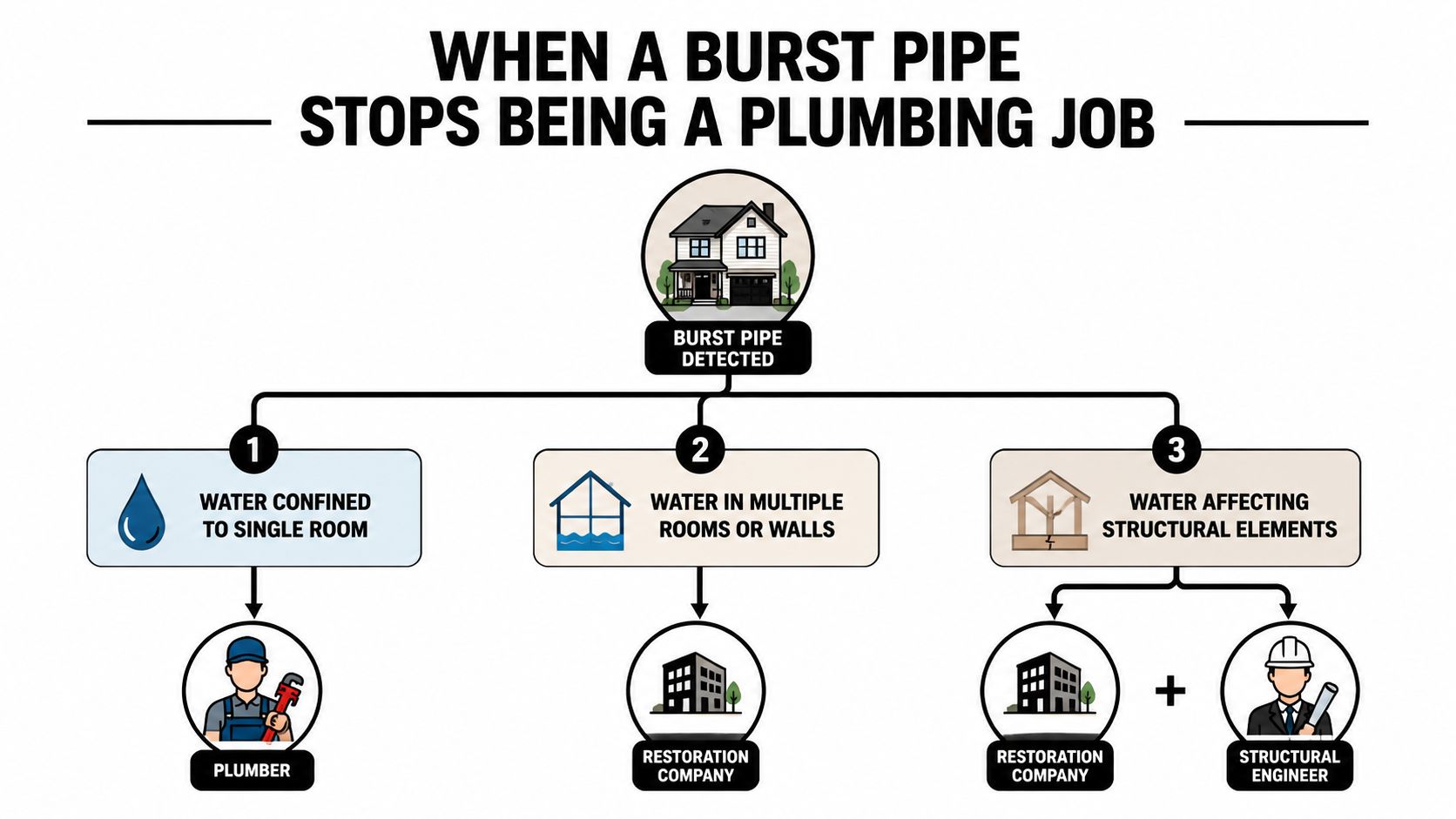
A burst pipe stays a plumbing job only when the water is contained and the materials around it didn't absorb much. Once the water gets into walls, cabinets, or multiple rooms, you're no longer just looking at a pipe replacement. You're looking at a moisture problem that needs a different kind of equipment and a different kind of paperwork.
Signs the damage has moved past the visible leak
Watch for musty odors, swelling baseboards, staining that shows up farther from the break than you expected, and discoloration under cabinets. Those are the signs I pay attention to first because they suggest the water migrated into concealed spaces. If the floor or wall feels soft, or if the stain keeps expanding after the leak is stopped, the problem has already spread.
Phoenix heat makes that worse because it can speed up secondary damage in materials that are already wet. Even after the pipe is fixed, hidden moisture can keep working in the background. That's why restoration guidance treats water-damage mitigation as a separate service from plumbing repair, not a fancy add-on.
If the damage is showing up in more than one room, the plumber alone usually isn't the whole answer.
Who to call first
Call a plumber first if the leak is active and the water is still moving. Call a restoration company when water has reached walls, flooring systems, cabinets, or other building materials that need drying and cleanup. If structural elements are affected, both may be needed, and you may also need a structural engineer depending on the extent of the damage.
For homeowners trying to phrase the situation on the phone, keep it simple. Say where the leak started, what rooms got wet, whether drywall or cabinets are affected, and whether you've already shut off water and power. If you need an example of a local category page that fits this stage of the job, Category 3 water damage is the right kind of reference point.
What a Licensed IICRC-Certified Restoration Crew Actually Does
The best restoration crews don't start with drying machines. They start with assessment. They look at where water entered, what it touched, and which materials are still salvageable before they touch the room with extraction gear. That sequence matters because it prevents unnecessary demolition and gives the insurance file a clean trail.
The actual process on arrival
A competent crew will map moisture with meters and thermal imaging, then extract standing water with truck-mounted or portable equipment. After that, they place structural drying equipment to move hidden moisture out of framing, flooring, and cavities. Once the affected area is stable, they may apply antimicrobial treatment where appropriate and document the whole job for the insurer.
That documentation is not optional fluff. It's part of how the claim gets justified, especially when the work crosses from visible cleanup into hidden-space remediation. A crew that can't explain moisture readings, scope, and drying targets is usually the crew you don't want in the house.
What IICRC certification means in practice
IICRC certification signals that the crew works from recognized water-damage cleanup standards rather than treating every wet room like a mop-and-go job. One major plumbing and restoration company notes that its IICRC-certified water cleanup professionals are available 24 hours a day, 365 days a year (source). That doesn't mean every job needs a certification label to dry out, but it does tell you the team is trained for water-loss work, not just basic plumbing repairs.
If you're comparing vendors, ask who is handling extraction, who is handling drying, and who is writing the scope for insurance. If the answers are vague, corners are probably being cut.
Working With Insurance and Choosing a Local Phoenix Crew
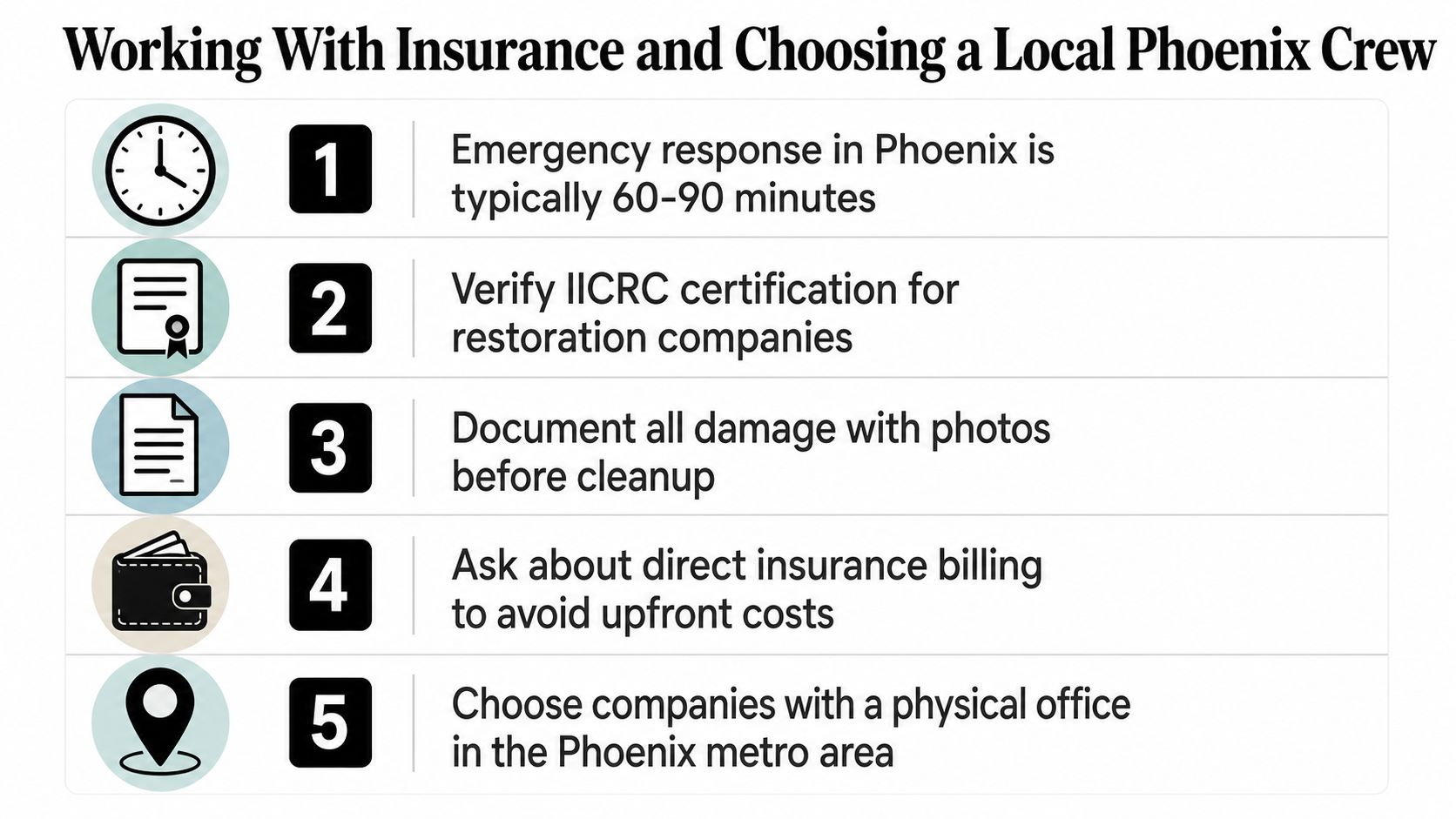
Emergency help in Phoenix has to be fast, but speed alone isn't enough. One emergency service provider markets 60-minute response time, and another says dispatch within 30 to 60 minutes or less. Those are provider claims, not universal standards, but they show the type of urgency homeowners should expect when active water loss is involved (source).
What to verify before you hire
Look for licensing, bonding, insurance, IICRC certification, and 24/7 availability. A local office in the Phoenix metro area matters because emergency response is a logistics problem as much as a technical one. If the company can't explain how it coordinates with adjusters, that's a sign the claim process may become your problem instead of theirs.
A few practical checks help before the next emergency ever happens:
- Save the shutoff location: Know where the main water valve is before you need it.
- Store insurance contacts: Keep your carrier and agent in your phone under clear names.
- Take room photos now: Baseline pictures make post-loss documentation easier.
- Keep towels and a wet-dry vac ready: Small tools buy you time while help is on the way.
- Pick one local crew in advance: A company like Restore Heroes handles water damage, mitigation, and restoration as part of the same response.
What to expect from a prepared contractor
The right crew should help document the loss, explain the difference between plumbing repair and restoration, and keep the insurer informed with photos and scope notes. Restore Heroes also serves the Phoenix metro area as a licensed, bonded, insured, IICRC-certified disaster restoration company, which is the kind of credential set that fits a burst-pipe loss when water has moved beyond the pipe itself.
If you're dealing with a burst pipe in Phoenix, Restore Heroes can handle the water, drying, and restoration side once the leak is stopped. Visit Restore Heroes to get help from a local crew that works on burst-pipe losses, water-damage mitigation, and the cleanup that follows when plumbing turns into a property emergency.