
Water on the floor changes the mood of a house fast. In Phoenix, it might be a monsoon downpour pushing water under a door, a failed water heater in the garage, or a supply line that let go while nobody was home. The first reaction is usually the same. Save what you can, stop the mess, and figure out who to trust.
That situation feels personal, but it isn't rare. The United States had a record 28 weather and climate disasters in 2023 costing at least $92.9 billion, which is one reason fast, professional response matters so much when water gets inside a structure, according to industry statistics on disaster-driven restoration demand. Water damage is stressful, but it's also manageable when you make good decisions early.
A good flood restoration company should do two things at once. It should stabilize the property right away, and it should document the loss clearly enough that the insurance side doesn't become a second disaster. In Phoenix, that second part matters more than many homeowners realize.
Water in Your Home? Your First Hour Is Critical
The first hour after you discover flooding usually decides whether this stays a drying job or turns into demolition, odor, and mold concerns later. Water moves quickly into baseboards, drywall, cabinets, flooring, and wall cavities. In our climate, people sometimes assume heat will dry things out on its own. That assumption causes trouble.
A calm first hour looks like this. You protect people first, you slow the water source if you can do it safely, and you start recording what happened. Then you call a flood restoration company that can handle both mitigation and documentation.
What matters most right away
- Safety first: If water is near outlets, cords, appliances, or your electrical panel, stay out until it's safe to enter.
- Source control: If the loss came from a plumbing line, appliance, or fixture, shut off the water if you know where to do it.
- Documentation: Take photos and short videos before moving too much.
- Fast professional help: Drying works best when the response is immediate and the structure is measured, not guessed at.
Practical rule: The goal in the first hour isn't to clean up everything. It's to prevent the damage from spreading and to avoid mistakes that make the claim harder later.
If the cause is still unclear, start with the obvious entry points. Roof leaks, window failures, slab leaks, and appliance lines can all mimic flood damage inside the house. If you're trying to narrow down where the water started, this guide on finding house leaks in Tucson is a useful homeowner-level reference because the troubleshooting logic is similar across Arizona homes.
You'll also want a realistic picture of what emergency mitigation involves before the crew arrives. This overview of emergency water mitigation after a disaster helps explain what happens first and why speed matters.
Emergency Actions to Take Before Help Arrives
Do the safe, high-value tasks first. Skip the heroic cleanup.
Start with hazards
If standing water is anywhere near electricity, stop and reassess. Don't step into a wet area to unplug something. Don't touch a breaker panel if you're standing on a damp floor. If you smell gas or suspect structural damage, leave the area and wait for the right professional.
Slip hazards matter too. Tile, sealed concrete, and wet laminate can get slick fast, especially when people are moving quickly and carrying boxes.
Then control what you can
If the water came from a broken supply line, overflowing fixture, water heater, refrigerator line, or similar household source, shut off the local valve or the main water supply if you can do it safely. If the flooding came from a drain backup, treat it differently. Backed-up water may be contaminated, and homeowner cleanup can spread the problem. If sewer backup is part of what you're seeing, MG Drain Services' sewer solutions offer a practical breakdown of what to check and what to leave alone.
Don't use a household vacuum, extension cord, or standard fan in a wet area unless you know the area is electrically safe. That shortcut injures people and often does very little for hidden moisture.
Protect belongings without overhandling the loss
Move portable items first. Family photos, documents, electronics, medications, and soft goods that can be relocated safely should go to a dry room with airflow. Put foil, wood blocks, or other barriers under furniture legs if that keeps upholstery or wood out of wet flooring.
What you should not do is start tearing out materials at random. Pulling baseboards, ripping carpet, or opening walls without a plan can complicate both drying and documentation.
A simple order of operations works well:
- Photograph the affected rooms before moving many items.
- Capture close-ups of wet materials, visible staining, swollen trim, appliance tags, and any failed plumbing part if visible.
- Move valuables to dry ground.
- Separate wet textiles so dyes don't bleed into nearby items.
- Keep damaged items unless they pose a health or safety risk.
What usually helps and what usually doesn't
| Action | Usually helpful | Usually a mistake |
|---|---|---|
| Taking photos and video | Yes | No |
| Shutting off the water source | Yes, if safe | No |
| Opening windows blindly during humid weather | Sometimes not | Often |
| Using towels for a tiny isolated spill | Yes | No |
| Using a shop vac on significant flooding | No | Yes |
| Running HVAC without a drying plan | Depends | Often |
Phoenix homeowners often ask whether carpet can be saved. Sometimes yes, sometimes no. It depends on the source of the water, how long it sat, what's underneath, and whether pad and subfloor are affected. This guide on how to dry wet carpet fast is worth reading before you decide whether that room needs simple drying or professional extraction and monitoring.
How to Choose a Reputable Flood Restoration Company
When you call a flood restoration company, the conversation should sound organized. The person on the phone should ask where the water came from, when it started, what rooms are affected, whether electricity is involved, and whether the source has been stopped. If they can't guide a basic triage call, that's a warning sign.
Water damage restoration is the largest segment of disaster recovery work, accounting for 38.56% of revenue share in 2025, and nearly 24% of all property insurance claims are related to water damage, according to Mordor Intelligence's disaster restoration market report. That's why specialization matters. You don't want a general contractor improvising a drying plan.
Ask these questions on the first call
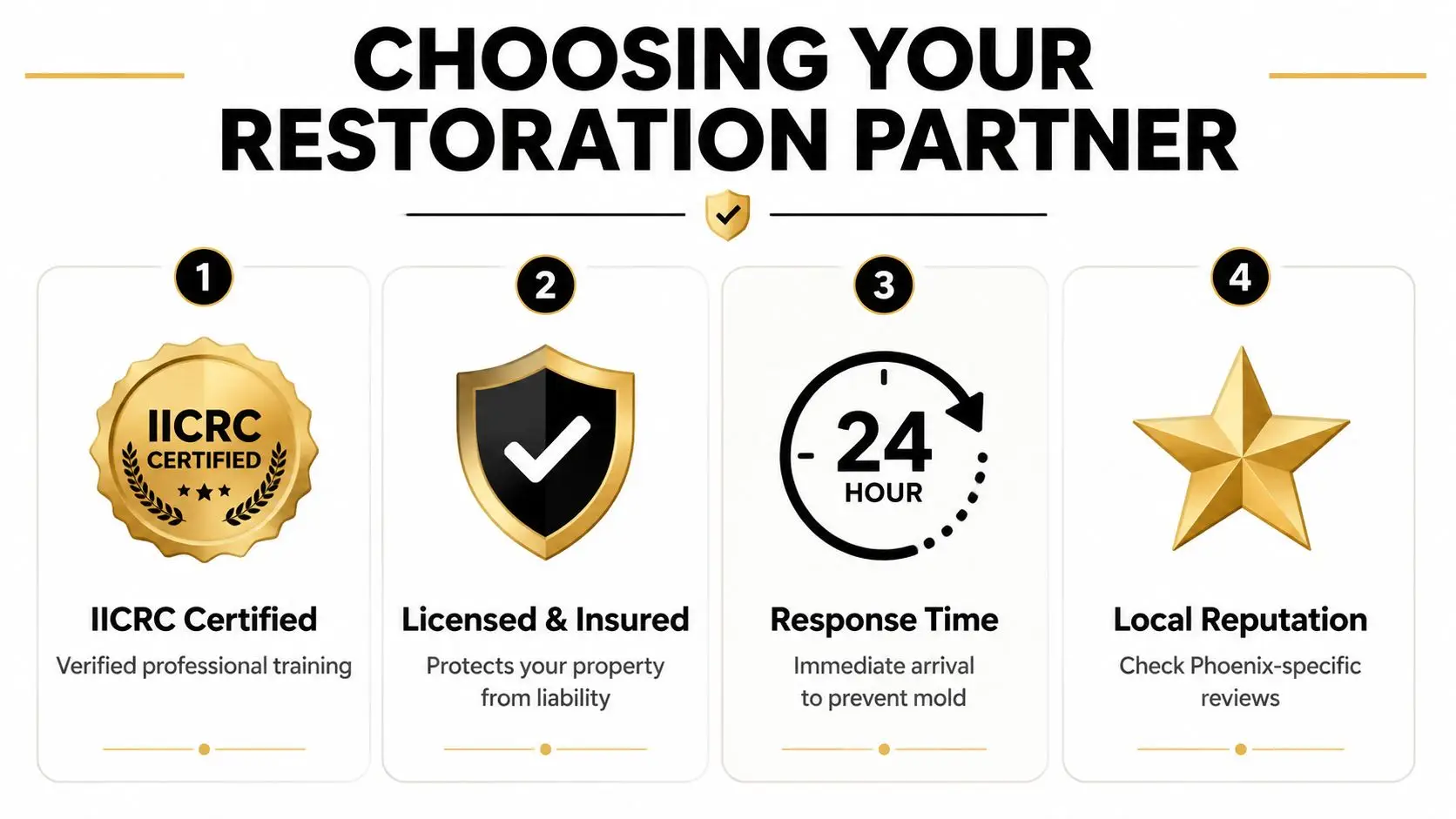
Are your technicians IICRC trained for water mitigation and structural drying
This is the first filter. A certified crew should understand moisture mapping, extraction, equipment setup, monitoring, and drying goals. They should talk about readings, not guesses.
How will you document the job for the insurance file
This question matters almost as much as the drying itself in Phoenix. A serious company should explain how it records affected materials, moisture readings, photos, equipment use, and daily progress. If they mention tools such as Xactimate, moisture meters, thermal imaging, and written drying logs, that's a good sign.
What happens in the first visit
Listen for a clear workflow. Inspection. Safety check. Moisture mapping. Extraction. Equipment placement. Monitoring plan. Discussion of what can stay, what may need removal, and what gets documented.
The right contractor doesn't just say, “We'll dry it out.” They explain how they'll measure progress and when they'll know the structure is actually dry.
Good answers versus weak answers
| Question | Strong answer sounds like | Weak answer sounds like |
|---|---|---|
| Certification | “Our team follows IICRC drying standards.” | “We've been doing this a long time.” |
| Insurance documentation | “We document readings, photos, and scope in estimating software.” | “Your insurer will figure it out.” |
| Equipment | “We use extractors, air movers, dehumidifiers, and moisture meters based on the materials involved.” | “We'll bring some fans.” |
| Communication | “You'll get updates as readings change.” | “We'll call if something comes up.” |
Watch for scope, not slogans
A dependable flood restoration company should be able to handle more than pumping water. Drying is only one piece. You may need selective demolition, sanitation, odor control, content handling, and coordination with the adjuster.
A local, full-service option can help. For example, what a restoration company does is broader than most homeowners expect. It usually includes inspection, mitigation, drying, cleaning, and the documentation needed for the claim process. In Phoenix, Restore Heroes is one example of a company that provides those services as part of disaster restoration work.
A few trade-offs homeowners should understand
Fast arrival matters, but speed alone isn't enough. A crew that arrives quickly and places the wrong amount of equipment can still leave moisture behind. On the other hand, a highly technical team that communicates poorly can create insurance headaches because the homeowner never understands what was removed and why.
Look for balance:
- Technical skill: They use moisture meters, thermal imaging, and professional estimating tools.
- Clear communication: They explain what they found in plain language.
- Claim awareness: They know that photos, line items, and daily notes protect you.
- Realistic language: They don't promise coverage, price, or outcomes they can't control.
Phoenix-Specific Flood Risks and Contractor Red Flags
Phoenix flooding has its own pattern. Water doesn't need to rise slowly to cause serious damage here. A short monsoon event can push water through thresholds, garage openings, block wall breaches, roof transitions, and low exterior grades. Homes that look fine from the street can still take on a surprising amount of water in one room or one corner of the property.
Hard water adds another local wrinkle. When water dries on surfaces and inside assemblies, it can leave mineral residue that complicates cleaning and can hide the true edge of the moisture spread. That's one reason visual inspection alone is unreliable.
Why paperwork matters so much here
In the Phoenix area, 35% of flood claims are denied due to issues like inadequate documentation, according to the cited claim-denial data in this Phoenix-area service reference. That doesn't mean every denied claim was avoidable, but it does mean poor records can become expensive.
The practical takeaway is simple. Hire a contractor who documents moisture readings, affected materials, photos, and scope changes from the first visit forward. If a company treats paperwork as an afterthought, you may end up arguing over what was damaged, what was pre-existing, and what work was necessary.
Red flags after a storm
Some red flags show up again and again after heavy weather in the Valley.
- Large upfront payment demands: A professional company should explain billing clearly. Pressure for full payment before meaningful work begins is a problem.
- No local footprint: If they can't point to Phoenix-area work or local references, be careful.
- No discussion of documentation: If they never mention moisture readings, photos, or estimating software, they may be thinking like cleaners, not restorers.
- Verbal promises about insurance: Nobody should tell you with certainty what your policy will or won't pay.
- Immediate demolition without testing: Some materials do need removal, but a real mitigation plan starts with inspection and measurement.
After a monsoon event, the busiest company isn't always the wrong choice. The wrong choice is the one that can't explain its process.
What to Expect During the Water Restoration Process
Once the crew arrives, the work should feel methodical. Good restoration looks less dramatic than many homeowners expect. It's a sequence of inspection, removal, drying, monitoring, and verification.
Professional drying follows IICRC S500 targets such as relative humidity of 40% to 50% and wood framing moisture under 12%, and firms hitting those benchmarks report damage prevention success rates above 95% when response is under 60 minutes, according to these drying benchmarks and workflow details. That's why certified crews keep measuring throughout the job instead of drying by feel.
The first visit
The technician usually starts with a moisture meter and a thermal hygrometer. You may also see thermal imaging used to spot likely hidden moisture behind walls, under flooring, or around cabinets. Then comes extraction with truck-mounted or portable equipment if standing water is present.
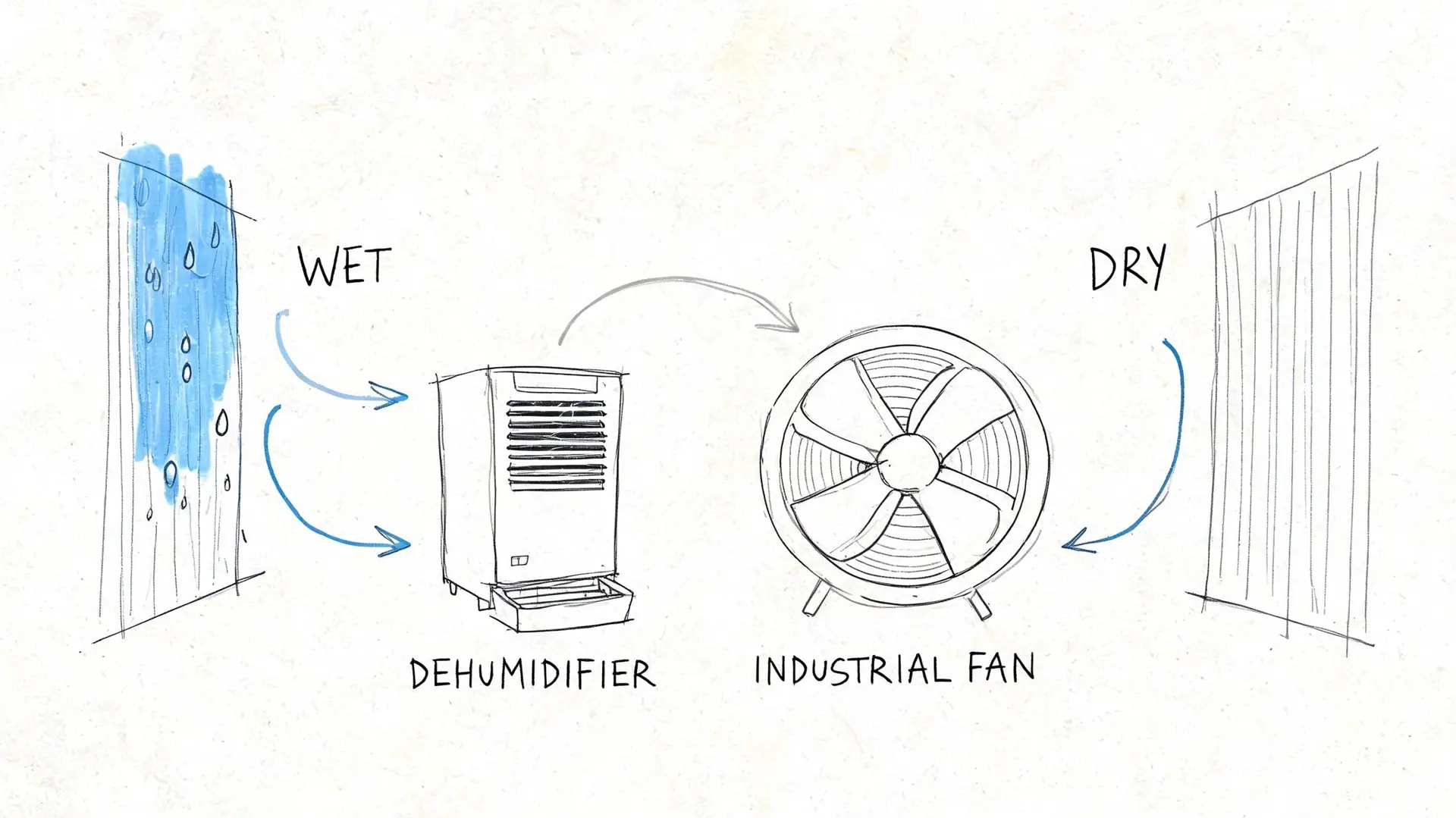
After that, the crew builds a drying chamber of sorts inside the affected area. Air movers push moisture off wet materials into the air. Dehumidifiers pull that moisture out of the air so it can't settle back into the structure.
What the equipment means
If the house suddenly sounds like a small airport, that usually means the drying phase is underway. The noise is normal. So is daily or near-daily monitoring on active jobs.
A professional should be able to tell you:
- which materials are being dried in place
- which materials may need removal
- what readings they're tracking
- what conditions have to be met before reconstruction starts
How the process usually unfolds
Inspection and moisture mapping
The crew identifies where water traveled, not just where you can see it.Extraction and removal of unsalvageable materials
Standing water comes out first. Some pad, drywall, or trim may need selective removal depending on contamination and saturation.Drying and dehumidification
Equipment stays in place while technicians track moisture decline.Cleaning and final verification
Once readings hit the target range, the mitigation phase can wrap and rebuild planning can begin.
For a clearer sense of timing, this guide on how long water damage restoration takes helps homeowners understand why some jobs are finished quickly while others require several days of monitored drying.
FAQ and Your Next Steps for Peace of Mind
A few questions come up in almost every flood loss.
Common questions homeowners ask
Can the house still be lived in during drying
Sometimes yes. Sometimes no. It depends on which rooms are affected, whether there's contamination, whether safe power is available, and how disruptive the equipment setup is. A small clean-water loss in one area is very different from a drain backup or widespread storm intrusion.
How do I know the house is actually dry
You shouldn't have to rely on smell, touch, or appearance. Verification should come from moisture readings and documented drying progress. That's the difference between cleanup and professional restoration.
Hidden moisture is what causes the regrets. If the contractor can't show you drying data, ask more questions before the rebuild starts.
Why worry about follow-up after the equipment comes out
Because incomplete drying can create a second problem that shows up later. A 2025 EPA report indicates that 70% of flood-affected homes can experience hidden mold regrowth within 6 months if structural drying isn't professionally verified, and 25% of occupants can develop respiratory issues, according to the cited mold-regrowth discussion here. That's why post-restoration monitoring matters, especially if walls, cabinets, or flooring trapped moisture.
If your claim starts to feel confusing or disputed, it can help to understand how policyholders approach documentation and negotiation. This overview of NC public adjusters for water restoration is outside Arizona, but it gives a useful look at the insurance advocacy side of water-loss claims.
Next steps you can take today
- Call a certified flood restoration company and describe the source, affected rooms, and whether power is involved.
- Take photos and short videos before major cleanup.
- Have your insurance information ready, but don't wait to begin safe mitigation.
- Ask how the company documents moisture, scope, and equipment use.
- Review local options carefully using a guide like best water damage restoration companies so you can compare response approach, certification, and communication style.
If you need help in the Phoenix metro, Restore Heroes is a local option for 24/7 water mitigation, structural drying, and insurance documentation support. The best next move is a prompt inspection, clear photos, and a contractor who can explain the plan in plain language without making promises they can't control.