
A burst supply line can turn a quiet bedroom into a restoration project overnight. The carpet feels soaked, the baseboards are darkening, and it's tempting to place a fan in the doorway, run a household dehumidifier, and assume everything will be fine by tomorrow.
That approach misses the moisture you can't see. Water can move beneath flooring, into drywall, insulation, and framing, where a dry-looking surface may hide a wet building assembly. Structural drying techniques address that hidden moisture through controlled airflow, evaporation, dehumidification, access, measurement, and ongoing adjustment. The goal isn't just to make the room feel comfortable. It's to bring affected materials back to an appropriate moisture condition without causing unnecessary demolition or leaving trapped water behind.
What Structural Drying Really Means for Your Home
Structural drying is the managed removal of moisture from the building itself. Water extraction removes standing water and water held near the surface, while structural drying continues into the materials that absorbed or trapped moisture. A carpet may stop releasing water under a vacuum, yet the subfloor beneath it can remain damp. A wall may look normal while its bottom edge and cavity still contain moisture.
That difference matters because building materials respond unevenly. Wood can swell, flooring can cup, drywall paper can support microbial growth, and insulation can hold water against framing. The longer concealed moisture remains, the harder it becomes to distinguish a simple wetting event from damage that requires removal.
Practical rule: A surface that feels dry is not proof that the assembly behind it is dry.
A professional drying plan usually begins with inspection and moisture mapping. Technicians identify affected materials, compare them with unaffected areas, and record conditions over time. They then select air movement, dehumidification, heat, cavity access, or removal based on how water moved through the structure.
That's different from placing fans randomly. Airflow may evaporate water from a surface, but the resulting vapor must be captured and removed from the room. If the air becomes too humid, evaporation slows. If a wall cavity remains sealed, surface airflow may never reach the moisture inside.
For homeowners, the useful distinction is simple:
- Extraction removes accessible liquid water.
- Drying in place removes moisture from materials that can remain safely installed.
- Demolition removes materials that are contaminated, physically damaged, or impractical to dry.
- Monitoring verifies whether the selected approach is working.
The structural drying services offered by restoration providers generally combine these activities rather than treating drying as a single equipment task. The six technique families below show why the right response depends on the moisture map, the material, and the surrounding climate.
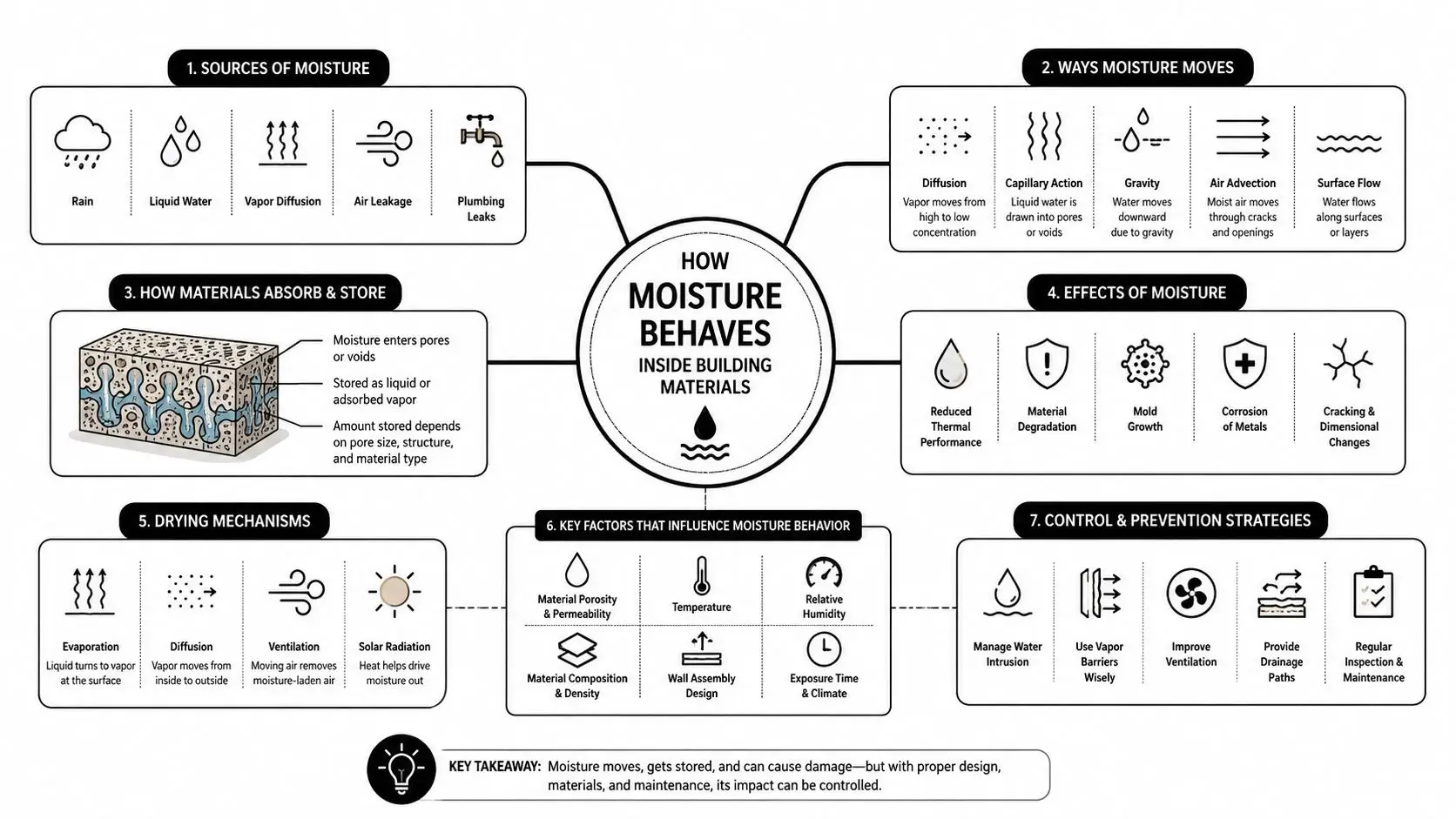
How Moisture Behaves Inside Building Materials
Water doesn't occupy every material in the same way. In wood, the fiber saturation point of North American species is about 28% to 30% moisture content, according to Purdue University Extension's explanation of wood moisture. Above that point, free water fills pores and can move through the material by gravity and capillary action. Below it, water is bound more tightly within cell walls and needs energy, moving air, and sufficiently dry surrounding air to leave.
A soaked subfloor behaves like a sponge full of loose water. Press it or move it, and liquid shifts through the openings. A damp subfloor below the fiber saturation point is more like a sponge that has been squeezed but still feels cool and heavy. The remaining moisture is held within the material, so drying depends on creating a favorable gradient between the material and the air around it.
Why readings matter
A moisture meter helps a technician compare affected areas with normal areas. The number isn't meaningful in isolation. A reading becomes useful when it's tied to the material, the meter type, the location, and a dry reference from the same structure. Homeowners can learn more about interpreting results in this guide to moisture meter readings.
Temperature changes the picture too. Warmer air can hold more water vapor, but heat alone doesn't remove that vapor. Air movement carries moisture away from a material, while dehumidification lowers the vapor content of the surrounding air so evaporation can continue.
For wood intended for heated interior use, university extension guidance describes moisture levels around 6% to 8% as an applicable drying target, while outdoor-exposed lumber may reach roughly 14% to 19% under favorable conditions. The University of Missouri Extension guidance on wood moisture illustrates why the correct target depends on the material's final environment, not a universal number.
This is why raw fan power can mislead. A stronger fan may move more air across a surface, but if the air is already saturated, the material loses moisture slowly. Effective drying requires a useful moisture gradient, a clear path for vapor to move, and enough dehumidification capacity to keep the surrounding air ready to accept more moisture.
The Main Structural Drying Techniques and When Each One Fits
No single method solves every wet-building problem. Restorers often combine techniques because a wet carpet, a wall cavity, and a dense wood floor release moisture at different rates.
| Technique | Best For | Limitations |
|---|---|---|
| Surface drying | Wet finishes, exposed flooring, and padless carpet | Doesn't reach sealed cavities or deep layers |
| Cavity drying | Wall and ceiling assemblies with trapped moisture | Requires suitable access and careful pressure control |
| Pressure drying | Dense materials and assemblies where air must be driven into a layer | Can be ineffective if air has no exit path |
| Heat drying | Materials that need more energy to release bound moisture | Heat without vapor removal can raise indoor humidity |
| Desiccant dehumidification | Cold conditions or very low relative humidity targets | Requires appropriate setup and exhaust management |
| Refrigerant or low-grain dehumidification | Warm, humid environments and general structural drying | Performance falls in colder conditions |
Surface and cavity work
Surface drying uses air movers to sweep dry air across exposed materials. It fits situations where the wet layer is accessible, such as carpet, flooring surfaces, or exposed subfloor. It underperforms when water has moved behind baseboards, under cabinets, or into a sealed wall.
Cavity drying solves the opposite problem. Technicians may remove trim, create controlled access points, or use injectors to move air into wall or floor cavities. The objective isn't to make holes unnecessarily. It's to create a path that lets trapped moisture leave rather than allowing it to remain enclosed.
Pressure, heat, and dehumidification
Pressure drying directs air into dense or layered materials. It can help when the surface has dried faster than the material underneath, but the air needs a route through the assembly. If pressure is applied without a practical exhaust path, the method may move air without moving enough moisture.
Heat increases evaporation by adding energy. It works best with dehumidification because the vapor released from the material must be removed. Refrigerant dehumidifiers are described as effective in the 70°F to 90°F range, while desiccant units are effective below 45°F and can support targets below 30% relative humidity, as summarized in this structural drying and dehumidification guidance.
The techniques stack rather than compete. A crew may use surface airflow on flooring, injection drying inside a wall, heat to support evaporation, and a dehumidifier to remove vapor. Psychrometric readings determine whether that combination is helping or needs adjustment.
Equipment Choices That Drive Real Drying Performance
Equipment should be selected for the moisture problem, not for appearance or fan count. An air mover creates circulation and changes the boundary layer at a wet surface. A dehumidifier removes water vapor from the air. An injector or mat system creates access to moisture trapped below or inside an assembly.
A quote that lists equipment without explaining placement, operating conditions, or monitoring leaves important questions unanswered. Ask what each unit is expected to accomplish and how the technician will confirm that it's doing so.
| Equipment Type | Key Performance Metric | Typical Range | Best Used For |
|---|---|---|---|
| Air mover | Airflow, measured in CFM | About 1 unit per 50 to 70 square feet for standard assemblies | Surface evaporation and circulation |
| Refrigerant dehumidifier | Operating temperature and moisture removal capacity | Effective around 70°F to 90°F | Warm, humid drying environments |
| Desiccant dehumidifier | Low humidity output and cold-weather performance | Effective below 45°F, with support for sub-30% RH targets | Cold spaces and demanding humidity control |
| Low-grain refrigerant unit | Grain depression and vapor removal | Depends on model and site conditions | High-performance drying in suitable temperatures |
| Cavity injector | Air delivery and number of intake or exhaust ports | Varies by equipment and assembly | Wall, floor, and ceiling cavities |
| Mat system | Contact with the affected surface and vacuum or pressure control | Varies by system and material | Wood flooring and layered assemblies |
The general deployment rule of about one air mover per 50 to 70 square feet applies to standard assemblies, but the industry guidance on structural drying emphasizes that psychrometric readings should override area formulas when material type or vapor pressure differs.
How to read a contractor's equipment list
- Ask about airflow: A CFM rating describes movement, but it doesn't prove that the air reaches the wet layer.
- Ask about dehumidification: The system must keep pace with the vapor released by the structure.
- Look for cavity tools: Wall injectors, floor mats, or controlled access may be necessary when surface air can't reach trapped moisture.
- Request humidity targets: The crew should explain how temperature and relative humidity affect evaporation.
- Request monitoring records: Daily moisture readings and psychrometric observations show whether the plan is progressing.
Air-changes-per-hour math can help assess room circulation, but it's only part of the picture. A room may have plenty of air movement and still dry slowly if moisture is trapped in a wall or the dehumidifier can't lower the vapor load. For general household moisture-control context, this resource on best dehumidifiers for basements can help explain why residential units and restoration equipment serve different purposes.
Homeowners comparing carpet-specific concerns can also review this guide to how to dry wet carpet fast, while remembering that carpet drying doesn't replace structural inspection below it.
A Step by Step Structural Drying Workflow With Timelines
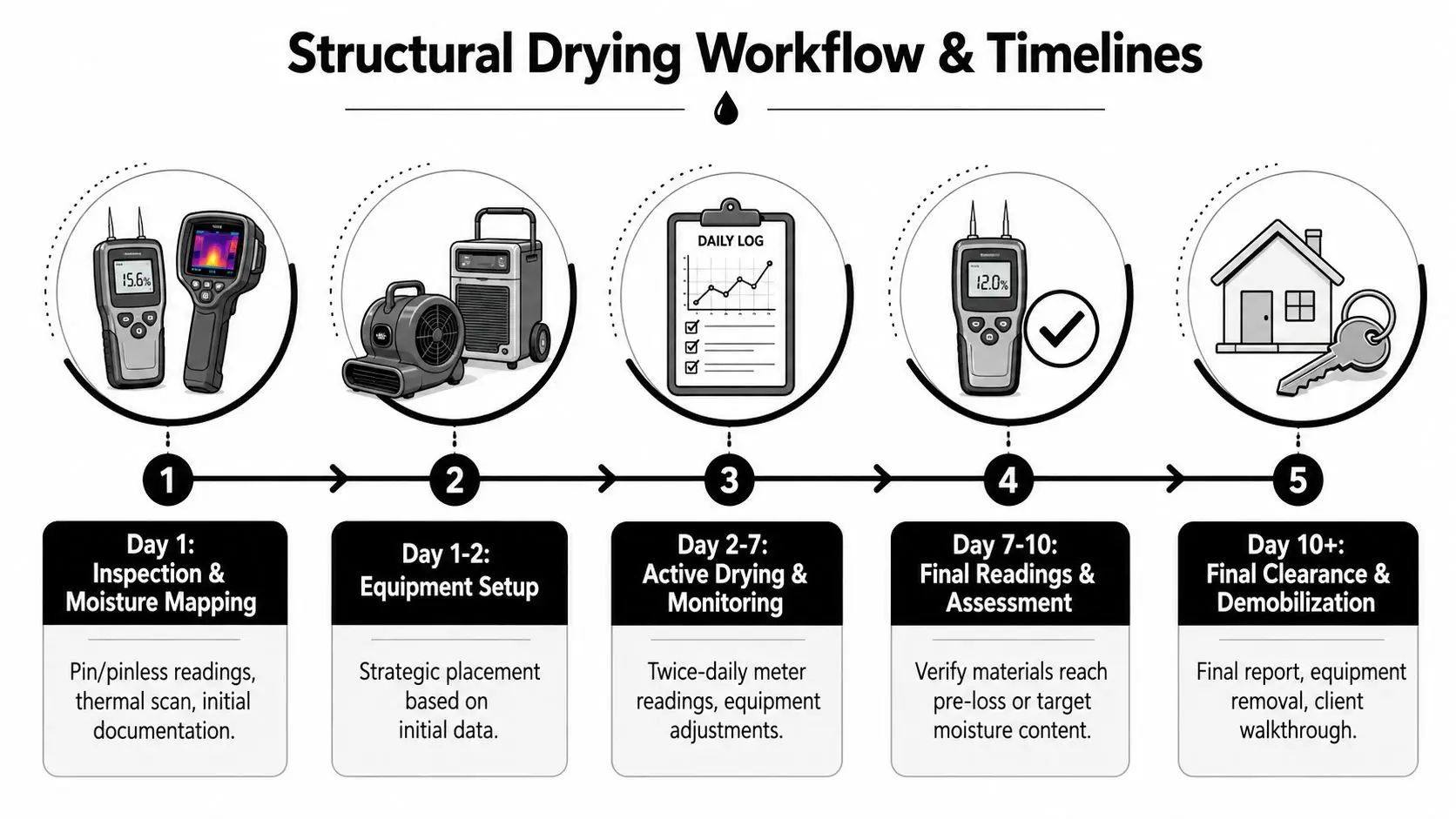
A sound drying job starts with a map, not a fan. On the first visit, the technician identifies the water source, checks safety conditions, documents visible damage, and records moisture in affected and unaffected materials. Pin meters can test at contact points, pinless meters can scan broader areas, and thermal imaging can help locate temperature patterns associated with hidden wet pockets.
The first setup
The crew should record photographs, moisture locations, material types, and equipment placement. This documentation supports communication with the homeowner and adjuster, especially when the scope changes after a wall, floor, or cabinet cavity is opened.
The drying process is commonly described in three phases:
- Phase 1, water removal: Extract standing water and accessible liquid.
- Phase 2, evaporation: Move moisture from materials into the air.
- Phase 3, moisture removal: Use dehumidification and ventilation strategy to remove vapor from the environment.
Equipment placement follows the readings. Air movers should contact affected surfaces without creating unsafe electrical conditions, while dehumidifiers should serve the room or containment area based on its moisture load. When a surface dries but readings inside a cavity remain high, the crew may open baseboards, create controlled weep holes, or switch to injection drying.
What happens during monitoring
Daily readings show whether moisture is declining. If readings stall, the technician may reposition air movers, add cavity access, change dehumidification type, adjust temperature, or recommend removal. A published structural-drying reference reports average moisture-content reductions of 8% to 12% per day in carpet systems and 5% to 8% per day in structural materials, with those figures described as about 60% faster than historical averages under standard protocols in this guide to water damage restoration.
Clean-water losses may take three to seven days, while Category 2 or Category 3 events can take longer, depending on material, access, contamination, and scope. Those timelines are planning ranges, not promises. A homeowner wanting a broader explanation of schedule factors can consult these water damage restoration timing considerations.
For additional practical cleanup context, flood damage cleanup steps can help homeowners organize safety, debris, documentation, and drying decisions after a larger event.
When Drying in Place Is the Wrong Answer
Drying in place sounds less disruptive, but it isn't always the safer or more defensible choice. The decision depends on water category, material condition, time since the loss, contamination, access, and occupant needs. Some standards discussions limit restorative drying to clean-water losses, while contaminated water may require removal, cleaning, and controlled disposal.
Category 3 water, sewage, and floodwater can introduce pathogens and other contaminants into porous materials. A fan may dry the material, but it won't make contaminated drywall, insulation, or carpet clean. Drying can also fail when MDF, engineered wood, or layered flooring has swollen, delaminated, or lost its physical integrity.
Two floors, two decisions
A soaked hardwood floor with stable boards, accessible moisture, and clean water may respond to a mat system that draws moisture through the surface while the room is dehumidified. The boards remain physically sound, and readings can show whether the assembly is improving.
An oak floor with severe cupping, separated layers, damaged fasteners, or moisture trapped beneath an underlayment may need removal. Continuing to dry it could consume time without restoring the material's shape or strength. Replacement may be the more reasonable scope even if the surface eventually feels dry.
The same logic applies to walls. Persistent odor, discoloration, swelling trim, or moisture readings inside a closed cavity indicate that surface drying hasn't solved the problem. If opening the assembly reveals contamination or widespread saturation, removal may protect occupants and reduce the chance of concealing damage.
The contrarian test: Don't ask whether a wet material can be dried. Ask whether it can be dried safely, cleanly, completely, and without losing its intended function.
Standards Safety and the Signs a Drying Job Is Truly Complete
A completed drying job is supported by measurements and documentation, not by a room that feels comfortable. The ANSI/IICRC S500 framework developed from field practice into a codified discipline for inspection, mitigation, monitoring, and completion. The third edition was published in 2006, and the fourth edition was published in November 2015, as described in the IICRC technical advisory on in-place drying.
Technicians compare affected materials with unaffected materials in the same structure to establish a dry standard. IICRC-based guidance says wood framing should be within four percentage points of normal equilibrium moisture content, and wood framing should be below 16% moisture content before new drywall is installed, according to this IICRC S500 equipment and dry-standard reference.
For general lumber protection, independent wood science guidance says structural lumber should generally be below 20% moisture content, because wood below that level is less susceptible to fungi and insect attack and is generally stronger, as explained by the University of Wisconsin Extension wood-moisture resource.
| Material | Baseline Reference | Target Moisture Content | Notes |
|---|---|---|---|
| Wood framing | Unaffected framing in the same structure | Within 4 percentage points of normal equilibrium; below 16% before new drywall | Confirm with material-appropriate readings |
| Structural lumber | Wood science guidance | Generally below 20% | Final use and environment still matter |
| Interior-use wood | Expected heated indoor condition | About 6% to 8% | Use depends on final ambient conditions |
| Outdoor-exposed lumber | Favorable outdoor exposure | Roughly 14% to 19% | Not automatically suitable for heated interiors |
A homeowner should expect readings to decline, conditions to stabilize, odors to resolve, swelling to stop, and affected areas to match comparable unaffected areas. Daily logs also help an adjuster understand why equipment remained in place or why the scope changed. Before reconstruction, post-remediation verification can provide an additional review when the project involves mold or other remediation concerns.
Safety remains part of completion. Wet electrical components, unstable structures, contaminated water, confined spaces, and active HVAC systems require professional judgment. A crew shouldn't remove equipment solely because the rental period is ending. It should remove equipment after the established material targets are reached and the results are documented.
When to Call a Certified Restoration Contractor
Call a professional when water has reached walls, subflooring, insulation, cabinets, or HVAC components, especially if the source was sewage, floodwater, or another contaminated supply. Visible mold, deep saturation, a loss that has been sitting for more than 48 hours, or a large affected area also calls for a trained assessment rather than a household fan.
Before signing, ask for IICRC certification, a written scope, a proposed timeline, moisture maps, psychrometric monitoring, equipment details, and proof of insurance. Ask what would make the contractor switch from drying in place to removal. A qualified professional should explain the decision in terms of material condition, contamination, access, readings, and final use, not just promise that more air will solve everything.
Restore Heroes provides structural drying and dehumidification for residential and commercial water damage, using commercial air movers, dehumidifiers, moisture detection, and monitoring to guide equipment adjustments. If you're in the Phoenix metro area, visit Restore Heroes to request an onsite assessment and discuss the safest drying or removal path for your property.