
A Phoenix water loss often starts fast and feels unreal for the first few minutes. One minute you're hearing monsoon rain hammer the patio roof, the next you're seeing water push under a back door, drip through a ceiling below an air handler, or spread from a failed supply line behind a wall.
That first hour matters. So does the next decision after it.
Water and flood restoration isn't just about drying what you can see. It's about stopping migration, checking hidden cavities, separating salvageable materials from unsafe ones, and getting the structure back to a documented dry standard before repairs begin. On a global scale, water-related floods and storms caused $175.9 billion in damages in 2022 and affected over 73.9 million people according to the HELP Global Report 2023. For Phoenix homeowners, the local causes may be different, but the response still has to be methodical.
Your First Steps After Water Damage in Phoenix
Phoenix homes don't all flood the same way. During monsoon season, flash flooding can send water through garage thresholds and patio entries. In other homes, the source is less dramatic but just as damaging. An overflowing water heater, a slab leak, a failed icemaker line, or an AC drain issue can soak drywall and subfloor before anyone notices.
The first thing to know is that panic leads to bad decisions. A calm, ordered response limits damage better than rushing in with towels, box fans, and guesswork. If the loss is active, stop the source if you can do it safely. If the source isn't obvious, treat the area like it may be unsafe until power and water are addressed.
Phoenix adds a few local wrinkles. Hard water can leave mineral staining around plumbing failures and fixtures. High outdoor heat can fool homeowners into thinking indoor materials will dry on their own. They often won't, especially inside wall cavities, under cabinets, or beneath flooring.
Practical rule: Dry surfaces don't always mean dry structure.
If the loss is around windows, sills, or frames, it also helps to review residential window mold prevention tips. Window areas often hold moisture longer than homeowners expect, especially where condensation, failed seals, and wind-driven rain overlap.
For a professional response focused on stabilization and moisture control, a local water damage mitigation team can inspect the affected areas and document what's wet before secondary damage spreads.
Emergency Checklist What to Do Immediately
The first phase is about safety and damage control, not full cleanup. If you do too much too early, you can spread contamination, disturb damaged materials, or create an electrical hazard.
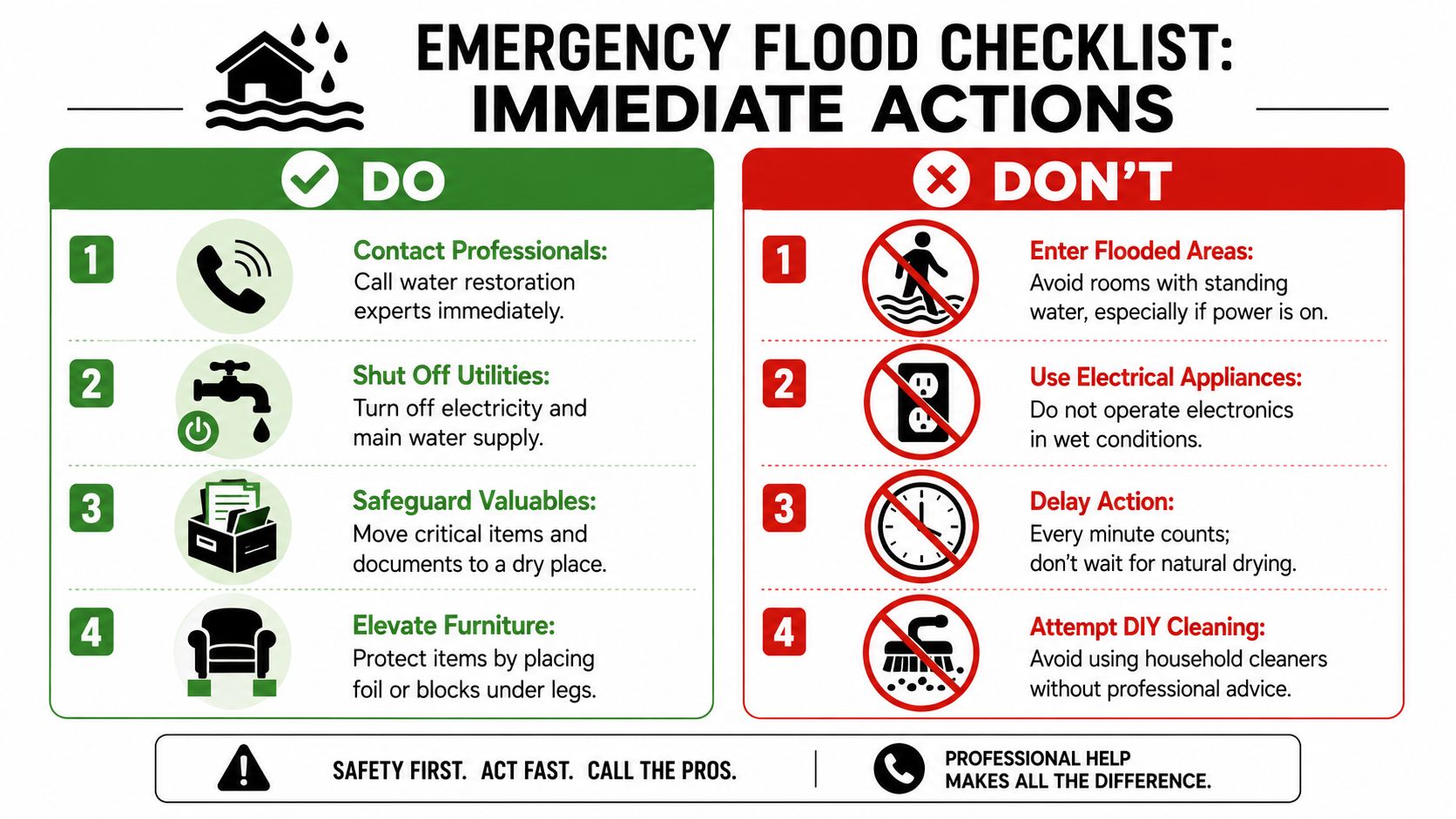
What to do right away
- Shut off electricity to affected areas: If water is near outlets, appliances, or baseboard-level wiring, keep out of the space until power is shut off safely.
- Stop the water source if possible: Turn off the nearest valve or the main water supply if a plumbing line is still feeding the loss.
- Call for emergency cleanup: Fast extraction and drying matter more than cosmetic cleanup. If you need immediate help, contact an emergency flood cleanup service.
- Move valuables to a dry area: Prioritize documents, medications, electronics, family photos, and anything irreplaceable.
- Lift furniture if it's safe: Use foil, wood blocks, or other barriers under legs to reduce staining and moisture transfer from wet flooring.
What not to do
- Don't enter standing water if power may still be on: This is the mistake that turns property damage into a safety emergency.
- Don't use a household vacuum on water: Standard vacuums aren't built for flood conditions.
- Don't pull up flooring just to “see what's under it”: Premature demolition can complicate documentation and make professional drying less controlled.
- Don't paint over stains or wipe contaminated water with regular cleaners: Surface cleanup doesn't fix wet insulation, framing, or cavities.
- Don't wait to see if it dries out by itself: Delay is one of the most common reasons a small loss turns into a larger repair.
A quick visual scan can help you spot less obvious damage. Bulging baseboards, peeling paint, soft drywall, and discoloration often show up before major collapse. Northpoint Construction has a useful guide on signs of moisture in walls that homeowners can use for a basic first pass while waiting for a technician.
A simple order of operations
| Priority | Action | Why it matters |
|---|---|---|
| First | Secure power and water | Reduces immediate hazard |
| Second | Protect people and pets | Limits exposure and injury |
| Third | Remove small valuables | Cuts preventable secondary loss |
| Fourth | Document visible damage | Helps with claim support |
| Fifth | Leave structural decisions to technicians | Prevents unsafe DIY removal |
If the room smells musty, feels humid, or has warm wet drywall, assume moisture has moved beyond the stain line.
The Professional Restoration Process Explained
A proper restoration job starts with a diagnosis. In Phoenix, that matters because a monsoon backup, a slab leak fed by hard water corrosion, and an overflowing supply line do not get handled the same way. The first task is to identify the source, stop it, classify the water, and map how far moisture has moved beyond the visible damage.
To see the full workflow at a glance, this process graphic is useful:
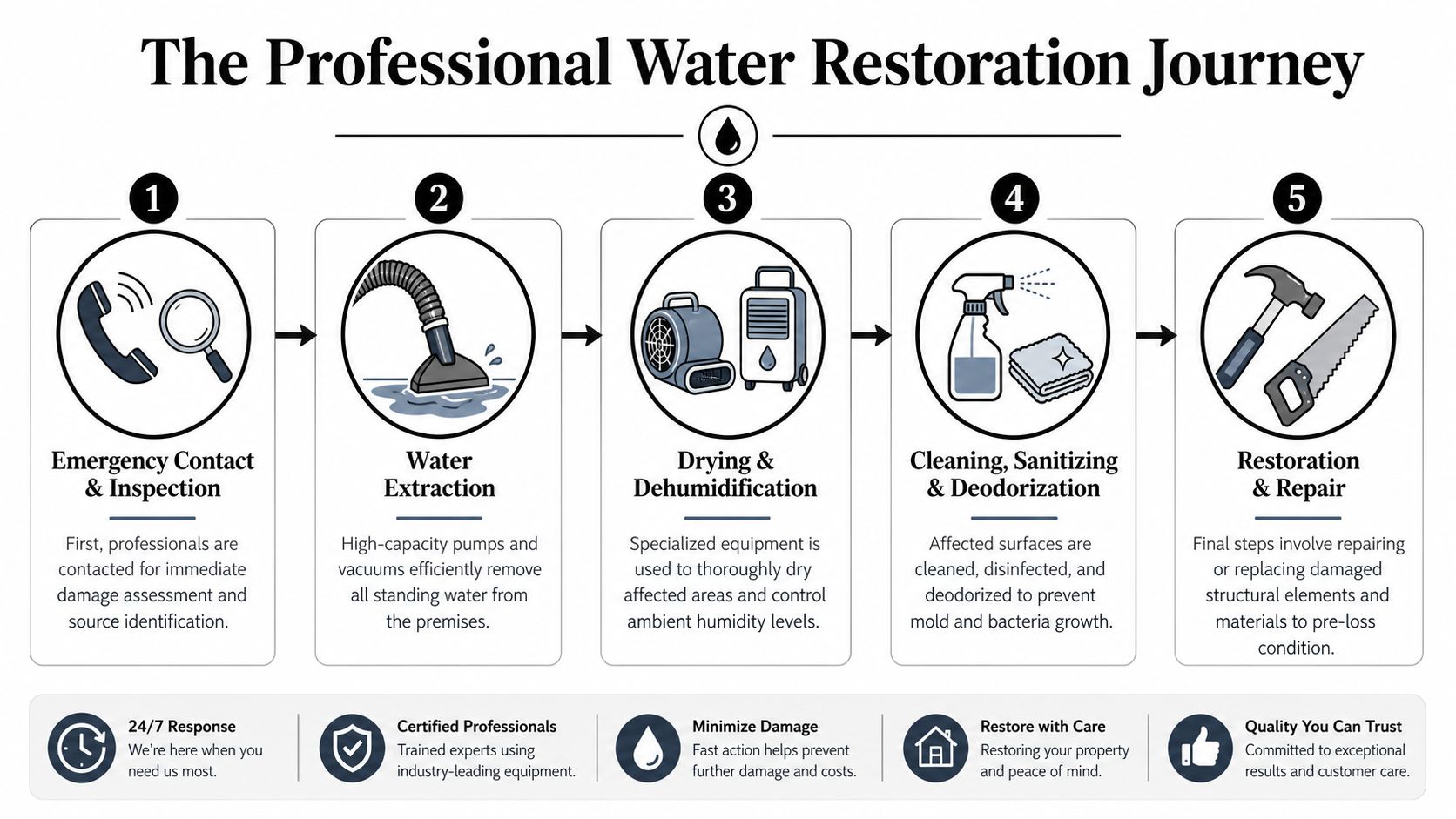
Inspection and moisture mapping
Technicians inspect more than the wet spot you can see. Water often travels into cabinet bases, under flooring, behind baseboards, into adjacent rooms, and down wall cavities. In Valley homes, we also pay attention to garages, laundry walls, and exterior-facing rooms where materials can trap moisture even when indoor air feels dry.
The IICRC S500 standard calls for documented readings, moisture mapping, and comparison to dry areas of the home. Wet framing, sheathing, and subfloors have to be measured, not guessed at. In Phoenix, that dry air can fool people. A room may feel normal while wood and drywall cores are still wet enough to support damage and microbial growth.
Extraction and controlled demolition
Once the wet area is mapped, the crew removes standing water and separates salvageable materials from materials that need to come out. That decision depends on both moisture and contamination.
A clean water loss caught early may allow some drywall, wood trim, or flooring to be dried in place. Floodwater from monsoon runoff is a different situation. Category 3 water brings contamination concerns, so porous materials in the affected zone, such as insulation, carpet pad, and often drywall, are usually removed rather than dried.
Homeowners often ask why crews cut out only the lower portion of a wall instead of tearing out everything. The reason is control. Targeted demolition gives access for airflow and cleaning while preserving materials that are dry, sound, and outside the contaminated area. For a straightforward overview of the full scope, from emergency mitigation through repairs, this guide on what a restoration company does lays out the roles clearly.
Drying and dehumidification
Drying takes longer than many people expect.
The room may look better in a day or two, but appearance is not the standard. Air movers, dehumidifiers, containment, and regular moisture checks are used to bring materials back to an acceptable dry condition. Technicians adjust the setup as readings change. If cabinets trap moisture under toe-kicks or water has moved beneath hardwood or laminate, specialty floor drying or wall-cavity drying may be needed.
Phoenix weather helps, but it does not replace controlled drying. Air conditioning, closed-up homes, shaded north walls, and dense finish materials can all hold moisture longer than owners expect. Mold can also behave differently here than people assume. In an arid climate, it may not explode across every surface overnight, but it can still establish inside wall cavities, under flooring, and around dust-loaded materials when moisture stays trapped.
This short video gives a practical look at the sequence and purpose of restoration work:
Cleaning, sanitation, and rebuild
After drying goals are met, the remaining structure is cleaned and, where needed, sanitized and deodorized. The exact scope depends on the water source. A clean appliance leak usually needs less cleaning than a stormwater intrusion or sewage backup.
Rebuild starts only after the structure is dry enough to close up. That may mean a small drywall patch and new baseboards, or it may involve insulation, cabinets, flooring, and lower wall assemblies. The trade-off is simple. Rebuild too early and moisture gets trapped behind new materials. Wait for verified dry readings and the repair has a much better chance of holding up.
Specialized Restoration Equipment and Techniques
At 2 a.m. after a monsoon storm, a garage or family room can look manageable with a shop vac and a few box fans. By the next afternoon, water may already be under baseboards, inside cabinet voids, or trapped beneath laminate. The equipment matters because the job is not just to remove visible water. It is to control how the structure dries, room by room and material by material.
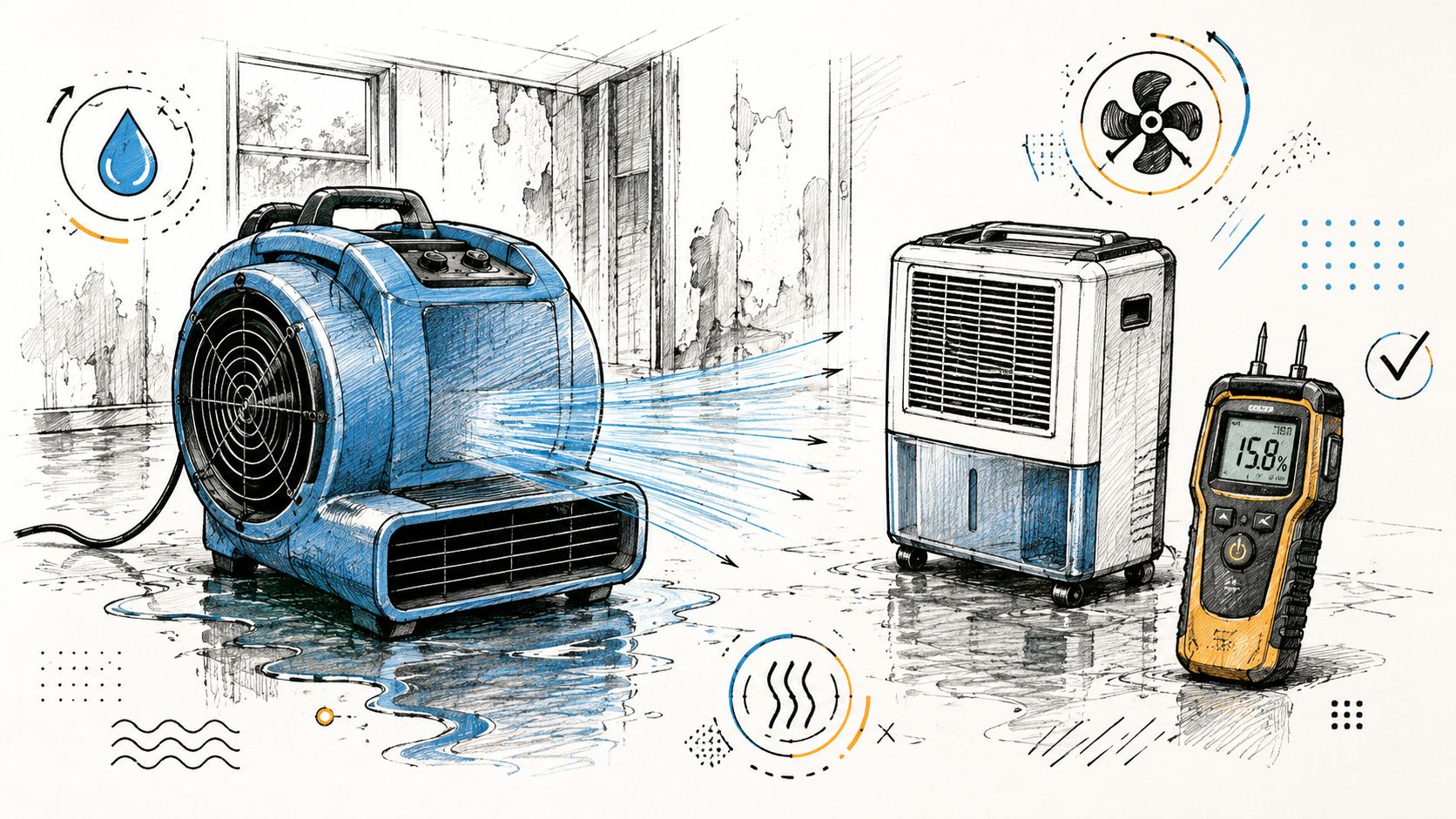
Extraction tools and moisture detection
Fast extraction sets the pace for everything that follows. Professional units pull water from carpet, pad, concrete seams, and low spots far more effectively than a wet vac. In Phoenix homes, that matters after flash flooding and after plumbing leaks tied to aging valves, scale buildup, or hard-water wear on supply lines and fixtures. The longer water sits, the farther it migrates.
Crews also use instruments that answer a simple question homeowners cannot solve by touch alone: what is still wet?
- Moisture meters: Check drywall, framing, trim, and subfloor moisture levels.
- Thermal imaging cameras: Help identify temperature patterns that can point to hidden moisture. They guide the inspection, but they do not replace direct meter readings.
- Hygrometers and psychrometric measurements: Track humidity, temperature, and evaporation conditions so equipment can be adjusted instead of left to guesswork.
That last part is where good drying plans separate from noisy ones. A room full of fans can feel productive and still dry unevenly.
Why Phoenix homes need targeted drying
Phoenix heat can mislead people. The air outside is often dry, but open windows and ceiling fans do very little for moisture trapped inside wall cavities, under toe-kicks, behind shower surrounds, or beneath dense flooring. Air movement has to reach the wet material, and dehumidification has to remove the moisture load from the indoor air.
Arid climates also create a false sense of safety around mold. Growth here may be slower on open, sun-baked surfaces than in humid regions, but hidden pockets still develop when water stays in enclosed spaces with dust and organic material. I see this after monsoon intrusions, slab-edge seepage, and slow kitchen leaks that never looked dramatic from the surface.
Some materials add another layer of difficulty. Engineered wood, laminate, plaster, and tightly built cabinet assemblies often need specialty floor drying mats, wall-cavity systems, or focused negative-pressure drying. The trade-off is cost and time versus demolition. In some losses, targeted drying can save materials. In others, opening the assembly sooner is the cleaner and more dependable choice.
Homeowners comparing machines and process can get a clearer picture from this breakdown of water extraction equipment and drying tools. Restore Heroes is one Phoenix-area company that uses extraction, drying, and moisture-detection equipment as part of water loss response.
Navigating Insurance Claims and Restoration Costs
The insurance side of a water loss frustrates people almost as much as the damage itself. Coverage depends on the source of loss and the policy language. A burst supply line and ground-driven floodwater are often treated differently. Don't assume a claim is covered, denied, or simple until the adjuster reviews the facts.
Your job is to document the loss clearly and avoid creating gaps in the story.
What to document before cleanup moves too far
Take photos and video before items are moved if it's safe to do so. Then keep adding to the file as work progresses.
Use this checklist:
- Photograph the source area: Include the failed appliance, pipe, ceiling stain, or entry point.
- Capture the spread pattern: Floors, lower drywall, cabinets, contents, and adjacent rooms.
- Save a written timeline: Note when you discovered the loss, when you shut off water, and when help was called.
- Keep all communication organized: Emails, claim numbers, adjuster names, and scope notes matter later.
- Ask for material notes in writing: If something is removed, dried in place, or declared unsalvageable, get that documented.
The material selection issue most homeowners miss
One of the biggest points of confusion comes after demolition, when the conversation shifts from cleanup to rebuild. Homeowners often assume any replacement material that looks good will be fine with insurers and future claims. That's not always how it works.
A recognized problem is the insurance-approved material gap. Guidance for flood-repairable homes points to water-compatible materials such as sacrificial plasterboard and epoxy floor treatments, yet many general guides skip that level of detail. The issue matters because 68% of US flood claims involve disputes over material suitability, based on the verified analysis tied to the flood repairable house practitioners handbook.
How to talk with your adjuster
Keep the conversation specific. Ask what they need to see, what they want preserved, and whether material upgrades or resilience-oriented replacements need pre-approval.
A practical resource for organizing that discussion is this guide with water damage insurance claim tips.
A few useful questions to ask:
| Question | Why ask it |
|---|---|
| Is this being handled as plumbing discharge, storm entry, or flood? | The claim path can change based on source |
| Which materials need to be retained for inspection? | Prevents accidental disposal problems |
| Do you want moisture logs or contractor notes? | Clarifies what documentation supports the file |
| Are replacement materials subject to approval? | Avoids disputes during rebuild |
Don't argue broad principles. Stay on the facts of the loss, the material condition, and the written policy process.
Timeline and What to Expect During Restoration
Most homeowners experience restoration in phases, not as one continuous job. The first day feels urgent. The next few days feel noisy. The rebuild phase often feels slower than expected because moisture clearance, approvals, material availability, and scheduling don't all move at the same speed.
What the first days usually feel like
Day one is about emergency action. Water gets extracted, wet materials are identified, and equipment is placed. If demolition is needed, parts of drywall, flooring, insulation, or cabinetry may be opened up quickly to stop hidden moisture from lingering.
Then the property settles into the drying phase. You hear air movers all day and all night. Doors to some rooms may stay closed. Parts of the house may feel warmer or drier than usual because the equipment is controlling the environment, not comfort.
The quiet-looking days are often the productive ones. That's when the structure is being brought back to a dry standard.
Why one job moves faster than another
Two homes with the same visible ceiling stain can have very different timelines. A clean water loss caught early in a tile area may dry with limited disruption. A flood-intrusion loss affecting drywall, insulation, cabinets, and baseboards usually involves a longer path because removal, sanitation, and later repairs all stack up.
Phoenix homeowners also notice a strange mismatch between weather and progress. It may be bright and dry outside while interior drying still takes time. That isn't a contradiction. Sunlight on the driveway doesn't tell you whether the wall cavity behind your kitchen cabinets is ready for reconstruction.
During the rebuild stage, the job often feels more like a remodeling project than an emergency service call. That shift is normal.
Phoenix Water Damage Restoration FAQs
Phoenix homeowners tend to ask the same few questions after a loss, but the right answer usually depends on the source of water, how long materials stayed wet, and what's happening behind finished surfaces.
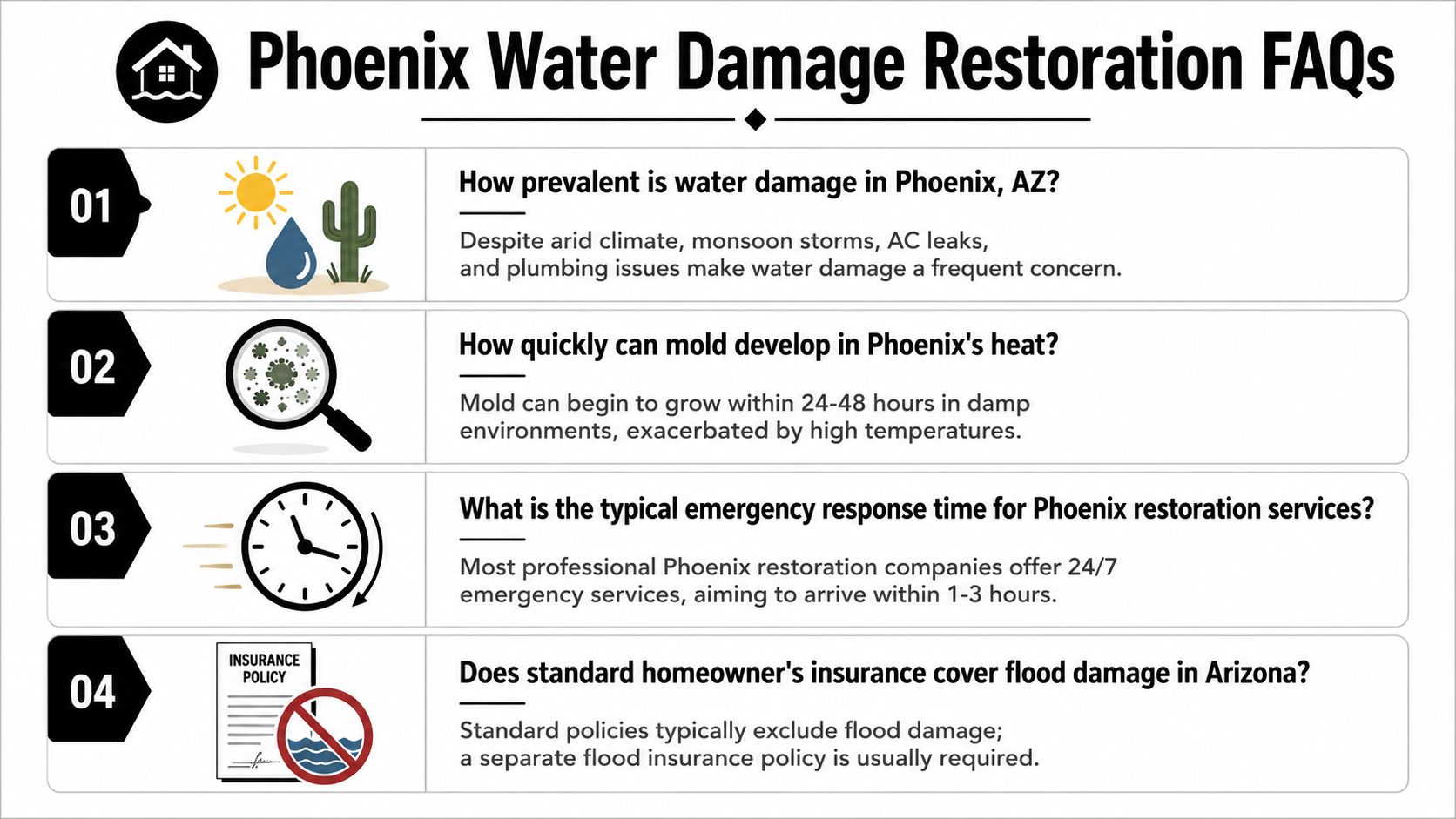
Does standard homeowners insurance cover monsoon flood damage
Usually, standard homeowners policies treat floodwater differently from interior plumbing failures. Water entering from ground-level flooding, storm runoff, or broader flood conditions may require separate flood coverage. A claim from a broken supply line inside the house is often evaluated under a different part of the policy. The only reliable answer is in the policy language and claim handling details.
How long do I really have before mold grows in Phoenix
The old “24 to 48 hour” rule is too simple for Arizona conditions. Verified guidance for this article notes that some porous materials can remain mold-free for over 7 days in low-humidity zones if dried aggressively, but that same guidance also warns that moisture trapped in wall cavities can accelerate hidden mold, which is why professional detection matters. That nuance comes from the source discussing the hidden mold timeline in low-humidity conditions.
What matters most isn't the clock by itself. It's the material, the humidity inside the assembly, and whether moisture is open to airflow or trapped behind finishes.
When is a leak small enough to handle myself
A small, clean spill on a hard surface is one thing. A leak that touched drywall, baseboards, insulation, cabinetry, laminate, or wood flooring is different. If you can't confirm what's happening inside the assembly, you're making a decision without the data that matters.
Use this rule of thumb:
- Handle it yourself: Small clean-water spills on fully exposed, non-porous surfaces you can dry completely.
- Call for inspection: Ceiling stains, repeated leaks, musty odor, buckled flooring, soft drywall, or any hidden-source suspicion.
- Treat as urgent: Floodwater intrusion, sewage involvement, or water that's been sitting in porous materials.
Does Phoenix's dry air make professional drying unnecessary
No. Dry outdoor air can support drying, but it doesn't replace extraction, cavity checks, moisture mapping, or controlled dehumidification. Homes dry from the inside out only when the wet assemblies are opened or dried correctly. A dry climate helps if the process is already working. It doesn't fix a trapped moisture problem by itself.
What about hard water damage after a plumbing leak
In Phoenix, hard water often leaves mineral deposits, crusting, and staining around leak paths and fixtures. That residue can help identify the source, but it can also mask how long the leak has been active. A line may look like it “just failed” when staining suggests it's been slow-leaking for much longer. That changes how carefully walls, cabinets, and flooring should be inspected.
If you're dealing with active water damage in the Valley, Restore Heroes provides Phoenix-area restoration support for emergency water extraction, structural drying, cleanup, and moisture inspection. The practical next step is to get the loss assessed, the source addressed, and the wet materials documented before hidden damage spreads.