
You hear water where there shouldn't be water. Or you wake up to a smoke smell and a chirping detector. Or you step into the laundry room and feel the floor give slightly under your foot.
In that moment, most homeowners aren't thinking about “process.” You're thinking, “Who do I call, how bad is this, and what do I do first?”
That's exactly where 24/7 emergency response matters. It isn't just a slogan. It's the difference between an incident that gets stabilized quickly and one that keeps spreading while everyone waits for normal business hours.
If you're dealing with water, smoke, mold concerns, or a biohazard issue, the first few decisions matter. What helps most is knowing what usually happens next, who does what, and what you can realistically expect from the call all the way through final paperwork.
When Disaster Strikes What Happens Next
A home emergency rarely starts at a convenient time. It's often late at night, early in the morning, or right when you're trying to get kids out the door. A pipe bursts. A water heater leaks. A kitchen fire leaves soot and odor even after the flames are out.
The first job is simple. Protect people, then stop the problem from getting worse if it's safe to do so. That might mean shutting off the water supply, turning off power to an affected area, or leaving the house until professionals say it's safe to return.

Why round-the-clock response exists
People sometimes think around-the-clock emergency service is a modern marketing phrase. It's rooted in public safety. The modern idea of always-available emergency help is closely tied to emergency calling systems like 911 in the United States, 112 in Europe, 999 in the United Kingdom, and 000 in Australia, with 911 becoming the nationwide emergency number in the late 1960s according to NGA 911 and Beyond essential emergency numbers.
That shift changed expectations. Help was no longer something people sought only during office hours. It became something systems were designed to provide immediately.
For property damage, the same logic applies. Water doesn't pause overnight. Smoke residue doesn't stay neatly in one room. The longer damaged materials sit, the harder cleanup usually becomes.
Practical rule: If the problem is active, your first goal isn't a perfect plan. It's stabilization.
What homeowners usually need first
The initial ten minutes don't call for a technical explanation. They call for order. A clear next step. A calm person asking the right questions.
That's why a good emergency process starts with triage. What happened, when did it start, is anyone in danger, is the source still active, and can the property be safely entered?
If you're dealing with water intrusion and want to understand what damage can be hiding behind walls and under floors, this walkthrough of what's happening inside a flooded house can help you make sense of what you can't see yet.
What Immediate Response Really Means
A lot of people hear “immediate response” and assume it means a truck is already turning onto their street. That isn't what the phrase should mean.
A better comparison is a hospital emergency room versus a doctor's office. A doctor's office may care a great deal and do excellent work, but it isn't set up for urgent action at any hour. An emergency room is built for triage, stabilization, and rapid decision-making.
A restoration emergency team should work the same way.
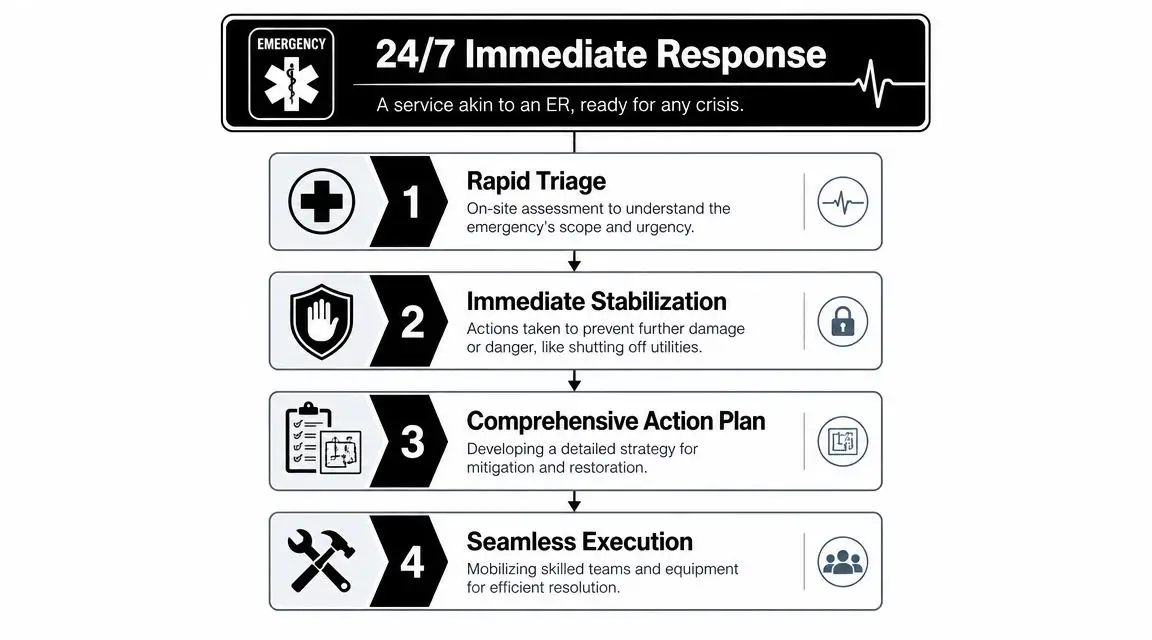
Always open versus ready to deploy
There's a big difference between answering the phone and being operationally ready.
In high-consequence emergency programs, the benchmark is 24/7/365 rotational on-call coverage tied to an Emergency Operations Center, because continuous staffing shortens the time between incident notice and specialist mobilization, as described in PG&E's company emergency response plan.
In property restoration, that idea translates into practical readiness:
- A call intake process: Someone has to gather useful details quickly, not just take a message.
- On-call technicians: A crew has to be available after hours, not scheduled only for daytime jobs.
- Loaded vehicles and equipment: Extraction units, air movers, dehumidifiers, containment materials, PPE, and moisture-reading tools need to be accessible.
- A dispatch method: The right team has to be notified and routed without confusion.
What the first response is trying to accomplish
Homeowners often assume the first visit is about complete restoration. Usually, it's about mitigation first.
That means stopping additional harm. With water damage, that may mean extraction, moisture mapping, and setting drying equipment. With fire damage, it may mean securing openings, addressing unsafe areas, and beginning soot control measures. With a sewage or biohazard event, it may mean containment and controlled cleanup procedures.
Immediate response is less about finishing the job and more about preventing the job from becoming much larger.
That's also why coordination matters. Emergency teams often need a clean handoff from intake to dispatch to field crew. If you want a plain-English look at how organizations think about that routing step, this guide to a unified emergency solution gives useful context for how incident information gets organized across teams.
For property owners specifically, the first operational goal after the call is often rapid water removal. If that's your issue, this overview of 24/7 water extraction explains what technicians are trying to accomplish before structural drying even begins.
Your Emergency Call A Step-by-Step Timeline
The first part of an emergency call can feel slow when you're standing in a wet hallway or staring at smoke residue on the ceiling. From your side, it may sound like too many questions. From the response side, those questions are what turn panic into action.
Here's what the opening phase often looks like.

The call itself
You call. The person answering tries to establish four things quickly:
- What happened
- Whether anyone is in danger
- Whether the source is still active
- Where the property is and how to access it
For a water loss, they may ask whether the supply has been shut off, whether power is affected, and which rooms are involved. For smoke or fire damage, they may ask whether the fire department has cleared the scene. For a biohazard issue, they may ask whether the area has been isolated.
This part can feel repetitive, but it reduces mistakes. In many industries, call routing exists to move information to the right team instead of letting details get lost. If you're curious how that works more broadly, this guide to optimizing business calls gives a useful explanation of why intake and routing matter so much in urgent situations.
What happens after you hang up
Once the key details are captured, the internal work starts. Dispatch contacts the on-call crew, confirms the incident type, and matches the job to the likely equipment and skill set needed.
A sewage backup isn't staffed exactly like a clean water leak. A board-up after a fire isn't handled the same way as drying a bathroom overflow. The call may sound simple, but the dispatch choices matter.
A realistic homeowner expectation is this: response begins before a truck arrives. The planning starts during and immediately after the call. Travel time, traffic, crew location, property access, and the nature of the loss all affect how quickly on-site work can begin.
If you're waiting for the crew, that doesn't mean nothing is happening. It usually means the mobilization phase is already underway.
What to have ready while you wait
You don't need to create a perfect file. Just gather what's easy and safe.
| What helps | Why it matters |
|---|---|
| Address and callback number | Lets dispatch reach you if they need gate codes or directions |
| Photos from a safe distance | Helps document visible conditions |
| Utility status | Tells the crew whether water or power is still active |
| Insurance information if available | Helps later, even if claim decisions come after inspection |
Once technicians arrive, the timeline shifts from intake to assessment and mitigation. If you want a fuller picture of how long the overall job may take after that first visit, this article on how long water damage restoration takes helps set expectations beyond the emergency phase.
What Restoration Professionals Do On Arrival
A professional crew shouldn't rush blindly into the building. The fastest useful response is usually a methodical one.
The first minutes on site are about safety, source control, and scope. Homeowners sometimes worry when they see technicians pause to inspect before unloading everything. In most cases, that pause is a good sign. It means they're working the problem in the right order.
Safety comes first
If water is near outlets, if ceilings are sagging, if there's heavy soot, or if contamination is possible, the crew starts by identifying immediate hazards. They may limit access to parts of the property, recommend that occupants stay out of certain rooms, or coordinate with other trades if utilities need to be shut down or verified.
That kind of discipline isn't accidental. Research on emergency response systems points to staffing problems, human errors, and equipment breakdowns as common failure modes, which is why organizations rely on recurring training and continuously staffed hotlines to improve response readiness, as discussed in this research on emergency response system reliability.
The source and the spread
After the initial safety check, the next question is usually, “Is the problem still active?”
With water damage, crews try to identify the source, confirm whether it has been stopped, and trace how far moisture may have traveled. Water often moves farther than the visible stain. It can wick into baseboards, insulation, subfloors, cabinet toe-kicks, and adjacent rooms.
With smoke damage, crews look at where residue settled, what materials were affected, and whether any openings in the building envelope need temporary protection. With contamination events, the focus shifts toward isolation, controlled removal, and proper cleaning of affected surfaces.
The first work that usually begins
Once the team understands the hazard and the scope, they explain the immediate mitigation plan in plain language. That conversation should include what they know, what they still need to verify, and what work can begin right away.
Common early actions include:
- Water extraction: Removing standing water with extraction equipment.
- Stabilization: Setting containment, protecting unaffected areas, or securing exposed openings.
- Drying setup: Positioning air movers and dehumidifiers where they can do useful work.
- Documentation: Recording moisture readings, affected materials, and visible conditions.
- Sanitation steps where needed: Applying cleaning or decontamination procedures appropriate to the loss type.
A company like Restore Heroes handles that sequence as part of its restoration workflow, but the same basic pattern applies across reputable emergency restoration teams. The important part is not flashy equipment. It's whether the crew can assess accurately, communicate clearly, and start the right mitigation steps without creating new problems.
Good emergency crews don't just move fast. They reduce uncertainty for the homeowner while they work.
Your Next Steps as a Property Owner
Once the crew is working, many homeowners feel stuck. You're not. Your role changes from emergency fixer to decision-maker and document keeper.
That matters more than people realize.

Focus on the tasks only you can do
The crew can manage extraction, containment, and cleanup. They can't make insurance decisions for you or tell your employer, tenant, or family what's happening.
Use your energy on these jobs:
- Stay safe: If the area is unsafe, stay out. Don't go back in for photos or belongings until someone qualified says it's appropriate.
- Document conditions: Take photos or short videos from a safe distance. Include wide shots and close-ups if you can do so without risk.
- Call your insurer: Start the claim process early, even if the full scope isn't known yet.
- Protect essentials: Move medications, important documents, chargers, wallets, and daily necessities to a dry, clean area.
- Keep a simple record: Write down names, times, claim numbers, and what each person tells you.
Questions worth asking on site
You don't need technical training to ask good questions. Keep them practical.
- What's the immediate plan for today?
- Which areas should we avoid?
- What materials are likely affected but not yet confirmed?
- What documentation will you provide for insurance?
- What happens next after this first stabilization phase?
For commercial property managers, add a few more: tenant communication, access control, temporary closures, and whether any affected spaces should remain offline until further inspection.
One calm mindset shift
Try not to solve the whole claim, budget, and repair plan on the first night.
Your real objective is smaller. Get the situation stabilized. Preserve documentation. Ask clear questions. Avoid preventable mistakes.
That approach gives you the best chance of making good decisions once the immediate stress settles.
Navigating Insurance and Billing for Restoration
Money worries usually show up fast. That's normal. A homeowner sees soaked flooring or smoke-stained walls and immediately wonders what insurance will cover, who gets paid, and whether a contractor can quote the full job right away.
In the emergency phase, a reputable restoration company usually focuses on documenting the loss carefully and separating immediate mitigation from later repair decisions. That documentation often includes photos, moisture readings, notes about affected materials, and records of what work was performed to stabilize the property.
Who does what in the claim process
The restoration contractor's role is to provide professional services and support the file with clear records. The insurer's role is to interpret the policy and decide what is covered.
That distinction matters. A contractor can explain the damage they observed, the emergency steps they took, and what conditions need further work. They can't rewrite your policy.
A firm price over the phone usually isn't realistic because crews haven't seen the extent of hidden damage, access issues, material types, or contamination concerns yet.
Some companies can coordinate directly with carriers or submit documentation in a format adjusters expect. That can make the process feel smoother, but it still doesn't guarantee coverage, timing, or payment decisions. The policy language controls those outcomes.
If you want a practical homeowner-focused overview of how to avoid claim mistakes during a water loss, these water damage insurance claim tips are a good place to start.
Frequently Asked Questions About Emergency Response
Is 24/7 emergency response the same as guaranteed on-site arrival any time of night
No. This is one of the biggest points of confusion. A service may answer calls at any hour, but actual on-site response still depends on staffing, geography, and dispatch capacity. That distinction matters because, as noted in this discussion of rural emergency response limitations, immediate call answering and immediate field arrival are not the same thing.
Why can't a company give me a final price during the first phone call
Because the visible damage is often only part of the job. Water can spread behind walls and under flooring. Smoke can affect cavities, insulation, and HVAC pathways. Biohazard work can require controlled removal and cleaning steps that aren't obvious from a phone description.
Is my home safe to stay in
Sometimes yes, sometimes no. That depends on the type of loss. Standing water near electrical systems, contamination, unstable materials, or heavy smoke residue can make parts of the property unsafe. Ask the on-site project manager which areas are safe and which should stay off limits.
What does IICRC-certified mean
It means the company or technician has training tied to restoration industry standards. For a homeowner, the practical takeaway is simple. You want people who follow a recognized process for inspection, mitigation, cleaning, and drying instead of improvising.
Should I call insurance before the restoration company
If the issue is actively damaging the property, many homeowners call for emergency mitigation first and notify insurance right after, or do both close together. The key is not delaying reasonable steps that prevent further damage.
What if the emergency involves roof damage after a storm
The first need is usually temporary protection and documentation. After that, the insurance path can become more detailed. If roof damage is part of your loss, this Arizona Roofers' claim process guide is a helpful companion for understanding how that side of the claim may unfold.
What should I do before the crew gets there
Keep it simple:
- Shut off the source if safe: Water, power, or gas only if you can do it safely.
- Stay out of hazardous areas: Don't step into standing water around electrical hazards.
- Take a few photos: Only from a safe location.
- Gather basics: Keys, phone charger, medications, insurance info, and essentials.
If you need help after water, fire, smoke, mold, or biohazard damage, Restore Heroes serves the Phoenix metro area with emergency restoration support and can help you move from the first urgent call to a clearer recovery plan.