
A facility manager usually doesn’t discover a mold problem during a calm week. It shows up after a roof leak, an HVAC drain issue, a plumbing failure above a tenant suite, or a monsoon storm that pushed water where it shouldn’t have gone. The first sign is often a musty smell that nobody can quite place. Then a tenant mentions headaches, a ceiling tile starts staining, or a conference room wall feels damp.
At that point, commercial mold remediation stops being a maintenance task and becomes an operations, liability, and documentation problem. You’re protecting occupants, preserving leasable space, managing disruption, and making sure every step can stand up to insurer and regulatory scrutiny. In commercial buildings, the question isn’t just “How do we remove mold?” It’s “How do we remove it without spreading contamination, shutting down more space than necessary, or creating a bigger claim later?”
The Hidden Threat in Commercial Properties
A Phoenix property manager notices a stale odor in a second-floor office a few days after monsoon rain. Maintenance changes an air filter and replaces a stained ceiling tile. The smell stays. A week later, a tenant reports irritation near a perimeter wall, and another suite complains that the odor is strongest when the air conditioning kicks on. That’s how many commercial mold jobs begin. Not with dramatic black patches on a wall, but with a small moisture event that got into concealed space and started affecting building operations.
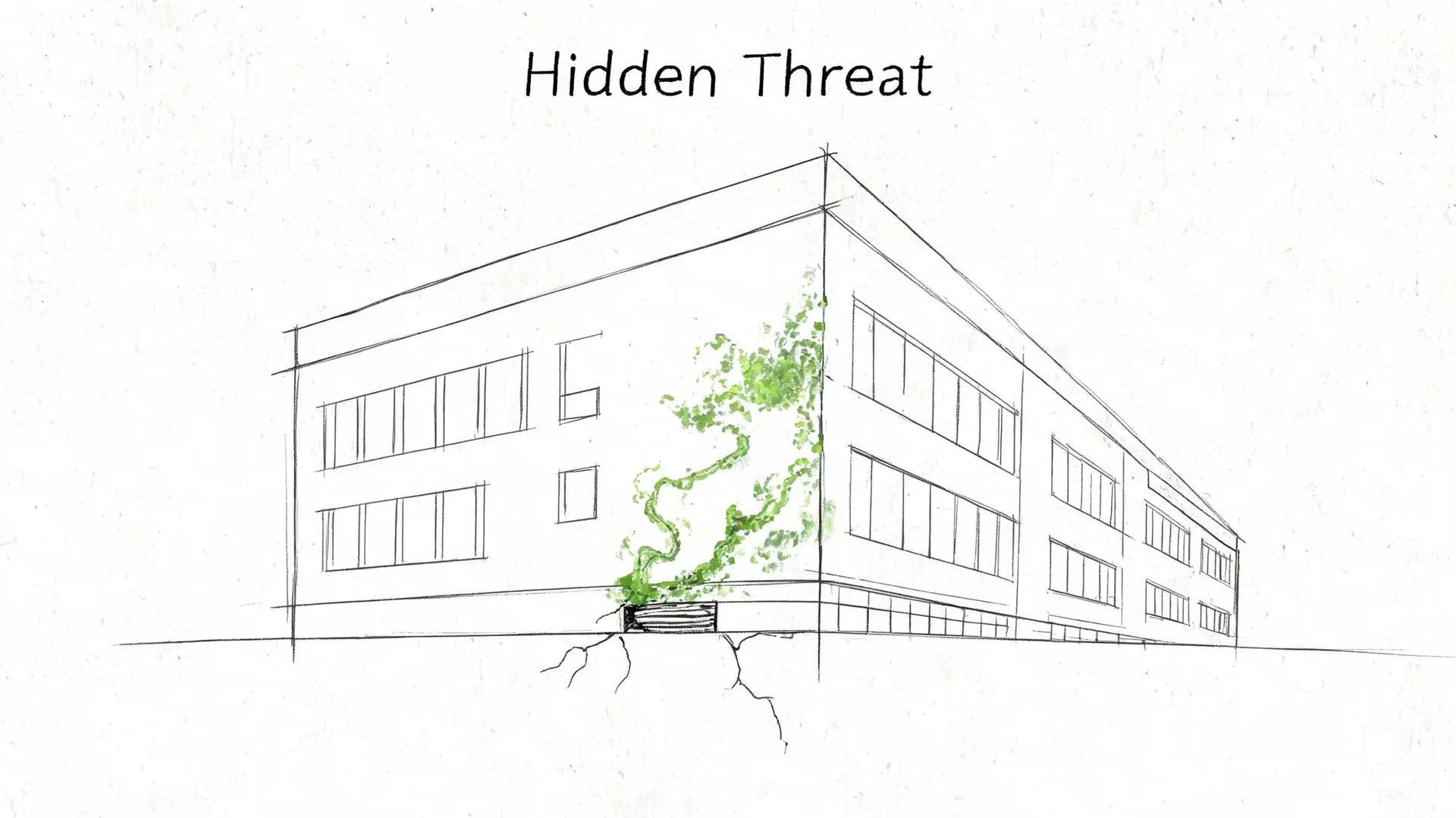
In a commercial property, mold rarely stays a simple cleaning issue. Shared HVAC systems, tenant improvement buildouts, drop ceilings, wall cavities, and occupied common areas make spread more likely and diagnosis more complicated. One unresolved leak can affect indoor air quality complaints, lease relationships, insurance reporting, and the timing of repairs across several spaces.
Why commercial buildings carry more risk
Commercial mold remediation matters because the consequences are broader than surface damage.
- Tenant health concerns: The CDC notes mold exposure can cause stuffy nose, sore throat, coughing, wheezing, burning eyes, or skin rash, and market research projects commercial mold remediation demand to grow at a 3.9% CAGR through 2030 as businesses work to reduce health hazards, avoid lawsuits, and meet standards for inspections and maintenance in commercial environments (Grand View Research market report).
- Business interruption: If contamination reaches occupied areas or HVAC pathways, managers may need to restrict access, move staff, or sequence work after hours.
- Liability exposure: When complaints were documented before action was taken, that paper trail can become part of a dispute.
Commercial mold is as much a continuity issue as a cleaning issue. The best jobs protect occupants and keep unaffected parts of the building usable.
Why small delays become expensive
Mold follows moisture. If a building team covers staining without fixing the source, the contamination usually returns. In commercial settings, that means repeat vendor calls, unhappy tenants, and repairs that expand from one wall section to a larger remediation scope.
That’s why professional commercial mold remediation starts with control. Not panic. Not cosmetic cleanup. Control of moisture, occupant exposure, documentation, and the work area.
Recognizing Early Signs of a Mold Problem
Facility managers usually see the clues before they see the mold. The challenge is knowing which clues deserve escalation. In commercial buildings, early signs often show up in patterns. Complaints cluster in one suite, one floor, or one side of the building after rain, a plumbing issue, or an HVAC problem.
What you can observe on a walk-through
Start with the obvious, but don’t stop there.
- Odor near vents or enclosed rooms: A musty smell that returns after cleaning often points to hidden moisture, contamination above ceilings, or mold inside wall cavities.
- Water staining: Ceiling tiles, baseboards, window perimeters, and drywall seams tell you where water traveled, not necessarily where it stopped.
- Surface changes: Bubbling paint, peeling wallcovering, warped trim, and persistent condensation on glass can all signal a moisture condition that supports growth.
- Recurring “minor” leaks: A condensate line that backs up, a restroom supply leak, or roof seepage around penetrations can feed hidden amplification over time.
Watch list: Musty odor, staining that comes back, soft drywall, repeated HVAC condensate issues, and complaints concentrated in one zone all justify a closer look.
A commercial manager should also think beyond offices. Break rooms, locker rooms, storage spaces, janitorial closets, medical suites, retail stock rooms, and school or childcare spaces often hide moisture longer because they have more fixtures, more traffic, or less day-to-day visual attention.
For wet environments outside the usual office footprint, resources on targeted issues can help staff distinguish routine residue from a real contamination problem. This guide to pool white mold removal is a useful example of how moisture-dependent growth behaves in specialized settings.
What occupants report before maintenance confirms it
Tenant feedback matters. People may not say “mold.” They’ll describe symptoms or patterns.
“The room smells damp every morning.”
“This suite feels worse when the AC starts.”
“That wall was repaired before, and the stain is back.”
Health complaints alone don’t diagnose mold, but they do help identify where to inspect. If several occupants mention irritation, coughing, or a stale odor in the same area, that’s a signal to investigate moisture and building materials nearby.
Hidden clues behind finished surfaces
Some of the most important evidence isn’t visible during a casual walkthrough. Look for:
- Baseboards pulling away from walls
- Rust on metal corner bead or fasteners
- Discoloration around window heads or sill corners
- Swollen casework under sinks or in break rooms
- Repeated patch-and-paint repairs in the same location
If you’re trying to determine whether staining or odor might be coming from concealed cavities, this overview of signs of mold in walls is a practical reference.
The rule is simple. If the building is telling you moisture has been present, assume the surface view is incomplete until proven otherwise.
The Professional Mold Inspection and Testing Process
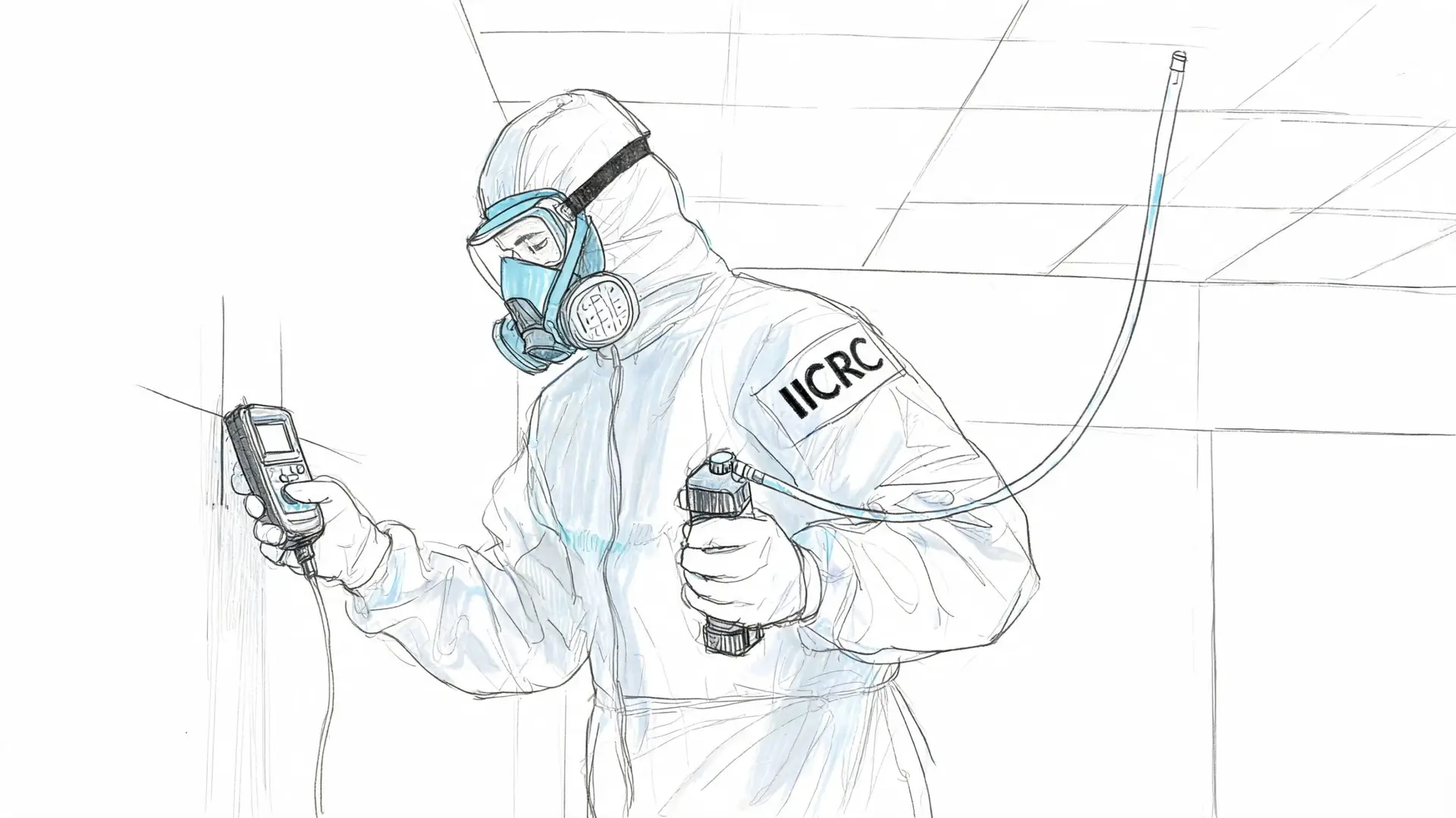
A real commercial mold inspection is not a quick glance with a flashlight. It’s a structured effort to identify the moisture source, define the extent of affected materials, and determine what level of containment the work will need. That scope drives budget, schedule, and business continuity planning.
The first pass is visual, but not casual
An experienced inspector starts with the building story. Where did the water come from. How long was it present. What repairs were attempted. Which spaces share HVAC, plumbing walls, or roof lines. That history often explains why contamination appears in one suite but originates elsewhere.
Then comes a room-by-room review of likely pathways and reservoirs. That includes ceiling plenums, wall intersections, supply and return areas, exterior perimeters, sink cabinets, and flooring transitions.
A useful way to prepare internally is to use a facility-ready checklist before the inspection team arrives. This mold inspection checklist helps organize observations, affected rooms, and prior water events so the site visit starts with facts instead of guesswork.
Moisture mapping determines the real footprint
Moisture mapping is where many assumptions get corrected. Inspectors use moisture meters to measure material wetness and infrared cameras to locate temperature differences that can point to concealed moisture. Infrared alone doesn’t confirm mold, but it helps direct openings and meter checks where hidden water is most likely.
This stage matters because mold remediation fails when crews clean the visible area but leave damp material behind. In commercial space, that often happens above hard ceilings, inside demising walls, around window systems, or behind millwork.
Field rule: You don’t scope mold by stain size. You scope it by moisture path, material type, and what’s concealed beyond the visible edge.
Later in the process, education helps building teams understand why those tools matter in practice.
What testing can and can’t tell you
Air and surface sampling can support the inspection, but they don’t replace it. Sampling is most useful when the team needs to compare occupied areas to suspect areas, investigate hidden contamination, or document conditions before and after work. It’s one piece of evidence, not the entire diagnosis.
A solid assessment usually answers these questions:
- What caused the moisture condition
- Which materials are affected
- How far contamination may extend
- What containment level the project requires
- Whether the space can stay occupied during portions of the work
That scope protects everyone involved. The contractor knows what to isolate and remove. The facility manager can plan access and communication. The insurer gets a documented basis for the remediation approach.
Containment and Remediation Methods Explained
A containment failure in a commercial building rarely stays contained. One poorly isolated demo area can spread contamination into neighboring suites, trigger tenant complaints, interrupt operations on multiple floors, and create a harder insurance conversation later. For facility managers, this phase is about more than cleaning. It is about controlling liability while keeping as much of the property functional as conditions allow.
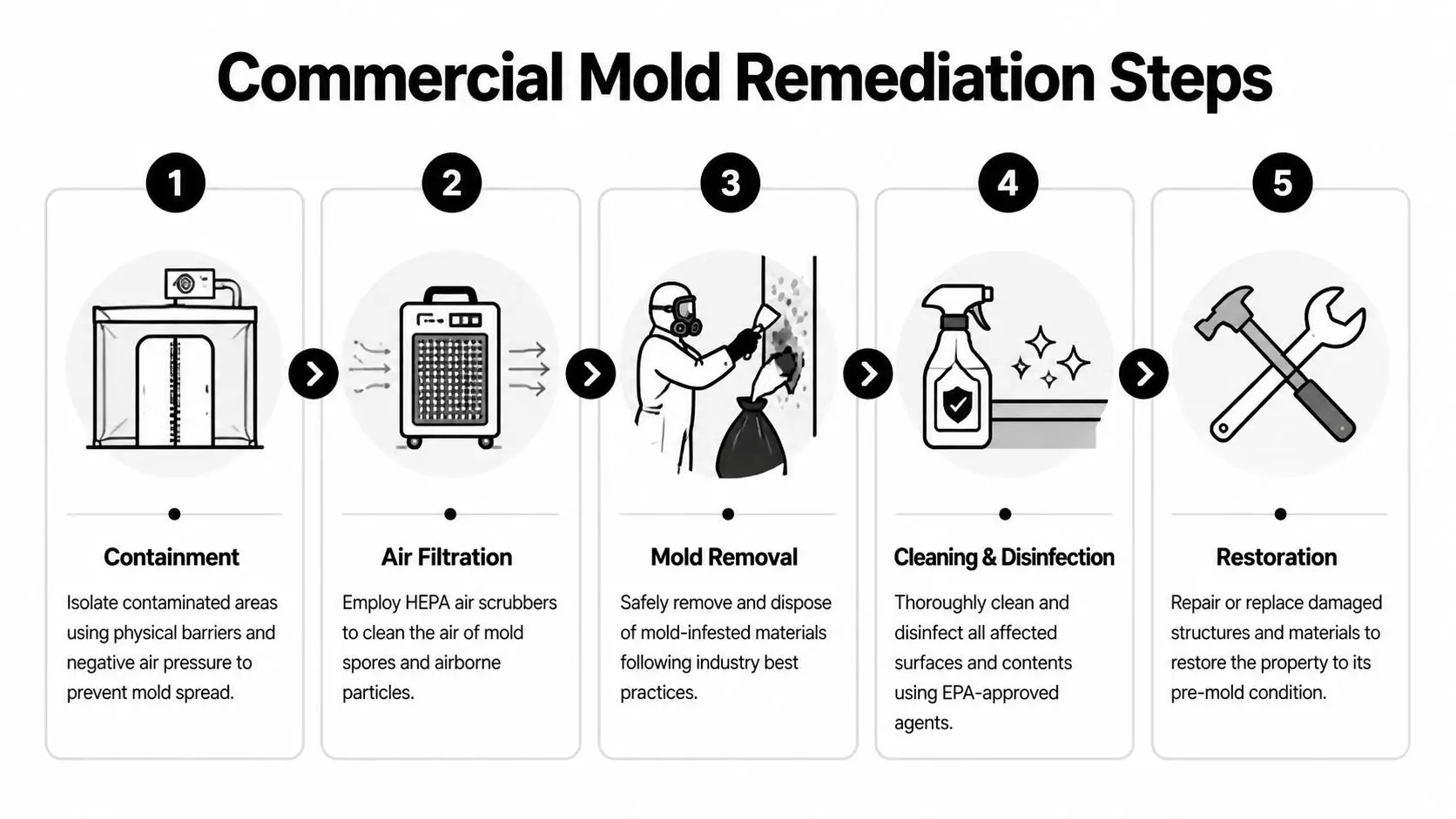
Containment comes first
Containment separates affected space from occupied space. In practice, that means the crew builds a defined work zone, controls air movement, and sets entry and exit procedures before demolition starts. If that step is rushed, spores and dust can move through return air pathways, elevator lobbies, corridors, and shared ceiling plenums.
The EPA and federal facility guidance scale containment to the size and conditions of the affected area. The WBDG summary outlines a progression from minimal controls in very small areas to full containment, negative pressure, and more protective respiratory equipment on larger projects (WBDG mold remediation guidelines).
| Contamination Size | Containment Level | Key Requirements |
|---|---|---|
| Under 10 sq ft | Minimal containment | Basic PPE such as N-95 respirators |
| 10 to 100 sq ft | Limited containment | Single-layer 6-mil fire-retardant polyethylene, negative pressure, HEPA-filtered AFDs, full-face respirators with HEPA cartridges |
| Over 100 sq ft | Full containment | Double-layer 6-mil polyethylene, multiple AFDs exhausting outdoors, PAPRs or supplied-air respirators |
Size matters, but it is not the only factor. In a medical office, school, law firm, or occupied retail center, the right containment level is also shaped by occupant sensitivity, HVAC design, access routes, and whether the work sits beside revenue-producing space. I often recommend a tighter setup than the bare minimum when the cost of cross-contamination is higher than the cost of extra plastic, labor, and filtration.
What the work zone should include
A properly built containment area usually includes critical barriers, negative air machines with HEPA filtration, protected walk paths, and a defined waste exit route. On larger projects, crews may add a decontamination chamber or clean room so workers can remove debris and PPE without carrying residue into the building.
That planning protects business continuity. It lets managers keep unaffected tenants in place, limit after-hours work to the highest-impact areas, and document that reasonable steps were taken to reduce exposure complaints.
What removal actually involves
Once the area is stable, remediation crews remove unsalvageable materials and clean the materials that can be saved. The goal is source removal, because mold growth embedded in porous material does not stay solved just because the surface looks better.
Typical work includes:
- HEPA vacuuming of settled dust and contaminated debris during multiple phases of the job
- Damp wiping or detail cleaning on non-porous and some semi-porous surfaces that can be restored
- Selective demolition of drywall, insulation, ceiling tile, carpet pad, casework backing, and other materials that cannot be reliably cleaned
- Controlled bagging and disposal so debris leaves the building without contaminating clean areas
- Targeted drying and humidity control to return the assembly to stable conditions before rebuild
Fogging or antimicrobial application may have a limited supporting role on some projects, but they do not replace removal, cleaning, and drying. If a contractor proposes chemicals as the main answer, treat that as a scope review issue.
Some properties also need support after remediation in adjacent sensitive spaces. A food production area, laboratory, or high-end medical suite may need a separate final cleaning standard even if it was outside the contained loss area. In those cases, it helps to find your specialty cleaning solution with a vendor that understands controlled environments.
Cleaning, drying, and coatings
Facility managers often ask whether encapsulants or antimicrobial coatings solve the problem. They can have a place on properly prepared structural surfaces after cleaning and moisture correction, especially where replacement is impractical. They do not make damaged porous materials acceptable, and they do not erase a poor demolition scope.
The sequence matters. Remove contaminated materials that cannot be restored. Clean the surfaces that remain. Dry the assembly to acceptable conditions. Then decide whether a coating belongs in the restoration plan.
That order affects liability as much as indoor air quality. If tenants later question the work, your file needs to show that the contractor addressed the source, controlled the spread, and restored the space in a defensible way. Managers who want a broader view of how that fits into recovery planning can review what a restoration company does across mitigation, drying, cleanup, and rebuild.
Navigating Insurance Claims and Regulations
The physical work gets most of the attention, but documentation often decides how smoothly the project moves. In commercial mold remediation, your file may be read by an adjuster, a tenant representative, legal counsel, or a risk manager months after the work is complete. If the record is thin, your position gets weaker.
Build the claim file from day one
Start documenting as soon as the issue is identified. Don’t wait until demolition begins.
A strong file usually includes:
- Date-stamped photos of visible damage, staining, and affected contents
- Incident timeline showing when the leak, intrusion, or complaint was first noticed
- Maintenance records for prior repairs, roof calls, HVAC issues, or plumbing events
- Inspection findings that identify moisture source, affected materials, and extent
- Tenant communications that show what was reported and how management responded
This protects the claim and the building operator. It shows that management acted reasonably, investigated promptly, and based decisions on observed conditions instead of assumptions.
Understand the regulatory side
The EPA’s Mold Remediation in Schools and Commercial Buildings Guide remains a key reference for non-residential work because it emphasizes moisture source correction and removal of contaminated materials to protect public health in occupied structures (EPA guide reference discussed here). That matters for schools, offices, retail suites, healthcare-adjacent spaces, and any property where occupants expect clean indoor conditions.
Compliance isn’t only about technical cleanup. It also affects worker protection, occupant separation, and whether your contractor can explain why the scope was built the way it was. When a project is challenged, documented adherence to recognized guidance carries weight.
Documentation rule: If a condition affected occupancy, air quality complaints, or a potential insurance claim, write it down, photograph it, and preserve the timeline.
Coordinate early with the carrier
Many commercial policies handle mold very differently depending on the cause of loss, endorsements, exclusions, and whether the underlying water event is covered. That’s why early reporting matters. The carrier may want specific photos, readings, invoices, or cause documentation before approving parts of the work.
Facility managers also need to separate emergency mitigation from permanent repair decisions. In practice, that means stabilizing the site, preventing spread, and preserving evidence before anyone rushes to close walls.
If your team is working through a water-related commercial loss that may lead to mold, these water damage insurance claim tips are a useful operational reference.
Good remediation records don’t just help get paid. They help show that management took occupant safety and property stewardship seriously.
Phoenix Mold Prevention and Maintenance Tips
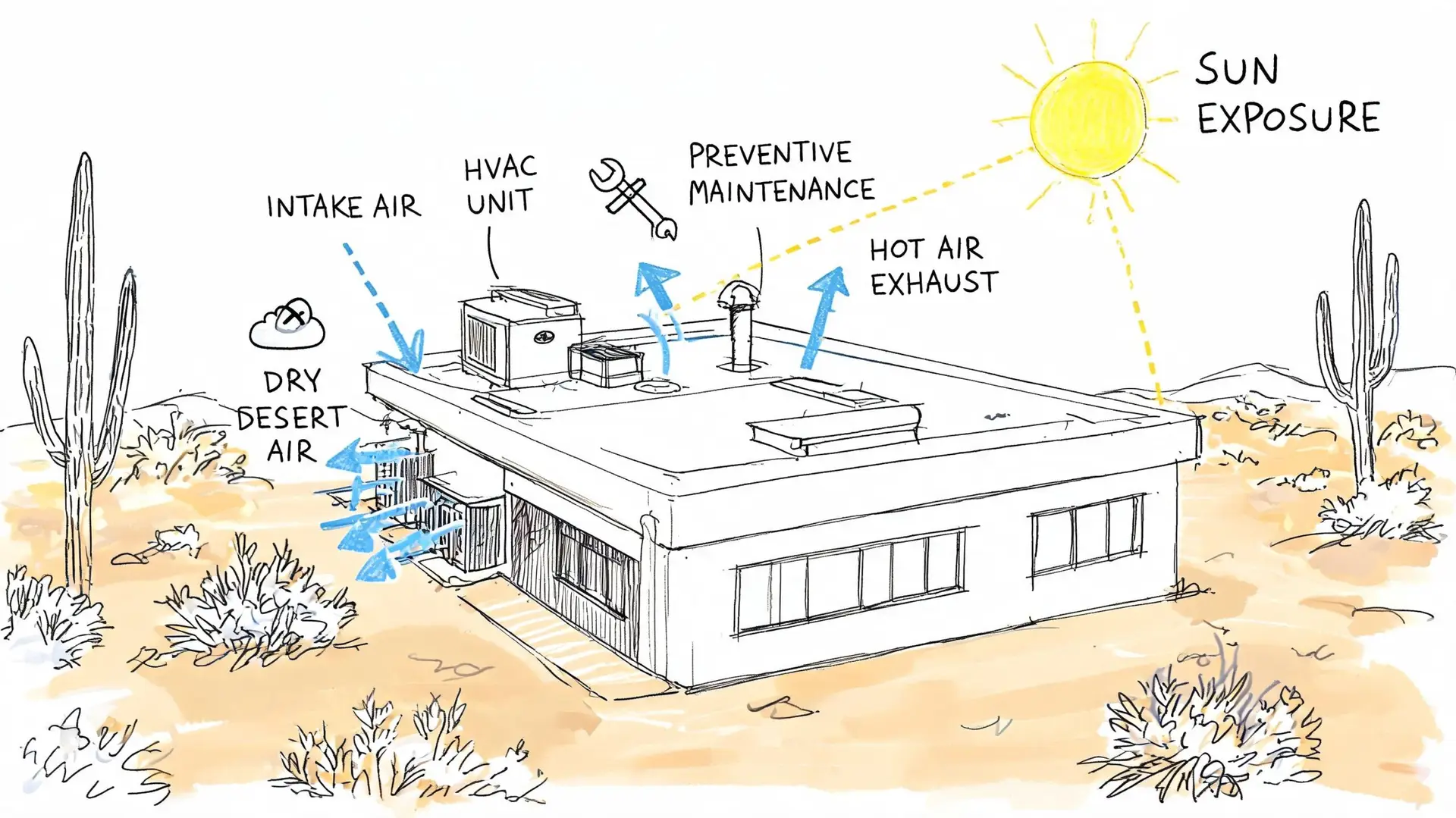
A Phoenix property can run trouble-free for months, then one storm, one clogged condensate line, or one unnoticed irrigation issue puts a tenant space on your incident log. By the time occupants smell mustiness or report staining, the problem is no longer just maintenance. It affects lease relationships, schedule disruptions, and whether management can show it acted reasonably once conditions changed.
Prevention starts with moisture verification
In Phoenix, visible cleanliness gives a false sense of security. Materials can look normal while wall cavities, insulation, casework, or carpet pad still hold enough moisture to support growth after a leak or HVAC event.
Good prevention work starts after the repair crew leaves. Verify that affected materials are completely dry, confirm the source was corrected, and document what was checked. For a facility manager, that record matters. If a tenant later claims the problem came back because the building was never properly dried, your logs, photos, and meter readings help show that the property responded with care instead of guesswork.
Phoenix trouble spots that deserve routine attention
The highest-value maintenance tasks are simple, but they prevent expensive interruptions.
- After monsoon activity: Check roof drains, penetrations, parapet edges, window perimeters, and top-floor ceiling tiles for staining or dampness.
- During HVAC service: Inspect drain pans, condensate lines, insulation, curb flashings, and supply diffusers that may be sweating.
- In plumbing-heavy suites: Look under sinks, behind toilets, around breakroom fixtures, and at cabinet bases or partition walls that swell first.
- At the exterior envelope: Watch for failed sealant, door threshold leaks, storefront perimeter gaps, and irrigation overspray soaking wall assemblies.
- In vacant suites: Add periodic walkthroughs. Empty spaces often hide slow leaks longer because no tenant is there to report them.
In this market, air-conditioning systems trigger many mold investigations. Condensation and drainage failures are common sources in buildings that otherwise seem too dry for fungal growth.
Build a reporting system your staff will actually use
Janitorial crews, maintenance techs, and tenant coordinators usually spot the first warning signs. Give them a reporting standard that takes less than two minutes: photo, suite number, location, date, and whether the material feels damp or smells off.
That small habit improves business continuity. Fast reporting gives management a chance to isolate a small issue before it becomes a tenant complaint, a relocation expense, or a dispute over who knew what and when. I have seen minor moisture issues stay manageable because a porter documented a baseboard stain early. I have also seen the same type of issue turn into a larger claim because nobody wanted to "wait and see" in writing.
Use preventive maintenance to reduce liability, not just cleanup costs
A prevention program should tie directly to operational risk. If a building has recurring window condensation, repeated AC drain backups, or known problem suites, track them like any other loss trend. Patterns matter when you are budgeting capital work, responding to insurers, or defending maintenance decisions after a tenant alleges negligence.
For window-heavy properties, some detail-level residential guidance still helps explain repeat condensation points. This article on mold prevention for homeowners is useful for understanding why sills and frames become recurring trouble areas.
If your property includes storage, utility rooms, or partially below-grade areas, review these practical tips on how to avoid mold in basement conditions. The same moisture control principles apply in commercial spaces, even when the occupancy and risk profile are different.
How to Select an IICRC-Certified Remediation Contractor
Commercial mold remediation is not a commodity purchase. Two scopes can look similar on paper and produce very different outcomes in an occupied building. The contractor you hire affects containment quality, insurance documentation, schedule control, and whether the problem stays gone.
What to treat as non-negotiable
Start with credentials and process discipline.
Look for a contractor that can clearly demonstrate:
- IICRC certification: This signals training against recognized restoration standards and helps separate remediation firms from general cleaners.
- Commercial containment experience: Office suites, healthcare-adjacent spaces, schools, retail centers, and industrial offices each require different sequencing.
- Insurance literacy: The team should document moisture source, affected materials, containment setup, and work progress in a way adjusters can follow.
- Clear chain of custody for affected materials: Debris handling, bagging, and movement through occupied space should be controlled and explained.
- Ability to coordinate around occupancy: Night work, phased access, and protection of unaffected areas matter in active buildings.
Questions worth asking before you sign
Don’t ask only for a price. Ask how they think.
- How will you determine the extent of contamination beyond the visible area?
- What containment level do you expect, and why?
- Which materials are typically cleaned versus removed in a job like this?
- How will you document the moisture source correction and drying progress?
- How do you protect neighboring suites, corridors, and HVAC pathways?
- Who communicates with the insurer and how often?
A strong contractor answers these directly. A weak one leans on vague language like “we spray everything,” “it should be fine,” or “we’ll know when we get there” without describing a method.
Don’t ignore the business case
Method choice affects downtime. That matters to any property manager with tenants, employees, or revenue-generating space. One market summary notes that modern approaches such as dry fog can save 30 to 50% compared to traditional demolition-based methods and reduce project timelines from weeks to hours, which is why owners look closely at interruption costs as well as direct remediation costs (commercial remediation technology discussion).
That doesn’t mean every building should use the same method. It means the contractor should be able to explain the trade-off between demolition, cleaning, drying, occupancy impact, and long-term confidence in the result. The right proposal isn’t always the cheapest scope. It’s the scope that controls contamination, addresses moisture, and makes operational sense for the property.
Frequently Asked Commercial Remediation Questions
Commercial managers usually ask practical questions first. Can tenants stay in place. What has to be disclosed. What makes one project much larger than another. Those are the right questions because commercial mold remediation is as much about managing people and operations as it is about cleaning materials.
| Question | Answer |
|---|---|
| Can a business stay open during commercial mold remediation? | Sometimes, yes. It depends on where the contamination is, how well the work area can be isolated, whether shared HVAC is involved, and how much demolition is required. In many buildings, unaffected areas can remain in use while the remediation zone is contained and put under negative pressure. |
| Do tenants need to be informed? | In practice, clear communication is wise whenever remediation affects access, schedules, air handling, noise, or occupant routines. Managers should coordinate with legal counsel and lease obligations for property-specific requirements. A calm notice that explains where work is occurring and how unaffected areas are being protected usually works better than vague reassurance. |
| What most affects project cost? | Scope changes the price more than any single cleaning step. The main drivers are the extent of hidden moisture, the amount of porous material that must be removed, containment complexity, after-hours scheduling, access constraints, and how much restoration is needed after remediation. |
| Is testing always required? | Not always in the same way. Some projects rely heavily on inspection and moisture mapping, while others benefit from air or surface sampling to document hidden conditions or support post-remediation verification. Testing is a tool, not the entire remediation plan. |
| Why not just clean visible mold and repaint? | Because visible growth is often the symptom, not the source. If moisture remains in the wall, ceiling, floor system, or HVAC-related components, cosmetic repairs usually fail and the problem returns. |
| What should a facility manager do first after discovering suspect mold? | Protect the area from unnecessary disturbance, document what you see, identify any recent water event, and get a qualified inspection. Don’t let maintenance tear into suspect material without containment planning. |
| How do you reduce liability during the project? | Keep a clean record. Document complaints, inspection findings, photos, work authorizations, moisture correction, tenant notices, and project updates. Liability usually gets worse when conditions were noticed early but not handled in a structured way. |
The biggest mistake is treating mold as a housekeeping issue. In a commercial setting, it’s a risk management issue tied to occupants, lease relationships, insurer expectations, and the long-term condition of the building. Handle it early, scope it correctly, and keep the record organized.
If you need help with commercial mold remediation in the Phoenix area, Restore Heroes is an IICRC-certified restoration company that handles inspection support, containment, remediation, drying, and insurance coordination for commercial properties. They serve the Valley with 24/7 response and can help property managers move from uncertainty to a documented, professionally managed plan.