
You pull a shirt from the closet, hold it up, and that stale, damp smell hits you right away. The fabric may look clean, but it doesn’t smell fresh. Maybe your shoes feel a little clammy. Maybe the back wall of the closet feels cooler than the rest of the room. In Phoenix, that can feel confusing because most of the year the air seems dry.
Closets are small spaces, and small spaces trap problems fast. A little leftover humidity from laundry, an AC issue, monsoon weather, or a past leak can linger where air barely moves. That’s where a closet moisture absorber can help. It operates as a quiet helper that sits in one spot and pulls moisture out of the air before that damp smell turns into a bigger issue.
Used the right way, these products can help protect clothes, shoes, and linens. Used the wrong way, they disappoint people because they’re placed badly, left too long, or expected to do a job they were never designed to do.
That Musty Smell in Your Closet and How to Stop It
A musty closet usually means one thing. Moisture has been hanging around longer than it should.
That doesn’t always mean you have a major leak. Sometimes it’s much simpler. You stored clothes that weren’t fully dry. The closet is packed tight. The door stays closed all day. Or monsoon humidity crept in and the air inside never really reset.
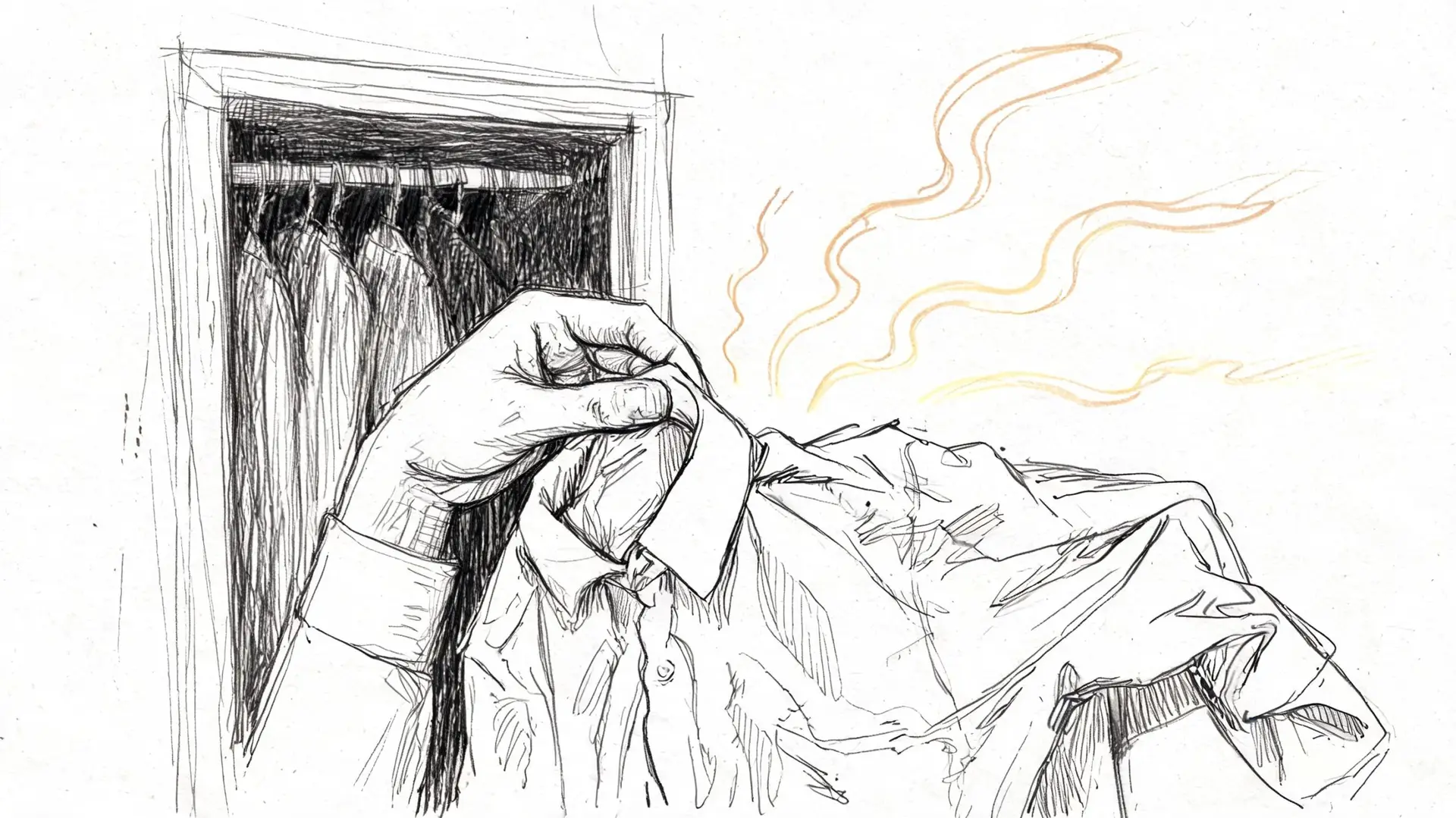
A closet moisture absorber is often the simplest first move. It’s a passive product, usually made to hang or sit in the closet, and it pulls humidity from the air without electricity. That matters in a small enclosed space where you don’t need a big machine running all day.
What the smell is telling you
Musty odor is less about “dirty clothes” and more about air that stayed damp too long. Fabrics hold onto that smell easily. Shoes do too. So do blankets on upper shelves.
A moisture absorber won’t wash clothes or remove contamination from a damaged wall. What it can do is lower the humidity in that little pocket of space so the closet stops behaving like a damp storage box.
A closet can smell bad long before you see obvious moisture. Odor is often the early warning sign.
A good first step, not a magic fix
If the issue is mild, a closet moisture absorber can be enough to steady the space. If the smell keeps returning, inspect the closet and the wall behind it too. A deeper moisture problem can hide there. For extra prevention tips, see this guide on how to prevent mold in a closet.
Here’s the simple way to consider it:
- If the closet is just a little stale, start with an absorber and better airflow.
- If clothing feels damp, check nearby walls, baseboards, and the floor.
- If you see staining or fuzzy growth, you’re past basic moisture control and into cleanup territory.
How a Closet Moisture Absorber Actually Works
A closet moisture absorber works like a thirsty sponge for the air. It doesn’t blow air around. It doesn’t cool anything. It attracts water vapor that’s already floating in that enclosed space.
Most of the common hanging bags and tubs use calcium chloride. That material is hygroscopic, which means it naturally pulls moisture from humid air. As it does that, the crystals start clumping together, then they gradually turn into liquid.
What you’ll see inside the product
This part confuses a lot of homeowners, because it looks strange the first time. You start with dry crystals or pellets. After days or weeks, the solid material shrinks and liquid begins collecting below it.
That’s normal. The product is doing its job.
According to product specifications for one common style, the absorption process relies on calcium chloride particles that contact humid air, gradually agglomerate, and liquefy. A typical absorption bag is designed to capture around 500 ml of moisture and is effective in an enclosed space up to 70 cubic feet according to this moisture absorber product description.
Why it’s different from a dehumidifier
An electric dehumidifier actively moves air. A closet moisture absorber doesn’t. It’s passive. That’s why it’s silent and easy to use, but also why it works best in a small, enclosed spot rather than a large room.
Think of it this way:
| Tool | How it works | Best use |
|---|---|---|
| Closet moisture absorber | Pulls moisture from nearby air without power | Small enclosed spaces |
| Electric dehumidifier | Actively draws air through the machine | Larger or wetter areas |
A passive absorber is local help. It isn’t a substitute for drying equipment after major water damage. If a closet got wet from a leak, pros often use air movement and drying equipment first. If you want to understand how that active drying side works, this overview of water damage fans helps connect the dots.
Practical rule: If you can collect the problem in a small bag or tub, the moisture issue is probably minor. If water reached drywall, carpet, or wood, passive products belong in a support role, not the lead role.
Why homeowners like them
They’re simple. You hang one, place one, and check it now and then. No cords. No noise. No maintenance beyond replacing or disposing of the product when it’s spent.
That simplicity is exactly why they’re useful in closets. They match the scale of the space.
Choosing The Right Type of Moisture Absorber
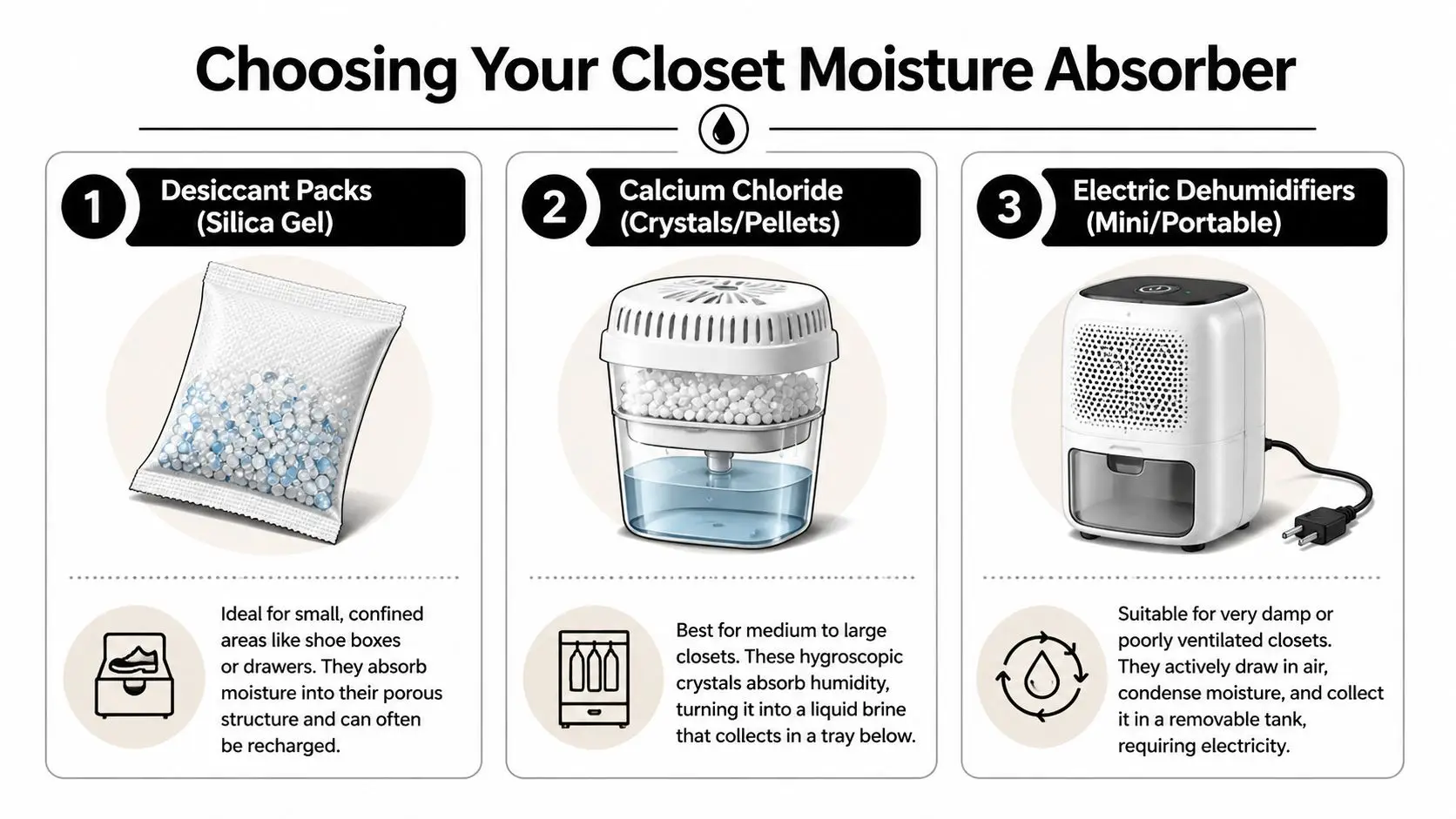
The best closet moisture absorber depends on what you’re trying to protect and how serious the moisture problem is. A drawer of socks, a packed hall closet, and a closet that recently sat near a plumbing leak all need different tools.
The quick comparison
| Type | Best for | Strength | Limitation |
|---|---|---|---|
| Silica gel packs | Drawers, shoe bins, storage boxes | Small and reusable in some cases | Limited capacity |
| Calcium chloride bags or tubs | Standard closets | Strong passive moisture capture | Can leak if ignored |
| Mini electric dehumidifiers | Very damp closets | Active moisture removal | Needs power and tank checks |
| Activated charcoal bags | Odor control | Helpful for smell | Not the best main moisture tool |
Silica gel packs for tiny spaces
Silica gel is the neat, low-mess option. These packs are great inside shoe boxes, garment bins, luggage, or small drawers where you need gentle moisture control.
They’re not usually the best answer for a whole closet. Think of them as detail tools. Good for protecting one item or one sealed area. Not the right choice when the entire closet smells off.
Calcium chloride for most closet jobs
This is the category commonly referred to when one says closet moisture absorber. Hanging bags, tubs, and crystal containers all fall here. They’re practical for everyday closet humidity because they absorb moisture and turn it into collected liquid.
If you’re choosing between a hanging bag and a cup-style product, standard hanging moisture absorbers often provide 10% greater absorption capacity than smaller cup-style alternatives, according to this hanging absorber product page.
That doesn’t mean cups are useless. It means hanging styles often make more sense when you want longer, steadier performance in a closet.
Electric units for stubborn dampness
Mini electric dehumidifiers are for closets that stay damp despite basic steps. They actively pull in air and condense moisture into a tank. That makes them more aggressive than passive absorbers.
They also ask more from you. You need an outlet, enough clearance, and a habit of emptying the tank. In a tight closet, cords and airflow can become awkward fast.
Charcoal bags for odor, not heavy humidity
Activated charcoal bags help with smell. They can be useful when a closet has lingering odor from shoes or stale air. But they don’t work like a calcium chloride absorber. If your real problem is moisture, charcoal alone usually won’t keep up.
A simple way to choose
Use this cheat sheet:
- Pick silica gel if the space is tiny and you want something tidy.
- Pick calcium chloride if your closet is enclosed and mildly damp.
- Pick an electric unit if the closet keeps feeling humid or recently had moisture exposure.
- Pick charcoal if odor is the main issue and humidity is under control.
If moisture has already affected nearby building materials, don’t focus only on products for the closet shelf. Check whether the problem spread to walls too. This guide on mold on drywall helps explain when closet odors point to something bigger.
If you’re deciding between “something simple” and “something stronger,” ask one question. Is the air damp, or did materials get wet? Air problems and material problems need different responses.
Proper Placement and Sizing for Best Results
A closet moisture absorber can be a good product and still fail if you place it badly. These products work in a tight area around them, not across the whole house.
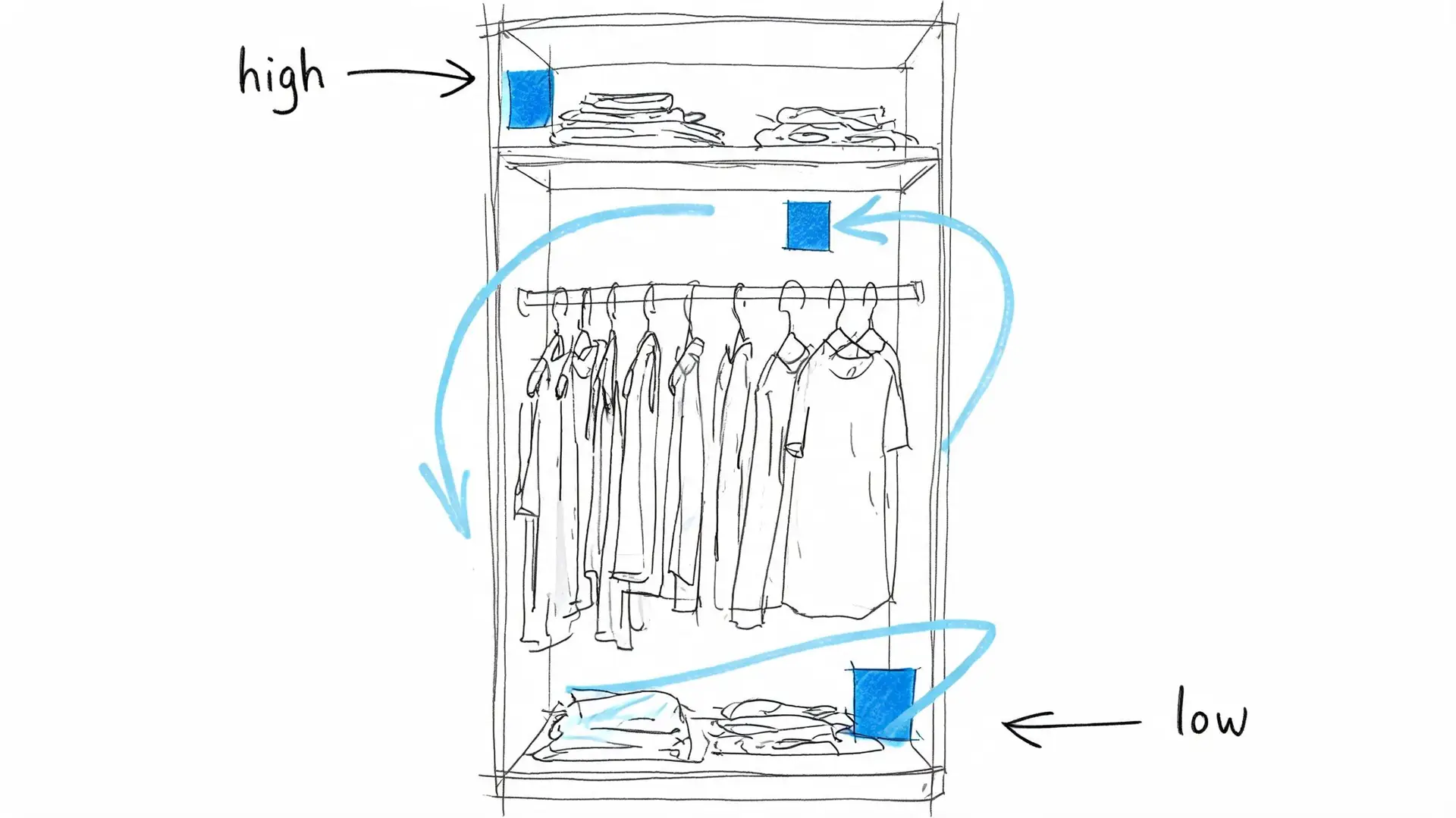
Closet moisture absorbers typically operate within a 20 to 30 cm radius, and a single unit can capture an average of 0.5 to 1 liter of water over 30 days, according to this moisture absorber performance overview. That local performance is why placement matters so much.
Where to put one
If you’re using a hanging bag, give it breathing room. Don’t bury it between coats or let it rest against fabric. Air has to reach it.
For tubs or trays, stable surfaces matter most. Use a shelf or a flat floor area where the container won’t tip if someone grabs a box or shoe nearby.
Good placement usually looks like this:
- Near the center of the closet: Better contact with trapped air
- Away from packed clothing: Fabric can block airflow
- Not directly against the wall: You want air moving around the unit
- Out of reach of children and pets: Safety comes first
How many do you need
Two common errors are made: using one small unit in an oversized closet, or crowding the space with too many products and expecting the closet to dry faster.
A better rule is to match the absorber to the enclosed area and the dampness level. Small reach-in closets often do fine with one properly placed hanging unit. Larger or awkward closets may need more than one, especially if one side stays stale.
The goal isn’t to fill the closet with products. The goal is to cover the pockets where humidity lingers.
This video shows the kind of climate-related performance issue Phoenix homeowners often run into:
Placement after a small water event
If a closet sits near recently damp flooring or baseboards, don’t hide an absorber in the back corner and hope for the best. First dry the affected materials. A passive product only helps after that immediate moisture is being addressed.
If the leak reached flooring, this guide on how to dry wet carpet fast can help you judge whether the closet issue is really part of a larger drying problem.
Maintenance Routines and Critical Safety Precautions
A closet moisture absorber is easy to use. It still deserves careful handling.
The biggest mistake I see is people treating it like harmless closet décor. It isn’t. It contains moisture-attracting material and, in many products, collected liquid that you do not want spilling, touched unnecessarily, or accessed by a child or pet.
What “full” looks like
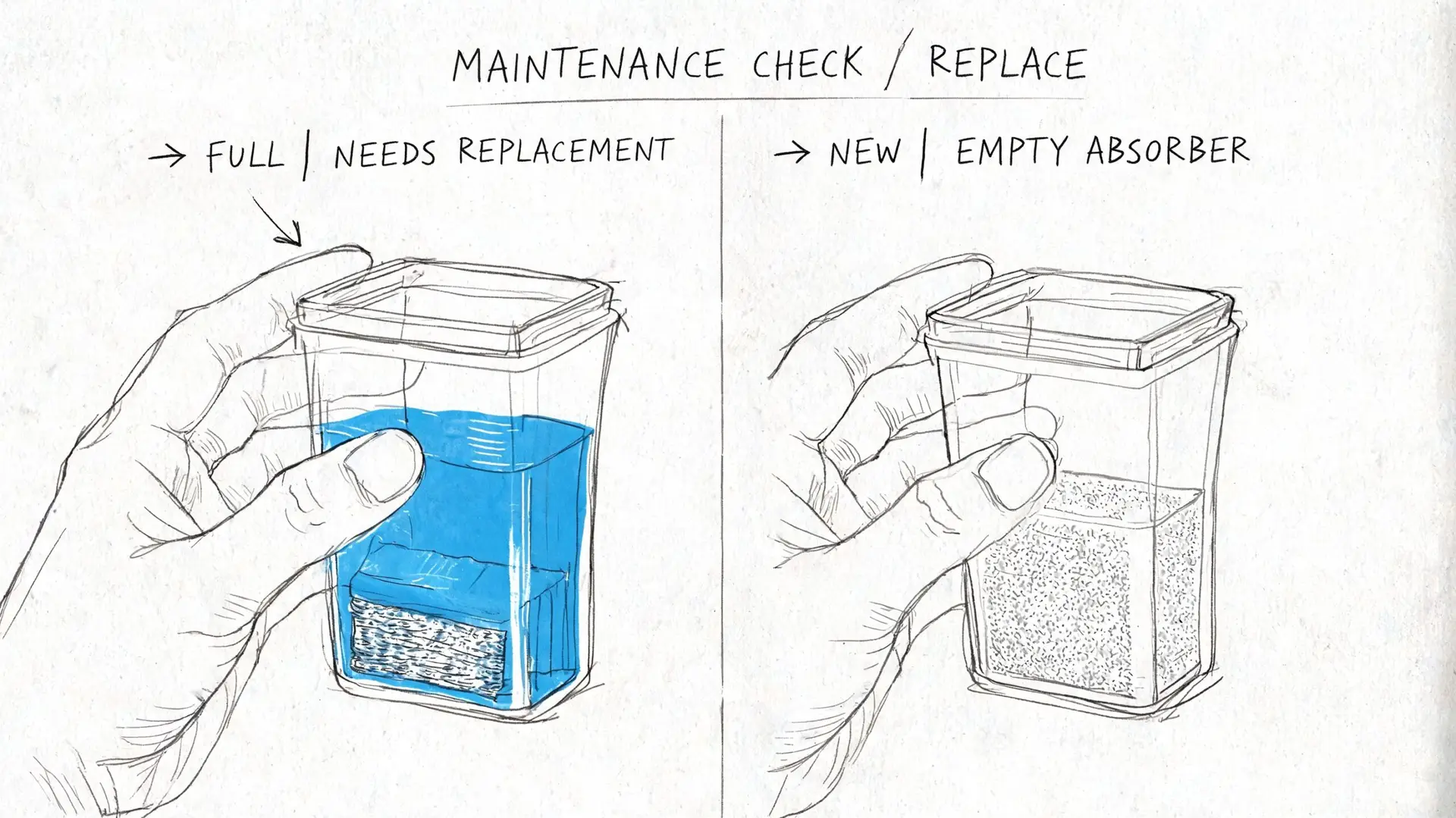
A fresh calcium chloride absorber starts with visible solid crystals or pellets. Over time, those solids shrink and more liquid collects in the lower chamber or bag.
Check for these signs:
- Crystals mostly gone: The product is near the end of its life
- Liquid reservoir getting heavy: Time to replace before handling gets risky
- Outer bag or container looks stressed: Don’t wait
- The closet smell starts returning: Performance is dropping
A safe maintenance routine
Use a simple routine instead of guessing.
- Look at it regularly. A quick visual check is enough.
- Keep it upright. If you need to move it, move slowly.
- Replace it before it looks overfilled. Waiting too long raises the chance of leaks.
- Wash your hands after handling. Especially if you touched the container.
Some hanging products last for a while under normal use, but heat and moisture load change that. In Phoenix, closets can push products harder during monsoon periods or after an indoor moisture event.
Why safety matters more than people think
A 2018 medical report documented the first known fatality from ingesting a commercial moisture absorber, where an individual consumed 300 g of calcium chloride, according to the BMJ Case Reports article archived here. That isn’t a minor warning label issue. It shows these products can be lethal if ingested.
So treat them like any chemical household product.
Safety check: Store and place moisture absorbers where children and pets cannot access them, knock them over, or mistake collected liquid for water.
What they do not do
They don’t kill established mold in building materials. They don’t sanitize a contaminated closet. They don’t make black staining safe.
If you’re seeing visible growth on wall surfaces, review the warning signs in this guide on how to remove black mold from drywall. At that point, moisture control is only one part of the problem.
DIY Solutions and When to Call a Professional
Homeowners often ask whether they can skip store-bought products and make a closet moisture absorber from things already in the house. Sometimes you can. It depends on what you expect that DIY fix to do.
For light odor or very mild dampness, DIY options can help a little. They’re best viewed as temporary support, not heavy-duty moisture control.
DIY options that people try
Baking soda is mostly an odor helper. It can freshen stale air in a small space, but it’s not the strongest choice if humidity is the primary concern.
Rock salt gets suggested because it can attract moisture. It’s messy, and improvised containers can spill or track residue.
Charcoal briquettes or activated charcoal bags can help reduce odor. That makes them useful in a shoe-heavy closet, but they’re not the first pick when your goal is moisture removal.
Where DIY helps and where it falls short
A homemade setup can make sense if the closet only needs a nudge. For example, a guest-room closet with stale air but no sign of damp materials may benefit from basic odor control plus better ventilation.
DIY falls short when the problem has any of these traits:
- The smell comes back fast
- Clothes feel damp to the touch
- Paint or drywall looks stained
- Wood shelves feel swollen or warped
- You recently had a leak, overflow, or AC issue
That’s the point where the question changes. It’s no longer “What should I put in the closet?” It becomes “What’s feeding the moisture?”
A simple line between small and serious problems
Use home remedies when you’re dealing with air quality in the closet. Stop using them as your main strategy when you’re dealing with water in materials around the closet.
That distinction matters. A little stale air can often be improved by ventilation, washing fabrics, and adding a proper absorber. Wet drywall, damp baseboards, and hidden wall cavity moisture need assessment and drying.
If the closet smells musty again soon after you clean it, the closet may not be the source. It may just be the place where the problem is easiest to notice.
Helpful cleaning support, but not a substitute for drying
Some homeowners also explore natural cleaning options for shelves and non-porous surfaces. If you’re looking into that category, this guide to U.S. tea tree oil applications is a useful overview of how people use tea tree oil around the home. Just keep expectations realistic. Surface cleaning and freshening can help with maintenance, but they do not replace moisture control or remediation when building materials are involved.
When it’s time to bring in a professional
Call for a professional assessment when the closet problem connects to a known water event or visible damage. Examples include a pipe leak in the wall behind the closet, an AC drain issue nearby, warped trim, recurring staining, or mold growth you can see.
A professional should also be considered if:
- The closet sits next to a bathroom, laundry, or plumbing wall
- You smell mustiness even after removing all fabrics
- The odor seems stronger near the baseboard or back wall
- You’ve already tried absorbers and ventilation without lasting improvement
At that stage, the closet moisture absorber isn’t useless. It’s just no longer the main solution. The main solution becomes finding the moisture source, drying the structure, and cleaning affected materials correctly.
Phoenix Specific Advice for Closet Moisture Control
Phoenix creates a strange kind of moisture problem. Most of the year, people assume moisture control doesn’t matter much because the air feels dry. Then monsoon season hits, or an AC leak shows up, or a supply line drips behind a wall, and suddenly a closet becomes a little humidity pocket.
That’s why generic advice from humid-climate articles often misses the mark here.
What’s different in Phoenix
In hot, arid climates like Phoenix, high heat can speed up the liquefaction of calcium chloride crystals. User data cited in the source material behind this topic notes that some products may last only 30 to 45 days instead of 60 in these conditions, especially during heat and moisture swings, as discussed in this Phoenix-related video source.
So if your product seems to “melt fast,” that doesn’t automatically mean it failed. Heat changes how quickly the crystals turn to liquid.
Best use cases in the Valley
A closet moisture absorber makes the most sense in Phoenix when:
- Monsoon weather pushes humidity up indoors
- A closet has weak airflow
- The closet sits near an exterior wall or plumbing line
- You’re in the cleanup phase after a minor moisture event
For routine desert living, you may not need one year-round in every closet. For a problem closet, seasonal use or targeted use after a leak often makes more sense.
The local rule of thumb
In Phoenix, treat passive absorbers as spot-control tools. They’re useful for the small pocket of humid air inside a closet. They are not the answer for wet drywall, soaked flooring, or a closet affected by a real water loss.
That local mindset helps homeowners avoid two common mistakes. One is ignoring closet humidity because “Arizona is dry.” The other is expecting a hanging bag to solve damage that really needs structural drying.
Frequently Asked Questions
Can a closet moisture absorber leak if it gets too full
Yes. That’s why regular visual checks matter. If the crystals have mostly dissolved and the liquid reservoir looks heavy, replace it before moving it around much.
Do moisture absorbers remove existing mold
No. A closet moisture absorber helps control humidity. It does not remove established mold growth from drywall, wood, or fabrics. If mold is already present, the moisture source and the contamination both need attention.
Are scented absorbers okay in a small closet
They can be, but scent can mask the warning smell of a real moisture problem. If you’re troubleshooting a closet, fragrance-free products usually make it easier to tell whether the musty odor is improving or just being covered up.
Should I use one all year in Phoenix
Not always. Many Phoenix homeowners use them only in problem closets, during monsoon season, or after a moisture event. The need depends on the closet, the home, and whether there’s a larger source of dampness nearby.
If your closet still smells musty after cleanup, or you suspect the odor is tied to a leak or hidden moisture, Restore Heroes can help you figure out whether it’s a simple humidity issue or part of a larger water damage or mold problem in your Phoenix-area home.