
That musty smell is usually where this starts. You carry a box downstairs, catch a damp odor, and notice a faint stain on the wall that wasn't there before. It's easy to shrug off because the basement still feels usable, and nothing looks dramatic.
That's exactly why basement water problems get missed. Small signs often show up long before standing water does, and those early clues matter. Left alone, moisture can lead to mold, damaged finishes, weakened materials, and a much bigger repair scope than most homeowners expect.
Water trouble in basements is also far more common than people think. One published roundup states that 98% of basements in the United States experience some level of water damage, which is why routine inspection matters so much for homeowners who want to catch problems early (water damage statistics for homeowners).
If you're trying to figure out whether what you're seeing is minor, urgent, or serious enough to call for help today, start with the signs below. This guide keeps the focus practical. You'll see what each warning sign usually means, how urgent it is, and what quick checks make sense before you pick up the phone. If mold is already part of the issue, these homeowner solutions for basement mold are also worth reviewing alongside the inspection.
1. Visible Mold and Mildew Growth
Urgency level: High
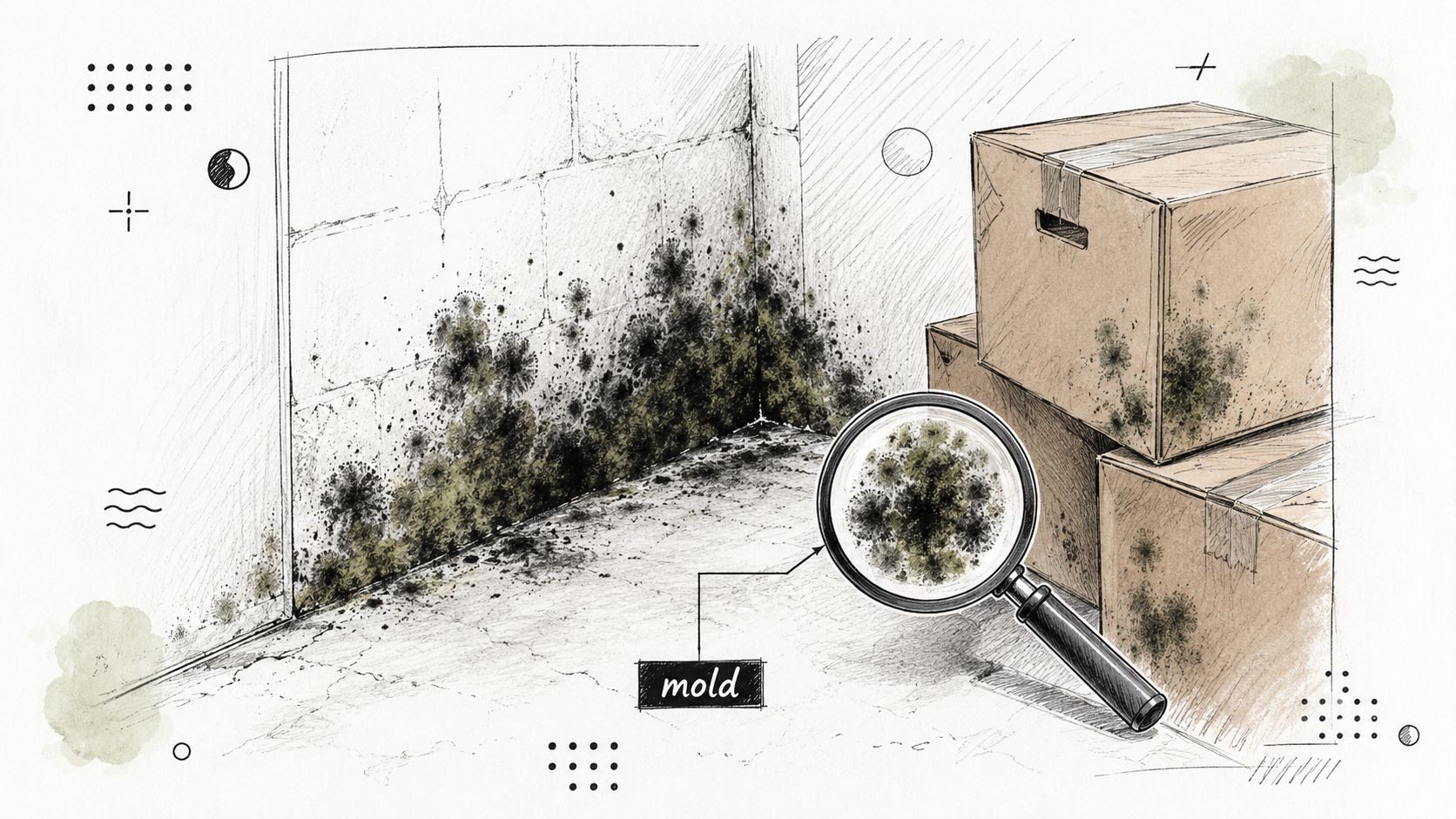
If you can see mold or mildew, the moisture problem has already been there long enough to support growth. In basements, that often shows up in corners, along the bottom of walls, around stored cardboard, behind furniture, or near plumbing penetrations.
Mildew is usually more superficial. Mold can look fuzzy, blotchy, or slimy depending on the surface and how wet it stays. Either way, visible growth is one of the clearest signs of water damage in basement spaces because it points to sustained dampness, not a one-time splash.
What to check before calling
Start by looking at the pattern. Mold that stays confined to a box or fabric item may point to high humidity. Mold tracking along a wall seam, baseboard, or crack usually suggests water entry or condensation at that location.
A simple humidity reading helps. Basement moisture guidance recommends keeping relative humidity below 50%, ideally in the 40 to 50% range, and says readings that stay above 55 to 60% indicate a moisture problem even when walls look dry (basement moisture signs and humidity guidance).
Practical rule: Don't scrub visible mold aggressively just to “see what's underneath.” Disturbing growth can spread spores and make cleanup harder.
Use your phone to document where growth appears and whether it's on concrete, drywall, wood, or stored items. If the area is finished, ask whether the inspection should include hidden spaces such as wall cavities. If you need a specialist, basement mold removal services are the right category to look for rather than a general handyman visit.
- Photograph the edges: Clear photos help show whether the growth is expanding over time.
- Check nearby materials: Cardboard, carpet tack strips, framing, and trim often reveal the true spread.
- Reduce moisture load: Run a dehumidifier and improve airflow, but treat that as support, not a fix.
A common real-world scenario is a small black or green patch behind storage bins after a plumbing drip or storm-related moisture event. Homeowners often clean the visible spot and move on, but the better move is to find out why that zone stayed damp in the first place.
2. Efflorescence and White Mineral Deposits
Urgency level: Medium to High
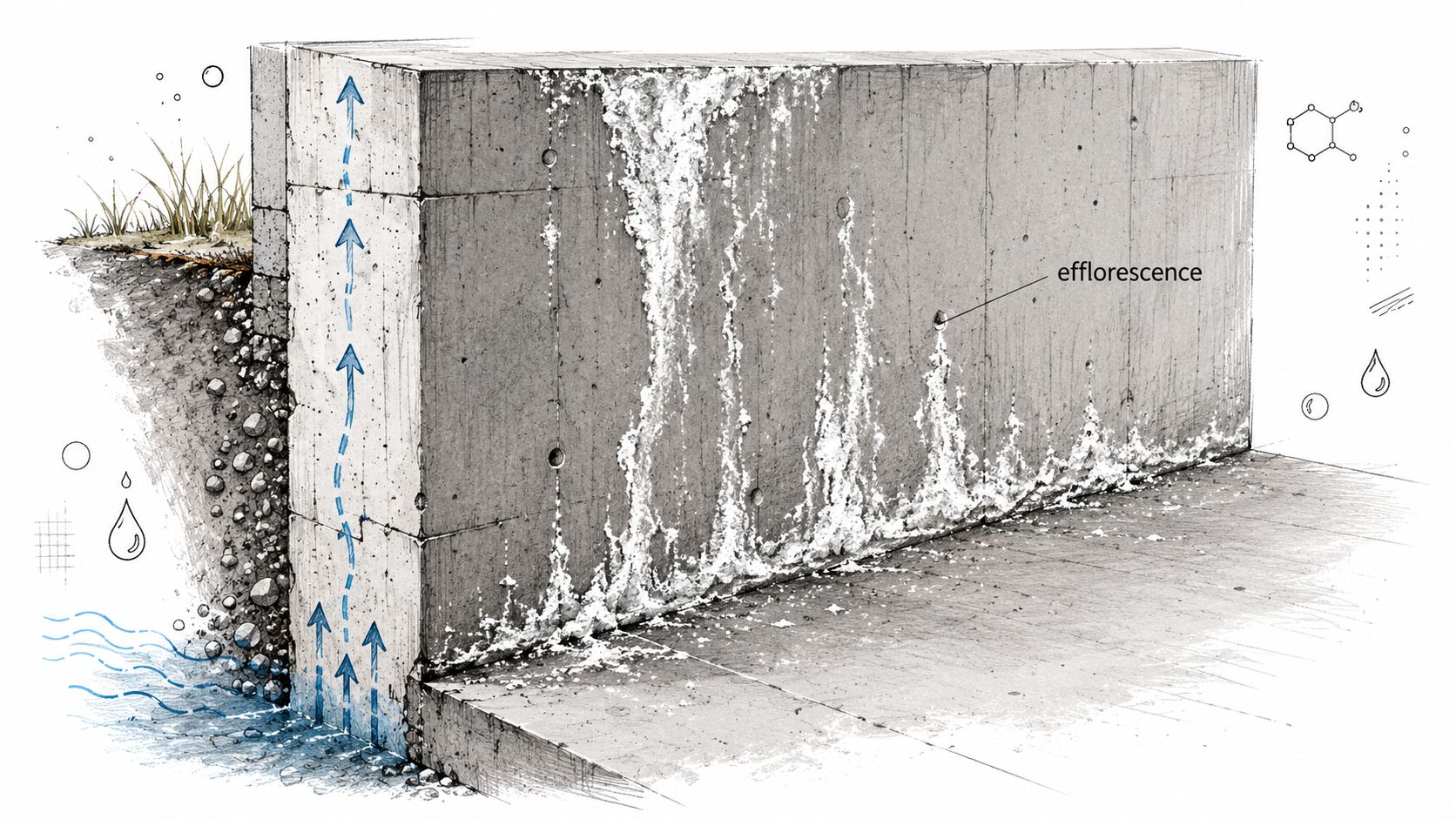
A white, chalky film on a basement wall often gets dismissed as a cosmetic issue. It is usually a moisture trail. Efflorescence shows up when water moves through concrete or masonry, carries dissolved salts to the surface, and leaves those minerals behind as the water evaporates.
That makes this a triage sign, not just a cleaning problem. Dry residue that stays unchanged is usually a monitor-it issue. Fresh buildup that keeps returning, spreads after rain, or appears with dampness moves into the call-a-pro range.
How to tell if it's active
Start with a simple check. Wipe a small test area clean, mark the date with painter's tape nearby, and inspect it over the next several days and after the next rain. The International Association of Certified Home Inspectors notes that efflorescence can return if moisture is still passing through the material (InterNACHI efflorescence inspection guidance).
Context matters in dry climates. In Phoenix, I sometimes see old mineral deposits on foundation walls that are tied to past moisture, slab curing, or one-off humidity events rather than a current leak. The pattern tells the story. A flat, dusty patch that does not change is different from a crusty band that keeps rebuilding or sits next to a cool, damp section of wall.
Use a moisture meter if you have one. Compare the suspect area to a dry spot on the same wall, at the same height, so you are not guessing. If the white deposits are showing up near finished materials, what happens when drywall gets wet explains why the problem can spread beyond the concrete surface.
Residue that stays dry and unchanged is usually lower urgency. Residue that returns quickly, creeps outward, or appears with damp concrete deserves faster action.
A few practical checks help narrow it down:
- Map the shape: A long horizontal line often points to widespread moisture movement through the wall. A tight patch near a crack or penetration suggests a more localized entry point.
- Check timing: Look at it after heavy rain, irrigation changes, or a plumbing event. If the deposit worsens on that schedule, the moisture source is still active.
- Do not seal over it: Paint and masonry coatings often fail early when vapor pressure is still pushing from behind.
- Inspect nearby finishes: Baseboards, stored boxes, insulation, and the bottom edge of drywall can show hidden spread even when the wall looks mostly dry.
A common field example is a below-grade wall with a white crust a few inches above the slab. If that area stays dry, the mark does not expand, and meter readings stay close to your baseline, monitoring is reasonable. If the residue comes back soon after cleaning or the wall reads wetter than surrounding areas, treat it as an active moisture warning, not surface dust.
3. Peeling Paint and Bubbling Wall Coatings
Urgency level: Medium
Paint doesn't blister on a basement wall for no reason. When coatings bubble, peel, or flake off concrete or drywall, moisture is usually trapped behind the finish and pushing outward.
In unfinished basements, you'll often see this on painted foundation walls. In finished spaces, it may show up as bubbling latex paint, soft joint compound, or a warped baseboard line near the floor.
What this sign usually means
This sign can point to active moisture, but it can also reveal old damage that was covered cosmetically instead of fixed. I see this a lot when someone repaints after a minor leak and assumes a clean wall means the problem is gone. It isn't gone if the substrate is still wet.
The first useful question is whether the finish is failing in one spot or across a whole wall. One isolated bubble near a window well suggests a localized problem. Broad peeling along the lower half of a wall often suggests moisture migration from the foundation side.
If drywall is involved, the stakes go up because drywall hides damage well. Wet gypsum can soften, stain, and support mold before the surface fully gives it away. If that's what you suspect, what happens when drywall gets wet explains why surface repainting rarely solves the underlying issue.
- Press gently, don't tear: You're checking for softness or hollow spots, not trying to remove material.
- Look at the bottom edge: Basement walls often fail low first because moisture collects there.
- Delay repainting: Fresh paint can hide the clue you need and may fail again quickly.
A real-world version is a homeowner noticing blistered paint after heavy seasonal rain. If the coating is just cosmetic damage from an older event, moisture readings may come back normal. If readings stay high in the same zone, the wall is still taking on moisture and needs more than patchwork.
4. Musty Odors and Stale Air Quality
Urgency level: Medium to High
A musty basement smell is often the first warning people notice. You may not see a leak, a stain, or a patch of mold, but the air tells you something is off.
That smell usually means moisture has been hanging around long enough to affect porous materials. Carpet backing, cardboard boxes, wood framing, insulation, and dust in hidden cavities all hold odor. In finished basements, this sign deserves extra attention because moisture can stay behind walls long before it reaches the surface.
How to narrow it down
Start by figuring out whether the smell is general or concentrated. If the odor gets stronger near one wall, under the stairs, around a sump area, or close to a finished exterior wall, that gives you a place to inspect more closely.
A hygrometer is one of the cheapest useful tools for this. If the basement smells musty but looks clean, check the humidity before you assume it's “just basement smell.” Persistently high readings point to a moisture issue even without visible damage, which is why stale air should never be dismissed.
If air fresheners make the basement smell sweeter for an hour and then the mustiness returns, you haven't solved anything. You've only covered the signal.
This is also where hidden damage becomes a concern. Finished walls can trap moisture out of sight, so odor may show up before staining does. If you're noticing that pattern, why a basement smells musty is the more useful path to investigate than adding fragrance or opening a window.
- Sniff low, not just at head height: Odors often pool near the floor and at wall intersections.
- Check soft contents: Upholstered furniture, stored fabrics, and boxes can absorb and re-release moisture smell.
- Inspect HVAC nearby: Filters, duct boots, and condensate-related areas can contribute to stale basement air.
One common Phoenix-area scenario is a basement that smells noticeably different after a monsoon event even though no puddles ever appear. That often points to damp materials or hidden moisture pockets rather than obvious flooding.
5. Staining and Discoloration on Concrete and Drywall
Urgency level: Medium
Water staining tells a story if you read the pattern correctly. Yellowish-brown marks, rust-toned streaks, tide lines, or darkened patches all indicate that water reached that surface at some point.
The key question isn't just whether a stain exists. It's whether the stain is old and inactive or tied to moisture that's still present.
Read the pattern before you react
Horizontal lines usually suggest a past water level. Vertical streaks often point to runoff from above, seepage through a crack, or water tracking down from a window or pipe penetration. Corner staining is especially important because water tends to find weak joints first.
This is one of the basement signs homeowners often misread. They paint over a stain, then assume the issue is solved because it looks cleaner. But if the moisture source remains, the stain usually comes back, often with peeling paint or odor right behind it.
If you want to sort out timing, how to tell if water damage is new or old is a helpful distinction to make before deciding between monitoring and active remediation.
Stains are evidence, not diagnosis. Their shape and location matter more than their color alone.
Here's a simple DIY triage approach:
- Photograph after rain: That helps you see whether the stain darkens or expands.
- Touch carefully: A dry stain on a hard surface may be old. A cool, damp, or soft area suggests current moisture.
- Check nearby joints: Window corners, floor-wall joints, and pipe entries often reveal the source.
A practical example is a rust-colored streak below a basement window after storms. That can point to failed sealing or water entry at the window well, while a broad tide mark across a whole wall usually suggests a larger water event in the past.
6. Wet Spots and Active Seepage on Walls and Floors
Urgency level: Critical
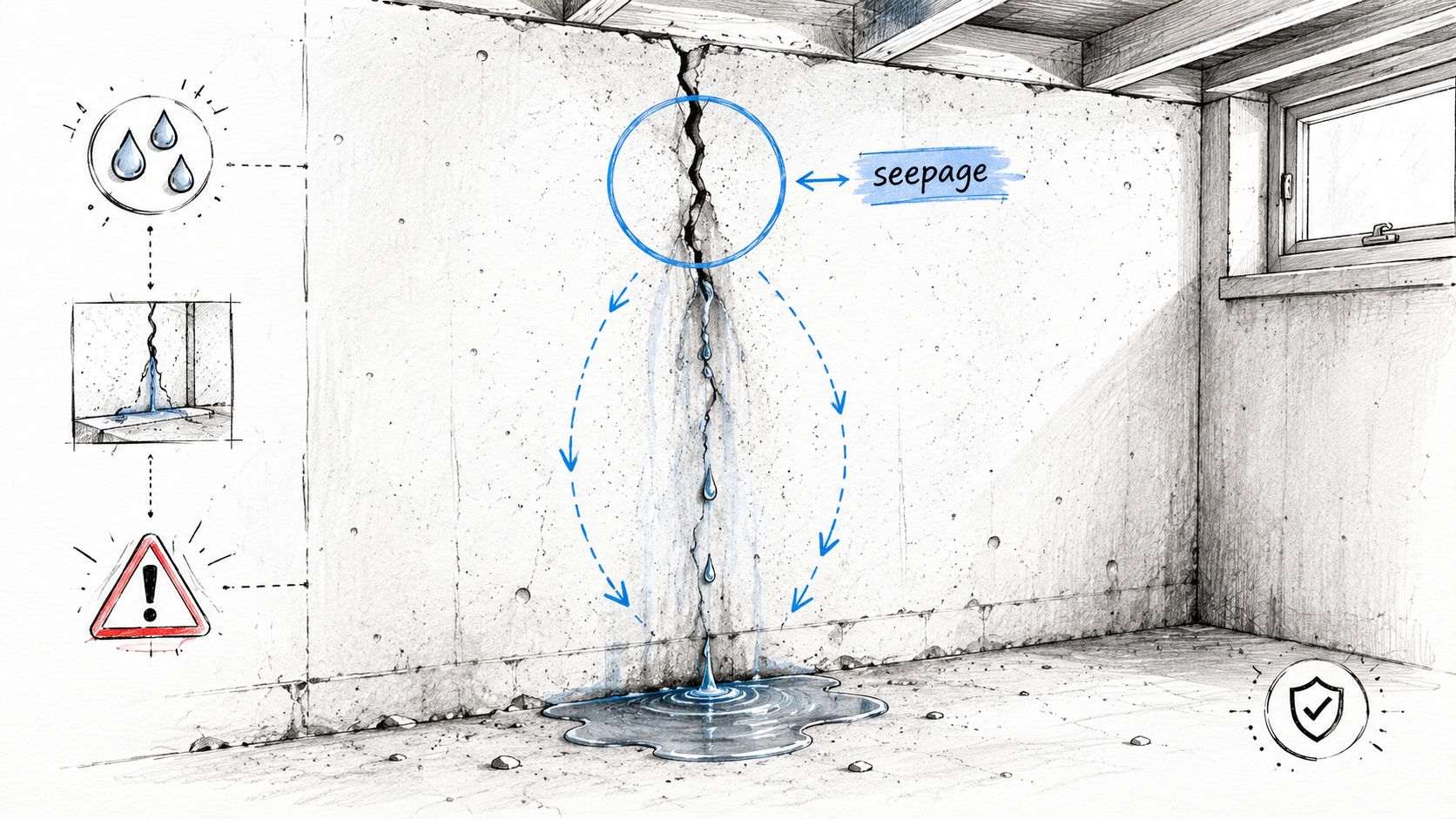
This is the sign you don't monitor casually. If you see damp concrete, droplets, trickling water, new puddles, or muddy seepage at a wall-floor joint, you're dealing with active intrusion.
At that point, the goal changes. You're no longer trying to determine whether a moisture issue exists. You're trying to limit damage and find the entry source fast.
What to do right away
Document the exact location, especially if water is coming through a crack, expansion joint, cove joint, or window area. Photos and short video clips are useful because active seepage often changes by the hour.
Then protect nearby contents. Move boxes, furniture, rugs, and electronics away from the wet zone. If water is near outlets, appliances, or electrical panels, treat that as a safety issue and don't start experimenting with cleanup beyond what's safe.
- Mark the spread: A strip of painter's tape can help you see if the wet area is expanding.
- Check water clarity: Clear water, muddy water, and rust-colored water can point to different paths.
- Don't assume it's temporary: Even if it stops when the storm passes, the path is still there.
A common example is a basement floor that develops a perimeter puddle after heavy rain, or a vertical wall crack that starts weeping during a monsoon storm. That usually needs professional mitigation and drying, not just towels and a fan. The immediate concern is preventing additional saturation in framing, flooring, and stored contents.
7. Rust Staining and Oxidation on Metal Components
Urgency level: Medium to High
Metal gives away chronic moisture in a different way than drywall or concrete. Instead of bubbling or staining, it corrodes. Look at pipes, support hardware, fasteners, furnace components, duct boots, shelving, window frames, and any exposed steel in the basement.
Rust streaks on nearby concrete are often the giveaway homeowners notice first. By the time that staining appears, the moisture exposure usually hasn't been brief.
Where rust matters most
Corrosion on a storage shelf isn't the same as corrosion on structural anchors, plumbing, or electrical hardware. The second category deserves faster attention because moisture plus metal failure can create both safety and repair issues.
If rust appears near a bathroom line, water heater connection, condensate route, or an exterior wall, inspect that area carefully for condensation, leaks, or persistent humidity. Orange or brown trails running downward are especially useful clues because they show the direction moisture has been moving.
A simple homeowner check is to compare isolated rust with broad-area corrosion. One rusty screw may be nothing. Multiple affected metal surfaces in the same zone usually mean the basement environment is staying damp too often.
- Inspect underneath: Rust on the underside of pipe straps or equipment legs can reveal repeated moisture exposure.
- Look for companion signs: Odor, staining, peeling paint, or damp cardboard nearby strengthen the case for a broader moisture issue.
- Don't ignore electrical corrosion: Metal oxidation near panels, boxes, or fixtures needs careful professional review.
A real example is finding red staining below a slowly sweating pipe or seeing oxidation on lower furnace components in a damp basement corner. Rust won't always be the first sign, but it often confirms the problem hasn't been short-lived.
8. Soft, Crumbly, or Deteriorating Concrete and Building Materials
Urgency level: Critical
A basement can stay damp long enough that the materials themselves start breaking down. Once concrete powders off in your hand, drywall loses its shape, or wood compresses under light pressure, this has moved into repair territory. The key question is no longer whether moisture is present. The question is how much of the assembly has already been weakened.
Concrete often shows this as pitting, flaking, or surface loss. Drywall usually fails at the bottom edge first, where it wicks moisture and turns soft or chalky. Wood trim, sill plates, and stored lumber may swell, split, or begin to rot.
What deserves immediate attention
This sign sits at the top of the triage list because it can point to material failure, not just a wet surface. Wood decay becomes much more likely once moisture content stays high, which is why moisture meter readings matter in suspect areas. The U.S. Forest Products Laboratory's wood handbook explains how wood moisture content affects durability and decay risk. In practice, if lower wall framing or trim reads materially higher than a known dry piece in the same basement, the area needs closer investigation.
Use a comparison check before calling for help. Test one interior wood surface that appears dry, then test the stained or soft area near the floor, exterior wall, or window. A single reading can mislead. A pattern of higher readings in one zone usually points to an active or repeated moisture source.
Soft or crumbling material is a late-stage warning. It usually means water has been present long enough to change the material, not just discolor it.
Be careful with hands-on testing. Pushing too hard can break damaged drywall or open up decayed wood, and hidden mold is common behind softened finishes.
- Press lightly: Use a fingertip or screwdriver handle, not a sharp probe.
- Check load paths: Pay close attention to sill plates, joist ends, support posts, and framing at the base of exterior walls.
- Look for spread: If deterioration is limited to trim, repairs may stay localized. If framing, subfloor edges, or masonry surfaces are failing too, the scope and cost usually rise fast.
- Call a pro sooner if concrete is shedding chunks: Surface dusting is one thing. Spalling, cracking, or pieces breaking free can signal a bigger moisture or structural problem.
One common field find is baseboard trim that looks slightly swollen until you touch it and it breaks apart. Another is a finished basement wall that seems intact from eye level but crumbles at the bottom corner after the baseboard comes off. Those conditions call for more than patching. They call for moisture-source diagnosis, material removal where needed, and a decision about whether the problem is cosmetic, repairable, or structural.
Comparison of 8 Basement Water Damage Signs
| Indicator | 🔄 Implementation Complexity | ⚡ Resources / Speed | ⭐ Expected Outcome / Severity | 💡 Ideal Use Cases / Recommended Action | 📊 Key Advantages |
|---|---|---|---|---|---|
| Visible Mold and Mildew Growth | High, containment + specialist remediation | High resources, prompt response (PPE, remediation crew, testing) | ⭐⭐⭐⭐⭐ | Engage certified remediation; avoid disturbance; request clearance testing | Highly visible sign that pinpoints active biological hazard and moisture problem |
| Efflorescence and White Mineral Deposits | Medium, diagnostic evaluation, drainage/waterproofing work | Moderate resources, slower permanent fixes (moisture mapping, drainage repairs) | ⭐⭐⭐ | Investigate drainage and waterproofing before cosmetic fixes | Visual mapping of subsurface moisture pathways; non-biological indicator for targeted repair |
| Peeling Paint and Bubbling Wall Coatings | Medium, remove coatings, repair vapor barriers | Moderate resources (moisture testing, contractor, moisture-resistant coatings) | ⭐⭐⭐ | Identify and fix moisture source and vapor barrier prior to repainting | Early warning that moisture barriers are failing; motivates professional investigation |
| Musty Odors and Stale Air Quality | Medium, requires air/moisture mapping to locate hidden source | Low–moderate resources (IAQ testing, dehumidification, inspection) | ⭐⭐⭐ | Perform moisture mapping and air quality testing; avoid masking odors | Early sensory alert that often precedes visible damage; prompts investigation of hidden areas |
| Staining and Discoloration on Concrete and Drywall | Low, diagnostic observation + confirm with moisture meter | Low resources initially (photos, moisture readings); further work if active | ⭐⭐ | Use stains as diagnostic clues; verify with moisture readings before repairs | Visual record of past or present water pathways; helps locate seepage points |
| Wet Spots and Active Seepage on Walls and Floors | Very high, emergency mitigation and source repair | Very high resources, immediate action (extraction, pumps, drying, repairs) | ⭐⭐⭐⭐⭐ | Call emergency water mitigation; document, extract water, and identify source | Unambiguous indicator of active infiltration; identifies exact entry points for urgent repair |
| Rust Staining and Oxidation on Metal Components | Medium, corrosion assessment, safety inspections | Moderate resources (electrical/structural inspection, component replacement) | ⭐⭐⭐ | Assess structural/electrical safety; repair/replace corroded parts and control humidity | Clear evidence of prolonged moisture exposure and potential safety hazards |
| Soft, Crumbly, or Deteriorating Materials | Very high, structural engineering and major remediation | Very high resources (engineer, replacement, permits, demolition) | ⭐⭐⭐⭐⭐ | Immediate structural engineer assessment and prioritized remediation/replacement | Strong indicator of advanced damage and compromised load-bearing elements; supports urgent action/claims |
Your Next Steps From DIY Check to Professional Restoration
Recognizing the signs of water damage in basement areas is the critical first move, but the right response depends on urgency. Some signs can be monitored for a short period. Others need action the same day. If you're looking at an old dry stain that never changes, a small patch of inactive efflorescence, or a single isolated finish blemish, it makes sense to document it, track conditions after rain, and use a hygrometer or moisture meter to gather more information before deciding what to do next.
That said, there are signs that should move you out of observation mode quickly. Active seepage, visible mold, repeated musty odors, and soft or deteriorating materials all point to a moisture problem that's already affecting the space. Those situations usually get worse when homeowners focus only on surface cleanup. The better approach is to document the evidence, protect contents, and get the moisture source identified.
For hidden issues, especially in finished basements, don't rely only on what you can see. Moisture can sit behind drywall, insulation, and paneling while the room looks mostly normal. Use practical checks first. Inspect low wall areas, smell around exterior walls, compare suspicious surfaces with drier baseline areas, and note whether conditions change after storms or HVAC use.
A good triage mindset looks like this:
- Monitor: Dry, unchanged residue or old-looking stains with no active moisture
- Schedule inspection soon: Persistent odor, recurring peeling paint, recurring rust, or suspicious humidity readings
- Call promptly: Visible mold, wet spots, new seepage, or crumbling materials
If you do bring in help, ask for more than a quick visual opinion. Ask how they'll confirm the source, what materials are still wet, whether hidden areas need testing, and what drying or removal steps are necessary. That keeps you from paying for cosmetic work while the cause remains inside the wall or under the floor.
For homeowners trying to prevent the next problem, these essential basement moisture tips are a useful next read after you've identified the warning signs.
If you're in the Phoenix metro area and the issue has moved beyond monitoring, Restore Heroes is one relevant option for inspection and restoration support. A restoration team can assess moisture sources, document affected areas, and handle mitigation steps such as extraction, drying, and cleanup. The most important thing is to act based on the severity of the sign, not just how inconvenient it feels today. Basement water issues rarely improve on their own.
If you've noticed musty odors, visible mold, seepage, or material damage in your basement, contact Restore Heroes to schedule a professional assessment and discuss the next practical steps for mitigation and drying.