
You notice dark spots on the wall after a leak in your Phoenix home. You wipe them away, clean the area, and feel relieved. A few weeks later, the spots return, sometimes with a musty smell or a larger discolored patch. That cycle is frustrating, but it has a clear explanation: cleaning visible mold doesn't necessarily correct the moisture that allowed it to grow.
The difference between mold removal and mold remediation comes down to depth. Removal addresses what you can see on a surface. Remediation investigates why the mold appeared, controls the work area, handles contaminated materials, corrects moisture, and works toward returning the building to normal fungal conditions. The distinction matters whether you're dealing with a bathroom wall, a roof leak, a flooded room, or growth hidden behind drywall. If the affected material is drywall, learn more about mold on drywall before deciding that a cloth and household cleaner are enough.
Why Wiping Mold Away Rarely Solves the Problem
A homeowner in Phoenix may first notice mold after a plumbing leak under a sink or a slow roof leak following a storm. The visible growth looks like a surface stain, so wiping it seems reasonable. The problem is that the wall, cabinet base, insulation, or flooring beneath the stain may still hold moisture.
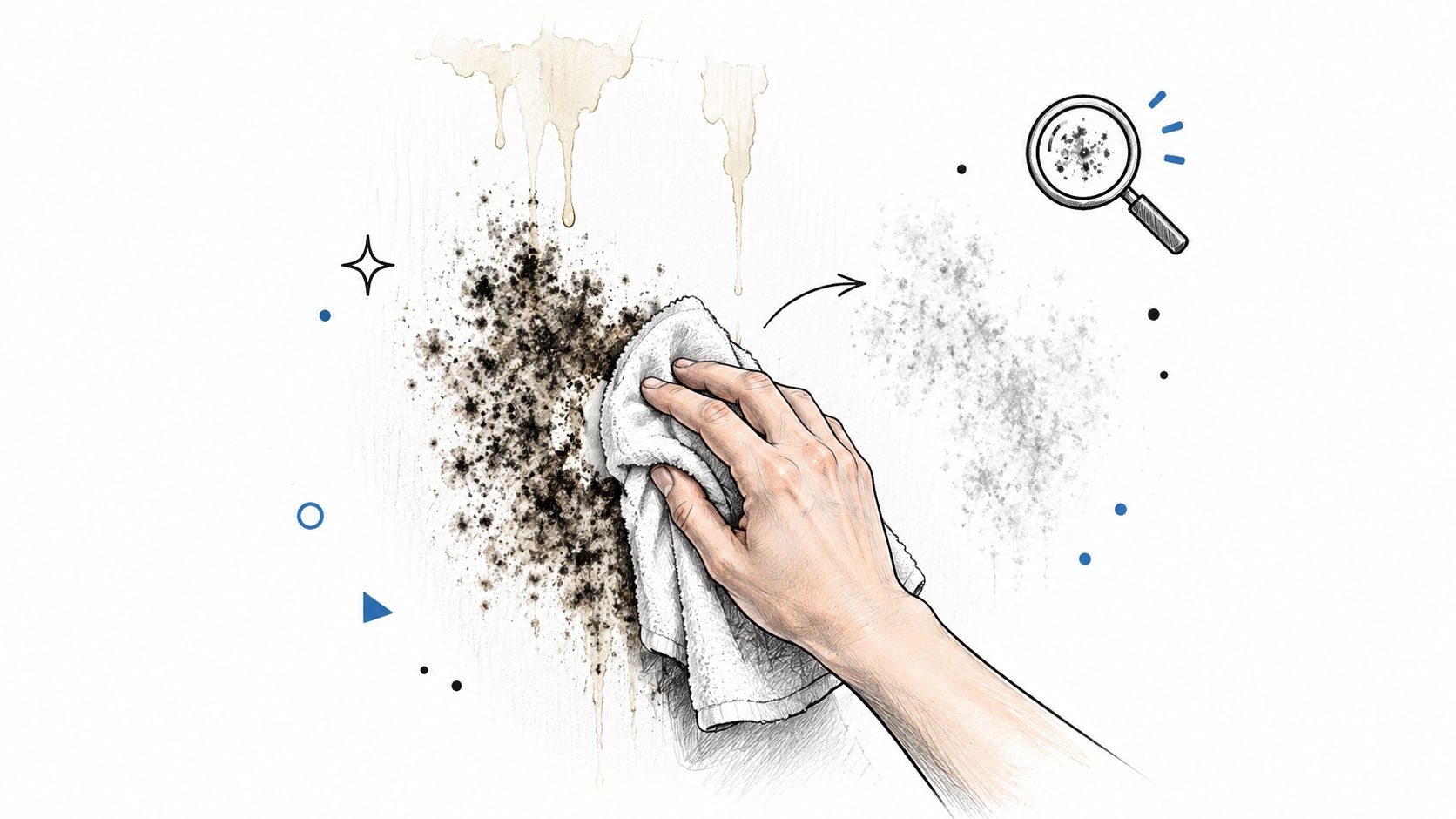
The cloth removes some growth from the face of the material. It doesn't automatically dry the wall cavity, repair the leak, or tell you whether contamination has spread behind the visible area. If damp conditions remain, mold can return because the underlying cause remains active.
Practical rule: If mold comes back after cleaning, treat the recurrence as a moisture investigation problem, not simply a tougher cleaning problem.
Surface appearance can mislead you
Mold removal is usually a localized act. Someone cleans or physically removes visible mold from an affected surface. That may be appropriate for a small area on a hard, washable material, but it doesn't describe the complete response to a building moisture problem.
Mold remediation is broader. It includes identifying the moisture source, containing the work area, cleaning or removing contaminated materials, drying the structure, and restoring the affected space to a safer condition. The EPA stresses that remediation isn't merely about killing mold. Dead mold can still trigger allergic reactions, and some dead molds may remain potentially toxic, so the contamination still needs to be physically cleaned up and the moisture problem corrected. Read the EPA mold remediation guidance for the underlying distinction.
By the end of this guide, you'll be able to ask better questions: Is the growth on a cleanable surface or inside a porous material? Is the moisture source fixed? Does the area call for containment? Does the proposed work address the building, or only the stain?
Understanding Mold Removal and Mold Remediation in Plain Language
Think about a water stain on a ceiling. Mold removal is like cleaning the visible mark. Mold remediation is like cleaning the mark, finding the leaking pipe or roof defect, drying the ceiling assembly, deciding whether damaged material must be removed, and controlling the area while the work takes place.
The first action may improve appearance. The second addresses the conditions that created the problem.
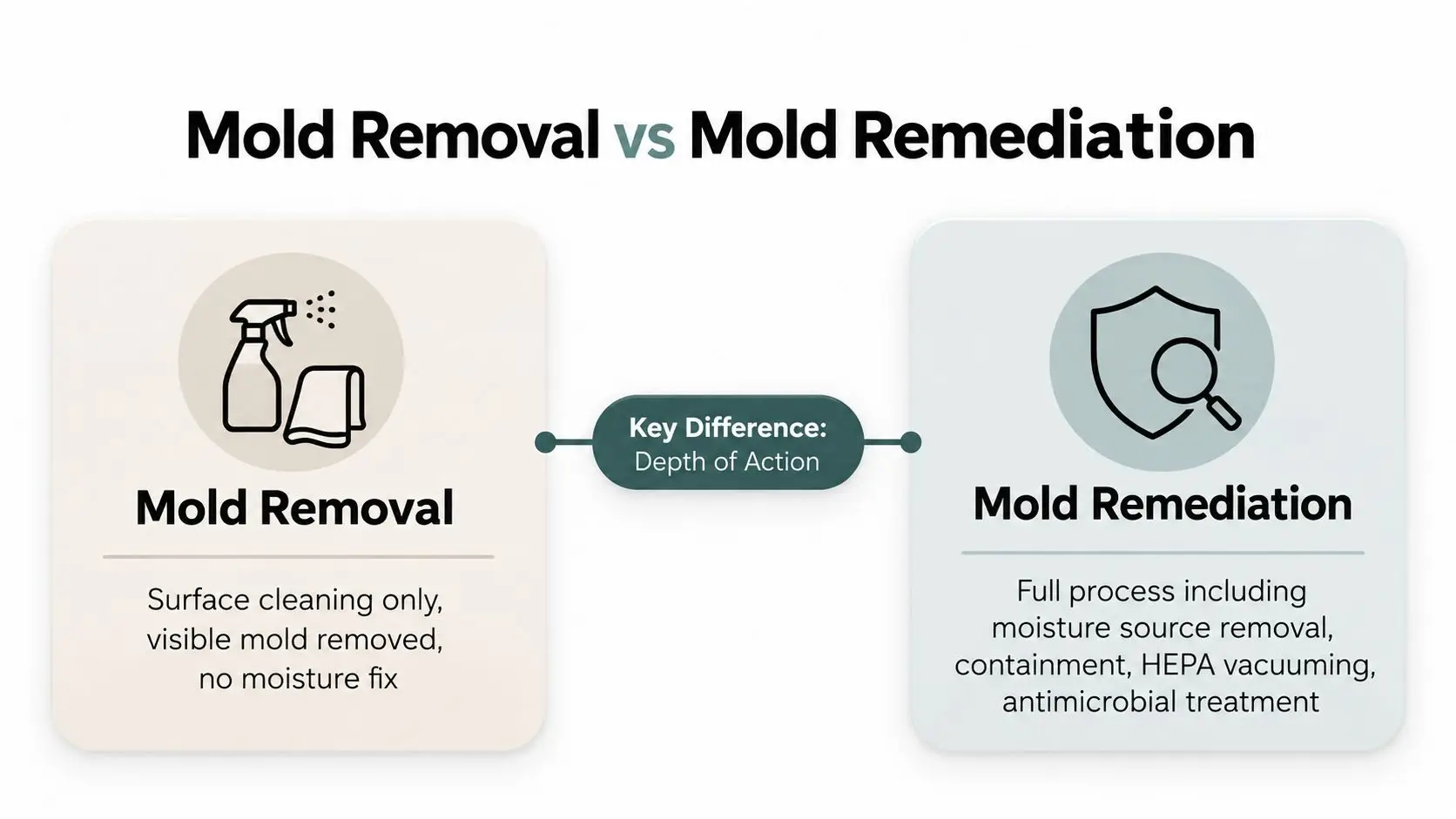
Mold removal focuses on visible contamination
Removal can mean wiping, scrubbing, vacuuming, or physically taking away mold from a surface. For small hard-surface cleanup, the CDC says soap and water may be used, or a bleach solution no stronger than one cup of household bleach per one gallon of water. The CDC's mold health guidance also directs owners to EPA remediation guidance when mold exceeds 10 square feet, an indication that size and complexity change the method.
Removal doesn't necessarily include:
- Moisture-source correction: Repairing a plumbing leak, roof opening, condensation problem, or other cause.
- Containment: Separating the work area so disturbed contamination doesn't spread.
- Material assessment: Determining whether drywall, insulation, or another porous material can be cleaned.
- Post-work verification: Checking whether the area and structure are ready to return to normal use.
Remediation treats the building problem
Remediation is a coordinated process. A professional examines the extent of contamination, traces moisture, controls airflow and access, removes or cleans affected materials, dries the structure, and restores the space. The purpose isn't to promise a completely mold-free building. Mold exists naturally indoors and outdoors. The practical goal is to remove active contamination and correct the conditions that support abnormal growth.
The IICRC S520 standard frames professional remediation as a procedure for residential, commercial, and institutional buildings focused on physically removing mold contamination and returning materials to Condition 1. In plain language, that means the response is judged by the condition of the building and materials, not by whether a dark mark has disappeared.
The key question isn't, “Can this stain be wiped off?” It's, “What caused it, where else could contamination exist, and what controls are needed to clean it without spreading it?”
How Professional Mold Remediation Works From Start to Finish
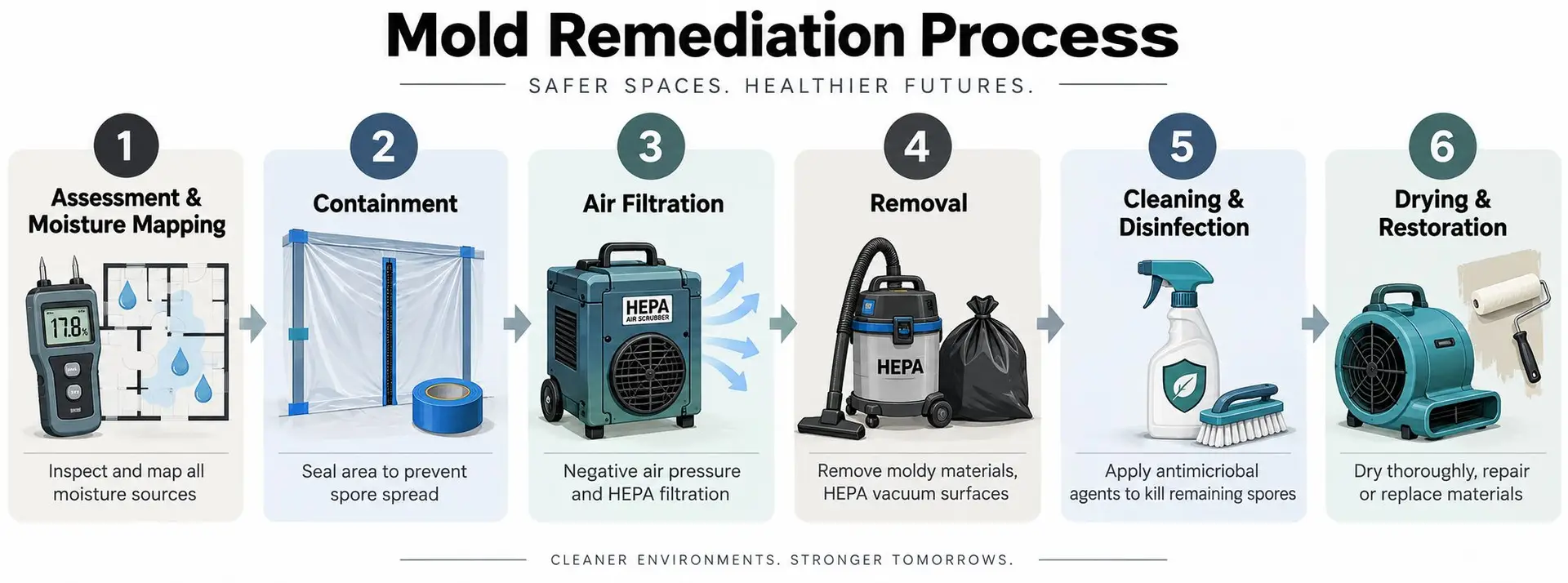
A thorough remediation plan follows the contamination through the building rather than stopping at the first visible patch. Each stage has a purpose, and skipping one can weaken the entire response.
Assessment identifies the problem's boundaries
The process begins with an inspection of visible conditions, building materials, and moisture sources. Moisture mapping helps locate damp areas that may not show obvious mold. A technician may examine the area around a leak, check adjoining materials, and determine whether the affected zone extends beyond what the homeowner can see.
The next concern is containment. Workers may separate the affected room from occupied areas with barriers and control airflow so disturbance doesn't carry contamination through the property. For larger or more complex work, negative air pressure and HEPA filtration help direct air through controlled equipment instead of allowing it to move freely into clean spaces.
Removal and cleaning protect the structure
Once the area is controlled, the team determines how each material should be handled. Cleanable surfaces may be HEPA vacuumed and cleaned. Materials with embedded contamination may need controlled removal, bagging, and disposal. The work isn't complete when the material leaves the room. Remaining surfaces and nearby areas must be cleaned so settled contamination isn't left behind.
Drying comes after the source has been stopped and affected materials have been addressed. Fans, dehumidification, and targeted monitoring may be used to bring the structure back to a dry condition. Painting over a damp or contaminated surface would conceal the problem rather than resolve it.
Verification supports the restoration decision
Post-remediation verification examines whether the work area has been cleaned adequately, whether moisture conditions have been corrected, and whether materials are ready for restoration. The IICRC S520's emphasis on returning materials to Condition 1 reinforces why verification focuses on the building's condition, not only on visual appearance.
A proposal should make these stages understandable. If it only promises spraying, deodorizing, or painting, ask how the company will identify the moisture source, control the work area, handle porous materials, and confirm that drying and cleaning are complete. You can also review professional mold remediation services to understand how a restoration scope may address assessment, containment, cleaning, and repair.
When Simple Cleaning Ends and Containment Begins
Size helps determine the response, but it isn't the only factor. The type of material, the moisture source, the location, and the possibility of hidden contamination can all change the plan.
The EPA says an affected area less than about 10 square feet can usually be handled by an occupant as a small cleanup job. The EPA describes that area as roughly a 3 ft. by 3 ft. patch in its home mold cleanup guidance. Once the affected area exceeds that practical threshold, formal remediation planning and control measures become more appropriate.
For contamination from 10 to 100 square feet, EPA guidance generally recommends limited containment. That might involve isolating the work zone and controlling access. The EPA containment guidance explains why containment is a core remediation mechanic, not an optional decoration.
| Affected Area | Typical Approach | Containment and Controls |
|---|---|---|
| Less than about 10 square feet | Small occupant cleanup may be appropriate when the material is hard and the moisture source is corrected | Basic isolation and careful cleaning, depending on the situation |
| 10 to 100 square feet | More formal remediation planning | Limited containment, controlled work practices, and source correction |
| Larger or complex contamination | Professional assessment and structured remediation | Source containment, local or mini containment, or full-scale containment, with barriers, negative pressure, and HEPA filtration as appropriate |
Containment keeps the work from creating a larger problem
The IICRC S520 framework describes three containment types: source containment, local or mini containment, and full-scale containment. Source containment focuses on the immediate area around the contamination. Local containment separates a limited work zone. Full-scale containment creates a more thorough separation for extensive or complicated projects.
Barriers, negative air pressure, and HEPA-filtered equipment can help prevent spores and debris from moving into occupied or clean areas. The exact setup depends on the building and the contamination, so a square-foot estimate alone shouldn't replace professional judgment.
A small patch inside an HVAC system or a damp wall cavity may deserve more attention than a larger, isolated mark on a washable surface. For Phoenix property owners dealing with water intrusion, mold damage mitigation should be evaluated by the source, material, and spread potential together.
Hidden Mold Porous Materials and Health Considerations
Mold often becomes harder to manage when it enters materials that absorb water. Glass and glazed tile are non-porous, so contamination generally remains on the surface and can be cleaned more directly. Drywall, insulation, ceiling tile, carpeting, and some wood products can hold moisture and contamination within their fibers or layers.
That difference changes the decision. Porous material with visible mold growth is typically removed and bagged rather than treated as though wiping the face will clean the entire material. EPA-style guidance summarized by the National Mold Authority's discussion of EPA guidelines connects porous-material handling with controlled removal and containment practices.
Hidden growth changes the inspection question
A leak behind a bathroom wall may leave only a small visible mark while dampening the back of the drywall. An attic problem may affect insulation and roof framing before the homeowner notices growth from the living space. A musty odor without visible mold can also justify looking beyond the surface, especially after flooding or a persistent leak.
Larger work areas may require controls such as single-layer polyethylene barriers, double-layer containment, decontamination chambers, and HEPA-filtered negative air machines. These controls help manage the movement of contaminated dust and spores while workers remove affected materials.
Health concerns also require a measured explanation. Mold exposure can aggravate allergies and asthma or cause irritation in sensitive people, but the right building response isn't based on fear or on a single visual description. The guidance on mold remediation standards notes that no federal consensus standard establishes one universal safe airborne mold limit.
Why a spore count isn't the whole answer
There isn't one number that automatically decides whether remediation is necessary. The more useful questions are:
- How extensive is the contamination? A broad or spreading area needs more control than a small isolated spot.
- What material is affected? Porous materials may need removal instead of surface cleaning.
- Has the moisture been corrected? Continued dampness can support recurrence.
- Could contamination be hidden? Wall cavities, flooring systems, attics, and HVAC components may require a closer assessment.
If a basement, crawl space, or other damp area has recurring growth, review the information about dangerous molds in basements while arranging an assessment. The goal is a controlled, evidence-based response that protects both the building and its occupants.
Choosing Between DIY Cleanup and Hiring a Certified Professional
DIY cleanup can make sense when the contamination is small, visible, and located on a hard surface, provided the person doing the work can safely clean it and the moisture source has been corrected. The CDC identifies soap and water as an option for small hard-surface cleanup and permits a bleach solution no stronger than one cup of household bleach per one gallon of water. Never mix bleach with other cleaners, and follow the product label and ventilation guidance.
A professional assessment becomes more sensible when the area is larger than 10 square feet, the growth keeps returning, porous materials are affected, moisture persists, or the contamination may involve an HVAC system or hidden cavity. Those situations require decisions about containment and material removal that a surface-cleaning routine can't answer.
| Situation | More suitable starting point | Reason |
|---|---|---|
| Small visible growth on a hard, washable surface | Careful occupant cleanup | The material can be cleaned, and the area is limited |
| Contamination above about 10 square feet | Professional assessment | EPA guidance moves larger areas toward formal planning and controls |
| Mold on drywall, insulation, or ceiling tile | Professional judgment | Porous materials may hold contamination beyond the visible face |
| Recurring growth after cleaning | Moisture investigation | The source may still be active or hidden |
| Suspected HVAC or wall-cavity involvement | Qualified professional | Disturbance could spread contamination through connected spaces |
| Flooding or substantial water damage | Structured remediation evaluation | Multiple materials and hidden moisture may be involved |
Ask what the scope actually includes
Certification alone doesn't tell you every detail of a project, but a qualified company should explain its assessment method, containment plan, equipment, material-handling approach, drying work, and verification process. The IICRC S520 standard focuses on physically removing mold contamination and returning materials to Condition 1, so ask how the proposed work addresses those objectives.
Don't choose based only on the promise of a spray or a fresh coat of paint. A clear proposal should identify the moisture source, describe what will be cleaned or removed, and explain how the company will limit spread. Homeowners comparing providers can review IICRC-certified restoration company services as part of that evaluation.
Restore Heroes is one Phoenix-area option that describes mold work involving moisture detection, containment, contaminated-material removal, cleaning, and restoration. Compare that scope with other qualified providers, and don't assume that any company can guarantee insurance coverage, a specific outcome, or a particular project price before assessing the property.
What to Remember Before You Act on Mold
The simplest way to remember the distinction is this: removal addresses what you see, while remediation addresses why it grew and how the work can be controlled. A wiped surface may look clean, but the building still needs attention if moisture, porous materials, or hidden contamination remain.
Before you act, make a short checklist:
- Document the condition: Photograph visible growth, stains, leaks, and damaged materials.
- Stop the moisture: Shut off accessible leaks and arrange repairs for plumbing, roofing, condensation, or other sources.
- Assess the material: Hard surfaces differ from drywall, insulation, ceiling tile, and other porous materials.
- Consider the scale: Areas above about 10 square feet call for more formal planning under EPA guidance.
- Ask about containment: Find out how workers will protect clean areas and manage contaminated debris.
- Request a defined scope: The proposal should explain assessment, cleaning or removal, drying, and verification.
You don't need to diagnose the entire building before asking for help. You do need to describe what happened, what you've cleaned, whether the growth returned, and whether anyone has health concerns. That information helps a contractor, landlord, property manager, or insurance adjuster discuss the right level of response without confusing cosmetic cleaning with building remediation.
For Phoenix homeowners, understanding these terms makes the next conversation more productive. You can ask whether the moisture source has been corrected, whether porous materials are involved, and whether the planned controls match the contamination. Those questions help you compare proposals calmly and avoid treating a recurring moisture problem as a stain alone.
Restore Heroes provides Phoenix-area assessment, containment, mold removal, cleaning, drying, and restoration services for residential and commercial properties. If mold has returned after cleaning or followed water damage, visit Restore Heroes to discuss the condition with a restoration team and request an appropriate next step.