
You step into the living room before sunrise and feel water soaking through your socks. A supply line beneath the kitchen sink failed overnight, the baseboards are dark, and the carpet gives under every step. Your first thought probably isn't about drying equipment. It's whether your homeowners policy will pay for the mess.
That question has several parts. What kind of water entered the home? Was the event sudden or gradual? Did the water come from inside the house or from outside? Which policy coverage applies, and what should you do immediately to protect both the property and a future claim? This guide walks through those decisions in the same order a restoration professional would assess them, without promising coverage, payment, or pricing.
When the Water Hits and the Policy Question Starts
A Phoenix homeowner facing standing water has two urgent problems, the physical loss and the insurance record. The safest response is neither to wait passively for an adjuster nor to start tearing out walls without documentation. First make the area safe, stop the source if you can do so safely, and record what the water has affected.
The policy question usually turns on the cause. A failed supply line may look very different from seepage around an aging pipe, a monsoon-driven flood, or water pushed backward through a drain. The visible puddle doesn't tell you which coverage applies. The source, timing, contamination, policy language, and endorsements do.
Practical rule: Mitigation should begin promptly, but document the condition before materials are removed whenever safety allows.
Take timestamped photos and videos from wide room views and close angles. Photograph the failed component, damaged flooring, baseboards, walls, cabinets, furniture, and personal belongings. Keep receipts for emergency purchases and preserve damaged items unless they create a health or safety hazard.
Your policy's declarations page can show limits and endorsements, but exclusions and conditions often sit elsewhere. If you need a plain-language starting point, use this guide on how to read a homeowners insurance policy before you call your agent with specific questions.
The rest of the decision becomes more manageable once you can describe the loss accurately. You don't need to diagnose every detail yourself, but knowing the basic classification helps you explain what happened and recognize when a contractor's assessment needs more supporting evidence.
What Counts as Water Damage in an Insurance Claim
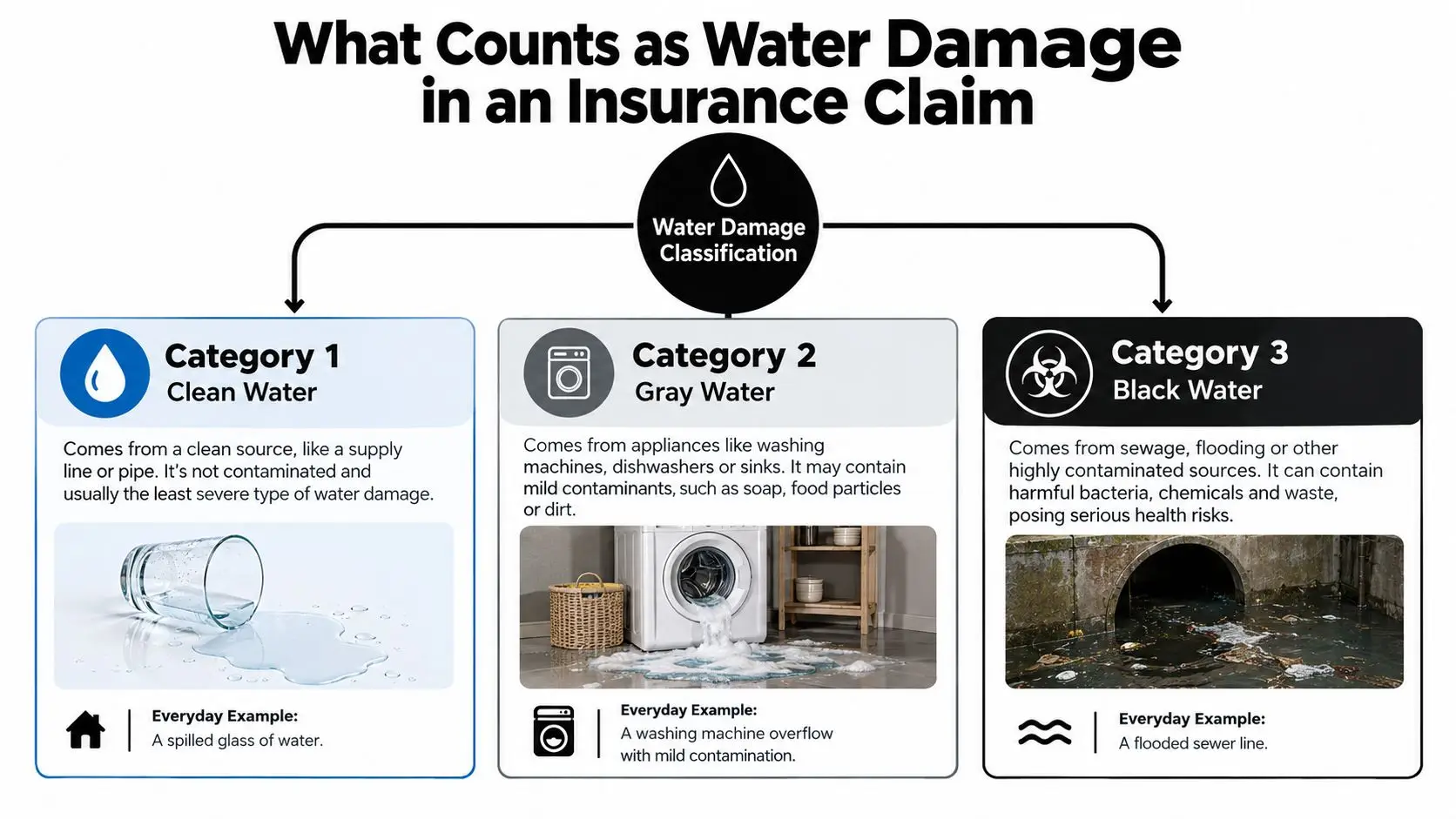
Insurance and restoration professionals don't classify every wet room as the same loss. Water category describes contamination. Material class describes how extensively water spread and how difficult the affected materials are to dry. Together, those descriptions shape safety procedures, removal decisions, equipment, and claim documentation.
Start with the water category
- Category 1, clean water: Water from a broken supply line is similar to water flowing from a tap that you'd use to fill a glass. It can still damage flooring, drywall, and cabinetry, and it may become more contaminated if it sits.
- Category 2, gray water: A dishwasher overflow or washing-machine discharge resembles runoff from a mop bucket. It contains more contamination and requires more careful handling than a clean supply-line loss.
- Category 3, black water: Sewer backup and outdoor floodwater are water sources you shouldn't touch casually. They may carry hazardous contamination and generally require specialized containment, removal, cleaning, and disposal.
If you suspect water beneath a slab, source identification matters before anyone opens flooring or walls. A resource on slab leak detection near me can help explain why hidden plumbing failures need a different investigation from an obvious appliance overflow.
Then describe the material class
Class 1 affects a limited area with little absorption. Class 2 reaches materials such as carpet and pad, where water can travel below the surface. Class 3 involves substantial saturation of walls, ceilings, or other areas, while Class 4 affects materials that don't release moisture easily and may need specialty drying methods.
Category and class aren't coverage decisions by themselves. They give the carrier, adjuster, and restoration team a shared vocabulary for describing the loss. For contaminated events, the Category 3 water damage guidance is especially relevant because porous materials may need removal rather than prolonged drying.
What Your Policy Typically Covers and What It Excludes
A standard homeowners policy usually separates property protection into three practical buckets. Dwelling coverage addresses the building. Personal property coverage addresses belongings. Additional living expenses, often called loss-of-use coverage, may help with eligible extra living costs when a covered loss makes the home unsuitable, subject to the policy's terms and limits.
A sudden, accidental discharge often fits the type of event these policies are designed to address. Examples can include a burst pipe, an appliance rupture, an ice-dam leak in applicable climates, or accidental sprinkler discharge. That doesn't mean every resulting invoice will be paid. The policy may cover resulting damage while excluding the failed part, deterioration, or neglected maintenance.
Think of a tire that blows out on the freeway compared with one that slowly loses air because the tread is worn away. The first is a sudden event. The second points toward wear and maintenance. Water coverage often turns on a similar distinction.
Common scenarios side by side
| Scenario | Standard Policy | Likely Result | Endorsement to Consider |
|---|---|---|---|
| Sudden burst supply line | Often addresses resulting sudden damage, subject to terms | Investigation, mitigation, and repair scope are reviewed | Review water-damage limits and service-line options |
| Gradual or repeated seepage | Commonly restricted or excluded | Coverage may be limited or denied for the resulting damage | Ask how hidden or long-term leakage is treated |
| Appliance failure | May cover resulting damage from a sudden rupture | The appliance itself may be treated differently from surrounding damage | Review equipment or appliance endorsements |
| Sewer or drain backup | Often excluded from basic wording | Coverage depends heavily on an added endorsement | Consider water-backup coverage |
| External floodwater | Standard homeowners coverage generally excludes flood | A separate flood policy may be needed | Compare NFIP and private flood options |
| Mold after a covered water loss | Often limited or capped | Treatment depends on cause, policy wording, and limits | Ask about mold sublimits and covered causes |
| Aging materials or poor maintenance | Usually not a covered accident | Repair may fall to the homeowner | Focus on maintenance and prevention |
A policy can cover the resulting damage without covering the plumbing component that failed. It can also cover a sudden plumbing event while excluding damage caused by a leak that continued or repeated for 14 days or more, as described in this discussion of the continuous or repeated seepage exclusion.
Mold creates another frequent misunderstanding. Many policies provide limited mold protection when mold follows a covered sudden water loss, while mold linked to humidity, condensation, or gradual leakage is generally excluded, as explained in this mold and hidden-water coverage overview.
Coverage isn't permission to delay. Most policies require reasonable steps to prevent further damage, so keep records of emergency calls, temporary measures, photos, readings, invoices, and conversations with the carrier.
Flood Versus Internal Water in Phoenix Homes
The same amount of standing water can produce opposite insurance outcomes depending on where it came from. A failed water heater inside a Phoenix home is an internal plumbing event. Monsoon water entering through streets, washes, yards, or rising groundwater is external floodwater. The floor doesn't identify the policy. The source does.
Standard homeowners insurance typically excludes flood damage. The National Flood Insurance Program can provide separate protection, but its coverage is structured differently from a homeowners policy. Under NFIP rules, basement building coverage is limited to specific operating components, including items such as furnaces, water heaters, electrical components, and sump pumps. Finish materials such as wallpaper and carpeting, along with furniture and other basement contents, are excluded under the cited FEMA guidance at basement coverage under the NFIP.
Phoenix residents should also avoid assuming that a property outside a familiar flood zone has no meaningful exposure. Homes near washes, low areas, or retention basins can face different drainage conditions from one neighborhood to the next. Review the property's elevation and flood mapping, then ask an agent whether a separate policy is appropriate. A focused flood risk assessment can help organize those questions before a storm arrives.
Compare the source before choosing the claim path
| Loss Type | Phoenix Cause Examples | Policy That Responds | Key Documentation |
|---|---|---|---|
| Internal water | Failed water heater, burst pipe, appliance rupture, AC condensate backup | Homeowners policy may respond if the cause and resulting damage meet its terms | Failed component, source location, timestamps, plumber findings |
| Surface flood | Monsoon runoff, overflowing wash, water moving in from streets or adjoining land | Separate flood policy may be required | Exterior photos, water path, weather conditions, elevation details |
| Sewer backup | Drain or sewer line pushing water into the home | Usually requires a specific endorsement or separate protection | Backup point, contaminated materials, plumber or restoration report |
| Mixed loss | Plumbing failure during a storm with exterior water also entering | Coverage may involve different provisions or policies | Separate interior and exterior sources, sequence of events, photos |
A new flood policy may not help with water already entering the home. Ask about waiting periods before purchasing, and don't treat flood coverage as a substitute for internal-water endorsements. The most useful conversation with an agent identifies each source separately rather than placing every wet surface under the single label of water damage.
Filing a Clean Restoration Claim Step by Step
The first hour should be orderly, even if the home isn't. Safety comes before evidence. Don't enter standing water near energized outlets or appliances, and don't operate electrical equipment in a wet area. If you can safely reach the main valve, stop the water. Isolate power to affected zones only when you can do so without entering danger.
The immediate sequence
- Stop the source: Close the local valve or main shutoff when safe. If the source is a plumbing failure, arrange qualified repair.
- Protect people: Keep children and pets away, avoid contaminated water, and leave unsafe areas isolated.
- Record conditions: Take timestamped photos and video before extraction or demolition. Capture both damaged and apparently unaffected areas.
- Call for assessment: A licensed restoration contractor can map moisture, inspect concealed areas, and establish a drying plan.
- Notify the carrier: Report the loss, open a claim, and obtain the claim number. Ask about emergency work, deductibles, preferred vendors, and documentation requirements.
Calling a restoration contractor early can strengthen the file because the team can capture moisture mapping, thermal imaging, temperature and humidity conditions, and psychrometric readings before demolition changes the scene. The contractor shouldn't decide coverage, but the report can give the adjuster objective information about what was wet, how far moisture traveled, and why each action was taken.
The claim file should show more than a final invoice. Ask for itemized line items, photographs, equipment records, daily moisture readings, affected-material notes, and a clear distinction between emergency mitigation and reconstruction. The step-by-step homeowners insurance claim guide can help you prepare questions for the carrier and adjuster.
Once the adjuster visits, provide the photo log, source information, inventory, plumber report, and restoration assessment. Don't sign an unfamiliar scope or assignment without understanding what it authorizes. Direct insurer billing may reduce out-of-pocket confusion, but it doesn't change your deductible, policy limits, exclusions, or responsibility for noncovered work.
The restoration company should follow ANSI/IICRC S500, the consensus standard for professional water-damage restoration. That framework addresses procedures, equipment, assessment, and documentation. A defensible file includes category and class reasoning, source control, extraction records, drying equipment, and moisture readings that trend downward toward material-specific dry standards. The ANSI/IICRC drying documentation reference explains why repeated readings matter.
Don't wait for a perfect coverage answer before taking reasonable steps to prevent additional damage. Document the work and keep the carrier informed.
A Realistic Timeline From Mitigation to Rebuild
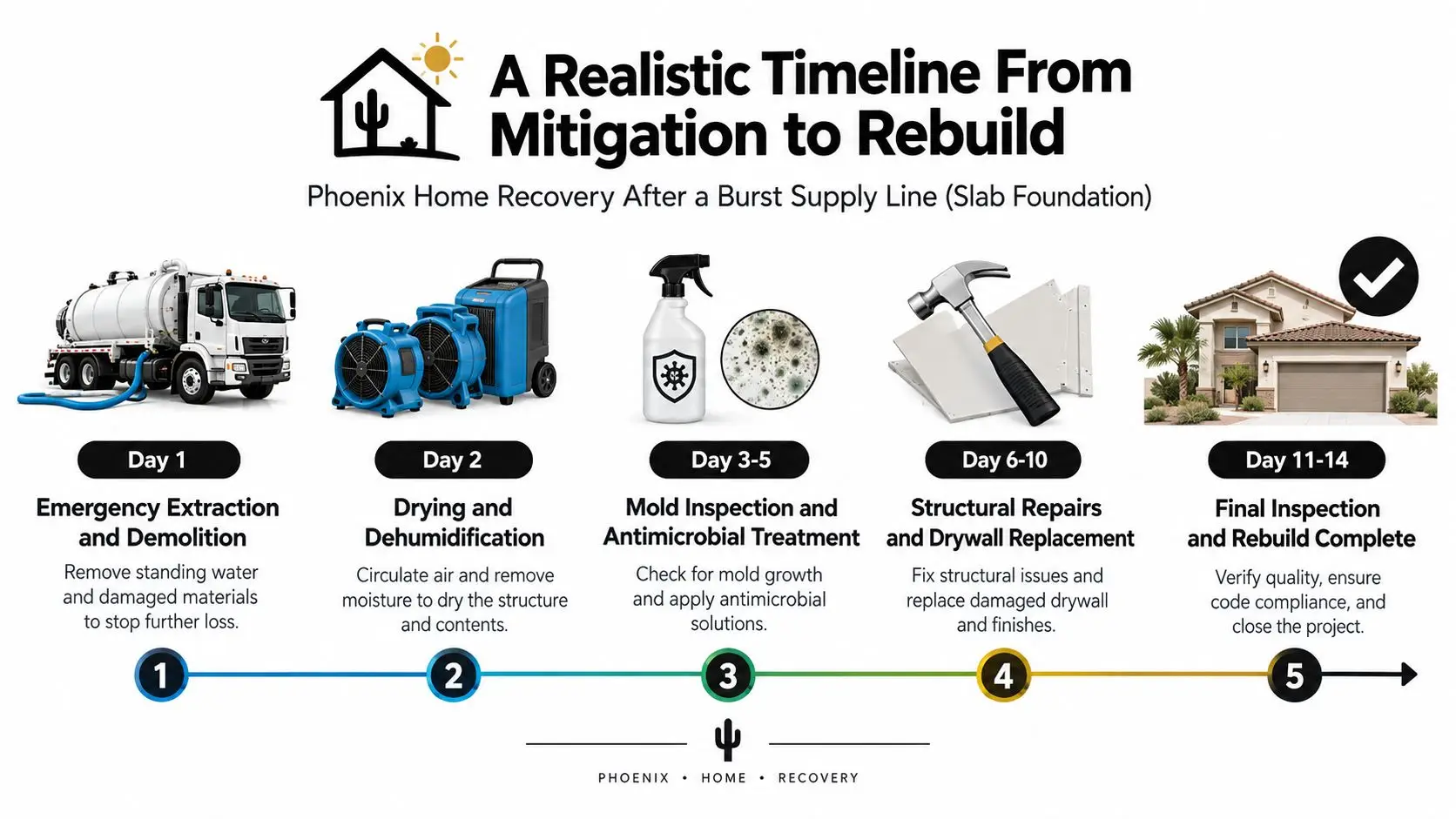
Consider a representative Phoenix claim involving a burst supply line in a single-story home with a slab foundation. The example isn't a promise of timing or coverage. It shows how a well-documented job may move when the source is controlled, access is available, and materials don't create unusual delays.
The first days
On day one, the crew focuses on emergency extraction, selective demolition, and safety. Wet pad, damaged baseboards, or unsalvageable porous materials may be removed when the category and condition justify it. The team sets drying equipment and records the initial moisture condition.
On day two, air movement and dehumidification continue. Technicians check affected rooms, wall cavities, flooring edges, and cabinetry rather than relying on how dry a surface feels. Phoenix's dry air can help evaporation, but opening windows alone doesn't prove that concealed assemblies have reached appropriate standards.
By day three, an adjuster may walk the property, review the source, and compare the observed damage with the estimate. The restoration team continues readings and adjusts equipment. If moisture remains high, drying continues rather than stopping because the floor looks better.
From drying to reconstruction
Over the next several days, the contractor documents the downward moisture trend and identifies areas ready for repair. Structural wood is typically considered dry below about 19% moisture content, while drywall and gypsum assemblies require substantially lower residual moisture, according to the water-damage inspection reference. Material-specific targets matter more than an arbitrary calendar.
Around day seven, an insurer may address approval and depreciation release, depending on the policy, estimate, adjuster review, and claim circumstances. Reconstruction then depends on the approved scope, contractor availability, cabinet ordering, drywall work, painting, flooring, and inspections. Monsoon conditions can affect scheduling, while cabinet lead times can extend the project even after drying is complete.
The homeowner's loss-of-use coverage may help with eligible additional living expenses when a covered loss makes the home unfit for occupancy. Keep receipts and ask the adjuster which costs qualify, whether advance approval is needed, and how the policy limit applies. A useful overview of project variables appears in how long water damage restoration takes.
A clean timeline has pauses for decisions, not unexplained silence. Ask what has been measured, what remains wet, which scope items are disputed, and what the next approval or repair milestone requires.
Why Water Claims Are Getting Pricier and More Scrutinized
Water losses now receive close attention because insurers see a pattern of fewer opportunities for inexpensive mistakes. The Insurance Information Institute's 2023-based figures show that water damage and freezing made up about 22.6% of homeowners insurance claims, and roughly 1 in 67 insured homes filed a water-damage-or-freezing claim each year during the 2019 to 2023 period. The same dataset reports an average private homeowners water-damage claim of roughly $15,400 and annual U.S. insurer payouts near $13 billion. These figures are summarized with the cited data at water-damage insurance claim statistics.
Severity also matters locally. Industry reporting states that non-weather water-loss severity rose 63.16% from 2019 to 2025, while frequency fell 7.8% from 2024 to 2025. That combination points to fewer but more expensive losses, which helps explain why carriers examine cause, maintenance, mitigation, and prior claim history carefully. The trend is discussed in personal insurance conditions and water-loss scrutiny.
Phoenix homes can present several overlapping concerns: concealed slab plumbing, complex appliance connections, expensive finish materials, monsoon exposure, and changing replacement-cost estimates in growing suburbs. Some insurers may request leak-detection or automatic shutoff systems, apply higher water-damage deductibles, or reconsider renewal after repeated losses. Industry reporting also describes potential preferred pricing credits of 5% to 10% for leak-detection technology, but eligibility depends on the carrier and policy.
What makes a file easier to review
| Signal | Tends to Lower Scrutiny | Tends to Raise Scrutiny |
|---|---|---|
| Source history | Clear failed component and prompt repair | Unexplained source or evidence of ongoing seepage |
| Timing | Same-day mitigation invoice and notification | Delayed action with worsening damage |
| Moisture evidence | Daily readings showing a defensible downward trend | One final reading with no baseline |
| Estimate quality | Itemized scope tied to observed conditions | Broad lump-sum charges |
| Property history | Maintenance records and prevention measures | Repeated similar losses without corrective action |
| Communication | Claim number, photos, reports, and consistent statements | Missing documents or conflicting descriptions |
Your objective isn't to make a loss look smaller than it is. It's to create a truthful record that shows what happened, what you did, and why each restoration step was reasonable. If you're comparing coverage before renewal or purchase, a resource on finding the right policy can help you prepare questions for an agent about exclusions, endorsements, deductibles, and future insurability.
A paid claim can still affect renewal decisions or pricing, so the long-term question matters alongside the immediate one: is this loss covered, and have you responded in a way that protects your ability to insure the home later?
Restore Heroes provides Phoenix-area water damage assessment, extraction, structural drying, moisture documentation, and insurance coordination for residential and commercial properties. If water has entered your home, visit Restore Heroes to request an inspection and discuss the next safe, documented step.