
Many people reach for fragrance, charcoal sachets, or a plug-in air purifier and hope the smell disappears. That's the wrong starting point after property damage, because what removes odors is usually not masking at all, it's getting the odor-causing material out of the building or stopping it from off-gassing in the first place.
A smell after water, smoke, mold, or biohazard damage is usually a clue, not the whole problem. If the odor is still there, something in the structure, contents, or moisture condition is still producing it, and the fix has to target that source.
Understanding the True Source of Persistent Odors
A lasting odor usually means a reservoir of contamination is still inside the building. That reservoir may be wet drywall after a leak, smoke residue in carpet and upholstery, or microbial growth hidden in a cavity. The smell is the symptom; the damage sits in the material.
CDC guidance says musty odor and visual inspection can be more reliable indicators of indoor mold than routine air sampling, and it also stresses moisture control, leak repair, and drying wet materials within 24 to 48 hours (CDC mold guidance). In real homes, that matters because a room can look dry on the surface while the backing, padding, framing, or insulation still holds moisture and odor.
Odor often points to a hidden reservoir
After a monsoon leak hits a wall or floor, the first thing a homeowner notices is often smell, not staining. The same pattern shows up after smoke exposure, sewage backup, or a slow plumbing leak behind a vanity. Porous materials absorb compounds, then release them again later.
Practical rule: if the smell returns after cleaning, the source probably wasn't removed.
A technician who wants a permanent result starts by tracing the odor back to the material, not the room. For a homeowner example of this problem, see basement smells musty.
Covering the odor rarely solves the problem
Fragrance can make a space easier to tolerate for a short time, but it does nothing for moisture intrusion, microbial growth, or smoke residue. Once the source stays in place, the odor often comes back when the room closes up or humidity rises. That is common in Phoenix, where air conditioning cycles, monsoon water intrusion, and sealed interiors can trap odors for long periods.
The practical question is whether the smell points to a material problem or a ventilation problem. For a broader consumer-facing comparison of surface and carpet odor issues, stop carpet smells after cleaning is a useful read because it shows how odor can live in the material, not just the air.
Why Basic Ventilation and Particle Filters Fall Short
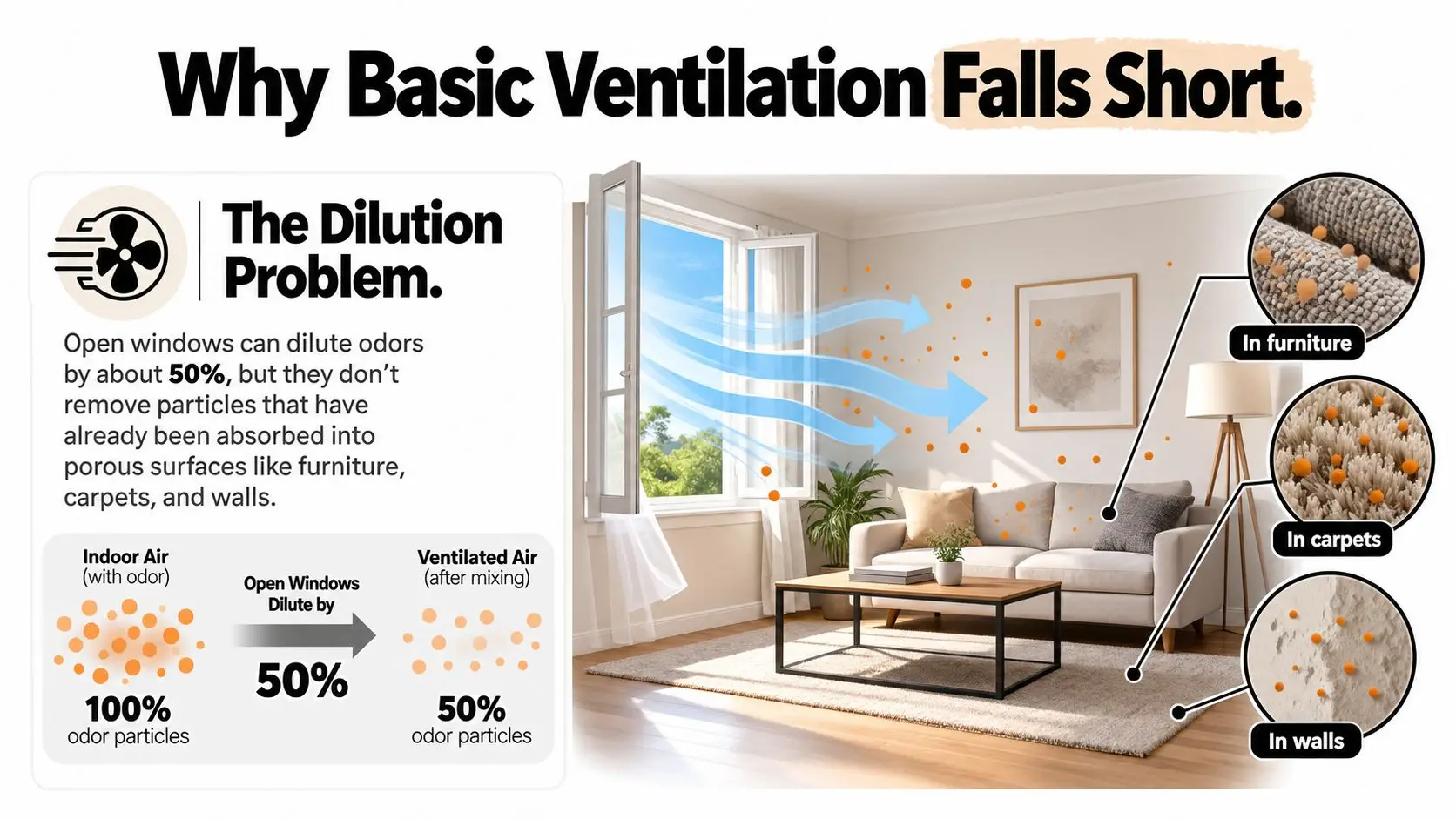
Ventilation helps, but only by dilution. Outdoor air lowers the concentration of volatile compounds in a room, yet it does not remove odor held in carpet pad, drywall, insulation, or furniture. Once airflow drops, those materials can release the smell again.
A NIST-linked building-ventilation study found that roughly 7.5 to 9 liters of ventilation air per second per person were needed to dilute body odor to acceptable levels for people entering from relatively clean air, while a Lawrence Berkeley National Laboratory review identifies 5 cubic feet per minute per person, about 2.5 liters per second, as a modern consensus rate for diluting human bioeffluents for occupants adapted to the space (ventilation and odor dilution). Those figures show why airflow matters, and they also show why air exchange alone cannot solve every odor source.
Air moves odor, it doesn't erase the reservoir
A home can smell better while the source still sits inside the building materials. Smoke, sewage, and wildfire odors behave that way. Opening windows can help for a while, but once the air settles, trapped compounds can off-gas again.
A 2025 report on an unburned home found increased VOCs persisted for nearly a month after wildfire smoke exposure, and opening windows or using a carbon-filter DIY air cleaner reduced concentrations only temporarily before levels rose again after those controls stopped (wildfire smoke persistence research summary). For a homeowner, that means fresh air can reduce the smell, but it does not prove the contamination is gone.
Standard filters are not gas filters
HEPA and other particle filters are useful for dust, soot, and aerosols. They are not built to grab gaseous odor molecules. That is why a room can look cleaner and still smell bad, especially after smoke or biological contamination.
If you want a practical consumer overview of neutralizers and fabric-safe approaches, guide for home and business is a decent starting point, but it still cannot replace source removal when the odor is embedded in materials. Use a purifier to support cleanup, and rely on source removal to finish the job. If you're unsure what's in your air, indoor air quality testing establishes a baseline before and after cleanup.
The Professional Sequence for Permanent Odor Removal
Professional odor work starts with the reservoir, then moves outward. The U.S. Environmental Protection Agency ranks source control, ventilation, and air cleaning in that order of effectiveness, and it warns that masking or filtering an odor does not remove the contaminant causing it (EPA source control guidance). That order matters because every later step depends on the one before it.
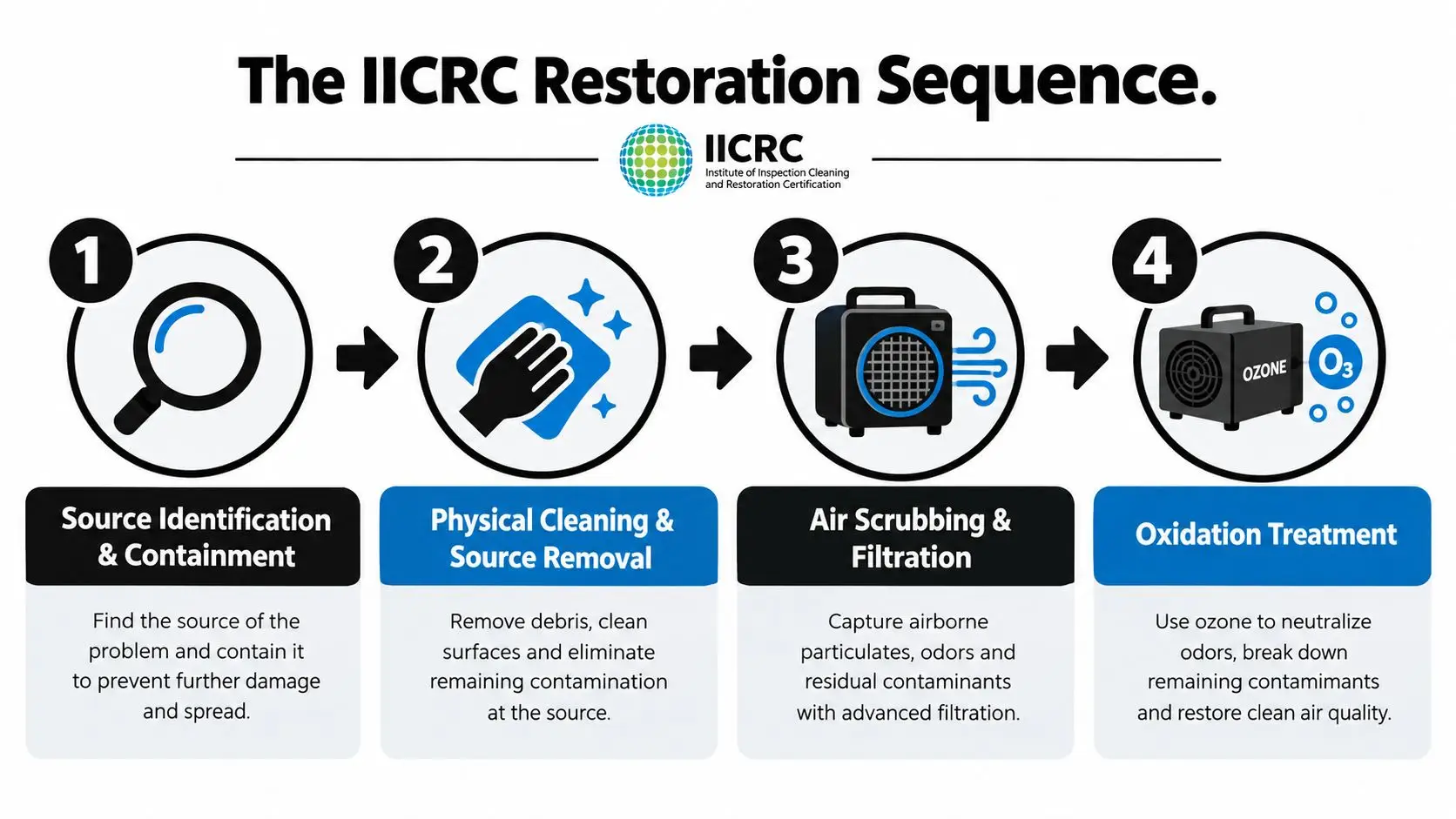
Step one is source identification and containment
A technician first finds the emitting material. That may be water-damaged drywall, soot-impacted contents, sewage-contaminated flooring, or mold-affected porous materials. If the source stays in place, the smell stays active too.
Step two is physical cleaning and removal
This is the hard part homeowners often try to skip. Contaminated porous materials may need to come out, residues need to be cleaned from hard surfaces, and moisture has to be corrected so the odor does not keep feeding itself. When that work is done properly, the result lasts. When it is skipped, the room may smell better for a few hours and then drift back.
Step three is air scrubbing and filtration
A carbon-equipped air cleaner can reduce residual vapors once the source is under control. EPA guidance notes that carbon filters work better when they contain a substantial mass or thickness of carbon, because more sorbent capacity improves contact time and delays breakthrough (EPA air cleaners guidance).
Step four is only for specialized cases
Some situations still need deodorization after source removal, but no machine should be treated as a shortcut around cleanup. A restoration company such as Restore Heroes can handle source removal, drying, and deodorization as part of a broader mitigation job. For a clearer look at the workflow, see what a restoration company does.
If you want a consumer-level contrast, musty home odor fixes is a useful reference. Professional work is built around eliminating the reservoir; freshening the room is a side effect.
Evaluating Advanced Deodorization and Filtration Technologies
Activated carbon helps because it removes odors by adsorption. Odor molecules attach to the carbon's porous surface instead of being covered with fragrance. In laboratory testing on medical-waste odors, activated carbon adsorbed about 35.7 milligrams per gram for trimethylamine, 6.6 milligrams per gram for methyl mercaptan, 6.3 milligrams per gram for acetaldehyde, 4.2 milligrams per gram for ammonia, and only 0.2 milligrams per gram for hydrogen sulfide (EPA ozone generator document with adsorption data).
Carbon works, but not equally on every odor
That spread in adsorption capacity explains why one deodorizer does not solve every smell. Performance depends on airflow, humidity, concentration, molecule size, and whether the carbon has already loaded up. In the same study, increasing airflow from 10 to 30 liters per minute reduced measured ammonia capacity from 11.0 to 9.8 milligrams per gram under the test conditions.
Once carbon saturates, odor starts passing through again. Carbon media has to be monitored and replaced or regenerated when it is spent. A thick carbon bed helps, but it is still a consumable part of the job, not a permanent fix.
Ozone is no cleanup shortcut
EPA summarizes available evidence showing that ozone concentrations kept within public-health standards have little ability to remove most indoor contaminants, and ozone-generating equipment should not be operated in occupied spaces because ozone is a lung irritant (EPA guide to air cleaners). In plain terms, ozone cannot replace removing wet materials, cleaning residues, or drying the structure.
For a contractor-level look at another specialty method, thermal fogging odor removal shows why deodorization still depends on source control first. For biohazard or smoke work, that sequence matters.
What to ask before anyone runs a machine
A homeowner does not need every chemical detail, but the questions should be direct:
- What source was removed? If the answer is vague, the odor likely will be too.
- What porous materials were discarded? If nothing came out, the smell may rebound.
- What media or treatment is being used? Carbon, ventilation, or oxidation all have different roles.
- How is saturation or exposure being managed? A treatment without monitoring is just hope.
Recognizing When DIY Fails and Professionals Are Needed
DIY can handle a light cooking smell or a one-time pet accident. It breaks down when the odor lives in structural damage, contaminated contents, or a moisture problem that keeps feeding the source. If the smell returns after cleaning, or grows stronger in heat and humidity, the problem is deeper than the surface.
Odor perception is a poor safety test. Some chemicals can affect health at levels people cannot smell, so a room can seem improved while the contamination is still there. That is why I do not trust odor alone when sewage, mold, smoke, or a damaged appliance may be involved.
Red flags that point past DIY
Certain patterns usually mean it is time to stop testing home remedies and bring in a restoration crew:
- Sour, biological smells often point to contamination in porous materials, not a surface stain.
- Sharp smoke odors often mean residue has entered fabrics, drywall, insulation, or HVAC pathways.
- Deep earthy dampness usually means moisture is still trapped somewhere.
- A smell that returns after cleaning usually means the reservoir was not removed.
CDC also warns that mixing bleach with other cleaners can produce poisonous gas, so aggressive cleanup tactics can create a second problem while the first one is still unresolved. That matters when a homeowner is trying to sanitize after water or biological damage.
What professionals bring to the job
A licensed, bonded, and insured restoration team can assess whether a material is cleanable, salvageable, or should be removed. That judgment matters because the wrong choice wastes time, money, and sometimes the whole room. Odor control often depends on making a structural decision, chemistry alone rarely settles it.
For property owners trying to decide what kind of service they need, what a restoration company does is a useful reference point. If the odor is tied to a larger loss, the fix should start with source control, not another round of masking.
Protecting Your Property and Air Quality After Restoration
After the source is removed, the job shifts to keeping the building from becoming an odor problem again. In Phoenix, that means watching humidity, maintaining HVAC equipment, and making sure combustion appliances vent correctly. Dust, heat, and monsoon moisture create the kind of cycle that lets new odors settle in fast.
Keep the air moving the right way
EPA identifies improperly vented or unvented fuel-burning appliances as major household sources of combustion pollutants and recommends increasing outdoor-air ventilation and using exhaust fans that vent outdoors when products or appliances may release pollutants (EPA indoor air guide). That applies to gas stoves, water heaters, dryers, and cleaning situations where fumes can build up.
A practical habit is to use kitchen and bathroom exhaust fans whenever moisture or products can release pollutants into the air. If windows can be opened safely and outdoor conditions are reasonable, fresh air helps too. If not, mechanical exhaust and HVAC maintenance become even more important.
Watch humidity and filters, not just smell
In Phoenix, the climate can hide problems. Air conditioning can make the air feel dry while a hidden leak or condensation issue still feeds odors behind walls or under flooring. Replace HVAC filters on a regular schedule, inspect returns and vents for buildup, and don't ignore any new musty note after monsoon weather or plumbing repairs.
Useful habit: if a repaired area starts smelling again, check moisture first, not fragrance.
For confirming that the job is finished, post-remediation verification is the right follow-up. That check matters because a quiet odor problem can return if the structure wasn't fully dried, cleaned, and cleared.
A final practical note. The best odor control isn't a spray, a candle, or a machine. It's source removal, drying, and clean airflow maintained after the repair is done.
Restore Heroes handles water, fire, mold, and biohazard cleanup in the Phoenix metro area, including odor removal that starts with source control and ends with verified decontamination. If the smell in your property keeps coming back, visit Restore Heroes to schedule a professional inspection and get the problem evaluated at the source.