
Smoke-related chemicals can remain indoors for days after a smoke event, with flooring, furniture and other surfaces continuing to release contaminants, according to the research summarized in the IICRC's fire and smoke restoration guidance. That explains a frustrating situation: a room can look clean and still smell smoky.
A professional smoke damage cleaning service should account for what you can see, what's hidden inside materials, and what may have entered the HVAC system. Those decisions affect the price, the work schedule and whether belongings can be cleaned. A useful estimate explains those decisions instead of treating deodorizing as the whole job.
What Smoke Damage Cleaning Costs and Why Prices Vary
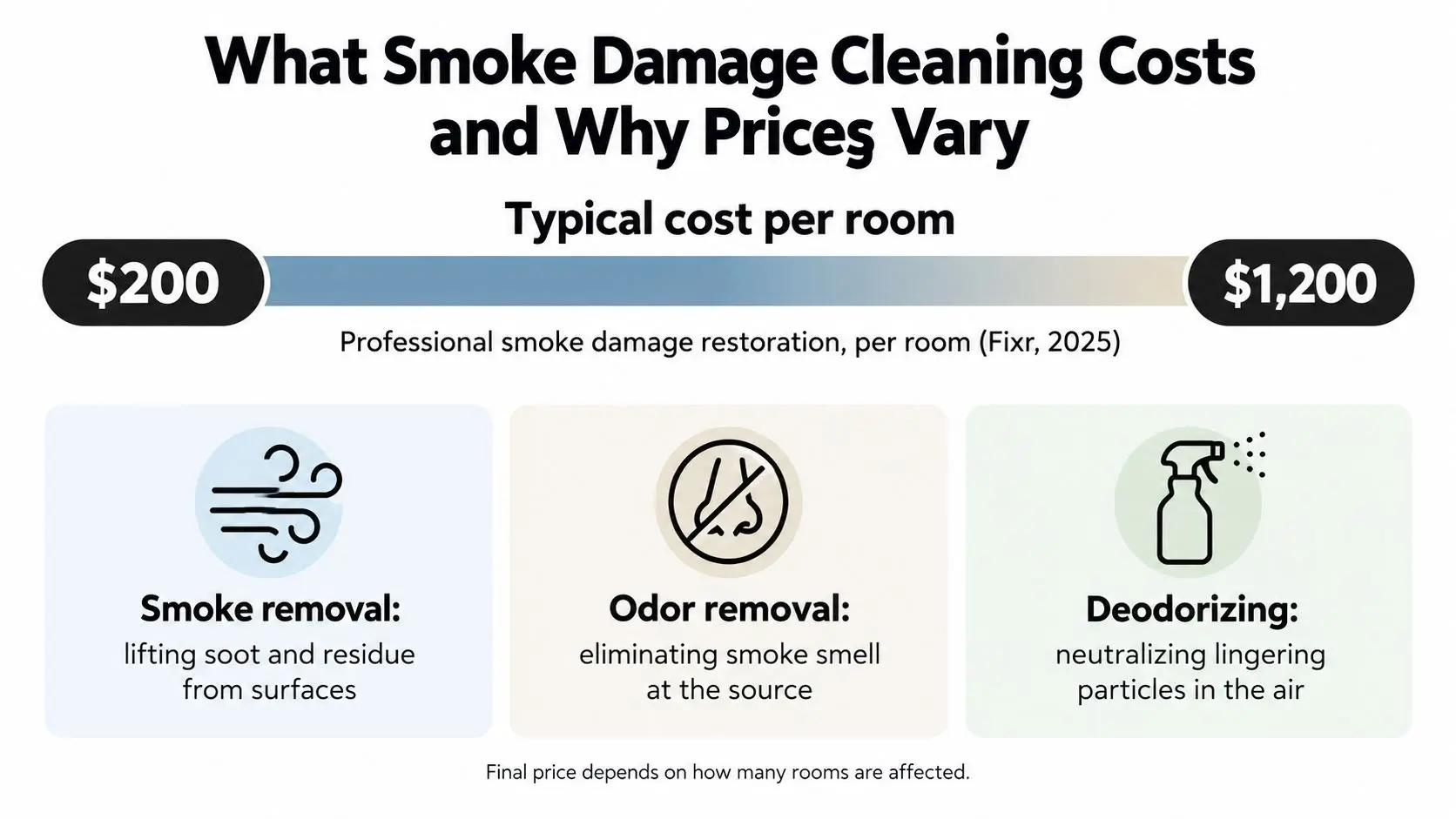
Professional smoke-damage restoration can cost $200–$1,200 per room for smoke removal, odor removal and deodorizing, according to Fixr. For broader fire and smoke remediation, HomeAdvisor reports a range of $800–$180,000, with an average of $27,477. These figures cover different scopes: a room-level cleaning allowance is not a whole-project budget that may include structural repairs.
Reported smoke damage cleaning costs
| Cost measure | Reported figure | Source | What it covers |
|---|---|---|---|
| Per room, smoke and odor removal | $200–$1,200 | Fixr, cited above | Smoke removal, odor removal and deodorizing in one room |
| Fire and smoke remediation, low end | $800 | HomeAdvisor, cited above | Lower end of the reported whole-project range |
| Fire and smoke remediation, average | $27,477 | HomeAdvisor, cited above | Average across reported projects, not a room-cleaning quote |
| Fire and smoke remediation, high end | $180,000 | HomeAdvisor, cited above | Upper end of the reported whole-project range, potentially involving extensive work |
The graphic shows the room-level reference range, not a guaranteed service price.
Build a budget around the actual scope
Count the affected rooms and use the published room range as a rough allowance. Then request separate line items for contents cleaning, HVAC work, material removal and rebuilding if those tasks aren't already included. Hidden residue, affected belongings and HVAC components can add work even when a room's visible surfaces look clean.
The estimate depends on what inspection finds:
- Soot spread: Did residue stay near the fire, or reach closets and adjoining rooms?
- Porous materials: Can carpet padding, insulation and ceiling materials be cleaned, or do they need removal?
- Belongings: Does the price cover empty rooms or furnished rooms with textiles and electronics?
- Building systems: Are inspection and cleaning of affected HVAC components included?
- Repairs: Does the estimate stop at cleaning, or include repainting and reconstruction?
Published ranges are reference points, not quotes. Ask for a written estimate after an onsite inspection, with exclusions stated and a clear process for approving additional work. The final price and schedule depend on the scope, and neither is guaranteed before the affected rooms, contents and systems are assessed.
Why Smoke Residue Spreads and Why It Affects Health
Think of smoke residue as fine flour dust mixed with a sticky film. The comparison isn't exact chemistry, but it helps explain why residue can settle in cracks while clinging to paint, carpet and fabric.
The surface reservoirs described above are why appearance alone isn't a reliable completion test. Cleaning a wall doesn't necessarily address an affected sofa, carpet pad or cabinet interior. A deodorizer may change what you smell without resolving those materials.
The visible damage below illustrates why technicians need to assess both finishes and porous contents.

Match precautions to the exposure
Smoke particles and gases can irritate the eyes, nose and airways. Children, older adults, pregnant people, and people with asthma or heart or lung disease need particular caution; the discussion of fire and smoke damage to lungs provides additional context for homeowners.
- Limit access: Keep vulnerable occupants away from heavy-soot rooms pending assessment, rather than asking them to help sort damaged items.
- Control airflow: Don't let an operating central system carry contamination into cleaner areas; outdoor-air settings also need attention when smoke remains outside.
- Protect anyone handling residue: Gloves and a properly fitted, task-appropriate respirator matter, but neither makes an unsafe building safe to enter.
- Don't rely on smell: Reduced odor doesn't establish that residue is gone or that the space is ready for occupancy.
Practical rule: A room that smells better hasn't necessarily been cleaned adequately. Ask what was removed, what was treated and what was checked.
The useful distinction is source removal versus air treatment. Moving or filtering air can support cleanup, but technicians still need to identify contaminated materials and decide how to address them.
First 24 Hours After a Smoke Event
Protect people first. Don't enter until the appropriate authorities have cleared the property, and don't go in just to save belongings if structural or electrical hazards remain.
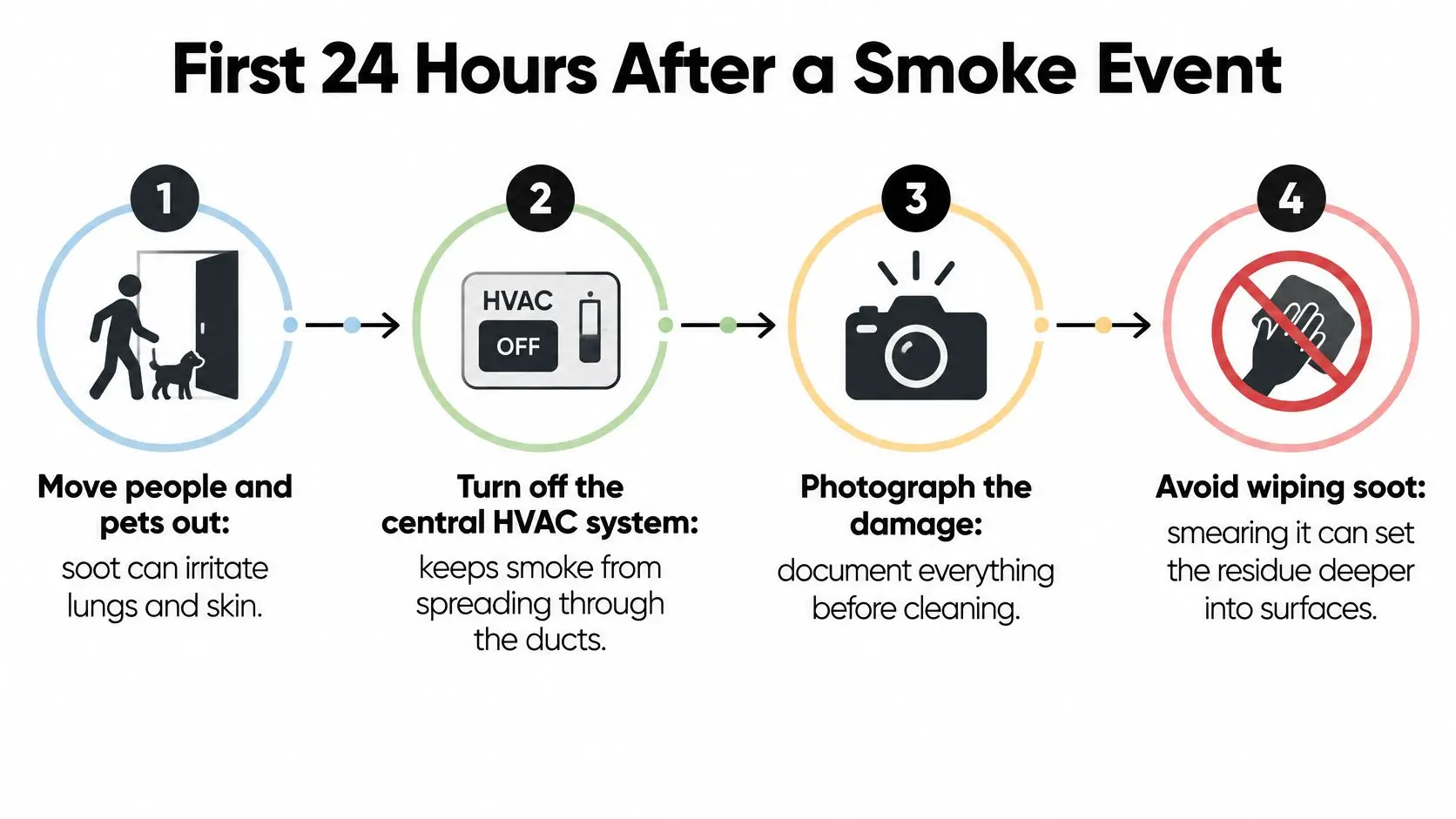
Use this graphic as a quick reminder of the immediate priorities.
Actions to take before cleaning
- Move people and pets out of heavy-soot rooms. Avoiding contact and unnecessary breathing exposure takes priority over recovering possessions.
- Turn off the central HVAC system if you can do so safely. This helps stop it from drawing contamination through the house.
- Open windows only after the fire is out and outdoor air is clean. Ventilation isn't helpful when it brings additional smoke indoors.
- Don't wipe, scrub or dry-sweep soot. Disturbing loose deposits can spread particles and complicate professional cleaning.
- Discard smoke- or heat-exposed perishable food and set cleaning candidates aside. Document them first when safe, and don't experiment with washing valuable or delicate belongings.
- Photograph and video the damage before moving items. Room views, item details and visible smoke lines help establish the original condition.
- Keep receipts for temporary expenses. Hotel stays, meals, pet boarding and emergency repairs need records if you later seek reimbursement.
- Request an onsite restoration inspection and record the conversation. Keep the contact's name, date and time so you can follow up on what was discussed.
Use the after-a-house-fire checklist to organize tasks without trying to perform the restoration yourself. Emergency measures and permanent cleanup aren't the same thing, so ask which work is being authorized.
For additional context while organizing your next steps, the video is included below.
The first call starts an assessment, not an automatic full-house treatment. The crew should examine residue boundaries, affected materials and access conditions before proposing containment, contents handling and cleaning.
How Soot and Odor Are Removed From Each Surface
Remove loose particles before introducing liquid. A HEPA-equipped vacuum or suitable dry-cleaning method comes first, followed by material-compatible wet cleaning where needed. Odor treatment follows source cleaning, rather than replacing it.
The surface matters as much as the equipment. A method that works on tile may damage a painted finish or drive moisture into upholstery, so technicians should test before treating a large area.
Cleaning method by surface type
| Surface | Cleaning method | Avoid |
|---|---|---|
| Painted walls and ceilings | Dry soot sponge first, then a mild wet cleaner after testing a hidden spot | Hard scrubbing that smears residue |
| Hardwood, tile and vinyl floors | HEPA vacuum, then damp wipe using a finish-compatible product | Dry sweeping or dusting |
| Sealed wood cabinets and trim | Controlled wet wiping with a compatible degreasing cleaner | Soaking or heavy scrubbing of the finish |
| Upholstery and carpet | HEPA vacuum, then fabric-specific cleaning, often by a specialist | Unchecked home shampooing that can worsen the odor problem |
| Masonry and concrete | Specialist dry or wet treatment selected for the surface | Unspecified acid-based cleaners |
| Insulation and porous ceiling materials | Evaluate for removal and replacement rather than cleaning | Leaving saturated material in place |
Choose odor treatments for a defined purpose
Ask the technician to explain what each proposed treatment will reach and how they'll check the result.
- Source removal: Saturated carpet pad, insulation or drywall may need removal when cleaning isn't a reasonable option.
- Thermal fogging: A deodorizing treatment may reach fabrics and voids, but it doesn't excuse leaving contaminated material behind; ask about the conditions and limitations of thermal fogging for odor removal.
- Hydroxyl treatment: If proposed for unoccupied rooms, request the equipment requirements, exposure controls and re-entry instructions in writing.
- Ozone treatment: This requires unoccupied treatment areas, controlled access and appropriate ventilation afterward because exposure can harm people and some materials.
- Sealing: A suitable stain-blocking primer may be part of the plan after cleaning, not a shortcut over loose soot.
Don't approve a machine-based treatment solely because it sounds powerful. The contractor should explain product compatibility, occupant restrictions and how adjacent spaces will be protected.
Persistent odor after treatment is a reason to investigate hidden sources, not automatically order more deodorizer.
Portable air cleaners are supplemental equipment. Their usefulness depends on capacity, placement and maintenance, not merely on whether a purifier is running nearby.
Restoring Furniture, Clothing and Other Belongings
Belongings need a separate work track from the building. For example, consider an upholstered chair scheduled for offsite cleaning: the useful record begins with photographs, an identifying inventory entry and a condition note before anyone loads it.
At the cleaning facility, the technician should test the fabric, decide whether treatment is reasonable, and record what was done. At return, you should be able to match that chair to its inventory entry and ask how the result was checked. That's a handling example, not a promise that every chair can be saved.
Typical handling of belongings after smoke exposure
| Item type | Typical approach | Note |
|---|---|---|
| Clothing and linens | Wash or dry clean, with repeated treatment if appropriate after colorfast testing | Some fabrics can't be saved |
| Electronics | Leave unpowered until a technician assesses them | Soot contamination can damage circuits when powered on |
| Mattresses and upholstered furniture | Pack out and clean, or replace if saturated | Odor may remain deep in foam and padding |
| Hard items such as glass, metal and ceramic | Wash with mild detergent, rinse and dry fully | Avoid abrasives that scratch |
| Photos and paper | Specialist cleaning, subject to condition | Some items aren't salvageable; avoid direct heat |
| Food, cosmetics and opened medicine | Usually discarded | Safety and contamination concerns take priority |
Agree on decisions before pack-out
Each item needs a practical decision: clean, test before committing, or discard. Guidance on removing smoke smell from furniture can help you frame questions, but the actual decision depends on the item's condition and construction.
- Inventory: Will you receive an itemized list with photographs?
- Disposal authority: Who recommends discarding an item, and who gives final permission?
- Storage: What charges apply, and what determines the return date?
- Return checks: How are cleaned items inspected, delivered and matched to the inventory?
For suitable belongings, ask whether an odor recheck after several days in a sealed bag or controlled room makes sense. This is a practical odor check, not a health-clearance test; returning odor should trigger reassessment and possibly further cleaning.
Don't assume family photos or heirlooms are beyond help because they look badly affected. Ask about specialist options before authorizing disposal, and keep a separate valuables list with purchase records and receipts wherever available.
HVAC Cleaning and Filter Decisions After Smoke
A room can look clean and still smell because smoke residue may remain in return pathways, ducts, the air handler or on contents. A filter change alone does not establish that the HVAC system is clean. Inspection should determine where residue traveled and which components need attention.
Portable air cleaners can reduce airborne particles, but their effectiveness varies with location and ongoing outdoor-air infiltration. A purifier in one room does not establish that other rooms or HVAC pathways are clear.
Let the inspection determine the HVAC work
For each affected zone, ask whether residue reached supply or return grilles, accessible duct-adjacent surfaces, ductwork, the air handler or the coil. The written scope should name affected components and the proposed cleaning method, rather than recommending every possible service by default.
- Limited, contained fire: If inspection finds no smoke migration into the HVAC system, broad duct cleaning may not be warranted. Confirm whether the filter or specific accessible components need attention.
- Evidence of duct contamination: Ask the contractor to document the affected pathways, how they will access them and which components are included.
- Commercial property: Include damper operation, ventilation settings, maintenance history and weatherization in the review.
- Multiple zones: Ask for checks in each area with signs of smoke or odor, rather than relying on one room's condition. The inspection findings, not the property's location or cooling habits, should determine the scope.
During smoke conditions, EPA's preparation guidance recommends the highest-efficiency filter the system can accommodate, typically MERV 13 or higher, with a proper fit and replacement when dirty. A more restrictive filter can reduce airflow if the fan and filter slot are not designed for it.
Manage outdoor-air intake and recirculation settings deliberately during an outdoor smoke event. Once outdoor conditions improve, EPA's indoor-air guidance recommends airing out the home and using appropriate exhaust ventilation.
Size supplemental cleaners properly
For portable equipment, EPA specifies a tobacco-smoke Clean Air Delivery Rate of at least two-thirds of the room's floor area, with greater capacity for ceilings above 8 feet. The guidance also calls for maintenance, spare filters and personnel trained to change them.
Ask who will maintain temporary equipment and what happens when filters load up. Include that upkeep in the work plan, since a cleaner with neglected filters may not keep removing particles effectively. The scope should also account for any smoke-affected contents, which can continue to hold odor after the room and equipment have been cleaned.
The EPA's wildfire public-health guidance discusses portable air cleaners and notes that performance can vary with room location and continued particle entry. Treat the cleaner as one part of the response, not proof that hidden residue has been removed.
Insurance Claim Steps and Expected Timeline
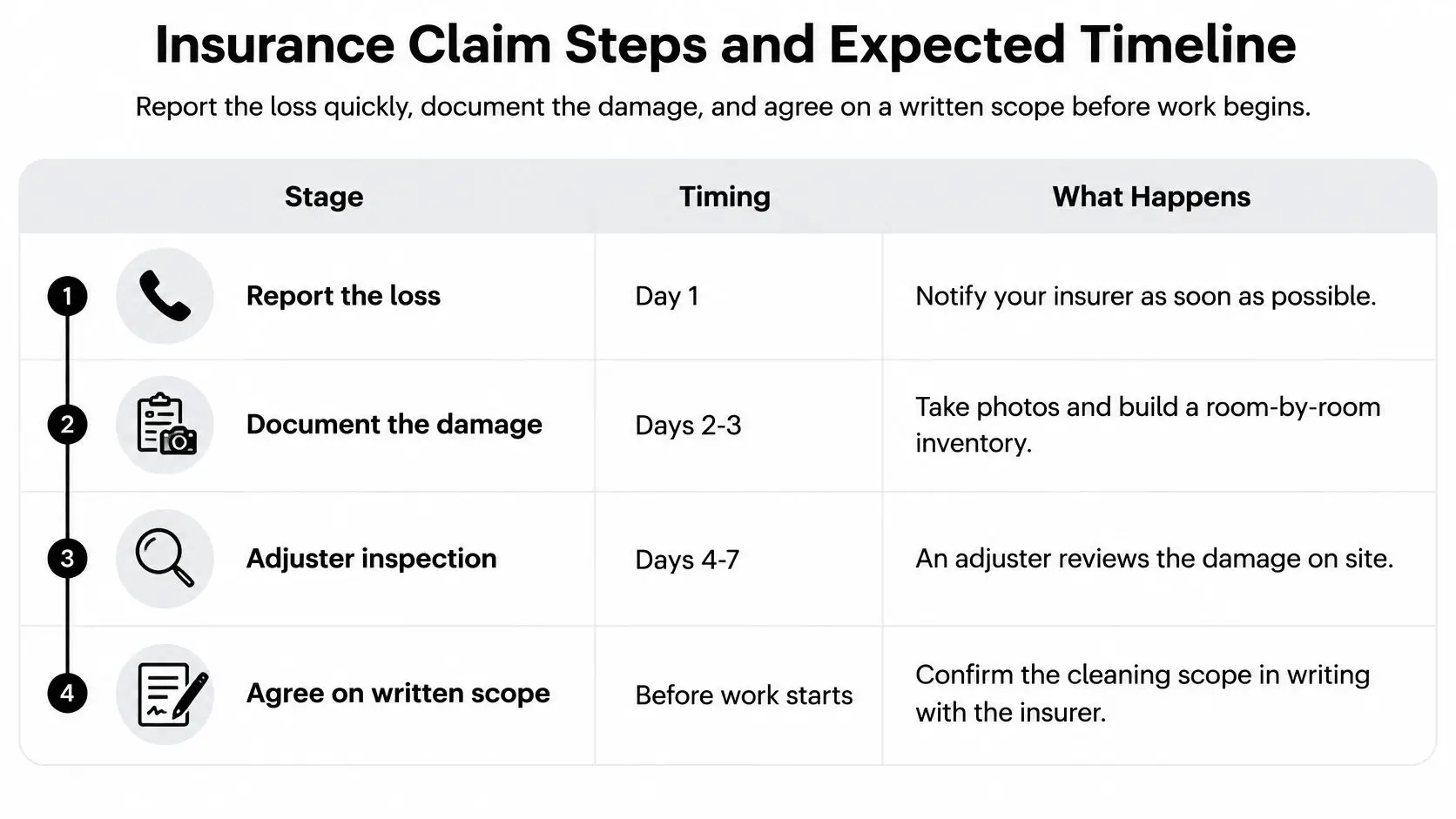
Report the loss promptly, document the condition and seek written agreement on the scope before nonemergency work begins. Ask your insurer how it wants urgent protective work handled so you don't confuse an emergency authorization with approval of the entire project.
The graphic shows a planning sequence, not insurer deadlines or promised appointments.
Typical phases and timing of a smoke cleanup
These are illustrative planning allowances, not measured averages or a committed schedule.
| Phase | Typical timing | What happens |
|---|---|---|
| Emergency call and onsite inspection | As access and scheduling permit | Photos, damage assessment and written scope outline |
| Board-up, ventilation and contents pack-out | Day 1 to 3 as a tentative planning allowance | Protects the structure and removes belongings |
| Soot and surface cleaning | Several days, depending on size | Dry removal first, then compatible wet cleaning |
| Odor treatment | Several days, sometimes repeated | Room-by-room checks and selected treatment |
| Contents cleaning | About 1 to 3 weeks as a provisional allowance, varies | Offsite cleaning of packed-out items |
| Repairs, repainting and final walkthrough | Weeks, depending on rebuild scope | Completion review and written sign-off |
Keep the claim and work records together
- Report the loss and record the claim number. Ask who your contact is and how to submit documents.
- Request an onsite inspection and written scope. Separate emergency measures from later cleaning and repairs.
- Send the scope and photographs to the adjuster. Ask for a clear written response identifying approved work and unresolved items.
- Retain invoices, receipts and messages. Keep revisions alongside the original estimate.
- Agree on hidden-damage procedures. Ask how discoveries during material removal will be photographed, priced and submitted.
- Check your deductible and policy terms. Don't assume the contractor's estimate equals the insurer's payment.
The fire-damage insurance claim guide offers a way to organize that conversation. Coverage depends on your policy; approval, payment and completion dates aren't guaranteed.
Phases can overlap, especially contents cleaning and building work. Ask for a written checkpoint at each handoff and a stated reason whenever the schedule changes.
Confirm the Scope Before Work Begins
Approve a scope you can read and check. A proposal that says only “smoke cleanup” leaves too much unresolved, especially when hidden materials and HVAC work could change the cost.
In 2025, professional fire and smoke restoration received its first publicly reviewed American National Standard, ANSI/IICRC S700, according to the IICRC's standards information. Its framework connects residue and odor assessment, buildings, contents, HVAC systems, work planning and documentation. That's a more useful basis for comparing contractors than a promise to make everything smell fresh.
Use a scope approval checklist
- Certification and qualifications: Ask whether the technicians hold relevant IICRC credentials and how the proposed work aligns with S700; a company credential and an individual technician's qualification aren't interchangeable questions.
- Defined work areas: Require named rooms, surfaces, HVAC components, contents and odor methods, with exclusions identified.
- Photo documentation: Confirm that the company records initial conditions, work progress and discoveries that could change the scope.
- Completion checks: Ask how several rooms and affected items will be evaluated, rather than accepting a single odor check near the entrance.
- Insurance coordination: Establish who submits estimates and revisions, and who remains responsible for approving work.
- After-hours communication: Get a contact method for access problems, equipment concerns and treatment restrictions.
- Pricing basis: Clarify whether charges are per room, per area, itemized or flat, and identify storage, disposal and repeat-treatment terms.
A useful estimate explains both what the contractor intends to do and what would justify changing the plan.
Verify company descriptions before signing
Among Phoenix-area options, Restore Heroes describes itself as licensed, bonded, insured and IICRC-certified, serving residential and commercial properties and offering onsite inspections and insurance coordination. Treat those descriptions as items to confirm, not substitutes for reviewing the actual proposal.
Request written confirmation of credentials, inspection terms and the services included in your job. Keep your photographs and receipts ready, then compare the proposed scope against this checklist before authorizing work. If a line item isn't clear, ask the contractor to explain the affected material, proposed method and expected limitation in plain language.
For Phoenix-area fire, soot and smoke cleanup, Restore Heroes offers assessment, surface and contents cleaning, odor treatment and insurance coordination. Request an onsite inspection, have your damage photos ready, and ask for a written scope that addresses hidden residue, HVAC decisions and belongings before you sign.