
You wake up in Phoenix, walk toward the kitchen, and realize last night's skunk smell hasn't stayed by the back door. The dog's been washed, but now the hallway and living room smell wrong, too. Before you spray another cleaner or pull up the carpet, separate the immediate cleanup from the building problem. They aren't always the same job.
Why Skunk Smell Lingers Indoors
Maybe your dog ran inside after being sprayed at the patio door. Maybe you noticed the odor near a crawl space, beneath a patio, or beside an air-conditioning return. Whatever the starting point, skunk odor removal is chemical decontamination, not just air freshening.
Research summarized in the Illinois skunk-scent publication identifies seven principal ingredients: three volatile thiols, three thioacetate derivatives, and one alkaloid, and reports that people can detect the musk at concentrations as low as 10 parts per billion. That helps explain why a small amount of residue can make the house feel overwhelmingly contaminated.
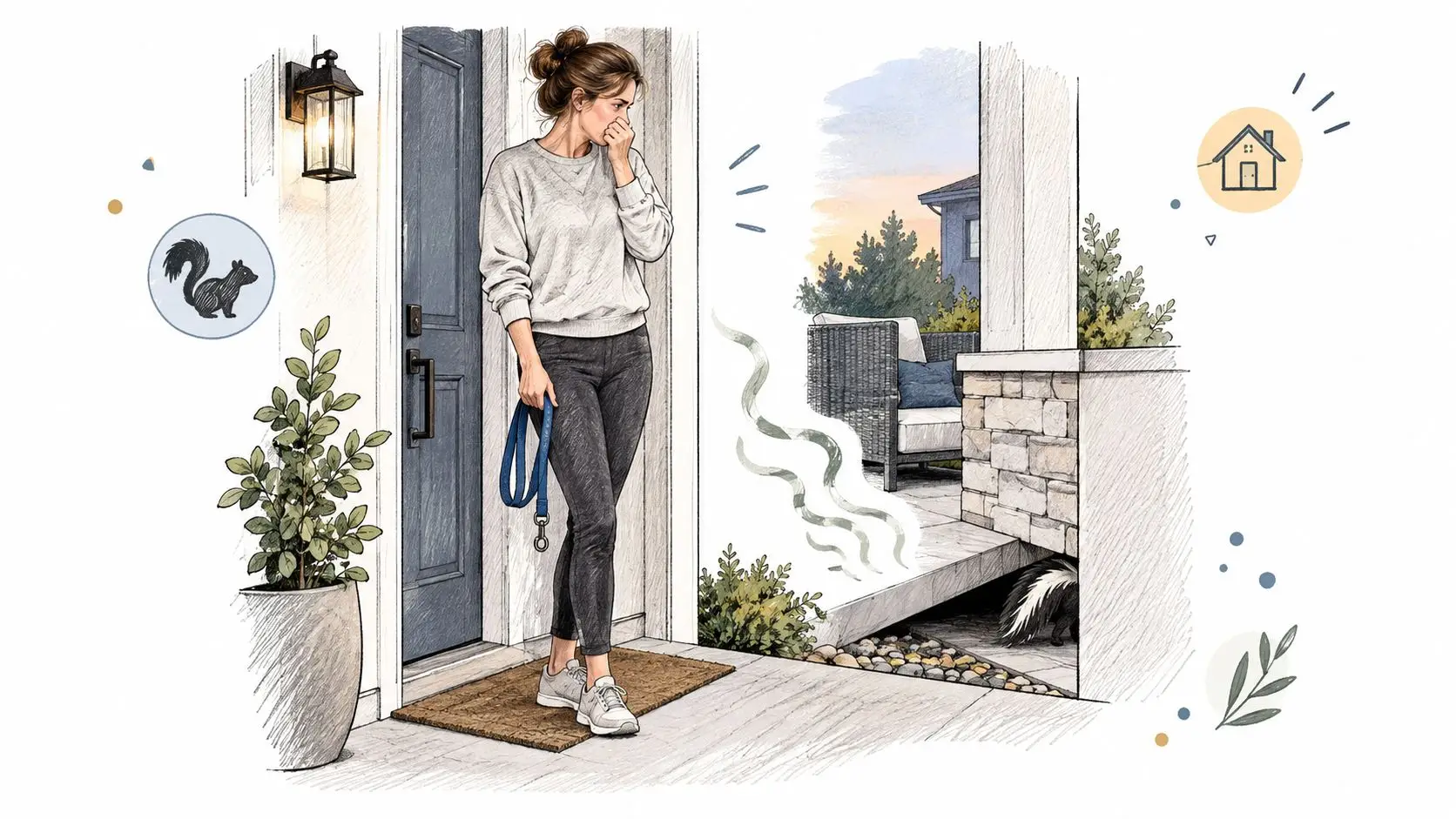
A clean-looking surface can still hold residue
Thiols produce the immediate, sharp smell. Thioacetates are less noticeable initially, but they can react with water and release more thiols later. That's why damp fur, carpet, wood, or insulation may smell again after you thought the cleanup was finished.
Think about the difference between wiping a tile threshold and treating the upholstered chair where a sprayed dog rubbed its coat. You can reach the tile's exposed surface. You can't assume the same wipe reaches residue inside upholstery, carpet backing, or another absorbent material.
A candle doesn't address either location. Neither does a pleasant-smelling spray establish that the oily contamination is gone.
Practical rule: Judge the cleanup by what happened to the contaminated material, not by what fragrance you smell afterward.
Follow the materials and the air path
Start with a simple distinction: what can you safely wash tonight, and what needs inspection? Clothing and removable bedding belong in the first group. Carpet padding, wall cavities, insulation, and suspect return-air pathways belong in the second.
In hot Phoenix weather, closed windows and air conditioning complicate that distinction because odor can move between rooms. A strong smell at a vent is a reason to investigate the air path, not proof that every duct needs replacement.
For broader background, this explanation of what removes odors is a useful companion to material-specific decisions. WipesBlog.com's discussion of tackling persistent smells in facility lobbies also offers context for thinking about persistent odors in shared indoor spaces, rather than treating every smell as a housekeeping issue.
Your immediate goal isn't to make the whole house smell perfumed. It's to keep the affected items separate, identify likely reservoirs, and recognize when a skunk odor removal service should map the building.
Immediate Skunk Odor First Aid at Home
Get people and pets away from the worst exposure before you start mixing anything. Choose a safe fresh-air location away from the animal. Don't chase the skunk, corner it near the door, or bring contaminated belongings through clean rooms.
Ventilate only when the outdoor source and airflow allow you to move odor out rather than push it farther inside. A wide-open patio door isn't helpful if the source is immediately outside it.
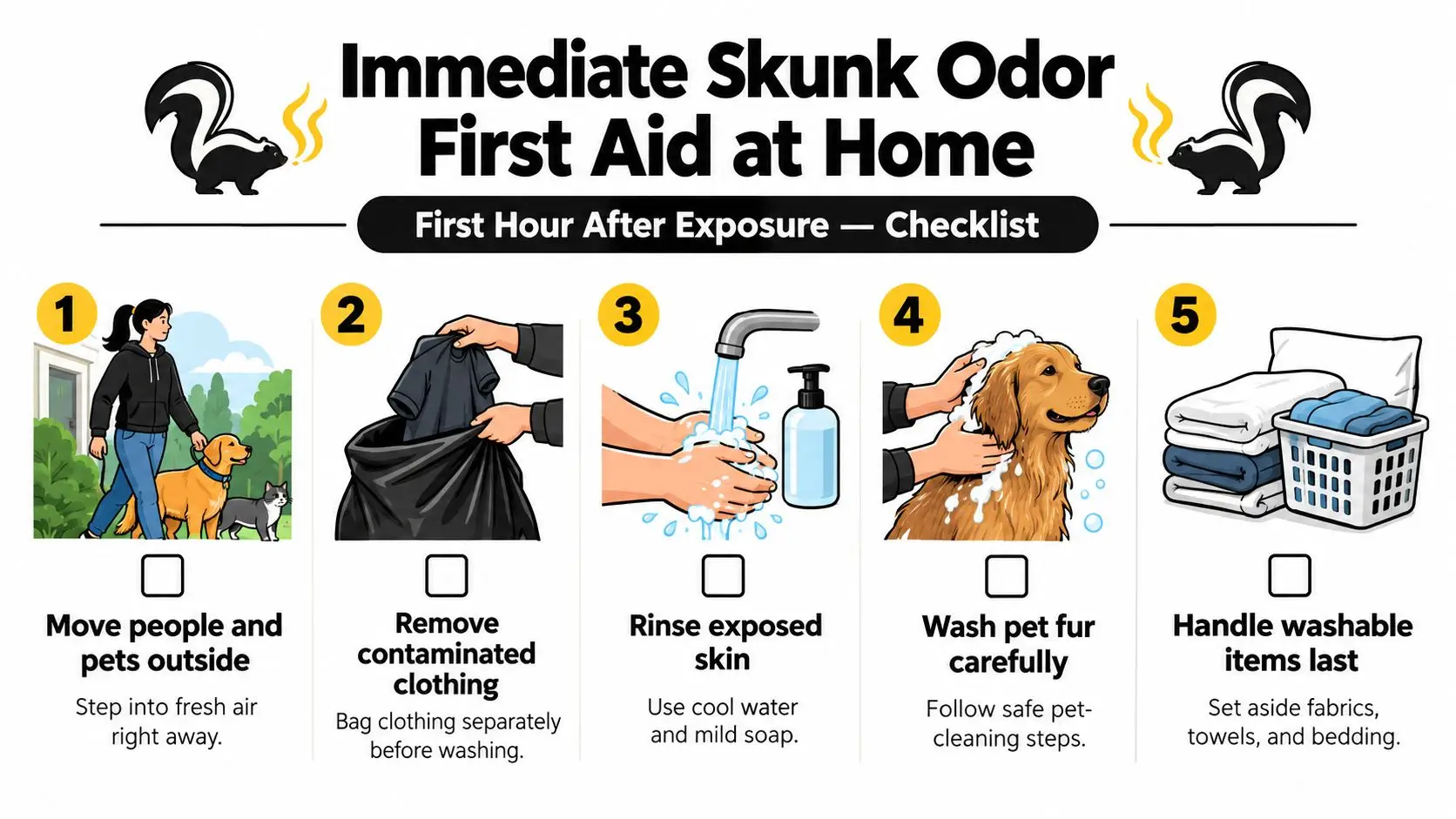
Separate exposure care from household cleaning
Keep the first tasks straightforward:
- Remove contaminated clothing. Set it apart from clean laundry before anyone sits on furniture.
- Rinse exposed skin gently. Use cool water and mild soap rather than treating a person like a contaminated floor.
- Protect eyes and faces. Keep cleaning mixtures away from eyes, mouths, and pets' faces. Ask a medical professional or veterinarian about persistent irritation or an unwell animal.
- Sort washable belongings. Separate towels, clothes, and removable bedding from cushions, rugs, and other items that can't be thoroughly washed.
Don't begin by soaking everything that smells. First decide whether the material can tolerate the treatment and whether you can rinse and dry it properly.
Mix only what you can use immediately
The University of Arizona Cooperative Extension skunk guidance gives this neutralizing mixture: 1 quart of 3% hydrogen peroxide, 1/4 cup of baking soda, and 1 teaspoon of liquid soap, mixed immediately before use and applied while bubbling.
Use fresh peroxide and an open container. Nebraska Extension's skunk-control guidance cautions against storing the gas-producing mixture, recommends testing fabrics for discoloration, and describes approximately five minutes of contact where appropriate, followed by thorough rinsing.
The peroxide oxidizes odor-producing thiols, baking soda supports the reaction, and soap helps wet and remove the oily secretion. That chemistry makes the mixture useful on compatible washable surfaces and animal fur. It doesn't make it suitable for every finish or every part of a building.
- Spot-test first. Peroxide can discolor fabrics and finishes.
- Keep it away from eyes. Don't pour it over a pet's head.
- Never add chlorine bleach or ammonia. Don't combine cleaning products to make the mixture “stronger.”
- Rinse thoroughly. Don't leave a chemical residue because you're worried the odor might return.
Arizona's guidance also mentions diluted vinegar, tomato juice, and masking products such as Neutroleum Alpha. Their inclusion isn't evidence that they perform the same chemical job or establish building cleanliness.
The broader distinction between surface cleanup and absorbed odor also matters when removing smoke smell from a house, although smoke and skunk contamination require different treatment choices. Tonight's washable-surface treatment still leaves a separate question: what happened inside carpet pad, insulation, wall cavities, and return-air paths?
When a Home Remedy Is Not Enough
A washable shirt and an upholstered sofa don't present the same cleanup problem. Neither does a sprayed dog outside versus a strong odor that appears throughout the house when the cooling system starts. Choose the next move by the contaminated material and its location, not just the strength of the smell.
Colorado State University Extension's guidance on coping with skunks identifies eye and nasal irritation, nausea, and breathing difficulty for people with asthma as possible effects of musk exposure. It also supports source removal, ventilation, and treatment of affected fabrics, rather than assuming a pet wash finishes an indoor incident.
Outdoor Spray Versus Indoor Contamination
| Situation | What to Inspect | Sensible Next Move |
|---|---|---|
| Pet or clothing only | Fur, clothing, towels, and anything touched afterward | Use appropriate washing methods, then keep items separate while drying |
| Smell at a door or patio | Threshold, nearby finishes, entry point, and exterior source | Address the source safely and clean compatible exposed surfaces |
| Odor in carpet, upholstery, or drapes | Carpet backing, padding, cushions, removable covers, and fabric layers | Assess whether thorough cleaning is possible or removal may be necessary |
| Crawl space, attic, or wall cavity | Access points, insulation, adjacent assemblies, and hidden residue | Arrange a contamination-focused inspection rather than blindly spraying |
| Odor spreads when a return or supply operates | Filters, return pathways, nearby contaminated materials, and connected spaces | Have the air pathway assessed before assuming the equipment alone is responsible |
The table isn't a demolition order. A suspicious smell tells you where to inspect; it doesn't automatically tell you what to discard. Ask for a material-specific explanation before authorizing removal.
Make an occupancy decision separately
Children, pets, and anyone with asthma shouldn't stay in a heavily affected room while strong odor treatment is underway. Don't use someone's ability to tolerate the smell as a safety test, and don't keep occupants inside a space where ozone is being applied.
A tolerable room isn't necessarily a cleaned room. A freshly scented room isn't proof of decontamination either.
Phoenix heat makes temporary relocation and ventilation harder. Don't trade heavy exposure for unsafe outdoor heat; choose a suitable clean indoor location when necessary. Likewise, don't rely on the air conditioner to solve an odor problem that appears connected to its return path.
My recommendation is to make a short written inventory before calling: the likely entry point, affected rooms, absorbent contents, and where airflow seems to spread the smell. Then request an odor removal service assessment that addresses those locations specifically.
If the problem remains confined to washable belongings, finish that targeted work. If hidden materials or air pathways are involved, another bottle of dish soap won't answer the building question.
How Professional Skunk Odor Removal Works
A good skunk odor removal service starts with inspection, not a fogger. The technician should explain where the contamination appears to be, which materials are affected, and how each treatment decision will be checked afterward.
The process below shows the difference between applying a deodorizer and managing a building-contamination problem.
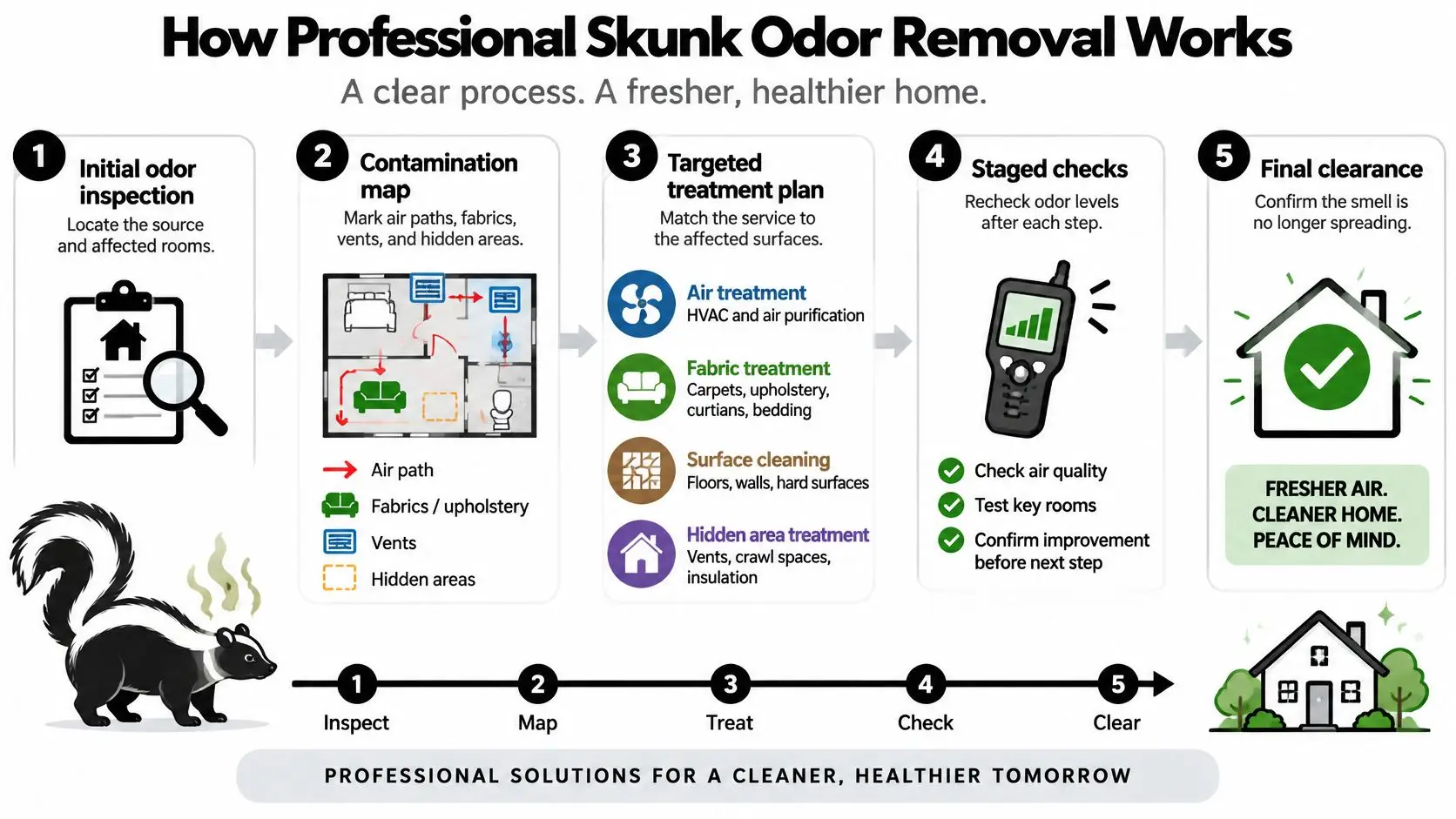
Inspection determines the scope
The LMCCA skunk deodorization guide supports a contamination map and staged verification. Inspection should include the exterior entry point, attic or crawl space where relevant, wall and floor assemblies, furnishings, textiles, and HVAC returns.
That map should lead to decisions you can understand:
- Clean recoverable materials. Match the method to the actual surface and the depth of contamination.
- Remove material that can't be reliably decontaminated. Ask why cleaning isn't suitable before approving disposal.
- Treat accessible, cleaned surfaces. Use compatible oxidizing or neutralizing products with controlled contact time.
- Protect vulnerable assemblies. Don't indiscriminately saturate gypsum board, insulation, electrical equipment, or finished wood.
Routine housekeeping remains a separate task. For example, Clean Space SA's house cleaning for Leon Valley homes is a useful reference when considering ordinary residential cleaning, but a persistent skunk incident needs an explicit contamination scope. A clean countertop doesn't answer what remains beneath a floor or inside a cushion.
Equipment is a choice, not the plan
Ask what a proposed machine or product is supposed to reach. If someone recommends thermal fogging for odor removal, request an explanation of material compatibility, preparation, occupancy restrictions, and how success will be evaluated. Don't accept equipment names as a substitute for a written treatment rationale.
Ozone deserves particular caution. For persistent odor in movable contents, a controlled chamber may be preferable to treating an occupied building. Effective treatment concentrations can exceed safe occupancy levels, and ozone can damage rubber, plastics, and fabrics.
The video below provides additional restoration context; your property still needs its own inspection and scope.
Verification is part of the work
The LMCCA guidance calls for ventilation and an independent odor judgment under normal temperature and humidity before occupancy resumes. A credible completion check includes dried materials and normal HVAC operation, not just the moment immediately after treatment.
Credible sources don't establish a universal success percentage. Material depth, access, and residual reservoirs differ, so a contractor shouldn't turn a general method into a guaranteed result.
Ask before authorizing work: “What evidence will you use to decide the treatment is finished?”
A useful answer describes repeatable checks and what happens if odor remains. It doesn't stop at “we'll spray everything.”
Practical Tips Before You Book Help
Give the crew a clear starting point and avoid making the scope larger while you wait. You don't need to identify every chemical or take apart the air handler. You do need to keep suspect belongings organized and stop experimenting with overlapping products.
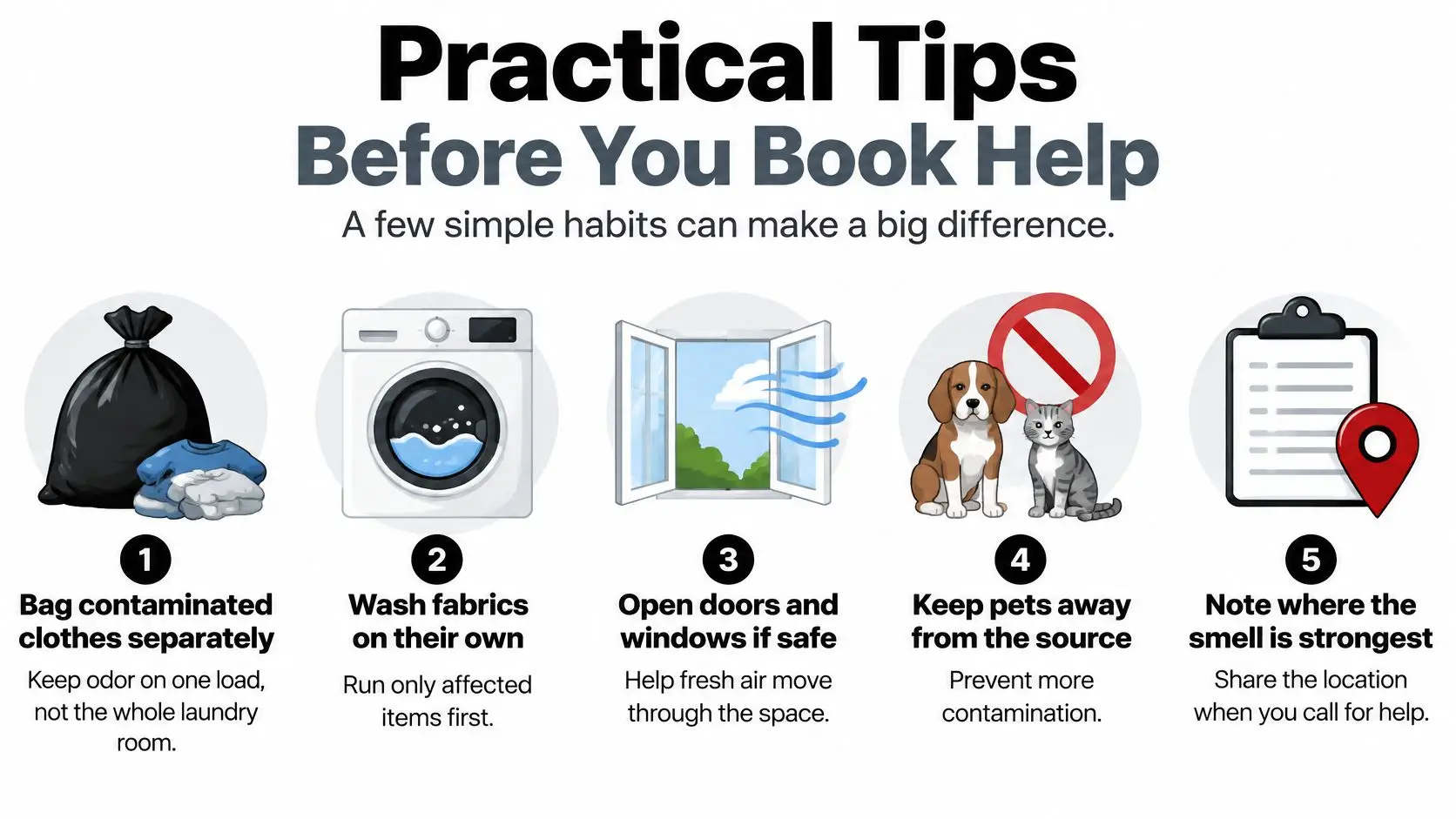
Keep cleanup material-specific
Penn State Extension's skunk guidance recommends laundry detergent with 1/2 cup of baking soda for clothing and describes vinegar or baking-soda solutions for sprayed structural areas, along with fan-assisted ventilation. Treat those as separate applications, not permission to pour a laundry treatment onto walls or saturate flooring.
Use these habits while arranging help:
- Keep affected laundry together. Bag contaminated clothing separately and wash it apart from ordinary household loads.
- Check the surface before washing. A washable hard finish and unfinished absorbent wood need different decisions.
- Aim fans toward a safe exit. Don't point them through contaminated rooms into clean living areas.
- Flag suspect filters. Tell the technician which filter was in place during the incident and whether odor is strongest nearby.
- Keep pets away from damp carpet. Don't let a recently washed animal return immediately to a questionable rug or sofa.
The moisture-related rebound described earlier is a reason to avoid declaring victory while materials are still wet. It's also a reason not to repeatedly soak carpet without knowing what's happening underneath.
Record observations instead of guessing
Write down where the smell is strongest in the morning, around midday, and when the air conditioner starts. Note whether the room was closed, recently washed, or operating under different indoor conditions. Those observations are more useful than saying the smell is everywhere.
For a wider household checklist, this guide to odor removal in a house can help organize the discussion. Keep your notes specific to this incident rather than assuming every household odor treatment applies.
Ask these questions before accepting a scope:
- What will be cleaned? Request the actual rooms, contents, surfaces, and air pathways.
- What may need removal? Ask what finding would justify that decision.
- Who must leave during treatment? Include children, pets, and people with respiratory concerns.
- How will you recheck the odor? Get the completion criteria in writing.
Don't accept a fixed completion time based only on a phone description. Multi-stage work may be necessary because materials absorb contamination differently.
Published extension guidance doesn't set a service price, visit count, or insurance outcome. Get job-specific figures after an onsite assessment of materials and access, and confirm policy questions with the insurer. Fragrance cover-ups and occupied-space ozone aren't substitutes for that assessment.
What to Do Next After a Skunk Spray
Make the next decision about scope, not about buying a stronger scent. If the contamination is limited to a pet or washable fabric, finish the appropriate fresh wash, rinse thoroughly, and keep those items separate while they dry. Don't return them to questionable furniture just because the first cleaning helped.
If you suspect carpet pad, difficult-to-clean upholstery, insulation, a crawl space, or the air handler, stop adding products and arrange an inspection. You're no longer deciding only how to wash an item. You're deciding which parts of the building need access, cleaning, or possible removal.
Prepare a useful handoff
Before the appointment, gather the information a technician can act on:
- Mark the likely entry point. Identify the door, exterior area, or suspected opening without approaching the animal.
- List affected rooms and contents. Include belongings that were moved after the incident.
- Name every product already used. Show the labels when possible, including cleaners applied by different household members.
- Explain airflow observations. Describe what changes when the cooling system starts rather than diagnosing the ducts yourself.
- Keep the worst area separated. Keep children and pets away until you have a suitable plan for treatment and occupancy.
For a rental home or small commercial property, share that same record with the responsible property manager. It helps everyone discuss the same locations and avoid duplicated cleaning or conflicting treatment choices.
Agree on the finish line
Ask the crew to distinguish between a noticeable improvement and completed remediation. The meaningful question is whether the treated materials and connected spaces remain acceptable after the checks described earlier, not whether the crew has finished running a machine.
You should also know whom to contact if odor returns and what a follow-up assessment would involve. That conversation belongs before authorization, alongside access arrangements, payment terms, and any insurance coordination.
A free inspection or around-the-clock availability doesn't establish coverage, a final price, or an odor-free result. It gives you a way to replace guesswork with a property-specific assessment.
Tonight, keep the work narrow and deliberate. Protect people, separate contaminated belongings, and avoid turning an isolated problem into a whole-house cleaning experiment.
Restore Heroes offers free onsite inspections, odor-removal assessment, and restoration support across the Phoenix metro, with 24/7 availability and insurance coordination when a claim applies. Visit Restore Heroes to request an inspection and describe the entry point, affected materials, and any odor that changes when your air conditioning runs. Ask for a material-specific scope and clear recheck criteria before approving treatment.