
You open the front door and catch the same smoky smell you noticed yesterday. The walls look clean, the windows have been open, and you've already tried candles and cleaning products. Before buying another deodorizer, it helps to understand what a professional odor removal service should investigate, treat, and document.
Walking Into a Home That Still Smells Like Smoke
You've washed the curtains, wiped the cabinets, and scrubbed every surface you can reach. For a while, the house seems better. Then you close the windows, leave for an errand, and return to that familiar smell.
That doesn't automatically mean you cleaned badly. It means the visible surfaces may not represent the whole problem.
After a fire, the useful question isn't, “What product removes smoke smell?” It's, “Where did the contamination go, and what remains?” Understanding the potential scope of smoke damage to a house helps you describe the problem beyond the room where the fire started.
Treat the smell as a clue
Think of an odor as a warning light on a dashboard. Covering the light doesn't explain why it came on. Likewise, making a room smell pleasant doesn't establish that the underlying condition has been corrected.
The EPA identifies source control as the most effective indoor-air strategy, alongside ventilation and air cleaning. For restoration work, that means addressing the material or condition producing the odor before relying on equipment to improve the air, as explained in its residential air-cleaner guidance.
Practical rule: Ask what the contractor intends to remove or clean, not just what they intend to spray.
Before an assessment, write down what you've noticed:
- Location: Identify where the smell is strongest, including closets and rooms away from the original damage.
- Timing: Note whether it returns after windows close or the heating or cooling system runs.
- Previous work: List cleaning products, painting, material removal, and deodorizing treatments already attempted.
These observations aren't a diagnosis. They give the technician a starting point and help prevent another round of treatment based only on the smell at the front door.
What an Odor Removal Service Actually Does
A professional odor removal service should connect source identification, treatment, and verification. Think of it as a diagnostic appointment rather than a visit to a perfume counter: the provider needs to understand the condition before selecting a remedy.
That distinction matters because indoor air can contain more than the compounds you happen to smell. EPA's Total Exposure Assessment Methodology studies found about a dozen common organic pollutants at 2 to 5 times higher levels indoors than outdoors, regardless of whether homes were rural or highly industrialized; indoor VOC concentrations can reach up to 10 times outdoor levels, according to its indoor-air-quality overview.
The basic service framework looks like this:
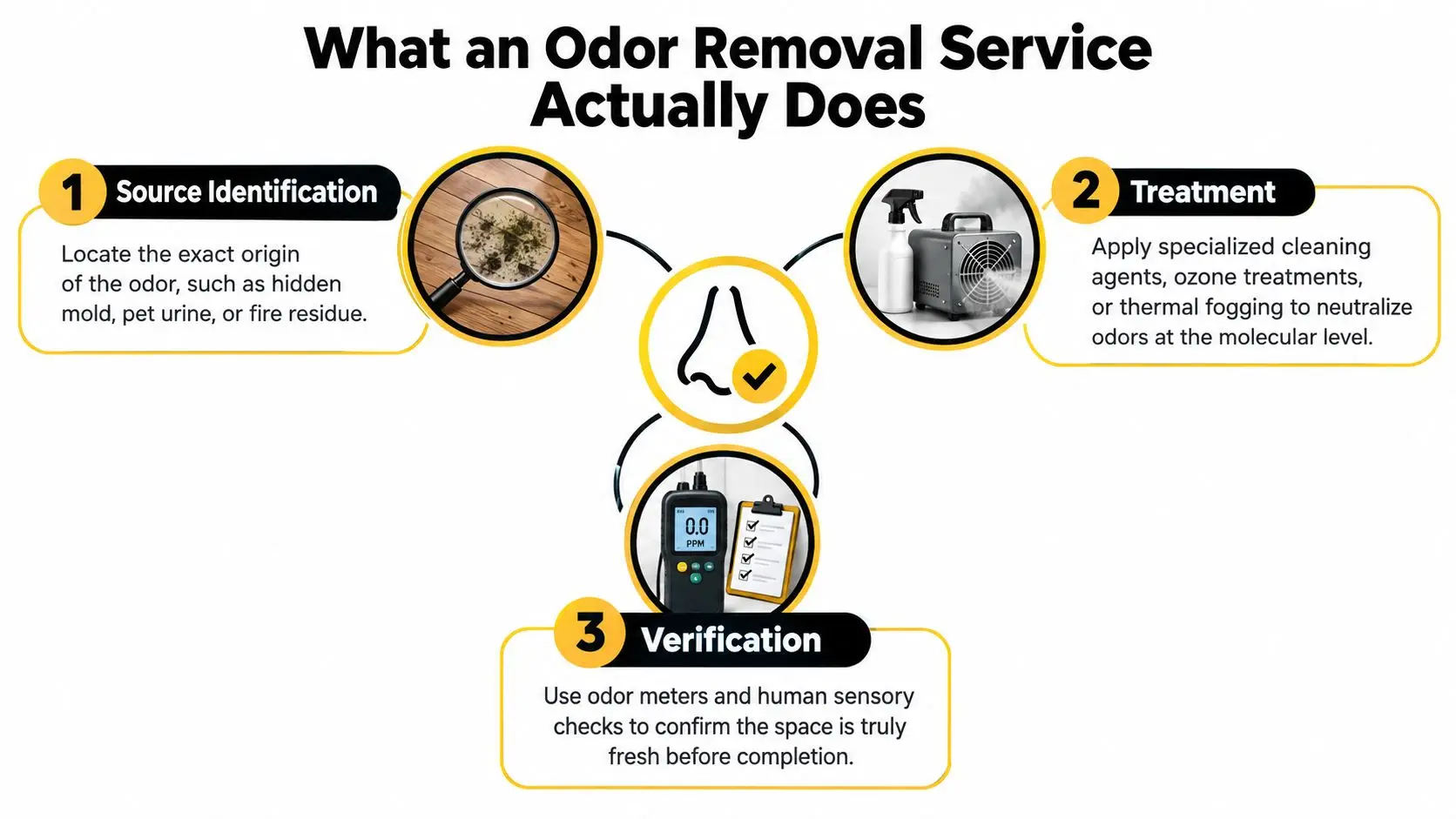
Diagnosis before deodorization
Source identification asks what caused the odor, which materials were affected, and whether the original problem is still active. A wet wall, contaminated carpet, and smoke-affected cabinet shouldn't receive an identical treatment plan.
Treatment addresses those findings. The written scope should distinguish material removal, cleaning, drying, ventilation, and air treatment rather than grouping everything under “deodorizing.”
Verification checks whether the agreed work addressed the identified problem. That can include inspecting cleaned surfaces, reviewing moisture conditions, checking affected contents, and investigating returning odors.
What “fresh” does and doesn't mean
Deodorization changes the odor condition. Remediation addresses the contamination or moisture condition responsible for it. The terms can overlap, but they aren't interchangeable.
If a pipe is leaking under your sink, mopping the floor helps only temporarily unless someone stops the leak. A fragrance-only response to unresolved contamination has the same limitation.
The infographic is a process overview, not a recommendation for every device it depicts. Neither a pleasant smell nor a single sensor reading establishes that every possible contaminant is absent. Ask what the provider will verify, what the equipment can measure, and which limitations will appear in the completion report.
Where Persistent Odors Come From
A smoky sofa, a musty wall, and a sewage-affected carpet can all smell unpleasant, but they raise different restoration questions. Sorting the problem by source and affected material is more useful than choosing a product labeled “heavy-duty odor remover.”
Porous contents are like sponges. What matters isn't only what landed on the outside, but what the material absorbed and whether a technician can clean and dry it completely.
Different sources need different investigations
- Smoke residues: Examine both building materials and belongings. A cleaned room can still contain affected upholstery, insulation, or other porous contents.
- Sewage and biological contamination: Establish where contamination traveled and what it contacted. This guide to addressing sewage smells provides context, but deodorizing shouldn't substitute for contamination cleanup.
- Musty odors: Investigate moisture rather than treating the smell as an isolated nuisance.
- Pet and cooking odors: Ask whether the concern is a cleanable surface deposit or a deeper contents or flooring problem.
- Renovation-related chemical odors: Identify the materials and products involved before selecting ventilation or filtration.
For mold concerns, the EPA explains that a musty smell may indicate active growth and recommends investigating the building and correcting moisture in its guidance on what mold smells like. Smell is a reason to investigate, not a reliable way to identify a specific organism or determine exposure.
Decide what can realistically be saved
The CDC advises removing items that have remained wet for more than 48 hours and can't be thoroughly cleaned and dried because they may remain a mold-growth source. Its post-disaster cleanup guidance includes carpet, padding, upholstered furniture, drywall, and insulation.
That's a conditional decision, not an instruction to discard every item exposed to water. Moisture history, material condition, and the feasibility of complete cleaning and drying matter.
A hard cabinet face and the absorbent backing behind it may therefore require different decisions. Before approving deodorization, ask which affected materials the contractor considers salvageable and why.
How Professionals Trace the Source
Consider a fire that began in the kitchen, followed by complaints about smoke odor in a bedroom. A useful inspection doesn't stop at the stove or assume the bedroom needs fragrance. The technician should investigate how the affected area connects to the rest of the building.
The IICRC S700 standard describes assessment of the presence, intensity, impact, and boundaries of fire residues and odors affecting buildings, HVAC systems, and contents. It also addresses restoration cleaning and fire-odor management, according to the IICRC's description of S700.
An inspection should connect visible damage with possible hidden conditions.
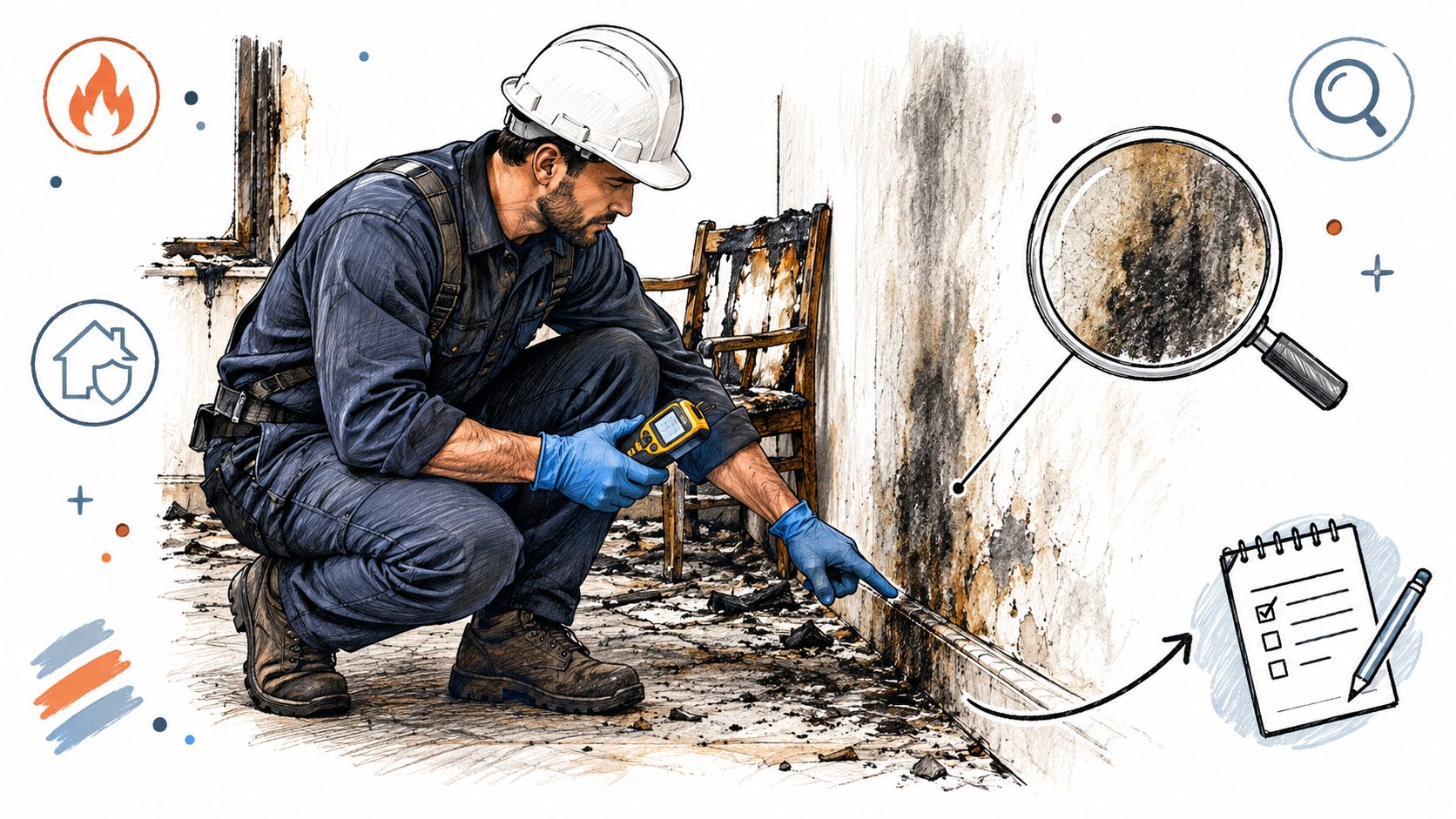
Follow the evidence beyond the obvious room
In this kitchen-fire example, sensible assessment questions include:
- Building surfaces: Are there residue patterns near outlets, returns, adjoining rooms, or accessible cavities?
- HVAC components: What evidence supports including or excluding the air-distribution system from the work?
- Contents: Which rugs, furnishings, and stored belongings need separate evaluation?
- Moisture: Did firefighting water or another leak affect walls, flooring, or concealed materials?
- Hidden areas: Is there evidence that justifies examining subflooring or insulation?
A moisture meter answers a moisture question. It doesn't identify every odor-producing compound. Likewise, a surface inspection can guide the scope without proving that every concealed area is unaffected.
Ask what testing would change
Discuss air-quality testing in terms of a specific question: what will be measured, why is that measurement appropriate, and how will the result affect the plan?
A useful inspection ends with a reasoned scope, not simply a recommendation to run a machine.
Before work starts, request a written explanation of confirmed findings, suspected conditions, access limitations, and any additional investigation that may be necessary. Ask whether the onsite assessment carries a fee rather than assuming every provider offers it free.
That distinction helps you compare proposals fairly. A low-detail estimate and an evidence-based restoration scope aren't necessarily offering the same job.
Inside the Remediation Process
Once the inspection defines the affected materials, the work should follow a logical sequence. Equipment supports that sequence; it shouldn't replace it.
This overview shows the main phases, although the treatments depicted aren't appropriate for every property.
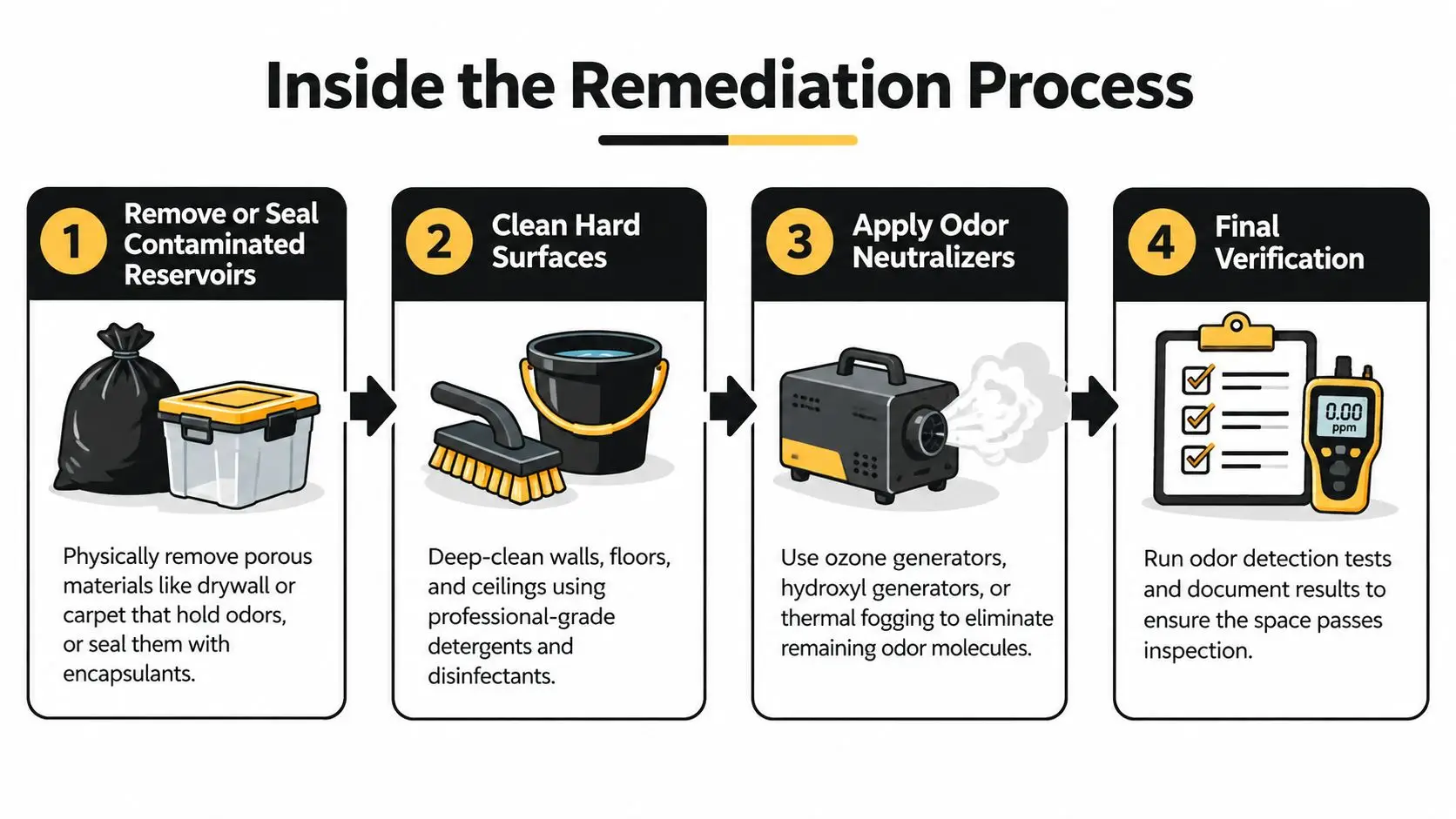
Remove reservoirs and clean remaining materials
The first decision is what to remove, what to clean, and whether any retained material is suitable for a specified sealing treatment. Sealing isn't permission to bury unresolved moisture or contamination.
The CDC states that mold remediation requires physical removal, not merely disinfecting contaminated surfaces. Its disaster-reopening guidance also identifies difficult-to-clean, incompletely dried, or persistently odorous porous materials as potential discard candidates.
Next comes cleaning of retained surfaces and contents. Ask the contractor to identify the cleaning method for each material, including any HVAC work supported by the inspection.
Match air treatment to the pollutant
A HEPA air scrubber belongs on the particle-control side of the plan. It shouldn't be presented as a substitute for gas-phase treatment.
Activated carbon works more like a sponge for certain airborne contaminants. EPA notes that thicker carbon media generally improve gas removal, particle-only filters don't control gases or many odors, and breakthrough can occur rapidly for some low-concentration odorants, including tobacco-smoke compounds, in its guide to home air cleaners.
For equipment terminology, the following video provides additional visual context.
Thermal fogging is an application method for a treatment product, not a way to extract contaminated building materials. If a proposal includes a hydroxyl generator, request the intended purpose, operating conditions, and safety documentation rather than accepting a blanket “safe and effective” claim.
Verify beyond equipment operation
- Before shutdown: Inspect the completed cleaning and review unresolved findings.
- After treatment: Check whether improvement persists without continuous air treatment.
- At handover: Record remaining limitations, follow-up needs, and the conditions used to judge completion.
Verification should describe what was observed and measured, not promise that one machine eliminated every possible contaminant.
Choosing the Right Treatment Method
The right method depends on what needs correction. A smoke-affected furnishing, wet wall cavity, and renovation-related chemical odor shouldn't receive the same equipment package because each smells bad.
Use this comparison to question a proposal, not to prescribe treatment without an inspection.
Matching Treatment Methods to Common Odor Scenarios
| Odor Source | Recommended Approach | Use with Caution | Generally Avoid |
|---|---|---|---|
| Smoke | Assess residues and contents, clean or remove affected reservoirs, then consider carbon filtration | Fogging or oxidizing treatments with a documented purpose and controls | Fragrance-only treatment or particle filtration presented as complete gas control |
| Mold or mustiness | Correct moisture and physically remove contamination | Sealing retained materials after appropriate evaluation | Disinfecting or deodorizing without addressing growth |
| Sewage | Evaluate contamination boundaries and material salvageability | Supplemental air treatment after cleanup | Treating reduced smell as proof of decontamination |
| Chemical or renovation odors | Identify the emitting source and plan suitable ventilation or gas filtration | Products or treatments that introduce additional chemicals | Assuming a weaker odor means exposure has ended |
Ozone deserves particular scrutiny. EPA states that at concentrations not exceeding public-health standards, ozone has little ability to remove most indoor contaminants; higher concentrations can create health risks, and apparent odor improvement may reflect impaired smell rather than removal, as described in its technical guidance on indoor volatile organic compounds.
That makes ozone unsuitable as a routine occupied-space default. Any proposed specialized oxidizing treatment needs a documented risk assessment, occupant exclusion, and post-treatment ventilation and verification.
Compare the controls, not the sales language
For thermal fogging odor removal, ask which product will be applied, which materials it targets, and what re-entry instructions apply. For hydroxyl equipment, request the same level of specificity.
Contractor red flag: A device name isn't a diagnosis, and “works on every odor” isn't a treatment rationale.
A defensible proposal explains why a method fits the findings, what it cannot accomplish, and how the contractor will judge the result. Be cautious when the explanation centers on machine size or treatment strength but says little about the affected materials.
Timeline, Costs, and Insurance Realities
You need to know when you can use the property again and what the work may cost. A responsible estimate ties those answers to inspection findings rather than offering a universal deodorizing deadline.
Emergency assessment, material removal, structural drying, cleaning, air treatment, and verification have different completion conditions. Ask which tasks can overlap and which must wait for an earlier condition to be resolved.
Request milestones instead of a single finish date
- Assessment: When will the contractor provide the initial scope, and what remains inaccessible?
- Drying and cleaning: What observations or measurements determine readiness for the next phase?
- Air treatment: What determines equipment runtime and filter replacement?
- Verification: When will the team reassess conditions after treatment stops?
A promising result while equipment is running may not be the final result. Field research on smoke-impacted homes documents the importance of indoor reservoirs that continue releasing compounds after temporary air improvements.
Separate the restoration estimate from coverage
Costs depend on the documented scope: demolition, contents handling, cleaning access, HVAC involvement, equipment operation, disposal, reconstruction, and follow-up assessment. Request those categories in writing, along with the process for approving additional work.
Insurance is a separate determination. If the odor followed fire, smoke, water damage, or sewer backup, ask your insurer whether the event and proposed work fall within your policy's coverage and limitations.
Don't interpret a contractor's willingness to work with insurers as approval of your claim. Preserve photographs, invoices, inspection findings, and written communications, and ask the adjuster what documentation is needed before non-emergency work proceeds.
Why Certification and Documentation Matter
Certification is a useful credential, not a substitute for checking the actual proposal. Ask whether the provider's training fits your loss and how the responsible technician will apply relevant assessment procedures.
The comparison below highlights questions worth asking, but it shouldn't be read as a blanket judgment about cleaning companies or a promise attached to certification.
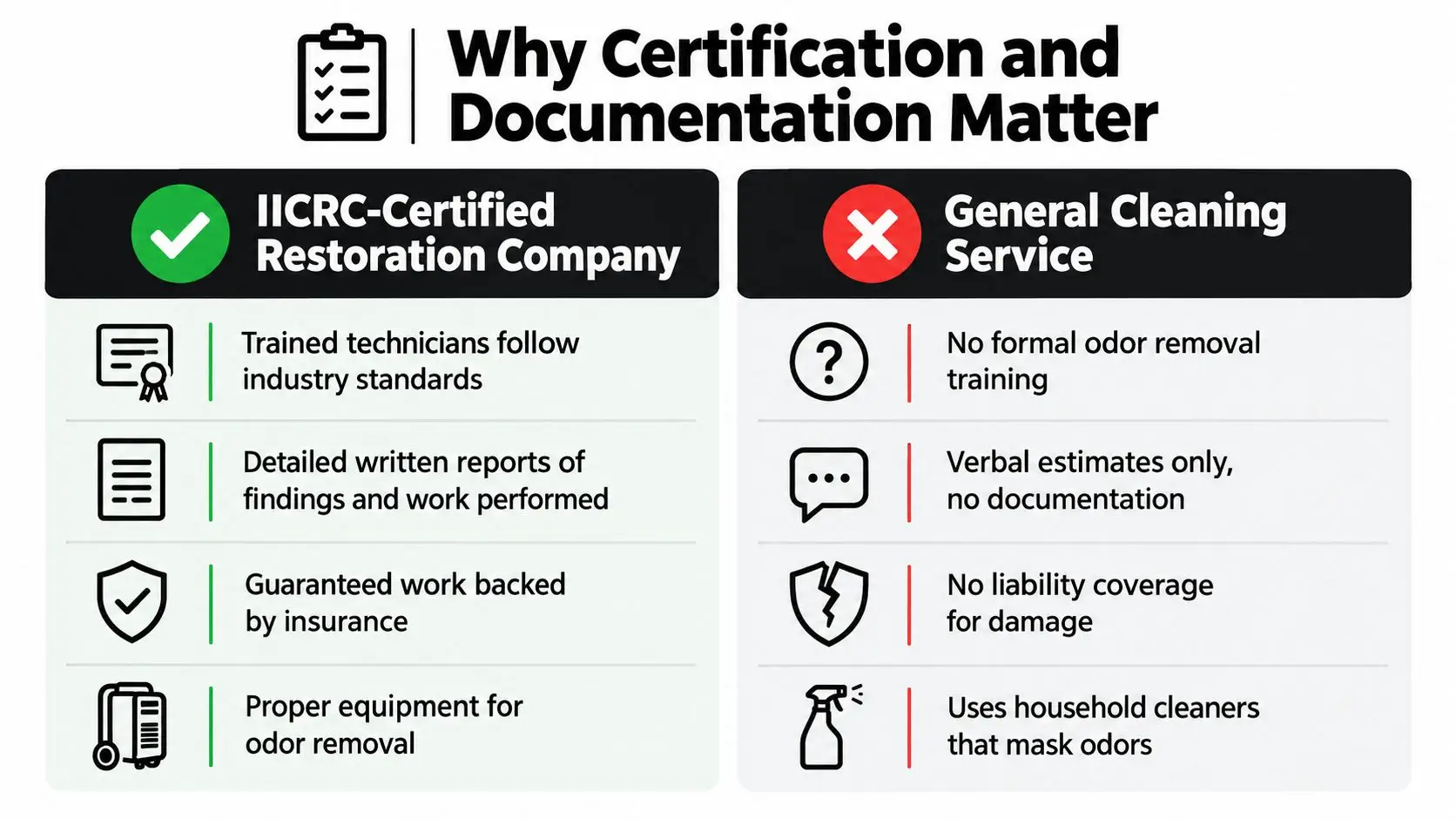
Check the evidence behind the credentials
A general cleaner may have training, insurance, and strong documentation. Conversely, a certification logo alone doesn't establish the completeness of a particular odor-removal plan.
For background on evaluating procedures, Estimatty's cleaning industry standards guide is a useful companion resource. For your project file, review these restoration documentation requirements and request photographs, moisture records where relevant, a written scope, and completion notes.
Decide what to do next
- Seek assessment promptly: There's unresolved wet material, suspected contamination, or a persistent post-disaster odor.
- Document while arranging help: Record affected rooms, previous treatments, and when the odor returns.
- Escalate unresolved work: Ask the contractor and adjuster to review returning odors against the original scope.
- Verify business terms: Ask about emergency availability, inspection fees, deposits, insurance coordination, and written warranty terms.
Policies described as no-upfront-payment, all-insurance acceptance, or satisfaction guarantees need careful reading. None independently proves remediation quality or establishes what your insurer will pay.
The strongest completion record explains what was found, what was done, and what remains uncertain. That gives you something more useful than an assurance that the house smells better.
For Phoenix-area properties, Restore Heroes offers odor removal within fire and smoke restoration, water-damage remediation, mold removal, and biohazard cleanup. Contact the team to discuss an onsite assessment, identify the likely source of the odor, and request a written scope covering treatment and verification.