
National budgeting benchmarks for odor removal are about $200 to $1,200 per affected room for smoke-related work and $200 to $600 for whole-home deodorizing. The final price depends on the odor source and the scope found at inspection.
But what are you paying to remove, the smell in the room or the material that keeps producing it? That distinction matters more than the strength of the odor. A treatment that briefly freshens the air can become an expensive detour if the underlying problem is soaked carpet padding, smoke-contaminated contents, or a hidden leak.
Odor Removal Costs at a Glance
Odor removal isn't a single service. Consumer cost guides provide national planning benchmarks, not quotes for a particular property, and a deodorizing charge isn't necessarily a complete restoration bill.
For room-level smoke work, Angi reports $200–$1,200 per room and approximately $200–$400 for ozone smoke removal in 2026. The table separates those treatment categories so you can recognize what a contractor is really pricing.
Typical national benchmarks for odor removal services
| Service | National benchmark | What it usually includes |
|---|---|---|
| Single affected room (smoke) | $200–$1,200 per room | Surface cleaning and deodorizing in one room |
| Whole-home deodorizing | $200–$600 | Air and surface deodorizing across the home |
| Furniture or textile deodorizing | $200–$1,000 | Upholstery, drapes, bedding, and other fabric items |
| Ozone treatment (sealed, unoccupied space only) | $200–$400 in one consumer guide; $400–$800 in another | Oxidizing treatment with occupants out and ventilation before reentry |
| Passenger vehicle smoke odor, basic | $250–$400 (2025) | Basic deodorizing; comprehensive treatment of heavily contaminated commercial vehicles runs $800–$1,500 |
| Phoenix local range | Inspection-based estimate; no verified local figure | Set after an on-site inspection |
The household benchmarks distinguish room cleaning, whole-home deodorizing, contents, and equipment treatments. Don't add them together automatically, because a contractor may bundle some tasks while excluding others.
For the vehicle comparison, MarketIntelo reported basic passenger-vehicle smoke treatments at $250–$400 in 2025 and comprehensive work on heavily contaminated commercial vehicles at $800–$1,500. Those are different vehicle types and scopes, not interchangeable packages.
Read the scope before the range
The whole-home row may look surprisingly low beside a room-level smoke-cleaning row. That's because deodorizing a home isn't the same as cleaning fire residue throughout it.
Ventilation work is another separate category. For readers comparing ventilation improvements abroad, Trickle Vent Installation Costa Blanca pricing is a resource for that service, not a Phoenix odor-remediation benchmark.
A lower-end estimate generally fits a contained problem with little material involvement. Structure, contents, and ductwork are the details that can move a project beyond basic deodorizing.
What Changes the Price of Odor Removal
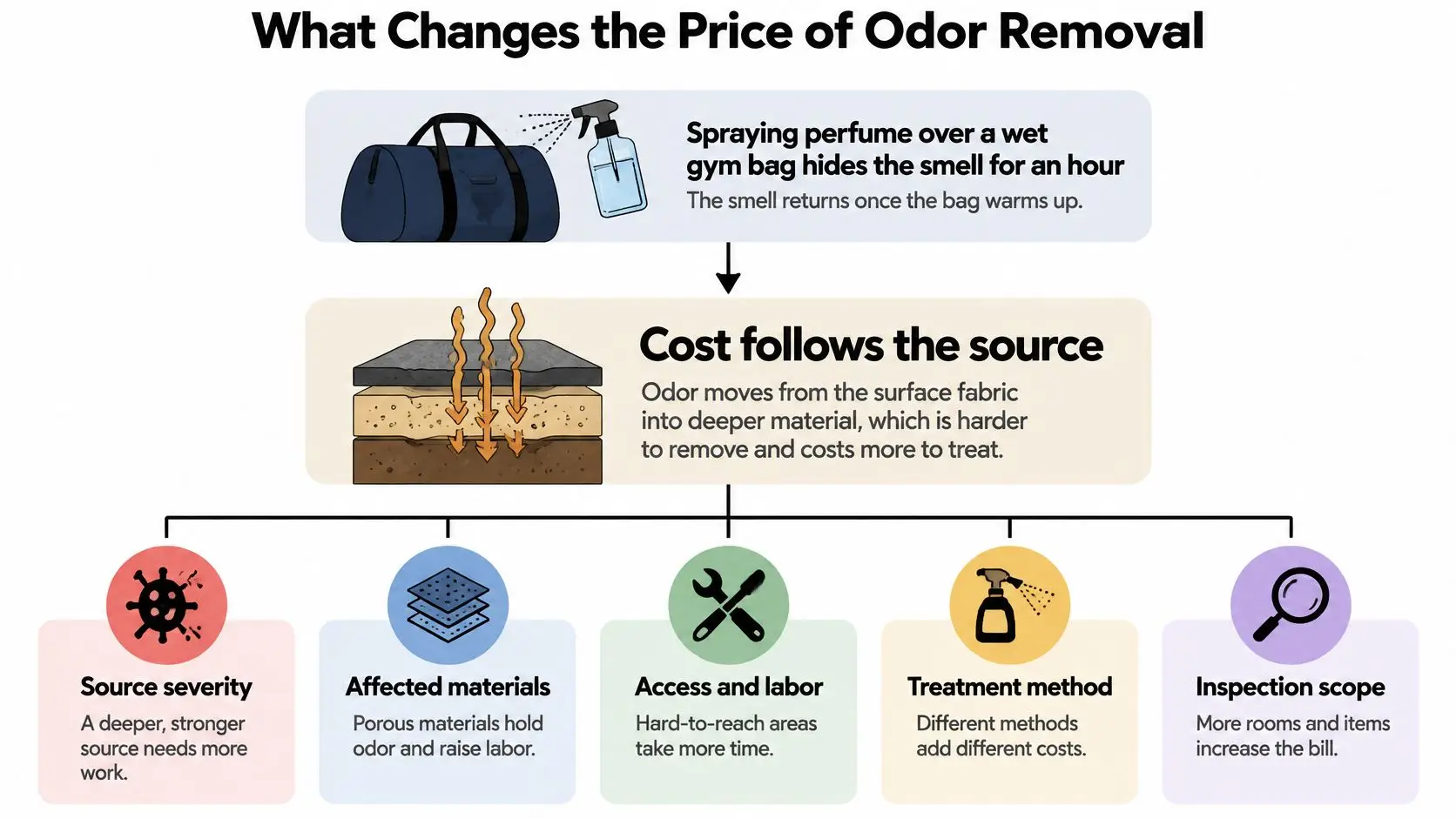
Spraying perfume over a wet gym bag might hide the smell for a while, but once the bag warms up, you'll notice it again. The practical lesson is simple: cost follows the source, not just what your nose detects.
Start with the cause and the materials
Smoke, sewage, pet urine, mold, and slow leaks require different work. Urine on a washable floor may need cleaning, while urine beneath carpet can require pad removal and subfloor treatment.
Severity changes labor. A light smoke haze isn't the same cleanup as charred kitchen cabinets with sticky soot on surrounding surfaces. Technicians must determine what can be cleaned and what can't reasonably be salvaged.
Porous materials complicate that decision. Carpet, padding, drywall, and insulation can retain contamination below the visible surface, so replacing affected carpet pad involves more work than wiping a hard floor.
Follow the spread
Affected square footage adds surfaces to inspect and clean, along with air volume to manage. An odor confined to a closet presents a different job from contamination extending into adjoining bedrooms.
Contents create separate handling tasks. A sofa, bedding, and a wardrobe of clothing may each need evaluation, cleaning, or disposal rather than a single room treatment.
HVAC involvement adds another branch to the estimate. If smoke entered a return duct, technicians need to assess the system instead of assuming the room itself is the entire problem. Access matters too, because reaching contaminated insulation above a ceiling takes more labor than cleaning an exposed wall.
Separate remediation from deodorizing
Fogging, filtration, duct cleaning, and other treatments should appear as identifiable tasks, not an unexplained equipment allowance. Ask what each task accomplishes and what must happen before it begins.
The EPA's guide to home air cleaners identifies source control as generally more effective than ventilation or air cleaning and explains that filters don't resolve musty odors caused by an underlying moisture problem. That makes leak correction and contaminated-material removal different from air treatment.
Estimate check: Find the source, severity, materials, area, contents, HVAC work, and treatment method in your proposed scope. If a driver is missing, ask whether the contractor inspected it or excluded it.
What Each Treatment Method Adds to the Bill
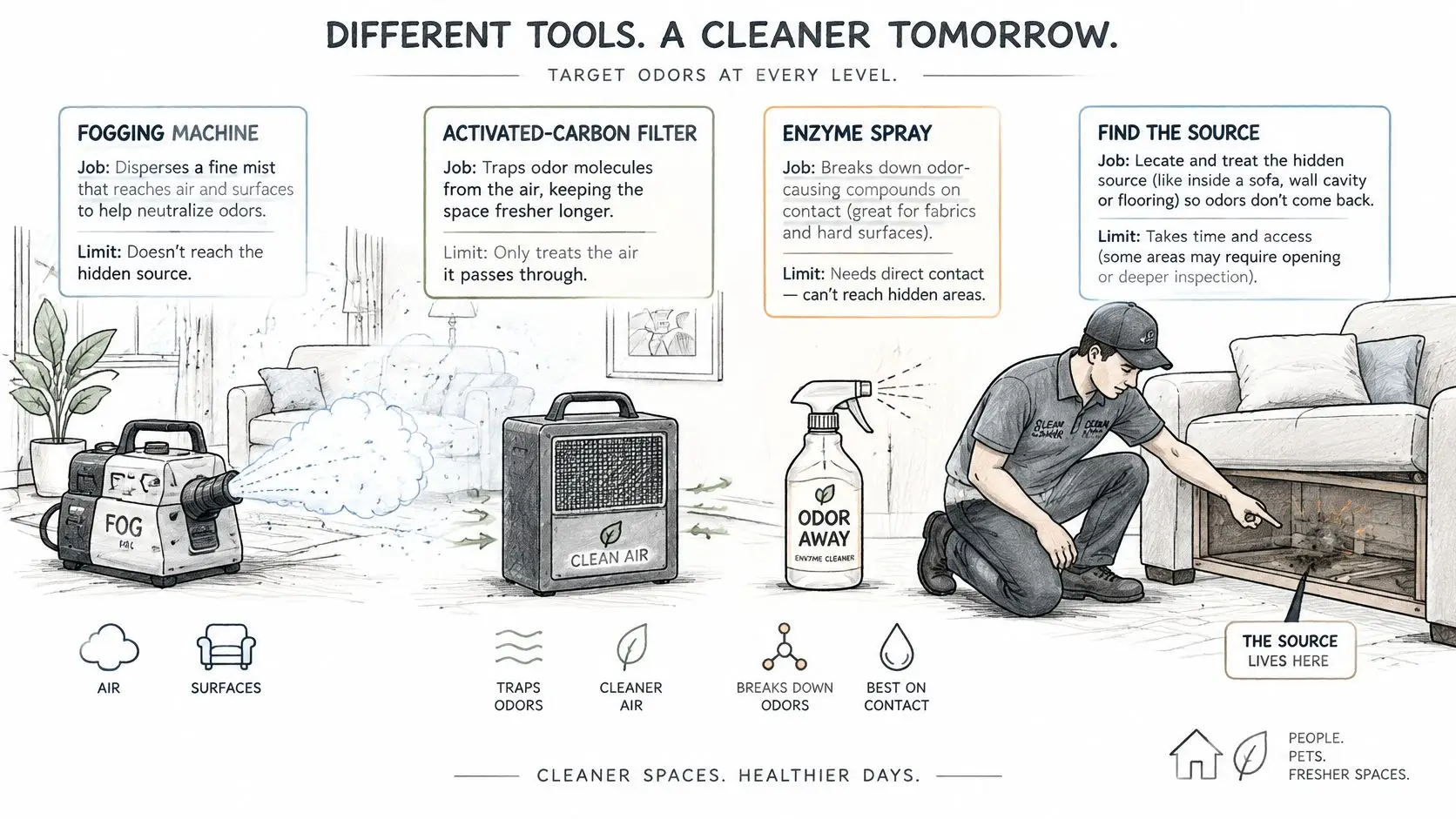
Odor-removal equipment is a collection of tools, not a menu of interchangeable fixes. Each tool has a job, and its usefulness depends on what the technician has already cleaned or removed.
Odor treatment methods compared
| Method | What it does | Limit | Effect on total cost |
|---|---|---|---|
| Fogging | Applies fine deodorizing mist to air and surfaces | Doesn't remove a source | Low line item can understate the complete job |
| Ozone | Oxidizing treatment for sealed, unoccupied spaces | Requires evacuation, ventilation, and a reentry procedure | Adds costs beyond the treatment fee |
| HEPA and carbon filtration | Captures particles and some gases | Can't stop continuing releases from contaminated materials | Adds equipment time and filter costs |
| HVAC cleaning and filter replacement | Addresses contamination in affected ducts and filters | Only appropriate to the identified system scope; distinct from routine maintenance | Priced around system size and access |
| Ionizers and bipolar ionization | Ion generators don't effectively remove gases or odors under EPA guidance | Bipolar ionization can produce ozone or other by-products without safeguards | Device cost may leave the source unresolved |
Match the tool to the task
Fogging distributes a fine mist where direct application may be difficult. It can look inexpensive as an isolated charge, but preparation and surface cleaning may be separate; this explanation of thermal fogging for odor removal helps distinguish the application from the complete restoration scope.
Ozone requires special caution, not just closing a door and returning when the machine stops. The EPA's guidance on ionizers and ozone-generating air cleaners identifies ozone as a lung irritant, warns that odor-reducing concentrations can exceed levels considered safe, and recommends avoiding air cleaners that intentionally generate it. Ask who manages evacuation, ventilation, and safe reentry.
HEPA and carbon filtration perform different jobs: HEPA captures airborne particles, while suitable carbon media can adsorb some gases. Equipment duration, media selection, and replacement filters affect the bill; neither substitutes for cleaning contaminated belongings.
Include the work around the equipment
HVAC cleaning and filter replacement require a defined system scope. Ask which returns, supply runs, accessible components, and filters are included rather than accepting a vague duct-cleaning allowance.
Ionizers and bipolar ionization devices shouldn't be selected just because their purchase price is lower than a restoration estimate. Their operating limitations and possible by-products make them a different proposition from removing contamination.
For an item-specific problem, Top Cleaners' mattress smell solutions for Dublin homeowners offers a separate resource for mattress concerns. Keep that contents-level question distinct from treatment of the room or building.
A complete quote should state:
- Method and area: The proposed treatment and affected square footage.
- Occupancy rules: Who must leave, including pets and workers.
- Reentry procedure: Ventilation, clearance steps, and the responsible person.
- HVAC scope: Components, cleaning, and replacement filters.
- Included labor: Surface cleaning, contents handling, disposal, and follow-up.
Common Odor Scenarios and Their Likely Costs
These examples are planning scenarios, not quotes. HomeAdvisor's smoke-damage guide lists approximately $200–$600 for whole-home deodorizing, $200–$1,200 per affected room, $200–$1,000 for furniture or textiles, and $400–$800 for ozone treatment. Those categories explain why similar-smelling properties can need very different budgets.
Smoke in a townhome or ranch house
A Phoenix townhome beside a grill fire. A neighbor's fire sends smoke through an open patio door, leaving odor in curtains and upholstery. If inspection finds limited residue, the likely scope is whole-home deodorizing and surface cleaning, using the whole-home benchmark before separately priced contents work.
The biggest uncertainty is whether the fabrics need individual cleaning. A basic air-and-surface treatment shouldn't be assumed to include every curtain panel and upholstered chair.
A ranch house after a kitchen fire. Soot coats the kitchen and hallway, and the return system pulled smoke beyond the cooking area. The likely scope includes affected-room cleaning, contents evaluation, and possible HVAC work, using the per-room benchmark rather than treating the entire project as simple deodorizing.
The major bill-changing detail is how far residue traveled. Opening a clean-looking cabinet or inspecting the return pathway may reveal work that wasn't apparent from the room entrance.
Urine, moisture, and sewage
A rental condominium with pet urine. After move-out, the landlord discovers staining beneath the carpet. The scope may include carpet and pad removal plus subfloor treatment; there's no verified price benchmark here for that combination.
A bungalow with a slow sink leak. The homeowner notices a musty cabinet before finding wet material behind it. Diagnosis, leak correction, and drying come first, with further mold evaluation if warranted; mold-remediation cost considerations belong in a separate repair budget.
A split-level home with a sewage-flooded basement. A backup affects finished flooring and wall materials. Contaminated-material removal, sanitation, and deodorizing require an inspection-based estimate, not a room-freshening price.
The most important detail in each scenario is what remains contaminated or actively releasing odor when treatment begins.
Not every strong odor originates indoors. If an animal encounter is plausible, Wildlife Control Services, LLC's skunk encounter guidance for Connecticut homeowners is a situation-specific resource, not a local cleanup price guide.
How Insurance Affects What You Pay
An adjuster reads an estimate like a map. If the scope says only odor treatment, it's hard to see how the loss led to the proposed work or which policy provisions might apply.
Coverage depends on your policy, the cause of loss, documented damage, deductible, and the insurer's decision. An estimate supports that review; it doesn't establish a coverage outcome.
Distinguish restoration from maintenance
The Washington State Office of the Insurance Commissioner explains that standard homeowners and renters policies typically cover sudden and accidental smoke damage, potentially including cleaning, deodorizing, repairs, damaged belongings, and temporary living expenses when the home is unsafe. That's useful general guidance, not a determination about an Arizona policy.
USA Today's reporting on smoke-damage insurance distinguishes commonly covered professional smoke deodorization, structural damage, and major soot cleanup from routine maintenance such as filter replacement or minor smoke odors. It also notes that insurers may require evidence of staining, residue, contamination, odor, or another alteration requiring professional attention.
A filter replaced during routine upkeep and a filter replaced within a documented smoke-remediation project may therefore receive different scrutiny. Ask the adjuster how your policy treats each line item rather than assuming the contractor's involvement makes every charge payable.
Prepare a reviewable file
Before the adjuster visit, gather:
- Photos and video: Record affected rooms and visible residue before cleanup, when it's safe.
- Damaged-item inventory: List furniture, textiles, and other affected belongings.
- Emergency receipts: Keep records for necessary protective or mitigation steps.
- Policy details: Have the deductible, limits, and relevant endorsements available.
- Itemized estimate: Separate cleaning, deodorizing, contents, HVAC work, disposal, and repairs.
For broader context, review these homeowners-insurance considerations after fire damage. Then ask your adjuster which parts of the scope the insurer will review and whether any work needs approval before it starts.
Ways to Lower the Bill Without Skipping the Fix
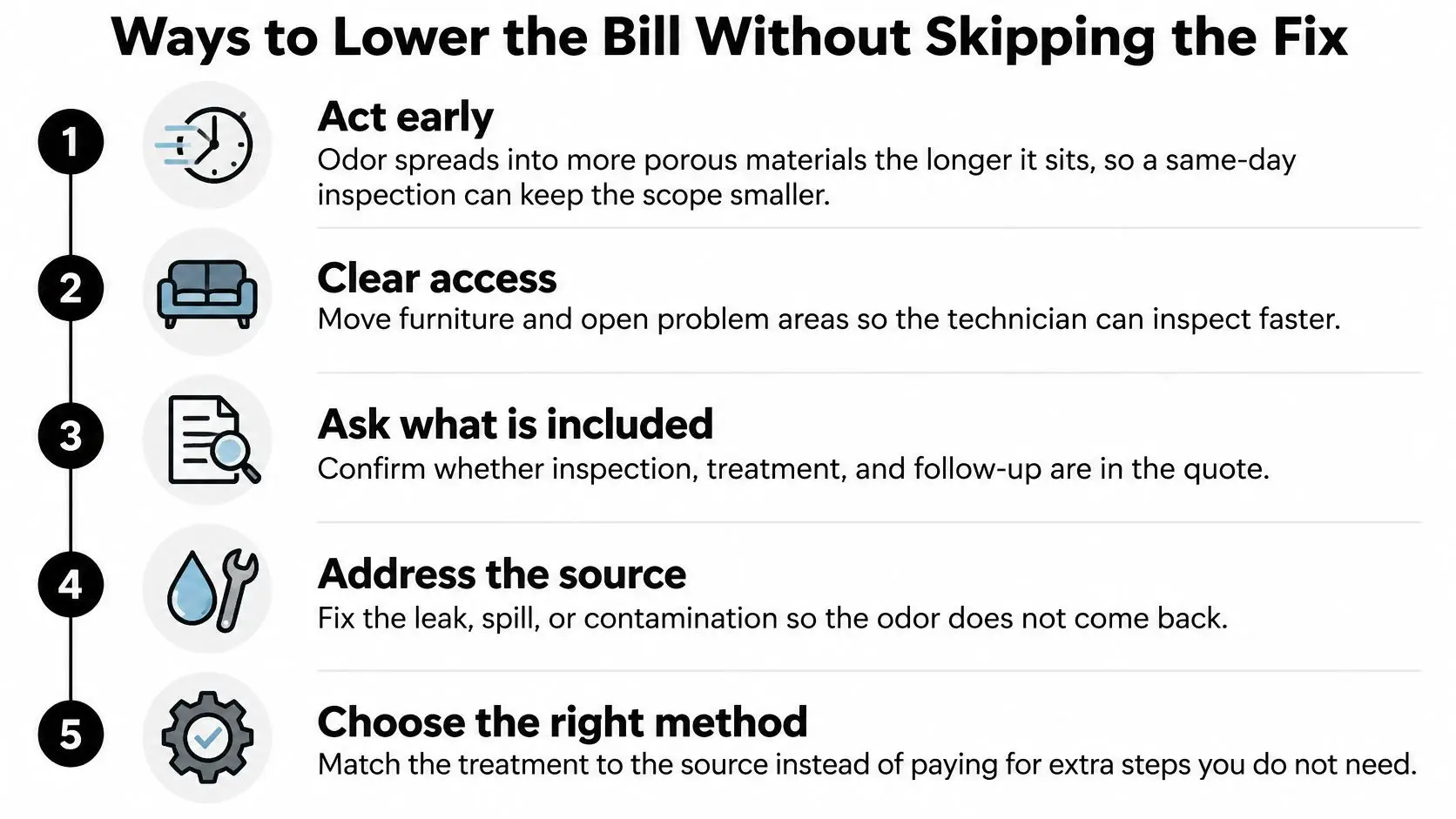
The useful question isn't just “How much does odor removal cost?” It's which expenses solve the problem, and which expenses could you avoid through better planning? Use these steps to make estimates easier to compare.
Spend on necessary work
Act early. Request an inspection promptly, especially when water or contamination remains active, so the contractor can identify measures that may limit additional affected materials.
Request an itemized scope. Separate source removal, contents, HVAC, filtration, deodorant application, and structural work because an unlabeled total gives you little to check.
Compare inclusions, not totals. A cheaper proposal that omits carpet-pad removal isn't equivalent to one that includes it; ask both contractors to price the same identified work.
Check the source correction. Confirm whether leak repair, burned-material removal, or another necessary correction is included or assigned to a separate trade.
Coordinate HVAC and room work. When ducts are affected, ask whether the cleaning sequence can be organized together to avoid repeating completed tasks.
Evaluate salvageable contents. Ask which belongings can reasonably be cleaned rather than replaced, and retain them for insurer review when safe to do so.
Clarify contents pricing. Find out whether upholstery, clothing, and bedding are charged per item, per room, or under another stated method.
Make the visit productive
Clear safe access to the affected area, but don't disturb suspect mold, sewage contamination, or fire-damaged materials just to make inspection easier. Tell the technician where the odor is strongest and whether it changes when the HVAC operates.
Use this guide to what removes odors to prepare method-specific questions. The aim is to authorize necessary tasks with clear boundaries, not to select the longest treatment list.
Get an Itemized Estimate Before You Approve Work
An on-site inspection should locate the odor source, identify affected materials, rooms, and contents, and check whether HVAC contamination needs further assessment. The resulting estimate should connect each proposed task to something the technician found.
For a Phoenix property, Restore Heroes is one contractor option offering assessment, mitigation, odor removal, and sanitation, with insurer coordination. Its stated process covers the job from initial evaluation through the relevant restoration work rather than presenting deodorization as an isolated machine treatment.
Verify service terms before signing
The company describes itself as licensed, bonded, insured, and IICRC-certified. It also advertises round-the-clock availability, no upfront payment, insurance acceptance, and free on-site inspections; confirm the applicable terms when booking rather than treating advertising language as your project agreement.
These are company statements about credentials and process, not independently verified findings or promises about price, response, or claim payment. Ask for any response or satisfaction commitment in writing before you sign.
The on-site estimate request page provides a starting point for an inspection inquiry. Confirm that the visit is free for your location and odor problem, and ask whether diagnostic testing or specialist assessment could carry a separate charge.
Approve a defined scope
Before authorization, identify who can approve additions if technicians discover concealed contamination. Ask how the contractor will document the finding, price the change, and obtain your approval before proceeding.
Follow a short decision sequence:
- Request the inspection. Describe the incident, affected rooms, and whether the source is still active.
- Ask for the itemized scope. Require separate descriptions for cleaning, contents, equipment, disposal, and repairs.
- Check the complete-quote details. Confirm treatment method, occupancy restrictions, reentry procedures, affected area, and HVAC involvement.
- Ask about insurer review. Establish who submits documentation and which proposed items may need approval.
The final price should follow the inspection and agreed scope, with a clear process for changes. Whether you hire this company or another contractor, a readable estimate helps you understand what you're authorizing, what's excluded, and which problem each charge is intended to address.
Restore Heroes offers Phoenix-area assessment, mitigation, odor removal, and sanitation for properties affected by restoration incidents. Request an on-site inspection, confirm the visit's terms, and ask for an itemized estimate that identifies the odor source before you approve treatment.