
You open the cabinet under the bathroom sink and find a dark patch along the back wall. The pipe feels damp, the cabinet smells musty, and you're wondering whether a sponge will handle it or whether someone needs to open the wall. In a Phoenix home, dry outdoor air doesn't answer that question. What matters is how much moisture remains inside the affected materials.
Mold removal and remediation services should address the wet building materials, not just the visible spot. Understanding where a small cleanup ends and a professional job begins helps you ask better questions, compare proposals, and avoid paying for cosmetic work that leaves the cause untouched.
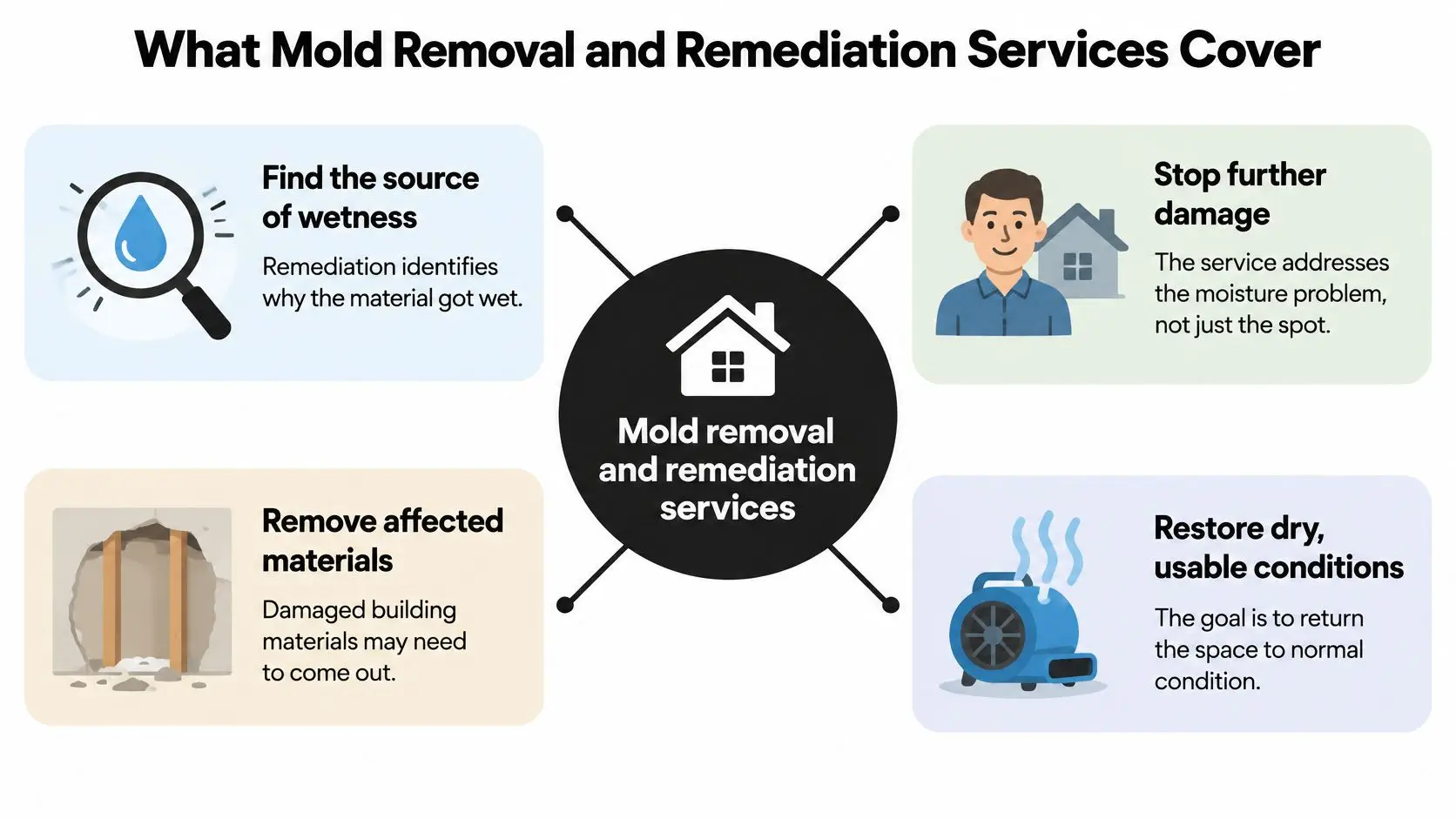
What Mold Removal and Remediation Services Cover
Remediation is a coordinated process, not another name for spraying a stained surface. A contractor investigates why the material got wet, establishes the affected area, and plans cleaning, removal, and drying around those findings.
The health reason for that approach is straightforward. The World Health Organization's indoor-air-quality guidelines concluded that occupants of damp or moldy buildings face up to a 75% greater risk of respiratory symptoms and asthma than occupants of unaffected buildings. That doesn't predict what will happen to an individual homeowner, but it explains why moisture correction belongs in the work itself.
This overview shows the main parts of the service.
Understand the service labels
Several related services can appear on the same proposal:
- Mold testing identifies or measures mold through a planned sampling process. It doesn't repair a leak or dry a wall.
- Mold removal means cleaning affected surfaces or taking contaminated materials out.
- Water-damage restoration includes extracting water and drying building materials after a leak or other water event.
- Mold remediation coordinates assessment, moisture correction, containment, material removal, cleaning, drying, and evaluation.
Not every property needs every service. A small patch on cleanable tile may require targeted cleaning after the water problem is corrected. Damp drywall behind a cabinet calls for a closer investigation because the visible face may not reveal the condition of the cavity.
Know what the proposal should include
A useful scope follows a practical sequence: inspection and moisture mapping, source repair, containment where needed, removal of unsalvageable porous materials, surface cleaning, drying, and follow-up. Ask who handles the plumbing or roof repair, since that work may require a separate trade.
Material-specific advice can help you understand the decision. Flacks Flooring's guide to removing mildew from damp carpets is a useful companion when flooring is affected, but the condition of the backing, padding, and subfloor also needs consideration.
A clean-looking surface isn't the same thing as a dry, correctly repaired building assembly.
When Small Cleanup Turns Into a Professional Job
Scope tiers: when a job needs a professional
| Situation | Typical approach | Usually handled by | First check |
|---|---|---|---|
| Under about 10 sq ft, hard surfaces | Clean with detergent and water, then dry fully | Homeowner following EPA guidance | Is the moisture source fixed? |
| About 10 to 100 sq ft | Plan limited containment, filtered air, and removal of porous damage | Professional remediation contractor | Map the area with a tape and moisture meter |
| Over 100 sq ft | Plan full containment under negative pressure | Trained remediation crew with verified credentials | Are occupied rooms protected? |
| Growth behind drywall or in insulation | Assess the cavity, remove affected porous material, and dry | Professional contractor | Moisture readings within the assembly |
| HVAC system involved | Keep the system off and assess ducts and air handler | Professional with HVAC experience | Could the system have distributed contamination? |
| Sewage or floodwater | Assess contamination and discard porous items that can't be thoroughly cleaned and dried | Professional contractor | Has the water source been identified? |
The EPA's household mold-cleanup guidance says homeowners can, in most cases, handle an affected area smaller than about 10 square feet, roughly a 3-foot-by-3-foot patch, by following its cleanup guidance. The table's area bands are planning categories, not legal cutoffs or assurances that a particular job is safe.
Size is only part of the decision
A small patch deserves professional attention when the material stays wet, the staining returns, or cleanup would disturb concealed growth. Removing a moldy panel is different from washing tile because demolition can release contaminated dust.
A musty odor from supply or return grilles also changes the investigation. Don't assume that cleaning the nearest visible spot addresses a possible HVAC pathway.
Occupant health matters, too. Children, older adults, and people with asthma or weakened immunity warrant a more cautious plan for occupancy and exposure. A homeowner's ability to tolerate cleanup work shouldn't be treated as a test of whether the building needs attention.
Measure without disturbing the damage
Use a tape measure to record the length and width of visible affected areas. Mark stains, swollen trim, soft drywall, and flooring edges on a simple sketch, but don't pull apart a suspect assembly just to improve your estimate.
For wall-related warning signs, CS1 Real Interiors mold inspection tips provide additional context for discussing drywall conditions. Hidden surfaces still need an onsite assessment rather than an assumption based on the exposed patch.
When you contact mold remediation specialists, describe the water event, materials, odors, and any recurring staining. Those details are more useful for initial planning than calling every dark mark a whole-house emergency.
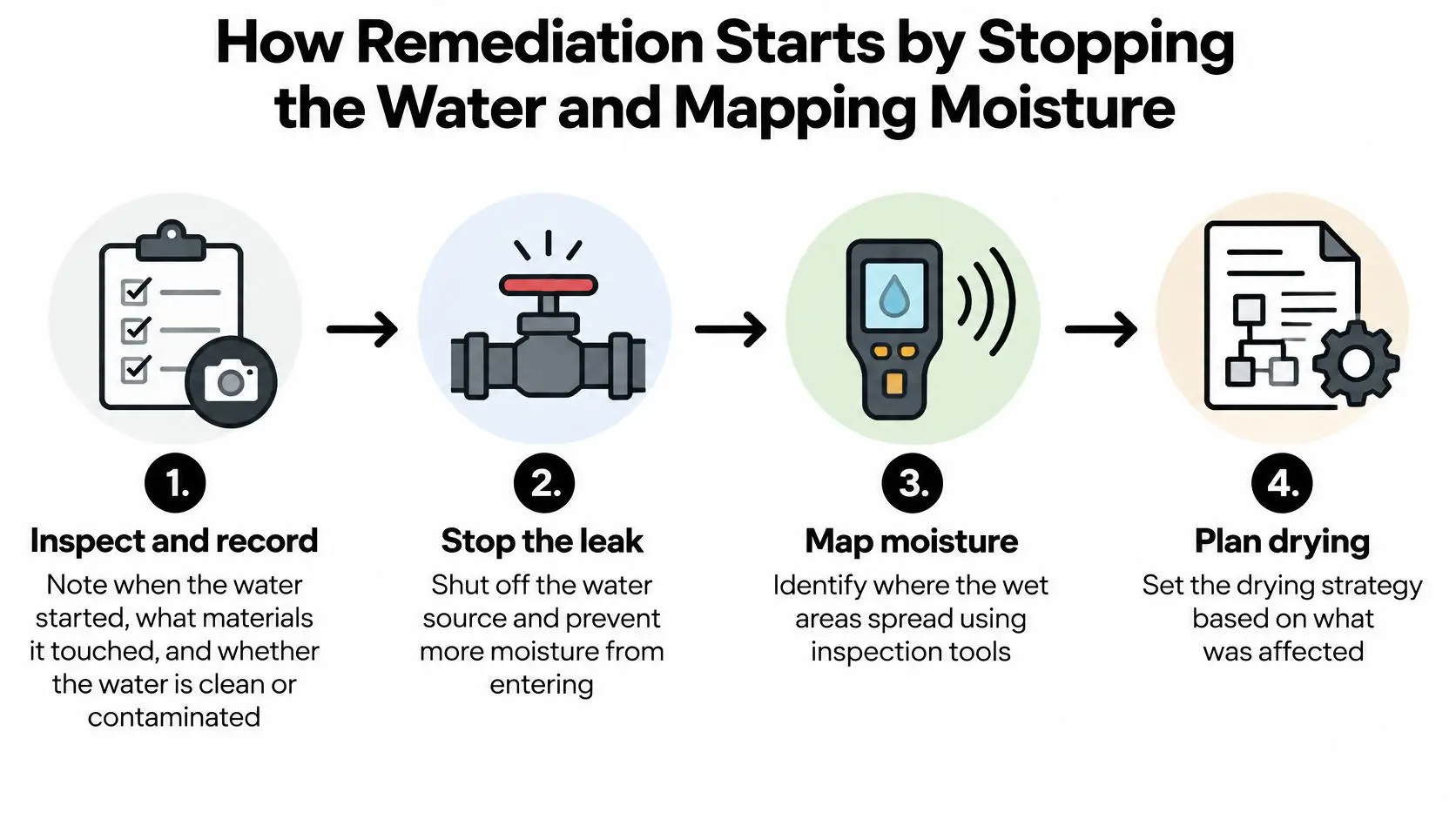
How Remediation Starts by Stopping the Water and Mapping Moisture
When you discover a leak or notice a new musty smell, record what you can without entering an unsafe area. Don't handle wet electrical equipment or step beneath a sagging ceiling to take photographs.
The initial investigation should produce a usable record, not just a verbal recommendation to run fans.
Establish the source and the affected materials
Inspect and record. Note when you first noticed water, where it appeared, and which materials it touched. Identify whether it came from a supply line, drain, roof opening, or contaminated water event. Photograph the damage before materials are moved, when it's safe to do so.
Stop the water source. A plumber, roofer, or appliance technician may need to make the repair. Shutting a valve can stop an active leak temporarily, but the permanent correction should be documented before the assembly is closed.
Map moisture. Technicians use moisture meters across walls, ceilings, subfloors, and accessible framing. They compare suspect areas with unaffected material and investigate changes rather than checking only the darkest stain. Insulation and concealed layers may require carefully planned access.
Set the work plan. Record which materials can be dried in place, which require removal, and how drying will be checked. Include photographs, a sketch of affected zones, meter locations, and the reasoning behind material decisions.
According to the EPA's guide to mold and moisture, drying wet materials within 24–48 hours after a leak or spill can often prevent mold growth. That's a reason to act promptly, not a promise that every soaked assembly can be saved within that window.
Why Phoenix homes still develop damp pockets
Evaporative cooler overflow can wet a ceiling from above. An air-conditioning condensate problem can keep a closet wall damp while the adjacent room feels comfortable. Storm-driven roof intrusion and in-wall plumbing leaks can also leave moisture where outdoor air does little to help.
For a shared or managed building, Commercial Roofers' roof inspection guidance for strata managers offers context for organizing roof-leak observations. The roofer still needs to establish the actual entry point rather than assuming it sits directly above the stain.
This video provides another way to follow the water-damage assessment process.
Before authorizing work after a water-damage and mold inspection, ask:
- Source correction: Who will verify that the leak has been repaired?
- Hidden moisture: Which concealed areas need investigation?
- Drying criteria: What readings will determine when materials are ready to close?
How Containment, Removal and Drying Are Done
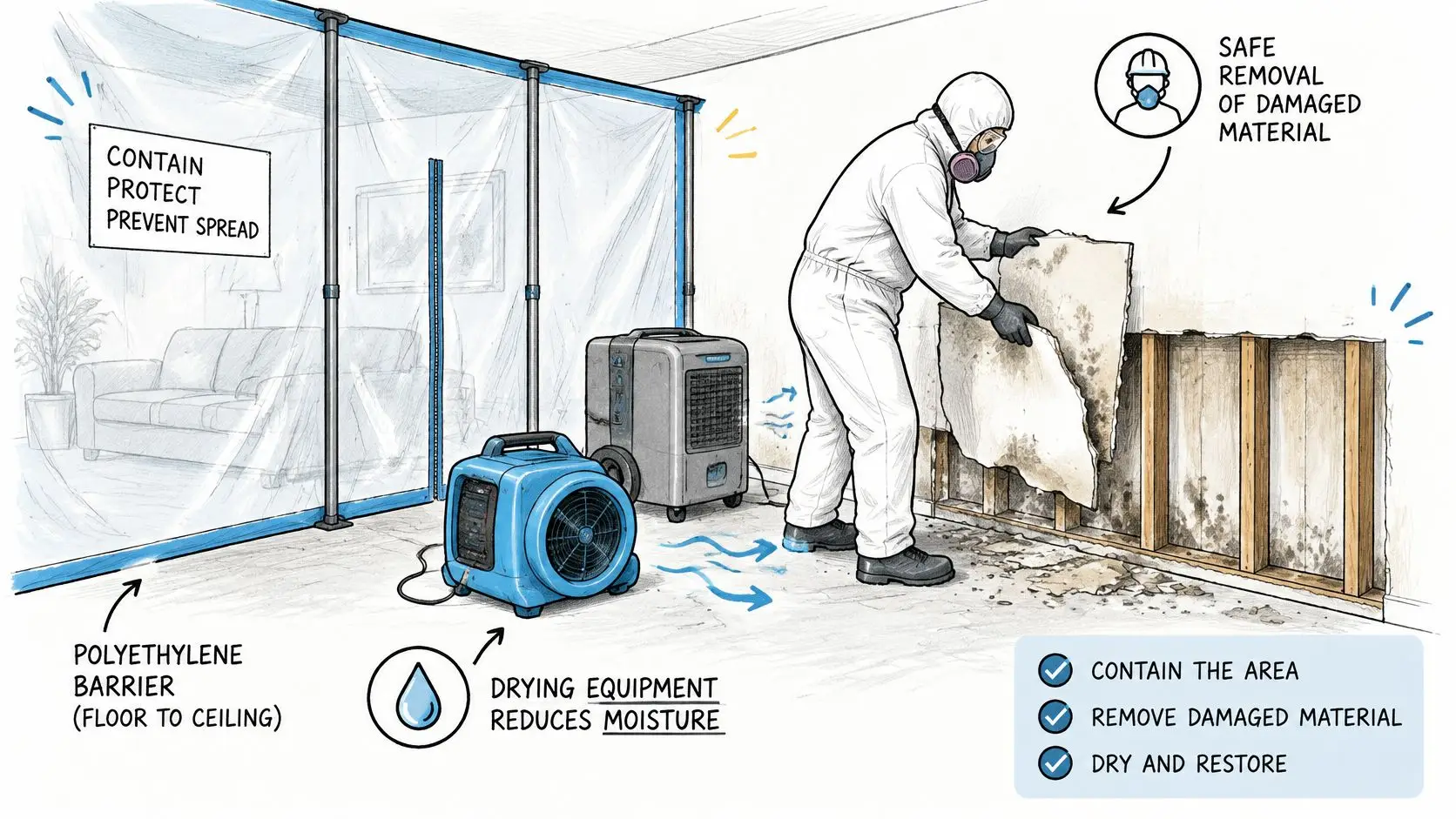
Containment should match both the amount of affected material and the chance of spreading dust. The EPA's remediation guide recommends limited containment for approximately 10–100 square feet, using floor-to-ceiling, single-layer 6-mil polyethylene sheeting, and generally recommends full containment above 100 square feet or whenever occupied spaces could otherwise be contaminated.
A contained job may look like this while damaged wall material is being removed.
Separate dirty work from occupied rooms
Contain the work area. Crews seal the work zone and establish inward airflow using a HEPA-filtered air unit exhausting outdoors. This negative pressure helps keep contaminated dust from migrating into adjacent rooms. HVAC equipment suspected of contamination shouldn't operate, and the crew should isolate relevant air pathways.
Remove materials that can't be cleaned. Affected drywall, ceiling tile, carpet padding, and insulation may need removal. Crews bag debris before moving it through clean areas. Painting or caulking over growth isn't a substitute for removing contamination and addressing wet material.
Clean appropriate surfaces. Detergent and water are suitable for many hard surfaces, followed by thorough drying. Rough framing and damaged finishes require material-specific judgment rather than a quick wipe.
The EPA's mold-and-moisture guidance doesn't recommend bleach or other biocides as the default approach and advises indoor relative humidity below 60%, ideally 30–50%. Killing mold alone doesn't remove the remaining material or its potential allergens.
Dry and finish the cleanup
Dry to documented targets. Technicians position air movers and dehumidifiers according to the affected assembly and containment plan. They recheck material readings against an appropriate dry comparison rather than relying on how the surface feels.
Clean settled dust. HEPA-vacuuming and damp wiping remove debris left on ledges, framing, and other surfaces. Crews collect waste for disposal and inspect the work zone before dismantling containment.
For cleanup protection, CDC guidance calls for at least a NIOSH-approved N95 respirator, suitable gloves, and goggles that fully protect the eyes; prolonged demolition may require greater respiratory protection. People with asthma, allergies, immune suppression, or underlying lung disease shouldn't participate in cleanup.
Chemical safety: Never mix bleach and ammonia. Strong chemical odors aren't evidence that a space has been successfully remediated.
Expect plastic barriers, equipment noise, controlled access, and bagged debris. Musty odors should diminish as affected materials are removed and remaining surfaces are cleaned and dried. Persistent odor calls for investigation, not fragrance or a promise that it will disappear after repainting.
Why IICRC Certification and Insurance Matter
Verify documents before comparing slogans. IICRC publishes restoration standards and provides technician certification, including the Applied Microbial Remediation Technician credential. Training is useful evidence of preparation, but it doesn't establish the condition of your property or guarantee a result.
Credentials and documents to verify
| Credential or document | What it proves | Why it matters | What to request |
|---|---|---|---|
| IICRC certification, such as AMRT | Relevant technician training and certification | Supports informed containment, drying, and cleanup practices | Certificate number and technician name |
| Arizona contractor license | State licensing status and authorized classification | Helps confirm the contractor can perform the contracted work | License number to verify with the Arizona Registrar of Contractors |
| General liability insurance | A policy exists, subject to its terms and exclusions | May respond to covered damage caused during work | Current certificate and property-specific documentation where appropriate |
| Workers' compensation | Current employee injury coverage, subject to policy terms | Addresses covered work-related injuries | Proof of current coverage |
| Surety bond | A bond exists with defined obligations and limits | May provide recourse for qualifying contractual failures | Bond details and applicable terms |
| Written scope with moisture readings | A documented plan supported by inspection findings | Helps you compare proposals and retain a property record | Itemized scope and sample meter report |
Check the person and the proposed work
Ask who will supervise the job and which credential that person holds. A company logo on a truck doesn't tell you whether the technician opening your wall has the relevant training.
Verify the contractor's license status and classification through the Arizona Registrar of Contractors. The classification should fit the proposed work, especially if the contract includes structural repairs rather than cleanup alone.
When considering an IICRC-certified restoration company, ask how its written procedures apply to your assembly. A useful answer describes containment boundaries, material decisions, drying measurements, and who checks the completed work.
Separate contractor protection from your property claim
The contractor's liability policy, employee coverage, and bond serve different purposes. None automatically pays every loss, and a certificate of insurance isn't a complete explanation of exclusions, limits, or claim handling.
Your homeowners or commercial property policy is a separate contract. A sudden leak may be evaluated differently from long-term seepage, and your carrier determines coverage under your policy.
Request an itemized scope before comparing bids. Confirm whether it includes leak repair, contents handling, demolition, drying, verification, and rebuilding, or whether another contractor will handle some of those tasks. A lower total isn't necessarily a comparable proposal when substantial work has been left out.
Typical Costs and Timelines in Phoenix
| Scope | Typical cost range estimate | Typical timeline | Phoenix factor |
|---|---|---|---|
| Small hard-surface cleanup | Cleaning supplies or an inspected service quote | Cleaning and complete drying determine completion | Localized summer moisture can remain despite dry outdoor conditions |
| Limited-containment remediation | Quote for enclosure, removal, cleaning, and drying | Access, material condition, and drying readings govern | Cooler and roof leaks can affect ceiling cavities |
| Full-containment remediation | Project-specific quote including larger containment and disposal | Cleanup and rebuilding require separate scheduling | Extensive damage requires repair coordination |
| Wall-cavity or insulation removal | Added opening, removal, disposal, and rebuild costs | Cavity drying must precede closure | Concealed condensate or plumbing leaks complicate access |
| HVAC contamination | System-specific assessment and remediation quote | Assessment and system condition determine restart | Cooling needs complicate occupancy planning |
| Sewage or floodwater cleanup | Contamination-specific removal, cleaning, and restoration quote | Water category, material loss, and drying determine duration | Stormwater and contaminated porous materials expand the work |
Use this as a planning tool, not a price list. A defensible dollar range requires local pricing evidence and an inspected scope. A photograph can't establish how far water traveled beneath flooring or whether a cabinet must come out.
What increases the bill
The contractor should explain each added task in plain language:
- Hidden moisture: Additional investigation may reveal affected material beyond the original stain.
- Difficult access: Cabinetry, tile, built-ins, and flooring can make removal and drying more labor-intensive.
- Rebuilding: Insulation, drywall, texture, paint, and finish carpentry are distinct from remediation.
- Verification: Independent inspection or targeted sampling can add a separate service.
- Emergency conditions: After-hours mobilization and difficult site conditions may affect the proposal.
For a closer look at proposal components, consult this mold remediation cost guide. Ask whether quoted equipment charges, disposal, and final cleaning are included or listed separately.
What determines the schedule
Inspection availability, safe access, source repair, and material drying all affect scheduling. Limited removal may be relatively straightforward, while rebuilding introduces trade availability, material orders, and finish work.
The CDC's mold-cleanup advice recommends drying homes and belongings as quickly as possible, ideally within 24–48 hours, and removing floodwater-soaked items that can't be cleaned and dried completely within that period. That guidance is an urgency target, not a contractor completion deadline.
Phoenix scheduling also depends on the source: evaporative cooler overflow, condensate drain trouble, storm-related roof intrusion, or slab and in-wall plumbing leaks require different repairs. Monsoon humidity can complicate drying, so crews should use measurements rather than assuming desert air will finish the job.
Compare the same written scope, with remediation and rebuild costs separated. Don't choose solely by the lowest total or the shortest promised schedule.
How to Judge a Finished Remediation
A finished wall isn't enough evidence to accept the work. Before reconstruction conceals the assembly, ask for the inspection record, material-disposal decisions, drying results, and the contractor's completion criteria.
The EPA's post-remediation guidance evaluates completion through corrected moisture conditions, absence of visible mold and mold-damaged materials, removal of moldy odors, appropriate interpretation of any sampling, and a return visit to check for renewed damage or growth.
Use observable acceptance conditions
- Confirm the source repair. Keep the plumber's, roofer's, or appliance technician's documentation with the remediation file.
- Inspect exposed surfaces. Look for remaining growth, damaged material, or unexplained discoloration before approving closure.
- Check cleanup quality. Ledges, accessible framing, and surrounding surfaces shouldn't retain demolition dust.
- Review any sampling in context. Ask why samples were collected and how indoor findings compare with outdoor conditions. There isn't a universal federal airborne mold limit that turns a single result into a health guarantee.
- Arrange follow-up. Establish who will revisit and what signs should trigger another inspection.
A post-remediation verification review should connect those observations to the actual work performed. If testing was included, request the interpretation as well as the laboratory sheet.
Keep a useful property record
Save dated photographs, the approximate start of the water event, source-repair invoices, moisture maps, change orders, and completion documents. Contact your insurer early and ask what records it needs, without treating a contractor's visit as claim approval.
If dampness or odors return, record where and when they appear. Repeated staining beneath a repaired sink calls for renewed moisture investigation, not an automatic assumption that another chemical treatment will solve it.
If water is still running, shut it off when you can do so safely. Leave bagged contaminated debris sealed and keep occupants away from active work areas. Request an onsite inspection so the proposed scope and price reflect access, material condition, and meter readings rather than photographs alone.
No firm can promise insurance payment, a universal health outcome, or that mold will never return. What you can request is a documented process, clear responsibilities, and evidence that the agreed work was completed.
For Phoenix-area homeowners, Restore Heroes offers mold inspection, moisture-source identification, containment, cleanup, and restoration services. Visit to request an onsite assessment and ask for an itemized plan that separates remediation, drying, and rebuilding before you authorize the work.