
The call is over. Police, paramedics, or the coroner have finished and driven away, and you're standing in a Phoenix hallway with one closed door and a phone in your hand. The first search you type is trauma cleanup near me, and the results promise two-hour arrival, discreet unmarked vans, and answers to questions you haven't formed yet.
Most of those pages skip the two things that decide whether this goes well: who is legally responsible for arranging the work, and what proof you should hold before you pay anyone. This guide walks through both, in the order you'll face them.
The need is steady. The FBI's 2024 reported-crime estimates put a violent crime in the United States at one every 25.9 seconds on average, with estimated violent crime down 4.5% from 2023. Those figures aren't a count of cleanup jobs, since many incidents leave no contamination behind. They do explain why the service exists in every major market, and why you'll have several providers to compare.
What Trauma Cleanup Covers and Who Arranges It
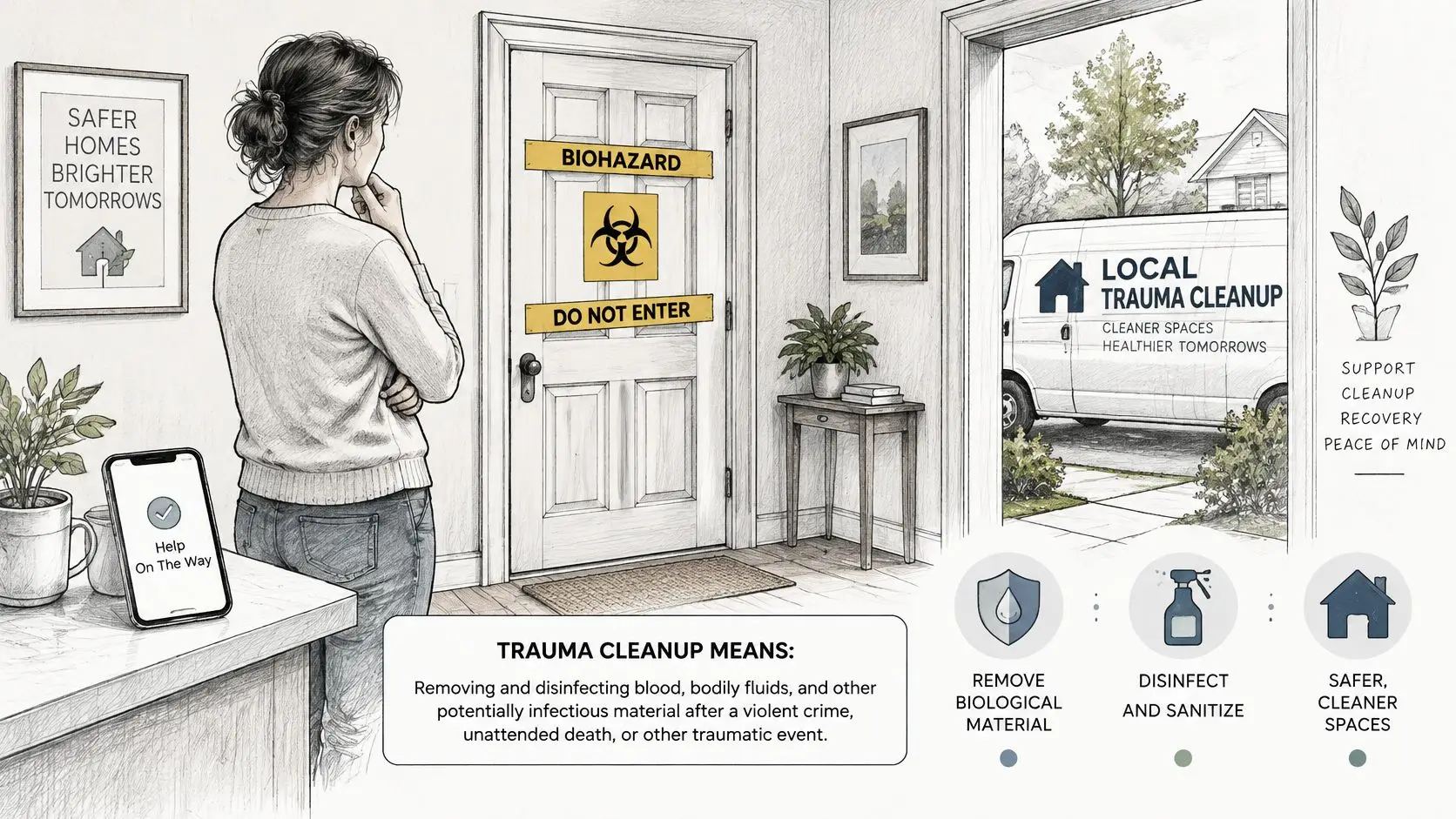
Trauma cleanup means removing and disinfecting blood, bodily fluids, and other potentially infectious material left after a violent crime, an unattended death, or a serious injury. Police, fire, and medical crews finish their work and release the property. The contamination stays behind.
The street can look normal again by morning. The room behind the closed door is a different category of work.
Use the table to sort the job before you call anyone.
| Property type | Who usually arranges cleanup | Question to settle first |
|---|---|---|
| Single-family home | Homeowner, with the insurer involved | Has fluid reached porous materials like carpet, drywall, or subfloor? |
| Rental or multifamily unit | Landlord or property owner | Who notifies tenants and records the condition? |
| Commercial building | Owner or facility manager | Will waste transfer be documented? |
Who Arranges Cleanup on Private Property
Responsibility is a legal question settled by ownership, management control, and local rules. The New York City Police Department's victim services guidance states that property owners are responsible for cleaning trauma scenes on private property, including residential and commercial buildings, and must arrange that cleanup themselves. Local rules may also require approved disposal for regulated medical waste, so the paper trail matters as much as the cleaning. A receipt for cleaning is not the same thing as a disposal record.
Three situations cover most calls:
- A home after a death. The homeowner arranges the work and files the claim. Unattended deaths often sit undiscovered for days, so contamination reaches subfloor, drywall, and soft furnishings rather than staying on one surface.
- A rental unit after an incident. Tenants frequently assume the city or the police department will handle remediation. It won't. The landlord or property owner arranges it, and the tenant needs to know when the unit is safe to re-enter.
- An office or retail space after a violent event. The facility manager owns the decision, the access control, and the communication with staff and neighboring tenants.
The Handoff After Investigators Leave
The scene release works like a relay handoff: once investigators step away, the property side carries the next leg. Someone has to restrict access, notify occupants, photograph and document the condition, and open the insurance file. On a rental, that's the landlord or property manager. In a commercial building, the facility manager or owner. Write down the moment investigators release the scene, because that's when the clock on the property's obligations starts.
Before paying, ask for the written scope, the documentation that will support the insurance file, and the disposal or transfer record for removed material.
Restore Heroes lists trauma, crime scene, and biohazard cleanup among its residential and commercial services, alongside water, fire, smoke, and mold work, and the biohazard cleanup in Phoenix page sets out the full scope.
Rules differ by city and county, so confirm the requirement with the authority where the property sits before scheduling anything. Then answer one question out loud today: who owns or manages this property, and who is making the call?
What to Do While You Wait for Professionals
The hours between your call and the crew's arrival are where most avoidable mistakes happen. None of them require you to handle anything.
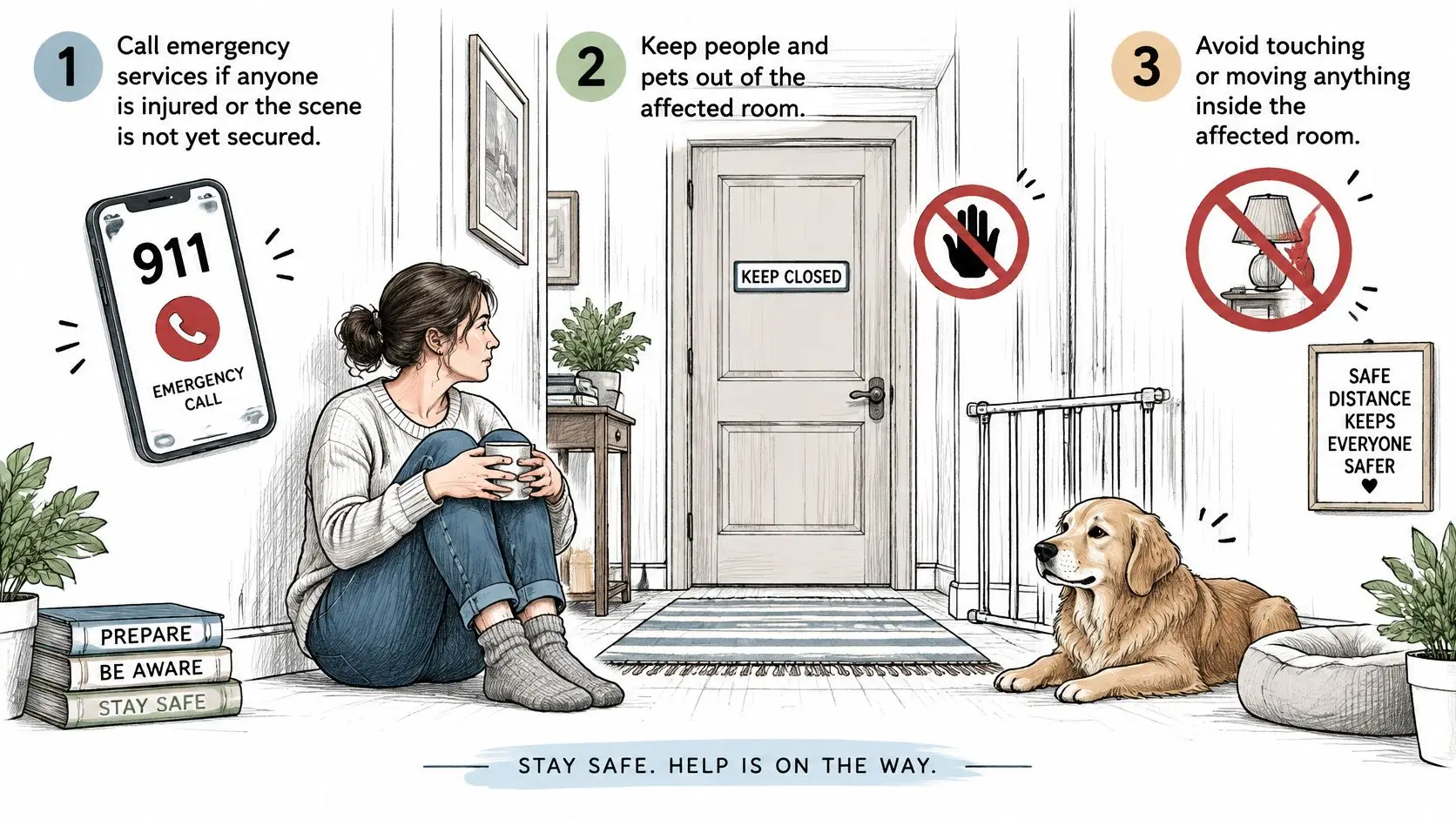
- Call emergency services first if anyone is injured or the scene isn't secured. Nothing in that room is worth more than the people standing outside it.
- Close the door and keep people and pets out. Every person who walks through picks up contamination on shoes and clothing and carries it into rooms that were clean when the night started.
- Don't scrub, mop, or spray household cleaner on blood or fluids. A cleaner can push material deeper into carpet backing and grout, and it makes the assessment harder for the crew that follows.
- Ask whether to shut off the HVAC system serving that area. Air movement can draw contamination into ductwork before containment is up, so ask during the first phone call, not after the van parks.
- Photograph the scene from the doorway and note times and names. Your insurer will want the condition documented and the responders identified, and that record is far easier to make now than to reconstruct next week.
- Confirm who is arranging the cleanup. If you rent, call the landlord or property manager. In a commercial building, that's usually the facility manager.
- Ask for dispatch hours in writing, then confirm them by phone. Arrival depends on technician availability and site conditions, so a stated window is a plan, not a promise. We're available 24/7 for emergency response throughout the Phoenix metro area, which is the baseline to check any provider against.
Waiting is often harder than watching the work. If you're the one who found the scene, or the family member fielding calls, simple grounding techniques for anxious moments can help you get through the next hour without making decisions you'd rather make with a clear head.
What comes next follows a pattern. A trained crew inspects the room, explains what it found and what it plans to remove, gives you a written plan, and then starts. Ask to be told at each stage: when containment is up, when materials come out, and when the final disinfection is finished.
Here's the same sequence in visual form if you'd rather watch than read.
Why Trauma Cleanup Follows Strict Safety Rules
The instinct is understandable. A stain looks like a stain, you have gloves under the sink, and waiting costs money. The safety framework behind this work exists because that shortcut keeps hurting people.
OSHA published its Bloodborne Pathogens Standard on December 6, 1991, and the rule took effect on March 6, 1992, per the Bloodborne Pathogens Standard, 29 CFR 1910.1030. Its goal is to limit occupational exposure to hepatitis B, human immunodeficiency virus (HIV), and other pathogens carried in blood or other potentially infectious material. The rule rests on a principle called universal precautions, which is a simple idea with a hard edge: treat blood and certain body fluids as infectious whether or not anyone has a diagnosis.
Blood soaks in. It doesn't sit on the surface waiting to be wiped away.
The required controls sound technical, and they map to things you can see on a job site: engineering and work-practice controls, protective clothing and equipment, worker training, medical surveillance, hepatitis B vaccination, and warning signs and labels. The scope follows the hazard rather than the job title. Funeral home workers, law enforcement officers, emergency responders, firefighters, and rescue workers all sit inside the rule.
Wiping a visible stain with a kitchen cleaner works like mopping a flooded room with a dish towel. It moves the problem around and looks like progress.
Three mistakes turn up again and again:
- Working without protective gear. Bare hands, open shoes, and a household sponge turn one contained room into a trail through the rest of the house.
- Putting contaminated towels or carpet in ordinary trash. That waste is regulated, and it can't ride to the curb with the week's garbage.
- Skipping labeled containers. The standard requires non-sharp regulated waste to go into closable, leak-resistant, labeled or color-coded containers, secured before removal. That detail matters to you as the property owner, because where the waste went becomes part of your property's record.
The same logic governs sharps. A needle hidden in carpet padding or bedding is an exposure device, which is why sharps injury prevention training exists for workers who never see the hazard coming.
The job has a paper side too. Before you sign off and pay, ask to see each of these:
- A contained work area, with entry controlled while work was underway.
- Task-appropriate protective equipment matched to the hazard present.
- Disinfection with an EPA-registered product, applied the way its label directs.
- Labeled, leak-resistant waste containers, sealed before leaving your property.
- A disposal record showing where the regulated waste went.
A crew that works to the standard can produce all five without being asked twice. Restore Heroes also offers bloodborne pathogen cleanup as part of its trauma and biohazard services.
How Professionals Clean and Disinfect a Scene
Decontamination is chemistry plus contact time plus surface knowledge. Spraying a stain and wiping it dry fails on all three counts, which is why a real job runs as a fixed sequence.
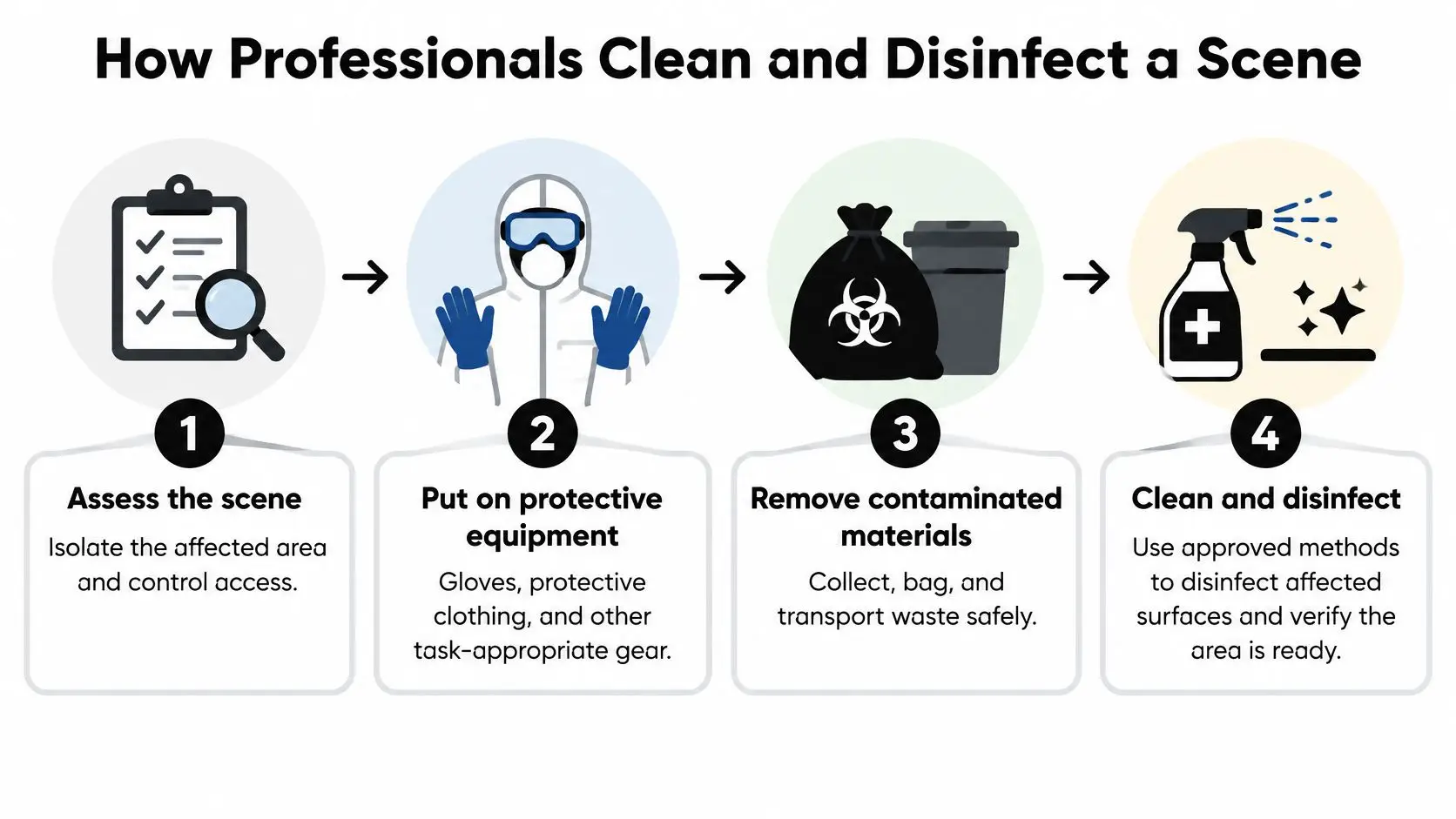
Seven Steps That Make Up a Real Job
- Assess and isolate. The crew identifies the contaminant, finds how far it traveled, closes off the area, and controls who enters.
- Put on task-appropriate protection. Gloves, protective clothing, masks or face shields, and eye protection, matched to the job rather than grabbed from a bucket.
- Remove contaminated porous material. Carpet, padding, mattress fill, insulation, and saturated drywall come out and get bagged as regulated waste.
- Clean the surface. Neutral detergent and warm water first, because disinfectant works poorly on top of soil.
- Apply an EPA-registered disinfectant and keep it visibly wet for the full label contact time. The EPA's guidance on registered disinfectants defines contact time as the period the product must remain visibly wet on the surface. Drying early lowers effectiveness, so a crew that wipes after 30 seconds has mostly wasted the product.
- Verify the result. Visual inspection, plus ATP testing where the surface allows it, tells you whether the work is finished rather than merely dry.
- Document disposal and hand over a completion report. This is the paperwork your insurer and any future buyer or tenant will ask about.
The Chemistry Depends on the Surface
CDC guidance for blood spills points to EPA-registered tuberculocidal products or germicides labeled for HIV or HBV, and for nonporous surfaces it lists hypochlorite dilutions: a 1:100 mix of 5.25–6.15% sodium hypochlorite, roughly 525–615 ppm available chlorine, for a small spill, and a stronger 1:10 first application before cleaning for a larger one, per the CDC disinfection recommendations. Keep a surface wet for the labeled time before rinsing; one example in CDC's environmental cleaning procedures is 10 minutes.
Those dilutions belong on nonporous surfaces only. Never improvise bleach on fabric, wood, drywall, or metal, where it can bleach, warp, corrode, or fail to reach what soaked in.
| Spill size | Surface | Reference method |
|---|---|---|
| Small spill | Nonporous surface | 1:100 dilution of 5.25–6.15% sodium hypochlorite (about 525–615 ppm available chlorine) |
| Larger spill | Nonporous surface | Stronger 1:10 first application before cleaning |
| Any size | Fabric, wood, drywall or metal | No improvised bleach; method chosen after assessment |
Containment is what keeps the problem in one room. Without it, contamination rides air and foot traffic into unaffected rooms and HVAC systems, and that second cleanup costs more than the first. Scope, materials, and timing change from scene to scene, so ask your provider to explain the plan for this room, not for trauma scenes in general. Our body fluids cleanup process starts with that same assessment step.
Certifications, Insurance and Local Rules to Check
Credentials are how you separate a trained crew from a well-designed website. Start with IICRC certification, which shows technicians are trained to recognized restoration standards. Ask for the certificate and the names of the technicians assigned to your job, because certification belongs to people, not to a logo on a van.
Then work through licensing, bonding, and insurance. Ask for the current license and a certificate of insurance, and check that the certificate covers the work being done at your address. We're IICRC certified, licensed, bonded, and insured, and we accept all insurance companies, so you're not asked to switch carriers mid-claim.
What to Ask Your Insurer First
Call your insurer before you call a cleanup company. Ask three questions: whether biohazard or trauma cleanup is covered under your policy, whether the insurer uses preferred vendors, and what documentation it needs from you, such as photos, estimates, and invoices. Coverage varies by policy, and no provider can promise you an insurance outcome.
Paperwork that protects you: the estimate, the certificate of insurance, the waste manifest, and the completion report belong in one folder, in that order.
Disposal rules are set locally. Confirm them with your city or county, and ask the provider for disposal documentation rather than a verbal assurance. If you manage staff, the same logic appears in general work health and safety obligations, which is why the records matter as much as the cleaning.
| Credential or document | What it shows | What to request |
|---|---|---|
| IICRC certification | Technicians trained to restoration standards | Certificate and technician names |
| Licensed, bonded and insured | Business authorization and financial protection | Current license and certificate of insurance |
| Insurer relationship | Whether the provider works with your insurer | Written confirmation, if one exists |
| Waste disposal records | Regulated waste left the site properly | Waste manifest or disposal documentation |
Landlords have one more step. Read the lease and your tenant notice duties before you schedule anything, because access, privacy, and relocation terms are usually written there rather than invented on the day. Our bonded and insured contractor page covers what those protections mean for a property owner.
How to Vet a Local Trauma Cleanup Provider
Ask in this order and keep every answer. The point isn't to interrogate anyone. It's to hold the same standard across two or three companies so the comparison is real.
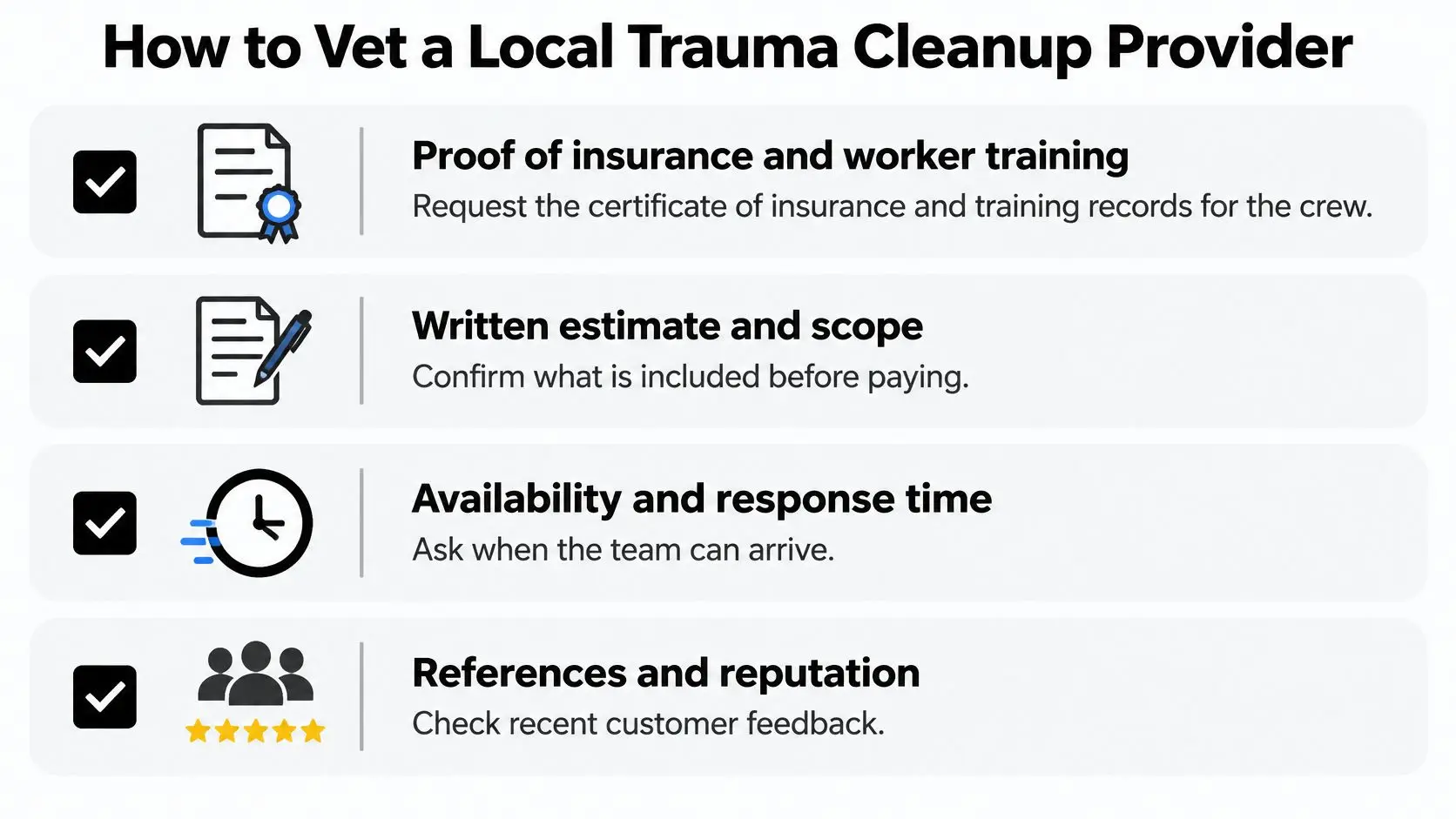
- Insurance and training. Request the certificate of insurance and the training records for the crew coming to your address.
- A written, site-specific risk assessment. It should name the protective equipment, the containment approach, and how access will be controlled.
- Containment. Ask how the work stays in one room, and whether negative-pressure or HEPA filtration will be used where appropriate.
- Porous materials. Ask which items will be removed and which will be cleaned. Carpet, drywall, mattresses, and wood rarely survive a blood spill intact.
- Hidden contamination. Ask how the crew finds spread beyond the visible stain, such as seams, subfloor, and wall cavities.
- Disinfection. Ask for the product name, its label contact time, and how the surface stays wet that long.
- Verification. Ask whether the job ends with visual inspection, ATP testing, or both, and get the answer in writing.
- Waste and completion. Ask for the waste manifest, disposal records, and a final completion report.
California's public health department requires commercial trauma-scene waste practitioners to register, maintain an approved waste-transfer or treatment arrangement, and hold that registration before starting work, according to the CDPH trauma scene waste practitioner checklist. Not every state runs the same program, but the underlying question travels: can this company prove where the waste went?
The Trap in a Fast Arrival
The van that arrives first isn't automatically the safest or the cheapest. Weak containment spreads contamination into rooms and ductwork that were fine, and the second remediation lands on your invoice. Speed is worth something. It isn't worth everything.
| Question to ask | Proof to receive | Red flag |
|---|---|---|
| Are the crew insured and trained? | Certificate of insurance and training records | Documents refused or delayed |
| How will the risk be controlled on site? | Written site-specific risk assessment | No written plan |
| How will spread be contained? | Description of containment and filtration | No containment step described |
| How are carpet, drywall and mattresses handled? | Written list of removed versus cleaned materials | Every item promised to be cleaned |
| How will hidden contamination be found? | Described inspection method | No inspection method |
| Which disinfectant and contact time are used? | Product name and label contact time | Vague or unlabeled product |
| How is the result verified? | Visual inspection, ATP testing or both, in writing | Verification is only visual or not defined |
| What proves the waste was disposed of properly? | Waste manifest and completion report | No disposal records offered |
A free onsite estimate and a free inspection are reasonable things to expect before you commit. We provide both, 24/7, at 480-690-5277 or through our contact form, so you can compare written answers instead of phone manners. Start with our biohazard cleanup services near me page to see what a scope of work looks like.
Confirm Your Provider and Book Today
You don't need perfect information. You need two or three providers run through the same checklist, and written answers to compare side by side.
Request service through the contact form and choose Trauma & Biohazard Cleanup from the service options, or call 480-690-5277 and ask for an inspection. Get a written estimate and scope before any work starts. Cost depends on how large the affected area is, which materials have to come out, and what disposal requires, so ask each provider to itemize those three factors. No responsible company quotes a trauma job over the phone, and this guide doesn't quote prices either.
Use conditional timing in your own planning. OSHA requires contaminated surfaces to be decontaminated immediately or as soon as feasible after a spill, but as the CDC's environmental cleaning procedures note, neither framework sets a private contractor's dispatch time or guarantees a property is usable again by a fixed date. Arrival, completion dates, and results are subject to availability and site conditions. Be cautious with any provider that promises a fixed arrival time or a guaranteed outcome without ever seeing the room.
Confirm the completion report and the waste documentation before you pay the final invoice. Then choose.
If you're facing this in the Phoenix metro, Restore Heroes handles trauma, crime scene, and biohazard cleanup for homes and commercial buildings, from containment and removal through disinfection, regulated disposal, and the completion paperwork your insurer will ask for. The team is available 24/7, IICRC certified, licensed, bonded, and insured, and will provide a free onsite estimate and inspection before any work begins. Call 480-690-5277 or send the request through the contact form, then hold the written answers next to the ones you collect from the other providers before you decide.