
You open a door, step into a room, and know right away this isn’t a normal cleaning job. Maybe it’s the aftermath of an accident. Maybe a tenant hasn’t been heard from for days. Maybe first responders have already left, and now the property is quiet in the worst possible way.
In that moment, individuals often search for biohazard cleanup services near me because they need help fast, but they also need to know what happens next. In Phoenix, the right next step isn’t guessing, scrubbing, or trying to make the problem disappear before anyone sees it. It’s protecting people first, then bringing in a trained crew that knows how to contain, remove, disinfect, document, and coordinate the job properly.
The hardest part for many owners isn’t only the scene itself. It’s the mix of health concerns, property damage, and insurance confusion that follows. A safe cleanup has to address all three.
When the Unthinkable Happens at Your Phoenix Property
A lot of calls start the same way. Someone says they found a room they don’t want anyone else walking into. They’re worried about a parent, a tenant, an employee, or a customer. They don’t know if they should touch anything, air the place out, or start cleaning before family or staff arrive.
The first thing to understand is simple. A biohazard scene can carry invisible exposure risks even when the visible area looks limited. Bloodborne pathogens are the reason trained remediation exists in the first place.
Diseases such as Hepatitis B, Hepatitis C, and HIV are among the risks professionals plan for in trauma cleanup. According to CDC data referenced in industry protocols, Hepatitis B has an infection rate of up to 30% from needle-stick injuries among untrained cleaners, while HIV transmission risk stands at approximately 0.3% in that same type of exposure scenario, as noted by HAZstat’s biohazard cleanup overview.
That’s why this work isn’t janitorial. It’s controlled remediation.
If the scene involves blood, bodily fluids, decomposition, drug residue, or contaminated materials, the safest response is to keep people out and use a certified team trained for biological hazards. A professional crew handles protective equipment, containment, cleaning chemistry, disposal rules, and documentation. If you need a clearer idea of what that kind of service includes, this overview of biological clean up is a good starting point.
Practical rule: If you’re asking whether a scene is serious enough for professional cleanup, it usually is.
The emotional side matters too. People in shock tend to focus on the stain they can see. Addressing the contamination that reached the air, the porous materials, and the spaces around the obvious source is the true task.
Your First Response Before Professional Help Arrives
The first hour matters. The goal isn’t to fix the problem. The goal is to keep the problem from getting worse.
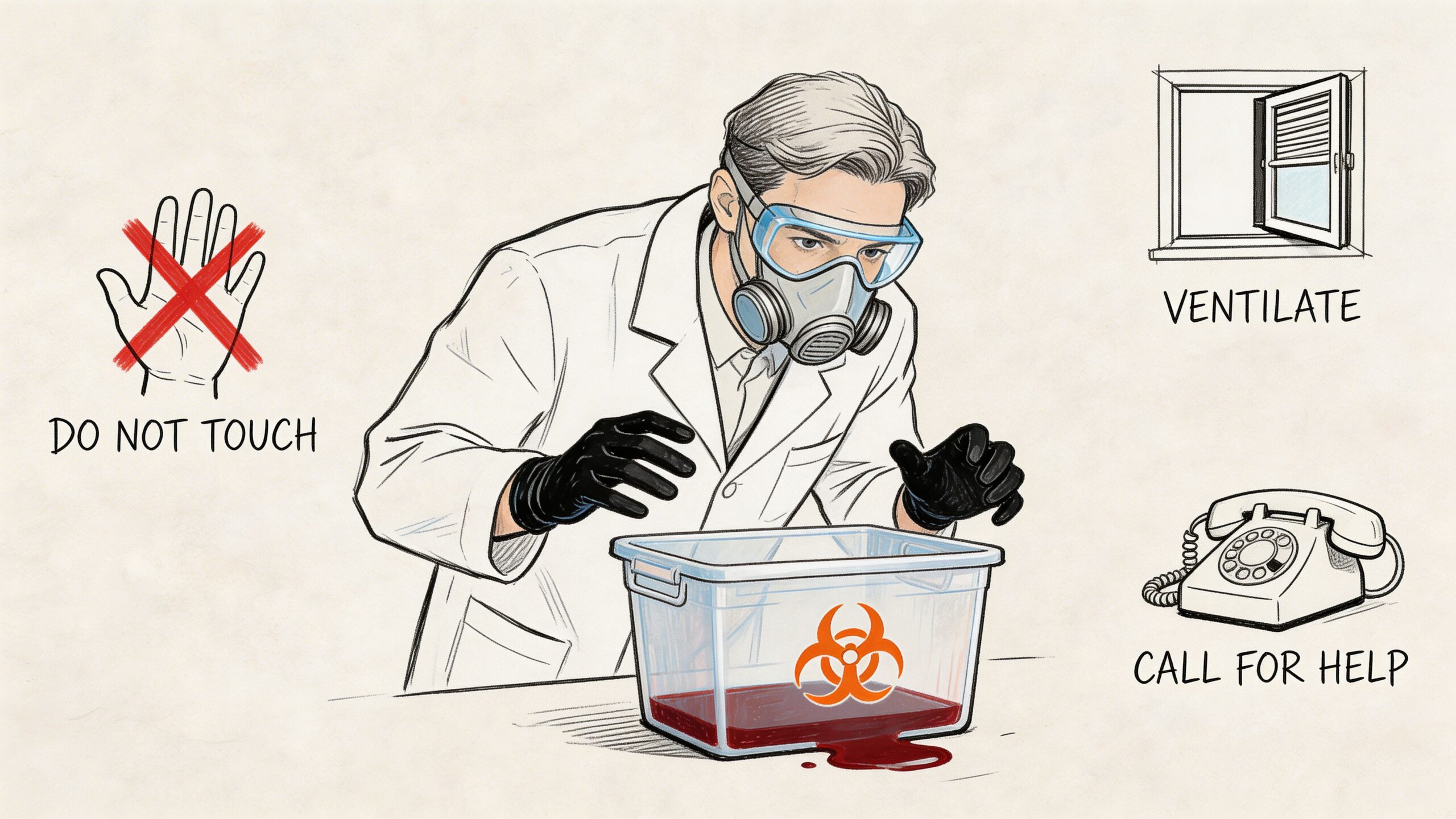
What to do right away
Secure the area. Close doors if you can do that without touching contaminated surfaces. Keep family members, tenants, staff, and pets away from the room or affected zone.
Limit foot traffic. Every extra step increases the chance of tracking contamination into hallways, carpet, tile grout, or vehicles.
Shut off the HVAC serving that area if it’s safe to access the controls. Air movement can spread particulates and odor into other parts of the property. If the controls require passing through contamination, leave them alone and wait for professionals.
Document what you can from a safe distance. A few photos or short videos can help with later insurance questions. Don’t stage the scene, move objects, or get closer just to take better pictures.
Call a qualified hazardous cleanup provider. If you need to understand the type of work involved, this page on hazardous clean up outlines the scope more clearly than most general cleaning descriptions.
What not to do
A lot of well-meaning actions create bigger problems.
- Don’t use bleach as a first response. Bleach is often the first thing people grab, but it isn’t a universal solution for every biohazard condition. It can also create dangerous reactions if mixed with other household chemicals.
- Don’t scrub or blot. That can push contamination deeper into carpet, grout, wood, drywall seams, and subfloor joints.
- Don’t use a household vacuum. Standard vacuums aren’t designed for this kind of material and can spread particles rather than control them.
- Don’t bag waste in ordinary trash bags for curb pickup. Biohazardous material has to be handled and disposed of under regulated procedures.
- Don’t try to save every item. Upholstered furniture, mattresses, cardboard, and other absorbent contents may not be safely restorable.
The safest mindset
Treat the area like a place that needs containment, not a mess that needs tidying.
A calm response usually looks like this:
| Situation | Safer choice | Riskier choice |
|---|---|---|
| Open room with visible contamination | Close off access | Let people walk through to inspect |
| Strong odor in one zone | Isolate the area | Open interior doors and run fans |
| Need evidence for insurer | Take distant photos | Move items around for clearer shots |
| Unsure what touched what | Assume spread is possible | Guess based on appearance |
Leave the scene as undisturbed as possible. A trained crew would rather start with intact contamination boundaries than undo accidental spreading caused by panic cleaning.
If police, fire, or EMS were involved, wait until the property is legally released before arranging remediation. Once that happens, the cleanup team can begin the controlled part of the process.
Hiring a Certified Biohazard Cleanup Service in Phoenix
When people search for biohazard cleanup services near me, the results often look similar. Same words. Same promises. Same stock photos of protective suits. The difference shows up in credentials, hazard-specific training, and documentation.
Essential Requirements
Start with the basics and verify them.
- Certification: Ask what training the technicians have for trauma, bodily fluid, decomposition, and hazardous residue cleanup.
- Insurance and bonding: The company should be properly insured for this kind of work, not just general cleaning.
- Waste handling: Ask how contaminated materials are packaged, transported, and documented.
- Scene documentation: The provider should be able to produce clear records for property owners and insurers.
- Scope clarity: A serious company should explain what gets cleaned, what gets removed, and what may need reconstruction later.
One Phoenix option property owners may compare is Restore Heroes’ biohazard remediation company service, which presents the kind of remediation scope and documentation questions worth asking any provider.
Ask about fentanyl and chemical hazard training
This matters more now than many owners realize.
CDC data from Q1 2025 reports a 22% national increase in fentanyl-related overdose scenes requiring hazmat cleanup, with Arizona’s Maricopa County logging 1,800 cases in 2025 alone. Recent OSHA updates mandate specific certification for opioid remediation, yet only an estimated 35% of U.S. providers comply, according to Trauma Services’ summary of those figures.
That means a company can market itself as “biohazard” and still be a poor fit for opioid residue or mixed-scene contamination.
Questions worth asking on the phone
Instead of asking “How much do you charge?” first, ask questions that reveal whether the crew is qualified.
What hazards are you trained to handle besides blood?
A useful answer should mention decomposition, sharps, drug residue, and contaminated porous materials.
How do you prevent cross-contamination?
You want to hear about containment, controlled entry, protective equipment, and air management. If the answer sounds like ordinary deep cleaning, keep looking.
How do you document disposal and remediation?
A qualified provider should be able to describe manifests, invoices, and job records in plain language.
Can you coordinate with the insurance adjuster if needed?
This doesn’t guarantee coverage, but it tells you whether the company understands the paperwork side of the job.
Red flags that should slow you down
Some warning signs show up fast.
| Red flag | Why it matters |
|---|---|
| They describe the work like maid service | Biohazard remediation isn’t routine cleaning |
| They won’t discuss disposal procedures | Waste handling is a core compliance issue |
| They avoid certification questions | Training gaps create safety and liability problems |
| They give a price without discussing scope | Scene size and material penetration affect the job |
| They push instant approval without documentation | Insurance disputes often turn on paperwork |
The best hiring decision usually comes from one question: Do they sound like they’re managing risk, or just removing stains?
That difference is everything in this field.
The Professional Biohazard Remediation Process Explained
Most distressed owners feel better once they know the cleanup follows a sequence. A proper remediation job isn’t random. It’s closer to a controlled technical procedure than to cleaning in the usual sense.
Early in the process, crews establish the work zone, then bring in the right gear and supplies.
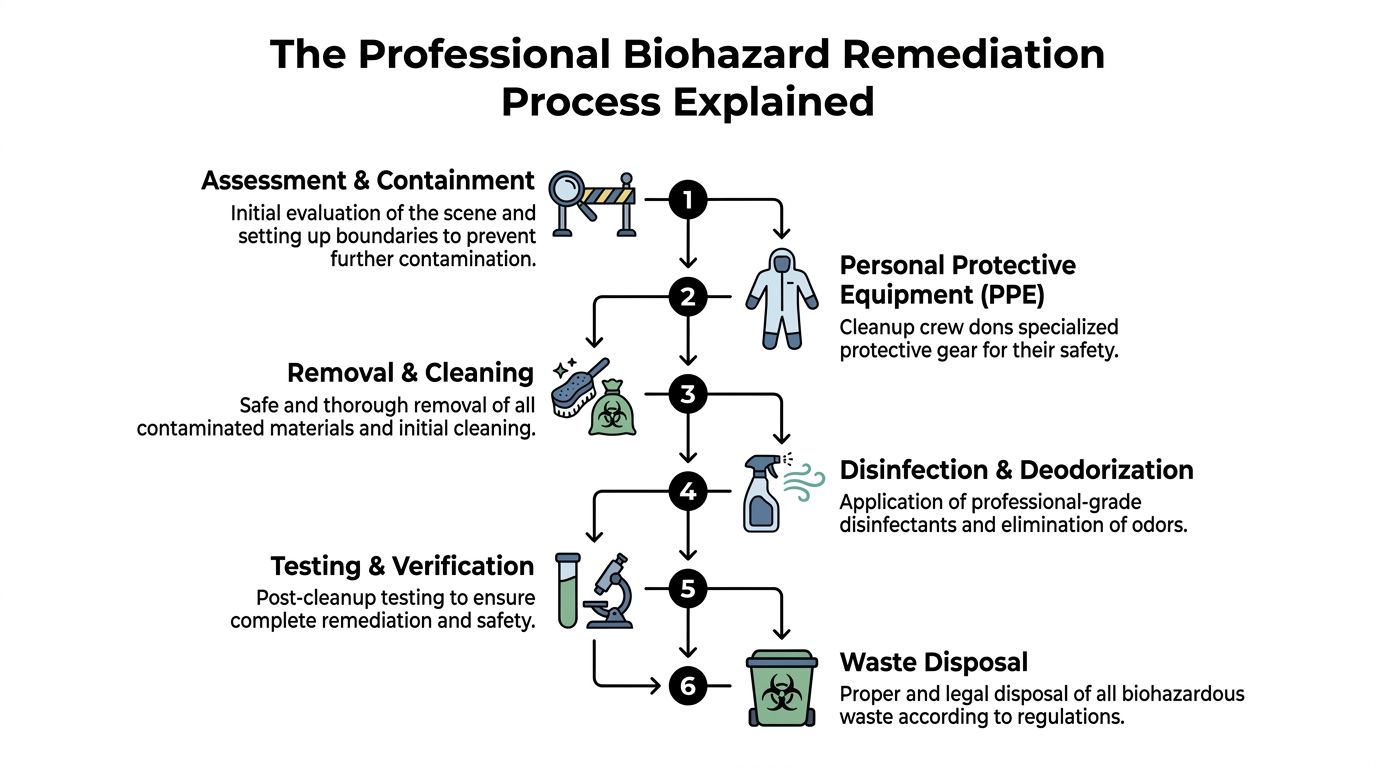
Assessment and containment
The first step is figuring out the true footprint of contamination.
That means identifying visible impact, likely spread paths, porous materials that may have absorbed fluids, and nearby areas that need protection. Then the crew isolates the site with barriers and controlled access points.
Containment matters because contamination spreads easily through shoes, tools, air movement, and careless handling. Negative air machines are often used to help control airborne particulates and keep the work area isolated from cleaner parts of the property.
PPE and controlled removal
The professional method uses full PPE, containment with negative air machines, gross removal of materials into marked containers, and decontamination with hospital-grade disinfectants. Verification often includes ATP swabbing, with a benchmark of less than 10 RLU indicating a pass, while incomplete cleanups show failure rates of 40 to 60 percent, according to Mira Safety’s guide to professional biohazard cleanup.
In plain terms, ATP testing is a fast way to check whether organic residue remains on a surface. It doesn’t replace judgment, but it gives the crew a measurable cleanliness target instead of relying on appearance alone.
A scene can look clean and still fail as a safe remediation if residue remains in seams, pores, or surrounding materials.
Removal happens before polishing. That surprises some property owners. If drywall, carpet pad, insulation, baseboards, or contents are contaminated beyond safe recovery, those materials are removed, bagged, and handled as regulated waste. Trying to “save” heavily affected porous materials often creates odor and sanitation problems later.
Deep disinfection and odor work
After gross contamination is removed, technicians move into detailed cleaning and disinfection.
That usually includes repeated treatment of hard surfaces, attention to cracks and transitions, and deodorization that addresses the source rather than trying to cover odor. In healthcare-style disinfection work, understanding which products effectively kill C. diff spores is a good example of why product choice and contact time matter so much. The chemistry has to match the hazard.
Video can make this easier to picture in real space:
A company handling this kind of work should be able to explain the difference between cleaning, disinfecting, and deodorizing. They are related, but they are not the same task.
Verification and disposal
The last phase is where professional work separates itself from improvised work.
- Surface verification: The crew checks whether cleaned areas meet the target standard used on the job.
- Visual confirmation: This matters, but only as one part of the review.
- Waste packaging and transfer: Contaminated materials are placed in marked containers and moved through the proper disposal chain.
- Job records: Owners often need these for insurers, property files, or future buyers and managers.
For Phoenix owners comparing providers, hazmat cleanup services should include that full chain of work, not just the visible cleanup portion.
What works is a methodical process with containment, removal, disinfection, verification, and disposal. What doesn’t work is skipping straight to chemicals and hoping the smell goes away.
Navigating Insurance and Potential Costs
This is the part many families and property managers don’t expect. The cleanup itself is difficult enough. Then the insurance questions start.
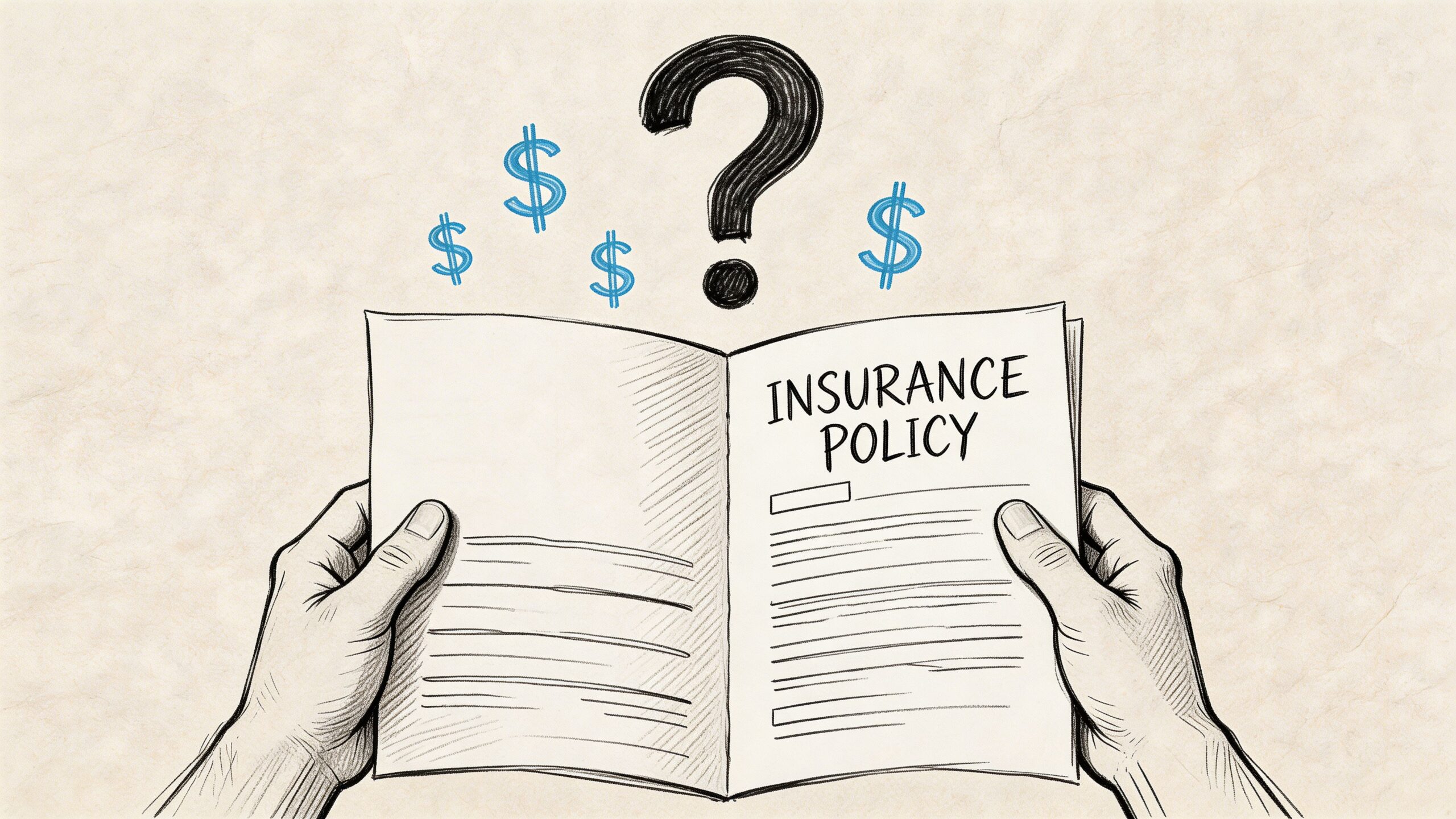
A lot of service pages say some version of “insurance accepted” or “little to no out-of-pocket cost.” Real life is less tidy. Coverage often depends on the cause of loss, the exact wording in the policy, whether contamination exclusions apply, and how the claim is documented from the start.
A 2023 industry report indicated that biohazard claims are denied in approximately 28% of cases due to contamination exclusions. Google Trends data shows a 40% spike in “biohazard cleanup insurance denied” searches in the Phoenix metro area, where bills can range from $5,000 to $20,000 without coverage, according to Bio Recovery’s insurance-focused overview.
Why claims get complicated
The trouble usually isn’t that the damage isn’t real. It’s that policies don’t always describe contamination events in plain English.
A homeowner may assume an unattended death cleanup falls under property damage. A commercial owner may assume a bodily fluid event is part of standard premises coverage. Then the carrier points to a contamination exclusion, a cause-of-loss limitation, or a documentation issue.
For businesses, it can help to review a plain-language breakdown of what a Business Owners Policy (BOP) covers before talking with the carrier or broker. That won’t answer every biohazard question, but it helps owners understand how property and liability coverages are often organized.
What to document immediately
Good claim support starts before the cleanup is finished.
Use this checklist if it’s safe to do so:
- Scene photos from a safe distance: Capture entry points, affected rooms, and visible material conditions.
- Short video walkthrough: Keep it simple and don’t touch anything.
- Timeline notes: Write down when the scene was discovered, when authorities arrived if applicable, and when the property was released.
- Contact log: Note who you spoke with at the carrier, agency, property management office, or cleanup company.
- Policy information: Have the policy number, insured name, and carrier contact information ready.
- Cleanup records: Ask for itemized invoices, scope notes, and disposal documentation when available.
Who to call first
There isn’t one answer for every loss, but the safest practical approach is usually to notify the insurer early and also speak with the remediation company promptly so documentation starts correctly.
If you wait too long to report the incident, the carrier may question the timeline. If you wait too long to involve a qualified cleanup company, the scene can worsen or the documentation can become weaker.
Documentation beats memory. The more clearly the file shows cause, condition, scope, and professional handling, the easier it is for an adjuster to evaluate the claim.
Questions to ask your insurer or adjuster
Don’t ask only “Is this covered?” Ask narrower questions.
| Ask this | Why it helps |
|---|---|
| Does my policy have a contamination exclusion? | This often drives the dispute |
| Is the event considered sudden or excluded? | Cause of loss affects treatment |
| What documentation do you need from the remediation company? | Prevents missing paperwork later |
| Do you need photos before removal begins? | Some carriers want pre-mitigation evidence |
| Are structural repairs reviewed separately from remediation? | Cleanup and rebuild may be handled differently |
How a cleanup company can help without promising coverage
A professional remediation company can support the claim process by providing detailed invoices, scope notes, photos, and direct communication with adjusters. That doesn’t force approval, and nobody should imply that it does.
If you’re trying to understand typical pricing factors before speaking with a carrier, this guide to the cost of crime scene cleanup can help frame the variables involved.
What usually improves the process is not a promise. It’s a well-documented file, a clear scope of work, and a provider who knows how to explain the remediation in insurance language.
After the Cleanup Final Steps and Property Restoration
Once the biological hazard is removed, owners often expect the job to be over. Sometimes it is. Often, there’s one more layer.
That layer is restoring the property so it’s not only disinfected, but also physically sound and usable again.
Hidden penetration matters
In many scenes, fluids don’t stay on the surface. They move into seams, edges, padding, subfloors, and wall cavities.
According to this guide on professional biohazard cleanup and structural remediation, fluids can penetrate porous materials like drywall and subfloors, and remediation may require cutting drywall 18 to 24 inches above the visible stain line per IICRC guidelines and treating the underlying structure to prevent future microbial growth.
That’s why a room may need removal and rebuild work after the sanitation phase. It isn’t overkill. It’s what full recovery looks like when materials absorbed contamination.
What final restoration can include
Some properties need only localized replacement. Others need broader finish work.
- Drywall and trim replacement: Removed materials have to be rebuilt cleanly.
- Flooring restoration: Carpet, pad, laminate, or portions of subfloor may need replacement.
- Odor treatment: Source removal comes first, then professional deodorization addresses what remains in the structure.
- Paint and sealing: Exposed framing or repaired surfaces may need sealing and refinishing.
If odor remains after “cleanup,” that usually points to missed source material, affected porous surfaces, or incomplete structural treatment.
What owners should expect at the end
A proper closeout should leave you with a clear understanding of what was remediated, what was removed, and what still needs reconstruction if any finishes were opened.
That final handoff matters for homeowners, landlords, facility managers, and anyone preparing a property for re-occupancy, sale, or turnover.
Frequently Asked Questions About Biohazard Services
How long does biohazard cleanup take
It depends on the size of the affected area, the type of contamination, how far fluids or residue spread, and whether porous building materials need removal.
A small, contained scene may move much faster than a room where contamination entered drywall, flooring, or contents. The best estimates come after an on-site assessment.
Will there be a lingering odor
Not if the source is fully addressed, but odor control has to be done correctly.
Air fresheners and household sprays don’t solve biological odor. Professionals focus on removing affected material, cleaning structural surfaces, and treating the air and surrounding area so the odor source is dealt with.
Is it safe to stay in another part of the property during cleanup
Sometimes yes, sometimes no.
That decision depends on where the contamination is, whether the area can be properly isolated, how the HVAC is configured, and what hazards are present. In a detached commercial suite, isolation may be simpler. In a small home with shared airflow, temporary relocation may be the safer choice.
Can I clean a small area myself if I wear gloves
That’s not a safe assumption.
Gloves alone don’t create a safe remediation setup. The key issues are exposure control, surface penetration, disposal rules, and the risk of spreading contamination beyond the visible area.
How is biohazard waste disposed of legally
It has to be packaged, marked, transported, and processed through the proper regulated channels.
That includes handling contaminated materials separately from ordinary trash. If a provider is vague about disposal, that’s a problem.
What if the scene involved an unattended death
Those scenes often involve deeper structural impact, stronger odor, and more complicated insurance questions.
They also carry a heavier emotional load for families and property staff. The right crew should treat the space carefully, protect privacy, and document the work without turning the job into spectacle.
Do I need a company that understands insurance paperwork
Yes. Even when coverage is uncertain, clear documentation helps.
A provider should be able to produce organized records that explain what was found, what was removed, what was disinfected, and what materials required disposal. That kind of file helps owners, managers, and adjusters work from the same facts.
What should I ask when comparing biohazard cleanup services near me
Ask about certification, hazard-specific training, containment methods, waste disposal procedures, and insurance documentation.
If they only talk about speed or basic cleaning, keep asking questions. In this kind of work, the details are the service.
If you’re facing a traumatic cleanup at your home, rental, or commercial property, Restore Heroes is one Phoenix-area option to contact for biohazard remediation and related restoration support. A qualified team can help you understand the safety steps, document the loss, and coordinate the cleanup process without making a hard situation harder.