
IICRC certification is a professional credential for individual inspection, cleaning and restoration technicians, issued by a nonprofit and built on ANSI-accredited standards. Certified Technicians must complete 14 continuing education hours during each four-year renewal cycle.
But if a restoration company displays the badge, do you know whether the person entering your home holds the credential your damage requires? That's the gap behind the question, what is IICRC certification? Understanding the designation means checking the person, the specialty and the paperwork, not recognizing a logo.
What IICRC Certification Means for Property Owners
The Institute of Inspection Cleaning and Restoration Certification, or IICRC, awards professional credentials tied to specific inspection, cleaning and restoration disciplines. It's a nonprofit credentialing and standards organization, not the contractor performing repairs at your property.
Founded by Ed York in 1972 as the International Institute of Carpet and Upholstery Cleaning, Inc., the organization later expanded into broader restoration disciplines, according to the IICRC's organizational history. By 2026, that same organizational overview reported more than 49,000 active Certified Technicians and more than 6,500 Certified Firms worldwide.
Its credentialing framework covers more than 20 categories, including water restoration, applied structural drying, fire and smoke restoration, and microbial remediation, as described in the IICRC's S500 publication announcement. The specialty matters as much as the organization's name.
Think of a driver's license and a motorcycle endorsement. Both concern operating vehicles, but the endorsement identifies preparation for a particular vehicle. Likewise, a water-restoration credential doesn't establish competence in every other restoration discipline.
The diagram separates the organization, the individual and the credential.
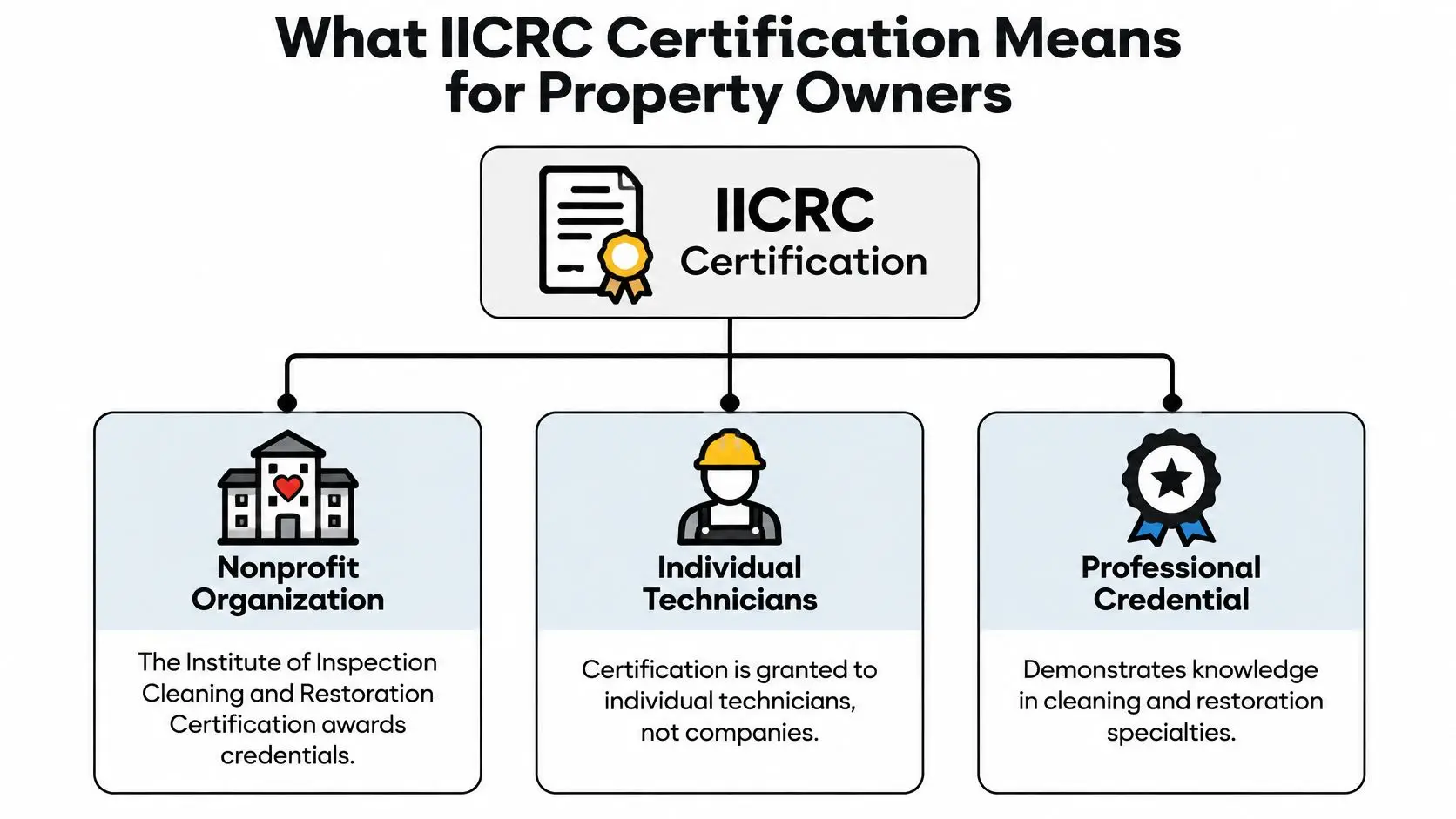
Individual certification versus Certified Firm
Individual certification belongs to a person. Certified Firm is a separate company designation, so the diagram's emphasis on individual credentials shouldn't be mistaken for an absence of firm recognition.
| Credential | Who Holds It | Requirement | What It Shows |
|---|---|---|---|
| Certified Technician | One person | Category education and examination; continuing education | Personal competence in a specific specialty |
| Certified Firm | A company | An active Certified Technician, current liability insurance and an application fee | The company maintains certified staff and insurance |
| Master or Inspector | One person | Designation-specific advanced pathway and more frequent continuing education | Advanced qualifications within the credential's scope |
For a homeowner, the useful takeaway is straightforward: a company claiming IICRC certification should be able to name who holds which credential. For an adjuster, those names also help establish who evaluated the damage and made technical decisions.
How Technicians Earn and Keep Certification
Earning a credential works like earning a driver's license: sitting through a course gets a technician to the exam room, and passing the examination is what puts the credential in their hands. Requirements differ sharply by designation, so an entry-level technician credential, a specialist credential and a master designation are not interchangeable tiers of the same thing.
Certification requirements by credential
| Credential | Experience or Exam Rule | Renewal Rule | What It Signals |
|---|---|---|---|
| Certified Technician | Category education and examination | 14 CECs per four-year cycle | Continued learning in a certified category |
| Mold Remediation Specialist | At least one year of verifiable mold-remediation experience; examination within 90 days of approval, with up to two attempts | 14 CECs per four-year cycle | Mold-specific experience and assessment |
| Master Water Restorer | Water Restoration Technician, Applied Structural Drying, Health and Safety Technician and related credentials, plus at least three consecutive years as a Certified Technician | 14 CECs every two years | Multi-discipline water-restoration progression |
| Master or Inspector | Designation-specific advanced pathway | 14 CECs every two years | Advanced standing maintained on a shorter renewal cycle |
The IICRC certification FAQs set the 14-CEC four-year technician cycle, the 14-CEC two-year Master and Inspector cycle, and the Master Water Restorer's three-consecutive-year progression requirement. For the Mold Remediation Specialist row, the IICRC certification information page lists the year of verifiable experience and places the designation on that same four-year technician renewal cycle. Its Mold Remediation Specialist candidate handbook gives approved applicants 90 days to sit the examination and permits no more than two attempts, an initial examination and a retest.
Why renewal matters
Continuing education credits, or CECs, are the documented proof that a technician kept learning after the exam. Equipment, contamination controls, inspection methods and technical guidance all change between renewal cycles, so a certificate framed years ago says little about current standing on its own. A lapsed credential works like an expired driver's license: it shows the holder once qualified, and that is all it shows.
This is also where the credential type earns its keep as a verification tool. A master pathway adds breadth and documented experience inside one discipline family, which is why the water route, from Water Restoration Technician up through Master Water Restorer, is detailed in our guide to water damage restoration technician certification. A mold loss calls for the specialist row of the table above, while a complex water loss leans on the water pathway and its layered prerequisites. Match the designation to the loss in front of you, and the table becomes a checklist rather than alphabet soup.
Practical rule: Check the credential's current status and exact designation, not just the date on a framed training certificate.
Which IICRC Standards Shape the Work
A credential describes a technician's qualifications. A standard describes procedures and considerations that guide the work.
For water losses, ANSI/IICRC S500 covers residential, commercial and institutional restoration, including moisture assessment, psychrometry, drying technology, equipment, safety and documentation. Psychrometry means understanding how air temperature, humidity and moisture interact, knowledge technicians use when evaluating drying conditions.
Key IICRC standards by loss or area
| Loss or Area | Governing Standard | What It Guides |
|---|---|---|
| Water damage | ANSI/IICRC S500 | Moisture inspection, extraction, drying, equipment and documentation |
| Fire and smoke | ANSI/IICRC S700 | Professional fire and smoke restoration |
| Commercial and infection-sensitive spaces | Applicable new or revised IICRC standards | Commercial cleaning and infection prevention within each document's scope |
The IICRC standards FAQs describe voluntary consensus standards developed through an ANSI-accredited process; they also identify the first edition of ANSI/IICRC S700, published in 2025, and developments in commercial cleaning, infection prevention and upholstery cleaning.
The practical connection is a chain of decisions. A technician inspects materials and measures moisture, then selects extraction and drying methods. Monitoring helps determine whether the equipment arrangement is working, while records explain why the technician adjusted or ended the process.
Say water reaches a kitchen cabinet base. A dry-looking tile floor doesn't establish that the cabinet backing or adjacent wall is dry. The technician needs measurements that address those materials, not just an assessment of the visible surface.
A standard provides a procedural foundation. It doesn't replace judgment about the building, materials, contamination or access limitations.
Our guide to IICRC water damage restoration connects those principles to a water-loss project. Request moisture maps, equipment records, monitoring readings and a documented drying completion rationale, including an explanation of any inaccessible areas.
How to Check a Company's Credentials Step by Step
Verification works best when you connect credentials to the people assigned to your property. A company's marketing page can start the conversation, but it shouldn't end it.
Use this visual checklist to organize the initial checks.
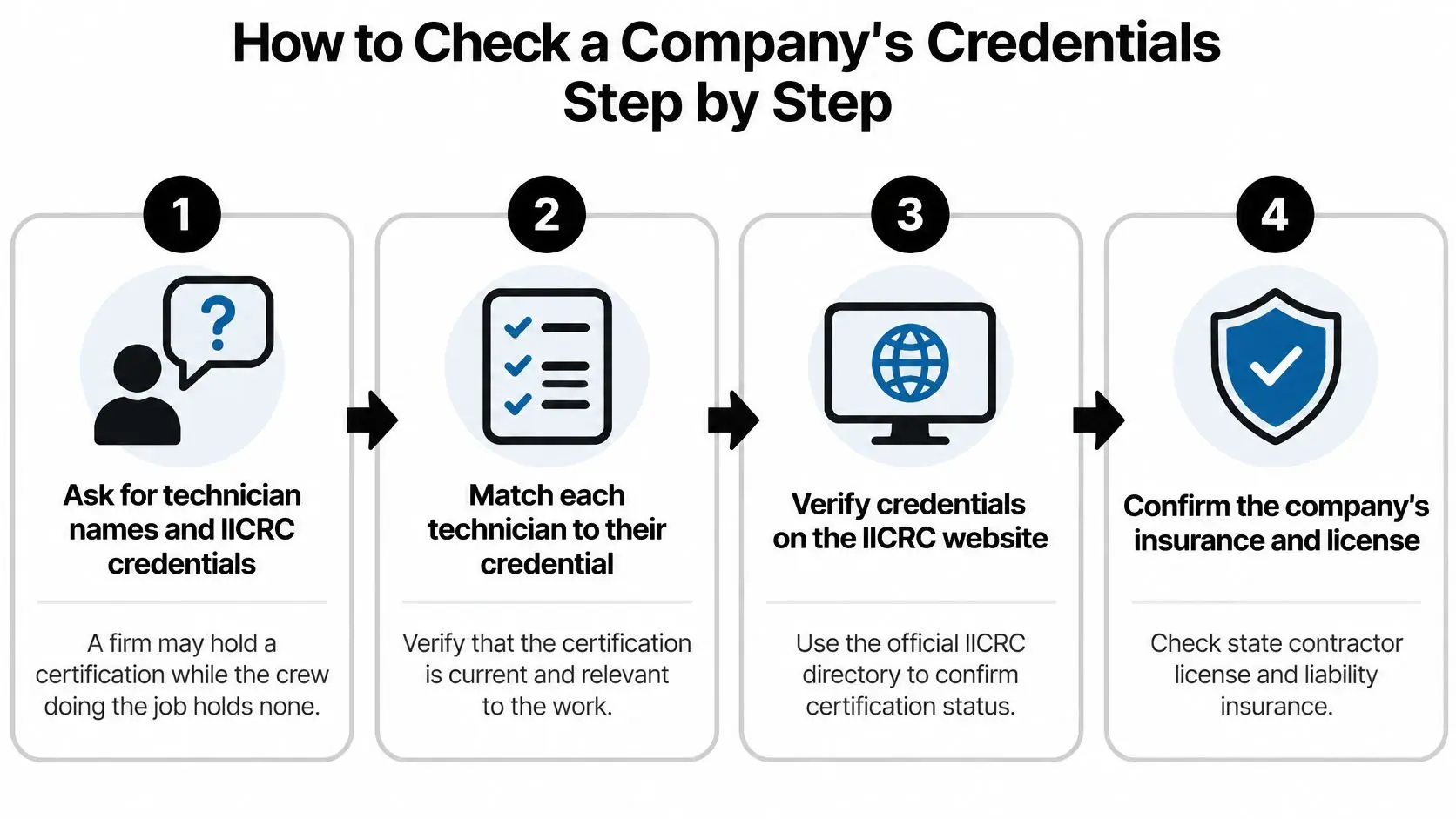
Establish who is responsible
Get the assigned technicians' names and credentials. Ask who will inspect, supervise and perform the work. A firm designation doesn't establish that every crew member holds an individual credential. Check current status through the IICRC's verification resources rather than relying solely on a logo.
Match the specialty to the damage. Water extraction, smoke cleanup, mold remediation and trauma cleanup involve different competencies. If the project changes, ask whether the personnel and qualifications need to change too.
Clarify the company's designation. Ask whether it holds Certified Firm status or employs individually certified personnel. Record the answer precisely instead of reducing either arrangement to a vague certified label.
Verify licensing, bonding and insurance separately. We're IICRC certified, licensed, bonded and insured at Restore Heroes. Our explanation of a water damage restoration license helps distinguish contractor authorization from technical credentials; compare current documentation rather than assuming one substitutes for another.
Examine the proposed work
Request a written scope and an initial moisture map. For a water loss, the map should identify affected locations and readings, while the scope should explain what the contractor proposes to extract, dry, remove or evaluate further. Ask how concealed or inaccessible materials will be assessed.
Request progress records and completion criteria. Drying logs should connect readings to locations and materials. Equipment records should identify what was used, and the completion explanation should show why the technician considers the drying objectives met.
Read the warranty before signing. Ask what it covers, what it excludes and how to report a concern. Keep it with the signed scope and any written change orders, not just in an email you might lose.
At Restore Heroes, our IICRC-certified professionals assess the extent of the damage, develop a customized restoration plan and make sure all moisture is properly removed. That process gives you concrete subjects to discuss during an assessment: affected materials, drying methods and the evidence used to evaluate completion.
The accompanying video offers another way to approach the credential conversation.
What Certification Does Not Guarantee
A common assumption is that an IICRC badge guarantees quality workmanship. It doesn't. A professional credential establishes a qualification within its scope, not a promise about every decision a company will make on your property.
The Maryland Attorney General's consumer guide on restoration companies recommends asking about IICRC certification while separately advising consumers to address workmanship problems directly with the restoration company, not the insurer. Although that guide serves Maryland consumers, the distinction is useful elsewhere: a claim decision and a workmanship dispute are different matters.
A credential also isn't a state contractor license, proof of financial responsibility or a substitute for checking current insurance. A technician's qualifications and a company's contractual responsibilities belong in separate parts of your hiring review.
The certificate in this image represents a qualification, not a project warranty.
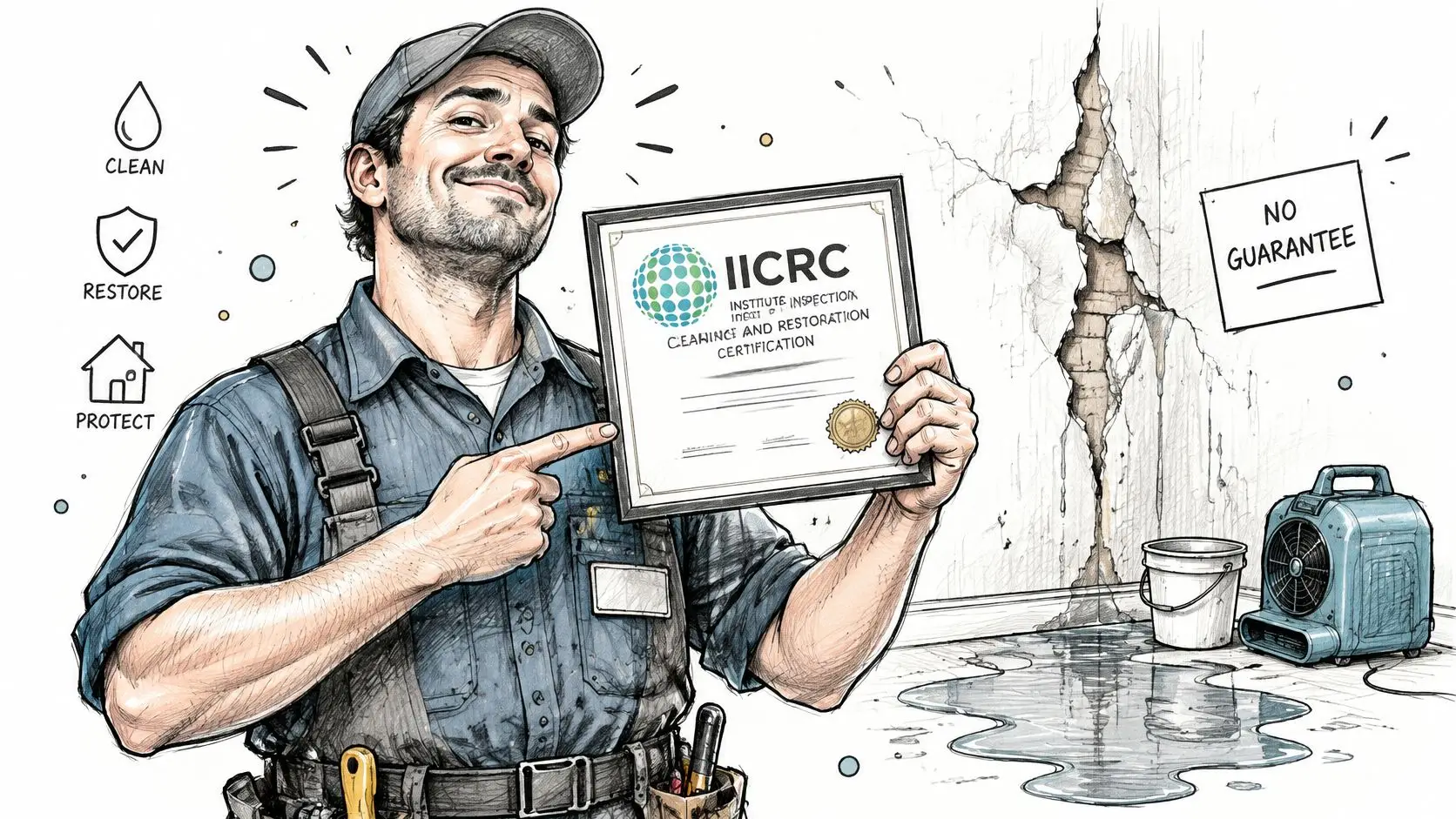
Where the badge stops
Say a certified water technician begins drying a flooded kitchen and discovers a mold-contaminated wall cavity. The water credential alone doesn't establish preparation for the newly identified remediation work.
The IICRC's professional framework supports standards-based practice rather than promises about a particular contractor's response time, insurance acceptance, price or outcome. Actual scope, timing, coverage and pricing depend on the property, damage, contract and applicable insurer or payer decisions.
Hiring takeaway: A useful badge still needs a named holder, a relevant specialty and written project commitments.
Treat unclear answers as a reason to request clarification before authorizing additional work. The goal isn't to collect the most impressive certificate; it's to establish who is qualified for the task and what the company has agreed to do.
A Flood Claim Walked Through Step by Step
A storm pushes water into your single-family home in a Phoenix suburb. You need to choose a restoration firm that day, but you can still ask focused questions without turning the emergency call into a lengthy interview.
At intake
You ask, Who will attend, what credentials do they hold, and is the business an IICRC Certified Firm? You photograph the affected rooms when it's safe, record when you discovered the intrusion and request an initial moisture map.
The inspection identifies wet flooring and an affected wall base. Before authorizing the proposed work, you ask which materials the technician expects to dry and which need further evaluation.
During extraction and drying
You request daily monitoring readings and a record of the equipment in use. Your question is practical: Which measurements show that these materials are getting drier?
Midway through the job, you notice a soft drywall section that remains damp. You don't assume it proves mold, but you ask whether the finding changes the assessment and whether a mold-remediation specialist is needed. If that specialty becomes relevant, you verify its experience and examination requirements rather than relying on the water credential.
At completion
Before equipment leaves, you ask, What documented evidence supports ending the drying process? You collect the completion explanation, final readings, authorized changes and written warranty.
Keep those documents together using a consistent approach to insurance claim documentation. Your insurer handles claim and coverage decisions; you direct questions about the restoration company's workmanship to that company. Separating those conversations helps you ask the right person for a specific answer.
Confirm Credentials Before You Sign a Contract
A sound hiring decision connects qualifications, project evidence and contractual responsibility. Don't choose solely by the number of badges on a website or the confidence of the person answering the phone.
Use this short checklist when comparing written proposals:
- Identify the person. Record who holds the relevant current credential and who will supervise your project.
- Check the business. Confirm firm status, licensing and current insurance documentation.
- Define the work. Obtain the scope, assessment records, completion criteria and warranty.
- Keep a project file. Gather photos, your insurance policy, the damage timeline and written answers from each firm.
Compare a local option on the same terms
We're IICRC certified, licensed, bonded and insured at Restore Heroes, serving homeowners throughout greater Phoenix and Rim Country. When evaluating a flood restoration company, apply the same credential and documentation checks to us that you apply to other providers.
We offer a free inspection and free onsite estimate, available 24/7 through our contact form or by calling 480-690-5277. An inspection can give you a clearer picture of the damage before signing a contract; it doesn't establish insurance coverage or promise a particular outcome, schedule or final price.
Contractor verification is useful beyond restoration. Aastro Roofing Company's guide to avoid roofing scams in Broward County offers a related resource for evaluating roofing contractors, though it isn't Arizona licensing guidance.
Compare the actual written answers, not just the sales presentation. A clear explanation of who will do the work and how completion will be documented gives you a firmer basis for deciding.
Restore Heroes offers a free inspection and onsite estimate to help you understand the damage and discuss an appropriate restoration plan. Visit Restore Heroes or call 480-690-5277 to request an assessment, and bring your photos, damage timeline and questions about the credentials relevant to your property.